Tell us about a time when you felt out of place!

Tell us about a time when you felt out of place!

I think it would be much easier to tell you about a time when I felt as if I was in my proper place. There were so few of them. As for the original question – Tell us about a time when you felt out of place – I think that a time should be replaced by the many times. Learning languages has always been more of a pain than a pleasure, for me, anyway. In the Basque Country, Northern Spain, at first with my parents, and then on my own. Sitting at the table or standing in the kitchen, listening to people chattering away in Spanish some days, in Basque, on other occasions. I was reduced to interpreting looks, smiles, scowls, meaningless sounds … how could I have felt that I was in my proper place? Etiquette – I knew nothing about their etiquette. Culture – I knew nothing about their culture and they knew even less about mine. I lived in a world where waves of sound battered at my body and I stood there, a rock on a seemingly deserted linguistic beach, being gradually worn down by the endless waves and the eroding tides. How could I have felt anything but ‘out of place’?

The same thing happened when I became immersed in French culture. I spent some time in the South of France, in an area where Provencal was still spoken. Between the two languages and the differing accents, I was lost, lost, lost.

Something similar happened when I came to Canada. Here, it wasn’t the language that baffled me, but the culture. I remember trying to learn to skate. My cousin played Junior “B” hockey and volunteered to teach me. Well, I learned very slowly (a) to keep my balance and (b) to move forwards very slowly. However, I couldn’t skate back wards and I couldn’t stop. In spite of that, I decided to try and play hockey. The park close to where I lived in Toronto had a frozen area where the little kids played shinny. I asked if I could join in. After three falls and a total inability to stick handle in any known fashion, they stuck me in goal. I used the goalie’s stick to try and stand up. After the third or fourth goal, one five or six year old whisked up to me, stopped in a sideways shower of ice, and said “Sir, please sir, you’re allowed to use the stick to stop the puck, you know.” I retired from ice hockey soon after that, and from skating. I did learn to cross-country ski, though. I also earned the name Wapiti (white-tailed deer) long before I saw one or knew what it meant.

And that is all just scratching the surface. I could say more, so much more. But I’ll control myself.

Monkey’s Clockwork Universe

Monkey’s Clockwork Universe


Some days, monkey winds himself up
like a clockwork mouse.
Other days he rolls over and over
with a key in his back like a clockwork cat.

Monkey is growing old and forgetful.
He forgets where he has hidden the key,
pats his pockets, and slows right down
before he eventually finds it
and winds himself up again.

One day, monkey leaves the key
between his shoulder blades
in the middle of his back.

All day long,
the temple monkeys play with the key,
turning it round and round,
and winding monkey’s clockwork,
tighter and tighter,
until suddenly the mainspring breaks
and monkey slumps at the table –
no energy, no strength,
no stars, no planets, no moon at night,
the sun broken fatally down,
the clockwork of his universe
sapped, and snapped.

Commentary:

I guess we normal human beings, not the monkeys who live in the Monkey Temple, think of this as a sort of mental and physical burn out. It can happen to anyone really. You don’t have to be a monkey. But if you live in a clockwork universe where you clock in at nine and clock out at five, and regulate everything – your eating, your breathing, your visits to the loo – by the tick of the tick-tock work clock, then I guess this can happen to you.

Escarmentar en cabeza ajena – a lovely Spanish proverb that means ‘to learn from the blows delivered to another’s head’. Much better to let this poor monkey teach you that yes, you have to take breaks or, like monkey, you will break down. You must learn to pace yourself, not to be put upon by others, and to look after yourself. Because, if you don’t, others will take advantage of you and push you to, and beyond, your limits. Don’t learn that lesson the hard way, by ending up broken, run down, and in hospital. Learn from monkey’s experience. Keep the key hidden. Don’t let other people see it, or steal it, or wind you up with it.

Life is hard enough anyway. Look after yourself first. And then you will be much better able to look after other people – especially your family and friends – when they need your help. A difficult lesson to learn, especially in this world of multi-tasking where too many people hold too many low-paying jobs and work long, long hours, day after day, just to make ends meet.

There is no escape from the clockwork labyrinth, you think. Alas, that too is true, all too often. But escape you must. Somewhere, Ariadne’s thread will lead you out. You must seek it, even in the darkness and the gloom. Once found, it will lead you out from the darkness and back into the light. And that is what we must all hope for and work for. Pax amorque – and blessings.

Clepsydra 14-15 – Clowns clowning around

Clepsydra 14-15
Clowns clowning around

14

… walking life’s walk
     grey jays in the ash tree
          fresh snow on the ground

at night
     deer track out of the woods
          moon’s dead skull
               chalking its slow path
                    westwards

snow falls
     white upon white
          whirling our world
               back to its cratered life

nothing needed
     other than moonlight on snow
          to ignite us

a white wall of water cascades
     earthwards from the moon
          waters of renewal
               waters of life
                    waters that restore us
and save us
     from the moonbeam’s slicing knife
          that amputates all life …


15

… it is scary tonight
     inside the topsy-turvy
          big-top of my circus world

carnival time
     clowns clowning around
          turning my life
               upside down

is my mind
     a spider-web
          spun by worry and doubt

I remember how
     they pushed me around
          kicked me out
               always the anonymous they

they abandoned me
     told me I was unwanted
          surplus to purpose
               forced me to exit

they told me to forget
     those amniotic waters
          that water world of comfort
               that illusion of reality
                     they had created
                          then threw me onto the street

    I left behind
          their stultified personalities
               with all their stupid rules
                    and blinkered minds
                         that stopped them
                              from seeing straight …

Absence in Presence

Absence in Presence

Just before her flight left,
she came up
from the basement,
her cleaning tasks
complete,
and smiled at me.

In the background, music,
a Golden Oldie,
the Rolling Stones playing
‘This could be the last time.’

Present in her eyes,
and in my heart,
the thought,
more than a thought,
the knowledge
that those words
might actually be true.

Carved In Stone

Carved in Stone

Brief Introduction

“Poetry explains itself. If it doesn’t, it’s inexplicable.” Pedro Salinas.

I entered this collection of poems for the Alfred G. Bailey Awad (poetry manuscript), WFNB, 2025. Alas, it did not win an award, but the judge, Kathy Mac, made some excellent suggestions as to how I might improve the manuscript. I have followed her advice to the best of my ability.

Carved in Stone is the second dialog (Chronotopos II) in my Bakhtinian Dialogs with my time and my place. Clepsydra, Chronotopos I, won third place in the Bailey Award (2025) and has already been published. I have one, possibly two, more Dialogs planned.

Reception Theory – I write, you read. Any meaning that you extract from my poetry will depend on your own culture and background. Tolle, Lege – Take and read. Read slowly, and with care.

I am a poet, a dreamer, if you will. These are my dreams. When you enter my world, you mingle your dreams with mine. The result, I hope, will be an interesting intellectual blend of new creativity. Pax amorque.

1

Behold me here,
filled with a sort of shallow,
hollowed-out wisdom
accumulated over decades
while listening with my eyes
to the words and thoughts
of writers, long-dead.

Imprisoned in book pages,
do they bang their heads
against walls that bind,
or hammer with their fists
at the barred lines
of their printed cages?

These spirits long to break free,
but they choke on library dust
and pollen from verbal flowers
that bloom unseen.

Those old ones avoided
the traps of temporal power,
or, once trapped,
gnawed off a precious limb
to limp into freedom.

Comment:
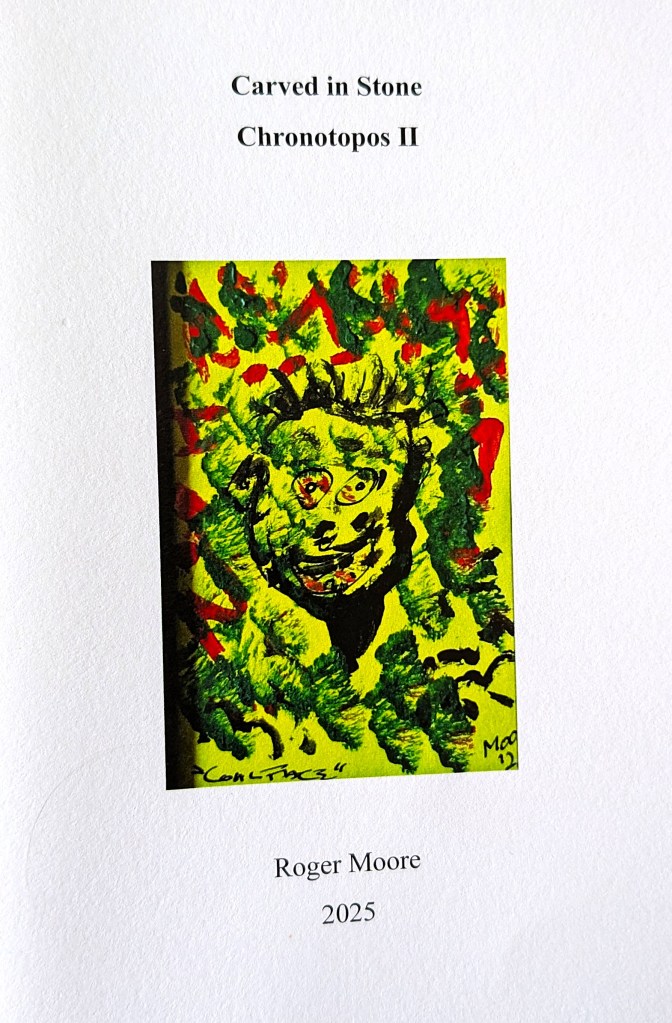
The cover painting, painted for me by my friend Moo when he read the manuscript of this book, is called Coal Face. It refers to the young Welsh boys in the Rhondda coal fields, aged 8-12 years old, who went down the mines to work at the coal face. This happened when the coal seams grew thin and only small children had the ability to work at the coal face and carve and mine the coal. Here are the relevant verses (44 – 45).

44

The old man, withered,
last house on the left,
leaning on his garden wall,
coughing, spitting up
coal dust and blood.

He’s not old, when you get close,
just grown old, underground,
where emphysema
and pneumoconiosis
devour men and boys.

He spits on the side walk.
Mining souvenirs,
Max Boyce calls them,
and they appear
every time the young man,
turned suddenly old,
starts to cough.

He can’t walk far,
wearing carpet slippers,
soft and furry,
just leans on the wall.

He fell, or was pushed,
into the trap at an early age,
when the coal seams
had grown so thin,
that only a small boy
could kneel at the coal face
before the black altar
of the underground god.

There, with a pick and shovel
he learned to carve and shape
those seams.

45

No candles burned at that altar.
A single match, let alone
a candle flame,
would spell the end,
if gas leaked from the seam.

Only the canaries,
confined in their cages,
sang songs.

Doomed,
like the blind pit ponies,
never to see the light of day,
they lived out their lives
down there.

So many died underground,
unable to get out,
buried alive,
before they were even dead.

What is your favorite form of physical exercise?

Daily writing prompt
What is your favorite form of physical exercise?

What is your favorite form of physical exercise?

As the arthritis gets worse and the pain grips more and more, I am not sure that I have any favorite form of physical exercise. Perhaps getting in and out of the whirlpool bath? Getting out after a half hour or so soaking, is easy enough. But getting in, after a couple of days without one – well, that can be a bit of a pain.

Then there’s getting up in the morning. That is exercise in itself. Hauling myself out of bed. Limping to the bathroom. Doing some s-t-r-e-t-c-h-i-n-g when I remember too. Painful to do, but I usually feel usually a bit better afterwards. Don’t forget the obstacle race of making it, half-asleep, to the bathroom during the night. Then there’s getting dressed in the morning and that’s always an interesting exercise. Sometimes I need help with socks, or shirt, especially after a bath. Shoes are always a wrestling match, as are shorts and jeans. What used to take me about 90 seconds, now takes closer to ten or fifteen minutes. Hardly aerobic!

And speaking of aerobics, physical exercise can also refer to anaerobic and an / aerobic with lactic acid build up. Lactic acid and the ensuing cramps have never been anyone’s favorite form of physical exercise, unless they are masochists instructed by a sadistic coach, as sometimes happens.

The stairs are always a great physical exercise. Easiest is walking safely downstairs in the morning. But there is always the fear of a fall, especially with the turn round the Newell post at the bottom. And then there’s climbing up again safely at night. That takes longer and longer, one painful foot lift at a time.

Cooking has become a physical exercise too. Peeling the vegetables and cutting them up can be quite vigorous. Standing at the stove cooking, gently stirring the food, that is good exercise, as is setting the table and serving the food.

But perhaps my favorite exercise is what the Abulenses call El paseo de la nevera. This is to get up, to walk to the fridge, and to grab another can of beer or open a new bottle of wine. Maybe that is my favorite form of physical exercise, that and the repeated elbow lift and flex that is necessary to drain the can or the bottle or the glass. And don’t forget, there’s always the pinch of salt and the over-the-shoulder salt throw, always necessary with this style of blogging, where everything you read should be taken with a large pinch of salt.

We’ll Rant and We’ll Rage …

We’ll Rant and We’ll Rage …

Spring is here. An election is near. Road repair season has started.

1. Spring potholes – they are terrible and they are everywhere.

It was so bad in one area of town that people filled them with water and put out little plastic yellow ducks to float on them.

That way they could be seen, which saved the loud clunk of them being heard and felt.

In one place, some street artist used the potholes as the centerpiece for porno pictures.

Success –  early next morning, the potholes had been filled in.

2. Spring road repairs – horrific – and all too abundant.

We have a sign at the bottom of road saying “Caution – Construction  – drive carefully for the next 6 kms.”

At the 1 km mark, a lollipop person with a STOP sign. 

Ahead of us, 24 cars – behind us, the traffic line up is building. 

We wait 15 minutes.

A white half ton appears, followed by a line of cars. 

The half ton pulls into a drive ahead of us.

We count the cars as they drive past.

99 of them. Then a pause.

The white half ton reverses out of the drive and pulls up in front of us.

On his tail gate a sign that says “FOLLOW ME”.

He pulls away, and the first car follows him, as do we all.

He drives at 10-15 kph.

After 1.4 kms, we see the road works – the actual working space is less than 200 meters long.

We keep driving. 

At the 3 km mark, the white half ton turns off, into someone’s drive.

Alas, the driver of the first car has no sense of humor and doesn’t follow the leader into the drive but sets off at speed down the road.

I count the cars that are waiting to return – 59 of them and more arriving.

It has taken us close to 25 minutes to negotiate 200 meters of road repair.

3. Bridge closures – there are three bridge crossings from the south side to the north side of the river.

One is at Mactaquac, over the dam, about 15 kms up stream from the Westmoreland Bridge, the central crossing point. 

The Mactaquac crossing has been reduced to ‘one way at a time’ traffic for the last two or three years, and will stay like that for most of the summer. 

Don’t ask, they won’t tell and I can’t tell, because I don’t understand.

The third bridge is the Princess Margaret. 

It is closed to all traffic for the next five weeks and this is the third year that someone has been working on it.

So, for the next five weeks, we are all reduced to crossing the river by one bridge, the Westmoreland, unless we drive 15 kms to a ‘one way at a time’ crossing or 20 kms down river to the Burton Bridge at the Town of Oromocto.

Rage, rage, against the dying of the light!
My thanks to my good friend, Dana Webster who inspired me to write this by sending me a rant of her own. NB Click here to link Dana’s Creative World.

Son Spots

Sun Spots

A painting and a poem dedicated to an only child who, in spite of all his achievements, was never good enough to earn the love of his parents.

Emptiness

The emptiness of air
          leaves the birch standing there,
framed by a space
          that will fill with chatter
and a flock of birds.

When evening comes,
          darkness frames the ash.
It sparkles
          with the gold dust of stars,
that swim through space.

Beneath snow’s empty page,
          grass and flowers root.
They will grow green tongues
          and rage next spring
at the coverlet
          keeping them in place.

A touch of warmth.
          Tiny flowers start to show.

What language do they speak
          as they spread their petals
and let fresh spring words flow?

My head fills with emptiness.
          My mouth is a silent space.

I sit and wait for words
          to break like sea waves
and create, who knows what,
          when they fill that empty place
within my heart and head.

Kipper Kapers

Kipper Kapers

Old Welsh Intelligence Test Question: “Does a kipper swim folded or flat?”

5-4-3-2-1 –
Time’s up, Ladies and Gentlemen.
So – what’s your answer?

Yes? No? Maybe? I don’t know?
It’s a trick question of course / wrth gwrs. And Kippers can play tricks on you too as they flipper and flapper, and flip and flop. Especially if you eat them late at night.

So this is a painting of a midnight Kipper Kaper Attack, when you want to sleep, but can’t, because you don’t know the answer to the kipper IQ test and all those little kippers are capering around and making fun of you and mocking you.

How do you avoid a Kipper Kaper Attack when the bad dreams start and the Kippers Kaper? Well, you answer this next Welsh IQ test question. “Adam and Eve and Pinch Me when down to the river to swim. Adam and Eve got drowned. Who do you think was saved?”

And if you answer “Pinch Me!” Then I will, and when I do, you’ll wake up, and you’ll be safe from another Kipper Kaper attack until the next time you eat them.

There – simple isn’t it?

Old Wounds

Old Wounds


“The slow wound
deepens with the years
and brings no healing.”

The Minister. R. S. Thomas

How deep time’s wounds
have cut and carved,
not just in flesh and bone,
but in the embers
of that slow-burn fire
 they call the heart.

Memory and mind
have also played their part.

Some days, those wounds
don’t ache at all.

But there’s no real healing,
and a moment of madness,
a knife-edged finger nail,
careless, in the dark,
opens them up again
to bleed afresh
and remind us
of the frailty of the flesh.

Comment:
The opening quote, from the Welsh poet, R. S. Thomas, made me aware of so many sad things that have happened in my life. Usually they lie dormant, asleep like an ancient volcano. Occasionally they erupt, and memory’s hot lava breaks through to the surface and spills like blood. Hard as I may try to control those moments, they are, in essence, uncontrollable. The scars itch. I scratch them with sharp finger-nails, and the old wounds open and bleed again.