Magnolia

Magnolia

She stands there, at the garden gate, waiting for me.
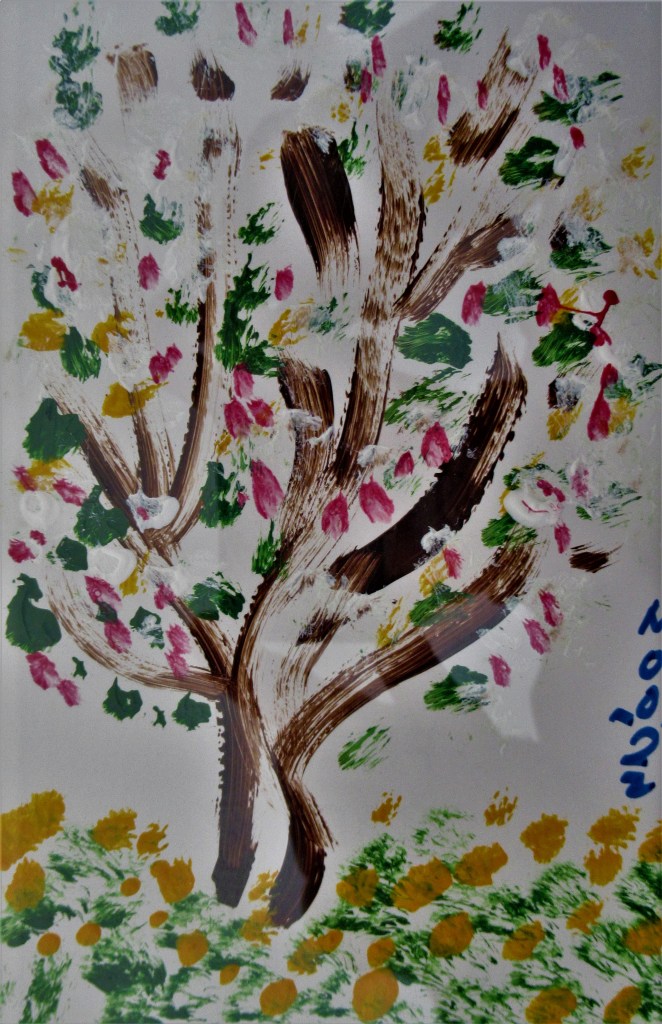
I can see the scene, the flower beds, the magnolia
bleeding, in Wales, its soft, spring snow of ivory pearls.

Some fall on her head, crowning her with a beauty
more precious than frankincense or myrrh. Petals
also perch their pure, ermine cape on her shoulders.

She walks towards me, eyes shining, arms open.
Then, the vision fades and she drifts away, leaving me
alone, my face bathed in the tears of her passing.

For pass each other by, we did. Ships in the night,
trains rushing through a tunnel of darkness, bathed,
for an instant, in the constellation of a station’s light.

Now, when I try to go back and to recreate that scene,
I find an empty garden, fallen leaves, and winter’s cold.

Comment:
I have been struck recently by the number of published articles that speak of post-Covid loneliness and the difficulties of re-establishing old friendships that fell by the wayside, let alone establishing new ones. It seems to get harder and harder, as we age, to leave our post-Covid isolation, to get out of our new comfort zones – sometimes so limited and limiting – and to make new friends. As we age, our minds go backwards and we return to earlier days and happier memories. Yet all too often those memories are tinged with the sepia sadness of old photos, from a non-digital age, faded and stained.

Who is the most famous or infamous person you have ever met?

Daily writing prompt
Who is the most famous or infamous person you have ever met?

Who is the most famous or infamous person you have ever met?

First, some definitions. What exactly does ‘met’ mean? I met you yesterday, for example. How long was the meeting? A nod and a passing of ships in the night? A stop and a handshake and a brief conversation? Or a genuine meeting of minds when people know each other reasonably well and can be considered ‘friends’? Infamous – that is relatively simple. Meanings, in my quick check, include – well known for some bad quality or deed, eg an infamous war criminal. Well, I have certainly never met any of those, not that I am aware of anyway. What does famous mean? Here’s one definition – famous implies little more than the fact of being, sometimes briefly, widely and popularly known. How wide is widely? How popular is popularly? Never mind. Let’s give it a go.

Brief encounters – I met several famous people briefly. Gento, from Santander, the Real Madrid soccer player and possibly the best winger of his time. John Charles, the Welsh soccer player, born in Swansea, and a good friend of my father. I met him once, briefly, in a Cardiff Street and my father presented me to him. Federico Bahamontes, the first Spanish cyclist to win the Tour de France. I met him, very briefly indeed, outside his bicycle shop in Toledo.

Longer encounters – these include the Spanish poet, Jose Hierro, who taught me Spanish, over three summers, in Santander at the UIMP. I also met Jose Manuel Blecua at that university and he introduced me to the poetry of Francisco de Quevedo. At the University of Toronto I had the good fortune to take courses from Erich von Richthofen, Geoffrey Stagg, Keith Ellis, J. H. Parker, and Diego Marin, each of them famous in their own way, with excellent academic reputations and publications. At Bristol University, I briefly met Jorge Luis Borges, whom I met again at the U. of T. a couple of years later. Academia and literature formed a happy blend in which to meet people who were famous within their own fields.

The same is true of the sporting life. While enjoying Cross-country running at Bristol University and while running for Bristol Athletic Club, I met Martin Hyman, Basil Heatley, Eddie Strong, John Boulter, and several other athletes of international renown. The same thing with rugby. Names that I can drop include Don Rutherford, Full Back for England and the British Lions, with whom I took a coaching course at Bisham Abbey. Welsh rugby personalities that spring to mind include Ray Williams, Billy Hullin, ‘Buck Rogers’, and several other luminaries of whom Alun Priday, Dai Watkins, and Elwyn Williams spring to mind.

But does any of this matter? I remember going to a poetry reading in Avila, Spain. This is what happened after the reading.

After the Reading

Many names were dropped and lay scattered on the floor.
Some of them broke. Others bounced back to their feet
and walked around stiffly, smiling unhappily.

Sugar and saccharine, unnamable sweetness, honeydew melon,
all lay on the ground, with empty shells, hollow metaphors,
accumulated clichés, vague imagery, the blanched bones of poets
that once wore life’s armour of grammar and blood.

When the cleaner came, she summoned a broom
and it swept away the remains:
dust without love, cigarettes butts and smoke,
nothing and nothingness, emptiness, empty nests, shadows of dreams,
living words, dead, now lying in a common grave.

The meaning of meaning – meeting and knowing, famous and infamous, names pulled from a hat like a rabbit and then dropped to the ground where they prick up their ears and scamper away. Yes, I have (briefly) met several famous people. But I know only a few really well. Sometimes, I wonder if I ever really met them, or knew them, and then I ask myself, did any of them know me, or remember me at all? Maybe that should be the larger question!
What historical event fascinates you the most?

Daily writing prompt
What historical event fascinates you the most?

What historical event fascinates you the most?

First, let us define ‘historical’. Here’s what I found – (1) of or concerning history. (2) concerning past events. (3) The historical background to such studies. (4) Belonging to the past, not the present. (5) Famous historical figures.

Now let us think of the number of times we hear on the TV sports shows that such and such an event is making history “right before our eyes”. Wow! In a boxing match, almost ever punch thrown is “an historical event”. Ditto rugby – with every try scored, every penalty missed, and every tackle made. Ditto soccer, basketball, baseball, athletics. So, from the battery of past events that adorn my life, I am being asked to choose “which historical event fascinates me most”. Double wow.

My answer – the day of my birth, about which I know absolutely nothing. Or, to be more specific, the actual action of being born, about which I know even less. So, how do I study the historical background, when no eye witnesses are left alive to assist me? More important, nobody in my family wanted to talk about such an important – for me at any rate – event.

I do have some factual memories – tales told to me later. I was born at exactly 8:00 pm. I know this because my parents’ dog had been left at a neighbor’s house while my home-birth was taking place. As the clock struck eight, Paddy, the dog, jumped straight through their window, and ran up the road towards the house that was now to be our house, barking. “Ah,” said our wise neighbor, “there goes the dog. That means the baby’s been born.”

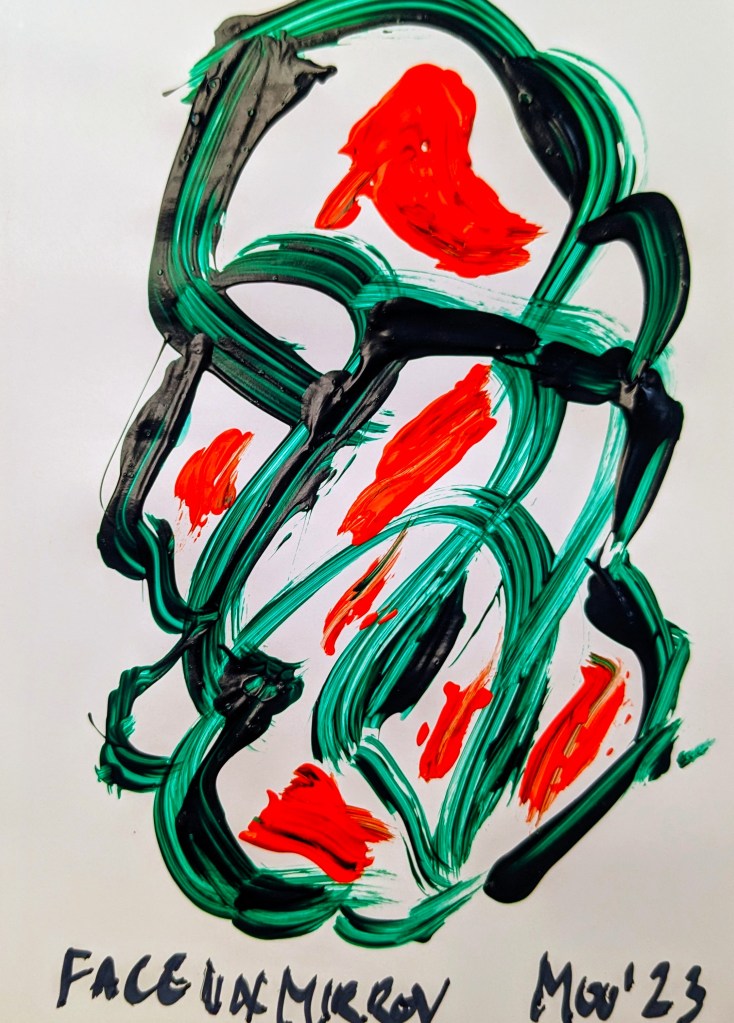
That is one version of the tale. My own version is the squawking of the stork who carried me, a sudden screech as he dropped me, a slow descent from a bright blue sky, a tumble down the chimney into the fireplace. And there I was. All covered in soot and ashes. I needed washing, of course. But baby, just look at me now. [See self-portrait above – Face in a Mirror].

My maternal grandfather swore that I had not been born at all, but found under a gooseberry bush. That would account for the green tinges in the painting. Apparently, all babies in South Wales were found under gooseberry bushes at that time. Unless they were delivered by the milkman.

And there’s many a tale about merry milkmen for, as they say in Wales, “It’s a wise man who knows his own father.” And I guess that is also a hysterical historical event about which I know nothing. But perhaps that’s why when the milkman who delivered the morning milk used to say “Good morning, son” when I met him at the the doorstep.

Come to think of it, the mailman also used to call me “Son” when he delivered the mail. Hmmmm – so did the butcher, the baker, and the candle-stick maker. Oh dear, so many historical events to choose from.

Rites of Passage

Rites of Passage

Summer slid silently away. Autumn’s
harvest is upon us. Slowly the mountain ash
is stripped of its fruit, from top to bottom.

Robins flit from branch to branch until
the whole tree shakes with bouncing birds
pouncing on the few remaining berries.

Berries gone now. Leaves will soon follow.
The Farmer’s Almanac forecasts a long, cold
winter, filled with wind, ice, and snow.

All too soon, the deer will appear, ghosting
their silent steps at wood’s edge. They’ll arrive
at dusk and wander all night, just to keep warm.

At dawn, they’ll leave, having exercised their
ancient rites of passage, the routes engraved
in their racial memory since the dawn of time.

When my time is up, I too shall follow them
into the lonely silence of that long, wintry night.
Restless, or at peace, I’ll hope for dawn’s light.