Carved in Stone 16 & 17

16

The Bulls of Guisando,
pre-historic, unweighable,
the bearers of Roman graffiti,
itself two thousand years old.

Were they carved as boundary markers,
or designed to designate pastures,
for horses, pigs, sheep, and bulls,
all grazing in their stone dreams?

Celtic, pre-Roman,
they speak to my Welsh blood,
and to the Irish soul
that will always be a part of me.

I place my hand
on the dimpled granite hide
and feel time coursing
beneath the stone skin.

Granite ships,
islands in a sea of time,
I sense a heart beating,
something surviving
within the stone.

17

We are powerful people,
we creative artists,
we carvers of stone,
we dreamers,
whether we dream
by day or by night.

Those of us
who dream by day,
often see our day-dreams
come true.

Commentary:

“Those of us who dream by day, often see our day-dreams come true.” Lawrence of Arabia – The Seven Pillars of Wisdom. You recognized the quote of course, wrth gwrs. Intertextuality, the weaving of words through text after text in different combinations according to our time and space. Some of us think we are original, but there are only so many plots to a play, 24 or so, if I remember my Aristotle correctly, and I have changed the number, just to test you. Oh ye of too much faith!

We think we are original, but, as Picasso said, the painters of the cave paintings, all those many years ago, created everything we artists could ever dream of. We all borrow in one way or another and originality is merely a disguised form of borrowing. The faces change, the actors change, the medium changes, the times change, but otherwise, everything else is the same. Sad, really, that we should claim originality (and fresh water) for all that water that has passed under so many bridges.

Welsh blood and Irish soul – not even original, but shared by so many in my family. Add an English education, studies and residence in Spain, France, Mexico, Canada, and the USA, and what do you have? An intellectual mongrel, that does not know its own mother, like so many other mongrels, and that shakes its coat only to shed so many multi-cultural and multi-lingual fleas.

And remember – “Great fleas have lesser fleas upon their backs to bit them, and lesser fleas have smaller fleas, and so ad infinitum.” Intertextuality – they were only playing leap-frog and one jumped over and another jumped over someone else’s back.

On Loneliness

Loneliness

58 What relationships have a positive impact on you?

I think one of my poems answers this question best. I write “one of my poems” but it is really my ‘free’ translation of one of Francisco de Quevedo’s sonnets – Retirado en la paz de estos desiertos. I have changed the poem slightly, but I am sure Don Francisco (1580-1645) will excuse Don Roger’s impoverished effort (2023).

On Loneliness
29 December 2023

Resting in the peace of these small rooms,
with few, but welcome books together,
I live in conversation with my friends,
and listen with my eyes to loving words.

Not always understood, but always there,
they influence and question my affairs,
and with contrasting points of view,
they wake me up, and make me more aware.

The wisdom of these absent friends,
some distant from me just because they’re dead,
lives on and on, thanks to the printed word.

Life flits away, the past can’t be retained.
each hour, once past, is lost and gone,
but with such friends, I’m never left alone.

And there are so many of those literary friends. I still read Rudyard Kipling and I have just finished Kim, Captains Courageous, Stalky and Co., Puck of Pook’s Hill, and Rewards and Fairies. I read these first when I was nine or ten years old, and I return to them regularly. Other friends include Garcilaso de la Vega, Fray Luis de León, St. John of the Cross, Quevedo, Góngora, Calderón, Miguel de Unamuno, Antonio Machado, various members of the Generation of 1898, the majority of the poets from the Generation of 1927… and these are just my Spanish literary friends. I have French friends, English friends, Anglo-Welsh friends, Canadian friends, Mexican friends, and, in translation, many, many more. My relationship with each of these friends has had an impact upon me.

A recent painting, by my friend Moo, is called Fiat Lux – Let There Be Light. It is reminiscent of Dylan Thomas’s poem, Light breaks where no light shines. Intertextuality – Quevedo drew inspiration from the Stoics. I drew inspiration from Quevedo. Moo drew inspiration from Dylan Thomas. The nature of creativity, and its continuing links throughout the ages, shines clearly through these wonderful associations. Long may they continue, and may others enjoy them and be influenced by them as much as I have.

Comment:
The funny thing is that I do not remember writing this blog prompt, nor do I remember having translated Quevedo’s poem into English. I wonder how many other forget-me-nots there are out there. Or, to be more precise, in my books and in my notes. A treasure trove – that’s my guess. Borges wrote of Quevedo that he was more a library than an author, and I am beginning to think that way about my self. A strange world, this, one in which the creator abandons, and then forgets, his creations. Perhaps we should change the image – not so much a library as an orphanage, and so many lost and abandoned orphans wandering around The Little World of Don Rogelio.

The Book of Everything

Discourse Analysis
and
The Meaning of Meaning

Words have dictionary definitions that allow us to agree on what they mean. In this fashion, when I say ‘my grandmother’, you automatically know that I am referring either to the mother of my mother (maternal grandmother) or the mother of my father (paternal grandmother). This is the dictionary meaning of the word ‘grandmother’.

But words have lives of their own, and their meaning changes when used by individuals. You, the reader, never knew my grandmothers. You never will. They both passed away a long time ago. I loved them both, but for very different reasons, and to me they were as different as different can be.

This means that when you, the reader of these words, reach the word ‘grandmother’, the faces you see, the emotions you feel, the memories conjured up by that word are totally different from mine. Same word, same dictionary definition, different personal memories, experiences, relationships. In addition, the role that our grandmother(s) played in our lives will be very different too. That role may vary from culture to culture, from language to language, and from the social structure of the changing society in which we live.

For example, when I first went to Santander, Spain, I visited a family who lived in a large, detached house that contained three generations of the family – grandmother and siblings, father and mother, grandchildren, and an assortment of aunts and uncles. No need for babysitters in that household. Everybody had a vested interest in the development of the young ones and the older ones received tender, loving care, twenty-four hours a day, every day of the week.

I lived from time to time in the same town as my own grandparents. I saw them regularly, but rarely on a daily basis. When my parents sent me to my first boarding school, age six (if I remember correctly), I lost contact with my family. My paternal grandfather died when I was away at school. My maternal grandmother died while I was away at school. My paternal grandmother died when I was living in Spain. My maternal grandfather died when I was living in Canada. Alas, after those early years, I scarcely knew them. My experience, then, was so different from that of other people.

When I moved to Canada, the Atlantic Ocean separated me from my parents. My daughter, born in Canada, grew up with no close knowledge of her grandparents. The word ‘grandmother’ did not mean the same to her as it did to the grandchildren in Santander, or to me. How could it? All those miles between the families, and visits limited to a couple of weeks every other year at best. Although the dictionary meaning is always the same, what a difference in the emotional meanings for each person using that word.

Discourse Analysis, the way I use it, builds not on the dictionary meanings of words, but on their emotional and personal resonance. I take the standard, dictionary meaning of words, twist it, look for meanings at different levels, and then build an alternative narrative on that changed meaning. I have great fun doing so.

Part of that verbal fun comes from my childhood. I listened to Radio Shows like The Goon Show and Beyond Our Ken. Giles’ Cartoons gave my names like Chalky White, the skeletal school teacher, or Mr. Dimwitty, a rather dense teacher in another school. These shows also twisted the meaning of words and drew their humor from such multiple meanings. The Goon Show – “Min, did you put the cat out?” “No, Henry, was it on fire?” Or on an escaped convict – “He fell into a wheelbarrow of cement and showed every sign of becoming a hardened criminal.” Or from Beyond Our Ken – “My ear was ringing. I picked it up and answered it. ‘Ken here, who am I speaking to?’ ‘Larry Choo.’ ‘Ah, Choo.’ ‘Bless you, Ken.’ Verbal scenes like these – it’s hard to get visual pictures from listening to the radio – remain engraved in my memory banks. More than engrained, they become part of the verbal system from within which I write.

This system includes Direct Discourse, Indirect Discourse, and the Twisted Discourse of an Inventive Mind that still wishes to create. It also comes from Francico de Quevedo’s Conceptismo, from Ramón del Valle-Inclán’s esperpento, and from certain aspects of Albert Camus’s Theory of the Absurd, all blended with the poetry of Jacques Prévert and the songs of Georges Brassens. This from the latter – “Tout le monde viendra me voir pendu, sauf les aveugles, bien entendu.” Everyone will come to see me hanged, except the blind of course.

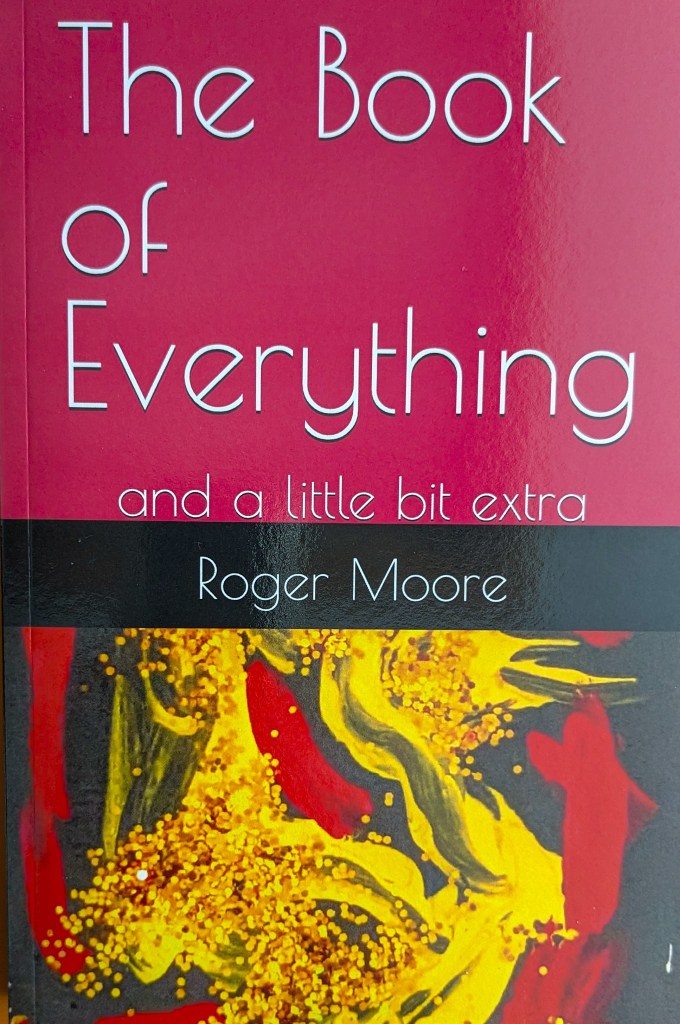
This is not always easy humor, nor is it a comfortable way to see the world. But it is a traditional one with a long literary history. The title of my book goes back to Francisco de Quevedo, of course, who, in 1631, in Madrid, published El libro de todas las cosas y otras muchas más / The book of everything and a lot more things as well. Don Roger turns to his good friend Don Francisco whenever he needs a helping hand.

The pieces themselves were first published on my blog rogermoorepoet.com. They have been revised, and I have added some more pieces in a similar vein. Tolle, lege – Take and read.  Above all, enjoy this world of mine, with its subtle and not so subtle humor, its sly digs at many of our follies, and its many forms of creativity.

The Book of Everything
and
a little bit extra

Click on the title to purchase this book.

Silence

Silence

Pain stops at the edge of silence
and silence is the sound of sunlight
breaking against the walls of the room
in which I sit and listen, in silence,
waiting for the notes to begin again.

Silence, yes, yet my silence lies broken
by the renewed intrusion of the clock,
by the electric hum from lights and heating.

Ghostly noises break into my thoughts:
cheers from a distant tennis court,
those eternal advertisements
that invade my innermost being.

What triviality now shatters
the Messiaenic mood that wrapped me
for a moment in a many-colored cloak
woven from musical oblivion.

Time’s teeth start to gnaw again
and the grandfather clock
nibbles at my soul, extracting
its essence in a surge of sound,
tick-tock, tick-tock.

Westminster Chimes choke
life from the hour and ring
the tick-tock knell that files
my life away, second by second,
minute by minute, day by day.

Comment:

Silence is the fifth poem in the first sequence (Crystal Liturgy) of my poetry book Septets for the End of Time.

“So,” said Moo, “today I offer this painting where the title, Sound of Silence, fits well with the title of your poem. That said, I am not sure that the painting itself, qua painting, is as suitable as earlier pairings. De gustibus non est disputandum / there is no arguing about taste. I guess you either like something or you don’t.”

“It certainly isn’t in your usual style. In fact, it looks more like a colored pencil sketch than a painting. Where did you draw the title from?”

“Actually, it’s from one of your poems about Avila, in Spain, the city where, or so they say, you can hear the silence. You complained about all the noise that you found, especially the church bells, in that otherwise silent city.”

“Ah yes. I remember that poem. And I’ll never forget the sound of the bells echoing from wall to wall in those narrow, medieval streets. Bells from all the churches inside the walls of the city, tolling at exactly the same time, calling the faithful to prayer.”

“And that is one of the differences between us that I mentioned yesterday. My paintings, whatever they depict, are always silent. I have heard you read your poems out loud on Spotify and I have also heard other people reading them on your behalf, not always successfully. Poetry is designed not only to be read silently, but also to be read out loud, before an audience. Painting, on the other hand, is always silent. It does not speak, nor can it be heard. A painting is just there, in two dimensions, powerful, if you are lucky, weak and wobbly if the artist does not fulfill his task.”

“Interesting, dear Moo. And the images that I draw from Messiaen’s music are interesting too. For musical notes, without words, change into images within the listener’s mind, and then, when heard by the poet in me, become verbal images upon the page. Fascinating.”

“It is. Some time soo we must talk about intertextuality, the ways in which one artistic form or text can influence another. Hopefully, you’ll find a poem and I’ll find a painting that illustrate just that.”

Transitions

Transitions

Modes of limited transitions,
moods of time tapped in time
to time’s rhythmic piano.

Scales fall from my listening eyes
and all-seeing ears.
A transitory awakening,
this glimpse of the composer’s vision,
each note a new version
extracted from abstracts
perceived in color,
each note a hue, and chords
a rainbow spectrum of light
glimpsed darkly through
the raindrop’s distorting lens.

Birdsong and sunshine.
Notes perched
on the matinal branch,
each in tune with the other,
at times in seeming discord,
yet the morning chorus
diluting the day
with the liquidity
of light and sound.

Comment:

Transitions is the fourth poem in the first sequence (Crystal Liturgy) of my poetry book Septets for the End of Time.

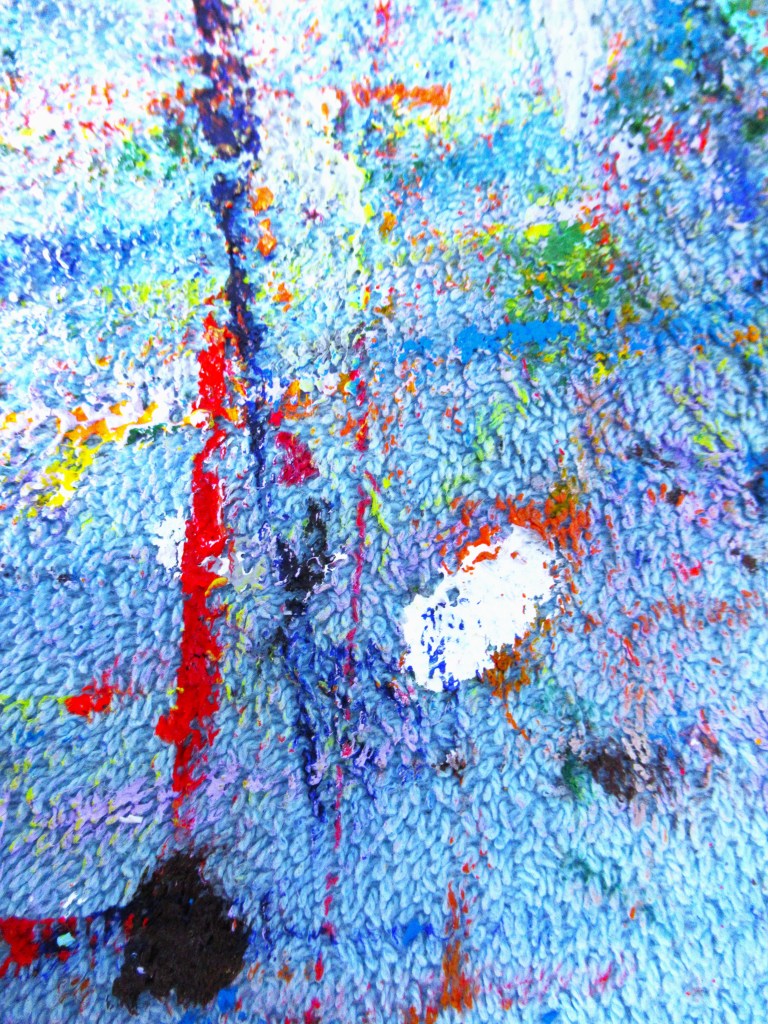
“How on earth did you create that painting?” I asked my friend Moo. “And how do you relate it to this poem?”

“Good questions,” Moo replied. “Difficult to answer, though.” First of all, this is not a painting. It is the background cloth, always changing, always in transition, upon which I create my post card paintings. The idea of transition summarizes the movement from paint, to brush, to painting, and the haziness of the creative moment. It relates directly to your lines ‘Scales fall from my listening eyes / and all-seeing ears.’ This is the point in time, the magic moment, when the painting declares itself. I assume you have the same moment when you write poetry.”

“The two processes are very different, I think. In my poetry, a thought leads to a verbal image, and then each of the words turn themselves into little worlds in which verbal gemstones appear. I try to catch those verbal gemstones and to transform them into poetry. If I listen carefully, then my ears see and my eyes hear the words forming themselves into the right order.”

“Interesting. And yes, that’s what happens in my painting too. The initial mood captured in that first color, and then the minor moods that emerge from the first one gradually woven into the painting.”

“That is somewhat similar to how I write – by listening to the words and doing what they tell me to do. Then I do what they want me to do, not what I want them to do.”

“Fascinating. But there is one huge difference between us.”

“What’s that?”

“I’ll tell you next time.”

Prompts and Impromptus

Prompts and Impromptus

The creative process is different for each one of us. I think of three different creative modes.

The Quarry and Treasure Trove – I write in my journal every day. I have done so for nearly forty years. For me, it is a treasure trove of creativity and I can return to it anytime I want to to revive old memories and to research old moods. I think of it as a quarry that contains valuable images and metaphors that can be used in different ways to create and recreate. I also find that, as I journal, I distinguish between that which is mere dust and ashes and can be abandoned, and that which is a genuine gemstone that can be polished and published. Writing regularly helps me to distinguish between the commonplace and that one piece of gold that emerges.

Impromptus – Some people, like the cat above, wait patiently for inspiration to come. Sometimes it does, sometimes it doesn’t. When it doesn’t, they blame Writer’s Block or something similar. While you can sit and wait for inspiration, using the methods outlined in The Quarry and Treasure Trove you can ‘go out and make things happen’. Seek and you will find. Knock and it will open. Now that’s inspiration for you!

Prompts – The creative writer can also use prompts. I have used those that appear in Word Press, but only in sporadic fashion. I do not use them everyday. In fact, I have been a bit down and otherwise engaged recently, and my visits to social media have been very limited. I apologize to my friends – we few, we happy few, we band of siblings.

One of my best friends has been helping me through this rough patch. She has been putting together a book of creative prompts. She converted that into a webpage called  judyandco.com and I highly recommend her work to anyone who, like me, gives up the ghost for a little while, and then wishes to regain the creative spirit. As she wrote to me only this morning – “there’s a bunch of free stuff on there” -.

So, for those who need a kick start for their creativity, try clicking on  judyandco.com – I am sure you will find inspiration there.

Who are your favorite people to be around?

Daily writing prompt
Who are your favorite people to be around?

Who are your favorite people to be around?

Creatives – because creative people need support in their creativity and need to believe in themselves and in their creations. I wrote two days ago about Rejections and Silence – while both are needed by creatives – rejections to help perfect and polish – and silence in which to create – too many rejections and too much silence can result in alienation, depression, and the suppression of creative acts.

“We few, we happy few, we band of siblings!” Not quite what Harry said before the Battle of Agincourt, yet can we, the readers, be absolutely certain that what Shakespeare said he said was actually what he said? But we share the spirit of creativity with creators big and small, famous, infamous, and struggling. That is why we need to band together, to support each other, and to ensure that creativity isn’t killed by the straitjacket of a nine to five job, or longer, or the multi-employment that has become so necessary just to survive in our diminished and diminishing world.

“What is this life if, full of care, we have no time to stand and stare?” wrote W. H. Davies, one of the great Welsh poets. And he concluded this poem with a parallel couplet: “A sad life this, if full of care, we have no time to stand and stare.”

I hope you like the painting that heads this prompt that is turning into a joyous rant. It is by one of my creative friends, the poet-painter Moo. He calls it Spotted Coppers and he painted it last night after watching the Midsomer Murders episode that dealt with the theft of valuable Spotted Copper Butterflies. Intertextuality – one text leads to another, and the butterfly becomes a TV episode becomes a painting by a friend becomes a rant prompted by my computer and written by me.

That is the circle of creativity and it blends into the circle of friendships, and creative artists are both competitors and friends, for “whether creativity survives or no, I’m sure is only touch and go.” Another line that another great Welsh poet, this time Dylan Thomas of Swansea, might almost have said.

So, who are my favorite people to be around? Creative people, of course, with all their passions, energy, warts, flaws, and their constant need of encouragement and support.

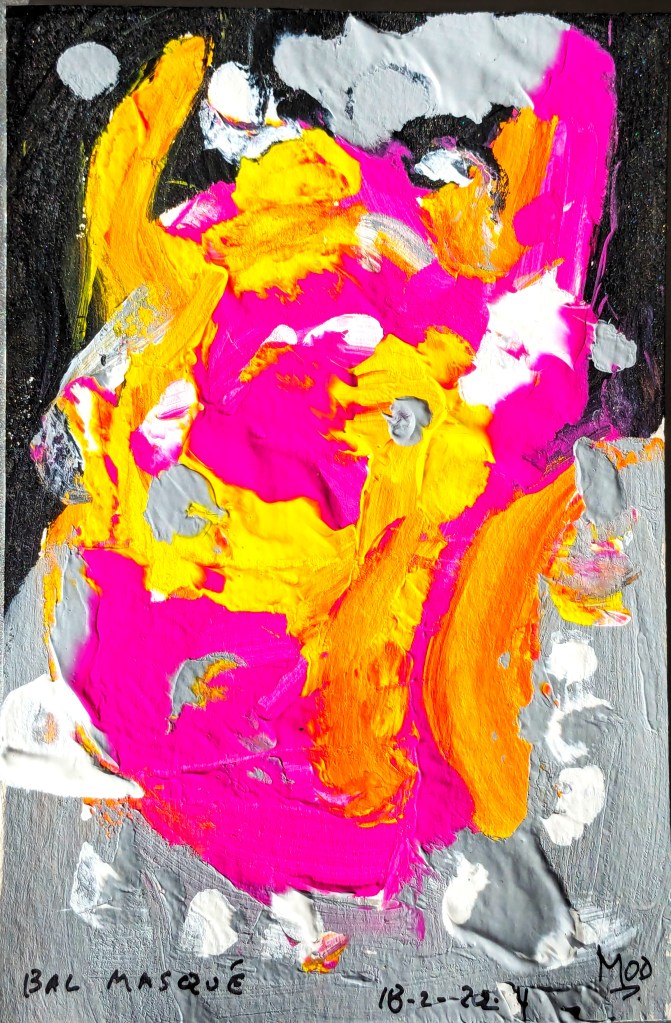
A Masked Ball

Masked Ball

After a two-week lay-off, the Dance of Colors returns. What caused the lay-off? Absolutely nothing. I grew tired of posting, of writing, of throwing my paint on the waters of the web and waiting to see what, if anything, happened. Well – nothing happened.

Steven King, On Writing, says “Paper your walls with rejections.” And I have done, pages and pages of them. The secret is ‘never surrender’ – ‘never give up’ – or, in the language of the WWII Prisoner of War Camps – Nil carborundum illegitimi. You can Google the meaning, if you can’t read Latin. It is a euphemism for ‘never despair’.

Rejection is one thing. Silence is something else. When I check my notebooks I find submissions, some sent several years ago, that are still unanswered. There is simply no response. It is as if the writer – submitter – does not exist, is not even worthy of a form letter.

I ran into that wall of silence during this two week lay-off. Does it matter? Probably not. The creation of art is as much a monologue as it is a dialogue. Bakhtin calls it ‘a creative artist’s dialogue with his time and place.’ I think of it as ‘this creative artist’s monologue with his time and place.’

Footsteps – I leave them here, I leave them there, you can find those footsteps anywhere. But beware the footsteps left on the beach at low tide. You will not find them on the beach the day after you leave them. The tide will have risen and washed them all away. In spite of that, some footprints are here to stay.

What relationships have a positive impact on you?

Daily writing prompt
What relationships have a positive impact on you?

What relationships have a positive impact on you?
I think one of my poems answers this question best. I write “one of my poems” but it is really my ‘free’ translation of one of Francisco de Quevedo’s sonnets – Retirado en la paz de estos desiertos. I have changed the poem slightly, but I am sure Don Francisco (1580-1645) will excuse Don Roger’s impoverished effort (2023).

On Loneliness
29 December 2023

Resting in the peace of these small rooms,
with few, but welcome books together,
I live in conversation with my friends,
and listen with my eyes to loving words.

Not always understood, but always there,
they influence and question my affairs,
and with contrasting points of view,
they wake me up, and make me more aware.

The wisdom of these absent friends,
some distant from me just because they’re dead,
lives on and on, thanks to the printed word.

Life flits away, the past can’t be retained.
each hour, once past, is lost and gone,
but with such friends, I’m never left alone.

The painting, by my friend Moo, is called Fiat Lux – Let There Be Light. It is reminiscent of Dylan Thomas’s poem, Light breaks where no light shines. Intertextuality – Quevedo drew inspiration from the Stoics. I drew inspiration from Quevedo. Moo drew inspiration from Dylan Thomas. The nature of creativity and its continuing links throughout the ages shines clearly through these wonderful associations.

Fake News!

Fake News!

A long time ago, wrapped in the stifling chrysalis of academia, a friend of mine tried to flutter her wings by making a joke at a very serious conference. She was delivering a paper on one of my favorite Spanish poets, in which she examined the sundry variants of a sonnet that the poet first wrote in 1603, then re-wrote in 1613, revised again in 1627-28, and revised a couple more times before its final revision in 1643, about two years before his death (1645).

At the end of her paper, she was caught off-balance when faced by an apparently serious question from the audience “Did the poet make any more revisions after 1645?” In an effort at humor, she replied, “Well, actually, no. But when they were carrying his body to the church for the funeral, he popped his head out of the coffin and proclaimed in a loud voice ‘Hell, no, I won’t go. I haven’t finished revising the poem yet.’”

This off-hand academic pseudo-joke was greeted with a babble of excited voices and an elderly fellow scholar clapped his hands, exclaimed “Wonderful!” and, in the ensuing silence, asked her what documentary evidence she had for this astonishing revelation, hitherto unknown to the academic world. If she was off-balance before, she was clearly reeling at this stage: a punch-drunk amateur academic swaying before the hypnotic fists of Dr. Muhamad Ali. She smiled sweetly, said she would produce the proper evidence at the appropriate time, and left the podium.

Later, sharing drinky-poos with the some fellow scholars, I listened to her as she made excuses for her strange sense of humor and I smiled as she explained the situation to them. They were not amused. “You, madam, are an acknowledged expert in your field,” one of them told her. “Your fellow academics trust you and believe you when you make such statements. You must be very careful about what you say.”

Fake news, indeed!

Now I must make an apology on my own behalf. Alas, if you read one of the blog items I posted recently, you might be puzzled by the Gazunda tree. I am forced to admit there is no such thing, to the best of my knowledge, as a Gazunda tree, not in the main square in Oaxaca, nor anywhere else in the world. Of course, when it rains people have been known to go under certain trees to use them as an umbrella and thus to take shelter from the rain, but this is the full extent of the origin of the name: the tourist or the golfer or the walker or whatever goes under (say it fast — Gazunda) the tree when it rains. There is nothing more to the Gazunda tree than that little joke.

And this brings us to a really serious series of questions: how do we know things are true? How do we establish the truth of a statement? Why do we believe some people and not others, some facts and not others? How do we choose between a series of alternate truths all of them presented as factual realities when, in actual fact, not all of them are true? This leads us on to the basic foundations on which our knowledge is built: how do we distinguish between scientifically established facts, and hearsay, and gossip if we are ignorant of basic scientific knowledge and principles?

To this we must add the triple increases that threaten us. These are (1) the increase in the availability of real scientific knowledge that bombards us every day with fresh facts and new information; (2) the increase in sources of information and the easy access to those sources; (3) the fact that many of these sources, far too many in my opinion, present us with a fictional or heavily biased version of a pseudo- or alternate truth. And yes, in light of telling the truth, the whole truth, and nothing but the truth, we are indeed entitled to question the existence and indeed the very meaning of these words: truth and alternate truths.

Such questioning is present in the writings of some of the early-modern philosophers. This is exemplified in the following passage that comes, I think, from René Descartes:

“There is no earth, no heaven, no extended body, no magnitude, no place and that nonetheless I perceive these things and they seem good to me. And this is the most harrowing possibility of all, that our world is commanded by a deity who deceives humanity and we cannot avoid being misled for there may be systematic deception and then all is lost. And even the most reliable information is dubious, for we may be faced with an evil genius who is deceiving us and then there can be no reassurance in the foundations of our knowledge.”

“There can be no reassurance in the foundations of our knowledge.” These are chilling words and present us with the unfortunate fact that unless we ourselves, each one of us, to the best of our abilities search out the absolute truth about all we hear, say, and do, we are indeed lost and we must wander in the dark with no light to guide us. ‘A sad life this, when beneath the axe, we have no time to check our facts.’