Carved in Stone 45

Carved in Stone

45

No candles burned at that altar.
A single match, let alone
a candle flame,
would spell the end,
if gas leaked from the seam.

Only the canaries,
confined in their cages,
sang songs.

Doomed,
like the blind pit ponies,
never to see the light of day,
they lived out their lives
down there.

So many died underground,
unable to get out,
buried alive,
before they were even dead.

Commentary:

“Only the canaries, confined in their cages, sang songs.” Yet the miners often sang, in their own cages, as they were lowered down from pit-head to seam. It wasn’t the songs that worried them, it was the silence. The men could rarely smell the gas, but when the canary stopped singing and toppled from its perch, then the men knew that bad news hounded their heels. As for the pit ponies, how did one get them out? Some of those mines, had been dug 5,000 feet deep and two or three miles out to sea. A pit pony should never be confused with a sea horse, and as for the white horses that surge in the waves in so many paintings, well, pit ponies need to be laundered before they can compete.

“Good-bye old friend.” I remember the photo from WWI of the dying horse, surrounded by crying men. The suffering of the animals is what men feared and pitied most. The animals are innocent. They do not ask to be sent underground, nor to be sent to war. They have no choice, poor things. So sad, when a dear, four-footed friend dies, so far away from the light of the sun. As for the men, there were no “safe rooms”, those reinforced rooms filled with food and water, not in the early days, anyway. A camaraderie, yes, but not many people went down to the mines willingly. Rita MacNeil summed it all up in her wonderful song that begins ‘It’s a working man I am.” – How many people, if they ever saw the sun, would ever go back underground again.”

Carved in Stone 44

Carved in Stone
44

The old man, withered,
last house on the left,
leaning on his garden wall,
coughing, spitting up
coal dust and blood.

He’s not old, when you get close,
just grown old, underground,
where emphysema
and pneumoconiosis
devour men and boys.

He spits on the side walk.
Mining souvenirs,
Max Boyce calls them,
and they appear
every time the young man,
turned suddenly old,
starts to cough.

He can’t walk far,
wearing carpet slippers,
soft and furry,
just leans on the wall.

He fell, or was pushed,
into the trap at an early age,
when the coal seams
had grown so thin,
that only a small boy
could kneel before
the coal black altar
of the underground god
and, with a pick and shovel,
he learned to carve and shape
the long, slow death
contained in those seams.

Commentary

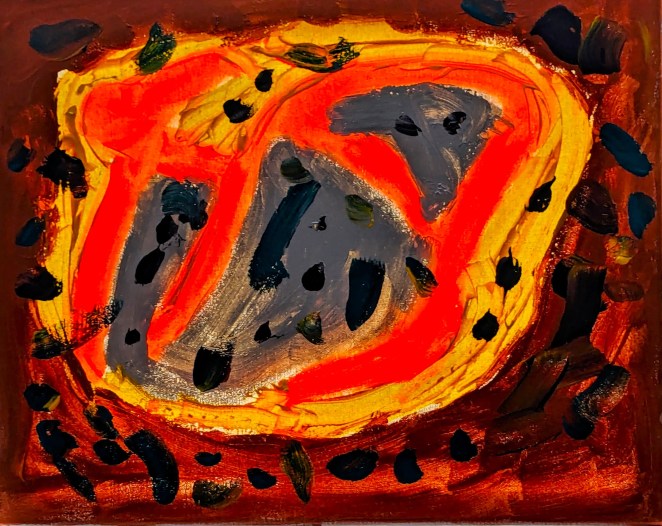
Moo’s painting, Coal Face, adorns the front cover of Carved in Stone, Chronotopos II. Coal Face is not the denigration of Black Face, white men pretending to be black by dyeing their faces, although they have some similarities. In Welsh Mining, the coal face is where the men used to dig when, with their shovel and their pick and their little lamp and wick, they knelt to dig out the coal. Knelt, because there was no standing room, deep down underground. Then, when the seams grew thinner, and the men could no longer reach them, the young boys were sent underground.

A day underground left men and boys with coal dust seamed into their bodies, especially their hands and their faces. Hence the triple meaning of black face – where the coal is dug, what men and boys looked like after a day’s work, and the blackening of their faces by white men, for the fun of it.

Faces are one thing, coal dust in the lungs is another. The result – emphysema and pneumoconiosis devour men and boys. Black lung, some call it. “And every time he coughs, he gets a mining souvenir” – a black spot coughed up on the sidewalk – Max Boyce.

Child labor, minimum wage, living wage, work that kills, slowly and silently, – what can I say? Forgive me, for I can say no more.

Carved in Stone 43

Carved in Stone
43

Back home, in that little cul-de-sac,
the husbands are away,
working their night shifts,
while the wives are at home,
entertaining the truckers,
those long-distance drivers,
who park in that street and lodge there,
overnight, in the houses.

The children, boys and girls,
go out into the street,
climb into the trucks,
duck under the tarpaulins,
and, with all of us sworn to silence,
practice what their elders
are doing back home.

Commentary:
Monkey see, monkey do. And who knows what Monkey sees or does when the lights are turned out, darkness descends, and the honor of the blood cult takes control. Ask the animals, they will teach you. That was the motto of Bristol Zoo, where the Monkey Temple ruled, and Alfred the Gorilla and Rosie, the Elephant, were King and Queen of the beasts.

Knowledge – where does it come from? How do we attaint it? Is there a difference between knowledge, what is known, felt, and worked out for yourself, and education, when you obey orders and do what you are told to do (and how to do it). “We don’t need no education, we don’t need no thought control.” I have always loved Pink Floyd and The Wall. So many walls, so many barriers, so many things to break down in order to build them up again. Songs – Frank Sinatra – “I did it my way!” And who teaches what and to whom, underneath the tarpaulin when the lights are out? “Hey, teacher, leave those kids alone.”

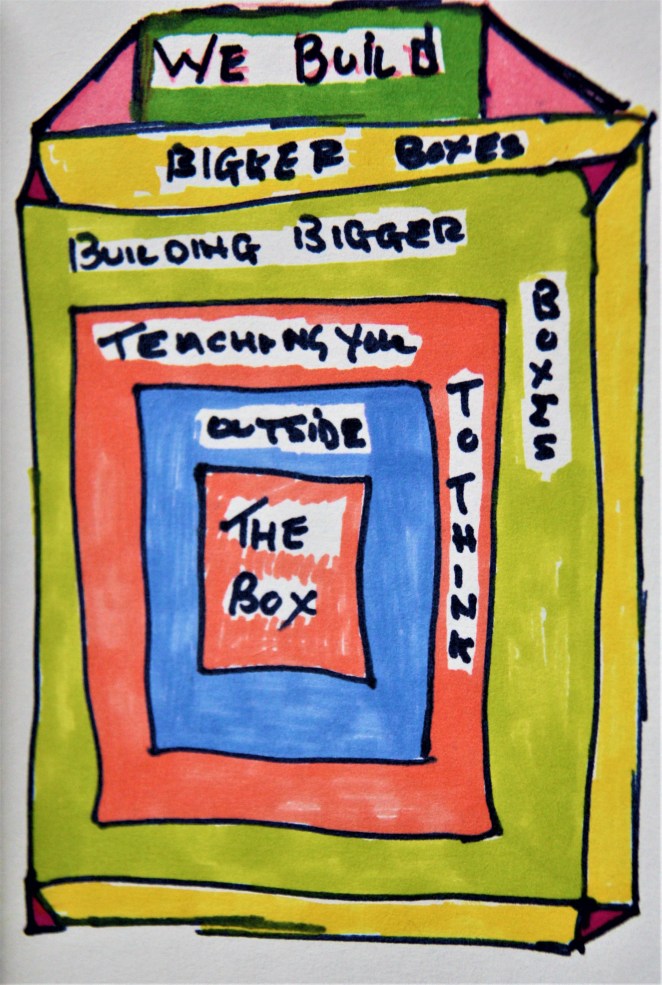
And beware of anyone who tells you that “we teach you to think outside the box.” That person will only give you a slightly bigger box, of his or her own making, inside of which you will be forced to think.

Of course, there are other ways in which we can think about education. How about this one? Filling empty heads with knowledge. How many ways are there to do this? And what is the exact content of the jug from which the knowledge will flow? And how many sows’ ears does it take to make a silk purse? “Hey, teacher, leave those kids alone.” Giddy up, Neddy I’m on my hobby horse now.

Carved in Stone 37

Carved in Stone
37

A great blue heron,
half-buried in the sand,
lies, covered in flies.

What words could I carve
in sand beside his grave?

What words would I carve
on mine?
What could anyone say?

I guess I could say
that I was happy,
in spite of the pain,
but would I do it
all again?

Commentary:

I guess I could say that I was happy, in spite of the pain, but would I do it all again? – Good question, and I have no answer to that question. Is life circular? Do we pass on from existence to existence, learning as we go? Some religions think so. Do the participants and believers have a choice? That I do not know.

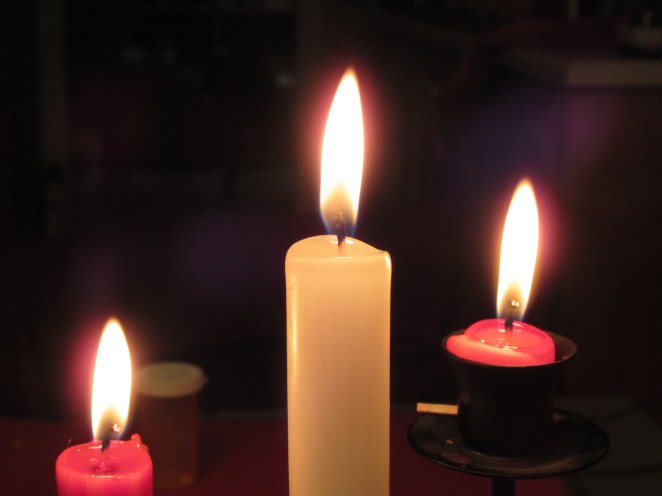
Would we, like the English cricket team currently in Australia, make the same mistakes again and again, never learning from each dismissal, never learning from the blows given to another’s body or head? All good questions. Or would we learn from each life, each circumstance, slowly ascending a sort of Platonic Ladder until we climbed to the highest level of perfection? Who knows? I most certainly don’t. Nor do I know where the light and the flame go when I blow out the candle.

So many mysteries, as the fate of my little bird was a mystery, as the fate of the fish in the first photo was also a mystery. Albert Camus – meurtriers ou victimes? Are these the only choices that we have, to be the predator or the prey? I most certainly hope not. Libre albedrío – free will in the Calderonian world of the seventeenth century in Spain. But how free are we? What cultural and developmental chains bind us, pull us down, and are we surrounded by our childhood and our culture, and our education, in such a way that we have little or no choice in how we think and what we do?

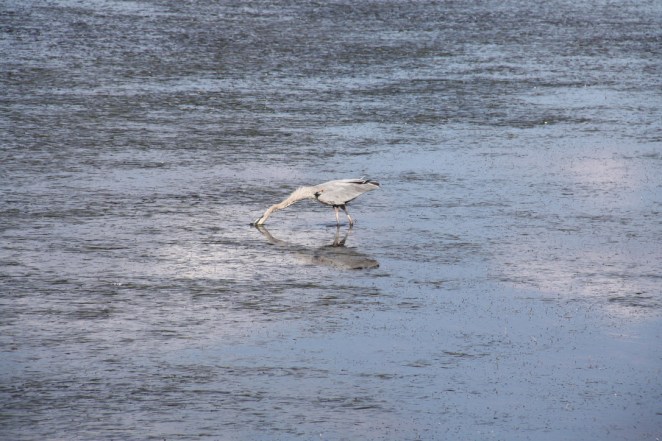
Answers by air mail, please, and tied to the back of a great blue heron, preferably the one in the upper photo, not in the lower one!

Joy of Words

Joy of Words

If the words won’t come, don’t worry.
Sooner or later, they will arrive, driving
down in flurries. Think wind-driven leaves
or the soft white whisper of snaking snow.

There is a moment when all sounds cease
and you can be at one with your inner self,
there, where summer sunshine twinkles
and soft rains bring forth clarity and joy.

What are words anyway, but soap bubbles
emerging from an iron ring to rise in
child-hood’s skies, soaring, dying, around
the cloudy thrones of sun-kissed clouds.

We, their so-called creators, are left below,
building cotton-wool castles spun from air.

Commentary:
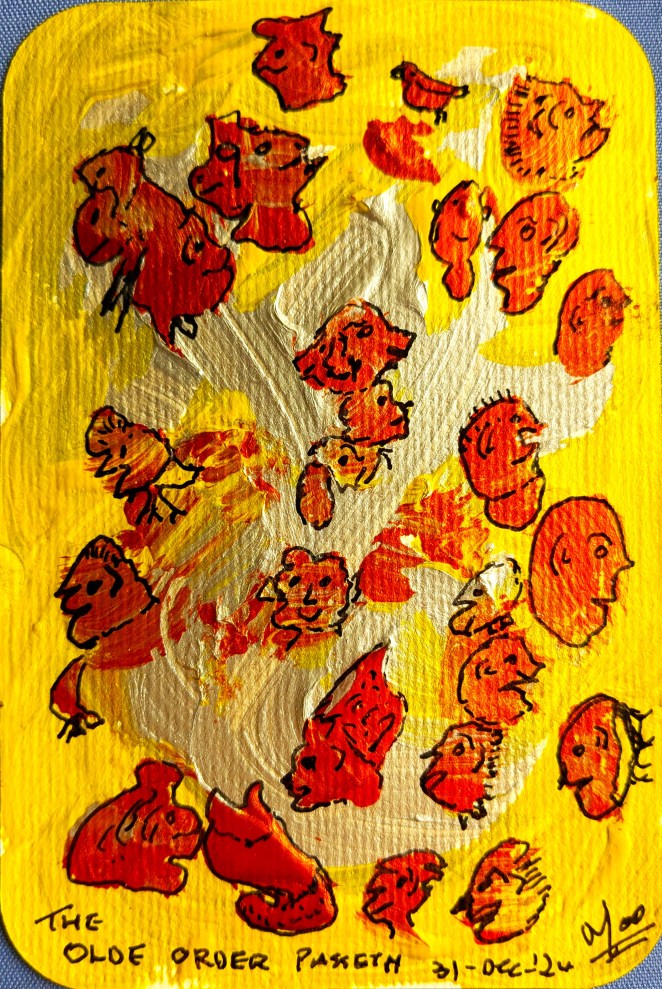
Moo suggested I use this painting of his to illustrate this poem. He called it originally The Olde Order Passeth, but the original phrase, from Tennyson’s Idylls of the King, should really be The Olde Order Changeth, lest one good custom should corrupt the world.

And yes, things do change. Here we have a fourteen line sonnet. Structure giving order to chaos. And words change, the world changes, our thoughts change, the weather changes. Hymns Ancient and Modern – Age and decay in all around I see, oh thou who changeth not, abide with me.

And what do we do when we meet with change? Weather – I change my clothes. There is no such thing as bad weather, only inadequate clothing. It used to be a useful saying, that one, but not any longer. When change changes into disaster, it is a very different kettle of fish. Thoughts change – mine just did. A useful phrase suddenly becomes an inadequate reaction to a changing situation. The world changes – sometimes for better, sometimes for worse, but how do we, each one of us, confront that change? How do we adapt to it?

I know far too many people who, like the ostrich, bury their heads in the sand and pretend that change is not all around us, that the world is the same as it always was. We humans are experts at adapting. We must adapt. But how do we adapt? Each one of us must answer that question in his or her own way. The alternative is to close our eyes, bury our heads, and pretend that nothing is happening.

Another alternative is to seek within for that moment when all sounds cease and you can be at one with your inner self, there, where summer sunshine twinkles and soft rains bring forth clarity and joy. Perhaps that is the world the ostrich discovers when he removes himself from this world and enters that other one beneath the sand. Who knows? Not even the ostrich, I would guess.

Carved in Stone 30 & 31

Carved in Stone

30

A well of beauty dwells within me,
not skin deep, but buried, arcane.

A flickering candle
tethered to an altar,
shimmers at midnight,
when the Latin mass is said,
bringing me light.

In the dark, canonical hours,
shadows move beside me
as I walk long corridors
from dormitory to a chapel
filled with heady incense.

31

I kneel, dumb-founded,
as candle flames wax and wane,
their brightness enhanced
by the midnight magic
that turns doubters into believers.

Spell and symbol, each candle a star,
shining, twinkling, in a galaxy of light,
and everywhere, the incense,
overloading my brain, releasing me
to revelations way beyond
muttered responses, mumbled words.

A world of inner darkness,
yet heart and soul soar together
up to the altar’s immortal light.

My shadow flickering
on the corridor walls,
as candle in hand, half-asleep,
I return to my cold bed
where the long, chill snake
of the bamboo cane
reminds me of tomorrow’s
flagellation.

Commentary:

Shadows on the wall or candles – with which should we start? Verbal and visual – how do they blend and knit together? Does my visual take away from your visual, or does it enhance it? To what extant does my verbal and the commentary on my verbal change the nature of your original thoughts when you re-create, within your own mind, my images, both verbal and visual?

Verbal and visual – now add the sense of smell. “The incense, overloading my brain, releasing me to revelations way beyond muttered responses, mumbled words.” And now remember that I was only six or seven years old when I experienced these things. Add the Latin mass, only half understood, the cold, damp feel of walls and wood beneath the hands. A world of inner darkness, yet heart and soul soaring together up towards the altar’s immortal light.”

My words are black print on white paper. My memories flare – an aurora borealis of senses sent crackling down the spine, in and out of the mind, tumbling the brain into a world … what sort of world? An unimaginable world. One never forgotten. One never re-recreated. One that never existed. One that never could exist. One for which the young child, six or seven years old, yearns for the rest of his life. His unsatisfied life. His unsatisfying life. His meaningless life. His absurd life.

Oh pity the poor puppy, not knowing what he has done wrong, not knowing how to put things right, always inadequate, whining and cringing at his master’s feet. And always, “that cold bed where the long, chill snake of the bamboo cane reminds me of the next day’s flagellation.”

Carved in Stone 21 & 22

21

Goodrich Castle – Civil War tore down
its curtain walls, fired its stables,
drove horses and people mad with fear,
all destroyed, a way of life, gone overnight.

I stand in the ruins of the solarium
beneath towering columns
empty now of the stained-glass
that would have kept out the rain
and retained the sun’s heat.

I imagine standing there,
speckled in sunshine,
coloured diamonds covering me.

22

I stop in the ruined quad
to sniff the air, to imagine the panic,
to smell the crackle of burning,
to hear the high-pitched screams
of dying horses, trapped in the stables.

Sometimes, at night,
fate mans the pumps of my blood,
and sends fire alarms surging
through my veins.

I do not want to die alone,
defenseless, besieged by memories
that gnaw away my remaining days,
like flames.

Commentary:

Memories burn away my remaining days, like flames. Fire controlled, stolen from the gods by Prometheus in Greek Mythology, by Zopilote, the Trickster, in Oaxacan Mythology. I will always recall those early mornings in Oaxaca, standing on the azotea (rooftop) doing my morning exercises in the half light. High above me, Zopilote slowly spiralled. His wings glowed red in the sun that had not yet penetrated to the earth below. As he descended, he brought the sun fire down with him and gifted it to humans.

Fire and flames, under control, in the candle on the table, on the birthday cake, in hearth and fireplace, a life-giving source of heat, light, and energy. Fire and flames, uncontrolled – wild fires in the woods, blazing out of control. It happened last summer. A severe drought, and the woods so dry. A lightning strike – and fire and flame soon raged, out of control. Smoke darkened the skies and the smell of burning hung around for days. So many people evacuated, moving out of their houses with three days, two days, one day’s notice. Sometimes it was so much less. Three hours, two hours, one hour … our community newsletter contained details of what to have ready to cover each of those situations. Very sobering and thought-provoking.

Back now to Goodrich Castle. The occupants trapped inside the walls with no place to go. Horses and livestock trapped in the stables, and those life giving flames now bringing death and misery. “Man hands on misery to man. It deepens like a coastal shelf. Get out as early as you can.” Hands up all of you who recognize the author of those lines, a great English poet who is possibly not as well recognized as he ought to be. I know who he is, but I’ll leave you guessing and googling! Go on, Google him. I know you want to!

Carved in Stone 19 & 20

19

The Spanish Civil War –
one brother pro-Franco, and the other,
imprisoned for a quarter of a century.

They locked him, with two dozen men,
in a deep cell below the convent
of San Marcos de León.

All save him were executed.
He spent our time together
telling me how guilty he felt
because he survived.

20

So many died standing blind-folded
with their backs to unforgiving stone walls,
because they refused to believe
what the enemy told them to believe.

Nobody spoke for them.
Who can speak for those who carry
the candle or board the tumbril,
or see the hooded executioner draw near?

The axe approaches. The gallows draw closer.
The guillotine falls. The single eye of each rifle
stares at the victim’s chest.

Commentary:

I find it hard, very hard, to talk about these two stanzas (19 & 20). I remember two of Goya’s paintings, The Second of May and the Third of May. The Third of May says everything that I cannot say. So, I will just leave you with two paintings to google and one photo of an unforgiving stone wall, with the gateway filled in. Pax amorque – we all need peace and love – I can say that, for we all need it.

Angel

Angel

Oh yes, I have been with them, the lost folk, the tramps, the homeless, the bag-women, all the gente perduta. I have stepped on their fingers as they sprawled on the sidewalk. I have trodden on their toes, tripped over their legs, bumped into their stiff, stumbling bodies and stepped in their wasted body fluids. I have stayed out all night, shared a pack of cigarettes, producing another pack or a bottle from the pouch beneath my wings. Such stories they tell, and they tell them in that antiquated language that I first heard hundreds of years ago. They know me now. I won’t say they trust me, but they tolerate my presence, a Jacques Cousteau voyeur, looking into the sea-depths of their despair.
            Garbed in garbage bags, thin trickles of wine and vomit slipping over their lips and cheeks, bloody bandages wound around needle wounds, they have scars at elbow and foot. I hear the warmish blood whistling its snake song through their arteries and veins but death shall have no dominion, not while I am on watch.
            I enfold myself in my wings and weep as these people, my people now, pillow their heads on bloody bandages. Their world is a world of vomit and reek, yet the edges of their shattered lives rip chunks from my hands and fingers, pluck feathers from my wings, tear holes in my heart. Needles I have seen and touched, blunt, shared between three, five, and twenty-five. Round and round, they go, slipping the thin threads of drug-dreams and tainted blood from friend to friend while the blunt points stab at bruised flesh and leathery vein until the freed blood oozes through fingers and hands clenched tight to hold and staunch.
            Night after night I have watched them searching for something just beyond their fingertips. As the late-night diners emerge from their opulent restaurants, I have seen my people fortifying shop doorways with cardboard castles. I have watched them climb inside, shut down the portcullis, and enfold themselves in the plastic that will keep them free from wind and rain. They all crave the bottle’s warmth. They fight and scratch for that which will hold them together, body and soul, that spiritual glue that binds the spirit before setting it on its drunken dreams of freedom. Kings and Queens, tumbled from their earthly thrones, they dream of the paradise they lost, yet think they can find again at the sharp point of a needle or the bottom of a bottle.
            Oh bird-on-a-wire dreams held captive in a skull-bone cage, how you yearn to grow wings, like me, to soar, to fly, to be released from the body, to at last be free …

Commentary:

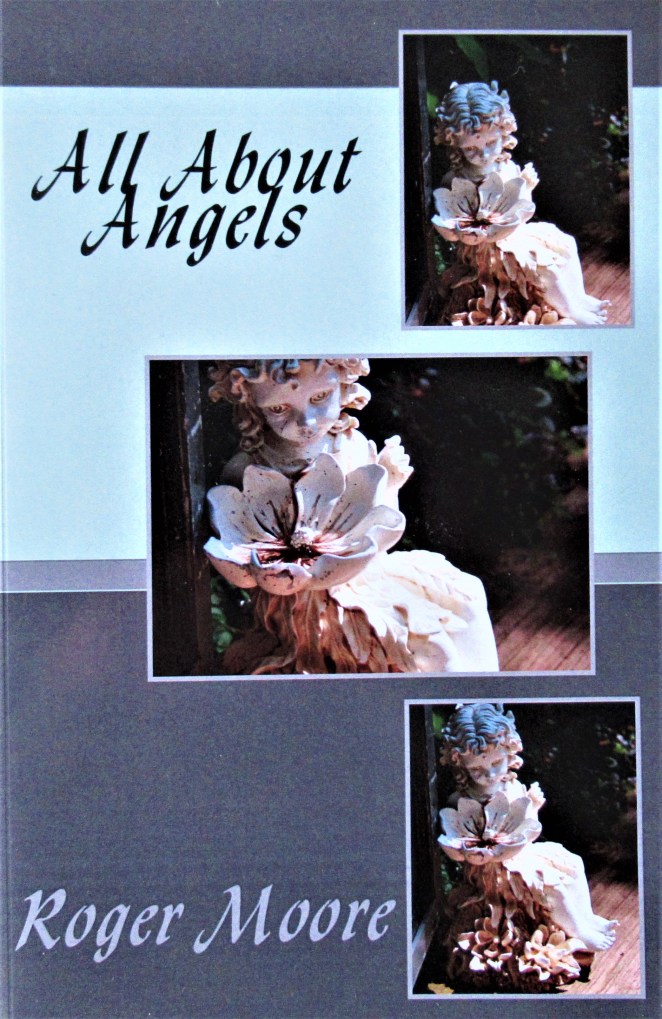
This book, All About Angels, is available online at Amazon.ca. Click on the link below to purchase the book.

All About Angels
Paperback edition

Carved in Stone 8 & 9

8

Primeval places,
both light and dark,
surround us.

Dark depths inhabit
the human heart,
and woe betide us if we forget
that eternal darkness
and allow it to thrive again,
for what we believed dead,
will surely rise once more,
and return at night,
to haunt our dreams.

9

One day I abandoned
the temporal quest and left behind
mindless quarrels, bitter strife,
and envious, petty jealousies.

Surrounded by light and trees,
I now confront fall’s splendours,
harvesting golden days,
collecting and storing them,
safe from ravaging storms.

I seek a distant, but honest truth,
that moves, relentless,
through time’s mists.
It sometimes reveals itself
in the low sun’s spotlight
and each enlightenment
lends meaning to many good things
I thought had been lost.

Yet they still linger,
their shadows flickering
across the walls of memory’s cave.

Commentary:

I spoke to a good friend tonight, he shall remain anonymous, just like Anonymous Bosch, and he encouraged me to continue with my blog and my commentary.

Dark night of the soul – yes, we all have them. We question ourselves, our worth, our place in the world and we ask ourselves the five Ws – five W’s – West Indies only had three Ws – Worrell, Walcott, and Weekes – so we add another two, just for ourselves.

Who am I? What am I? Where am I? When am I? Why am I? How many of us ask ourselves those questions and how often do we do so? Like many of us, I am afraid, and I ask myself those questions more and more often as I age. We all do, unless we are non-sentient beings and just waffle along from show – click -to show -click- to show click – to show!

So, if you are reading this – ask yourself the 5 Ws. Who am I? What am I? Where am I? When am I? Why am I? If you can’t be bothered, click to another blog. However, if you are willing to be engaged, send me a snail mail or a husky mail, by sled, via the north pole. I am sure it will get here quicker than Canada Post.