Inquisitor

Inquisitor
Sun and Moon

He told me to read,
and plucked my left eye from its orbit.
He slashed the glowing globe of the other.
Knowledge leaked out, loose threads dangled.
He told me to speak and I squeezed dry dust
to spout a diet of Catechism and Confession.

He emptied my mind of poetry and history.
He destroyed the myths of my people.
He filled me with fantasies from a far-off land.
I live in a desert where people die of thirst,
yet he talked to me of a man who walked on water.

On all sides, as stubborn as stucco,
the prison walls listened and learned.
I counted the years with feeble scratches:
one, five, two, three.

For an hour each day the sun shone on my face,
for an hour at night the moon kept me company.
Broken worlds lay shattered inside me.
Dust gathered in my people’s ancient dictionary.

My heart was like a spring sowing
withering in my chest
It longed for the witch doctor’s magic,
for the healing slash of wind and rain.

The Inquisitor told me to write down our history:
I wrote … how his church … had come … to save us.

Commentary:

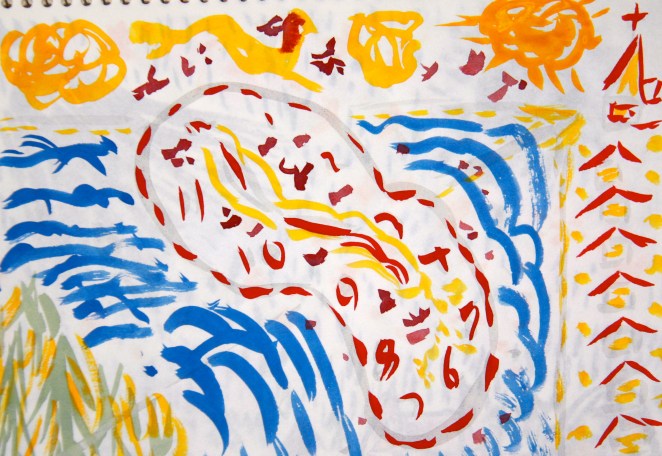
No wonder the little girl in Moo’s painting looks so sad. She must have read this poem and understood how the exercise of power and authority, be it religious or secular, can effect those upon whom it is exercised. Times change, but so many things remain the same. The pendulum swings, and it moves from chaos to order and back again. The meaning of meaning – how we define chaos and how we define order define who we are.

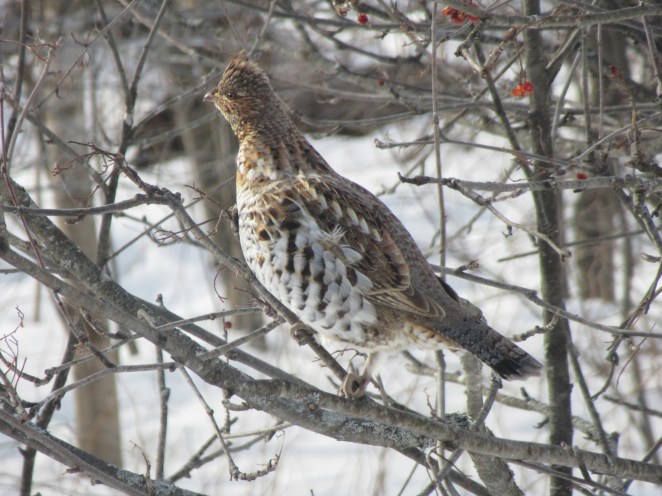
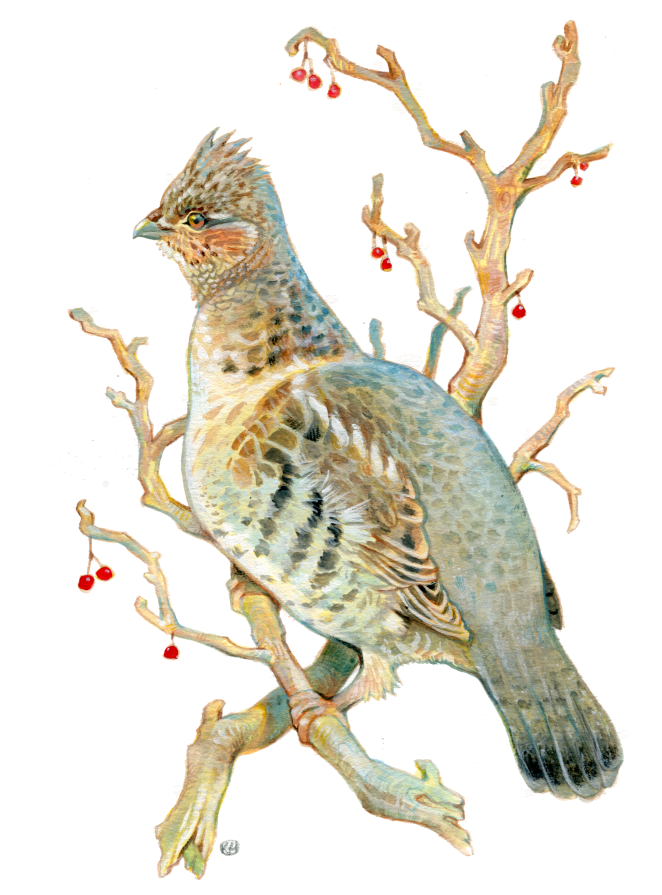
Birds of a feather flock together. Manners maketh the man. Wonderful sayings. But fine words do not necessarily make for fine men or women at that. Serpents and senators, both can speak with forked tongues. It is up to us to apply discourse analysis and distinguish between what they say and what they actually mean. As my friend Jean-Paul Sartre once said – “L’homme n’est rien d’autre que ce qu’il fait.” A man is nothing more than what he does. His deeds reveal his true inner self – and remember – the plumage doesn’t necessarily make the bird.

Gaia

Santo Domingo
Worshipping Gaia before the great altar
in Santo Domingo

If the goddess is not carried in your heart
like a warm loaf in a paper bag beneath your shirt
you will never discover her hiding place

she does not sip ambrosia from these golden flowers
nor does she climb this vine to her heavenly throne
nor does she sit on this ceiling frowning down

in spite of the sunshine trapped in all this gold
the church is cold and overwhelming
tourists come with cameras not the people with their prayers

my only warmth and comfort
not in this god who bids the lily gilded
but in that quieter voice that speaks within me

and brings me light amidst all this darkness
and brings me poverty amidst all this wealth

Commentary:

A Golden Oldie from Sun and Moon – Poems from Oaxaca. The Church of Santo Domingo in Oaxaca, Mexico, contains approximately six tons of gold and gold leaf. Incredible. I visited it regularly, but rarely saw anyone else in there. The local people seemed to avoid it and tourists with cameras were the main visitors. I refuse to take pictures inside churches, for several reasons.

It has always amazed me that the Spaniards built their churches on the sites of previous places of religious worship. This is partly because the indigenous appreciated the sacredness of certain sites, and partly because it was to these sites that the indigenous had traveled prior to the arrival of the Spaniards. Interesting, too, that the Spaniards call their arrival the Discovery while the indigenous call it the Conquest. History – a coin with two different sides – and it is sometimes difficult to look at both sides at once. Malinche – heroine or traitress? Cortes – hero or murderer? And, as they used to say in Northern Ireland, during the troubles, one man’s freedom fighter is another man’s terrorist.

Spin the coin of history, by all means. But beware of seeing only ‘heads’ and forgetting that there are ‘tails’. And never reduce those ‘tails’ to mere ‘tales’. Neither the written tradition nor the oral tradition is infallible. Many people, quiet and secretive as they may be, have long memories. And remember too that all that glitters is not necessarily gold.

The Screws

The Screws

There is no science to sciatica,
just a series of sensations
most of them involving pain.

I don’t know how or when it comes,
but one day, it knocks on your door
and makes you clutch back and buttock.

It’s like a hawk at the bird feeder,
flown in from nowhere to shriek
and shred, unawares, one small bird.

Was it the flannel I dropped yesterday
when showering?  I stooped to pick it up,
lunged forward and, was that it?

The pain came later. It kept me awake
all night, my worst nightmare.
No comfort anywhere. An endless

wriggling and every movement a knife
blade stabbing at my buttock and groping
its slow, painful way down my leg.

The screws, my grandfather called it,
a metal screw screwed into his leg,
leaving him limp and limping.

I googled it today, sciatica, and they
suggested an ice pad for twenty minutes,
repeated twenty minutes later.

“Yes,” I muttered, “yes” and found
in the fridge the ice pack we used
to use in our Coleman’s cooler.

My beloved helped me undo my pants.
“This,” she said, “will be icing on the cake.”
“No,” I said, “it will be icing on the ache.”

Tomorrow, I will call the pyro-quack-tor.
She will bend me to her will, straighten
my back, cure the pain, set me right again,
provided she doesn’t read this post
and will permit me to enter her domain.

Commentary:

Moo doesn’t paint pain, even though it occasionally emerges in his paintings. This painting of his is called Grey Day and I guess a Grey Day is rather like a Blue, Blue Day, something to be avoided, because you feel like running away. And that’s the problem with “The Screws” – it’s hard to face the pain when it’s behind you, unless you are a contortionist and can twist and twirl and see yourself in the mirror. I suppose another solution is to have eyes in the back of your head, but not everyone is that gifted.

As for the pyro-quack-tor, my apologies, Chiropractor, mine is excellent. I limp into her office, crawl onto the medical bed, and then, thirty minutes later, I hop off it like a man reborn, and skip down the corridor, waving my sticks and grinning as if I were a Gorilla in heat. Oh dear, not the sort of condition in which one should drive the zoo bus!

As for my joke – “This,” she said, “will be icing on the cake.” “No,” I said, “it will be icing on the ache!” This takes me back to my old school days – Aix-les-Bains / Aches and Pains. I remember one of my school friends going to Baden-Baden for his summer holiday. A double-barreled name, wow, very foreign. He asked me where I had been and I replied “Cardiff-Cardiff – this is Cardiff.” They used the English version back in those days, not the Welsh one – “Caer Dydd – Caer Dydd.” Doesn’t sound quite the same in Welsh. And how about Cas Newydd – Cas Newydd [Newport] or Pen y Bont – Pen y Bont [Bridgend]. And let’s not get into Llanfair.p.g – Lanfair.p.g – [Llanfairpwllgwyngyllgogerychwyrndrobwllllantysiliogogogoch – Llanfairpwllgwyngyllgogerychwyrndrobwllllantysiliogogogoch].

Try saying that one twice in quick succession. You’ll be sitting in the railway station a long time, just waiting to find out where you are. That, of course, is if trains still run to Llanfair p. g. “Gentlemen will please refrain from …. ” and if you can finish that little ditty off, in public, you have more courage than I do! Besides which, my voice broke long ago, and I haven’t mended it yet!

Clepsydra 21

Clepsydra 21

… she left me
          at the lighthouse
               rising tide
                    beach diminishing

and grew smaller
     as she walked away

I search the sand for sea-gems
     sand-dollars
          cerulean sea-glass
               rarest of all the reds

ground down
     polished
          sanded to perfection

so many worlds
     in a grain of sand
          their words going unspoken
               carried away by the sea-wind

the wind that haunts
     caves and cliffs
          hooting like a ghost train
               in a forlorn
                    tunnel of love

love lost
     love found
          an old love
               rediscovered
                    only to be lost anew

what is this thing
     called love …

Commentary:

Listen! “Can you hear the music?” “No, but I hear singing even though there’s no one there.” I know, I know, we have had this conversation before. Moo didn’t have a painting along the lines of ‘what is this thing called love’, so he dug out this one – Walking on Air – the painting, not Moo. But then, Moo’s a silly old romantic and verses and songs settle in his mind. All too often, when he walks he finds he’s ‘walking on air’! The two of us, Moo and me, have always loved that song. Great to work it into a commentary on a poem (again).

Love – what is this thing called love? And how many types of love are there? We use the word so frequently, or infrequently, if we are Mr. Grinch. But what does it mean? Love of self, love of other? And how many others can we love – I know that Minnie had a heart as big as a whale, but how many loves can fit into it? Love of father, mother, daughters , sons, brothers, sisters, cousins – how far do we go? Winning sports teams – everybody loves everyone on the team when they win they cup. That love is so much harder if they lose it – especially if there is a goat on the team, and I don’t mean greatest of all time! I mean sacrificial.

I love you with all my heart! Does that include the pacemaker and the stent? What does atrial fibrillation mean in that situation? Good questions. Neither me nor Moo have the answers. Write your answers on a postcard and send it to – where? With Canada Post on strike, you will need a team of real snails. Hitch your postcards to them. Threaten them with the salt shaker. And off they go. Snail mail is back. Or you could place them on a dog sled, hitch up the huskies and Mush, Moo, mush! Away they all go hauling the mail. Why does it always be the mail? Why can’t it be the Femail? Mail – Femail. Oh, but I love that. There, you see. We’ve just added another meaning to love. Let’s hope none of the huskies lies down to rest. That’s called a Canadian flat tire. Oh, I love that one too.

I am running out of time, space, and ideas. And that’s only one word from the poem that we’ve looked at. Oh, shame and scandal in the letter-box.

Absence

Absence …

… makes the heart grow
callouses scabs you can
pick at with your finger
nails bleeding fresh blood

they remind you that you have
a heart feelings something
buried so deep you need
a pick and a shovel to dig
a shaft with wooden slats
placed carefully at the sides
so your mine won’t collapse

you dig deeper and deeper
until in the gloom you see
the feathered fluttering —

a broken-winged canary
sacrificed in its cage
so part of you can escape
flee the mine
and come out alive

Commentary:

A golden oldie. Moo thought Poppy Day (11/11/2024) would be a suitable painting. Those who survive rarely forget those they were forced to leave behind. Kindred spirits, they travel though life together, the live one carrying the other on his shoulders as he would have done earlier, had he been able to.

Moo still has a teddy bear. He tells me he has always slept with one. His first teddy was an Australian Koala, a real stuffed koala given him by his Australian family, back when he was born. Moo was reading a book on the Battle of Britain (15 September 1940). It had a picture of the gunner from a Bolton Paul Defiant, sitting in the gun turret. Behind him, he had his little teddy bear. Moo couldn’t stop crying. He thinks he might have been an air gunner in another life, and when he saw that teddy, it brought back so many memories – flak, night fighters, search lights, tracer bullets, pain, flames, and then the unending darkness. So many did not come back, especially the tail-gunners. Their absence is still a presence to someone in their families. And so it should be.

Clepsydra 16-17

Clepsydra 16 & 17
Click on the following link for the previous stanzas
Clepsydra 14 & 15

16

… would this be the beginning
     or the end

men and women
     on the street
          hands out
               fingers splayed
                    panhandling

their eyes
     black holes in empty faces
          not brain dead
               just drained of hope
                    brains deadened
                         by blow after blow

loaf after loaf crisping
     blackening in life’s oven
          fit only for preacher crows
               flitting from tree to tree

descending on garbage day
     to feast on desperate souls
          marooned kerbside
               for garbagemen to find …

17

… no soul allowed
     to weigh more than forty pounds
          each one swaddled
               in a plastic garbage bag
                    that serves
                         as a winding sheet

dust to dust
     to grey-faced ashes
          wound up by brawny arms
               swung flung skywards
                    into the truck

then ferried away
     to that place where crows
          and hunch-backed vultures
               gulls and humped eagles
                    wait for merciless ferries,

they cross into the shadow lands
     who was the one who found me
          who untied the ties that bind
               freed me from my cell
                    the shell of myself
                         and set me free …

Commentary:

Poetry explains itself.
If it doesn’t, it’s inexplicable.

Monkey Meets Pontius Parrot

Monkey Meets Pontius Parrot
(With glorious  memories of Macarronic Latin)

Pontius Parrot is very clever
and very pontifical.
“Pretty Polly!”
He pontificates from his pulpit.

His name isn’t Polly
and he doesn’t have a pulpit
but he parrots words
in Macaronic Latin:
“Caesar adsum jam forte.”

Pontius Parrot is perky at the podium
and bounces up and down,
preening himself self-consciously,
rattling his chains,
shaking his bars,  and speaking Latin:
“Brutus aderat.”

He is marked with shame and scandal.
A dysfunctional family of feathered friends
 has henpecked him until he is black and blue
and he has thrown up copiously:
 “Caesar sic in omnibus.”

He dips his wings in holy water,
calls for some soft soap, 
and washes his feathers and claws.

Poor Pontius Parrot,
he can only say “Repent!”
“Brutus sic in at.”

Commentary:

I asked Moo if he had ever painted a parrot, but he told me that he hadn’t. However, one of his favorite viewers, had once called this painting a pile of spaghetti wriggling in tomato sauce and he thought that spaghetti was close enough to macaroni for it to serve as a painting for Bony Macaroni Latin.

I had to explain to him what we mean when we say Macaronic Latin. Back to that boarding school and we used to invent all sorts of Macaronic Latin phrases. They used to cane us with bamboo canes. So here’s the verb paradigm in Latin for ‘to cane a student’. Bendo – whackere- ouchi – sorebum. Of course, it helps if you know what Latin verb paradigms look like. They are easy to remember and are aide memoires for the four main parts of the verb. Bendo – I bend over – first person singular, present tense – whackere – to whack or cane – infinitive – ouchi – I said ‘ouch’ – past tense – sorbum – the inevitable result – past participle.

Now, if we look at the italics in the poem we see a poem within a poem, and that smaller poem is written in Macaronic Latin.

“Caesar adsum jam forte.
Brutus aderat.
 Caesar sic in omnibus.
Brutus sic in at.

Translation

Caesar had some jam for tea.
Brutus had a rat.
Caesar sick in omnibus.
Brutus sick in hat.

Oh never underestimate the ingenuity – linguistic and / or otherwise (and we won’t go into that one right now) – of the bored-to-tears Public Schoolboy. Especially if he is not destined to be a Perfect Prefect like Perfect Prefect Plod – who was never any good at Latin, if I remember well. Neither was I come to think of it. Horrible language, dead and reeks like the dead rat that Brutus ate.

As for the ‘repent’, well, usually, just before he beat you, the master doing the beating would enquire as to your health and ask you if you repented of your sins, crimes, bad language, being cheeky to Perfect Prefect Plod, or whatever else you had done (like smoking or holding a girl’s hand in public instead of a boy’s). You always said ‘yes, of course I do, sir,’ in the vain hope of avoiding a beating. But, bad luck, the cane descended anyway, ouchi was heard, and the victim retired to the bath room to examine his past participle, also known as his sorbum.

I bet you never imagined any of that. Wow! What a great lesson I have taught you today. Think about it all and think about it carefully. Now you know why Pink Floyd sang “We don’t need no education.” But what an education it was. And remember, the Duke of Wellington, Old Nosey, once said ‘my battles were won on the playing fields of the pubic schools of England.’ Oh dear – I hope I got that right. I fear there’s a letter missing somewhere.


Gorilla Drives the Zoo Bus

Gorilla Drives the Zoo Bus

Gorilla drives the same zoo bus
all day, every day;
same starting time, same finishing time,
same route, same stops,
different passengers,
but every passenger the same:
faceless.
Gorilla doesn’t want to know their names.

“Please tender the exact fare!”
Not a penny less, not a penny more,
and he polices every penny.
Bus conductor and master
of every passenger’s destiny,
he opens and shuts the door,
letting passengers on and off the bus,
but only at official stops.

Every passenger has a ticket,
and he punches every ticket
with a neat, round hole.

He never makes mistakes.
He grinds, like God’s own mills,
exceedingly small.

He has spent all his life in uniform.
He has a belt and braces to hold his trousers up.
He’s always prepared for the worst.  

Ten, fifteen, twenty years:
an anonymous wife;
anonymous little babies;
at shift’s end, a pension,
and another bus.

St. Peter’s at the wheel.
He doesn’t want to know
where gorilla wants to go:
he wants to know where he’s been.

Commentary:

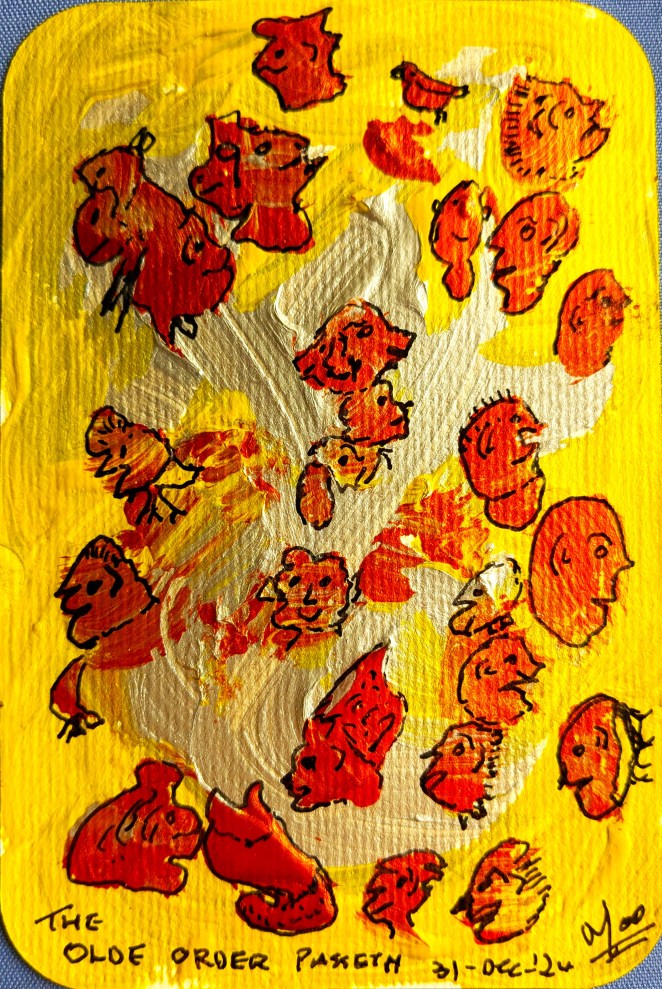
Moo didn’t have a painting of a gorilla driving a bus, so he offered me a painting of the passengers instead. Look carefully – you might even find a portrait of me or you in there. Who knows where Moo goes and who he sees? I certainly don’t. Remember Picasso – he used to run downstairs, out into the street, see a face he liked, and run back upstairs and paint it from memory. I wonder if Moo does the same thing. I’d ask him, but if he doesn’t want to answer the question, he just grunts. And I can imagine him grunting at that one.

Anyway, we all know and recognize the gorillas when we meet them. They are totally unimportant, have a miniscule job to do, but do it with absolute authority and the utmost perfection. Like Gorilla – “Not a penny less, not a penny more, and he polices every penny.” – “he opens and shuts the door, letting passengers on and off the bus, but only at official stops.” – “he punches every ticket with a neat, round hole.” – and probably in the exact same spot of every ticket! – “He never makes mistakes.” – and if he does, it’s the passenger who suffers, because ‘Get on, get off, who ever you may be, I am the lord of the bus,’ says he.

What will happen to us at the end of our shift? I really don’t know. And I don’t think anyone else does, either. Will St. Peter be there to greet us? (I don’t know.) Has the Zoo bus replaced the ferry over the River Styx? (I don’t know.) What will we be asked when we get there? (I don’t know.) How will we answer? (I don’t know.) Is there a little book in which all our deeds, good and bad, are written down? (I don’t know.) Are we to be divided into sheep and goats? (I don’t know.) What will poor monkey do when he is turned into a sheep or a goat? (I don’t know.)

So many questions, deep questions, packed into one small poem. Most of those questions unanswerable. But that’s one of the joys of poetry – to open a poem is to open a tin of calamares – there’s always another something or other left in the corner. Look, over there, bottom left, right at the bottom of the can, I spy with my little eye another question. ‘What is that question?’ you ask. Sorry, mate, I’m afraid I don’t know.

Hair Cut

Hair Cut 

Curly locks, wisps of grey and silver,
curve around my ears, cuddle my collar.
I stand in the bathroom, look at my scissors,
glance in the mirror, and start to hack.

I turn my head swiftly from side to side,
watching white hair falling, like snow.

“All done!” I look at myself in the mirror:
hair shorter, still sticking out in clumps,
but some curls still tickle and cling.

Not bad for front and sides. I still
can’t see the back, but if feels fine.
“Right” I say. “I’m ready for the show.”

What show? The one where I sit before
the computer screen and admire myself
before I click in the code, type the password,
and join the virtual meeting that today,
in the pandemic, passes for face to face.

Commentary:

Face to Face – Moo helped me with this one by allowing me to have one of his ‘face to face’ paintings. Thank you, Moo. Sorry I said you weren’t too bright yesterday. And we both got the singer of All Shook Up wrong – it was Tommy Steele of course. Also, as you explained to me, you may not be great at adding two and two and making four, and you may be unenlightened with words, but wow, when you add a colour or two to the palette you are enlightened and enlightening and dazzle people with the lightness of your enlightenment. There – hope we can be friends again now. I would miss your paintings if you withdrew your services.

And this is a Golden Oldie. In 2020, when Covid walked with us, I started cutting my own hair – hacking might be a better word – and I have continued to do so ever since. In fact, I have only been to the barber’s three times since 2020. Each time, the hair lay so thickly upon the floor behind the barber’s chair that we walked knee deep in the white stuff. Great fun. How the young lady made fun of me. Right down the middle of the back of my head she found a large mullet that I couldn’t reach with either hand. She found that so funny. Asked me if I wanted to keep it. Of course, I said no!

I remember those face to face on the computer days. At least we couldn’t catch Covid from an image talking back to us on a screen. I always find those online meetings so difficult and awkward. I love the awkwardness of that word – awkward. The facilitator always began with – ‘Now, let’s all introduce ourselves.’ What on earth do you say on such occasions. ‘Easy,’ Moo told me. ‘I always say “Hi. I’m Moo. I’m a painter.” Nobody bothers me after that. Once somebody asked me what I painted and when I replied ‘houses’, everyone lost interest and the facilitator moved on.’

I always get tongue-tied and can never manage to be coherent. In fact, I am neither coherent nor cohesive and I often fall apart. “Hi! I’m Roger. I’m a writer.” This always opens the doors and the windows to all sorts of questions. ‘What do you write?’ ‘Have you published anything?’ ‘What’s your latest work?’ Of course, if I had any sense – and often I have less sense than Moo – when someone asks me ‘What do you write?’ I should reply. ‘English.’ Or ‘Italics.’ Or ‘Greeting cards.’ That last would be as much of a show stopper as Moo’s response – ‘houses’! Of course, I could get really inventive and say ‘Bilingual jokes for Christmas Crackers.’ Another pet peeve – have you noticed how the French and the English don’t match up? I could have a great old rant about that one. But don’t let’s talk about Fortune Cookies!

And suddenly, we have strayed a log way from the act of getting our hair cut during Covid. But, like many diversions, the journey is often more important than the destination, especially if we are amusing ourselves! And I hope you had some fun and took some joy from my words.

Time Flies

Time Flies

… bends like a boomerang,
flies too rapidly away,
limps back to the hand.

Endless this shuffle of unmarked
days dropping off the calendar.

Hands stop on the clock.
The pendulum swings:
time and tide stand still,
do not move.

The print in my grandma’s house:
seemingly moving seas,
sails swelled out,
the ship stays firm in its frame.

‘As idle as a painted ship
upon a painted ocean.’

Our garden fills
with brightly colored birds
and red and grey squirrels.

Light and dark
switch back and forth
each day
a twin of the day before.

The TV screen hangs out
the daily washing.
Tired, worn out shadow,
their faces boring us
with shallow wit
and hand-me-down wisdom.

Time:
an albatross around the neck,
an emu, an ostrich, a dodo,
an overweight bumble bee,
too clumsy, too heavy to fly.

“Time flies?”
“You can’t.
They fly too fast.”

Commentary:

My friend Moo told me he was ‘all shook up’ when I read him this poem. I don’t think Moo’s too smart. He thought All Shook Up was written by the Rolling Stones when they went out moss gathering during the Fredericton Harvest Festival, but I said no, it was definitely written by Buddy Holly on an off-day when he was playing cricket. It wasn’t okay in those days to play croquet.

The last three lines come from an examination question in the General Paper, “S” Level, as it used to be. “Punctuate this sentence – time flies you can’t they fly too fast” – of course, they should have said, “in exactly the same way we want you to. Corrections and alternative versions will not be accepted.” What did they think I was? A mind-reader? I wasn’t. I was a teenager having a field day in the national examinations. I would love to have been a fly on the wall when they marked my paper.

In the biology exam, they gave each one of us a Brussel Sprout and asked us to draw it and tell us as much as we could about it. Of course, I ate mine, and I said it tasted a little bit dry and needed some salt. Then I drew a mess of potage, all yellow and green with chewed up squiggles, and added “That’s what the sprout probably looks like right now.” I failed that exam too. Didn’t even get a part mark for ingenuity, though the science teacher said I could have a glow of satisfaction. Very useful after lights out in a boarding school, I can tell you.

I can’t remember if Moo went to that school with me or not. I don’t think he did. I think he drifted into my life a little bit later. He wasn’t a painter at that stage, just a half-starved philosopher doomed to live in a garret. Of course, once he started painting houses, he made money. It’s amazing how many people will pay you for painting their houses. Of course, that was before they invented plastic siding.

About now you realize that I live in a strange world all of my own and a lot of people live in it with me. You, too, if you enjoyed reading this. Long may the ‘strange world of me, you, and Moo’ continue. I’d send you a penny for your thoughts, but they have gone out of circulation. I can’t even sing you a song of sixpence these days either. Silver sixpences have walked the dodo path too.