Rage, Rage 5 & 6

Rage, Rage
5

Empty now the house,
clean the floors
where she scattered her toys,
polished the grubby tables,
where her small hands
splattered food,
wanted and unwanted.

Empty the bathroom,
the tub where she took
her daily bath,
dry the towels she dampened,
wrinkled the toothpaste tubes
she happily emptied.

Empty too
this heart of mine
wherein she built her nest.

Like a wild bird, she has flown,
joined the end of summer migration,
yet I still possess a part of her
within my emptiness.

6

I remember how she stood
at the window, excited,
gazing at the birds.

“Finch,” I pointed.
“Goldfinch. Grosbeak.”

Her hands plucked at the air,
not a feather fell,
she caught nothing.

“Yellow, she cried, “yellow,”
jumping up and down with joy.

Her nose, all wet and runny,
left damp, sticky smudges
on the cold window-pane.

I see the greasy smears
that remain where her nostrils
pressed against the pane.

Still the glass stays unwashed
and now that shadow stands
between me and the sun.

Commentary:

Empty house, empty nest. How many homes have just enjoyed the festive spirit, rejoicing in the company of family and friends. Alas, the holiday is almost done. In many houses, the taxis have left for the airport, the cars have driven away, the rooms that were filled with warmth, joy, and laughter are cold and empty. Only the shadows remain. The echo of voices that are now silent.

The old remain, as they were before the festive invasion, old and lonely. The young have flown back and away to their usual lives, their schools, their jobs. I sit before my screen and type these words. My beloved sits in another room and watches TV. When the adverts come on, the volume increases and the same tedious voices mouth their joyless messages. My nest may be empty, but I do not have an empty head. And I don’t want it swamped by the commercial acumen of the tv set.

My head contains many rooms and many of those rooms are filled with memories that will, as Albert Camus said, last me a lifetime. One summer afternoon, examined in its intensity, will last forever, or for as long as the viewer lasts. Alas, I mourn for those who age, who suffer from Alzheimer’s and the like, and whose heads are empty. What do they think, what do they feel, what twilight memories flicker through the empty nests of their ageing brains? I hope and pray I never know.

Rage, Rage 4

Rage, Rage
4

I walk from room to room,
startled by shadows,
and open doors,
search under the table,
look behind chairs.

Nothing. No one.
The house stands
still and empty,
but for the sadness,
the silent sadness,
that fills each room
with their remembered
presence.

Commentary:

Absence and presence. How many of us feel that something is there, walking beside us, or just behind us? How many feel that an empty room is not empty, but is filled with a presence, something we feel, half-recognize?

I have been in houses, invited for the night, where I would not sleep. Why? I do not know. But I felt a presence, a prescience, if you wish, that filled me with a desire to leave and not to stay.

What is it? Is it other memories, other lives, that impinge upon ours in this current time frame? I do not know. But I do know that there are houses and rooms in which I will not stay. I also know that there are others that throw open warm arms to welcome me.

Look at Moo’s painting(s). How many of them welcome us in? Do some of them shut us out and make us shiver with a fear, not of the unknown, but of the hardly-remembered, that lies in wait to shake us out of this dream which is our present life?

Rage, Rage 2 & 3


Rage, Rage
2

These problems start the day
you realize you are alone.
Your beloved goes away,
for a holiday,
to be with your daughter
and grandchild.

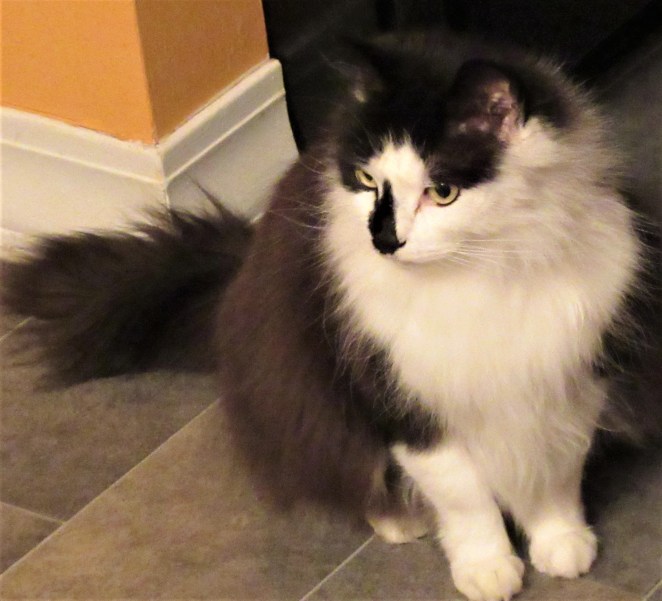
Now the house and the cat
are yours, and yours alone.
No problem you say and
everyone believes you.

You jumped in the car,
drove daughter, and child,
holidays done,
to the airport.

Your beloved went with them,
her holiday about to begin.
And that’s when it all began.

3

When I come back home
from leaving them at the airport,
the front door stands open.

I thought I had closed it
when we left.
I tip-toe in and call out
“Is anybody there?”

Echo answers me –
‘… there, there, there …”

Commentary:

Raymond Guy LeBlanc, one of my favorite Acadian poets, published his poetry book, Cri de Terre, in 1972. My painter friend Moo, who also likes Acadian poetry, borrowed the title and changed it slightly when he painted this painting – Cri de Coeur. Earth Cry / Heart Cry.
What is all creativity, visual of verbal, but a cry from the land or a cry from the heart? Sometimes it is more than a cry – it becomes a clarion call, a shout out, a calling out.

So many of us are born with creativity in our hearts. So few of us carry that creativity, be it verbal or visual, into the adult world, a world that all too often grinds us down and sifts us out. We become grey people in grey clothing sitting behind grey desks beneath artificial lighting, doing grey jobs that slowly turn us into nine to five (or longer) dusts.

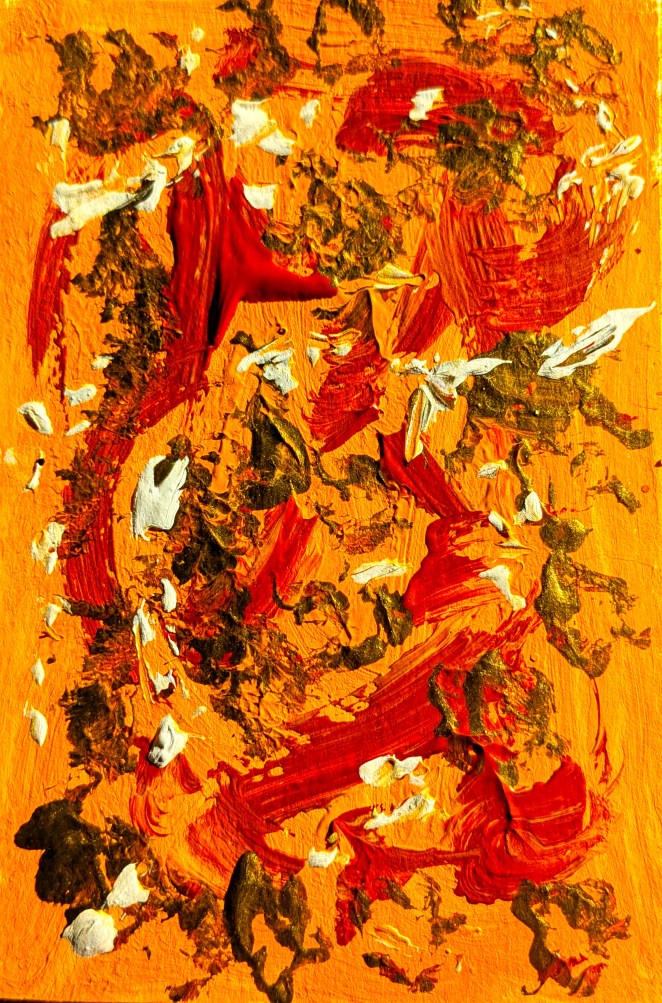
Moo has promised me a series of red paintings for this sequence. We shall see how he does. Red for anger, red for age, a red flag for danger, a red rag to wave at the raging bull of life, to provoke it, then bring it under control.

Nadolig Llawen – Welsh for Have a Joyous Festive Season. You can add other languages, as you wish. But above all remember Pedro Calderon de la Barca’s words – “Life is a dream and dreams are nothing but dreams.” One day, we shall all wake up. Artists and dreamers, grey ghosts and people of straw and dust.


Rage, Rage 1

Rage, Rage
1

Old age creeps up on you,
slowly, ambushes you,
catches you unawares.

At first, you don’t believe
that it’s real.
You ignore the signs,
pretend they aren’t there.

Then comes a knock on the door.
There, did you hear it?
Around you your body’s house
slumbers in comfort.

You lose your footing,
but you do not fall.
Your book drops to the floor,
you bend down and pick it up.

Everything is as it always was.
Or is it? One of your friends
slips and falls down the stairs.

You descend the stairs
with more care than usual.
No, you don’t need a cane.
Nor special shoes and socks.

You convince yourself that
all is well. And so it is,
for a little while longer.

Commentary:

Rage, Rage
against the dying of the light

Dylan Thomas’s famous poem celebrates the passing of his father. “Do not go gentle into that good night, / old age should burn and rave at close of day. Rage, rage against the dying of the light.”

I am no Dylan Thomas, although I am still a Swansea boy at heart and, as my paternal grandfather used to sing while at the fighting front during WWI – “and still I live in hopes to see Swansea Town once more.”

Alas, I never will see Swansea Town, save in my dreams, for Swansea Town is no longer a town. It is now Swansea City and no, I will not be leaving Island View again, not even to return to Wales, the land of my fathers. But I can and do age, and ageing is a strange and very personal experience. These pages contain the thoughts that occur to me, in my solitude, as I come to terms with my diminishing existence.

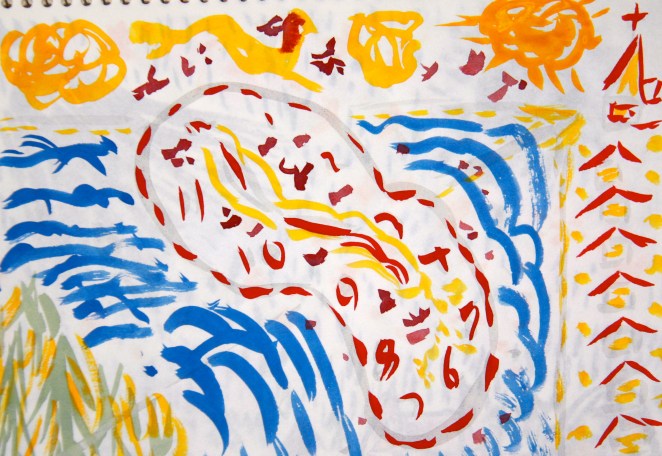
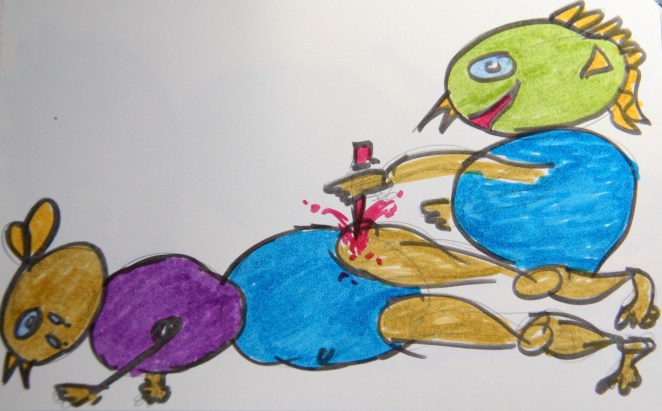
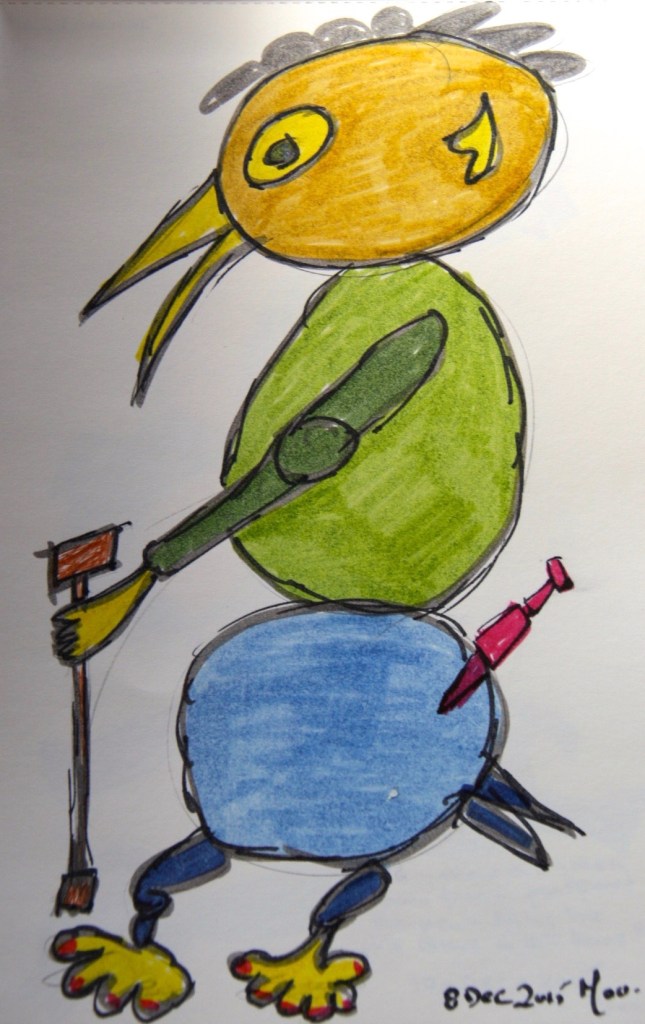
Moo has been very silently recently. But when he saw this poem he climbed out of the woodwork where he had been hiding like a silent spider and he said “Roger, have I got just the painting for you.” The painting is also called Rage, Rage – make of that what you will.

Carved in Stone 72 & 73

Carved in Stone
72

Is this world I create real?
Of course it isn’t.

It exists only in my head,
and on the page,
but perhaps, one day,
you too will see
the things I have seen.

Yet the world I describe
is as unreal as the words
from which it is woven.

73

Heraclitus once wrote
we can never bathe
in the same river twice
.

This is the Catch 22
faced by all poets,
to remember,
and to try to recreate.

Shadow hands on cave walls,
colored pictographs on gesso,
hieroglyphics on papyrus,
ink on paper, raw words,
and in the end,
everything reduced
to these three little letters
carved in stone –

RIP

Commentary:

If you have read this far, we have walked a long journey together – 73 verses that comment on life and the meaning of life. Hard reading in places, easy in others. I trust you have enjoyed the journey and found some stops and resting points along the way in which to contemplate the ways in which the threads of your own life intermingle with mine.

Throughout this journey, I have tried to use a four step process. (1) Verbal – the poems themselves. (2) Visual – photos that intertwine with the verbal. (3) A Commentary – that goes beyond the verbal and visual and opens up the ideas a little more. (4) A Dialog between myself – the poet – and Moo – the visual artist who has so frequently loaned me his paintings when he thinks they illustrate my words.

It’s been a topsy-turvy journey through what Bakhtin calls a world of carnival, where little is at it seems, and the world is turned upside down. That said, we have a clear choice – to slide down the downside of this life, or to scale the upside, to contemplate, with joy and happiness, the world from those heady heights.

Blessings. Pax amorque.
And thank you for travelling with me.

As Right as Rain

As Right as Rain

It’s the day after the night before
and I awake to an ache
in each of my arms.

I went to bed early, at ten,
and slept until eight-thirty,
but my AI watch tells me
that I only got six hours sleep.

I found a bump in the bed,
on the right side,
when I look towards the window.

I must have lain my arm against it,
during the night. It was so sore,
my right arm, the Covid arm,
when I got up this morning,
but the left arm, the flu arm,
was perfectly alright, except for
a little itch, and a tiny tingle,
like the jingle of elf-bells.

Black coffee and an aspirin
soon cleared it all up, and now
I am as good as new,
as right as rain,
except the rain that fell last night
brought power losses, cold,
and an absence of warmth and light,
and that sort of rain is not all right.

Commentary:

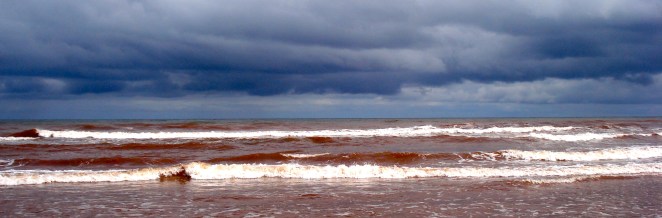
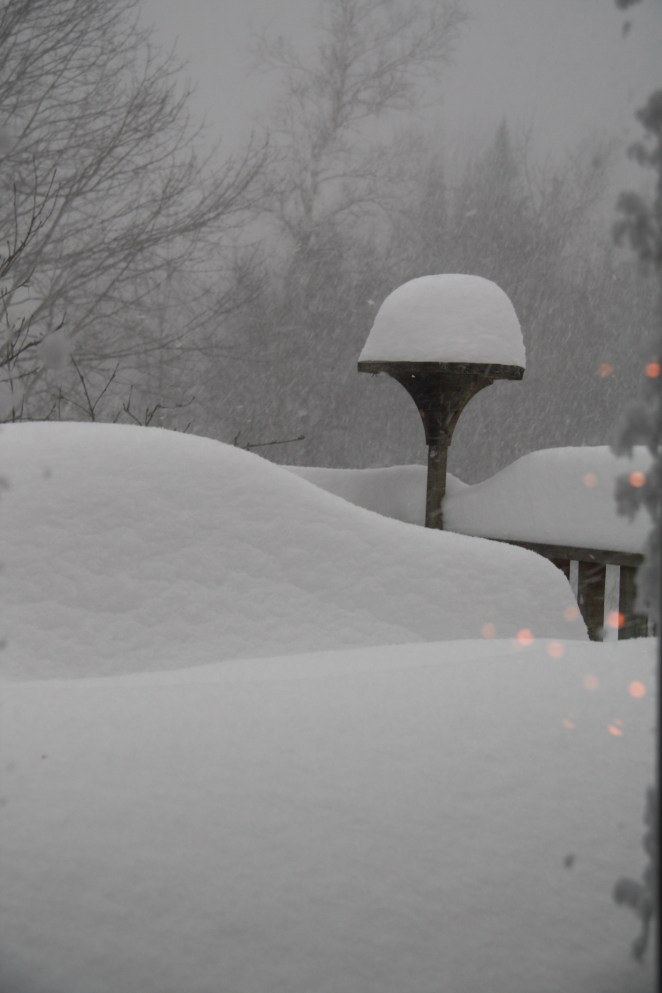
That’s a golden oldie from a couple of years back. I did both jabs in the same arm this year and didn’t feel a thing. It didn’t rain either, but look at the muck coming down in the photo – we had a bit of that a couple of days ago. Welcome to our Canadian half-winter. We used to get 3 metres / ten feet of snow every winter. Last year I only used the snowblower of three occasions. No wonder I think of it as a half-winter – winter ain’t what it used to be.

Daffodils

Daffodils

Winter’s chill lingers well into spring.
I buy daffodils to encourage the sun
to return and shine in the kitchen.
Tight-clenched fists their buds,
they sit on the table and I wait
for them to open.

For ten long days the daffodils
endured, bringing to vase and breakfast-
table stored up sunshine and the silky
softness of their golden gift.

Their scent grew stronger as they
gathered strength from the sugar
we placed in their water, but now
they have withered and their day is done.

Dry and shriveled they stand paper-
thin and brown, crisp to the touch.
They hang their heads as their time
runs out and death weighs them down.

Commentary:

A sad poem, really, for a wet, damp, dark, chilly day that begs for some light and warmth. And what warmth and light daffodils bring. Not to mention their delicate scent that lingers long in the nostril, faint, but intoxicating. For ten long days the daffodils endured. This was a joy in itself. Sometimes cut flowers wither so quickly. But ten days … wow! And they do indeed bring to vase and breakfast-table stored up sunshine and the silky softness of their golden gift.

Their scent grew stronger as they gathered strength from the sugar we placed in their water. Indeed it did. And the sugar itself enhanced their ability to linger on. A little Somerset trick that, all the way from Zummer Zet where the cider apples grow. And no, you can’t have real cider without real cider apples from real cider apple trees. But never forget Sally the Sozzled Sow – she got into the storage shed and drank about five gallons of the stuff. It was all over the newspapers. She got loose and knocked the milk churns over and rolled them in the clover. The corn was half cut at the time, and so was she.

Dry and shriveled they stand paper-thin and brown, crisp to the touch. So sad when this starts to happen. Then one day, they just fade away. And then they hang their heads as their time runs out and death weighs them down. Sad, really, as I said at the start – but we must never forget the joy and light and happiness they bring us when they are in their prime.

Carved in Stone 61 & 62

Carved in Stone
61

Water through the water clock,
water off a duck’s back,
the waters of life,
continually flowing,
trapped in our children
and their children,
and the love we create
never lost, just circling,
like the hands of the clock,
like the planets and stars.

But who will wind up
the clockwork universe,
and tend the mechanism
that balances planets and stars?

What will happen
when the clockwork
finally runs down,
the last candle is snuffed,
and the water clock dries up?

62

Whoever, whatever remains
will be left to contemplate
Ozymandias with his two vast
and trunkless legs of stone,
standing in the desert.

“Look on my works,
ye mighty, and despair.”

Commentary:

“Look on my works, ye mighty, and despair.” Well, Moo does have a sense of humor after all. I thought he did. From Ozymandias to the meaning of “works” to the destiny of the work we did. What a journey. It goes from the joy of the children who build a snowman to the warm spring wind that melts him to the crows and the dog who do what crows and doggies do. Intertextuality – the links between verbal and visual and think about it – such strange things happens in Moo’s creative mind.

But what do we leave behind? Think about it. Only the wake of the ship in which we sail. The wake – that white trail we leave behind us, on the surface of the sea, slowly vanishing as we also vanish, pulling away into the unknown that always lies ahead. Moo is right – so many things disappear out of the frame of the painting. “There are no pockets in shrouds” said the preacher in the hospital where I took my father, so long ago for treatment.

And even if there were, how would you fit a snowman, several crows, a cardinal, and the rear end of a dog into the pocket? “Contemplate Ozymandias with his two vast and trunkless legs of stone, standing in the desert. Now contemplate the fate of the snowman. Now look on my works, ye mighty, and despair.”


Carved in Stone 59 & 60

Carved in Stone
59

St. David of Wales once said,
“Do ye the little things in life.” 

I do, and I wander
along the banks of the River Taff,
admiring how wild daffodils
flourish each spring, in Wales.

Young, I run on the beaches,
Brandy Cove, Pwll Ddu, Langland,
Caswell, Swansea Bay,
and, as I write these words,
I hear my footsteps
echoing back through time.

Baudelaire’s words ring in my mind,
“Creativity is nothing more nor less
than childhood recovered at will.”

Or, as Pablo Picasso said,
“I have spent my life
learning to see, paint,
and write again, like a child.”

And on and on I go –
child-hood, youth, maturity, age,
then back to my second childhood,
when I can recreate
that youthful world
in all its joyous beauty.

60

Does life flows through me,
like water in a clepsydra?

Does it flicker like a candle
guttering on a church altar?

Is it circular, like a sundial,
or the Roman numerals
on the face of the clock?

Am I just flesh and blood,
doomed to blossom and flourish,
then wither and perish?

Or will some small part of me
linger on, an unchained melody,
with all my memories slowly erased.

Commentary:

Moo’s daffodils are painted and potted, not growing wild at all. They are still the national flower of Wales and they still grow wild, in the spring, in Blackweir Gardens and beside Roath Park Lake. At least, I hope they do. I haven’t been back to check for 37 years now. Maybe things have changed, and the daffodils have gone the way of the sky lark, the cuckoo, the cowslips, and the bluebells. I wonder if the foxes still wear gloves? Let me know if you know the answer to that one. Just write “I do” on the back of the usual postcard. And you know what to do with it.

As for me, I am moving into my second childhood and, in may ways it is so much better than my first one. Here, I am free to look back on my life, to harvest my memories, to paint what I want – well, what Moo wants, anyway – and to think my own thoughts. Thank heavens Moo doesn’t think for me, though he does get his fingers covered in paint when he reads my mind and puts paintbrush to postcard, and designs his designs.

I feel very sorry for Moo. I guess he never had a childhood, so therefore, ipso facto, he can never have a second one. How much he is missing even he doesn’t know. How could he? Mysterious Moo – I like that idea. Sólo el misterio nos hace vivir, sólo el misterio. Only the mystery keeps us alive, only the mystery. And if you guessed that the author was Federico García Lorca, then you can award yourself a glow of satisfaction, for I have no prizes to hand around.

But hold on a moment, that was the title of one of Lorca’s drawings, so he was the artist, yes, but maybe not the author. Picky, picky nit-picky! Another of the joys of second childhood – annoyingly spotting the minor slips of other second-childhood thinkers – and never, never ever admit the mistakes you might, or might not make, are your own. Blame someone else. There’s always somebody out there whether to own up to your errors, especially if the price is right.

Dorset Knobs and Old Vinny

Dorset Knobs and Old Vinny

Five Lysol wipes remain in the can.
As rare as hen’s teeth or Dorset Knobs
and old Vinny, they have become precious
items sold in marked up prices online
by people who stocked up at the beginning
of the crisis on commodities they were able
to seize before rationing stepped in
and limited quantities were permitted
to each purchaser who waited patiently,
in line, to enter the super-market.

I place my leather glove on my hand
and move to the gas pump. How many people
have used it, pumping gas with bare hands,
and the metal surface retaining how many germs
who knows for how long? I cannot wear my mask
while pumping gas. Cover my face and they will
not serve me for fear I may flee without paying.
I finish pumping, open the car door, remove
my glove, put on my mask, pick up my cane,
and walk into the gas-station shop to pay.

As I limp towards the door, a man, mask-less,
holds the door open for me, his face less
than a foot from mine. “There you are, sir,”
he says, showing his teeth. “Service with a smile.”

I return to the car, remove a precious sanitizing wipe,
clean my glove, the car door handles, every spot
my gloved hand touched. Then I wipe the handle
of the gas pump and dispose of the precious wipe
in the garbage can nestled between the pumps.

Commentary:

Well, I am willing to place a bet with my favorite bookmaker, at Covey’s Print Shop, that not many of you out there know what Dorset Knobs and Old Vinny is or are. Moo has joined me in my wager and he is willing to bet that very few of you know where the line “où est le papier?” comes from. Even fewer will be able to sing the whole song! Oh dear, our world is only artificially intelligent, not really intelligent. In my teaching days I would ask the class if we were in a smart classroom. “Yes, sir,” they would reply. I’d then walk to the wall, tap it and ask it “What’s 2 + 2?” The wall never answered. I’d try again. “What’s 2 + 2?” – Silence. “Not such a smart classroom then,” I’d say to the students.

But I bet you all remember Covid, the days of taking all sorts of precautions, of wearing masks and gloves, of washing everything that came into the house, of washing hands, and not touching surfaces in public places where the unwashed may have left a winning lottery ticket with your Covid Number upon it. Oh dear, those were indeed the days. And this little poem, a golden oldie, recalls them. Let us hope they do not return. And let us doubly hope they do not return with a mutating or mutated helix of sinister proportions.