As Right as Rain

As Right as Rain

It’s the day after the night before
and I awake to an ache
in each of my arms.

I went to bed early, at ten,
and slept until eight-thirty,
but my AI watch tells me
that I only got six hours sleep.

I found a bump in the bed,
on the right side,
when I look towards the window.

I must have lain my arm against it,
during the night. It was so sore,
my right arm, the Covid arm,
when I got up this morning,
but the left arm, the flu arm,
was perfectly alright, except for
a little itch, and a tiny tingle,
like the jingle of elf-bells.

Black coffee and an aspirin
soon cleared it all up, and now
I am as good as new,
as right as rain,
except the rain that fell last night
brought power losses, cold,
and an absence of warmth and light,
and that sort of rain is not all right.

Commentary:

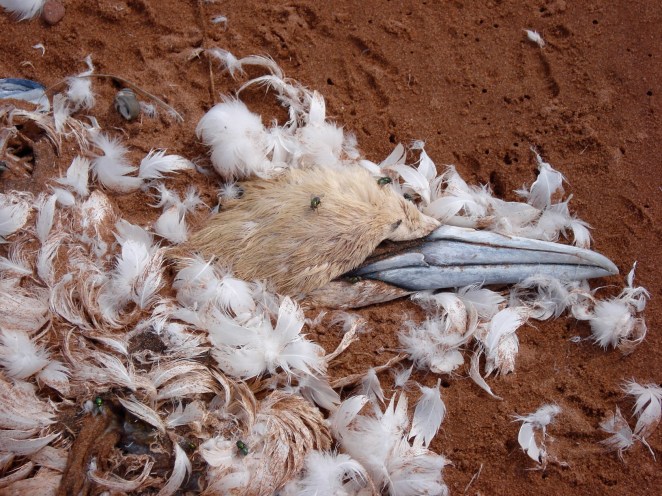
That’s a golden oldie from a couple of years back. I did both jabs in the same arm this year and didn’t feel a thing. It didn’t rain either, but look at the muck coming down in the photo – we had a bit of that a couple of days ago. Welcome to our Canadian half-winter. We used to get 3 metres / ten feet of snow every winter. Last year I only used the snowblower of three occasions. No wonder I think of it as a half-winter – winter ain’t what it used to be.

Daffodils

Daffodils

Winter’s chill lingers well into spring.
I buy daffodils to encourage the sun
to return and shine in the kitchen.
Tight-clenched fists their buds,
they sit on the table and I wait
for them to open.

For ten long days the daffodils
endured, bringing to vase and breakfast-
table stored up sunshine and the silky
softness of their golden gift.

Their scent grew stronger as they
gathered strength from the sugar
we placed in their water, but now
they have withered and their day is done.

Dry and shriveled they stand paper-
thin and brown, crisp to the touch.
They hang their heads as their time
runs out and death weighs them down.

Commentary:

A sad poem, really, for a wet, damp, dark, chilly day that begs for some light and warmth. And what warmth and light daffodils bring. Not to mention their delicate scent that lingers long in the nostril, faint, but intoxicating. For ten long days the daffodils endured. This was a joy in itself. Sometimes cut flowers wither so quickly. But ten days … wow! And they do indeed bring to vase and breakfast-table stored up sunshine and the silky softness of their golden gift.

Their scent grew stronger as they gathered strength from the sugar we placed in their water. Indeed it did. And the sugar itself enhanced their ability to linger on. A little Somerset trick that, all the way from Zummer Zet where the cider apples grow. And no, you can’t have real cider without real cider apples from real cider apple trees. But never forget Sally the Sozzled Sow – she got into the storage shed and drank about five gallons of the stuff. It was all over the newspapers. She got loose and knocked the milk churns over and rolled them in the clover. The corn was half cut at the time, and so was she.

Dry and shriveled they stand paper-thin and brown, crisp to the touch. So sad when this starts to happen. Then one day, they just fade away. And then they hang their heads as their time runs out and death weighs them down. Sad, really, as I said at the start – but we must never forget the joy and light and happiness they bring us when they are in their prime.

Carved in Stone 61 & 62

Carved in Stone
61

Water through the water clock,
water off a duck’s back,
the waters of life,
continually flowing,
trapped in our children
and their children,
and the love we create
never lost, just circling,
like the hands of the clock,
like the planets and stars.

But who will wind up
the clockwork universe,
and tend the mechanism
that balances planets and stars?

What will happen
when the clockwork
finally runs down,
the last candle is snuffed,
and the water clock dries up?

62

Whoever, whatever remains
will be left to contemplate
Ozymandias with his two vast
and trunkless legs of stone,
standing in the desert.

“Look on my works,
ye mighty, and despair.”

Commentary:

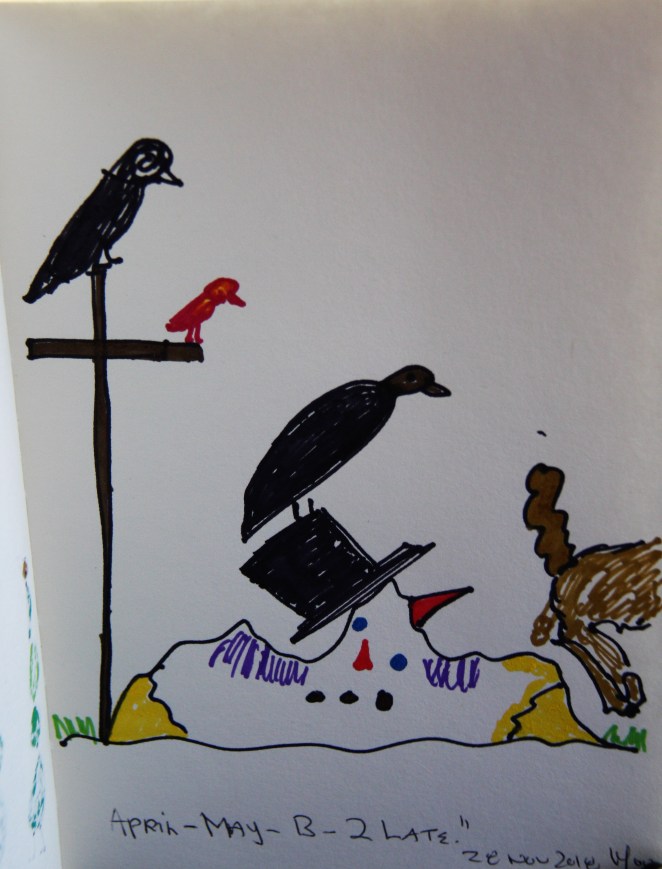
“Look on my works, ye mighty, and despair.” Well, Moo does have a sense of humor after all. I thought he did. From Ozymandias to the meaning of “works” to the destiny of the work we did. What a journey. It goes from the joy of the children who build a snowman to the warm spring wind that melts him to the crows and the dog who do what crows and doggies do. Intertextuality – the links between verbal and visual and think about it – such strange things happens in Moo’s creative mind.

But what do we leave behind? Think about it. Only the wake of the ship in which we sail. The wake – that white trail we leave behind us, on the surface of the sea, slowly vanishing as we also vanish, pulling away into the unknown that always lies ahead. Moo is right – so many things disappear out of the frame of the painting. “There are no pockets in shrouds” said the preacher in the hospital where I took my father, so long ago for treatment.

And even if there were, how would you fit a snowman, several crows, a cardinal, and the rear end of a dog into the pocket? “Contemplate Ozymandias with his two vast and trunkless legs of stone, standing in the desert. Now contemplate the fate of the snowman. Now look on my works, ye mighty, and despair.”


Carved in Stone 59 & 60

Carved in Stone
59

St. David of Wales once said,
“Do ye the little things in life.” 

I do, and I wander
along the banks of the River Taff,
admiring how wild daffodils
flourish each spring, in Wales.

Young, I run on the beaches,
Brandy Cove, Pwll Ddu, Langland,
Caswell, Swansea Bay,
and, as I write these words,
I hear my footsteps
echoing back through time.

Baudelaire’s words ring in my mind,
“Creativity is nothing more nor less
than childhood recovered at will.”

Or, as Pablo Picasso said,
“I have spent my life
learning to see, paint,
and write again, like a child.”

And on and on I go –
child-hood, youth, maturity, age,
then back to my second childhood,
when I can recreate
that youthful world
in all its joyous beauty.

60

Does life flows through me,
like water in a clepsydra?

Does it flicker like a candle
guttering on a church altar?

Is it circular, like a sundial,
or the Roman numerals
on the face of the clock?

Am I just flesh and blood,
doomed to blossom and flourish,
then wither and perish?

Or will some small part of me
linger on, an unchained melody,
with all my memories slowly erased.

Commentary:

Moo’s daffodils are painted and potted, not growing wild at all. They are still the national flower of Wales and they still grow wild, in the spring, in Blackweir Gardens and beside Roath Park Lake. At least, I hope they do. I haven’t been back to check for 37 years now. Maybe things have changed, and the daffodils have gone the way of the sky lark, the cuckoo, the cowslips, and the bluebells. I wonder if the foxes still wear gloves? Let me know if you know the answer to that one. Just write “I do” on the back of the usual postcard. And you know what to do with it.

As for me, I am moving into my second childhood and, in may ways it is so much better than my first one. Here, I am free to look back on my life, to harvest my memories, to paint what I want – well, what Moo wants, anyway – and to think my own thoughts. Thank heavens Moo doesn’t think for me, though he does get his fingers covered in paint when he reads my mind and puts paintbrush to postcard, and designs his designs.

I feel very sorry for Moo. I guess he never had a childhood, so therefore, ipso facto, he can never have a second one. How much he is missing even he doesn’t know. How could he? Mysterious Moo – I like that idea. Sólo el misterio nos hace vivir, sólo el misterio. Only the mystery keeps us alive, only the mystery. And if you guessed that the author was Federico García Lorca, then you can award yourself a glow of satisfaction, for I have no prizes to hand around.

But hold on a moment, that was the title of one of Lorca’s drawings, so he was the artist, yes, but maybe not the author. Picky, picky nit-picky! Another of the joys of second childhood – annoyingly spotting the minor slips of other second-childhood thinkers – and never, never ever admit the mistakes you might, or might not make, are your own. Blame someone else. There’s always somebody out there whether to own up to your errors, especially if the price is right.

Dorset Knobs and Old Vinny

Dorset Knobs and Old Vinny

Five Lysol wipes remain in the can.
As rare as hen’s teeth or Dorset Knobs
and old Vinny, they have become precious
items sold in marked up prices online
by people who stocked up at the beginning
of the crisis on commodities they were able
to seize before rationing stepped in
and limited quantities were permitted
to each purchaser who waited patiently,
in line, to enter the super-market.

I place my leather glove on my hand
and move to the gas pump. How many people
have used it, pumping gas with bare hands,
and the metal surface retaining how many germs
who knows for how long? I cannot wear my mask
while pumping gas. Cover my face and they will
not serve me for fear I may flee without paying.
I finish pumping, open the car door, remove
my glove, put on my mask, pick up my cane,
and walk into the gas-station shop to pay.

As I limp towards the door, a man, mask-less,
holds the door open for me, his face less
than a foot from mine. “There you are, sir,”
he says, showing his teeth. “Service with a smile.”

I return to the car, remove a precious sanitizing wipe,
clean my glove, the car door handles, every spot
my gloved hand touched. Then I wipe the handle
of the gas pump and dispose of the precious wipe
in the garbage can nestled between the pumps.

Commentary:

Well, I am willing to place a bet with my favorite bookmaker, at Covey’s Print Shop, that not many of you out there know what Dorset Knobs and Old Vinny is or are. Moo has joined me in my wager and he is willing to bet that very few of you know where the line “où est le papier?” comes from. Even fewer will be able to sing the whole song! Oh dear, our world is only artificially intelligent, not really intelligent. In my teaching days I would ask the class if we were in a smart classroom. “Yes, sir,” they would reply. I’d then walk to the wall, tap it and ask it “What’s 2 + 2?” The wall never answered. I’d try again. “What’s 2 + 2?” – Silence. “Not such a smart classroom then,” I’d say to the students.

But I bet you all remember Covid, the days of taking all sorts of precautions, of wearing masks and gloves, of washing everything that came into the house, of washing hands, and not touching surfaces in public places where the unwashed may have left a winning lottery ticket with your Covid Number upon it. Oh dear, those were indeed the days. And this little poem, a golden oldie, recalls them. Let us hope they do not return. And let us doubly hope they do not return with a mutating or mutated helix of sinister proportions.

Latch-Key Kid

Latch-Key Kid

In one room in my head, I stand on a stool beside my father’s mother helping her to mix the cake she will later bake in the wood-fired oven of her black, cast-iron stove. Every time she mixes a cake, she places a small piece in a dish and bakes it just for me. As a child, I spent hours in that kitchen, watching her cook. When she boiled vegetables, she never threw out the vegetable water, but used it for boiling other vegetables or for making rich, thick, delicious gravy.

Later, with both my parents working, I became a latch-key kid. I spent all day in an otherwise empty house and cooked my own breakfast and lunch. I also prepared supper for my parents so that it would be waiting when they came home. I grew up loving to cook.

When I went abroad to spend my summers in Spain or in France, I spent as much time as possible in the kitchens, watching, listening, learning. The women always had time for a small child. Then men seldom did. Children should be seen and not heard. They just got in the way. That was the male attitude. I learned so much in those kitchens.

Later, in Santander, my landlady would place one egg, one onion, and one potato beside the stove. It didn’t matter what time I came back from a night out with the boys, my supper was there, a Spanish omelet, una tortilla Española, waiting for me to cook it. Sometimes she left me a piece of chorizo, but I preferred the omelets. I did enjoy making shapes and designs out of the chorizo – that was always fun.

Not many people knew about my cooking skills. One of my aunties always cooked for me. She told me that her husband didn’t even know how to boil an egg. The men in my family seldom cooked, except for my maternal grandfather, who learned how to fend for himself in the trenches and dug-outs during WWI. He taught me how to make stews and soups, rich and nourishing, and always better on the third day. He also told me what he put in them – and you wouldn’t want to know about what he hunted and scavenged to stay alive in those cold, dark days. Nowadays, so many of us just don’t know how lucky we are. I do know how happy and lucky I am, not to be homeless, not to be living out on the streets, dependent on soup kitchens, charity, and fighting the elements just to stay alive.

Carved in Stone 51 & 52

Carved in Stone
51

Time, shape, and location –
the Templars’ Castle
in Ponferrada,
considered impregnable,
but it had no water works,
no moat.

Napoleon placed his cannon
on the hills above
and fired down into the bailey,
shattering walls, gates, and doors.

Again, only the ruins remain
inhabited by choughs
that nest in the walls,
and rise up in stormy clouds
when visitors disturb them.
 
I go there on a sunny day
and wonder when the castle drowses
if it dreams of its former glories,
ground down into the dust.

52

I climb a ruined wall
and watch white clouds
as they gather over the hills,
then roll down into the valley –
a cavalry charge of plunging horses.

So easy to see
Santiago Matamoros,
St. James the Moor Slayer,
descending from the clouds
to rescue the Christian army.

I study the skies
and see something secret,
almost mythical,
carved from the mists of time.

But this not my land
and these are not my people
nor my legends.

I sense I am not welcome here,
that I can never belong,
and I decide to move on.

Commentary:
“I sense that I am not welcome here, that I can never belong, time to move on.” Sad words – but we live in a world that, all too often, has turned its back on people. More, it has turned them into numbers and statistics, and number sand statistics are not flesh and blood. Tragic really. And doubly tragic the labels that are stuck on people. So hard to get off, those sticky labels, for they are designed not to come off easily, but to linger, like sticky plastic wrappers in the grocery store.

James Bond – 007 – interesting – but I am not a number, though I have had numbers attached to me all my life, as have you and all the people you know. Number plates on cars, telephone numbers, Medicare numbers, dental care numbers, bank account numbers, driving license numbers, student numbers, graduate student numbers, library card numbers – and now passwords, a mixture of numbers, letters (small and capital), and signs, all jumbled in such a way as to make things inaccessible for those who do not know the numbers. An alien world, my friends, for the numbers, those numbers, are much more important than we are, and each of us, like it or not, is reduced to a number, or a label, or a recognizable feature or nick-name.

So, how do we belong? How do we fit in? How do we survive? If we are lucky, we have small communities that thrive around us and look after us. But sometimes we are left alone. All alone. And then we have nothing to belong to, no sense of being, of belonging, no sense of a valued place in life, of being worthy. And when our worthlessness sinks in, then we sink lower, and lower, and we wake up one day and realize that it is all over and that the end is near, for we have nothing, not even the desire to live on.

Carved in Stone 50

Carved in Stone
50

Here, in the castle of my own home,
I sit and write and patiently wait
for the enemy’s superior forces
to arrive and overwhelm me.

But death is not the enemy.
He is the friend
who has walked beside me
every day, since the day
that I was born.

I know him and I trust him,
though I am unaware
of when he will come to call
and I am ignorant of the shape
he will finally take.

Commentary:

Francisco de Quevedo, the 17th Century Spanish Neo-stoic and Metaphysical poet, wrote “the day I was born I took my first step on the path to death.” And so it is, with all of us. Sometimes we are able to choose our paths, sometimes they are forced upon us, sometimes they appear – with choices – and we make our selection and move on.

There are so many roads to travel. For Antonio Machado (Spain, Generation of 1898) there is no road. There is only a wake upon the sea – “Caminante, no hay camino, solo hay estela sobre el mar.” We must look back, to see where we have come from and where we have been. But there are many other possible paths, beside that of the sea – gravel paths, cobbled ways, log trucking roads in the Canadian Forest, cattle roads, transhumance roads, winding roads, straight Roman roads, roads that run up hill, down hill, or twist and bend following the paths of rivers.

The picture above shows the old Roman Road that leads to the Puerto del Pico, in the province of Avila. It followed the contours of the hill and formed part of the Ruta de la Plata, the road that took Latin American silver from Seville to the Spanish capital in Madrid. Look carefully and you can see the modern highway that runs parallel to the old Roman road. Nowadays, that older road is used for transhumance, the movement of cattle from the valleys in the winter to the hills in the summer. The same road, the same pass, so many different uses, and the road a wake upon the path of so many lives.

Carved in Stone 44

Carved in Stone
44

The old man, withered,
last house on the left,
leaning on his garden wall,
coughing, spitting up
coal dust and blood.

He’s not old, when you get close,
just grown old, underground,
where emphysema
and pneumoconiosis
devour men and boys.

He spits on the side walk.
Mining souvenirs,
Max Boyce calls them,
and they appear
every time the young man,
turned suddenly old,
starts to cough.

He can’t walk far,
wearing carpet slippers,
soft and furry,
just leans on the wall.

He fell, or was pushed,
into the trap at an early age,
when the coal seams
had grown so thin,
that only a small boy
could kneel before
the coal black altar
of the underground god
and, with a pick and shovel,
he learned to carve and shape
the long, slow death
contained in those seams.

Commentary

Moo’s painting, Coal Face, adorns the front cover of Carved in Stone, Chronotopos II. Coal Face is not the denigration of Black Face, white men pretending to be black by dyeing their faces, although they have some similarities. In Welsh Mining, the coal face is where the men used to dig when, with their shovel and their pick and their little lamp and wick, they knelt to dig out the coal. Knelt, because there was no standing room, deep down underground. Then, when the seams grew thinner, and the men could no longer reach them, the young boys were sent underground.

A day underground left men and boys with coal dust seamed into their bodies, especially their hands and their faces. Hence the triple meaning of black face – where the coal is dug, what men and boys looked like after a day’s work, and the blackening of their faces by white men, for the fun of it.

Faces are one thing, coal dust in the lungs is another. The result – emphysema and pneumoconiosis devour men and boys. Black lung, some call it. “And every time he coughs, he gets a mining souvenir” – a black spot coughed up on the sidewalk – Max Boyce.

Child labor, minimum wage, living wage, work that kills, slowly and silently, – what can I say? Forgive me, for I can say no more.

Carved in Stone 42

Carved in Stone
42

After school, in a cul-de-sac
that backs on to the railway yards,
the street boys show me
how to hold a knife,
how to approach a man,
how to ask for a light,
for a forbidden cigarette,
while other boys,
knives in hand, lie in wait
to ambush the victim.

How old am I?
Five or six.

I would go to Woolworth’s
with my friends and distract
the shop girl while the others
stole whatever they could.

Then we would go
to the public washroom,
boys and girls together,
and share the spoils.

Something for everyone,
and everyone sworn to secrecy,
a blood cult, knives
or razor blades inserted,
and wrist pressed to wrist.

Commentary:

Free will or determinism? How does one escape from the back-street poverty of a run-down neighborhood and emerge from the shadows to bask in the light of the sun? Or is it all a dream, a made-up picture of a childhood that never was in a neighborhood that never existed? Vanishing point – the railway tracks fading away into the distance. Point of vanishing – to lose oneself in the mysteries of a past that never was in order to establish a future that never will be. Dream, dream, dream – all I have to do is dream!

And then there are the nightmares, when the dreams are true and the memories are so exact that you can see the blood on the razor blade and feel the almost silent slash of this particular slice of life. Secrecy – and who can tell whether I am telling the truth, or not, here in a foreign land, not the land of my fathers – and I only had one father, that I am aware of, and one mother too – where nobody knows me and the children from that imagined back street would never think of visiting.

For Jorge Luis Borges, whom I met twice, once in Bristol and once in Toronto, – Canada was a land so distant and so cold that it lacked reality. And thus I can dream my dreams, rewrite my past, reimagine myself, in whatever way I want to and I can vanish at any vanishing point I choose and emerge wherever I want to, and do it over and over and again, and who knows the truth? Over the points, over the points, and Liza none the wiser, whoever Liza happens to be!!!