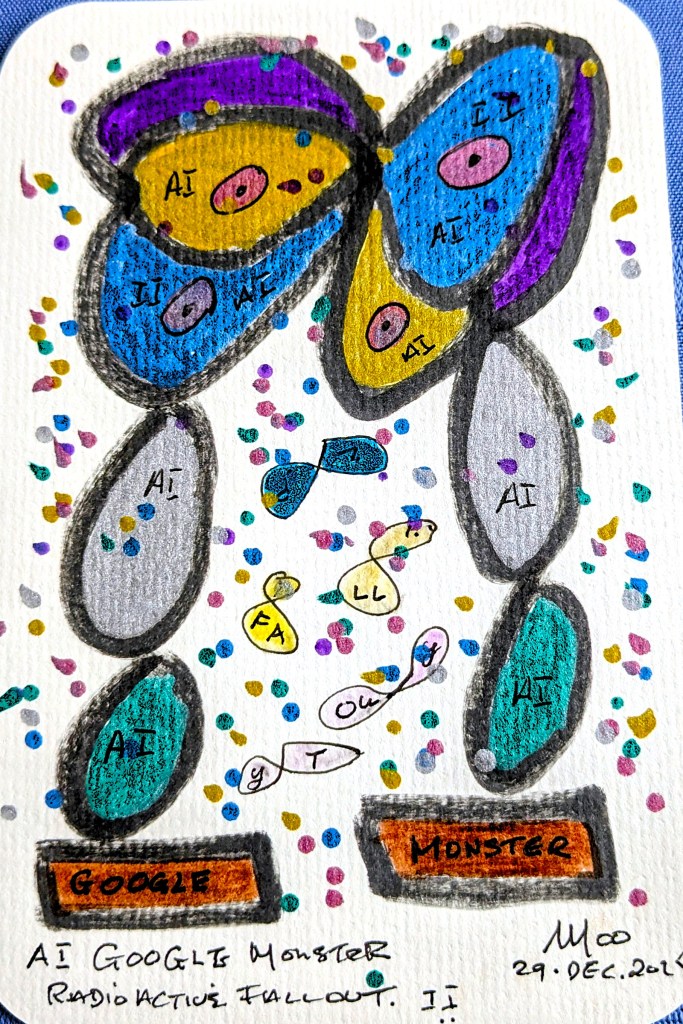
A picture is worth a thousand words.
A picture is worth a thousand words.
Rage, Rage
8
A late summer storm
lays waste to the doggy daze
that clouds my mind.
Carnivorous canicular,
hydropic, it drains my soul,
desiccates my dreams,
gnaws me into nothingness.
Tonight, the old black hound
will dog me,
sending my head spinning.
It will force me
to chase my own tail,
round and round
in ever-decreasing circles.
It will devour my future,
leaving past failures
to ghost through my mind.
9
Where now are the hands
that raise me up,
that rescue me
from dark depression,
that haul me out
from life’s whirlpool,
that forestall
the jaws that bite,
that save me
from the claws
that snatch?
Where are the hands
that move the pieces
on the chess board
of my days and nights,
that prepare my breakfast,
that bake my birthday cake
and count the candles
that they place and light?
What will I do
without them
now they are gone?
Commentary:
Gnawed into nothingness – the umbra nihili of the medieval mystics, the shadow of nothingness that sometimes falls upon us, threatening our peace of mind. An AI search offers – Umbra Nihili (Latin for “Shadow of Nothingness”) refers to a concept of cosmic loneliness or existential void famously cited by Meister Eckhart. A great many of my friends have recently discovered this umbra nihili. I am not sure why. I guess it varies for each one of us. Mal de todos, consuelo de tontos / that everyone suffers consoles only fools, the Spaniards say. What can we do at such times? Reach out, help when we can, count only the happy hours, as the inscription on the Roman sundial tells us – horas non numero nisi serenas.
Many have walked this way before. But that should not be a consolation in itself. Rather, it should be an acknowledgement that there is an exit to the maze, a key to unlock misery’s door, a thread to lead us out of the labyrinth. We must just acknowledge that fact and search for the exit, the key, the thread, that will prove to be our personal salvation, and hopefully the salvation of other fellow sufferers as well.
Rage, Rage
7
Blood of my blood,
my daughter’s daughter,
time is not on our side.
I sometimes wonder
if I’ll survive,
if you and I
will ever meet again.
When we talk online
I see you trying
to understand, to hold
my image in your mind,
to figure out this shadow
that moves and talks
on the computer screen.
Words, born from old Welsh
melodies, bring poetry
to my heart, place music
on my lips.
But they fall short,
and fail to satisfy
my need to reach out
and hold you.
In spite of that I still survive
and live in hopes to see you
in our realities of flesh and blood.
Commentary:
When I first came to Canada, such a long time ago, I communicated with home by means of air mail letters written on special air mail paper that came in very thin, foldable envelopes. Very rarely I communicated by means of very expensive telephone calls of a limited three minute duration. How times have changed. Now via Skype (as was), Team (as is), Messenger, FaceTime, and other means, we can have unlimited face to face conversations, free of charge, with people on the other side of the world. And yet, face to face and screen to screen, there is still something missing. The cat senses it. She stares at the screen and sniffs – then she bristles and hisses. She fails to understand a known voice that has sound and movement but no smell.
And yet, what we now have is so much better than what we had before. Communication is so much easier. We have generated a generation that works in the audio-visual world, not in my preferred world of written verbalization. How we have changed. I can do so many things, in my head, that the younger generation cannot do, even with pen or pencil and paper. However, when my computer fails me, or my cell phone acts up, it is to that younger generation I go, because they dominate this new world in which we live.
I gave one of my academic articles to a friend the other week. “I can’t read this,” he said. “Tell me, what’s it all about?” I started to explain. “Hold on,” he said. He asked his AI program to read my article and generate, in words a 14 year old could understand, the main contents of my not-so-easy-to-read academic writing and thinking. About thirty seconds later, the analyzed contents appeared on the screen before him. I threw my mind back to when Coles Notes were forbidden. “Anybody caught using Coles Notes will be given an automatic F.” Then I looked at my own article, analyzed perfectly, and set out in the very way I had planned it, albeit with a simplified vocabulary – and the longer words explained in a sort of appendix. Quite simply, I was blown away.
Then my mind went back to my childhood in Wales. No running water, no electricity, no indoor toilets, no telephones, no television, a radio with limited stations and programming … imagine what we have come from – imagine where we are going. My only questions – will we control it or will it control us? And you know what it is. The clarion call goes out across the centuries. – Quis custodiet ipsos custodies? Who shall guard the guards? Who shall police the police? Who shall program the programmers? Each generation must find its own answers to those questions. And the sooner you do it, the better because it’s not going to be my problem for much longer!
Rage, Rage
5
Empty now the house,
clean the floors
where she scattered her toys,
polished the grubby tables,
where her small hands
splattered food,
wanted and unwanted.
Empty the bathroom,
the tub where she took
her daily bath,
dry the towels she dampened,
wrinkled the toothpaste tubes
she happily emptied.
Empty too
this heart of mine
wherein she built her nest.
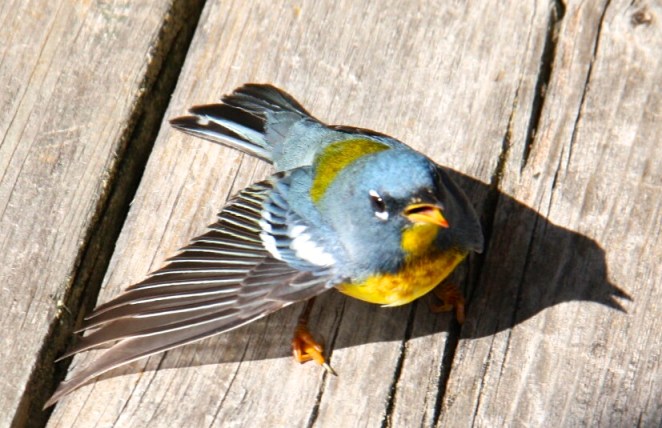
Like a wild bird, she has flown,
joined the end of summer migration,
yet I still possess a part of her
within my emptiness.
6
I remember how she stood
at the window, excited,
gazing at the birds.
“Finch,” I pointed.
“Goldfinch. Grosbeak.”
Her hands plucked at the air,
not a feather fell,
she caught nothing.
“Yellow, she cried, “yellow,”
jumping up and down with joy.
Her nose, all wet and runny,
left damp, sticky smudges
on the cold window-pane.
I see the greasy smears
that remain where her nostrils
pressed against the pane.
Still the glass stays unwashed
and now that shadow stands
between me and the sun.
Commentary:
Empty house, empty nest. How many homes have just enjoyed the festive spirit, rejoicing in the company of family and friends. Alas, the holiday is almost done. In many houses, the taxis have left for the airport, the cars have driven away, the rooms that were filled with warmth, joy, and laughter are cold and empty. Only the shadows remain. The echo of voices that are now silent.
The old remain, as they were before the festive invasion, old and lonely. The young have flown back and away to their usual lives, their schools, their jobs. I sit before my screen and type these words. My beloved sits in another room and watches TV. When the adverts come on, the volume increases and the same tedious voices mouth their joyless messages. My nest may be empty, but I do not have an empty head. And I don’t want it swamped by the commercial acumen of the tv set.
My head contains many rooms and many of those rooms are filled with memories that will, as Albert Camus said, last me a lifetime. One summer afternoon, examined in its intensity, will last forever, or for as long as the viewer lasts. Alas, I mourn for those who age, who suffer from Alzheimer’s and the like, and whose heads are empty. What do they think, what do they feel, what twilight memories flicker through the empty nests of their ageing brains? I hope and pray I never know.
Rage, Rage
4
I walk from room to room,
startled by shadows,
and open doors,
search under the table,
look behind chairs.
Nothing. No one.
The house stands
still and empty,
but for the sadness,
the silent sadness,
that fills each room
with their remembered
presence.
Commentary:
Absence and presence. How many of us feel that something is there, walking beside us, or just behind us? How many feel that an empty room is not empty, but is filled with a presence, something we feel, half-recognize?
I have been in houses, invited for the night, where I would not sleep. Why? I do not know. But I felt a presence, a prescience, if you wish, that filled me with a desire to leave and not to stay.
What is it? Is it other memories, other lives, that impinge upon ours in this current time frame? I do not know. But I do know that there are houses and rooms in which I will not stay. I also know that there are others that throw open warm arms to welcome me.
Look at Moo’s painting(s). How many of them welcome us in? Do some of them shut us out and make us shiver with a fear, not of the unknown, but of the hardly-remembered, that lies in wait to shake us out of this dream which is our present life?

Rage, Rage
2
These problems start the day
you realize you are alone.
Your beloved goes away,
for a holiday,
to be with your daughter
and grandchild.
Now the house and the cat
are yours, and yours alone.
No problem you say and
everyone believes you.
You jumped in the car,
drove daughter, and child,
holidays done,
to the airport.
Your beloved went with them,
her holiday about to begin.
And that’s when it all began.
3
When I come back home
from leaving them at the airport,
the front door stands open.
I thought I had closed it
when we left.
I tip-toe in and call out
“Is anybody there?”
Echo answers me –
‘… there, there, there …”
Commentary:
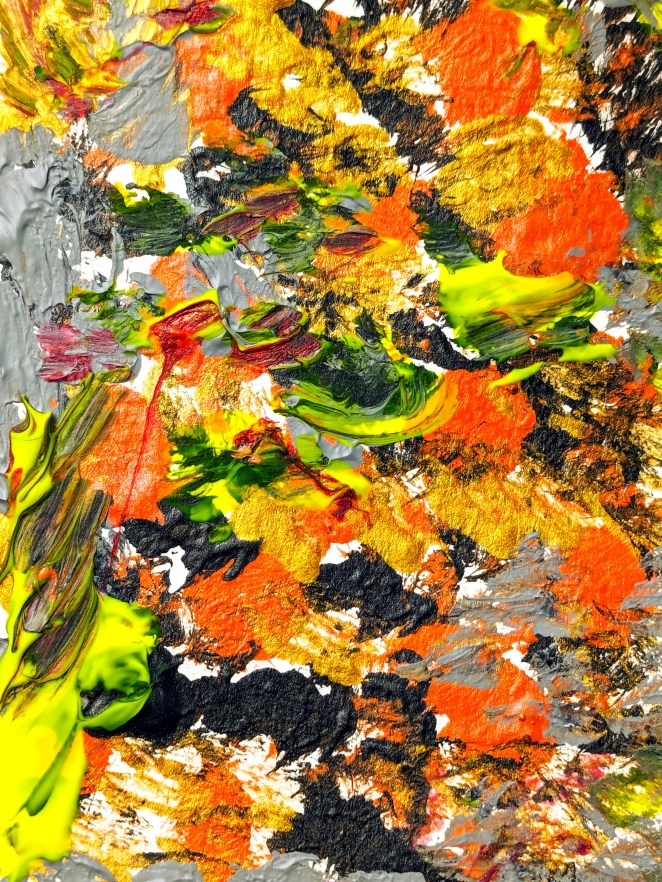
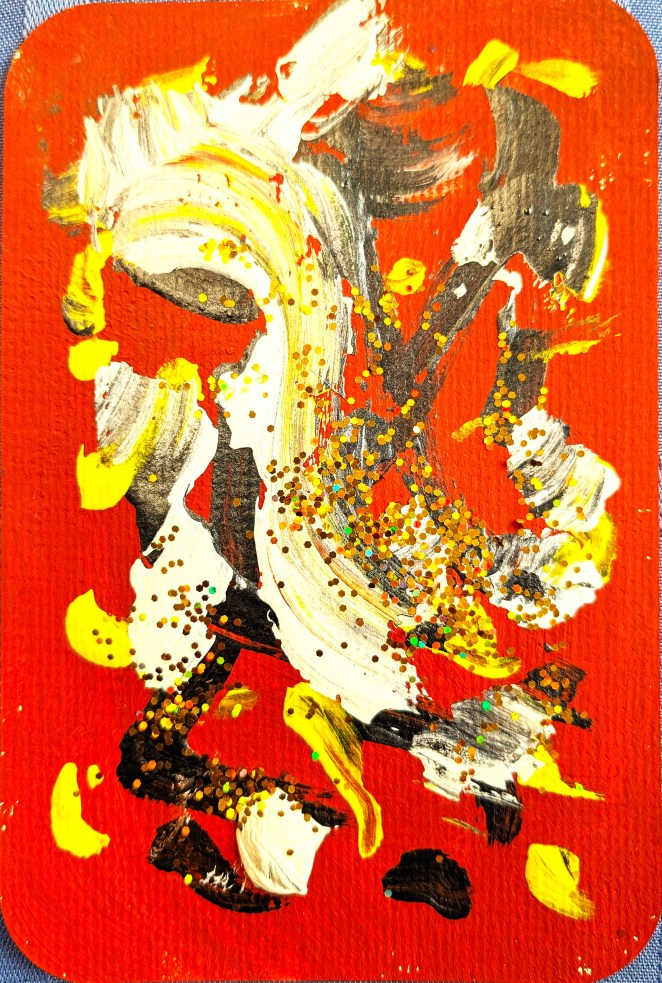
Raymond Guy LeBlanc, one of my favorite Acadian poets, published his poetry book, Cri de Terre, in 1972. My painter friend Moo, who also likes Acadian poetry, borrowed the title and changed it slightly when he painted this painting – Cri de Coeur. Earth Cry / Heart Cry.
What is all creativity, visual of verbal, but a cry from the land or a cry from the heart? Sometimes it is more than a cry – it becomes a clarion call, a shout out, a calling out.
So many of us are born with creativity in our hearts. So few of us carry that creativity, be it verbal or visual, into the adult world, a world that all too often grinds us down and sifts us out. We become grey people in grey clothing sitting behind grey desks beneath artificial lighting, doing grey jobs that slowly turn us into nine to five (or longer) dusts.
Moo has promised me a series of red paintings for this sequence. We shall see how he does. Red for anger, red for age, a red flag for danger, a red rag to wave at the raging bull of life, to provoke it, then bring it under control.
Nadolig Llawen – Welsh for Have a Joyous Festive Season. You can add other languages, as you wish. But above all remember Pedro Calderon de la Barca’s words – “Life is a dream and dreams are nothing but dreams.” One day, we shall all wake up. Artists and dreamers, grey ghosts and people of straw and dust.

Rage, Rage
1
Old age creeps up on you,
slowly, ambushes you,
catches you unawares.
At first, you don’t believe
that it’s real.
You ignore the signs,
pretend they aren’t there.
Then comes a knock on the door.
There, did you hear it?
Around you your body’s house
slumbers in comfort.
You lose your footing,
but you do not fall.
Your book drops to the floor,
you bend down and pick it up.
Everything is as it always was.
Or is it? One of your friends
slips and falls down the stairs.
You descend the stairs
with more care than usual.
No, you don’t need a cane.
Nor special shoes and socks.
You convince yourself that
all is well. And so it is,
for a little while longer.
Commentary:
Rage, Rage
against the dying of the light
Dylan Thomas’s famous poem celebrates the passing of his father. “Do not go gentle into that good night, / old age should burn and rave at close of day. Rage, rage against the dying of the light.”
I am no Dylan Thomas, although I am still a Swansea boy at heart and, as my paternal grandfather used to sing while at the fighting front during WWI – “and still I live in hopes to see Swansea Town once more.”
Alas, I never will see Swansea Town, save in my dreams, for Swansea Town is no longer a town. It is now Swansea City and no, I will not be leaving Island View again, not even to return to Wales, the land of my fathers. But I can and do age, and ageing is a strange and very personal experience. These pages contain the thoughts that occur to me, in my solitude, as I come to terms with my diminishing existence.
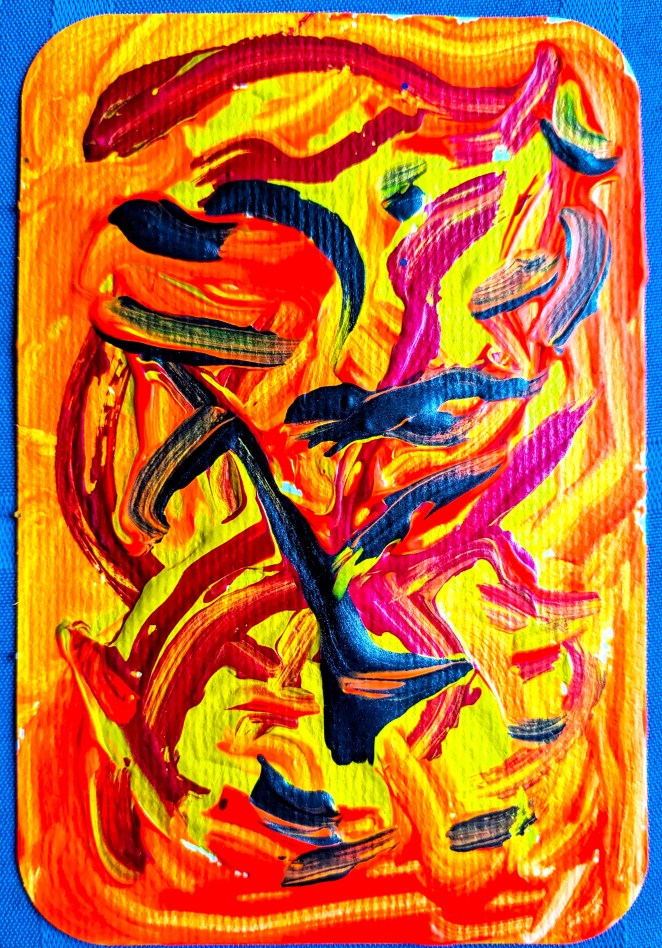
Moo has been very silently recently. But when he saw this poem he climbed out of the woodwork where he had been hiding like a silent spider and he said “Roger, have I got just the painting for you.” The painting is also called Rage, Rage – make of that what you will.

Carved in Stone
72
Is this world I create real?
Of course it isn’t.
It exists only in my head,
and on the page,
but perhaps, one day,
you too will see
the things I have seen.
Yet the world I describe
is as unreal as the words
from which it is woven.
73
Heraclitus once wrote
we can never bathe
in the same river twice.
This is the Catch 22
faced by all poets,
to remember,
and to try to recreate.
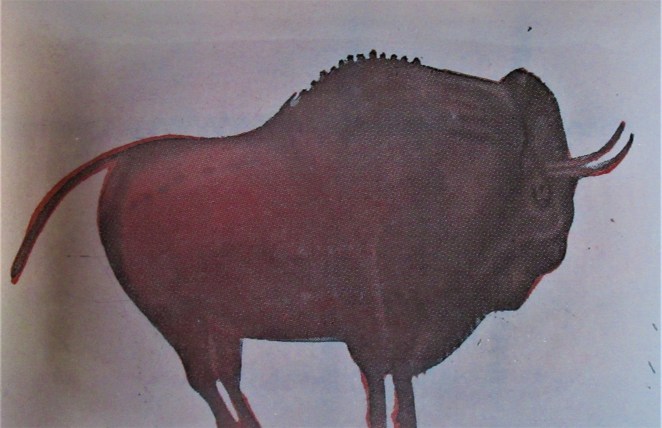
Shadow hands on cave walls,
colored pictographs on gesso,
hieroglyphics on papyrus,
ink on paper, raw words,
and in the end,
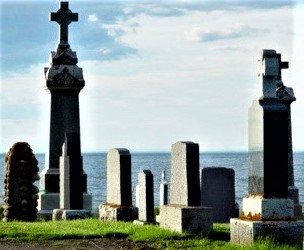
everything reduced
to these three little letters
carved in stone –
RIP
Commentary:
If you have read this far, we have walked a long journey together – 73 verses that comment on life and the meaning of life. Hard reading in places, easy in others. I trust you have enjoyed the journey and found some stops and resting points along the way in which to contemplate the ways in which the threads of your own life intermingle with mine.
Throughout this journey, I have tried to use a four step process. (1) Verbal – the poems themselves. (2) Visual – photos that intertwine with the verbal. (3) A Commentary – that goes beyond the verbal and visual and opens up the ideas a little more. (4) A Dialog between myself – the poet – and Moo – the visual artist who has so frequently loaned me his paintings when he thinks they illustrate my words.
It’s been a topsy-turvy journey through what Bakhtin calls a world of carnival, where little is at it seems, and the world is turned upside down. That said, we have a clear choice – to slide down the downside of this life, or to scale the upside, to contemplate, with joy and happiness, the world from those heady heights.
Blessings. Pax amorque.
And thank you for travelling with me.
Sheep
Wales is whales (with an aitch) to my daughter who has only been there once on holiday, very young, to see her grandparents, a grim old man and a wrinkled woman. They wrapped her in a shawl and hugged her till she cried herself to sleep suffocating in a straitjacket of warm Welsh wool. So how do I explain the sheep? They are everywhere, I say, on lawns and in gardens. I once knew a man whose every prize tulip was devoured by a sheep, a single sheep who sneaked into the garden the day he left the gate ajar. They get everywhere, I say, everywhere. Why, I remember five sheep riding in a truck on the coal train leering like tourists travelling God knows where bleating fiercely as they went by. In Wales, I say, sheep are magic. When you travel to London on the train, just before you leave Wales at Severn Tunnel Junction, you must lean out of the carriage window and say “Good morning, Mister Sheep!” And if that sheep looks up, your every wish will be granted. And look at that poster on the wall: a hillside of white on green, and every sheep as still as a stone, and each white stone a roche moutonnée.
Commentary:
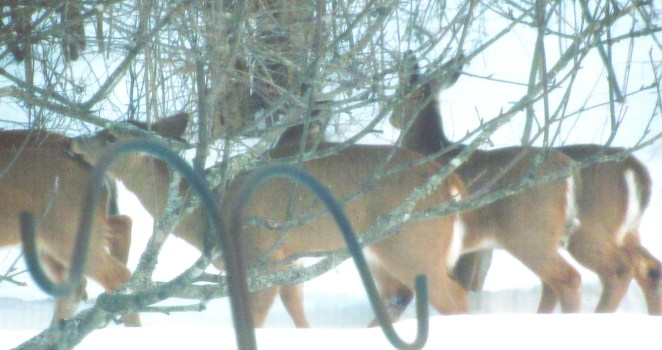
Sheep in Wales and deer in Canada. And here is a little group wandering around in our garden. So how do I explain the deer? They are everywhere, I say, on lawns and in gardens. I once knew a man whose every green leafed plant was devoured by a herd of deer, who sneaked into the garden the day he left the gate ajar. They get everywhere, I say, everywhere. And everybody loves them, because the heart beats a little faster when you see them walk by.
Carved in Stone
70
Where can I survive
in this harsh world
where poetry and ideas
struggle to be free,
a world in which
the great literary myths
have been destroyed?
Where mass media rules,
sensationalizes, lies,
falsifies the power and glory
of words, now used
not to delight and educate,
but to manipulate.
A treacherous world
in which an evil genius rules
and constantly misleads us.
71
An Age, not of Enlightenment,
but of Endarkenment,
this is not the world
in which I want to live.
My chosen world
is that quiet corner,
outside El Rincón
in the Plaza Zurraquín,
by the Mercado Chico,
in Ávila, Spain,
where leaves and confetti
dance to the wind’s tune.
A world of mystery and dream,
personal perhaps,
but well known to
all of those dreamers
who have the eyes to see
and the heart to stand still
and listen.
Commentary:
“There is no earth, no heaven, no extended body, no magnitude, no place and that nonetheless I perceive these things and they seem good to me. And this is the most harrowing possibility of all, that our world is commanded by a deity who deceives humanity and we cannot avoid being misled for there may be systematic deception and then all is lost. And even the most reliable information is dubious, for we may be faced with an evil genius who is deceiving us and then there can be no reassurance in the foundations of our knowledge.” René Descartes (1596-1650).
Cervantes wrote about such times in Don Quixote. Do we see what others see? What is truth and what is fiction? How do we approach and understand authority? What do we believe and why do we believe? Are they windmills or giants, wineskins or warriors, a flock of sheep or an invading army? “Only believe, and thou shalt see” – but what do we believe and why do we believe. “The fault, dear Brutus, lies in ourselves, not in the stars, that we are underlings,” Shakespeare, from one of his many plays.
 rogermoorepoet