Carved in Stone 16 & 17

16

The Bulls of Guisando,
pre-historic, unweighable,
the bearers of Roman graffiti,
itself two thousand years old.

Were they carved as boundary markers,
or designed to designate pastures,
for horses, pigs, sheep, and bulls,
all grazing in their stone dreams?

Celtic, pre-Roman,
they speak to my Welsh blood,
and to the Irish soul
that will always be a part of me.

I place my hand
on the dimpled granite hide
and feel time coursing
beneath the stone skin.

Granite ships,
islands in a sea of time,
I sense a heart beating,
something surviving
within the stone.

17

We are powerful people,
we creative artists,
we carvers of stone,
we dreamers,
whether we dream
by day or by night.

Those of us
who dream by day,
often see our day-dreams
come true.

Commentary:

“Those of us who dream by day, often see our day-dreams come true.” Lawrence of Arabia – The Seven Pillars of Wisdom. You recognized the quote of course, wrth gwrs. Intertextuality, the weaving of words through text after text in different combinations according to our time and space. Some of us think we are original, but there are only so many plots to a play, 24 or so, if I remember my Aristotle correctly, and I have changed the number, just to test you. Oh ye of too much faith!

We think we are original, but, as Picasso said, the painters of the cave paintings, all those many years ago, created everything we artists could ever dream of. We all borrow in one way or another and originality is merely a disguised form of borrowing. The faces change, the actors change, the medium changes, the times change, but otherwise, everything else is the same. Sad, really, that we should claim originality (and fresh water) for all that water that has passed under so many bridges.

Welsh blood and Irish soul – not even original, but shared by so many in my family. Add an English education, studies and residence in Spain, France, Mexico, Canada, and the USA, and what do you have? An intellectual mongrel, that does not know its own mother, like so many other mongrels, and that shakes its coat only to shed so many multi-cultural and multi-lingual fleas.

And remember – “Great fleas have lesser fleas upon their backs to bit them, and lesser fleas have smaller fleas, and so ad infinitum.” Intertextuality – they were only playing leap-frog and one jumped over and another jumped over someone else’s back.
Carved in Stone 13

13

What is life?
Is it just an illusion,
as Calderón tells us,
and nothing but a dream?

And what is time?
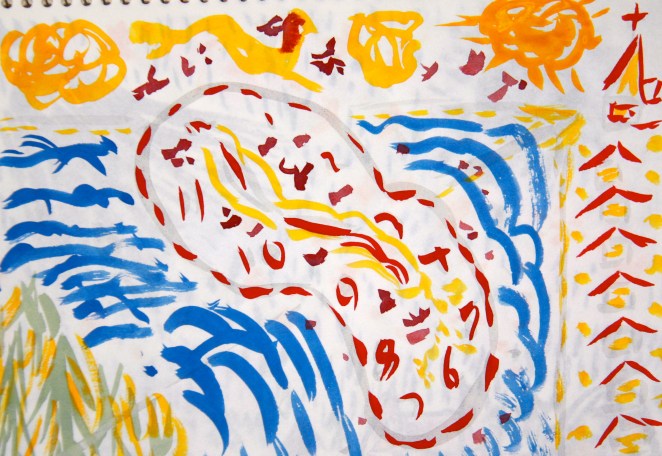
Does it bend, as Dalí shows us
when his surreal clock breaks into pieces,
time and numbers flying off
as it explodes over a waterfall?

Another clock folds –
a pancake draped
over the bough of a tree.
 
Time – a water clock,
a marked candle,
a grandfather clock,
with Roman numerals,
and time marching,
round and round,
erasing the past,
establishing a future
that will itself
soon be erased.

And what am I
but a moment on time’s clock,
a drop in the clepsydra,
a striation on a flickering candle,
a piece of roughly polished sea-glass
perched on a lonely beach?

Commentary:

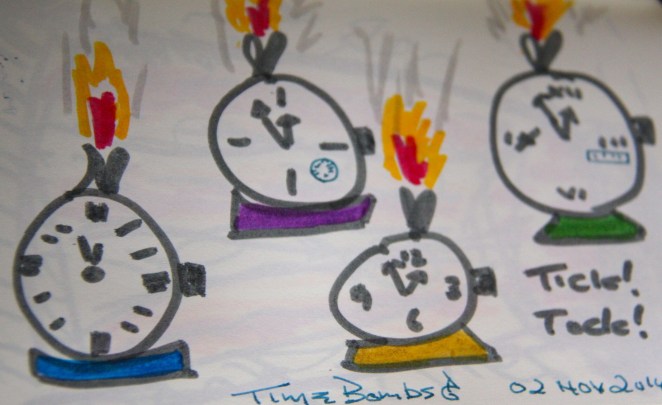
Well, Moo has done me proud this time. Two early paintings, both depicting aspects of time, as conceived by Moo. In the first, time is seen as a tick-tock time bomb, or rather a set of tick-tock time-bombs. In the second, in imitation of Salvador Dali (Moo always set his sights high!), a clock going over a water fall and the hours flying off the clock face as time bends. So, tell me if you can, what is time?

Perhaps more important, what is life? Is it a dream, an illusion? And if it is a dream, what happens when we wake up? I know what happens when I wake up – I get up and go pee. Is that to be my final reality? By extension, is life our only reality? Or is our life a series of lives, as some religions would persuade us? And if a cat has nine lives, how many lives do we have? Can they be numbered? Or, like innumerable onions, do we peel away layer after layer? And if so, what is in the centre of the onion when we finally get down that far?

And why do some people write center while others write centre? Is life an illusion, a play? If so does it take place in a theatre or a theater? Or is really a sort of metatheatre or metatheater, life in rings, like the onion, lay after lay, layer after layer? Oh dear, this is all much too complicated. I’ll ask Moo to paint me a painting of life and we’ll see what he comes up with. He’s a bit lazy at the moment and his paint brush has the bends and refuses to cooperate. It’s probably made of cat bristles, and is untrainable and almost impossible to train, let alone to herd. Never mind. We’ll abandon all this for now and give the cat the task of training Moo to paint another painting.

Carved in Stone 12

12

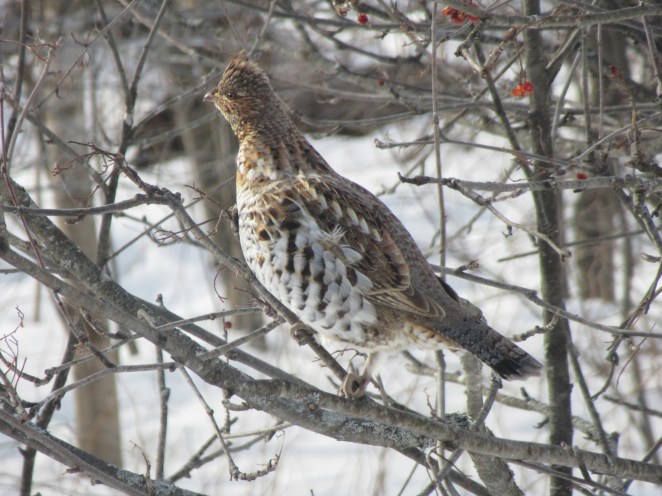
A Ruffed Grouse sought refuge
among the berries
of the Mountain Ash.

I shot him,
not with a gun,
but with a camera.

Intertextuality –
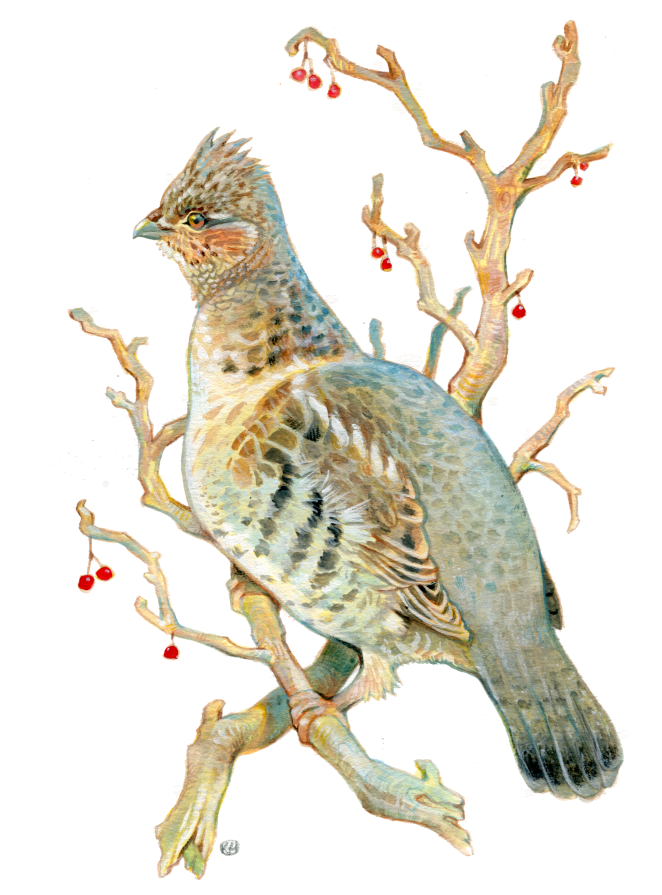
a friend borrowed the photo,
turned it into elegant brush strokes,
and now the painting
hangs on my wall,
opposite the tree
where once he sat.


A still-life
face to face with its reality
as early morning dew
forms on spider webs,
hammock-strung
between grass-blades,
bending in the wind.

And what if the spell breaks
and I can no longer see the fine seeds
of the dandelion clock kissed away
by the lisping lips of time?

What is life?
Is it just an illusion?

Commentary:

I shot him, not with a gun, but with a camera. Interesting. I have never seen the need to take the life of living creatures, except in cases of absolute necessity. And no, I have never killed, let alone for fun or sport. Shooting with a camera, that’s my ideal, and when a friend and fellow KIRA artist likes the photo and offers to paint it … well, that leads us into the nature of intertextuality, where reality becomes photo, becomes painting, becomes a text, and you, dear reader, are contemplating all those moments that join us.

The fine seeds of the dandelion clock kissed away by the lisping lips of time. This image comes from my walks in the Welsh countryside around Brandy Cove, Gower, with my paternal grandmother. “What time is it Nana?” I can still see her, bending down, plucking a dandelion, and holding it out for me to blow the seeds away – one puff, one o’clock, two puffs, two o’clock. I recall the seeds, drifting away on the summer breeze. “The Good Lord loved those dandelions,” she once told me. “That’s why He planted them everywhere.”

What will happen when the wells run dry and water runs out and there are no more dandelion seeds? How long will it be before I can no longer see them? Vis brevis, ars longa. The answer to my questions – I care, but I really don’t know.

Carved in Stone 3

3

Death is everywhere.
It rides a pale horse
in the lands
where Odin reigned.

Sleipnir, his eight-legged steed,
carried him round the world.

It also carried the god
to the underworld,
and brought him back,
one of the few to enjoy
a return ticket.

Purity, innocence, power,
the White Horse rules
these Wiltshire hills,
a symbol of hope and renewal.

Above the horses,
hill forts in high places,
lie hidden.

Wave after wave
of earth-wall and ditch
blend into the landscape
making the forts
invisible from below.

Commentary:

Odin > Wodin > Wednesday, in English, not Mercredi (French) or Miercoles (Spanish). English, via Anglo-Saxon, often goes back to the Nordic gods of the invaders. Not so in Welsh for Wednesday in Welsh is Dydd Mercher, the word breaking down into “Dydd” (day) and “Mercher” (which is named after the Roman god Mercury). Alas, it is all too easy to reduce language to its most basic level. But dig below the surface and the wonders of language, history and culture, adoption and rejection, complication and simplification, are all there to be seen.

Our language links us, binds us, holds us across our culture and history. And remember ‘to lose our language is to lose ourselves.’ While to learn another language is to grow another heart and soul.


Clepsydra 45 & 46

45

… I enter ancient rooms
     on the walls
          pale ghosts walk
               flickering shadows

why am I tongue-tied
     why do I struggle
          a fly in a spiderweb
               to make myself heard

I long for
     the freedom of flight
          for culture restored
                    for a return
                         to my own lost world

I grasp at shadows
     reaching out
          for the ones I know
                         are no longer there …

46

… how deeply time’s wounds

     have cut and carved
          through my flesh and bone

               into the embers
                    of that slow-burn fire
                         they call the heart

some days those wounds
     neither ache nor itch
          but in moments of madness
               a knife-edged finger nail
                    careless in the dark
                         opens them up

they throb again
     and begin to bleed afresh …

Commentary:

” … on the walls, pale ghosts walk flickering shadows – I grasp at shadows, reaching out for the ones I know are no longer there …” Vanity of vanities, all is vanity. For in much wisdom is much grief, and he who increases knowledge increases sorrow.

” … the embers of that slow-burn fire they call the heart … ” Pulvus eres et pulvus eris. Just another shadow on life’s wall.

Clepsydra 35 & 36

35
… to save myself
     I must grasp it firmly
          as I would a nettle
               not with my hands
                    but with my teeth

but my hands are tied
     behind my back
a cloth is bound
     over my eyes         
          and I cannot see … 

36

… I struggle and squirm
     until released
          I float ashore
               and stand on the sea wall
                    calling out to the moon
                         begging her not to hide
                              her scarred face


I entreat the ebbing tide
     to carry me with it out to sea
          past the island
               beyond the lighthouse
                    into deep water

waves stronger than any

     thing I have known
          thrust rough fingers
               under my arms
                    lift me up
                         then drag me down

to the depths
     where I can finally rest
          in peace …

Commentary:

Mors omnia solvit – death solves everything. But does it? What about the crossword, the jigsaw puzzle, the unsolved ? What about the problem of life itself? What is it? How does it function? And what is that poor bird doing lying on its PEI beach half-covered in sand? What problems did he have solved?

” my hands are tied behind my back, a cloth is bound over my eyes and I cannot see” …  so how can I tell where I am going and why I am going there? Simple questions – yet there are no answers, none that are given to me anyway. And who am I to reason why? Is my detiny, as always, to just do and die?

I do not know. The bird on the beach does not know. The ebbing tide doesn’t know, or care what it carries out with it. And what are we anyway? Why do we search for meaning in the meaningless? For answers in the absurd? And why does Sisyphus roll his rock up the hill, release it, then walk back down, pick it up and carry it up again? And why must we imagine that Sisyphus is happy? Our daily work – ce boureau sans merci – why should we be thankful for it?  Because there is nothing else? Because otherwise we would be abandoned? Or just because?

Oh, ho-ho-ho-ho, tell me if you know, who the… where the … why …. the what for … where did that one go? Even poor old Alf and dear old ‘Erbet, somewhere on the Somme, didn’t know the answer to that one. And they had their little dugout made a mess of by a bomb. Well, at least they found another hole, but when that other shell went over, it left them still wondering! And don’t we all?

Clepsydra 34

34

… my heart so broken
     I can’t count the pieces
          nor solve the puzzle

scars are trenches
     deep defensive lines
          gouged into my face 

every night
     the black dog returns
          and I wake up from a dream
               to find myself pincered

attracted by the light
     squeezed tight
          between cave walls

my top half struggles to be free
     my bottom half
          hips down is held
               in a ferocious grip

I scream the way
     a stuck pig screams
          when the knife flashes
               and the hot blood spurts

all at sea
     I move up and down
          on dark restless waves

I reach for a life raft
     but find only an apple
          bobbing as it floats …

Commentary:

Moo thought I needed cheering up, so he did this painting for me. U R My Sunshine, he said to me, then gave me the painting for today’s post. I think he was rather taken with the phrase ‘attracted by the light’ … hence the nice, bright, sunny painting. Whenever I feel down, Moo reminds me that every cloud has a silver lining. Today’s clouds over Island View certainly do. They have actually brought rain and we need that rain so badly. We are in the middle of a drought, in places it is a severe drought. Wells are drying up, the river and the aquifers are low, we need rain – and now we have some. Too late for the apple orchards and the farmers who do not have enough winter feed for their cattle. Too late for the local deer who do not have their usual post-summer glossy looks. And too late for the trees that look drab, having lost their usual fall glow to appear very pale and peaky. Let us hope that a little more rain, on a regular basis, will change all that, and give us the sort of silver lining that, next year, will produce golden apples and brightly colored fall leaves

Book of Life

Book of Life

When I lost my place, I tied my hanky in a knot,
to help me remember the number of my page.
Last night I looked in pockets and sleeve, but
I couldn’t remember where I put my hanky.

At midnight the stars dropped liquid fires and they
pooled like letters on the fresh snow of my dreams.

One night I caught some falling stars and I joined them
together, one by one, till they stretched their daisy chain
across the garden. Words grow like flowers in the Spring.

Once I could accelerate the universe. But now I slow
down when I spell my name. There is a circlet of gold
on the sky’s bright brow. What gave these stars the right
to write my future in expanding letters? A satellite moves
in a straight line, north to south and starlight crumbles
in the wake of artificial knowledge spanning the eye ball
of the planet.  Who will repair these broken tunes? Who
will glue these scattered notes back into the piano’s frame?

My tongue stumbles against my teeth and trips on my lip.
A leaf of fire scorches the deep bell sound of my throat.

Commentary:

I looked over my shoulder, backward into time and space, and discovered this poem, penned more than a quarter of a century ago and abandoned in an old folder. Moo tells me he hasn’t painted for some time – I wondered if he was on a rotating striking, like our posties (Canadian for mail men and women), but he assured me that he had been sleeping, not sleep-walking in circles. Anyway, he felt inspired, put paintbrush to postcard and gave new life to my Book of Life. Thank you, Moo.

Do you remember when we used to tie knots in our hankies to remember what we had to do? Paper tissues put an end to that. No point in tying a knot in a soggy tissue, even if you could. And as Francisco de Quevedo told us – no point in looking in your hanky after you’ve used it. No point in searching for diamonds and emeralds, let alone pearls of wisdom, they just won’t be there. Good one, Franky. Of course, he was writing in Spanish, not English and my translation can’t do him justice.

It used to be fun watching the night sky out here in Island View. So clear – the satellites passed overhead and followed different paths from the stars. No Platonic dancing to ethereal music for them. Tone deaf, the lot of them, cutting their own little paths across the night sky. We used to get Northern Lights too, Aurora Borealis. They were always spectacular. Great crackling curtains of light hanging down from the heavens almost to the rooftops. Moo wishes he could paint everything h sees. I wish I could write down in verse every thought I think. If each of us had our wishes fulfilled, we’d have two books of life – one in color and one in black and white!

Clepsydra 30

30

… but before all that
     did I emerge slowly
          from the grain
               of a granite heart
                    as a sculpture
                         emerges from stone

I broke out of a silent world
     left the flesh-and-blood house
          where my mother lodged me
               abandoned that amniotic silence
                    broken only
                         by my mother’s heartbeat

my own heart
     responded to that rhythm
          until I materialized
               and slipped into
                    this waiting world

only to be held at the hips
     trapped
          a climber in a cave
               half out
                    yet not able to break
                         completely free

and me
     visited all my life
          by the nightmare
               of that pincer grip
                    until the doctor
                         forceps in hand
                              pincered me
                                   and drew me forth
white meat
     from a reluctant lobster’s claw
          silent
               dangling upside down
                    a special lobster
                         blue at the bottom
                              red at the top
                                   breathless
                                        motionless

until that first slap
     broke the silence
          and wailing
                I came into
                     that waiting world …

Commentary:

Nice painting, Moo. I like that. Its original title is Walking on Air, and I guess that’s what it might have felt like, dangling up side down, held by my feet, trying to walk on my hands, and look at all those suggestive colours. Colors / colours – English or Canadian? Does it matter? Red is still red and a rose by any other name would smell as sweet.

“Vanity of vanities, all is vanity.” Ecclesiastes, if I am not mistaken. “Great knowledge brings great grief; for in much wisdom is much grief, and he who increases knowledge increases sorrow.” So, we live and we learn, but what do we learn? Only the wisdom of all the wise people who walked this way before us. “In my beginning is my end …” – T. S. Eliot – “and in my end is my beginning.” In blood we begin our days, and in blood will we end them, just as the day begins with the spilling of the sun’s blood and ends in an evening of glory. Except when it’s cloudy, and then, of course, we have to guess what’s happening.

Guess-work – we guess how it began and we guess how it will end. And there’s the Clepsydra for you – drop after drop of water and people gathering knowledge, only to know how little they know, for, as Erich von Richthofen said, in the Medieval Course at the University of Toronto, a long time ago, in the 60’sixties of the last century which was also in the last millennium – “The more I know, the more I realize how much I don’t know.”

Clepsydra 27

Clepsydra 27

… the museum closes its doors
     inside the clepsydra murmurs
          on and on

evening falls from the sky
     in great cataracts of light
          stars flare like candles

who will see
     that last drop of water
          trembling at
               the clepsydra’s edge,

who will snuff out
     that last flickering
          flame of my life
               as the final verses
                    of the children’s song
                         loom closer

Here comes a candle
     to light you to bed.
          And here comes a chopper
               to chop of your head…

Commentary:

Moo got it right this time – “evening falls from the sky in great cataracts of light, stars flare like candles …” Lovely painting of a star ‘flaring like a candle’ against the evening sky. I think he called the painting Affirmation. Yup, he’s nodding his head, and he has his eyes wide open. He’s not dropping off into one of those drowsy moments of old age. Too early in the morning to do ‘noddy’ I say. Oh-oh, there he goes. It’s Billy Cotton Band Show Time … “Wakey-wakey!” Now how many of you remember the Billy Cotton Band Show on BBC Radio on Sunday afternoons, just as people are dropping off to sleep after the enormous Sunday dinner and dessert? Hands up if you’re over eighty and remember that. Oh dear. Not a good idea. Moo’s hand’s gone up and he’s still got his eyes shut. Ah well, appearances aren’t everything.

And look at that comma after – the clepsydra’s edge, (line 10) -. The one that got away. There’s always one that gets away, no matter how hard we try – and try we do. Clepsydra is meant to be a single sentence, with no punctuation other than an ellipsis at the beginning and end of each sequence. And what have we here? A common or garden comma, growing like a large, spring dent-de-lion / dandelion in the middle of a patch of flowery images and metaphors. Out, out fowl spot! What bird was that? A Flying MacBeth just dropped something on my windshield. ‘What a foul fowl was that fellow,’ said the soccer referee pointing to the penalty spot. A round spot with a whale of a tail.

“Any questions?” I asked my students at the end of class one day. A brave young lad raised his hand. “I have a question, sir?” [I liked it when they called me, sir. It happened about once or twice a year. I always knew something drastic was about to happen when I received a knighthood.] “Ask away,” I replied. “What the heck are you on? I’d love to have some of that. Can you give me some, sir!” Two knighthoods in one day. I’ll be a KG next, instead of an RG. I bet you don’t get that joke! Answers by snail mail and dog sled, please!