Carved in Stone 42

Carved in Stone
42

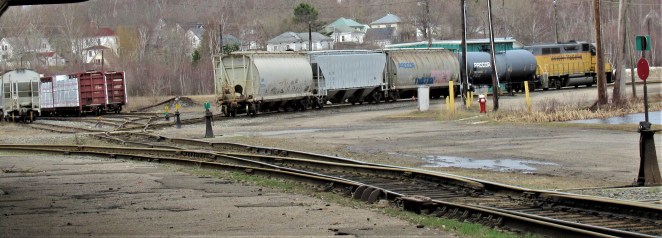
After school, in a cul-de-sac
that backs on to the railway yards,
the street boys show me
how to hold a knife,
how to approach a man,
how to ask for a light,
for a forbidden cigarette,
while other boys,
knives in hand, lie in wait
to ambush the victim.

How old am I?
Five or six.

I would go to Woolworth’s
with my friends and distract
the shop girl while the others
stole whatever they could.

Then we would go
to the public washroom,
boys and girls together,
and share the spoils.

Something for everyone,
and everyone sworn to secrecy,
a blood cult, knives
or razor blades inserted,
and wrist pressed to wrist.

Commentary:

Free will or determinism? How does one escape from the back-street poverty of a run-down neighborhood and emerge from the shadows to bask in the light of the sun? Or is it all a dream, a made-up picture of a childhood that never was in a neighborhood that never existed? Vanishing point – the railway tracks fading away into the distance. Point of vanishing – to lose oneself in the mysteries of a past that never was in order to establish a future that never will be. Dream, dream, dream – all I have to do is dream!

And then there are the nightmares, when the dreams are true and the memories are so exact that you can see the blood on the razor blade and feel the almost silent slash of this particular slice of life. Secrecy – and who can tell whether I am telling the truth, or not, here in a foreign land, not the land of my fathers – and I only had one father, that I am aware of, and one mother too – where nobody knows me and the children from that imagined back street would never think of visiting.

For Jorge Luis Borges, whom I met twice, once in Bristol and once in Toronto, – Canada was a land so distant and so cold that it lacked reality. And thus I can dream my dreams, rewrite my past, reimagine myself, in whatever way I want to and I can vanish at any vanishing point I choose and emerge wherever I want to, and do it over and over and again, and who knows the truth? Over the points, over the points, and Liza none the wiser, whoever Liza happens to be!!!

Joy of Words

Joy of Words

If the words won’t come, don’t worry.
Sooner or later, they will arrive, driving
down in flurries. Think wind-driven leaves
or the soft white whisper of snaking snow.

There is a moment when all sounds cease
and you can be at one with your inner self,
there, where summer sunshine twinkles
and soft rains bring forth clarity and joy.

What are words anyway, but soap bubbles
emerging from an iron ring to rise in
child-hood’s skies, soaring, dying, around
the cloudy thrones of sun-kissed clouds.

We, their so-called creators, are left below,
building cotton-wool castles spun from air.

Commentary:
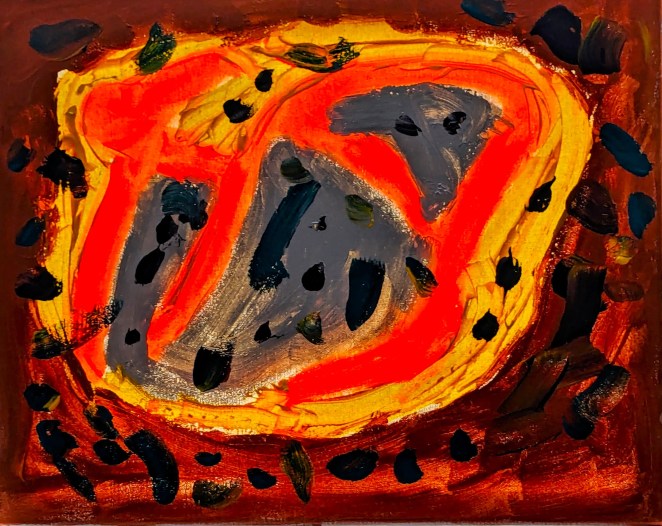
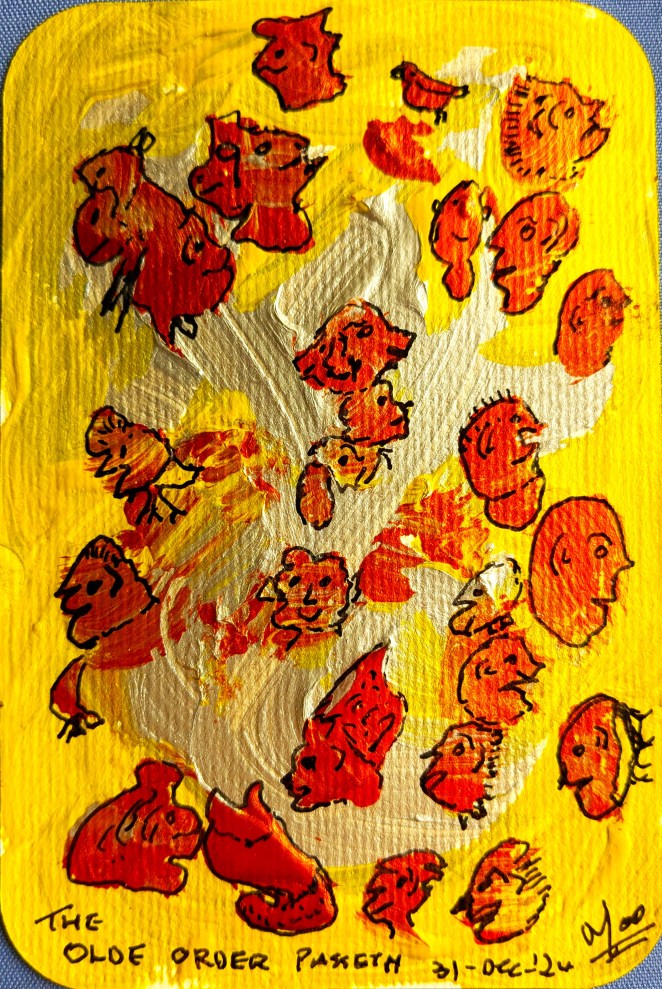
Moo suggested I use this painting of his to illustrate this poem. He called it originally The Olde Order Passeth, but the original phrase, from Tennyson’s Idylls of the King, should really be The Olde Order Changeth, lest one good custom should corrupt the world.

And yes, things do change. Here we have a fourteen line sonnet. Structure giving order to chaos. And words change, the world changes, our thoughts change, the weather changes. Hymns Ancient and Modern – Age and decay in all around I see, oh thou who changeth not, abide with me.

And what do we do when we meet with change? Weather – I change my clothes. There is no such thing as bad weather, only inadequate clothing. It used to be a useful saying, that one, but not any longer. When change changes into disaster, it is a very different kettle of fish. Thoughts change – mine just did. A useful phrase suddenly becomes an inadequate reaction to a changing situation. The world changes – sometimes for better, sometimes for worse, but how do we, each one of us, confront that change? How do we adapt to it?

I know far too many people who, like the ostrich, bury their heads in the sand and pretend that change is not all around us, that the world is the same as it always was. We humans are experts at adapting. We must adapt. But how do we adapt? Each one of us must answer that question in his or her own way. The alternative is to close our eyes, bury our heads, and pretend that nothing is happening.

Another alternative is to seek within for that moment when all sounds cease and you can be at one with your inner self, there, where summer sunshine twinkles and soft rains bring forth clarity and joy. Perhaps that is the world the ostrich discovers when he removes himself from this world and enters that other one beneath the sand. Who knows? Not even the ostrich, I would guess.

Carved in Stone 30 & 31

Carved in Stone

30

A well of beauty dwells within me,
not skin deep, but buried, arcane.

A flickering candle
tethered to an altar,
shimmers at midnight,
when the Latin mass is said,
bringing me light.

In the dark, canonical hours,
shadows move beside me
as I walk long corridors
from dormitory to a chapel
filled with heady incense.

31

I kneel, dumb-founded,
as candle flames wax and wane,
their brightness enhanced
by the midnight magic
that turns doubters into believers.

Spell and symbol, each candle a star,
shining, twinkling, in a galaxy of light,
and everywhere, the incense,
overloading my brain, releasing me
to revelations way beyond
muttered responses, mumbled words.

A world of inner darkness,
yet heart and soul soar together
up to the altar’s immortal light.

My shadow flickering
on the corridor walls,
as candle in hand, half-asleep,
I return to my cold bed
where the long, chill snake
of the bamboo cane
reminds me of tomorrow’s
flagellation.

Commentary:

Shadows on the wall or candles – with which should we start? Verbal and visual – how do they blend and knit together? Does my visual take away from your visual, or does it enhance it? To what extant does my verbal and the commentary on my verbal change the nature of your original thoughts when you re-create, within your own mind, my images, both verbal and visual?

Verbal and visual – now add the sense of smell. “The incense, overloading my brain, releasing me to revelations way beyond muttered responses, mumbled words.” And now remember that I was only six or seven years old when I experienced these things. Add the Latin mass, only half understood, the cold, damp feel of walls and wood beneath the hands. A world of inner darkness, yet heart and soul soaring together up towards the altar’s immortal light.”

My words are black print on white paper. My memories flare – an aurora borealis of senses sent crackling down the spine, in and out of the mind, tumbling the brain into a world … what sort of world? An unimaginable world. One never forgotten. One never re-recreated. One that never existed. One that never could exist. One for which the young child, six or seven years old, yearns for the rest of his life. His unsatisfied life. His unsatisfying life. His meaningless life. His absurd life.

Oh pity the poor puppy, not knowing what he has done wrong, not knowing how to put things right, always inadequate, whining and cringing at his master’s feet. And always, “that cold bed where the long, chill snake of the bamboo cane reminds me of the next day’s flagellation.”

Carved in Stone

Carved in Stone

28

The man who cannot cry
is dry indeed,
his inner space
a wasteland without rain.

Who can now walk forty days
in a desert wilderness,
without water?

Where is that crystal fountain,
with its healing streams
flowing from the rock,
its waters flowing through us,
bringing us tears of sorrow
and tears of joy.

Water and words –
they drift through me
and shadowed waves move,
shifting shape in the changing light.

29

A rising moon,
shimmers over the bay.
It reveals the path
that leads me back
to my primal waters.

Oh, salt flow of tears,
salty the waters
of the baptismal font
washing away all stain of sin.

Immersion in water,
a new start, a new life,
and all the soul-sweet eternities
of water and the word.

Commentary:

Water – such an important commodity, and filled with so much symbolism, religious and otherwise. And our bodies, on average, are composed of 60% water. We can survive for three days without water, if we are lucky. How precious it is. How much we depend on it.

The Bay of Santander, so beautiful beneath the moon. And I remember the full moon’s circle touching a rocky triangle as it rose above Peña Cabarga. Oh, the night life of the fish as they rose in the bay and basked in the moonlight. How often was I tempted to walk out along that moon path and walk the waves to Somo and Pedreña on the far side of the bay.

Immersion in water, a new start, a new life, and all the soul-sweet eternities of water and the word. Total immersion, then, not just in languages, but also in water. Where would we be without those life-long commitments, not to mention the crystal fountain whence the healing streams do flow?

Carved in Stone 21 & 22

21

Goodrich Castle – Civil War tore down
its curtain walls, fired its stables,
drove horses and people mad with fear,
all destroyed, a way of life, gone overnight.

I stand in the ruins of the solarium
beneath towering columns
empty now of the stained-glass
that would have kept out the rain
and retained the sun’s heat.

I imagine standing there,
speckled in sunshine,
coloured diamonds covering me.

22

I stop in the ruined quad
to sniff the air, to imagine the panic,
to smell the crackle of burning,
to hear the high-pitched screams
of dying horses, trapped in the stables.

Sometimes, at night,
fate mans the pumps of my blood,
and sends fire alarms surging
through my veins.

I do not want to die alone,
defenseless, besieged by memories
that gnaw away my remaining days,
like flames.

Commentary:

Memories burn away my remaining days, like flames. Fire controlled, stolen from the gods by Prometheus in Greek Mythology, by Zopilote, the Trickster, in Oaxacan Mythology. I will always recall those early mornings in Oaxaca, standing on the azotea (rooftop) doing my morning exercises in the half light. High above me, Zopilote slowly spiralled. His wings glowed red in the sun that had not yet penetrated to the earth below. As he descended, he brought the sun fire down with him and gifted it to humans.

Fire and flames, under control, in the candle on the table, on the birthday cake, in hearth and fireplace, a life-giving source of heat, light, and energy. Fire and flames, uncontrolled – wild fires in the woods, blazing out of control. It happened last summer. A severe drought, and the woods so dry. A lightning strike – and fire and flame soon raged, out of control. Smoke darkened the skies and the smell of burning hung around for days. So many people evacuated, moving out of their houses with three days, two days, one day’s notice. Sometimes it was so much less. Three hours, two hours, one hour … our community newsletter contained details of what to have ready to cover each of those situations. Very sobering and thought-provoking.

Back now to Goodrich Castle. The occupants trapped inside the walls with no place to go. Horses and livestock trapped in the stables, and those life giving flames now bringing death and misery. “Man hands on misery to man. It deepens like a coastal shelf. Get out as early as you can.” Hands up all of you who recognize the author of those lines, a great English poet who is possibly not as well recognized as he ought to be. I know who he is, but I’ll leave you guessing and googling! Go on, Google him. I know you want to!

Carved in Stone 19 & 20

19

The Spanish Civil War –
one brother pro-Franco, and the other,
imprisoned for a quarter of a century.

They locked him, with two dozen men,
in a deep cell below the convent
of San Marcos de León.

All save him were executed.
He spent our time together
telling me how guilty he felt
because he survived.

20

So many died standing blind-folded
with their backs to unforgiving stone walls,
because they refused to believe
what the enemy told them to believe.

Nobody spoke for them.
Who can speak for those who carry
the candle or board the tumbril,
or see the hooded executioner draw near?

The axe approaches. The gallows draw closer.
The guillotine falls. The single eye of each rifle
stares at the victim’s chest.

Commentary:

I find it hard, very hard, to talk about these two stanzas (19 & 20). I remember two of Goya’s paintings, The Second of May and the Third of May. The Third of May says everything that I cannot say. So, I will just leave you with two paintings to google and one photo of an unforgiving stone wall, with the gateway filled in. Pax amorque – we all need peace and love – I can say that, for we all need it.

Carved in Stone 16 & 17

16

The Bulls of Guisando,
pre-historic, unweighable,
the bearers of Roman graffiti,
itself two thousand years old.

Were they carved as boundary markers,
or designed to designate pastures,
for horses, pigs, sheep, and bulls,
all grazing in their stone dreams?

Celtic, pre-Roman,
they speak to my Welsh blood,
and to the Irish soul
that will always be a part of me.

I place my hand
on the dimpled granite hide
and feel time coursing
beneath the stone skin.

Granite ships,
islands in a sea of time,
I sense a heart beating,
something surviving
within the stone.

17

We are powerful people,
we creative artists,
we carvers of stone,
we dreamers,
whether we dream
by day or by night.

Those of us
who dream by day,
often see our day-dreams
come true.

Commentary:

“Those of us who dream by day, often see our day-dreams come true.” Lawrence of Arabia – The Seven Pillars of Wisdom. You recognized the quote of course, wrth gwrs. Intertextuality, the weaving of words through text after text in different combinations according to our time and space. Some of us think we are original, but there are only so many plots to a play, 24 or so, if I remember my Aristotle correctly, and I have changed the number, just to test you. Oh ye of too much faith!

We think we are original, but, as Picasso said, the painters of the cave paintings, all those many years ago, created everything we artists could ever dream of. We all borrow in one way or another and originality is merely a disguised form of borrowing. The faces change, the actors change, the medium changes, the times change, but otherwise, everything else is the same. Sad, really, that we should claim originality (and fresh water) for all that water that has passed under so many bridges.

Welsh blood and Irish soul – not even original, but shared by so many in my family. Add an English education, studies and residence in Spain, France, Mexico, Canada, and the USA, and what do you have? An intellectual mongrel, that does not know its own mother, like so many other mongrels, and that shakes its coat only to shed so many multi-cultural and multi-lingual fleas.

And remember – “Great fleas have lesser fleas upon their backs to bit them, and lesser fleas have smaller fleas, and so ad infinitum.” Intertextuality – they were only playing leap-frog and one jumped over and another jumped over someone else’s back.

Carved in Stone 14 & 15

14


The sun throws shadows
across the cathedral’s face.

Crosses, arrows, stars,
masonic symbols
hammer-and-chiseled
into the granite sea-cliff
of the entrance way,
reveal the signatures
of the master masons
who laboured here.

And not just here,
for they traveled everywhere,
adding their stone signatures
to those of the other workmen
who left a piece of themselves,
carved in stone.

15

In the cathedral
of Santiago de Compostela,
Maese Pedro sculpted
a statue of himself,
a figurine, small,
low down, facing the main altar.

Students rub noses with him
before their exams,
when they look for luck
having forsaken their studies.

Illiterate people
consult these carvings
in the same way the educated
seek knowledge in their books.

16

The Bulls of Guisando,
pre-historic, unweighable,
the bearers of Roman graffiti,
itself two thousand years old.

Commentary:

workmen who left a piece of themselves, carved in stone … I couldn’t find my masonic markings from the cathedral in Avila, so I added the words carved into one of the Bulls of Guisando instead. Amazing how people want to make a little bit of themselves eternal – in the sense that we extend our names, our graffiti, our messages beyond our lifetime and, stones thrown into a pond, who knows how long the ripples from those tiny word-waves will endure?

So, what’s it all about, Alfie? And which Alfie are we referring to, the one who burnt the cakes or the (in)-famous gorilla in Bristol Zoo, who went missing? And how many Alfies are there out there? And why buy an Alfie-Romeo when you can buy a neat tombstone for a much smaller sum of money and have it remind people of you long after you have gone?

Silly questions, really, but this is what poetry is for, to open up the curious mind and to dig warrens for bunny rabbits so that the hunters of curiosities can dig their ways down and find whatever they shall find. But do we ever find what we are looking for when we first start out? Good question. Carve your answers into a piece of rock and leave it by the roadside to see what happens to it. Or else, you can write a message, stick it in a bottle, and send it out to sea to float on the waves. Put my name on it, along with yours, and maybe, one day, it will arrive at my doorstep in Island View and, if I am still here, I will reply to you by the same method.

Carved in Stone 13

13

What is life?
Is it just an illusion,
as Calderón tells us,
and nothing but a dream?

And what is time?
Does it bend, as Dalí shows us
when his surreal clock breaks into pieces,
time and numbers flying off
as it explodes over a waterfall?

Another clock folds –
a pancake draped
over the bough of a tree.
 
Time – a water clock,
a marked candle,
a grandfather clock,
with Roman numerals,
and time marching,
round and round,
erasing the past,
establishing a future
that will itself
soon be erased.

And what am I
but a moment on time’s clock,
a drop in the clepsydra,
a striation on a flickering candle,
a piece of roughly polished sea-glass
perched on a lonely beach?

Commentary:

Well, Moo has done me proud this time. Two early paintings, both depicting aspects of time, as conceived by Moo. In the first, time is seen as a tick-tock time bomb, or rather a set of tick-tock time-bombs. In the second, in imitation of Salvador Dali (Moo always set his sights high!), a clock going over a water fall and the hours flying off the clock face as time bends. So, tell me if you can, what is time?

Perhaps more important, what is life? Is it a dream, an illusion? And if it is a dream, what happens when we wake up? I know what happens when I wake up – I get up and go pee. Is that to be my final reality? By extension, is life our only reality? Or is our life a series of lives, as some religions would persuade us? And if a cat has nine lives, how many lives do we have? Can they be numbered? Or, like innumerable onions, do we peel away layer after layer? And if so, what is in the centre of the onion when we finally get down that far?

And why do some people write center while others write centre? Is life an illusion, a play? If so does it take place in a theatre or a theater? Or is really a sort of metatheatre or metatheater, life in rings, like the onion, lay after lay, layer after layer? Oh dear, this is all much too complicated. I’ll ask Moo to paint me a painting of life and we’ll see what he comes up with. He’s a bit lazy at the moment and his paint brush has the bends and refuses to cooperate. It’s probably made of cat bristles, and is untrainable and almost impossible to train, let alone to herd. Never mind. We’ll abandon all this for now and give the cat the task of training Moo to paint another painting.

Carved in Stone 10 & 11

10

Firelight dances,
bringing things back to life.

Each morning,
I take time to empty my mind
of those restless cats
I herd at night as they shimmy
through my troubled dreams.

By day, each cat
throws a different shadow
that parades before me
in the sweetness of soft sunlight
where a honeyed sweetness reigns
and no bitterness dwells.

My own cat haunts me,
purring for butter,

sitting there, staring,
eyes wide open, hypnotic.

What, I wonder,
does she really want
as she turns her back,
walks away,
and stalks a different prey
among my books?

11

Does she hear the clock’s dry tick
and sense the Roman numerals
marching round, left – right – left,
always in step
with the pendulum’s sway.

Does she recall migrating birds
or those gaudy summer butterflies,
fanning their wings
as they perch on Cone Heads,
Bees’ Balm, Black-eyed Susans,
generic butterflies,
specific flowers,
planted by my own hands?

I often ask myself –
“What does she know
that I don’t know?”

Commentary:

A strange thing knowledge. I have learned the hard way that “the more I know, the more I know I don’t know.” Just look at today’s second stanza. I would love to know more about, and understand better, migrating birds, summer butterflies, especially the lovely Monarchs that fly at Mexico and back, the flowers themselves, the way language substitutes the generic (butterflies, flowers) for the specific (Red Admirals, buttercups), and as for that cat, I really would like to know what she knows that I don’t know. I have never been able to train her, but she has certainly managed to train me!

And I would love to understand humor and laughter. Slapstick aside, humor is one of the cultural secrets that travels least in translation. Jokes in French or Spanish just do not translate well into English. It takes a deep cultural and linguistic knowledge to grasp foreign humor at first glance.

Take today, for instance. I drove the car to the garage to change the tires from summer to winter. I asked the garage guy, my friend, if he would drive me home, and he said he would. He got i the passenger side and I drove home. Then he drove the car back to the garage. He opened the garage doors, drove the car in, turned the engine off, hoisted the car up, and changed the tires. When he’d finished, he tried to start the engine. No luck. He called me – “Where’s the key?” “In my pocket!” I replied. We were having such fun chatting we never thought to offer or request the car key when we exchanged drivers. Well, we are all still laughing about it.

When I got into the house, even the cat was laughing, and as for that cat, I really would like to know what she knows that I don’t know. Maybe, it’s just that we humans, especially as we age, aren’t as clever as we sometimes think we are. Some things, I guess, I’ll never know.