Butterflies

Butterflies
Miguel de Unamuno

… butterflies … temporal forms … fluttering …
existing for one sweet day … they perch … spread
their wings … fan us with their beauty … flourish …
catch our attention … then caught by a gust
tear their wings on a thorn … and perish … blink
your eye and they are gone … yet reborn … they
cluster and gather in dusty ditches …
congregate on bees’ balm … smother Black-Eyed
Susan and Cape Daisy … shimmer in shade …
butterflies by day … fireflies by night …
terrestrial stars floating in their forest
firmament … dark tamarack … black oak … bird’s
eye maple … silver birch … impermanence
surrounds us … dances beneath stars … sings with
robins … echoes the owl’s haunting cry …
eternity held briefly in our hands …
then escaping like water or sand … black
words on white paper capturing nothing …
… my dialog … my time … my place … butterflies …

Note: “La poesía da permanencia a las formas temporales del ser / Poetry gives permanence to the temporal forms of the self.” Miguel de Unamuno (1864-1936)

The temporal forms of the self – and so much today is unsettled, changing, insubstantial. I have often wondered how one makes time stop. Is it even possible to do so? Time and tide wait for no man. And why should they? Fray Luis de León – “Con paso silencioso, el cielo vueltas dando, las horas del vivir le va hurtando.” / With silent step, the ever-turning sky, steals away life’s hours. Or Fancisco de Quevedo – “Que sin saber ni cómo, ni adónde, la edad y la salud se hayan huído. Falta la vida, asiste lo vivido, y no hay calamidad que no me ronde.” Without me knowing how or where, age and health have fled. Life is lacking, past life flew by, and there isn’t a calamity that doesn’t hound me.

Ars longa, vis brevis – art endures, life flies by. My translations are freer than usual today, but I too feel like being creative in my own language. So, if we can’t slow time down, what can we do? We can create – poems, paintings, photos. We can read – and translate from one language to another. We can, like butterflies, perch on flowers and enjoy our brief days in the sun. Mindfulness – we can make the most of each moment by living it thoroughly and well. Carpe diem – we can seize each moment of every day and live it to its full measure. And, above all, we can write and read poetry – because, as Unamuno says – Poetry gives permanence to the temporal forms of the self.

On Loneliness

Loneliness

58 What relationships have a positive impact on you?

I think one of my poems answers this question best. I write “one of my poems” but it is really my ‘free’ translation of one of Francisco de Quevedo’s sonnets – Retirado en la paz de estos desiertos. I have changed the poem slightly, but I am sure Don Francisco (1580-1645) will excuse Don Roger’s impoverished effort (2023).

On Loneliness
29 December 2023

Resting in the peace of these small rooms,
with few, but welcome books together,
I live in conversation with my friends,
and listen with my eyes to loving words.

Not always understood, but always there,
they influence and question my affairs,
and with contrasting points of view,
they wake me up, and make me more aware.

The wisdom of these absent friends,
some distant from me just because they’re dead,
lives on and on, thanks to the printed word.

Life flits away, the past can’t be retained.
each hour, once past, is lost and gone,
but with such friends, I’m never left alone.

And there are so many of those literary friends. I still read Rudyard Kipling and I have just finished Kim, Captains Courageous, Stalky and Co., Puck of Pook’s Hill, and Rewards and Fairies. I read these first when I was nine or ten years old, and I return to them regularly. Other friends include Garcilaso de la Vega, Fray Luis de León, St. John of the Cross, Quevedo, Góngora, Calderón, Miguel de Unamuno, Antonio Machado, various members of the Generation of 1898, the majority of the poets from the Generation of 1927… and these are just my Spanish literary friends. I have French friends, English friends, Anglo-Welsh friends, Canadian friends, Mexican friends, and, in translation, many, many more. My relationship with each of these friends has had an impact upon me.

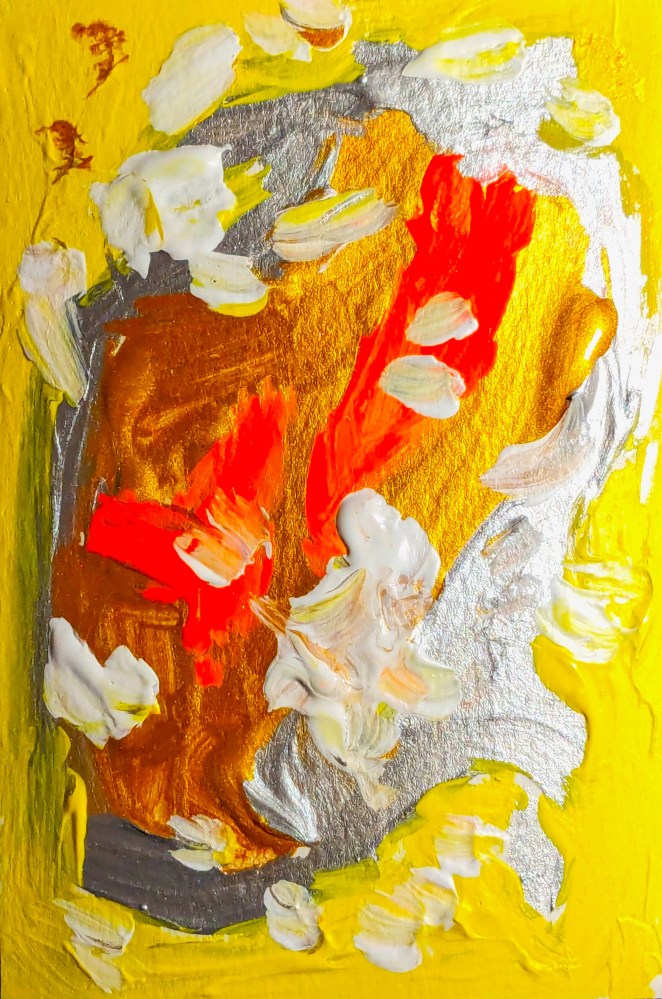
A recent painting, by my friend Moo, is called Fiat Lux – Let There Be Light. It is reminiscent of Dylan Thomas’s poem, Light breaks where no light shines. Intertextuality – Quevedo drew inspiration from the Stoics. I drew inspiration from Quevedo. Moo drew inspiration from Dylan Thomas. The nature of creativity, and its continuing links throughout the ages, shines clearly through these wonderful associations. Long may they continue, and may others enjoy them and be influenced by them as much as I have.

Comment:
The funny thing is that I do not remember writing this blog prompt, nor do I remember having translated Quevedo’s poem into English. I wonder how many other forget-me-nots there are out there. Or, to be more precise, in my books and in my notes. A treasure trove – that’s my guess. Borges wrote of Quevedo that he was more a library than an author, and I am beginning to think that way about my self. A strange world, this, one in which the creator abandons, and then forgets, his creations. Perhaps we should change the image – not so much a library as an orphanage, and so many lost and abandoned orphans wandering around The Little World of Don Rogelio.

Absence in Presence

Absence in Presence

Just before her flight left,
she came up
from the basement,
her cleaning tasks
complete,
and smiled at me.

In the background, music,
a Golden Oldie,
the Rolling Stones playing
‘This could be the last time.’

Present in her eyes,
and in my heart,
the thought,
more than a thought,
the knowledge
that those words
might actually be true.

Clepsydra 11

Clepsydra 11

11

… gone too
     that Raggedy Ann doll
          held together
               by her patchwork heart

cross-stitched lovingly
     with needle and thread
          the sluggish drip-drip
              of her cotton blood
                    proving
                         she is still alive

neither mummified
     nor rat-and-mouse-gnawed
          in limbo perhaps
               but not dancing

asleep maybe
     dreaming in the museum’s oubliettes
          with their closed doors
               their cellars and attics
                    stuffed with memories
                         all dusty and worn

memories
     that only come alive
          at midnight
               when the full moon
                    awakens the shadows

boys and girls
     come out to play
          and walk and dance once more
               beneath liquid moonlight

the celestial lantern’s
     liquescent flame …

Clepsydra 9 & 10

9

… what lies behind this attic door
     ready to spring out
           at the slow push of my hands

cobwebbed
     this world revealed
          a universe of memories
               waiting to be called
                    back into life

what life
     the flickering half-life
          of shadows on a wall     

or the alternate reality
     of planets that lost their way
          and forgot how to dance
               around their sun

do they still move
     in rhythm to an unsung song
          an unstrung guitar
               music no one else can hear
                    played by a wandering star

lost the glimmer
     of life’s candle
          adrift on distant waters,
               but never forgotten …

10

… nor seen
     nor heard
          I am amazed by the maze
               wandering
                    among cluttered objects,

my world takes shape
     in a mad hatter’s workshop
          where things grow legs
               walk this way that way
                    constantly getting lost

I can hear them
     chittering chattering
          but I can neither
               see nor hold them

like so many bats
     they roost upside-down
          little children lost
               in memory’s attic
                    where everything ages
                         slowly gathering dust …

Rock

Rock

You are the rock
on which I build
my life.

You are the fairy castle
planned in paradise
where the sun always shines
and stress is distant.

How often have I mapped
your inner islands,
traveled your well-known ways,
always discovering
new sacred spots
where I can immerse myself
in your inner serenity?

You are the fortress
within whose walls
I can forget my past
and create my future.

Candle Light

Candle Light

Candle light
softens your features
brings out the bone shape
makes me forget
the minor flaws
of ageing.

Bone shape,
rock shape,
land scape,
your face contours
traced by the flame,
counting the years,
like tree rings.

Beneath the surface
you are as you always were
and always will be.

When I look into your eyes,
I see your soul
dancing in the candle’s flame.

Clepsydra

Clepsydra

WFNB 2025 BAILEY PRIZE: 3rd Place
Citation

Clepsydra relates a process of identity loss, as time’s passing removes the people closest to the eroding narrator. Its consistent form – the manuscript is one long poem made up of 48 sections of varying length, each of which begins and ends with an ellipsis – provides a framework in which the narrator strives to describe how their sense of self drains away, drop by drop, the way the liquid in a clepsydra (a water clock) marks the passing of time. Amazingly, the poems convey existential dread through remarkably vivid and grounded images of things like “seals basking in sunshine, / knowing themselves, being themselves, / thinking themselves safe, / kings and queens of their seal-dom, / never questioning” (19) and “…an osprey, sudden, the swoop, / turned into a stoop, water shattered, total immersion, then emerging, / lusty thrust of wings, claws clasping, / prey imprisoned” (20). Sense slides in and around the sounds of the words as well as in their dictionary meanings. In Clepsydra the author rigorously plumbs a difficult subject: the loss of subjectivity.

Exhortation

Thank you for the privilege of reading your poetry manuscript, Clepsydra. I was quite taken with all of its virtues: a meaningful concept, carried out in an impressive form which is followed both rigorously and nimbly in each section.

Introduction

     The National Museum of Wales, in Cardiff, had a working Clepsydra that fascinated me. School children could enter free, and every week day, during the school holidays, I would visit the museum and also the Clepsydra.

     I have built the structure of the Clepsydra into the verses of this book. The words flow down, from left to right, just like the waters of the Clepsydra. Sometimes they overflow the line, and sometimes they hold back, just a little. This visual construction fortifies the idea of the ebb and flow of time, water, and memories.

     I first met the poetic image of the Clepsydra in the poetry of Antonio Machado – No temas. Tú no verás caer la última gota que en la clepsidra tiembla. / Never fear. You will not see the fall of the last waterdrop that trembles in the clepsydra. I have, for better or for worse, repeated this theme throughout the poetic dialog.

     I would like to thank the judge, the poet Kathy Mac, for her comments and her excellent suggestions. I have followed most of them in this revision of the original manuscript. My thanks go to all who have read Clepsydra at one time or another.

Clepsydra

1

… time, and my own place
     not this dry museum
          filled with dust

its ghosts, running rampant,
     raging silent
          over ancient artefacts

the clepsydra dreaming
     time like its liquid
          slipping
               through clay fingers
 
runnels of water
     ebbing flowing
          continually running down

earthen-throated
     its hour glass structure
         
each terracotta bowl
     lower than the one before
   
a mini-cataract
      a constant waterfall
            second by second
                    time dwindling away…

Fall Foliage

Fall Folly Age

Fall Folly Age aka Fall Foliage is a play on words.
Thank you, Moo, my painter friend, for putting this title
on your painting and allowing me to use it for one of my book covers.

After intense heat
the garden is dusty dry.
The hollyhocks,
stressed out,
bow their heads
and tumble down.

Before the heat,
heavy rain drenched
the flowerbeds.
The yucca subsided
beneath waves of water.

One hollyhock,
regally proud,
stored so much liquid
in its flowery crown
that it bent and broke.

The mountain ash
bears a host of berries.
Bright orange,
they are already turning
to their winter shades.

I see so much stress
in the little world
I inhabit.
I no longer listen
to the news
or watch TV.

So much is beyond
my control.
Yet I can control
the radio and the TV
by turning them off.

The friends I meet
now have white hair.
Like me and my flowers,
they are dried up
and bent, held up
by sticks and canes.

My beloved and I
are growing old together.
We watch each other
with great care
wondering who
will be the first
to topple and fall.

Comment:

It has been a long, long time since I last wrote on my blog. Many things have distracted me, including editing books for friends, working on my own books, journaling, painting, and surfing the web in search of something positive to read. As for my own books, I published four this summer. Clepsydra – Chronotopos I, Carved in Stone – Chronotopos II, Rage Rage – Chronotopos III, and No Dominion – Chronotopos IV. Maybe I will try to post on a regular basis and copy some of those poems here, in my blog.

Transitions

Transitions

Modes of limited transitions,
moods of time tapped in time
to time’s rhythmic piano.

Scales fall from my listening eyes
and all-seeing ears.
A transitory awakening,
this glimpse of the composer’s vision,
each note a new version
extracted from abstracts
perceived in color,
each note a hue, and chords
a rainbow spectrum of light
glimpsed darkly through
the raindrop’s distorting lens.

Birdsong and sunshine.
Notes perched
on the matinal branch,
each in tune with the other,
at times in seeming discord,
yet the morning chorus
diluting the day
with the liquidity
of light and sound.

Comment:

Transitions is the fourth poem in the first sequence (Crystal Liturgy) of my poetry book Septets for the End of Time.

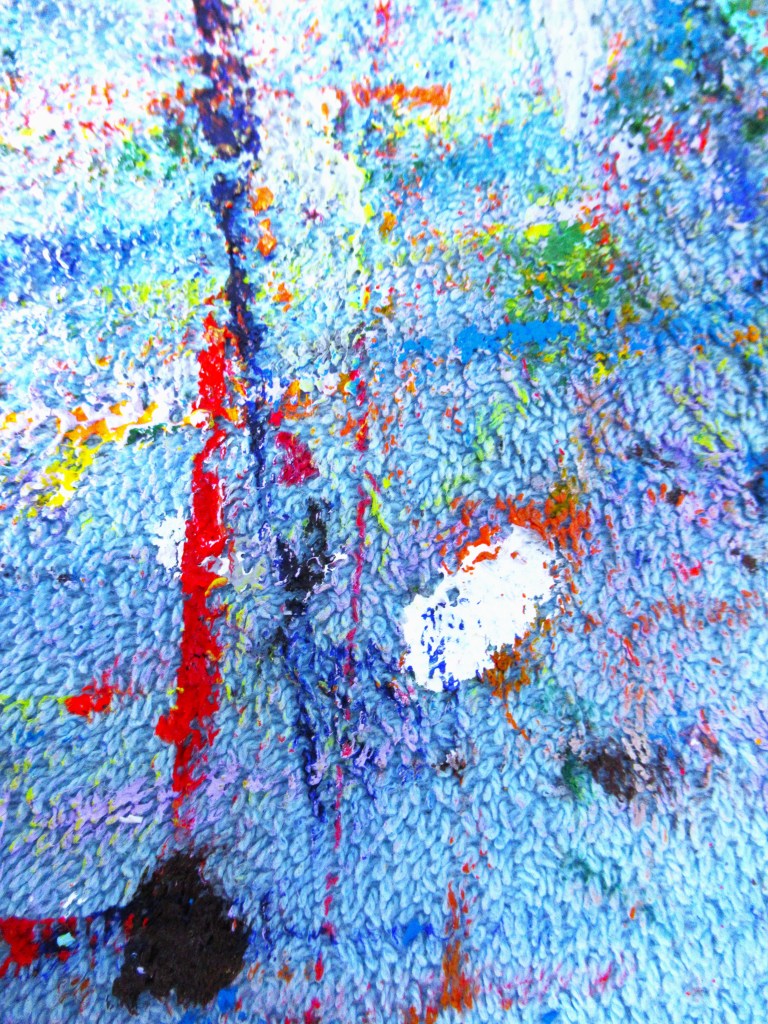
“How on earth did you create that painting?” I asked my friend Moo. “And how do you relate it to this poem?”

“Good questions,” Moo replied. “Difficult to answer, though.” First of all, this is not a painting. It is the background cloth, always changing, always in transition, upon which I create my post card paintings. The idea of transition summarizes the movement from paint, to brush, to painting, and the haziness of the creative moment. It relates directly to your lines ‘Scales fall from my listening eyes / and all-seeing ears.’ This is the point in time, the magic moment, when the painting declares itself. I assume you have the same moment when you write poetry.”

“The two processes are very different, I think. In my poetry, a thought leads to a verbal image, and then each of the words turn themselves into little worlds in which verbal gemstones appear. I try to catch those verbal gemstones and to transform them into poetry. If I listen carefully, then my ears see and my eyes hear the words forming themselves into the right order.”

“Interesting. And yes, that’s what happens in my painting too. The initial mood captured in that first color, and then the minor moods that emerge from the first one gradually woven into the painting.”

“That is somewhat similar to how I write – by listening to the words and doing what they tell me to do. Then I do what they want me to do, not what I want them to do.”

“Fascinating. But there is one huge difference between us.”

“What’s that?”

“I’ll tell you next time.”