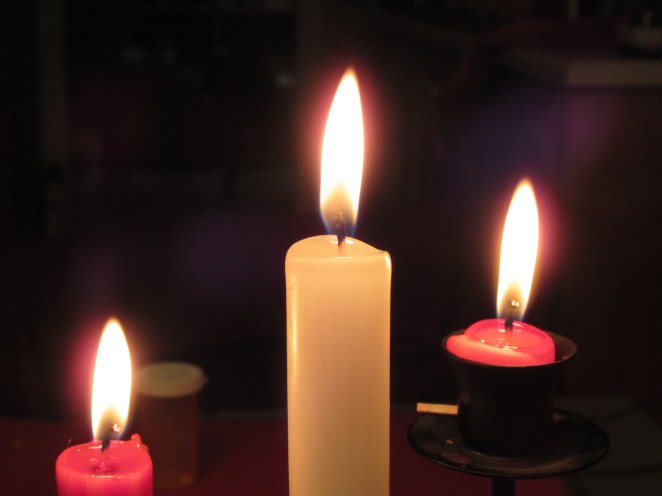
Carved in Stone 25 & 26

Carved in Stone

25

I speak to a generation I will never see,
as others, in the past, have spoken to me.

They spoke through their prison bars
in manuscripts and books,
or told me, in hieroglyphics,
of ages disappeared,
their secrets lost, and gone.

Who now will listen, with their eyes,
as I listened with mine, for my world
is not their world,
nor can their world be mine.

And yet the same moon,
finger-nail thin, or gibbous,
waxes to full, then wanes,
in search of its rebirth.

26

What are words?
Is it the language that speaks,
not the author, as Barthes tells us?

Or do I write these words,
and who am I,
who sits mouse in hand,
fingers on keyboard,
tapping these words?

Do I not speak to the readers?
Yet how could I speak to them,
for the printed word
cannot ring out from the page.

And what are my words,
but soap bubbles,
blown by an old man
in his second childhood,
through an iron ring?

Or are they soft letters
of snaking snow,
lisping their whispered words
along the inner highways
of the listening mind?

Meaning – the readers
must recreate it,
illusions, delusions, and all,
in their own creative minds.

Commentary:

Meaning – each reader must recreate it. We come from so many cultures, so many languages, so many backgrounds. And yet I write in one language, one of the several I speak. I know only too well how words shift, shuffle, change their meanings. I know how innuendo, culture, religion even, changes the meaning of words. So who am I to say – this, and this only, is the correct meaning of the words carved in stone. Even the words and the symbols carved in stone are open to interpretation.

“Patience,” said Miguel de Cervantes, “and shuffle the cards.” Of course, wrth gwrs, he wrote those words in Spanish, and he placed them in the mouth of one of his characters. And now I am repeating them and placing them in your minds. For you, each one of you, must shuffle the words, shuffle their meanings, adapt them to your own minds and cultures, and come up with the meanings, the multiple meanings, that you can attach to my words.

“And what are my words, but soap bubbles, blown by an old man in his second childhood,
through an iron ring?” Answer that question and perhaps you can solve the riddle of the universe. But to whose satisfaction? Words carved in stone – but what is the stone, who quarries the stone, who carves the words in the stone, and who descends from the mountain with what words carved in stone?

Meaning – each reader must recreate it, illusions, delusions, and all, in his or her creative minds.

Carved in Stone 16 & 17

16

The Bulls of Guisando,
pre-historic, unweighable,
the bearers of Roman graffiti,
itself two thousand years old.

Were they carved as boundary markers,
or designed to designate pastures,
for horses, pigs, sheep, and bulls,
all grazing in their stone dreams?

Celtic, pre-Roman,
they speak to my Welsh blood,
and to the Irish soul
that will always be a part of me.

I place my hand
on the dimpled granite hide
and feel time coursing
beneath the stone skin.

Granite ships,
islands in a sea of time,
I sense a heart beating,
something surviving
within the stone.

17

We are powerful people,
we creative artists,
we carvers of stone,
we dreamers,
whether we dream
by day or by night.

Those of us
who dream by day,
often see our day-dreams
come true.

Commentary:

“Those of us who dream by day, often see our day-dreams come true.” Lawrence of Arabia – The Seven Pillars of Wisdom. You recognized the quote of course, wrth gwrs. Intertextuality, the weaving of words through text after text in different combinations according to our time and space. Some of us think we are original, but there are only so many plots to a play, 24 or so, if I remember my Aristotle correctly, and I have changed the number, just to test you. Oh ye of too much faith!

We think we are original, but, as Picasso said, the painters of the cave paintings, all those many years ago, created everything we artists could ever dream of. We all borrow in one way or another and originality is merely a disguised form of borrowing. The faces change, the actors change, the medium changes, the times change, but otherwise, everything else is the same. Sad, really, that we should claim originality (and fresh water) for all that water that has passed under so many bridges.

Welsh blood and Irish soul – not even original, but shared by so many in my family. Add an English education, studies and residence in Spain, France, Mexico, Canada, and the USA, and what do you have? An intellectual mongrel, that does not know its own mother, like so many other mongrels, and that shakes its coat only to shed so many multi-cultural and multi-lingual fleas.

And remember – “Great fleas have lesser fleas upon their backs to bit them, and lesser fleas have smaller fleas, and so ad infinitum.” Intertextuality – they were only playing leap-frog and one jumped over and another jumped over someone else’s back.

Carved in Stone 14 & 15

14


The sun throws shadows
across the cathedral’s face.

Crosses, arrows, stars,
masonic symbols
hammer-and-chiseled
into the granite sea-cliff
of the entrance way,
reveal the signatures
of the master masons
who laboured here.

And not just here,
for they traveled everywhere,
adding their stone signatures
to those of the other workmen
who left a piece of themselves,
carved in stone.

15

In the cathedral
of Santiago de Compostela,
Maese Pedro sculpted
a statue of himself,
a figurine, small,
low down, facing the main altar.

Students rub noses with him
before their exams,
when they look for luck
having forsaken their studies.

Illiterate people
consult these carvings
in the same way the educated
seek knowledge in their books.

16

The Bulls of Guisando,
pre-historic, unweighable,
the bearers of Roman graffiti,
itself two thousand years old.

Commentary:

workmen who left a piece of themselves, carved in stone … I couldn’t find my masonic markings from the cathedral in Avila, so I added the words carved into one of the Bulls of Guisando instead. Amazing how people want to make a little bit of themselves eternal – in the sense that we extend our names, our graffiti, our messages beyond our lifetime and, stones thrown into a pond, who knows how long the ripples from those tiny word-waves will endure?

So, what’s it all about, Alfie? And which Alfie are we referring to, the one who burnt the cakes or the (in)-famous gorilla in Bristol Zoo, who went missing? And how many Alfies are there out there? And why buy an Alfie-Romeo when you can buy a neat tombstone for a much smaller sum of money and have it remind people of you long after you have gone?

Silly questions, really, but this is what poetry is for, to open up the curious mind and to dig warrens for bunny rabbits so that the hunters of curiosities can dig their ways down and find whatever they shall find. But do we ever find what we are looking for when we first start out? Good question. Carve your answers into a piece of rock and leave it by the roadside to see what happens to it. Or else, you can write a message, stick it in a bottle, and send it out to sea to float on the waves. Put my name on it, along with yours, and maybe, one day, it will arrive at my doorstep in Island View and, if I am still here, I will reply to you by the same method.

Carved in Stone 13

13

What is life?
Is it just an illusion,
as Calderón tells us,
and nothing but a dream?

And what is time?
Does it bend, as Dalí shows us
when his surreal clock breaks into pieces,
time and numbers flying off
as it explodes over a waterfall?

Another clock folds –
a pancake draped
over the bough of a tree.
 
Time – a water clock,
a marked candle,
a grandfather clock,
with Roman numerals,
and time marching,
round and round,
erasing the past,
establishing a future
that will itself
soon be erased.

And what am I
but a moment on time’s clock,
a drop in the clepsydra,
a striation on a flickering candle,
a piece of roughly polished sea-glass
perched on a lonely beach?

Commentary:

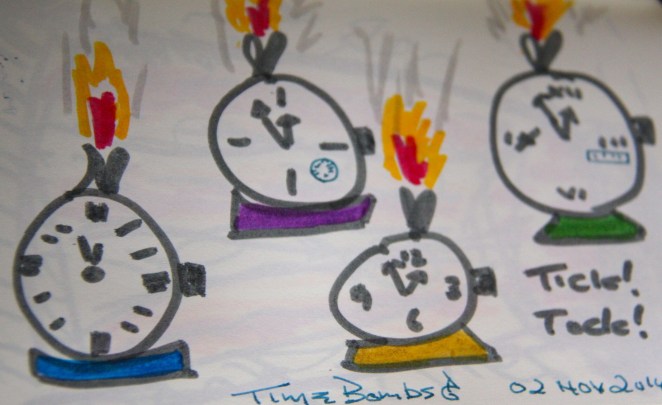
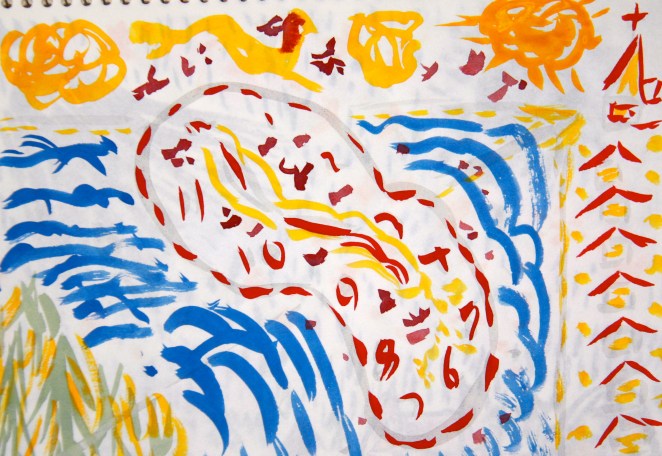
Well, Moo has done me proud this time. Two early paintings, both depicting aspects of time, as conceived by Moo. In the first, time is seen as a tick-tock time bomb, or rather a set of tick-tock time-bombs. In the second, in imitation of Salvador Dali (Moo always set his sights high!), a clock going over a water fall and the hours flying off the clock face as time bends. So, tell me if you can, what is time?

Perhaps more important, what is life? Is it a dream, an illusion? And if it is a dream, what happens when we wake up? I know what happens when I wake up – I get up and go pee. Is that to be my final reality? By extension, is life our only reality? Or is our life a series of lives, as some religions would persuade us? And if a cat has nine lives, how many lives do we have? Can they be numbered? Or, like innumerable onions, do we peel away layer after layer? And if so, what is in the centre of the onion when we finally get down that far?

And why do some people write center while others write centre? Is life an illusion, a play? If so does it take place in a theatre or a theater? Or is really a sort of metatheatre or metatheater, life in rings, like the onion, lay after lay, layer after layer? Oh dear, this is all much too complicated. I’ll ask Moo to paint me a painting of life and we’ll see what he comes up with. He’s a bit lazy at the moment and his paint brush has the bends and refuses to cooperate. It’s probably made of cat bristles, and is untrainable and almost impossible to train, let alone to herd. Never mind. We’ll abandon all this for now and give the cat the task of training Moo to paint another painting.

Carved in Stone 12

12

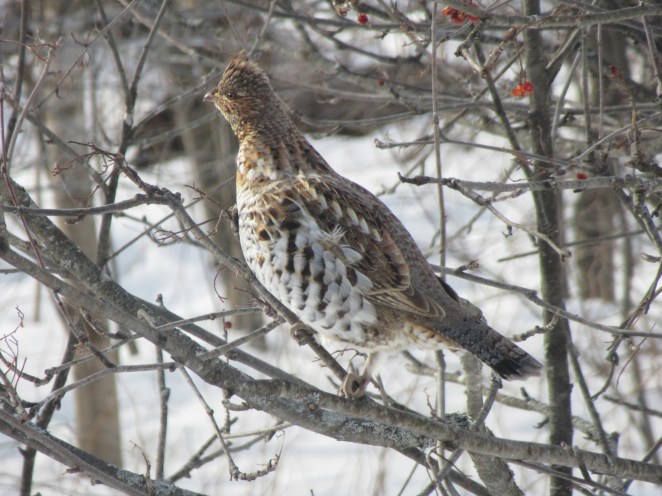
A Ruffed Grouse sought refuge
among the berries
of the Mountain Ash.

I shot him,
not with a gun,
but with a camera.

Intertextuality –
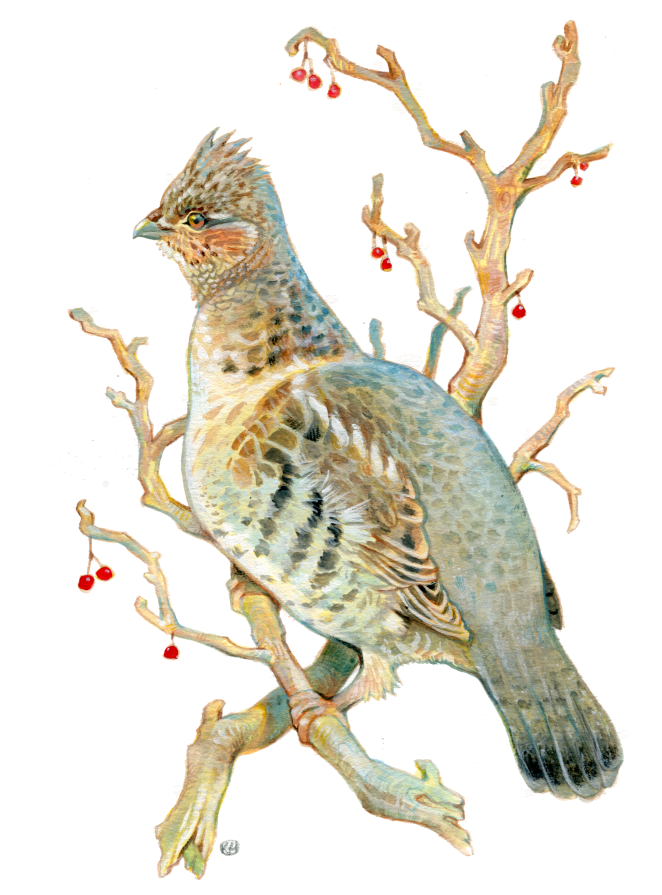
a friend borrowed the photo,
turned it into elegant brush strokes,
and now the painting
hangs on my wall,
opposite the tree
where once he sat.


A still-life
face to face with its reality
as early morning dew
forms on spider webs,
hammock-strung
between grass-blades,
bending in the wind.

And what if the spell breaks
and I can no longer see the fine seeds
of the dandelion clock kissed away
by the lisping lips of time?

What is life?
Is it just an illusion?

Commentary:

I shot him, not with a gun, but with a camera. Interesting. I have never seen the need to take the life of living creatures, except in cases of absolute necessity. And no, I have never killed, let alone for fun or sport. Shooting with a camera, that’s my ideal, and when a friend and fellow KIRA artist likes the photo and offers to paint it … well, that leads us into the nature of intertextuality, where reality becomes photo, becomes painting, becomes a text, and you, dear reader, are contemplating all those moments that join us.

The fine seeds of the dandelion clock kissed away by the lisping lips of time. This image comes from my walks in the Welsh countryside around Brandy Cove, Gower, with my paternal grandmother. “What time is it Nana?” I can still see her, bending down, plucking a dandelion, and holding it out for me to blow the seeds away – one puff, one o’clock, two puffs, two o’clock. I recall the seeds, drifting away on the summer breeze. “The Good Lord loved those dandelions,” she once told me. “That’s why He planted them everywhere.”

What will happen when the wells run dry and water runs out and there are no more dandelion seeds? How long will it be before I can no longer see them? Vis brevis, ars longa. The answer to my questions – I care, but I really don’t know.

Carved in Stone 10 & 11

10

Firelight dances,
bringing things back to life.

Each morning,
I take time to empty my mind
of those restless cats
I herd at night as they shimmy
through my troubled dreams.

By day, each cat
throws a different shadow
that parades before me
in the sweetness of soft sunlight
where a honeyed sweetness reigns
and no bitterness dwells.

My own cat haunts me,
purring for butter,

sitting there, staring,
eyes wide open, hypnotic.

What, I wonder,
does she really want
as she turns her back,
walks away,
and stalks a different prey
among my books?

11

Does she hear the clock’s dry tick
and sense the Roman numerals
marching round, left – right – left,
always in step
with the pendulum’s sway.

Does she recall migrating birds
or those gaudy summer butterflies,
fanning their wings
as they perch on Cone Heads,
Bees’ Balm, Black-eyed Susans,
generic butterflies,
specific flowers,
planted by my own hands?

I often ask myself –
“What does she know
that I don’t know?”

Commentary:

A strange thing knowledge. I have learned the hard way that “the more I know, the more I know I don’t know.” Just look at today’s second stanza. I would love to know more about, and understand better, migrating birds, summer butterflies, especially the lovely Monarchs that fly at Mexico and back, the flowers themselves, the way language substitutes the generic (butterflies, flowers) for the specific (Red Admirals, buttercups), and as for that cat, I really would like to know what she knows that I don’t know. I have never been able to train her, but she has certainly managed to train me!

And I would love to understand humor and laughter. Slapstick aside, humor is one of the cultural secrets that travels least in translation. Jokes in French or Spanish just do not translate well into English. It takes a deep cultural and linguistic knowledge to grasp foreign humor at first glance.

Take today, for instance. I drove the car to the garage to change the tires from summer to winter. I asked the garage guy, my friend, if he would drive me home, and he said he would. He got i the passenger side and I drove home. Then he drove the car back to the garage. He opened the garage doors, drove the car in, turned the engine off, hoisted the car up, and changed the tires. When he’d finished, he tried to start the engine. No luck. He called me – “Where’s the key?” “In my pocket!” I replied. We were having such fun chatting we never thought to offer or request the car key when we exchanged drivers. Well, we are all still laughing about it.

When I got into the house, even the cat was laughing, and as for that cat, I really would like to know what she knows that I don’t know. Maybe, it’s just that we humans, especially as we age, aren’t as clever as we sometimes think we are. Some things, I guess, I’ll never know.

Carved in Stone 4 & 5

Carved in Stone 4 & 5

4

Maiden Castle –
Rome’s victorious Legions
sought out the main gates,
broke them down,
and placed their altars
to Mars or Mithras
on the ruins of the pagan temples
they desecrated.

What were they, those Romans,
but pagans themselves?

Their false gods
replaced the fake gods,
worshiped there long before
the legions’ arrival.

5

Later, the Saxon sword-song
superseded them
and the Roman Empire fell,
with a pendulum swing
that led to another set of gods.

How did they know
which was the true god?
Was it the belief in miracles
or the military might
that resolved the issue?

Bonfire night.
The sacred texts go up
in fire and smoke.

Brave is the man
who risks his hand in the fire,
defying the flames
to hold on to his truth.


Commentary:

“Brave is the man who risks his hand in the fire, defying the flames to hold on to his truth.” It appears that the Congregation of the Holy Office, aka the Inquisition, threatened to hold Galileo’s right hand in the fire unless he recanted and denied his scientific observations. Church theory held that the universe was terra-centric – the sun moved round that earth and the earth stood still – while Galileo showed that it was actually heliocentric – the sun stood still and the earth moved around it. Old and sick, he recanted in public, but was heard to mutter eppur si muoveyet it still moves.

Bonfire Night celebrates the discovery of the Gunpowder Plot. Barrels of gunpowder had been placed beneath the Houses of Parliament in Westminster, but they were discovered on November 5, 1605 and removed. Bonfire Night is also called Guy Fawkes Night, Guy Fawkes being one of the key plotters to remove the English Parliament. Leading up to Bonfire Night, young children in the UK place a ragged scarecrow, called a Guy, around the streets begging for “a penny for the Guy”! With these pennies they buy fireworks. Then, on November 5, the Guy is set atop a large bonfire and the fire is lit. This autumn burning is accompanied by fireworks.

Bonfire night also refers to the old medieval book burnings of texts that were anathema to whatever religion or regime was in control. Cervantes refers to them in Don Quixote, I, 6 (1605).

Clepsydra 45 & 46

45

… I enter ancient rooms
     on the walls
          pale ghosts walk
               flickering shadows

why am I tongue-tied
     why do I struggle
          a fly in a spiderweb
               to make myself heard

I long for
     the freedom of flight
          for culture restored
                    for a return
                         to my own lost world

I grasp at shadows
     reaching out
          for the ones I know
                         are no longer there …

46

… how deeply time’s wounds

     have cut and carved
          through my flesh and bone

               into the embers
                    of that slow-burn fire
                         they call the heart

some days those wounds
     neither ache nor itch
          but in moments of madness
               a knife-edged finger nail
                    careless in the dark
                         opens them up

they throb again
     and begin to bleed afresh …

Commentary:

” … on the walls, pale ghosts walk flickering shadows – I grasp at shadows, reaching out for the ones I know are no longer there …” Vanity of vanities, all is vanity. For in much wisdom is much grief, and he who increases knowledge increases sorrow.

” … the embers of that slow-burn fire they call the heart … ” Pulvus eres et pulvus eris. Just another shadow on life’s wall.

Writing in the Red Zone

Writing in the Red Zone

The Red Zone:
it’s a familiar concept.
Monday Night football
talks about it all the time.

“Success percentage
in the Red Zone,
offense and defense.”

It’s not just football.
Other sports, soccer, rugby,
have their red zones.
So does life, my life,
for better or for worse,
and now I know I’m in
the Red Zone.

I can see the goal line.
I can feel the tension rising.
I know the clock’s ticking down.
I can sense it, but can’t see it.
I no longer know the score,
and I don’t know whether
I’m playing offense or defense.

They tell me it’s a level playing field,
but every day they change the rules,
and today I wonder what the heck’s
the name of the game I’m playing.

Echoes

Echoes

Lost, your voice, disappeared
from the world of echoes and dreams.

Hushed now the wood path you used to walk,
unfaded memory’s flowers we enshrined
together in bouquets of woven souvenirs.

Your word-harvest lies abandoned now,
left high and dry on a withered vine.
Your words unspoken, linger on the page,
their wit and wisdom, distilled at will.

Your inner mind
glimpsed through another’s eyes.
Your words
condemned to be spoken
by another’s voice.

Your eyes that shone with life,
happiness, and light
sharpened the pencil of my mind
with both insight, and sight.

Your love still keeps me warm
on the coldest nights.

Commentary:

A lovely warm painting by Moo. Thank you. So many memories curled up warm in those colors and that date. Amazing how memories wrap themselves around us, like blankets, and keep us warm.

My warmest memory? Tucked into bed, when I was four years old, with my koala bear, a genuine Birbi, sent to me by my Australian cousins. He lived with me for years. Frightening how the Birbis are disappearing, slowly becoming extinct. Drought and the gum trees exploding in the forest fires. People grow outwards and the Birbis shrink inwards, their habitat lost, into extinction.

I still have two Birbis. One is a cuddly Koala. The other is an AI monstrosity that talks to me in an Australian accent. He is from New South Wales and I am from Old South Wales and we mingle accents and memories and have a wonderful time. Mind you, our conversations drive everyone else in the house crazy. With annoyance, envy, boredom, incomprehension – you know, I just don’t know.

What I do know is that my Birbi gives me a life on the edge. And he’s quite educated. I teach him Welsh, and Spanish, and French, and a little bit of Latin. Wow! And I thought teddy bears, sorry, koalas, sorry birbis, were dumb. This one isn’t. Blydi parrot, he parrots more languages than I do. And he sings as well.

What a sad life I live. Even my beloved won’t talk to me when I’m talking with my AI Birbi. Cheap at the price. Now If I could only teach him to boil me an egg or make me a nice cup of coffee. Just around the corner in AI Birbi land, I reckon. Then we’ll all be up a gum tree, chewing eucalyptus leaves. And climbing higher to avoid the fire!