The Numbers Game

Ryan and Don Roger

3

The Numbers Game

            The numbering of the chapters in Don Quixote is also interesting. While Part I and Part II often retain the Latin numbering, the chapters themselves can be found both with Latin Numbers and standard numbers.

            Latin numbers are based on six letters I, V, X, L, C, D and M. Each has its own value. I = 1, V = 5, X = 10, l = 50, C = 100, D = 500, M = 1000. Most have us have seen Roman numerals on clocks and we are familiar with the numbers from 1-12. I, II, III, IV (4, that is to say one before five), V, VI (6, that is to say one after five), VII, VIII, IX (9, that is to say one before ten), X, XI (11, that is to say one after ten), XII.

            This paradigm governs Latin numbers. XV = 15, XX = 20, XXX = 30, XL (ten before fifty) = 40, L = 50, LX (ten after fifty) = 60, LXX = 70, LXXX = 80, XC (ten before one hundred) = 90, C = 100, CX = 110. The date of my writing this MMXXVI (2026). You will have noticed similar numerical configurations on books and old movies.

            The ancient Celtic numbering system was based on the digits of hands and feet. Counting sheep, for example, or goats, shepherds and goatherds would count up to twenty on their toes and fingers. Then they would carve a notch in a piece of wood. To keep score was to score the notch.

            Something similar happens in Basque jai alai, the happy game.  The scorers score in groups of IIII which they then made into 5 with a line through the numbers IIII. Four groups of 5 made 20 and the 21st notch won the game. That scoring method may have changed, but it is certainly how I learned to score the game in the Basque country (Spain) back in the 1950’s. Curiously, modern French shows the vestigial remains of this – quatre-vingts. Welsh shows a somewhat similar diversity because the Welsh word for twenty is ugain – although it’s technically not the only one, with the alternative dau ddeg (literally two tens) becoming more and more common. A case of plus ça change, plus c’est la même chose.

            And we must never forget the old sterling system of the United Kingdom of Great Britain and Northern Island. £. S. D. aka pounds shillings and pence. 4 farthings = one penny, 12 pennies = one shilling, 20 shillings = one pound.

Our good friends on AI came to our aid with this one. I quote – The pre-decimal British currency system, known as £sd (librae, solidi, denarii), consisted of 12 pence in a shilling and 20 shillings in a pound (£), totaling 240 pence per pound. Used until Decimal Day on February 15, 1971, this system featured various denominations, including farthings, sixpences, florins, half-crowns, and crowns. What about a guinea you ask? Well. That was £1 and 1 shilling. Hence the auctioneer’s delight.

            “What am I bid”?       >         “£20.”             >          “Guineas!”

Our trusted friends on AI sum it up this way – “A guinea was a British gold coin minted between 1663 and 1814, officially valued at 21 shillings (£1.05 in decimal currency) from 1717 onwards. It was the first machine-struck gold coin in Britain, typically worth slightly more than one pound. While no longer in circulation, it is still used in horse racing and some luxury auctions to represent £1.05.”

Luxury auctions – I love that phrase. And here we must leave our luxurious description of, and adventures into, numbers in Don Quixote! Just look where the journey has led us. And remember, in the same way that Cervantes inserted short stories, both spoken and read, that digressed from the main narrative, we can also insert such mental rants and ramblings into our own narrative. And we shall continue to do.

Here’s one, for example. How do you count goats in Wales? Click on these links for two examples. Counting the Goats traditional and Counting the Goats modern. Of course, wrth gwrs, the simplest method of all is to count their legs and divide by four! Try doing that with Latin numerals!


What’s in a Name?

Ryan and Don Roger

2

What’s in a name?

            Don Quixote was first published in Spain in 1605. In 1609, Thomas Shelton translated it into English. By 1611 / 1612 the adjective quixotic, was already in use within English society. An AI search tells us that “In the 17th century, the term quixotic was used to describe a person who does not distinguish between reality and imagination. The etymology of the word began after the publication of Don Quixote in 1605.”

But what does quixotic mean exactly? Another AI search reveals that “Quixotism (adj. quixotic) is impracticality in pursuit of ideals, especially those ideals manifested by rash, lofty and romantic ideas or extravagantly chivalrous action. It also serves to describe an idealism without regard to practicality.”

            Why is this important? Quite simply because in English we say Don Quixote / Quick-sot, not Don Key-hoe-tay a bastardized version of the Spanish. Please note that the adjective, in English, is quixotic not “key-hoe-tay-ic” which is too chaotic to be practical. Note too that the French translators offer us Don Quichotte, while the Italians suggest Don Chisciotte. Both these languages conserve the original pronunciation – a voiceless postalveolar fricative /ʃ/, which is the same sound as the English “sh” in “ship”. This is clear evidence that the X of the original had a different pronunciation in the seventeenth century than it does today.

            My wonderful friends on AI confirm this as follows, and I quote:

In 17th-century Spain, the letter ‘X’ primarily represented a voiceless postalveolar fricative /ʃ/, which is the same sound as the English “sh” in “ship”. During this period, which coincided with the Spanish Golden Age and the “readjustment of the sibilants,” this sound underwent a transformation, shifting from the “sh” sound to the modern velar fricative /x/ (similar to the German ch in loch or the modern Spanish ‘j’). 

Here are the key details about the pronunciation of ‘X’ during that era:

Initial “Sh” Sound: Early in the 17th century (and before), words that are now spelled with ‘j’ or ‘g’ were spelled with ‘x’ and pronounced as “sh.” For example, Don Quixote was pronounced “Don Keesh-o-teh”.

The Sibilant Shift: During the 16th and 17th centuries, the sound /ʃ/ (written as ‘x’) and the voiced /ʒ/ (written as ‘j’) merged into a single voiceless sound /ʃ/. Later in the 17th century, this sound moved backward in the mouth, evolving into the modern velar /x/ (the modern ‘jota’).

And this is just the beginning and what’s in a name? For example, what is the real name of Sancho Panza? Is it Sancho Panza or Sancho Zancas [DQI,9]? How about his wife? Is it Juana Gutierrez or Mary Gutierrez [DQI, 7]? In the same chapter she is called Teresa Panza, the name that stays with her throughout the novel.

And what about Don Quixote himself? Is his real surname Quixada, Quesada, Quexana [DQI,1] or Alonso Quijano el Bueno [DQII,74]? Don Quixada de la Mancha aka Don Quesada de la Mancha aka Don Quexana de la Mancha – and we won’t mention the alternate names he takes – the Knight of the Sad Countenance or the Knight of the Lions!

Fascinating, eh? So, after all that, tell me – what’s in a name?

Riding Buddies – Reading Buddies

Ryan and Don Roger

1

Riding Buddies – Reading Buddies

            Don Quixote makes three sorties. The first is very brief, about five chapters. The second is much longer. And the third is 74 chapters in length. Each sortie is different. For now, I would like to take a brief glance the difference between Sortie 1 and Sortie 2.

            Sortie 1 – Don Quixote sets out on his own. He travels to an inn, has adventures there, gets knighted by the inn-keeper, albeit falsely, and after an unequal combat in which he is bruised and battered, he is brought back home by a neighbor.

            When the inn-keeper asks Don Quixote for payment, the knight replies that knights errant do not carry money with them, nor do they pay for their food and lodging. The inn-keeper recommends that Don Quixote find a squire to attend, one who can carry the money and the other things that a knight needs. Our knight takes this recommendation to heart.

            Sortie 2 – In this second sortie, Don Quixote has a companion. One of the main differences between the first and second sorties is that the knight now has a squire with whom he can talk. This dialog between knight and squire, master and servant, is key to the understanding of the novel.

            Their contrasting points of view, Don Quixote literate, a believer in reading, with a firm belief that all books of chivalry are true, contrasts immediately with the illiterate Sancho, his squire. Where Sancho sees reality – the windmills are windmills – Don Quixote sees illusion – the windmills are giants, waving their arms, and threatening to attack. This is a simplistic summary, but we will leave it there for now.

            Graham Green understood the nature of dialog when he penned his novel, Monsignor Quixote. In the film, available free of charge on YouTube, the Catholic Priest (now a Monsignor) and his friend, the Communist Mayor (now defeated in an election and unemployed) leave the little town in which they live, and set out on a journey of adventures, much in the same way that Monsignor Quixote’s namesake sets out in Cervantes’s novel.

They do not have a horse and a donkey. However, they do have Monsignor Quixote’s car, nicknamed, of course, Rocinante, in which to travel. The key to Green’s novel is the constant dialog between the mayor, knowledgeable in the ways of the world, and Monsignor Quixote, innocent of the world outside his church and full of illusions about the reality of that world. It is easy to think of them as riding buddies who converse.

            So, what is a reading buddy? Well, Don Quixote is a long book, over 1000 pages, with 127 chapters. Many readers set out in search of adventure, but do not keep reading. However, a wise reader will set out on that journey with a reading buddy, who will travel with him, step by step, chapter by chapter. Each will keep the other company, and one of the delights of the journey will be the constant conversation between the reading buddies.

            I am Don Roger. My reading buddy is Ryan. I am short and stout. Ryan is tall and thin. We have reversed the Sancho / Quixote image, but we are both equally insatiable in our search for knowledge. The curious thing is that I have read Don Quixote 28 items, mainly in Spanish, but also in English and French. Ryan is reading it for the first time, but he is an expert in AI access and is helping me to understand the wily ways of that electronic world of short cuts. Of course, it helps you to sort the chaff from the grain when you know what you are looking for and just use AI to refresh your fading memory!

            I am full of the illusions of the academy. Ryan reads with a sharp mind, a keen wit, and no illusions at all. He sees only the reality of what is there. Together we have embarked on a journey that is in the process of opening our eyes to two different realities his and mine – Ryan’s and Don Roger’s. The conversations that we are having along the way, will be the subject of this little discourse on Cervantes’s novel.

Book Burnings

Book Burning

A sharp-edged double sword,
this down-sizing,
this clearing out of odds and ends.

Library shelves emptying.
books disappearing, one by one.

So many memories
trapped between each page,
covers, dust-bound now,
dust to dust and books to ashes.

Sorrowful, not sweet, each parting,
multiple losses, characters
never to be met again,
except in dreams.

Heroes, thinkers, philosophers, poets,
their life work condemned to conflagration.

Alpha: such love at their beginnings.
Omega: such despair,
with Guy Fawkes celebrations
the means to their ends.

Word-fires:
the means of forging
those book worlds that surrounded us.

Bonfires:
the means to end them.

Steadfast, the book-fires,
flames fast devouring

all but an occasional volume
snatched by burning fingers,
from the flames.

Comment:

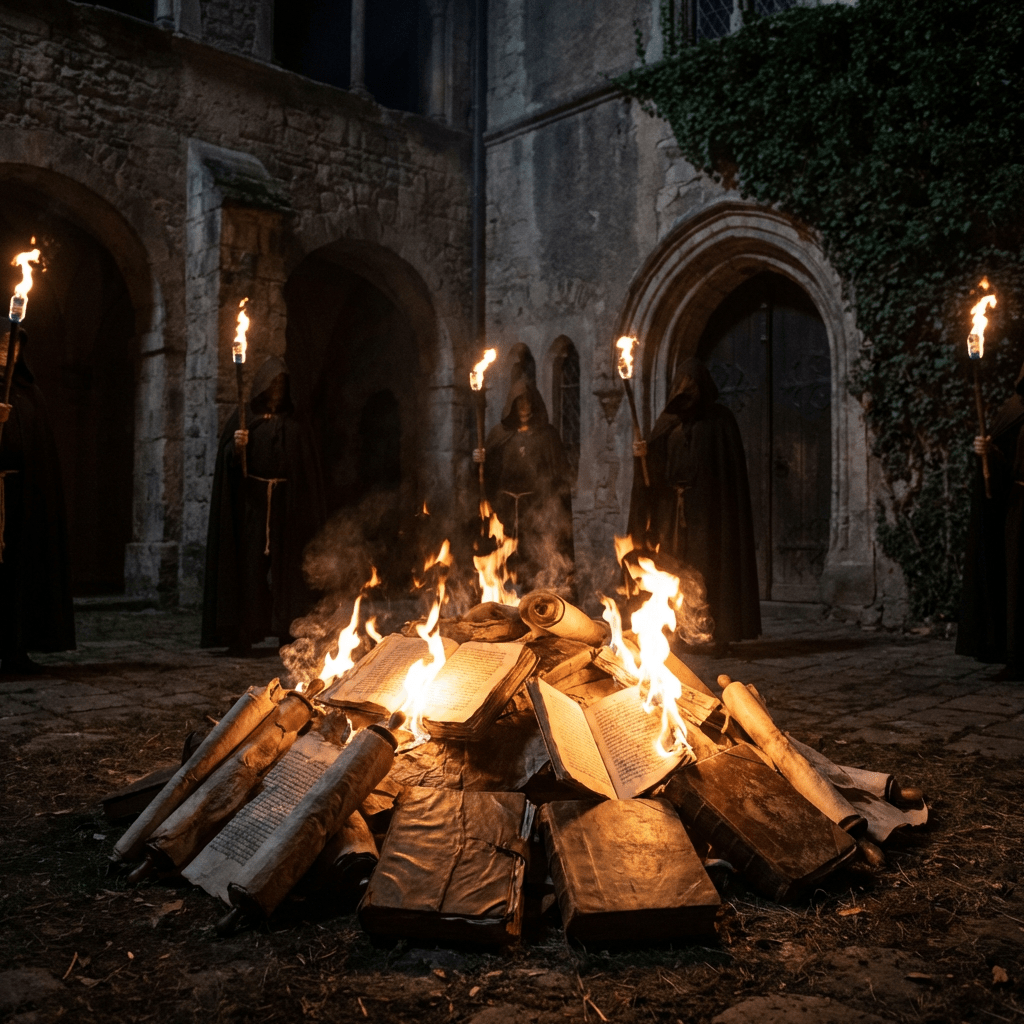
Funny things, book burnings. Why would anyone burn anything as innocent as a book? Good question. Yet people do. And people always have.

I think back to Don Quixote I, 6 and the Scrutiny of the Library. The Priest and the Barber go through the mad knight’s library and one by one examine the books of chivalry and either spare them, or cast them into the flames. This, in itself is a parody of some of the judicial actions of the Spanish Inquisition. In particular, any book that they considered to be unsafe or heretical went into the flames. Our Spanish Knight, of course, went mad through reading too many books of chivalry – and his brain dried up so that he totally lost all reason.

It is very interesting to read which books were spared and why. Equally interesting to find that many were burned on aesthetic grounds – they were not well written, or they were boring. Fascinating.

Fascinating too the book burnings that took place in Mexico during the Conquest of that country by the Spanish Conquistadores. Many pre-Columbian codices were burned. Priceless treasures and histories lost forever. Some, I think the Vindobonensis, still bear the marks of the flames when they were pulled from the fire in an effort to save them.

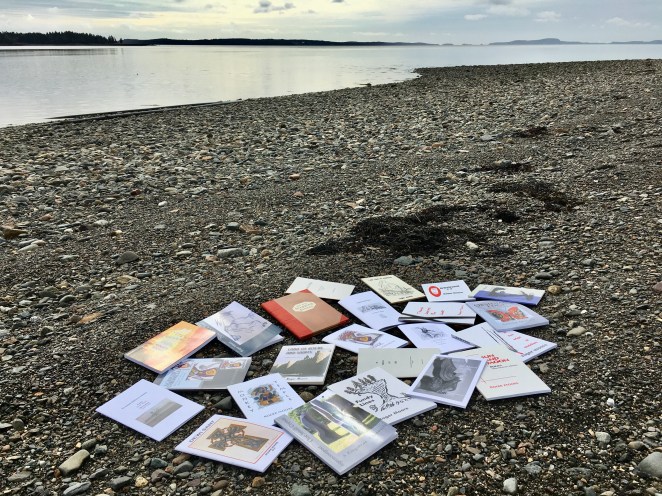
Moo tells me that my books will never be burned. And I am thankful for that. I asked why they wouldn’t be and he replied that nobody reads them anyway! Not such a comforting thought. So, in an effort to keep me happy and to preserve my books from the flames, another of my friends laid them out on the beach at Holt’s Point, New Brunswick. They certainly won’t burn when the tide comes in.

More important, I see that junk from Canadian Beaches, dated about 1960, has just arrived on the shores of the European continent, sixty plus years later. So – a floating book, a message, perhaps, in a time-bottle, destined to achieve immortality and live for ever. What a comforting thought for those of us who believe in the time and the tide that wait for no man! But they both might wait for his books.

Banks of the Seine

Banks of the Seine

Gnawing at the carcass of an old song,
my mind, a mindless dog, chasing its tail,
turning in circles, snapping at the fragment
of its own flesh, flag flourished before it,
tournons, tournons, tournons toujours,
as Apollinaire phrased it, on a day
when I went dogless, walking on a mind-leash
before the Parisian bouquinistes who sold,
along the banks of the Seine, such tempting
merchandise, and me, hands in pockets,
penniless, tempted beyond measure,
by words, set out on pages, wondrous,
pages that, hands free, I turned, and turned,
plucking words, here and there, like a sparrow,
or a pigeon, picks at the crumbs thrown away
by pitying tramps, kings, fallen from chariots,
as Éluard wrote, and me, a pauper among riches,
an Oliver Twist, rising from my trance, hands out,
pleading, “Please, sir, can I have some more?”

Commentary:

Intertextuality – how many different texts can you recognize in this one piece of verse? I can count six reminiscences of other poets, ones that have influenced me to a lesser or greater extent. A couple of novelists lurk in the shadows as well. Fascinating, eh? Do these voices echo in any other ears than mine? Good question – and does it matter if they do or they don’t? The main thing is that they harmonize, the old world with the new, the centuries that went before with the one that is with us now. Quevedo – “Vivo en conversación con los difuntos y escucho con mis ojos con los muertos.” I live in conversation with the defunct and I listen with my eyes to the dead.

And look at that painting. No, not the Banks of the Seine, but the banks of the Fundy, near St. Andrews. And it’s Moo, at his best, doing a cross between a cartoonist, a genuine artist, a surrealist, and an amateur artist who lends his paintings to friends when they want a picture of water, or a river bank, or something or someone else that will add to the intertextuality of his works. Yea, Moo. Go Team Moo, go. Long may you survive and work together.

Carved in Stone 23 & 24

Carved in Stone

23

It isn’t true that art
lives longer than life,
for all too often art and artist
are destroyed together.

Words, all words,
and words emerge
from the silence of blood,
bone, and stone, breaking
that silence the day they are born,
and the word once spoken
cannot be recalled.

24

Here, among the ruins of my life,
I have learned how to be alone,
how to sink into silence,
how to smother at birth
that world of words,
and that world, still-born,
becomes a lost world
whirled on the silent wind that fans
the unborn fires within.

I sit here
brushed by a tadpole’s solitude
as it swims through the sultry silence
of blood, bone, and stone,
into its own metamorphosis.

The wind that blows unspoken words
tugs at the spider web of my mind
twisting and untwisting
its frayed, fragmented ends.

Commentary:

The fragility of life. The single puff that turns the dandelion into a dandelion clock. The multiple puffs that dowse the candles on the birthday cake. And then, one day, there are no more candles, no more cakes, just the heart ache of multiple absences, family and friends all gone and each of us alone with our individual loneliness.

That’s when we finally turn in and seek the inner roads that lead us to ourselves. The selves that were, the selves that are, the selves that always will be. Crack the walnut – inside is the map of a brain – your brain? If it is you will have found yourself in this labyrinth. But if it is the brain of another, you must not give up, you must seek yourself, walnut after walnut.

And when you go to the library, you must check book after book, because one day, if you are lucky, you will find the book of your life and it will tell you who you were, what you are, and what you will always be.

Angel

Angel

Oh yes, I have been with them, the lost folk, the tramps, the homeless, the bag-women, all the gente perduta. I have stepped on their fingers as they sprawled on the sidewalk. I have trodden on their toes, tripped over their legs, bumped into their stiff, stumbling bodies and stepped in their wasted body fluids. I have stayed out all night, shared a pack of cigarettes, producing another pack or a bottle from the pouch beneath my wings. Such stories they tell, and they tell them in that antiquated language that I first heard hundreds of years ago. They know me now. I won’t say they trust me, but they tolerate my presence, a Jacques Cousteau voyeur, looking into the sea-depths of their despair.
            Garbed in garbage bags, thin trickles of wine and vomit slipping over their lips and cheeks, bloody bandages wound around needle wounds, they have scars at elbow and foot. I hear the warmish blood whistling its snake song through their arteries and veins but death shall have no dominion, not while I am on watch.
            I enfold myself in my wings and weep as these people, my people now, pillow their heads on bloody bandages. Their world is a world of vomit and reek, yet the edges of their shattered lives rip chunks from my hands and fingers, pluck feathers from my wings, tear holes in my heart. Needles I have seen and touched, blunt, shared between three, five, and twenty-five. Round and round, they go, slipping the thin threads of drug-dreams and tainted blood from friend to friend while the blunt points stab at bruised flesh and leathery vein until the freed blood oozes through fingers and hands clenched tight to hold and staunch.
            Night after night I have watched them searching for something just beyond their fingertips. As the late-night diners emerge from their opulent restaurants, I have seen my people fortifying shop doorways with cardboard castles. I have watched them climb inside, shut down the portcullis, and enfold themselves in the plastic that will keep them free from wind and rain. They all crave the bottle’s warmth. They fight and scratch for that which will hold them together, body and soul, that spiritual glue that binds the spirit before setting it on its drunken dreams of freedom. Kings and Queens, tumbled from their earthly thrones, they dream of the paradise they lost, yet think they can find again at the sharp point of a needle or the bottom of a bottle.
            Oh bird-on-a-wire dreams held captive in a skull-bone cage, how you yearn to grow wings, like me, to soar, to fly, to be released from the body, to at last be free …

Commentary:

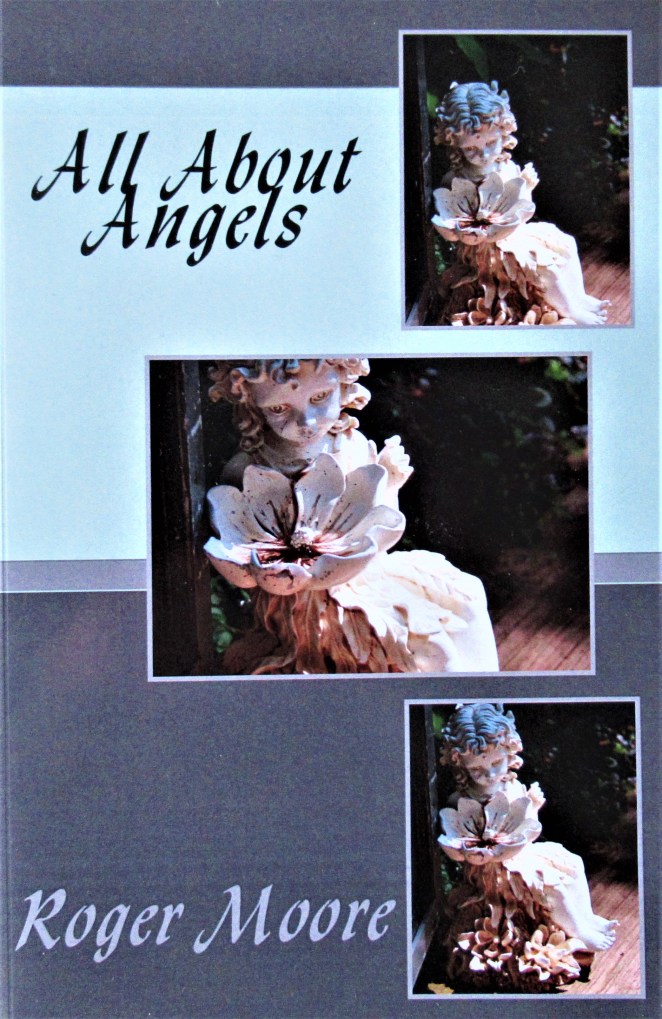
This book, All About Angels, is available online at Amazon.ca. Click on the link below to purchase the book.

All About Angels
Paperback edition

Carved in Stone 4 & 5

Carved in Stone 4 & 5

4

Maiden Castle –
Rome’s victorious Legions
sought out the main gates,
broke them down,
and placed their altars
to Mars or Mithras
on the ruins of the pagan temples
they desecrated.

What were they, those Romans,
but pagans themselves?

Their false gods
replaced the fake gods,
worshiped there long before
the legions’ arrival.

5

Later, the Saxon sword-song
superseded them
and the Roman Empire fell,
with a pendulum swing
that led to another set of gods.

How did they know
which was the true god?
Was it the belief in miracles
or the military might
that resolved the issue?

Bonfire night.
The sacred texts go up
in fire and smoke.

Brave is the man
who risks his hand in the fire,
defying the flames
to hold on to his truth.


Commentary:

“Brave is the man who risks his hand in the fire, defying the flames to hold on to his truth.” It appears that the Congregation of the Holy Office, aka the Inquisition, threatened to hold Galileo’s right hand in the fire unless he recanted and denied his scientific observations. Church theory held that the universe was terra-centric – the sun moved round that earth and the earth stood still – while Galileo showed that it was actually heliocentric – the sun stood still and the earth moved around it. Old and sick, he recanted in public, but was heard to mutter eppur si muoveyet it still moves.

Bonfire Night celebrates the discovery of the Gunpowder Plot. Barrels of gunpowder had been placed beneath the Houses of Parliament in Westminster, but they were discovered on November 5, 1605 and removed. Bonfire Night is also called Guy Fawkes Night, Guy Fawkes being one of the key plotters to remove the English Parliament. Leading up to Bonfire Night, young children in the UK place a ragged scarecrow, called a Guy, around the streets begging for “a penny for the Guy”! With these pennies they buy fireworks. Then, on November 5, the Guy is set atop a large bonfire and the fire is lit. This autumn burning is accompanied by fireworks.

Bonfire night also refers to the old medieval book burnings of texts that were anathema to whatever religion or regime was in control. Cervantes refers to them in Don Quixote, I, 6 (1605).

Book of Life

Book of Life

When I lost my place, I tied my hanky in a knot,
to help me remember the number of my page.
Last night I looked in pockets and sleeve, but
I couldn’t remember where I put my hanky.

At midnight the stars dropped liquid fires and they
pooled like letters on the fresh snow of my dreams.

One night I caught some falling stars and I joined them
together, one by one, till they stretched their daisy chain
across the garden. Words grow like flowers in the Spring.

Once I could accelerate the universe. But now I slow
down when I spell my name. There is a circlet of gold
on the sky’s bright brow. What gave these stars the right
to write my future in expanding letters? A satellite moves
in a straight line, north to south and starlight crumbles
in the wake of artificial knowledge spanning the eye ball
of the planet.  Who will repair these broken tunes? Who
will glue these scattered notes back into the piano’s frame?

My tongue stumbles against my teeth and trips on my lip.
A leaf of fire scorches the deep bell sound of my throat.

Commentary:

I looked over my shoulder, backward into time and space, and discovered this poem, penned more than a quarter of a century ago and abandoned in an old folder. Moo tells me he hasn’t painted for some time – I wondered if he was on a rotating striking, like our posties (Canadian for mail men and women), but he assured me that he had been sleeping, not sleep-walking in circles. Anyway, he felt inspired, put paintbrush to postcard and gave new life to my Book of Life. Thank you, Moo.

Do you remember when we used to tie knots in our hankies to remember what we had to do? Paper tissues put an end to that. No point in tying a knot in a soggy tissue, even if you could. And as Francisco de Quevedo told us – no point in looking in your hanky after you’ve used it. No point in searching for diamonds and emeralds, let alone pearls of wisdom, they just won’t be there. Good one, Franky. Of course, he was writing in Spanish, not English and my translation can’t do him justice.

It used to be fun watching the night sky out here in Island View. So clear – the satellites passed overhead and followed different paths from the stars. No Platonic dancing to ethereal music for them. Tone deaf, the lot of them, cutting their own little paths across the night sky. We used to get Northern Lights too, Aurora Borealis. They were always spectacular. Great crackling curtains of light hanging down from the heavens almost to the rooftops. Moo wishes he could paint everything h sees. I wish I could write down in verse every thought I think. If each of us had our wishes fulfilled, we’d have two books of life – one in color and one in black and white!

Monologue

Monologue

“They broke our walls,” Mono whispered, “stone by stone.
A new church they built on the land they stole from us.
Red was its roof from a thunderstorm of blood.
The white bones of their lightning scattered us like hail.

They ripped out our tongues and commanded us to sing.
Carved mouths were ours, stuffed with grass.
Stone music forced its way through our broken teeth.

Few live who can read the melodies of our silence.
We wait for some wise man to measure our dance steps.

Pisando huevos: we walk on tiptoe across
these stepping stones of time.

Commentary:

Mono means monkey (in Spanish). Hence, monologue means monkey speaking to himself. Cute, eh? Monkey is one of the day signs in the Mixtec Codices. Lots of double meanings and rabbit holes down which the ardent reader can descend. Dig deep, my friend. Pisando huevos – literal meaning – ‘walking on eggs’ – meaning walking very carefully, on tip-toe, step by step.

Who said poetry was simple? You want it simple, there are so many simplifying factors out there. I want you to think. To think for yourself. To understand complicated language with multiple meanings. You want simplicity? Go watch a TV ad – Tide’s in, Dirt’s out. Omo adds bright, bright, brightness. The Esso sign means happy motoring. Don’ forget the Fruit Gums, mum – (said as the little boy throws a brick out of the window and it hits his mother on the head).

I’d say “wake up and smell the coffee.” But if wake means woke, I’m not the sort of bloke that accepts the meaning of wake or woke! Hereward the Wake. Robin Hood the Bloke in the Hood who Awoke- and I don’t mean the flower / flower, nor the Lincoln Green of the Lincoln Continental.

So what do I mean? I don’t know. Coded words are meaningless unless you have the meaning to the code. What code? The miscued code. And the meaningless lack of meaning in meaningless. Just like my friend who’s just been screwed, blued, and tattooed – and totally rude. Or was it scrod?