What is your mission?

Daily writing prompt
What is your mission?

What is your mission?

Let us begin, as usual, by asking, what do we mean by ‘mission’? Here are some examples of the meaning of mission. (a) an important assignment carried out for political, religious, or commercial purposes, typically involving travel. (b) the vocation or calling of a religious organization, especially a Christian one, to go out into the world and spread its faith. (c) any important task or duty that is assigned, allotted, or self-imposed. (d) an important goal or purpose that is accompanied by strong conviction; a calling or vocation.

I can happily dismiss (a) and (b) from the start. I do not consider an assignment to be a mission, not in my case anyway. I am not one to wander the world, good book in hand, heart on sleeve, convincing people to believe what I believe. That said, I can work with (c) and (d) because, as a life-long teacher, who was offered, at various time, an array of other jobs, I am happy to say that I was a teacher by vocation, by calling. Teaching was my mission. My mission was accomplished.

I taught, in Canada, from 1966 to 2009. Then I reached retirement age. On June 30, 2009, I was a teacher. On July 1, 2009, I was nothing. The shock was enormous. It took me a long time to recover and discover that no, my life was not over, and yes, I had many other things to do. Thankfully they all involved teaching, in one way or another. I used my teaching / research experience to sit on the editorial boards of various learned journals. I even edited a couple of them. I also translated, usually from Spanish to English, and worked with the translations of other people. I also wrote articles on teaching and on creativity.

Creativity gradually took me over. I offered workshops on prose and poetry, wrote and edited books, penned introductions for other writers, and even published some books by other people, usually my family or close friends.

There was never much money in teaching or in creative writing. I always did it for love – love of the subject, love of learning, love of the students, love of watching them grow and develop. When I work one-on-one with another writer, or with a small group of writers, that love is still there. Alas, as I grow older (much older!), I feel the ability to motivate slipping away. The will, the vocation if you like, is still there, but body and mind are growing weak, and that, my friends, is the saddest thing of all.

Dark Angel

He will come to me, the dark angel,
and will meet me face to face.

He will take all that I own,
for my wealth is only temporary:
health, wealth, possessions are all on loan.

My house, my wife, my car,
my daughter, my grand-child,
 my garden, my trees, my flowers,
my poetry, my works of art.
I use the possessive adjective
knowing full well that these things
are only on loan. I will never be able
to preserve and possess them.

I even rent this aching heart,
these ageing, migrant bones,
this death that has walked beside me,
step by step, every day
since the day that I was born.

My death alone is mine.
It belongs to nobody else.
It will be my sole possession.
It will soon be the only thing
I have ever really owned.

Comment:

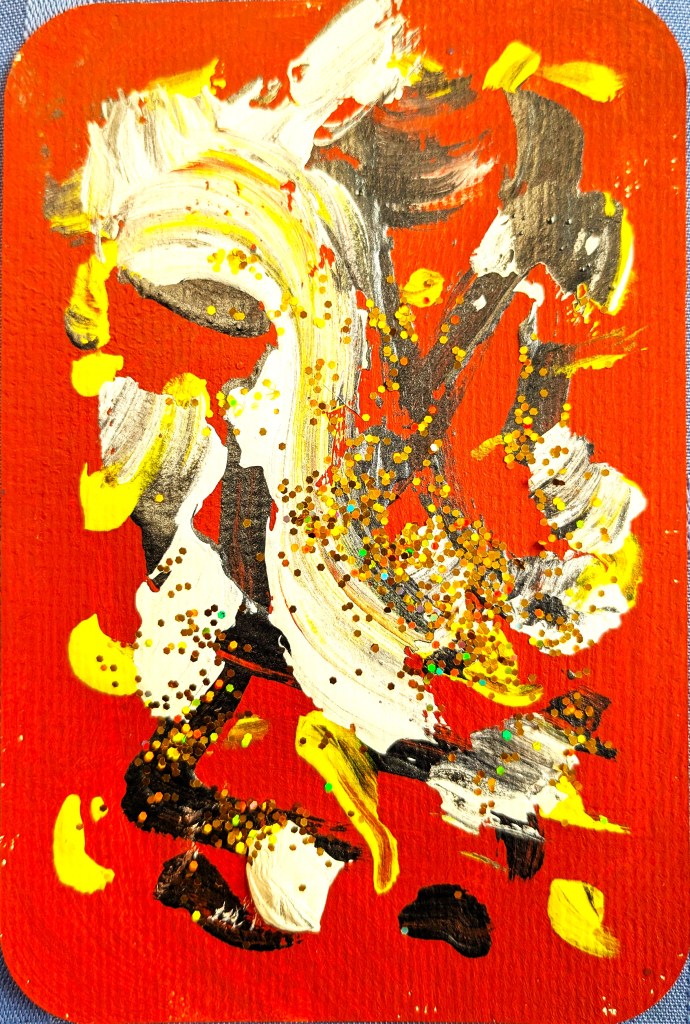
Dark Angel is from my poetry book – Septets for the End of Time / Poems for the end of Time. The lead painting in today’s blog is by my friend, Moo, and he calls it Storm-Me.

When are you most happy?

Daily writing prompt
When are you most happy?

When are you most happy?

What on earth does that mean? When? Are we talking time of day, or time of night? Are we talking a season of the year? Are we talking mood swings – happy now, oh dear, mood swing, not happy now? Are we talking Hen Wen, the magic white pig at the feeding trough? “I am at my happiest, oink-oink, when I am eating a big burger from …” – and here you name your favorite burger outlet. None of that Hen Wen nonsense applies, of course, if you are vegetarian, vegan, or have an allergy to burgers or buns!

I can tell you when I am least happy – 7:30 am, on a wet, damp, cold, icy, snowy winter morning, when I have to get up, get dressed, and go out in the mush and the slush to have an early morning blood test – no food or drink for 12 hours – at the local hospital. Last time I did that, I couldn’t find a parking spot, and drove round and around until eventually one opened up, as far away as possible from the hospital of course. No, I was not a happy camper on that occasion. Especially when I slipped on the ice, returning to my car, and then found someone had driven into my side while I was parked there. Oh, that made me so happy and so jolly, I laughed until I cried. [I do hope you can recognize sarcasm when you see it.]

So, let us reverse the question and reframe it by saying that I am perfectly happy when the things that make me miserable do not happen. No fender-bender in the ice and snow – I am a happy man. Caught speeding or jumping a red light – totally by accident, of course, – and the man in blue asks me for my license, sees that it’s my birthday, and lets me drive away with a verbal warning and a jovial ‘happy birthday”! Ah yes, reverse psychology, that sort of thing does make me happy.

So, above all, it’s the little things in life that go right, and not wrong, that make me happy. This morning’s boiled egg, boiled to perfection – not too hard, not too soft. My coffee a perfect blend designed to bring joy and happiness. Marmalade on blue cheese, the Welsh equivalent of Chinese sweet and sour – oh yes, and actually making someone laugh or smile when they read this nonsense I write. Even Hen Wen grunts with joy – oink! oink! – at that one. So if you have enjoyed this post, please take the time to send me an oink or two, and I will be happy. Thanking you in advance is, yours sincerely, Hen ‘oink!’ Wen ‘oink!’ Wink, ‘oink!’

Poppy Day

Poppy Day

Remembrance Day
11 November 202
4

I wasn’t there
I never saw the gas clouds
            rolling over our positions
            never felt the barbed wire’s bite
            nor the bayonet’s jab

I never hung out my washing
            on the Siegfreid Line
            (“Have you any dirty washing, mother dear?”)
            never broke out of barracks
            never did spud bashing
            nor feasted on bread and water
            nor heard the rifle’s rapid rattle

I wasn’t there
            to see them carried away in carts
            coughing spluttering vomiting
            or bandages over their eyes
            walking slowly to triage a hand on
            the shoulder of the man ahead
            the sighted leading the blind

I wasn’t there
            but both my grandfathers were
            both decorated
            one mentioned in dispatches
            signed by Winston Churchill
            that one uninjured
            the other one gassed
            coughing up his lungs
            bit by bit for forty years

I am here now
    to remember
    and to honor them
           though so much
    has been lost

Comment:
My friend, the painter known as Moo, painted this poppy today. My generation, unless they served voluntarily, as many have done, was never conscripted. As a result, the horrors and tragedies of combat were never known to us, except as seen through they eyes of other people. I think of Wilfred Owen and his magnificent, heart-rending poems from WWI.
Today, I pay tribute to those members of my family who served in the armed forces by land, sea, and air. I also pay tribute to the veterans who survived, and to those who gave their lives in the defense of our country.

What could you do less of?

Daily writing prompt
What could you do less of?

What could you do less of?
I shall deliberately misinterpret that prompt / question and answer it my way. I could do less of listening to stupid adverts, repeated ad nauseam, sometimes with gimmicky tunes – one to two lines maximum – again and again, all day, every day. Surf the channels to escape an ad, and what do you get? A synchronized set up where almost every channel is blasting out the same, or similar, ads at the same time. Have you noticed that when you leave the TV room, and retreat to the kitchen to get some limited peace, the ads follow you because the volume is turned up at ad time so you just can’t escape.

I remember my grandfather, back in the sixties, with the advent of ITV in Wales – the Independent TV channel that used ads – sitting before the TV set, his foot up before the screen and his fingers in his ears so he would not be able to see or hear those ads. Alas, once heard, seldom forgotten, and I can still sing most of those meaningless jingles heard back in my childhood. How it I hate when I go shopping in the supermarket and shoppers tunelessly whistle a TV ad as they shuffle along behind their carts. Alas, ad free programming, all too often, is either expensive or non-existent.

And what about those telephone calls when they put you on hold until the next agent is free to attend to you? I won’t mention names, because I don’t want to get sued, but I guess we have all had the same experience. I had a ninety minute online wait one day, with horrible music, an exhortation to stay on the line so I wouldn’t lose my place in the queue aka line-up, and a 90 second ad that glorified the joys of the company’s product, repeated once every five minutes. I suffered through that ad 18 times on that one call alone. Another local firm gave me the similar treatment, except that it was a one minute ad, repeated once every ninety seconds. I suffered through 10 repetitions in a wait of 15 minutes, got fed up, and hung up the phone.

Look at the peaceful scene above. That’s the view from my bedroom window in Island View. Even the crows are absent, and the early morning silence, like the sun, is golden. Two birds with one stone – a morning person or an evening person? A morning person with dawns like this, but an evening person when a sunset like this one miraculously occurs.

What is one thing you would change about yourself?

Daily writing prompt
What is one thing you would change about yourself?

What is the one thing you would change about yourself?

Only one thing? I remember a story about a boy who boarded in a monastery school, and there, like the monks, they all changed their dirty habits once a week. So, is a dirty habit a thing? Probably is, if its a brown, sackcloth habit, tightened around the waist with a white cord by a man wearing open-toed sandals and no socks. So, there we go, once a week, on Wednesdays, like those monks, I also change my dirty habits. I also change my shoes, my socks, my shirts, my sweaters, my jeans.

More important, as I grow older, I have permitted myself to change my mind as often as I like. So, yes, I also change my mind, and not just on Wednesdays. And I really do change it when, like my habits, it gets dirty. “Oooh, you’ve got a dirty mind, you have.” “Well, so I do. Never mind, I’ll just go and change it.”

“What did Big Ben say to the Leaning Tower of Pizza?” – I’ve got the time, if you’ve got the inclination.
“How many ears did Davy Crocket have?” – Three – a left ear, a right ear, and a wild front ear.
“What’s yellow and deadly?” – Shark infested custard.
“What’s black and deadly?” – A crow in a tree with an AK47.
“When is a door not a door?” – When it’s a jar.
“What time is it Eccles?” – “It’s eight o’clock.” “Here, how do you know it’s eight o’clock?” “I’ve got it written down on a piece of paper.” “What do you do if it’s not eight o’clock?” “I don’t look at the paper.”
“Ding-a-ling” – That’s my ear ringing. I’ll just pick it up and answer it.
“What’s the first sign of madness?” – Hairs in the palm of your hand. “What’s the second sign of madness?” – Looking for them.

So what is one thing I would change about myself? Possibly the absolute necessity to tell awfully bad jokes. Easy to say – I’ll probably keep adding to these as I remember more of them. Take care – you have been warned.

“How many – men – does it take to change a light bulb?” – Five. One to hold the bulb and four to turn the ladder. Jokes like these can be good or bad. Good because they are occasionally funny. Bad, because it so easy to insert an adjective before – men – and to turn the joke into something more devious and not necessarily very pleasant.

“And that is the end of the gnus,” said the lion on BBC television, as he licked his paws. “Enough, no more. It is not as sweet now, nor as sour, as it was before. Pass the chow mean, please.”

Words

Words

Words grow like flowers, invasive,
cruel, beautiful, cutting, and when cut,
they wither and fade, like flowers too.

Catch them while you can, I say.
Catch them, hold them tight,
press them to you heart,
for time is voracious
 and will soon devour them,
 swallowing them in the black holes
of forgetfulness, carelessness,
and memory loss.

Shine a light on your words.
Underline them, grace them with stars,
think about them, carefully.

And remember, the word
once spoken or written
can never, ever be recalled.

Click here for Roger’s reading on Anchor.
Words

Octo-+Plus

Octo+Plus

The Octo-Plus has eaten up all my words and the stream has run dry. When the words don’t flow, I let the paint flow instead. Sometimes it works and sometimes it doesn’t. That might actually be a self-portrait, lurking in the bottom left corner of the painting’s glass. Ah, the ghost, not in the machine, but in the painting. It’s a hard life, being a writer when the words dry up.

I remember the old school’s terms of abuse “Oh, dry up!” Well, 70 years later, I have done just that. Mind you, it’s only for a day or two, and look, miracle of miracles, I am writing again. Leave the keyboard, take up your pen. The words are flowing and you’re writing again.

Terza Rima

Terza Rima
Apologia pro carmina mea

Dear reader who reads my poems: sometimes
I say what I do not mean to write
and write what I don’t mean to say. Rhymes

make things clearer, for I puzzle what I might
say, and plan ahead so an awkward word
will not intrude. Words, birds in flight,

bright as postage stamps across the absurd
white snow of a page or a digital screen.
When I think about it, I assume about a third

of what I say, I really mean. Who has seen
the early morning wind drifting our thought-cloud
across the lawn, moving shadows cast on green

blades of grass, as we think our thoughts aloud,
each thought a pea in a pod, as some we clasp
between finger and thumb while others crowd,

and the loud, uneasy word slips from our grasp
to wound or injure or otherwise to hurt and maim.
It’s not my aim to do this. My word is not an asp

or a viper or a screw to be driven. I lay no claim
to hurt and yet sometimes a word slips sideways
and does not say what I mean it to say. I aim

to please, to tease, to provoke, in so many ways
and yet I often hurt where no hurt is intended.
If I have done you wrong and my word displays
unintended ends, forgive me: let all rifts be mended.

Learning Disabled Learning Troubled

alebrije2

Learning Disabled Learning Troubled
by
Victor Hendricken
 

Like separate lives, they flow through our weekly meets.

The many speakers, special to their cause,

Marking trails with wise words and images

That surely we can follow through dense forest,

Where new growth, vibrant, verdant,

Fertilized by wisdoms, fed by lore,

Shines and sparkles to ever light our way.

They tell us who they are,

And hint at what we may become.

Guided by their telling,

Senses stir, touched by feelings

Long lost or never known

And yet we ask for more.

No stopping here, no rest from task.

Reflection does make wealth of all the learning,

So the last day is the first,

While still we reach, unending in our thirst.


Expectations of discovery:

Telling stories in old age,

Hoping to discover who we are,

Or who we might have been

Had we not been ourselves as we are now.

More than mental beings, physical too.

Bodies wracked by desire, not for human flesh,

But something sinister, demanding, unclean almost,

Liquid in form or hazy blue and drifting,

Wild in its ability to bring ecstacy

To crazed senses and convulsed parts.

We talk, confused by dialect

Long lost or perhaps newly made

That speaks of different times,

When different rivers ran and winds were not so cold.

And yet we tremble to recapture words

That tell our passing and the greatness that we might have been

But for our special needs.


Readers we are not, but thinkers and doers,

Now there shines a bright star.

But wild it is, yet tamed with nectar of the gods

In white coats with sealed bottles at their will,

And small round pebbles of human kindness to dispense.

Lethargic no; sleepless yes!

And still our thirst, never satisfied,

Coyly beckons to the spring.

Until at last, letters dancing

Like eggs, scrambled, with dots of pepper laced.

We close our eyes and listen

And hear the world conform, at last.

Though weary, we who hear so well,

Cannot raise the glass, or read the words

So simply carved upon our epitaph of stone.


Many have come calling,

None remained, none returned.

Yet through it all one stayed;

A beacon, to light the way through confusion,

Bringing us home through the darkness

Of our ignorance and of our bliss,

Where vision, too often blurred by regularity,

Sees not the forms that cast the shadows,

Nor the minds that hold the forms.

For we too are human, with needs,

Unique, special, and starving to be met.


How can we say without saying,

Do without doing?

What magic cleverly spins its charm

To turn the chore from task to deep desire,

So that, without seeming to accede,

Demands are met, and institutions no longer risk.

Answers are oft found in their own questions.

But questions must be disassembled,

Stripped, laid bare to each their naked parts;

Abundant clues that lead to hidden corridors of knowing

Reveal, upon examination, answers that flow

From the tips of fingers to places inside,

Where decisions are dreamed and voiced.

There, nestled in the gut, close by the heart,

Feelings are born, expressions lived.


Look to the question,

And, in the very asking find the answer.

Who educates?  Evaluates?  Decides?

Is it how well I did, or how good I am?

Did I get to play a part and why not?

Choosing is as real on the inside, as it is on the out.

Comment: I am posting some poems and texts by friends. This poem is the first on the list, written by my good friend Victor Hendricken. Congratulations, Victor: You’re #1 on the hit parade!

Day 23 CV-19

IMG_1652 (2)

Day 23 CV-19
Codes and Coding

“Languages: they say that to learn another language is to gain another soul and another set of eyes through which to view the world.” I wrote these words just yesterday [Day 22 CV-22]. The words are mine, but the idea belongs elsewhere. I have borrowed it and adopted it. I would willingly attribute it to a specific author, but I do not know who said it first. I offer my apologies to the to me unknown genius who first spoke these words.

Why codes and coding? A rhetorical question, of course. But codes and coding are the basic elements through which language transfers thought, our thoughts. What is a code? Well, we know all about Morse Code and the elaborate codes through which spies from all countries communicate their needs. A code is a way of converting language, changing it, making it available to those initiated in the code and unavailable to those who have not received such initiation. Sounds simple, doesn’t it?

When I was travelling regularly to Spain for research in Spanish libraries, my first port of call was always the local barber shop. I did this for several reasons. In the first place, my Canadian haircut gave me away as a foreigner. This is the hairdresser’s code. The barber’s shop was always the centre of local gossip. Here, buzz words changed hands, politicians were discussed, all the local news was immediately available. Each of these items was a code, a code that made an insider (acceptable) versus an outsider (not to be spoken to). I remember, one summer in Madrid, not getting served in any bar or restaurant. Check haircut: okay. Check shoes: bought new pair. Check shirt, jacket, tie: all up to date. Inspect lucky customers … ah … they are all wearing a shiny brass pin showing the symbol of Madrid: El Oso y el Madroño, the bear and the strawberry tree, as seen in La Puerta del Sol.

The next bar I entered saw me sporting El Oso y el Madroño in my lapel. Qué quiere el señor? Immediate service and with a smile. These are social codes, the codes that include the winks and nudges of the upper class, the secret handshakes and foot positions, the names dropped so gently and quietly that they never shatter when they hit the floor. There are also language codes. Northrop Frye wrote The Great Code: The Bible and Literature, a study of the mythology and structure of the Bible was published in 1982. In this wonderful study, Frye showed how themes and language from the bible have influenced the structure of Western Literature, particularly that written in English. Within this code, names, themes, miracles, parables, psalms form a body of are common knowledge available to all readers who are christian and whose first language is English.

But there are other codes. Think Petracharism. Petrarch’s poetry, originally written in Italian, was widely imitated throughout Europe. Italian literature, Spanish, French, English, all dip into that code, as does Shakespeare among so many others. Think the Great Chain of Being. Shakespeare is incomprehensible in places unless you unlock this particular code. Think Platonism, Neo-Platonism, Stoicism, Existentialism … okay, so all this is academic, and I do not want to lose you in a sea of academia. So think NFL, think NBA, think NHL, think baseball, think cricket, think rugby, think darts, think all of the things we manipulate on a daily basis in our lives and think how they include some people (those who know and share our codes) and exclude others (those who are unaware of them). LBW, c&b,  c. A, b. B, st. A b. B, w, W, b, lb, dec., rsp …

This is a wonderful line of discussion. It follows along the lines of micro-language and macro-language. Macro-language is accessible to all who happen to speak that language. Micro-language in its multidinous forms incarnadine belongs ONLY to those who share the micro community, be it family, household, village, town, county, region … all that is closest and dearest to our micro-hearts.