Crystal Liturgy

I

Crystal Liturgy

Here, in the abyss,
where song-birds pluck their notes
and send them, feather-light,
floating through the air,
here, you’ll find no vale of tears,
no fears of shadow-hawks,
for all blackness is abandoned
in the interests of sunlight and song.

Here, the crystal liturgy surges,
upwards from the rejoicing heart,
ever upwards, into the realms of light,
where color and sound alike
brim over with the joy that, yes,
brings release to head and heart.

Here, seven-stringed rainbows reign,
the everlasting harp is tuned and plucked,
and an eternity of music cements
the foundations of earth and sky.

Here, the master musician conducts
his celestial choir, their voices rising,
higher and higher, until they reach
the highest sphere, and song and voice
inspire, then expire, passing from our eyes
and ears into unbounded realms of light.

Here, the seven trumpets will sound
their furious dance, a dance that will announce
the end of this singer, the end of his song,
but never the end of song itself.

Commentary:

Crystal Liturgy is the first poem in the poetry sequence Septets for the End of Time. I will start placing these poems here and you can follow the sequence as it evolves. It consists of 56 poems – seven septets and a coda.

A Note for Readers

Olivier Messiaen is one of my favorite composers. I purchased his Quatuor pour la fin du temps / Quartet for the End of Time in Rimouski, PQ, in 1982 while driving around the Gaspé Peninsula. I was fascinated both by the music and by the words that headed each section. I should note that I have always enjoyed ekphrasis, the verbal description of visual works of art. With Messiaen, I tried to recreate not only the thoughts and images generated in me by his music, but the spaces and repetitions that come from light and dark sounds and birdsong caught in the intervals between notes. This was a new sphere of experimental writing for me and while composing I played first the Quatuor pour la fins du temps / Quartet for the End of Time, then Éclairs sur l’au-delà/ Lightning above the Beyond, and finally Petites esquisses d’oiseaux / Little Sketches of Birds. What I tried to capture came from within my own mind, but the metaphors and images were inspired by listening to Messiaen’s music.
As Right as Rain

As Right as Rain

It’s the day after the night before
and I awake to an ache
in each of my arms.

I went to bed early, at ten,
and slept until eight-thirty,
but my AI watch tells me
that I only got six hours sleep.

I found a bump in the bed,
on the right side,
when I look towards the window.

I must have lain my arm against it,
during the night. It was so sore,
my right arm, the Covid arm,
when I got up this morning,
but the left arm, the flu arm,
was perfectly alright, except for
a little itch, and a tiny tingle,
like the jingle of elf-bells.

Black coffee and an aspirin
soon cleared it all up, and now
I am as good as new,
as right as rain,
except the rain that fell last night
brought power losses, cold,
and an absence of warmth and light,
and that sort of rain is not all right.

Commentary:

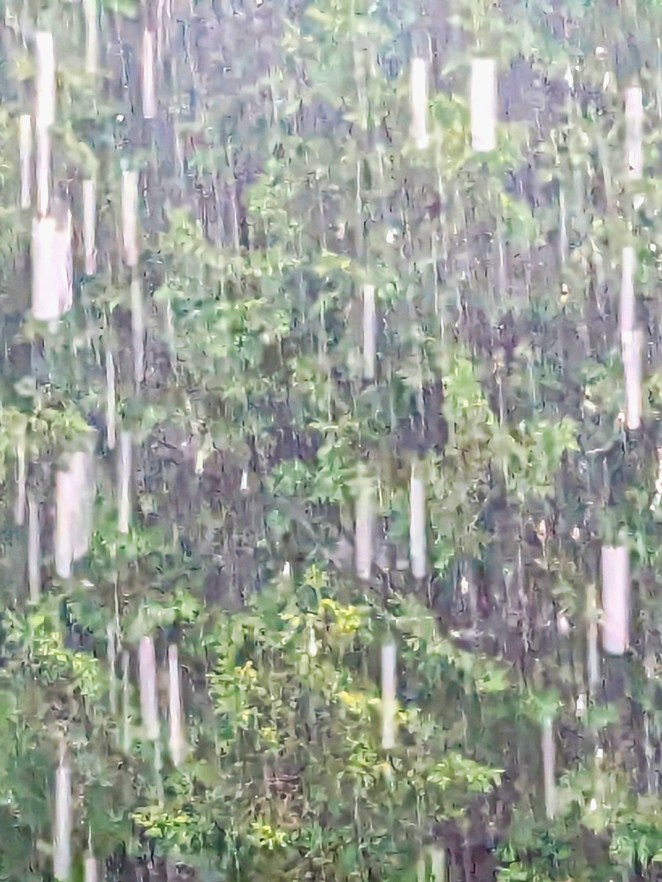
That’s a golden oldie from a couple of years back. I did both jabs in the same arm this year and didn’t feel a thing. It didn’t rain either, but look at the muck coming down in the photo – we had a bit of that a couple of days ago. Welcome to our Canadian half-winter. We used to get 3 metres / ten feet of snow every winter. Last year I only used the snowblower of three occasions. No wonder I think of it as a half-winter – winter ain’t what it used to be.

Carved in Stone 63

Carved in Stone
63

Words descend, soft and peaceful.
They brush my mind
with the hushed touch
of a grey jay’s soundless wings.

Yet the grey jays have gone,
vanished along with the grosbeaks,
evening, pine, and rose breasted.

Words can hardly express what I feel
in this diminishing world
when I inhale color and light.

Dawn bursts into bloom,
and the indoor hyacinth starts,
once more, to blossom.

Its immanent beauty
fills me with a warmth
that disperses night’s shadows,
taking away all sense of gloom.

Commentary:

The indoor hyacinth starts, once more, to blossom. Its immanent beauty fills me with a warmth that disperses night’s shadows, taking away all sense of gloom. Indeed it does. Once upon a time, it became infested with little bugs and was reduced to one leaf. Clare worked with it, spoke to it, cajoled it, and bit by bit it came back to life. Now it lives in the front porch in summer and returns to the house, southern aspect, in winter, to flourish when least we expect it.

Hyacinth, Jamaica in Spanish. And nothing more delicious than the miel de jamaica that one is offered in Oaxaca, fruit juice squeezed from the hyacinth flowers. “My wife has gone to the West Indies.” “Jamaica?” “No, she went of her own accord.” Humor flows and the hyacinth flowers, and I spend my winter hours sitting and watching my indoor flowers.

Yet the grey jays have gone, vanished along with the grosbeaks, evening, pine, and rose breasted. They used to flock on the picnic tables but as the weather warmed, they went further north. I remember when 64 mourning doves perched on the power lines. Now, we have two or three who look lonely in the garden and sound even lonelier. Words can hardly express what I feel in this diminishing world when I inhale color and light, but long for the passerines’ morning and evening flight.

But, in spite of all that, sad as it is, the hyacinth’s immanent beauty fills me with a warmth
that disperses night’s shadows, taking away all sense of gloom.

Daffodils

Daffodils

Winter’s chill lingers well into spring.
I buy daffodils to encourage the sun
to return and shine in the kitchen.
Tight-clenched fists their buds,
they sit on the table and I wait
for them to open.

For ten long days the daffodils
endured, bringing to vase and breakfast-
table stored up sunshine and the silky
softness of their golden gift.

Their scent grew stronger as they
gathered strength from the sugar
we placed in their water, but now
they have withered and their day is done.

Dry and shriveled they stand paper-
thin and brown, crisp to the touch.
They hang their heads as their time
runs out and death weighs them down.

Commentary:

A sad poem, really, for a wet, damp, dark, chilly day that begs for some light and warmth. And what warmth and light daffodils bring. Not to mention their delicate scent that lingers long in the nostril, faint, but intoxicating. For ten long days the daffodils endured. This was a joy in itself. Sometimes cut flowers wither so quickly. But ten days … wow! And they do indeed bring to vase and breakfast-table stored up sunshine and the silky softness of their golden gift.

Their scent grew stronger as they gathered strength from the sugar we placed in their water. Indeed it did. And the sugar itself enhanced their ability to linger on. A little Somerset trick that, all the way from Zummer Zet where the cider apples grow. And no, you can’t have real cider without real cider apples from real cider apple trees. But never forget Sally the Sozzled Sow – she got into the storage shed and drank about five gallons of the stuff. It was all over the newspapers. She got loose and knocked the milk churns over and rolled them in the clover. The corn was half cut at the time, and so was she.

Dry and shriveled they stand paper-thin and brown, crisp to the touch. So sad when this starts to happen. Then one day, they just fade away. And then they hang their heads as their time runs out and death weighs them down. Sad, really, as I said at the start – but we must never forget the joy and light and happiness they bring us when they are in their prime.

Carved in Stone 61 & 62

Carved in Stone
61

Water through the water clock,
water off a duck’s back,
the waters of life,
continually flowing,
trapped in our children
and their children,
and the love we create
never lost, just circling,
like the hands of the clock,
like the planets and stars.

But who will wind up
the clockwork universe,
and tend the mechanism
that balances planets and stars?

What will happen
when the clockwork
finally runs down,
the last candle is snuffed,
and the water clock dries up?

62

Whoever, whatever remains
will be left to contemplate
Ozymandias with his two vast
and trunkless legs of stone,
standing in the desert.

“Look on my works,
ye mighty, and despair.”

Commentary:

“Look on my works, ye mighty, and despair.” Well, Moo does have a sense of humor after all. I thought he did. From Ozymandias to the meaning of “works” to the destiny of the work we did. What a journey. It goes from the joy of the children who build a snowman to the warm spring wind that melts him to the crows and the dog who do what crows and doggies do. Intertextuality – the links between verbal and visual and think about it – such strange things happens in Moo’s creative mind.

But what do we leave behind? Think about it. Only the wake of the ship in which we sail. The wake – that white trail we leave behind us, on the surface of the sea, slowly vanishing as we also vanish, pulling away into the unknown that always lies ahead. Moo is right – so many things disappear out of the frame of the painting. “There are no pockets in shrouds” said the preacher in the hospital where I took my father, so long ago for treatment.

And even if there were, how would you fit a snowman, several crows, a cardinal, and the rear end of a dog into the pocket? “Contemplate Ozymandias with his two vast and trunkless legs of stone, standing in the desert. Now contemplate the fate of the snowman. Now look on my works, ye mighty, and despair.”


Dorset Knobs and Old Vinny

Dorset Knobs and Old Vinny

Five Lysol wipes remain in the can.
As rare as hen’s teeth or Dorset Knobs
and old Vinny, they have become precious
items sold in marked up prices online
by people who stocked up at the beginning
of the crisis on commodities they were able
to seize before rationing stepped in
and limited quantities were permitted
to each purchaser who waited patiently,
in line, to enter the super-market.

I place my leather glove on my hand
and move to the gas pump. How many people
have used it, pumping gas with bare hands,
and the metal surface retaining how many germs
who knows for how long? I cannot wear my mask
while pumping gas. Cover my face and they will
not serve me for fear I may flee without paying.
I finish pumping, open the car door, remove
my glove, put on my mask, pick up my cane,
and walk into the gas-station shop to pay.

As I limp towards the door, a man, mask-less,
holds the door open for me, his face less
than a foot from mine. “There you are, sir,”
he says, showing his teeth. “Service with a smile.”

I return to the car, remove a precious sanitizing wipe,
clean my glove, the car door handles, every spot
my gloved hand touched. Then I wipe the handle
of the gas pump and dispose of the precious wipe
in the garbage can nestled between the pumps.

Commentary:

Well, I am willing to place a bet with my favorite bookmaker, at Covey’s Print Shop, that not many of you out there know what Dorset Knobs and Old Vinny is or are. Moo has joined me in my wager and he is willing to bet that very few of you know where the line “où est le papier?” comes from. Even fewer will be able to sing the whole song! Oh dear, our world is only artificially intelligent, not really intelligent. In my teaching days I would ask the class if we were in a smart classroom. “Yes, sir,” they would reply. I’d then walk to the wall, tap it and ask it “What’s 2 + 2?” The wall never answered. I’d try again. “What’s 2 + 2?” – Silence. “Not such a smart classroom then,” I’d say to the students.

But I bet you all remember Covid, the days of taking all sorts of precautions, of wearing masks and gloves, of washing everything that came into the house, of washing hands, and not touching surfaces in public places where the unwashed may have left a winning lottery ticket with your Covid Number upon it. Oh dear, those were indeed the days. And this little poem, a golden oldie, recalls them. Let us hope they do not return. And let us doubly hope they do not return with a mutating or mutated helix of sinister proportions.

Dog Daze

Dog Daze

Memories deceive me with their half-remembered shows, shadow shapes shifting over the walls with a flick of the magician’s fingers. What magic lantern now slips its subtle slides across night’s screen? Desperate I lap at salt-licks of false hope that increase my thirst and drive me deeper into thick, black, tumultuous clouds. A pandemic storm lays waste to the days that dog my mind. Carnivorous canicular, hydropic, it drinks me dry, desiccates my dreams, gnaws me into nothingness. At night a black dog hounds me, sends my head spinning, makes me chase my own tail, round and round. It snaps at dreams, shadows, memories, anything that ghosts through my mind. Hunter home from the hill, I return to find my house empty, my body devastated, my future a foretold mess. Tarot Cards and Tea Leaves are lost in a Mad Hatter’s illusion of a dormouse in a teapot raking runes from an unkempt lawn.

Commentary:

Well, what a muddle. Images flying everywhere, in and out, like Von Richthofen’s flying circus of WWI fame. And look at that last line! Tarot Cards and Tea Leaves are lost in a Mad Hatter’s illusion of a dormouse in a teapot raking runes from an unkempt lawn. No wonder Moo said “Nein!” when I asked him if he had a painting to illustrate this one. In fact, he quoted Salvador Dalí at me: “There’s no difference between you and a madman, except that some days, you aren’t mad.” I guess this implies that some days I am.

“Ah well,” said Mrs. Thomas calling her son Arwel in for tea. Welsh joke. Many won’t get it. Arwel didn’t and he didn’t get his tea either. Never mind. Those things happened a long time ago when the world was so much younger, and, dare I say it, wiser! Actually, there’s nothing wrong with the world itself. The problem, as always, just like the old woman who lived in a shoe, it’s the madmen who inhabit the shoe that are the problem. And when the shoe’s sole needs a nail, who is going to come and glue it back together. Not me, said the red squirrel, laughing. And he always laughs. As soon as it gets cold he tucks into my garage and it’s a devil of a job to get him out again.

What’s worse, he insists on building nests in my car engine. That’s three times now. And it costs money to dig those nests out. Not to mention the mess. First time, I didn’t even know he was in there until the windscreen wiper on the driver’s side started to fail. Then the whole watering system broke down. I took it to the garage, and the garagemen said “I hope you’re getting rent money, you’ve got a tenant.” Anyway, he got rid of the squirrel and the nest. But the little blighter must have followed me home, because a few days later he was back in there again. He’s in there now. I can hear him chuckling as I type this.

Dog Daze, indeed. I wish I had my doggy back. Alas, as you can see from the photo, he crossed the rainbow bridge to his doggy paradise, leaving me to contend with a garage full of ham-fisted red squirrels. No wonder my head is spinning around and I am chasing my own tail, round and round. At least he’s single, that squirrel. I don’t know what I’d do if he got married. I know my maths ain’t no good (nor is my English), but where squirrels are concerned, I am pretty sure that 1 + 1 = 6 or more and a foretold mess.

Banks of the Seine

Banks of the Seine

Gnawing at the carcass of an old song,
my mind, a mindless dog, chasing its tail,
turning in circles, snapping at the fragment
of its own flesh, flag flourished before it,
tournons, tournons, tournons toujours,
as Apollinaire phrased it, on a day
when I went dogless, walking on a mind-leash
before the Parisian bouquinistes who sold,
along the banks of the Seine, such tempting
merchandise, and me, hands in pockets,
penniless, tempted beyond measure,
by words, set out on pages, wondrous,
pages that, hands free, I turned, and turned,
plucking words, here and there, like a sparrow,
or a pigeon, picks at the crumbs thrown away
by pitying tramps, kings, fallen from chariots,
as Éluard wrote, and me, a pauper among riches,
an Oliver Twist, rising from my trance, hands out,
pleading, “Please, sir, can I have some more?”

Commentary:

Intertextuality – how many different texts can you recognize in this one piece of verse? I can count six reminiscences of other poets, ones that have influenced me to a lesser or greater extent. A couple of novelists lurk in the shadows as well. Fascinating, eh? Do these voices echo in any other ears than mine? Good question – and does it matter if they do or they don’t? The main thing is that they harmonize, the old world with the new, the centuries that went before with the one that is with us now. Quevedo – “Vivo en conversación con los difuntos y escucho con mis ojos con los muertos.” I live in conversation with the defunct and I listen with my eyes to the dead.

And look at that painting. No, not the Banks of the Seine, but the banks of the Fundy, near St. Andrews. And it’s Moo, at his best, doing a cross between a cartoonist, a genuine artist, a surrealist, and an amateur artist who lends his paintings to friends when they want a picture of water, or a river bank, or something or someone else that will add to the intertextuality of his works. Yea, Moo. Go Team Moo, go. Long may you survive and work together.

Carved in Stone 43

Carved in Stone
43

Back home, in that little cul-de-sac,
the husbands are away,
working their night shifts,
while the wives are at home,
entertaining the truckers,
those long-distance drivers,
who park in that street and lodge there,
overnight, in the houses.

The children, boys and girls,
go out into the street,
climb into the trucks,
duck under the tarpaulins,
and, with all of us sworn to silence,
practice what their elders
are doing back home.

Commentary:
Monkey see, monkey do. And who knows what Monkey sees or does when the lights are turned out, darkness descends, and the honor of the blood cult takes control. Ask the animals, they will teach you. That was the motto of Bristol Zoo, where the Monkey Temple ruled, and Alfred the Gorilla and Rosie, the Elephant, were King and Queen of the beasts.

Knowledge – where does it come from? How do we attaint it? Is there a difference between knowledge, what is known, felt, and worked out for yourself, and education, when you obey orders and do what you are told to do (and how to do it). “We don’t need no education, we don’t need no thought control.” I have always loved Pink Floyd and The Wall. So many walls, so many barriers, so many things to break down in order to build them up again. Songs – Frank Sinatra – “I did it my way!” And who teaches what and to whom, underneath the tarpaulin when the lights are out? “Hey, teacher, leave those kids alone.”

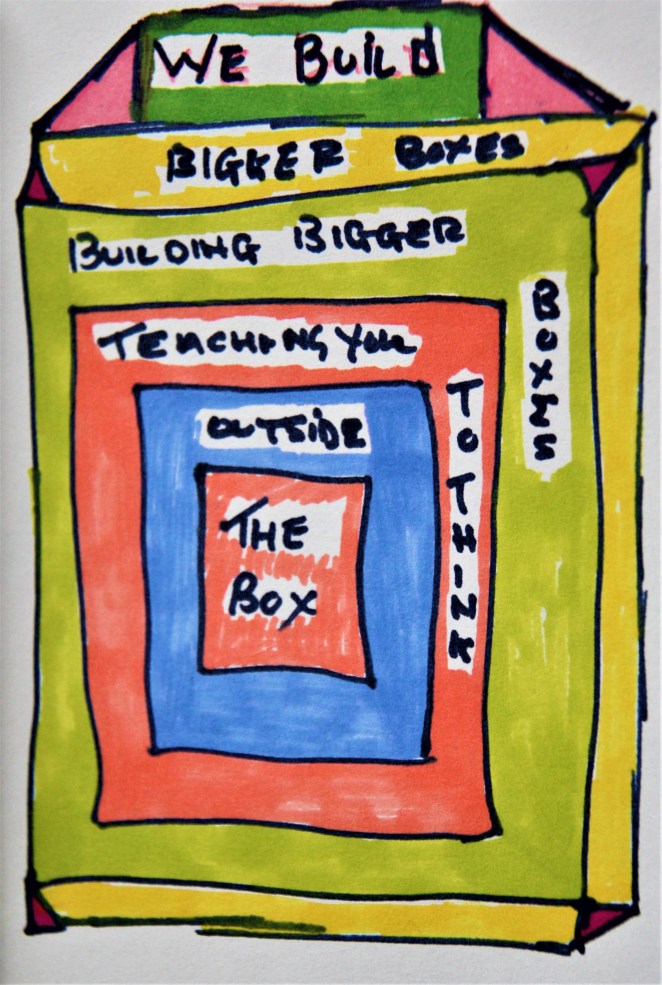
And beware of anyone who tells you that “we teach you to think outside the box.” That person will only give you a slightly bigger box, of his or her own making, inside of which you will be forced to think.

Of course, there are other ways in which we can think about education. How about this one? Filling empty heads with knowledge. How many ways are there to do this? And what is the exact content of the jug from which the knowledge will flow? And how many sows’ ears does it take to make a silk purse? “Hey, teacher, leave those kids alone.” Giddy up, Neddy I’m on my hobby horse now.

Carved in Stone 42

Carved in Stone
42

After school, in a cul-de-sac
that backs on to the railway yards,
the street boys show me
how to hold a knife,
how to approach a man,
how to ask for a light,
for a forbidden cigarette,
while other boys,
knives in hand, lie in wait
to ambush the victim.

How old am I?
Five or six.

I would go to Woolworth’s
with my friends and distract
the shop girl while the others
stole whatever they could.

Then we would go
to the public washroom,
boys and girls together,
and share the spoils.

Something for everyone,
and everyone sworn to secrecy,
a blood cult, knives
or razor blades inserted,
and wrist pressed to wrist.

Commentary:

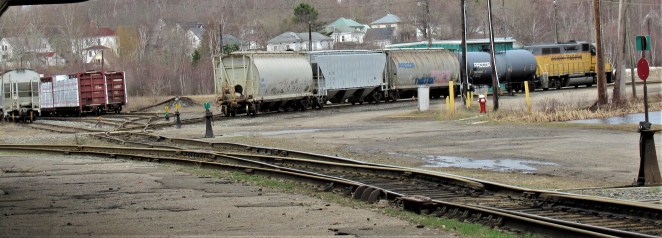
Free will or determinism? How does one escape from the back-street poverty of a run-down neighborhood and emerge from the shadows to bask in the light of the sun? Or is it all a dream, a made-up picture of a childhood that never was in a neighborhood that never existed? Vanishing point – the railway tracks fading away into the distance. Point of vanishing – to lose oneself in the mysteries of a past that never was in order to establish a future that never will be. Dream, dream, dream – all I have to do is dream!

And then there are the nightmares, when the dreams are true and the memories are so exact that you can see the blood on the razor blade and feel the almost silent slash of this particular slice of life. Secrecy – and who can tell whether I am telling the truth, or not, here in a foreign land, not the land of my fathers – and I only had one father, that I am aware of, and one mother too – where nobody knows me and the children from that imagined back street would never think of visiting.

For Jorge Luis Borges, whom I met twice, once in Bristol and once in Toronto, – Canada was a land so distant and so cold that it lacked reality. And thus I can dream my dreams, rewrite my past, reimagine myself, in whatever way I want to and I can vanish at any vanishing point I choose and emerge wherever I want to, and do it over and over and again, and who knows the truth? Over the points, over the points, and Liza none the wiser, whoever Liza happens to be!!!