The Numbers Game

Ryan and Don Roger

3

The Numbers Game

            The numbering of the chapters in Don Quixote is also interesting. While Part I and Part II often retain the Latin numbering, the chapters themselves can be found both with Latin Numbers and standard numbers.

            Latin numbers are based on six letters I, V, X, L, C, D and M. Each has its own value. I = 1, V = 5, X = 10, l = 50, C = 100, D = 500, M = 1000. Most have us have seen Roman numerals on clocks and we are familiar with the numbers from 1-12. I, II, III, IV (4, that is to say one before five), V, VI (6, that is to say one after five), VII, VIII, IX (9, that is to say one before ten), X, XI (11, that is to say one after ten), XII.

            This paradigm governs Latin numbers. XV = 15, XX = 20, XXX = 30, XL (ten before fifty) = 40, L = 50, LX (ten after fifty) = 60, LXX = 70, LXXX = 80, XC (ten before one hundred) = 90, C = 100, CX = 110. The date of my writing this MMXXVI (2026). You will have noticed similar numerical configurations on books and old movies.

            The ancient Celtic numbering system was based on the digits of hands and feet. Counting sheep, for example, or goats, shepherds and goatherds would count up to twenty on their toes and fingers. Then they would carve a notch in a piece of wood. To keep score was to score the notch.

            Something similar happens in Basque jai alai, the happy game.  The scorers score in groups of IIII which they then made into 5 with a line through the numbers IIII. Four groups of 5 made 20 and the 21st notch won the game. That scoring method may have changed, but it is certainly how I learned to score the game in the Basque country (Spain) back in the 1950’s. Curiously, modern French shows the vestigial remains of this – quatre-vingts. Welsh shows a somewhat similar diversity because the Welsh word for twenty is ugain – although it’s technically not the only one, with the alternative dau ddeg (literally two tens) becoming more and more common. A case of plus ça change, plus c’est la même chose.

            And we must never forget the old sterling system of the United Kingdom of Great Britain and Northern Island. £. S. D. aka pounds shillings and pence. 4 farthings = one penny, 12 pennies = one shilling, 20 shillings = one pound.

Our good friends on AI came to our aid with this one. I quote – The pre-decimal British currency system, known as £sd (librae, solidi, denarii), consisted of 12 pence in a shilling and 20 shillings in a pound (£), totaling 240 pence per pound. Used until Decimal Day on February 15, 1971, this system featured various denominations, including farthings, sixpences, florins, half-crowns, and crowns. What about a guinea you ask? Well. That was £1 and 1 shilling. Hence the auctioneer’s delight.

            “What am I bid”?       >         “£20.”             >          “Guineas!”

Our trusted friends on AI sum it up this way – “A guinea was a British gold coin minted between 1663 and 1814, officially valued at 21 shillings (£1.05 in decimal currency) from 1717 onwards. It was the first machine-struck gold coin in Britain, typically worth slightly more than one pound. While no longer in circulation, it is still used in horse racing and some luxury auctions to represent £1.05.”

Luxury auctions – I love that phrase. And here we must leave our luxurious description of, and adventures into, numbers in Don Quixote! Just look where the journey has led us. And remember, in the same way that Cervantes inserted short stories, both spoken and read, that digressed from the main narrative, we can also insert such mental rants and ramblings into our own narrative. And we shall continue to do.

Here’s one, for example. How do you count goats in Wales? Click on these links for two examples. Counting the Goats traditional and Counting the Goats modern. Of course, wrth gwrs, the simplest method of all is to count their legs and divide by four! Try doing that with Latin numerals!
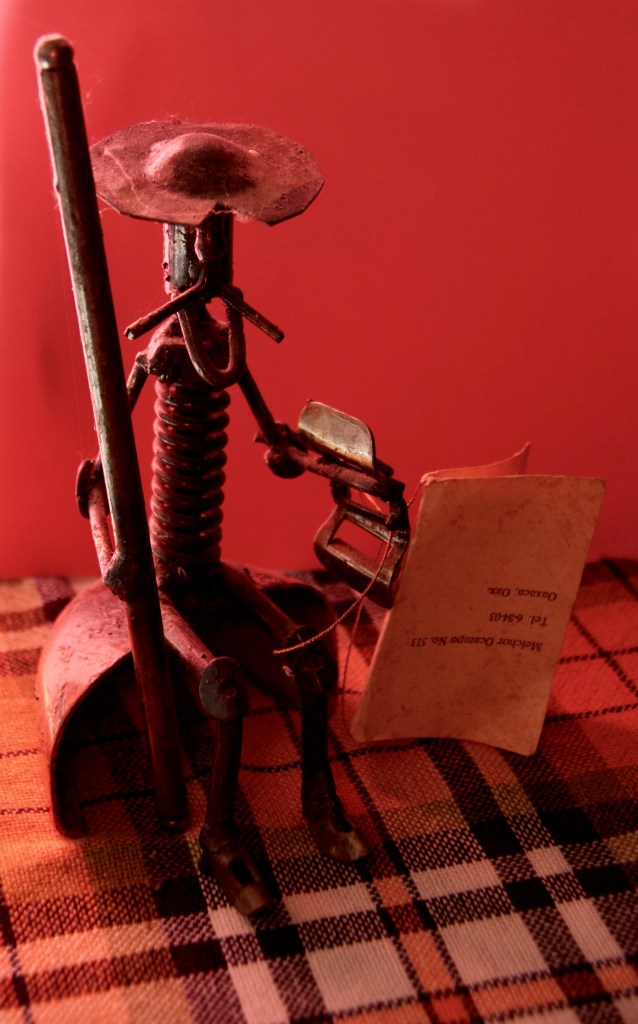
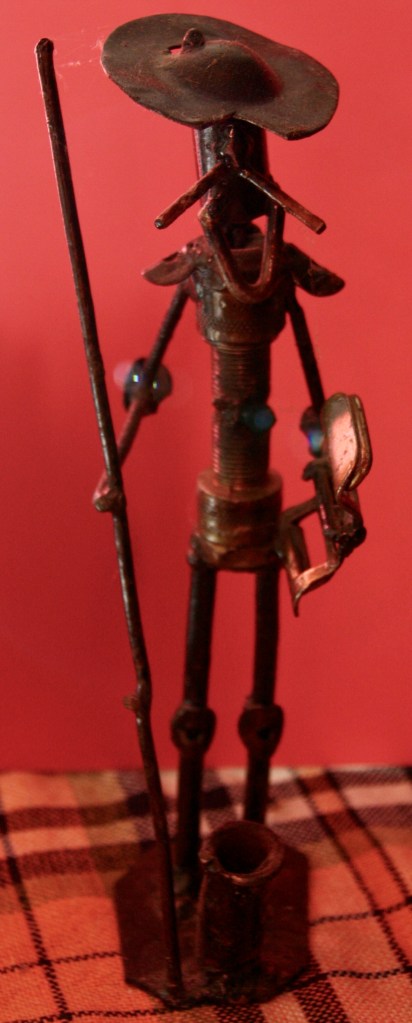
           

What’s in a Name?

Ryan and Don Roger

2

What’s in a name?

            Don Quixote was first published in Spain in 1605. In 1609, Thomas Shelton translated it into English. By 1611 / 1612 the adjective quixotic, was already in use within English society. An AI search tells us that “In the 17th century, the term quixotic was used to describe a person who does not distinguish between reality and imagination. The etymology of the word began after the publication of Don Quixote in 1605.”

But what does quixotic mean exactly? Another AI search reveals that “Quixotism (adj. quixotic) is impracticality in pursuit of ideals, especially those ideals manifested by rash, lofty and romantic ideas or extravagantly chivalrous action. It also serves to describe an idealism without regard to practicality.”

            Why is this important? Quite simply because in English we say Don Quixote / Quick-sot, not Don Key-hoe-tay a bastardized version of the Spanish. Please note that the adjective, in English, is quixotic not “key-hoe-tay-ic” which is too chaotic to be practical. Note too that the French translators offer us Don Quichotte, while the Italians suggest Don Chisciotte. Both these languages conserve the original pronunciation – a voiceless postalveolar fricative /ʃ/, which is the same sound as the English “sh” in “ship”. This is clear evidence that the X of the original had a different pronunciation in the seventeenth century than it does today.

            My wonderful friends on AI confirm this as follows, and I quote:

In 17th-century Spain, the letter ‘X’ primarily represented a voiceless postalveolar fricative /ʃ/, which is the same sound as the English “sh” in “ship”. During this period, which coincided with the Spanish Golden Age and the “readjustment of the sibilants,” this sound underwent a transformation, shifting from the “sh” sound to the modern velar fricative /x/ (similar to the German ch in loch or the modern Spanish ‘j’). 

Here are the key details about the pronunciation of ‘X’ during that era:

Initial “Sh” Sound: Early in the 17th century (and before), words that are now spelled with ‘j’ or ‘g’ were spelled with ‘x’ and pronounced as “sh.” For example, Don Quixote was pronounced “Don Keesh-o-teh”.

The Sibilant Shift: During the 16th and 17th centuries, the sound /ʃ/ (written as ‘x’) and the voiced /ʒ/ (written as ‘j’) merged into a single voiceless sound /ʃ/. Later in the 17th century, this sound moved backward in the mouth, evolving into the modern velar /x/ (the modern ‘jota’).

And this is just the beginning and what’s in a name? For example, what is the real name of Sancho Panza? Is it Sancho Panza or Sancho Zancas [DQI,9]? How about his wife? Is it Juana Gutierrez or Mary Gutierrez [DQI, 7]? In the same chapter she is called Teresa Panza, the name that stays with her throughout the novel.

And what about Don Quixote himself? Is his real surname Quixada, Quesada, Quexana [DQI,1] or Alonso Quijano el Bueno [DQII,74]? Don Quixada de la Mancha aka Don Quesada de la Mancha aka Don Quexana de la Mancha – and we won’t mention the alternate names he takes – the Knight of the Sad Countenance or the Knight of the Lions!

Fascinating, eh? So, after all that, tell me – what’s in a name?

Riding Buddies – Reading Buddies

Ryan and Don Roger

1

Riding Buddies – Reading Buddies

            Don Quixote makes three sorties. The first is very brief, about five chapters. The second is much longer. And the third is 74 chapters in length. Each sortie is different. For now, I would like to take a brief glance the difference between Sortie 1 and Sortie 2.

            Sortie 1 – Don Quixote sets out on his own. He travels to an inn, has adventures there, gets knighted by the inn-keeper, albeit falsely, and after an unequal combat in which he is bruised and battered, he is brought back home by a neighbor.

            When the inn-keeper asks Don Quixote for payment, the knight replies that knights errant do not carry money with them, nor do they pay for their food and lodging. The inn-keeper recommends that Don Quixote find a squire to attend, one who can carry the money and the other things that a knight needs. Our knight takes this recommendation to heart.

            Sortie 2 – In this second sortie, Don Quixote has a companion. One of the main differences between the first and second sorties is that the knight now has a squire with whom he can talk. This dialog between knight and squire, master and servant, is key to the understanding of the novel.

            Their contrasting points of view, Don Quixote literate, a believer in reading, with a firm belief that all books of chivalry are true, contrasts immediately with the illiterate Sancho, his squire. Where Sancho sees reality – the windmills are windmills – Don Quixote sees illusion – the windmills are giants, waving their arms, and threatening to attack. This is a simplistic summary, but we will leave it there for now.

            Graham Green understood the nature of dialog when he penned his novel, Monsignor Quixote. In the film, available free of charge on YouTube, the Catholic Priest (now a Monsignor) and his friend, the Communist Mayor (now defeated in an election and unemployed) leave the little town in which they live, and set out on a journey of adventures, much in the same way that Monsignor Quixote’s namesake sets out in Cervantes’s novel.

They do not have a horse and a donkey. However, they do have Monsignor Quixote’s car, nicknamed, of course, Rocinante, in which to travel. The key to Green’s novel is the constant dialog between the mayor, knowledgeable in the ways of the world, and Monsignor Quixote, innocent of the world outside his church and full of illusions about the reality of that world. It is easy to think of them as riding buddies who converse.

            So, what is a reading buddy? Well, Don Quixote is a long book, over 1000 pages, with 127 chapters. Many readers set out in search of adventure, but do not keep reading. However, a wise reader will set out on that journey with a reading buddy, who will travel with him, step by step, chapter by chapter. Each will keep the other company, and one of the delights of the journey will be the constant conversation between the reading buddies.

            I am Don Roger. My reading buddy is Ryan. I am short and stout. Ryan is tall and thin. We have reversed the Sancho / Quixote image, but we are both equally insatiable in our search for knowledge. The curious thing is that I have read Don Quixote 28 items, mainly in Spanish, but also in English and French. Ryan is reading it for the first time, but he is an expert in AI access and is helping me to understand the wily ways of that electronic world of short cuts. Of course, it helps you to sort the chaff from the grain when you know what you are looking for and just use AI to refresh your fading memory!

            I am full of the illusions of the academy. Ryan reads with a sharp mind, a keen wit, and no illusions at all. He sees only the reality of what is there. Together we have embarked on a journey that is in the process of opening our eyes to two different realities his and mine – Ryan’s and Don Roger’s. The conversations that we are having along the way, will be the subject of this little discourse on Cervantes’s novel.

Rage, Rage 54

Rage, Rage
54

Terminal and terminus,
they both mean nec plus ultra:
the Pillars of Hercules,
the end of the known world,
and my own world’s end.

I throw my hands skywards
in desperation:
“Is anybody up there?”
There’s no reply,
and I see no ladder
for angels to descend
or ascend.

Only the crows,
those black-winged
monarchs
destined to wear
the survivor’s crown,
cry out their anguish
as they wait for the day
when they’ll pick clean
my unburied bones and
rule this sickening world,
an earthly paradise no more.

Comment:

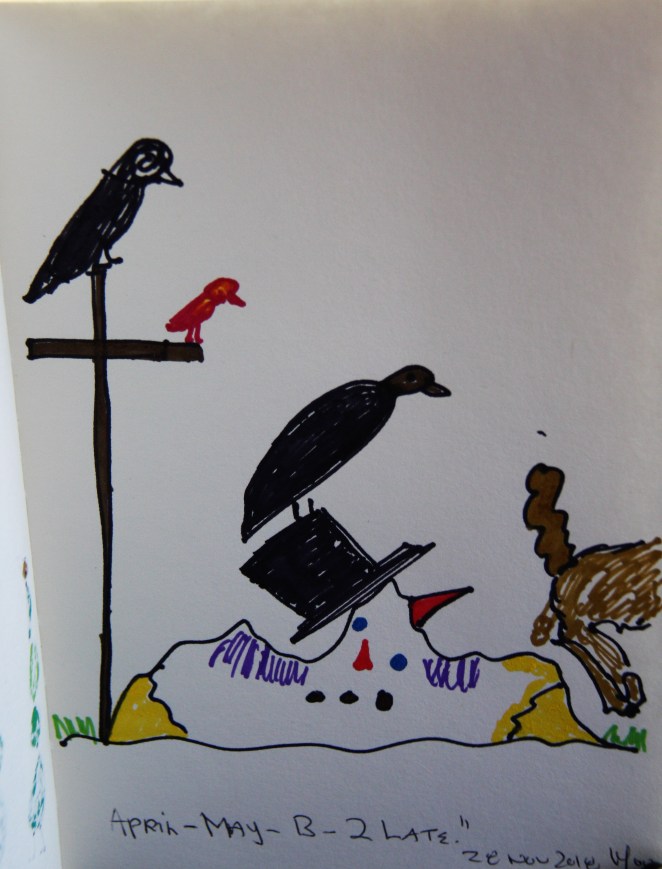
When I said “I am looking for a picture of a crow,” Moo went wild. “Me,” he said. “I’ve got one.” And indeed he had. Here it is – two crows perched like vultures over the body of a fast melting snowman. Our current world in miniature – and don’t forget the yellow snow and the doggy doing a dump. “Moo,” I said, “That’s not nice.” “True to nature, though,” he replied. “You want reality – you got it.”

Reality – what a strange word. Who knows nowadays what is real? The barber’s basin in Don Quixote – is it a barber’s basin or is it Mambrino’s Helmet? Good question. Relativism – it depends on your point of view. U a barber’s basin – turn it upside down Ω and it’s a helmet. So how do we deal with an object that has two functions and can be seen both as one thing and then another?

Good question. Cervantes solves the problem in his own unique fashion – U – bacía / basin and Ω – yelmo / helmet. Put them together and you get the neologism [newly invented word] baciyelmo – a basin that serves as a helmet and a helmet that serves as a basin. Wonderful – if it weren’t for the snout, I’d swear that was the origin of the pig-faced bassinet.

Some days, I try to understand all this – but I throw my hands skywards in desperation: “Is anybody up there?” Another good question. I often ask myself that question but I despair of an answer.

My friend Francisco de Quevedo voiced the same question in a dream that came to me last night.

¡Ah de la vida! ¿Nadie me responde?

Life ahoy! Will nobody reply?
Is anybody up there?
Will someone reply?

Blas de Otero once made a similar utterance –

“I raise my hands in supplication
– you cut them off at the wrist.”

Tell me, if you know, – what is this life if, full of care, we have no time to stand and stare. And look at those crows, standing there, staring, waiting … waiting for their turn to come. Patient, eternally patient. Just standing around. Waiting.

Rage, Rage 36 & 37

Rage, Rage
36

How many times
must I open these
Pandora’s Boxes
packed so lovingly
to give me the tests
I loathe?

Yesterday they gave me
a throw-away plastic potty,
and three wooden spatulas.

I also got
an air-dry sample card,
stamped and dated.

37

Today
a teenage apprentice
prompts me to reveal
my birthdate, then binds my arm
with a thick rubber thong.

She tells me to make a fist
and probes with blunt fingers,
searching in vain for a fresh vein
she can open to extract
and bottle a sample
of my precious blood.

I watch my body’s sap
pumping out
in irregular spurts,
driven by my heart,
that worn-out
flesh-and-blood machine.

Drip by febrile drip,
blood accumulates
and the teenager smiles
with youth’s perfections:
slim body, wit, and grace.

Now, my heart is once more
a time-bomb ticking
beneath her fingers.

Comment:

“Youth’s perfections: slim body, wit, and grace.” Those were the days, my friends, I thought would never end. Then I watched my weight rising, my body thickening, my hips and knees sticking. But I am still me – my own hair, my own teeth, my own limbs, creaky as they are.

I remember. back in the days, watching the TV series – $6 million dollar man.” remember him? Artificial everything and he could out run a car, out jump a kangaroo, outswim an otter, out fight the world’s greatest ever boxers, with one hand tied behind his back. Everything artificial. The willing suspension of disbelief.

Well, I called a couple of friends from my rugby playing days, and guess what? They were all in competition with the $6,000,000 man. An artificial hip… an artificial knee … an artificial shoulder. One of my friends, probably the best player of the lot, had a shoulder replacement, two hip replacements, and two knee replacements. Try going through a metal detector with that lot clanking like Don Quixote’s armor on a warm day.

And DQ was lucky. His magic balsam would heal a man, even if he had been chopped in half by a malignant giant with a sharp sword. Instructions to his squire – “if that happens to me, just join the two halves together as closely and as carefully as you can. Then sprinkle a few drops of the balsam on my body and watch how the two halves grow back together, almost instantly.”

Well, it doesn’t always work like that. I spent half an hour soaking my thumbs in hot water when I got them stuck together using some form of Crazy Glue or Gorilla Glue or Rhinoceros Glue or Elephant Glue or the like. Now there’s a magic balsam for you. However, don’t get into any hot water until the halves are well set and the flesh has grown afresh. Otherwise you might come apart in the bath!

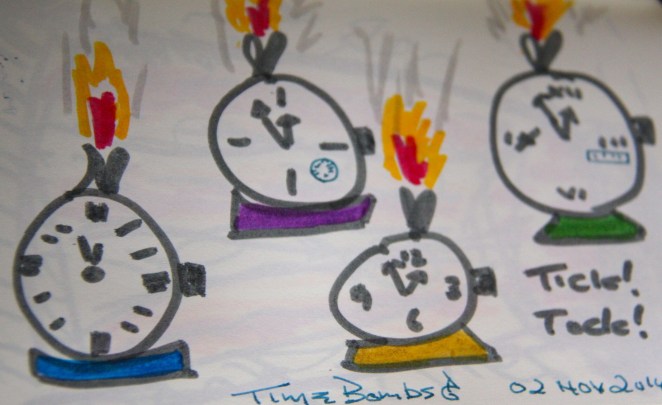
PS Moo did not think this was an amusing piece. So he would only give me a very early cartoon of a ticking alarm clock – well, four of them. And each one set to go off at a slightly different time. Way to go Moo.

Rage, Rage 35

Rage, Rage
35

Now,
once a month, they stick
a needle in my arm
and check the levels
of my PSA, cholesterol,
and testosterone.

Is my blood pressure rising?
Is my cholesterol high?
Are my electrolytes
ticking slowly down?

The doctor keeps telling me
it’s a level playing field
but every week
he changes the rules
and twice a year
he moves the goal-posts.

What game is he playing?
A man in a black-and-white
zebra shirt holds a whistle
to his lips while another
throws a penalty flag.

It comes out of the tv set
and falls flapping at my feet.
Now I know for certain that
I’m living in the Red Zone
and I’m running out of time.

Comment:

Now, once a month, they stick a needle in me! Not always in the same place. But, I sometimes feel like a pin cushion. “The slings and arrows of outrageous fortune” have turned into the “probing instruments of innumerable doctors.” Try repeating those lines at speed and you will end up repeating the message, from lips to ear, like the battalions waiting to go over the top, used to do in the trenches of WWI.

Original message – “Send reinforcements, we’re going to advance.” Last message in sequence – “Send three and fourpence, we’re going to a dance.” Funny how times change. I am re-reading Don Quixote (yet again) and am bowled over by the length and complexity of the sentences. Then I realize how words, culture, times, and attitudes have changed. “Change and decay in all around we see…” – indeed we do.

How many people now know what ‘three and fourpence’ means? And how about LSD – and no, it’s not a psychedelic drug, it’s code for pounds, shillings, and pence. Well, for the original Latin terms for them anyway.

Oh the joys of AI – “The terms librasestercia (commonly sestertius), and denarius are the direct Roman ancestors of the British pre-decimal currency system (£sd), which was in use until 1971. The system was adopted from the Roman/Frankish model where a pound (libra) was divided into shillings (solidus) and pence (denarius).”

Oh the wonders of the British pre-decimal currency system (£sd). Four farthings = one penny; 12 pennies / pence = one shilling; 20 shillings = one pound; 21 shillings = one guinea. What fun we had adding and subtracting British coinage in those days, let alone multiplying and dividing for those wonderful state examinations.

Ah well, it’s all forgotten now, as are the jabs, the needles, and the tests. Anyone got a Wills’ Woodbine? Or a Player’s Navy Cut? And how about a Lucifer to light your fag? There weren’t any fags in my boarding school. Fagging was strictly forbidden. As was smoking. And drinking. And loads of other things that we did anyway.

Rage, Rage 34

Rage, Rage
34

A squiggle of spaghetti
or twisted noodles,
that’s what my brain
has become.

My second-hand mind
is a hand-me-down,
an antipersonnel bomb
from another place
and a distant time.

Blind, in so many ways,
with nowhere I want to go,
my soon-to-end days
lie humped on my shoulders,
weighing me down
as I limp along.

Comment:

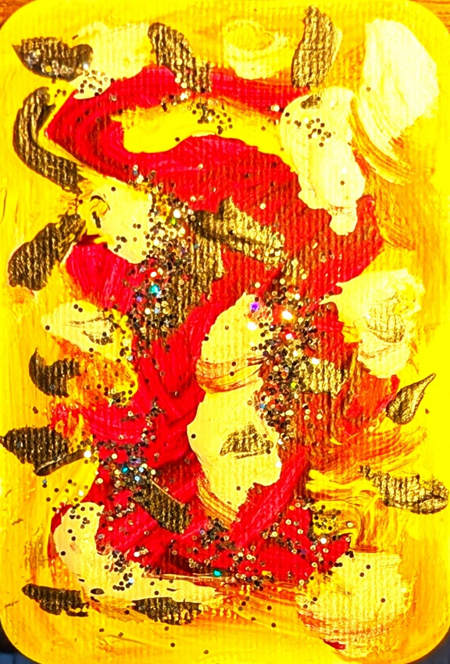
You can blame my friend Moo for the painting. “That’s my view of your brain,” he told me. “A squiggle of spaghetti or twisted noodles.” I think his painting looks like what my Beloved, courtesy of Corrie Street (as was), calls a Spag Bowl. Funny how easy it is to become muddled and confused as we age. Did I shut the back door? Double-check. Yes, I did. And you can multiply that to the power of N (or DR – for don’t remember!). And what about those windmills that wave their arms in my mind? Will that be cash or “Charge!”

Re-reading the Quixote, side by side with a very good friend, I forget some of the ideas that I once had. I try to read my penciled marginal notes. What fun! First, I can hardly read them. Second, I can hardly understand them. And third, I have to reinvent what they might possibly have told me. All good fun. But sometimes, at the end of a session, my mind feels like the bodies of Don Quixote, Sancho, and Rocinante, after their meeting with the Yanguesans – battered, bruised, and beaten! Why, can someone kindly tell me, did Cervantes treat his two main characters to such frequent and brutal assaults?

Ah well, Friday today, and Friday is fish – not Spag Bowl. Are scallops fish? Not when they are sliced off your body with a razor-sharp sword. But then, I doubt if Quixote’s sword was razor sharp. It was probably vencida de la edad – conquered by age – just like he was. Conquered? No, not yet. Happily, I just limp along, however slowly. Ah yes, I forgot. I need a name for my Nexus. Maybe I’ll call it Rocinante, like DQ’s horse.

Book Burnings

Book Burning

A sharp-edged double sword,
this down-sizing,
this clearing out of odds and ends.

Library shelves emptying.
books disappearing, one by one.

So many memories
trapped between each page,
covers, dust-bound now,
dust to dust and books to ashes.

Sorrowful, not sweet, each parting,
multiple losses, characters
never to be met again,
except in dreams.

Heroes, thinkers, philosophers, poets,
their life work condemned to conflagration.

Alpha: such love at their beginnings.
Omega: such despair,
with Guy Fawkes celebrations
the means to their ends.

Word-fires:
the means of forging
those book worlds that surrounded us.

Bonfires:
the means to end them.

Steadfast, the book-fires,
flames fast devouring

all but an occasional volume
snatched by burning fingers,
from the flames.

Comment:

Funny things, book burnings. Why would anyone burn anything as innocent as a book? Good question. Yet people do. And people always have.

I think back to Don Quixote I, 6 and the Scrutiny of the Library. The Priest and the Barber go through the mad knight’s library and one by one examine the books of chivalry and either spare them, or cast them into the flames. This, in itself is a parody of some of the judicial actions of the Spanish Inquisition. In particular, any book that they considered to be unsafe or heretical went into the flames. Our Spanish Knight, of course, went mad through reading too many books of chivalry – and his brain dried up so that he totally lost all reason.

It is very interesting to read which books were spared and why. Equally interesting to find that many were burned on aesthetic grounds – they were not well written, or they were boring. Fascinating.

Fascinating too the book burnings that took place in Mexico during the Conquest of that country by the Spanish Conquistadores. Many pre-Columbian codices were burned. Priceless treasures and histories lost forever. Some, I think the Vindobonensis, still bear the marks of the flames when they were pulled from the fire in an effort to save them.

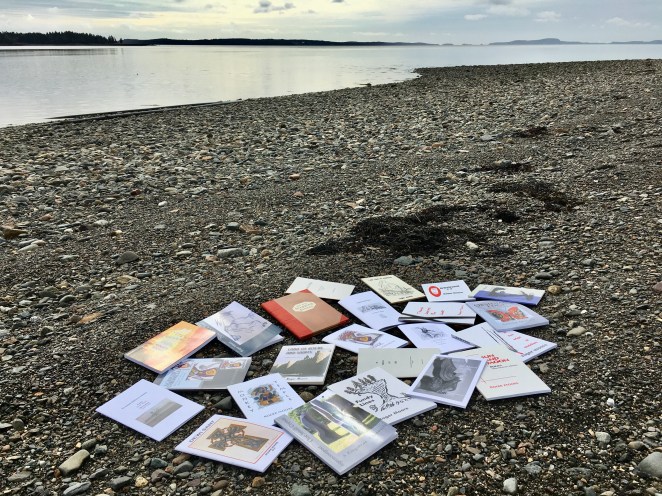
Moo tells me that my books will never be burned. And I am thankful for that. I asked why they wouldn’t be and he replied that nobody reads them anyway! Not such a comforting thought. So, in an effort to keep me happy and to preserve my books from the flames, another of my friends laid them out on the beach at Holt’s Point, New Brunswick. They certainly won’t burn when the tide comes in.

More important, I see that junk from Canadian Beaches, dated about 1960, has just arrived on the shores of the European continent, sixty plus years later. So – a floating book, a message, perhaps, in a time-bottle, destined to achieve immortality and live for ever. What a comforting thought for those of us who believe in the time and the tide that wait for no man! But they both might wait for his books.

Carved in Stone 70 & 71

Carved in Stone
70

Where can I survive
in this harsh world
where poetry and ideas
struggle to be free,
a world in which
the great literary myths
have been destroyed?

Where mass media rules,
sensationalizes, lies,
falsifies the power and glory
of words, now used
not to delight and educate,
but to manipulate.

A treacherous world
in which an evil genius rules
and constantly misleads us.

71

An Age, not of Enlightenment,
but of Endarkenment,
this is not the world
in which I want to live.

My chosen world
is that quiet corner,
outside El Rincón
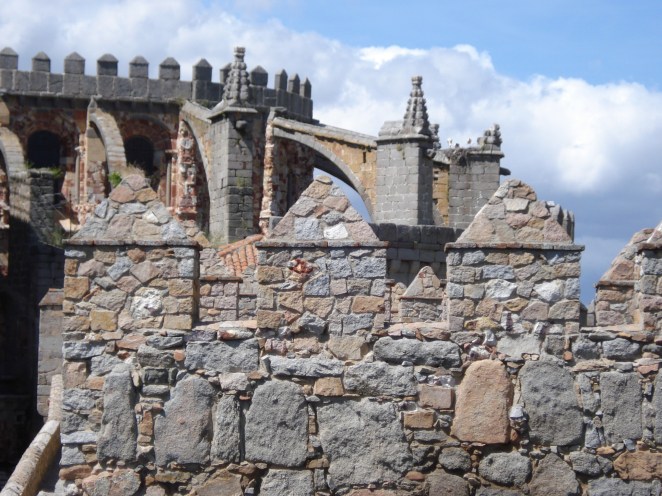
in the Plaza Zurraquín,
by the Mercado Chico,
in Ávila, Spain,
where leaves and confetti
dance to the wind’s tune.

A world of mystery and dream,
personal perhaps,
but well known to
all of those dreamers
who have the eyes to see
and the heart to stand still
and listen.

Commentary:

“There is no earth, no heaven, no extended body, no magnitude, no place and that nonetheless I perceive these things and they seem good to me. And this is the most harrowing possibility of all, that our world is commanded by a deity who deceives humanity and we cannot avoid being misled for there may be systematic deception and then all is lost. And even the most reliable information is dubious, for we may be faced with an evil genius who is deceiving us and then there can be no reassurance in the foundations of our knowledge.” René Descartes (1596-1650).

Cervantes wrote about such times in Don Quixote. Do we see what others see? What is truth and what is fiction? How do we approach and understand authority? What do we believe and why do we believe? Are they windmills or giants, wineskins or warriors, a flock of sheep or an invading army? “Only believe, and thou shalt see” – but what do we believe and why do we believe. “The fault, dear Brutus, lies in ourselves, not in the stars, that we are underlings,” Shakespeare, from one of his many plays.

Carved in Stone 27

The philosopher in search of his stone.

Carved in Stone

27

Miguel de Cervantes –
I read and re-read his words,
envious of his ability to reach out
with language that thrills me still.

I see him as a total entity,
while I see myself in pieces,
broken, unable to express
the simplest thoughts.

As I age, I sense the water
slipping from the water-clock,
the candles burning lower.

I still cannot make the mark
I want to make, for they are beyond me,
those marvelous word-worlds.

My words are mortal, his are immortal.
Mine just ink stains on a humble page,
his cast in print, but crafted to last forever.

As I bear witness to those powers,
so much greater than mine,
my eyes fill with tears.

Commentary:

They are beyond me, those marvelous word-worlds. Indeed they are. But I do not seek to create ‘a marvelous word-world’. I am happy with ‘ink stains on a humble page’. I seek to reach out and find those one or two people who accept me for what I am and find their own selves in a small corner of the tiny gardens I discover or create. Not a world, then, but a tiny corner of my own world, described, and offered to those who have eyes to see and ears to hear and hearts and minds to feel and understand.

And what is this infatuation with the poem itself? I no longer write individual poems, I write sequences of linked poems, a set of poetic narratives, if you need to find a label for what I am trying to do. Cervantes once wrote “La épica también puede escribirse en prosa.” / Epic poetry can also be written in prose. What happens if we reverse that statement and say – “A narrative sequence can also be written in poetry.” Interesting, eh?

And what is this desire to leave something, some trace of us, behind? I cannot answer that question. The answer will vary for each one of us, and for each fall wall flower perishing against the garden wall. I look at the homeless, pushing their grocery carts, head down. Their existence is as important as mine. Their desire to survive, for another day, another week, another season – and winter is coming one – is more powerful than any poet’s desire to leave a work – a magnum opus – to celebrate their lives.

And yes, my words are mortal, as I am mortal, as Miguel de Cervantes and all the great writers were mortal. Patrick Lane once told me that if poets leave one poem behind them that is remembered, they have done well. Even the greatest poets, and you can check this in the anthologies over the ages, rarely leave more than ten or a dozen memorable poems. As for me, I am happy to say that I have never had a poem included in an anthology. Not to my knowledge anyway.

And what does Magnum Opus actually mean? I leave you with the quote from Wikipedia set out above. Click on it, and find yet another way to distract, deflect, and change the direction of our lives! Given that road, who would ever want to walk it to its end?