Rage, Rage 18

Rage, Rage
18


I nod off again and dream
of a summer beach,
burning sand, tide way out,
sparkling waves, clouds moving,
inaudible, as they drift by.

I dream of my beginning
and find a forlorn formlessness
that sought the solace of sound
only to discover waves and wind
as I drifted on an amniotic sea.

The wind of change has blown.
I awake and pick up my book.

Voltaire –
“Si jeunesse savait,
si vieillesse pouvait.”

“If youth knew,
if age were able to.”

Comment:

The wind of change has blown and, by all accounts, it is still blowing. A Nor’ Easter here, swinging down from the Arctic and bringing us cold weather, ice, and more snow. Driving isn’t too bad, for the roads are cleared regularly, especially when schools are in. Most enterprises have cleaned, salted, and sanded their premises. Some haven’t. Yesterday, it took two people to move my shopping cart from the shop to the car, a matter of about thirty yards. The wind was so strong. It tussled and tugged, drove me where I didn’t want to go, and two people stepped in to help me. Then I discovered an undug doorway. I parked my car at a sharp upward angle, on the snow. A man offered me his arm. I said no, but he stood beside me, hands held out to help, just in case. Leaving that same shop, I was accompanied by a young lady who insisted on carrying my bags, taking my arm, and leading me to my car. The dangers of falling on down hill ice were even greater than going uphill.

I dream of my beginning, more and more often nowadays and now-a-nights. I know, spell check underlined that word. A neologism, not a proper word. But I like it, for though I dream by day, nodding suddenly into a shallow sleep, it is by night that I really do my dreaming.

At night, I find I can roam a world that has become hostile in the light of day. I can, and do, dream of my childhood on the Gower Peninsula. The fields are still there. My grandmother walks among the bluebells, and together we tell the time by the old dandelion clock. The larks still rise on Bishopston Common and Bluebells, Cowslips, and Primroses still hide beneath the trees. The sands at Brandy Cove are still clean. There is no pollution in my dreams and no oilers clear their tanks in the pristine waters of the Severn Estuary. There is no industrial haze and, on a clear day, I can still see, from the steps of the bungalow, Ilfracombe, across the bay.

And the people – my family and friends are still there. My uncles and aunts, my cousins, all young still, my parents and my grandparents … and all my dogs return, one by one, from their canine adventures. At night the cows can be heard crunching grass, and wheezing in my dreams. I met one, once, on a night trip to the outhouse – we had no indoor plumbing. And, on one memorable night, I stepped into a wet, warm cow patty, left like an anti-personal landmine, just outside the back door. I still shiver as I think of that warmth creeping up between my toes. No amount of wiping has ever really removed it. It haunts like the ghosts of summers past that drift at midnight round my room. waiting to be plucked from the air.

Rage, Rage 16 & 17

Rage, Rage
16

I doze in my chair.
The book I am reading
tumbles to the floor.

I fumble with my claw
and its metal hand
pincers the book,
then raises it.

The cat needs feeding.
I pick up her bowl
with my claw
but scatter her kibble
on the floor.

I can’t remember
where I put
the garden kneeler –
I just leave the kibble
where it lies.

Icing on the cake,
I pop my pills and now
I’ll feel less pain
for an hour or two.

17

On my own.
Outwitting old age,
accepting its growing limitations
 with as much grace and humor
as I can and must.
Trying to feel no bitterness.

That aspirin this morning,
falling into my shirt,
then appearing on the floor
a moment before
I sat on the loo.

A blue-eyed, mini-aspirin
winking at me quite happily.

I reached for my claw,
picked the pill up
and swallowed it,
washing it down with a smile,
and a draught of laughter.

Comments:

I doze in my chair. Just about sums it up. I remember playing darts in the Red Lion, Knowle, Bristol. When I threw an occasional good dart, the locals would whisper “Dozy, dozy.” To them it meant “lucky, lucky.” After a bit, I began to play better. One of the professionals made me my own darts set. Hand made. Adjusted to how I throw. I got better and better. One night, playing 301, double in, double out, I needed 131 to finish. I made it in a three dart finish – 57 (treble 19) – 42 (treble 14) – 32 (double 16). This was the only three dart finish, over 100, that I ever made!

I left the darts there. “Weed the board,” they shouted – meaning – clear the board of wasted darts so the next player could throw. “Check!” I countered, meaning I wanted them to check that I had won the game. “Dozy, dozy,” they cried. And, if I went back there, more than sixty years later, those who survived, and remembered, would still call me Dozy.

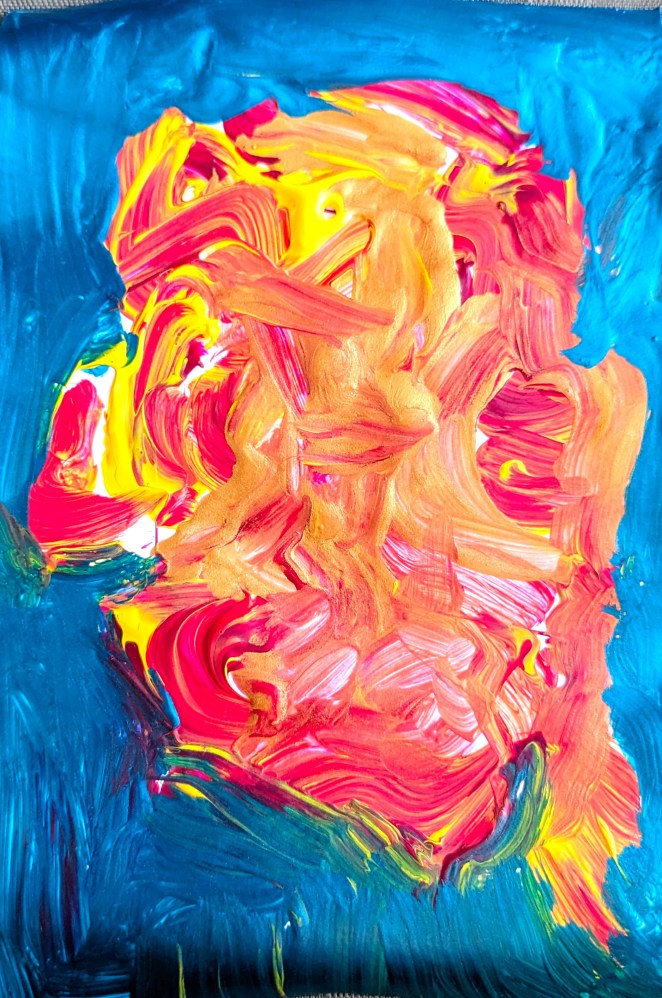
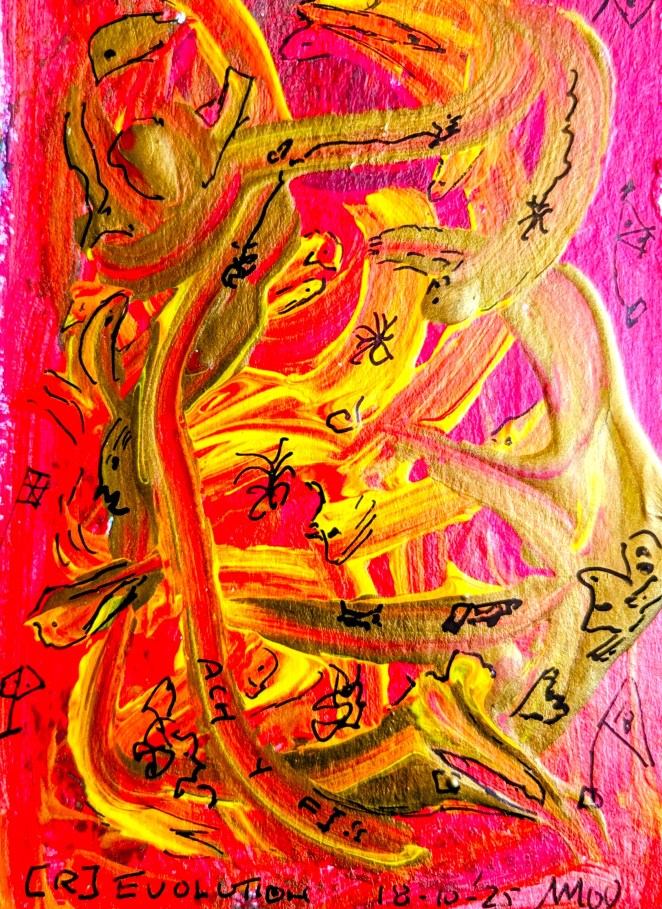
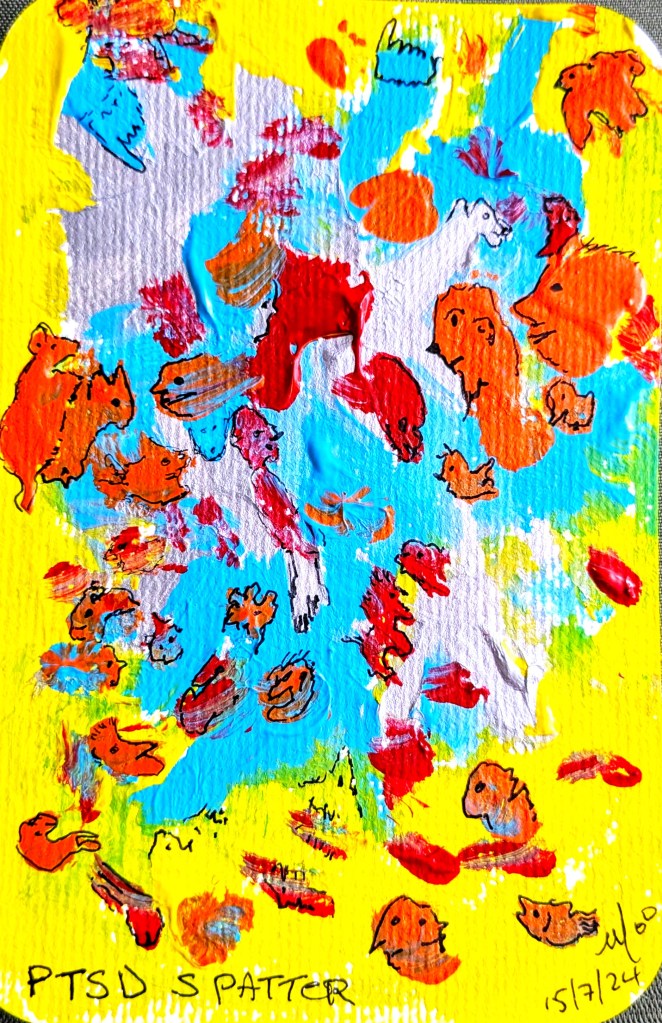
So, I sit here and doze about my life. The good days, the bad days, the in-between days. Faces drift in and out – [that’s why Moo painted me the picture] – and sometimes I can put names to them and sometimes not. And that’s life. A collection of personal memories – very vivid – and a selection of faces that we can no longer name and names to whom we can no longer fit a face.

My life – A blue-eyed, mini-aspirin winking at me quite happily.


Rage, Rage 14, 15

Rage, Rage
14

As for you, my love,
one moment you were with me,
at the airport,
the next, you were not.

I turned away for a second,
and, when I looked again,
you had walked
through the boarding gate,
and passed out of my life.

Now, I can’t think straight.
Hair leaks from my head
like straw from a scarecrow.

My teddy bear brain
has morphed from sawdust
into a mess of lonely grey jelly.

15

Memories deceive me
with their flickering
shadow shows.
Shapes shift with a click
of the magician’s fingers.

What magic lantern
now slips its subtle slides
across night’s screen?

Desperate, I lap,
like a wild Alpine goat,
at salt-licks
that increase my thirst
and drive me
deeper into thick,
black clouds
of want and need.

Comments:

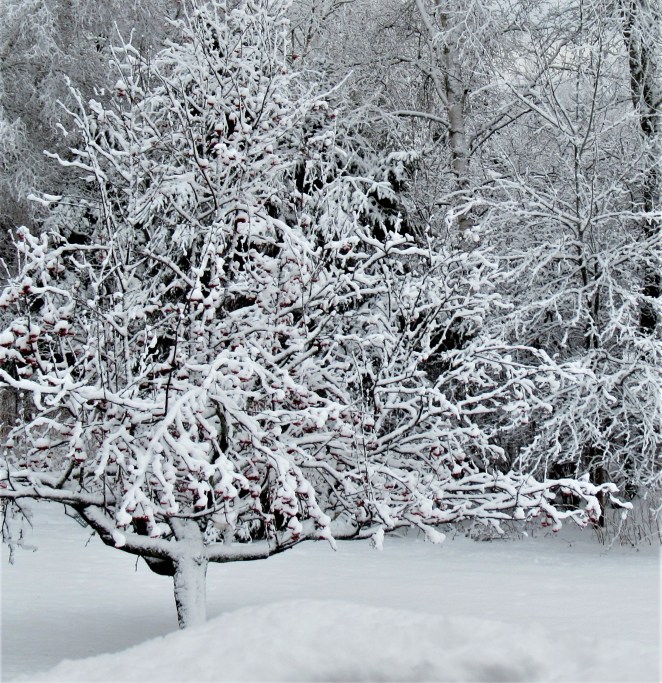
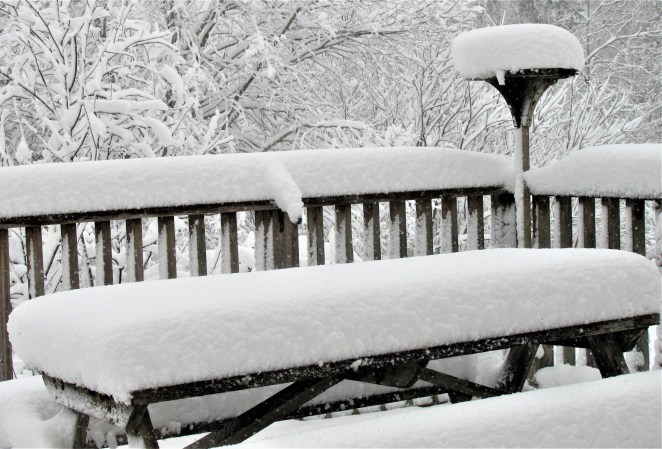
Shapes shift with a click of the magician’s fingers. Indeed, they do. I love the shape-shifting nature of snow. One day, the ash tree stands stark against dark pines. The next, the garden is winter white and the trees are dressed in their fine wedding garments. The table is no longer a table, though I do not know exactly what it has turned into. The distant trees seem to lean in close. The railings lose their summer dirt and snow turns everything inside out and upside down.

It reminds me of Pete Seeger – “Snow, snow, falling down, covering up this dirty little town.” Except the garden isn’t dirty, just a little abandoned in winter until the snow arrives, or, even better, the ice storm, followed by sun, when we suddenly seem to live in the heart of an icy diamond, looking out.


Rage, Rage 11

Rage, Rage
11

In one room in my head
my mother’s mother
sits at the kitchen table,
with me on her knee,
playing patience.

In another room,
I stand on a stool in the kitchen
helping my father’s mother
to mix the cake she’ll bake
in her coal-fired oven.

My mother’s father
sits before the television,
leaning back in the chair,
raising his foot so he can’t see
the adverts on the screen,
putting his fingers in his ears
so he can’t hear them.

My father’s father lies in bed,
his dog beside him.
The dog licks his hand,
waiting, like all of us,
for the death that threatened
since he was gassed
in World War One.

I sit at the computer,
following the figures
that track the latest pandemic
singing softly to myself
“¡Qué será, será!”

Comments:

Brightlands – 1956 – we sat behind the goal posts, watching the soccer First XI playing. A dream of Doris Day drifted down to us and we sang this song as we watched the game. Strange how a moment in time can suddenly reappear in full clarity and grace us with its remembered presence. Beside us, the River Severn, Sabrina, in Latin – flowed out to the sea. Then the tide turned. The river ceased to flow, and the Severn Bore swept everything before it as we gazed in amazement at the rolling clash of river and tide.

Above, I have posted five memories, each taken from a small room in my head, and turned into words. “In my father’s house, there are many mansions.” And I can say the same of the memories that crowd my head. Some as bright as the bright lands where our school played their school, some as raging as the fight between the river and the sea, as witnessed by the tidal bore, and some as dark as the mist and fog that always fell with the change of river and tide.

So – what about your memories? Does a word here or a word there, a phrase or a metaphor, make you stop for a moment and explore the Olde Curiositie Shop that thrives in the attic in your own mind? I do hope so. For that is what I would like to think, that my words are stirings that jerk the puppets of memory that dwell in each of our minds. I would be so happy to know that a thought of mine has set your own mind dancing to tunes of its own.

Never mind. “¡Qué será, será!” Whatever will be, will be.

Rage, Rage 8 & 9

Rage, Rage
8

A late summer storm
lays waste to the doggy daze
that clouds my mind.

Carnivorous canicular,
hydropic, it drains my soul,
desiccates my dreams,
gnaws me into nothingness.

Tonight, the old black hound
will dog me,
sending my head spinning.

It will force me
to chase my own tail,
round and round
in ever-decreasing circles.

It will devour my future,
leaving past failures
to ghost through my mind.

9

Where now are the hands
that raise me up,
that rescue me
from dark depression,
that haul me out
from life’s whirlpool,
that forestall
the jaws that bite,
that save me
from the claws
that snatch?

Where are the hands
that move the pieces
on the chess board
of my days and nights,
that prepare my breakfast,
that bake my birthday cake
and count the candles
that they place and light?

What will I do
without them
now they are gone?

Commentary:

Gnawed into nothingness – the umbra nihili of the medieval mystics, the shadow of nothingness that sometimes falls upon us, threatening our peace of mind. An AI search offers – Umbra Nihili (Latin for “Shadow of Nothingness”) refers to a concept of cosmic loneliness or existential void famously cited by Meister Eckhart. A great many of my friends have recently discovered this umbra nihili. I am not sure why. I guess it varies for each one of us. Mal de todos, consuelo de tontos / that everyone suffers consoles only fools, the Spaniards say. What can we do at such times? Reach out, help when we can, count only the happy hours, as the inscription on the Roman sundial tells us – horas non numero nisi serenas.

Many have walked this way before. But that should not be a consolation in itself. Rather, it should be an acknowledgement that there is an exit to the maze, a key to unlock misery’s door, a thread to lead us out of the labyrinth. We must just acknowledge that fact and search for the exit, the key, the thread, that will prove to be our personal salvation, and hopefully the salvation of other fellow sufferers as well.

Rage, Rage 4

Rage, Rage
4

I walk from room to room,
startled by shadows,
and open doors,
search under the table,
look behind chairs.

Nothing. No one.
The house stands
still and empty,
but for the sadness,
the silent sadness,
that fills each room
with their remembered
presence.

Commentary:

Absence and presence. How many of us feel that something is there, walking beside us, or just behind us? How many feel that an empty room is not empty, but is filled with a presence, something we feel, half-recognize?

I have been in houses, invited for the night, where I would not sleep. Why? I do not know. But I felt a presence, a prescience, if you wish, that filled me with a desire to leave and not to stay.

What is it? Is it other memories, other lives, that impinge upon ours in this current time frame? I do not know. But I do know that there are houses and rooms in which I will not stay. I also know that there are others that throw open warm arms to welcome me.

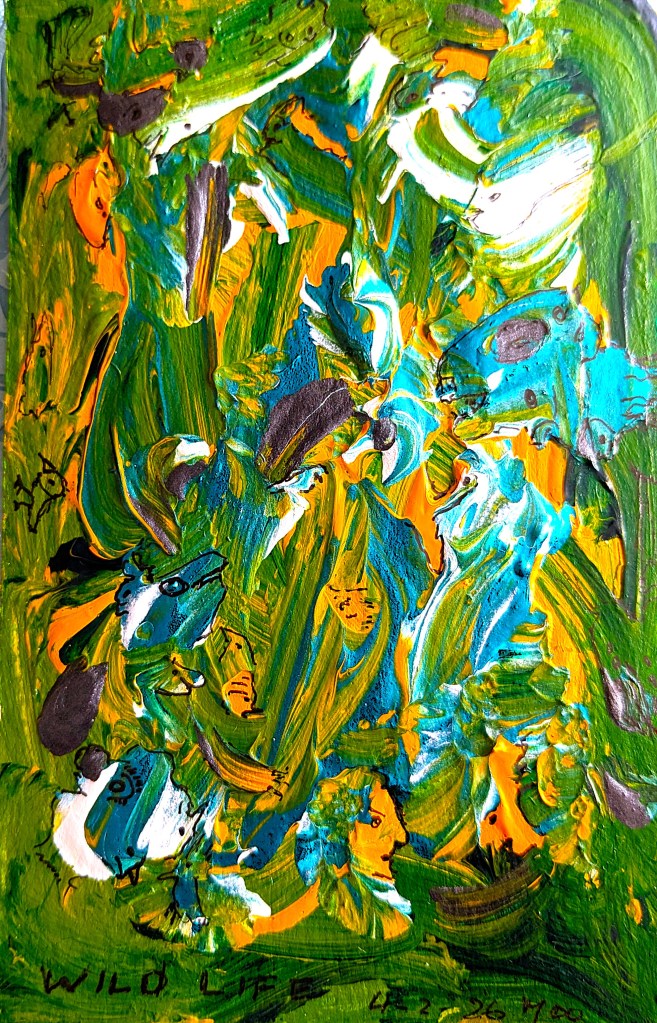
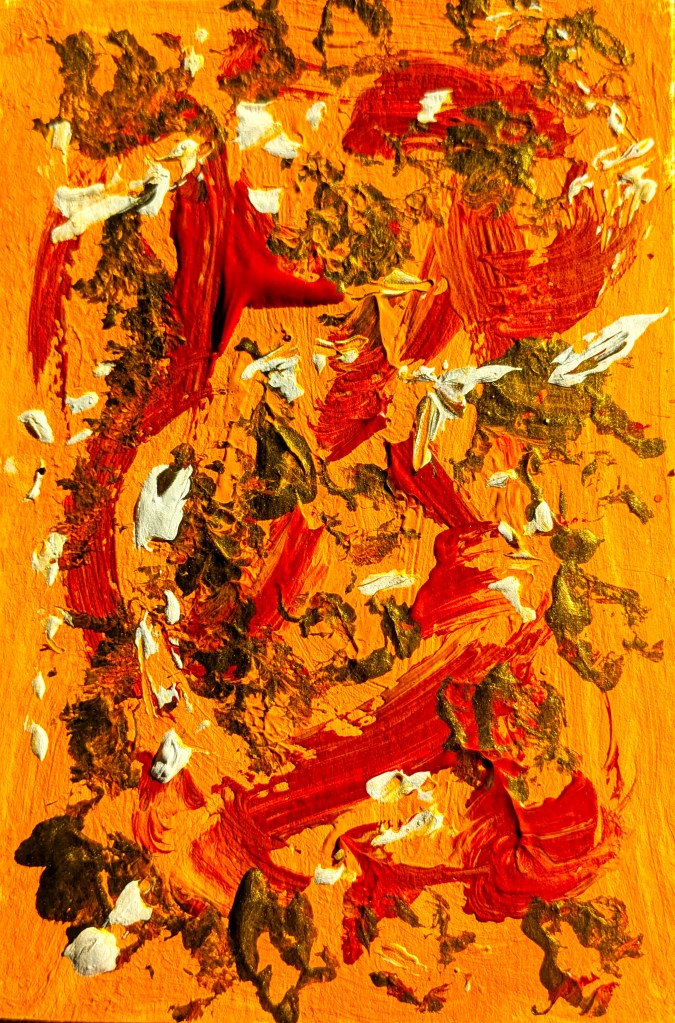
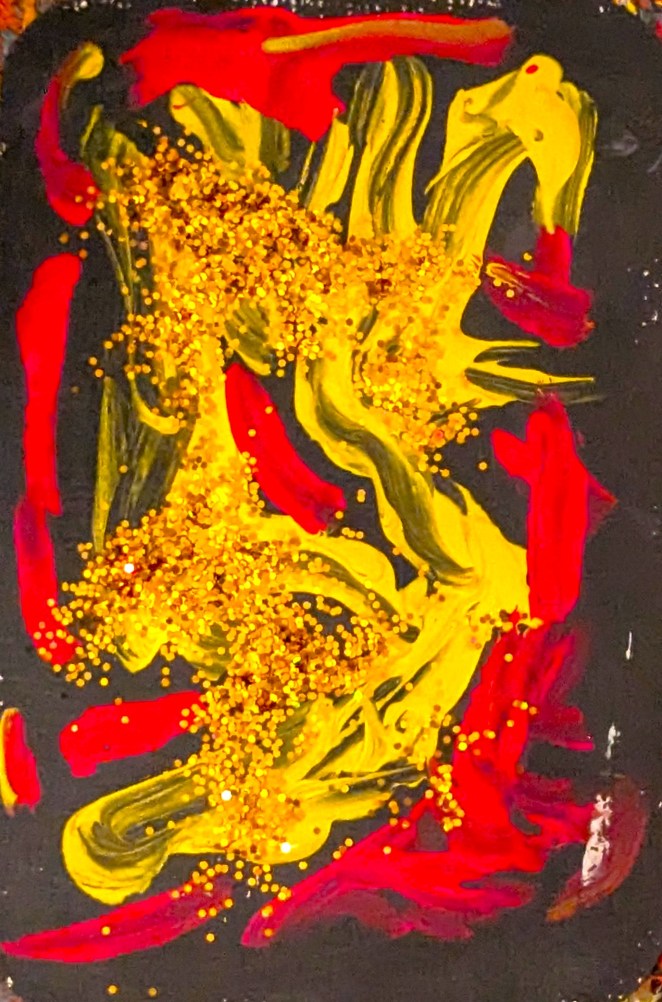
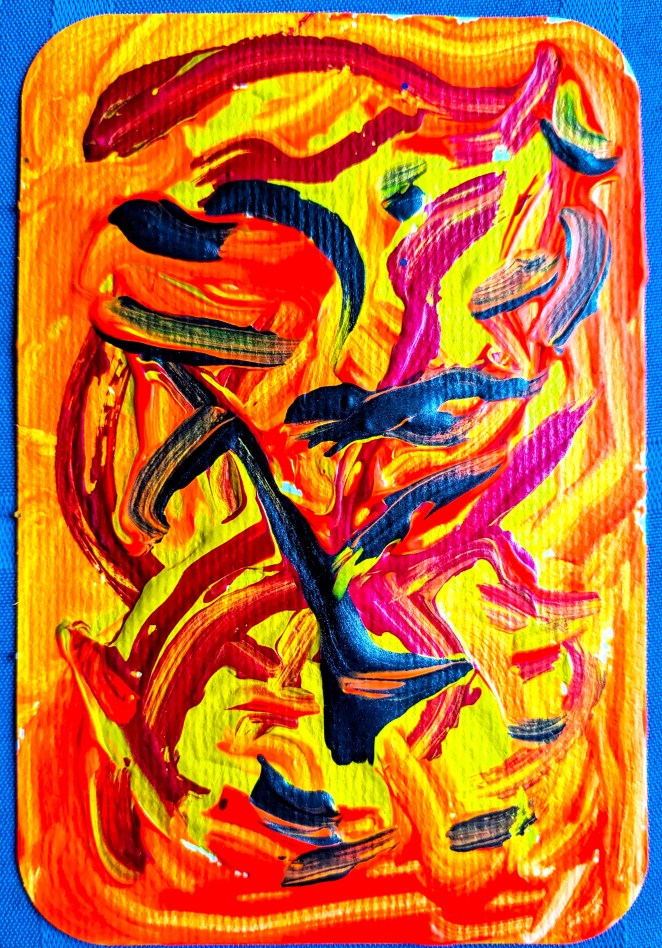
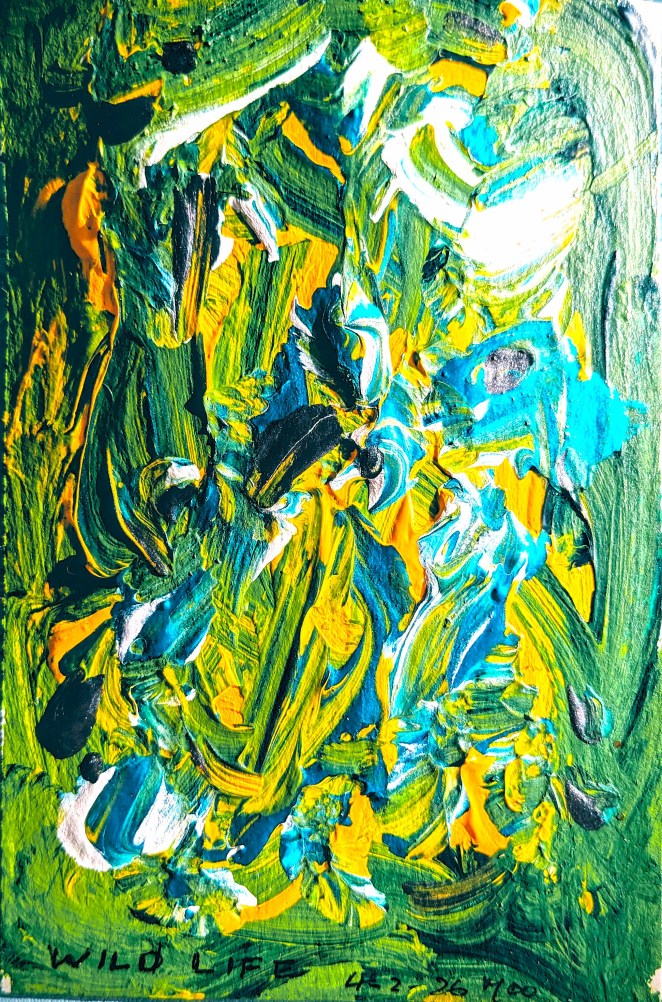
Look at Moo’s painting(s). How many of them welcome us in? Do some of them shut us out and make us shiver with a fear, not of the unknown, but of the hardly-remembered, that lies in wait to shake us out of this dream which is our present life?

Carved in Stone 70 & 71

Carved in Stone
70

Where can I survive
in this harsh world
where poetry and ideas
struggle to be free,
a world in which
the great literary myths
have been destroyed?

Where mass media rules,
sensationalizes, lies,
falsifies the power and glory
of words, now used
not to delight and educate,
but to manipulate.

A treacherous world
in which an evil genius rules
and constantly misleads us.

71

An Age, not of Enlightenment,
but of Endarkenment,
this is not the world
in which I want to live.

My chosen world
is that quiet corner,
outside El Rincón
in the Plaza Zurraquín,
by the Mercado Chico,
in Ávila, Spain,
where leaves and confetti
dance to the wind’s tune.

A world of mystery and dream,
personal perhaps,
but well known to
all of those dreamers
who have the eyes to see
and the heart to stand still
and listen.

Commentary:

“There is no earth, no heaven, no extended body, no magnitude, no place and that nonetheless I perceive these things and they seem good to me. And this is the most harrowing possibility of all, that our world is commanded by a deity who deceives humanity and we cannot avoid being misled for there may be systematic deception and then all is lost. And even the most reliable information is dubious, for we may be faced with an evil genius who is deceiving us and then there can be no reassurance in the foundations of our knowledge.” René Descartes (1596-1650).

Cervantes wrote about such times in Don Quixote. Do we see what others see? What is truth and what is fiction? How do we approach and understand authority? What do we believe and why do we believe? Are they windmills or giants, wineskins or warriors, a flock of sheep or an invading army? “Only believe, and thou shalt see” – but what do we believe and why do we believe. “The fault, dear Brutus, lies in ourselves, not in the stars, that we are underlings,” Shakespeare, from one of his many plays.

Carved in Stone 69

Carved in Stone
69

Words, words, foundered words,
flotsam and jetsam
that I rescue from the beach.

I find them in the tide mark,
its seaweed filled
with bleached carapaces,
charred wood, old rusted iron,
and the bright bones
of long dead creatures,
polished by the relentless action
of wind and sandpaper sea.

Commentary:

Words, words, foundered words – where do they come from. Good question, but I have no answers. Automatic writing – you put pen to page and scribble for five minutes. Everything that comes into you head. The Surrealists did it. They thought they were in contact with their own subconscious minds, but the written results were c-r-a-p, or any other word that means the same thing. I have seen university teachers request their students to do it, but crap by any other name would smell as sweet.

Poets who said they were not surrealists did it. Lorca and Paz, for example. But they did not publish the automatic writing. They used it as a quarry to seek for the one or two gems that actually surfaced when they had done it. Those they chose. The rest they dismissed as the crap that it was.

So, where do we find our inspiration, our words? I find it in the tide mark, its seaweed filled
with bleached carapaces, charred wood, old rusted iron, and the bright bones of long dead creatures, polished by the relentless action of sea-breeze and sandpaper sea.

Carved in Stone 67 & 68

Carved in Stone
67

At night, on the cool
sea-shore of my dreams,
the calls of shore-birds
at Ste. Luce-sur-Mer
are borne on the wind.

High-pitched, they are,
like the voices of children,
or of men and women,
in distress.

I walk on the sand
at low tide and a lone gull
flies past my head,
battering itself
against the wind’s cage
with outraged, sturdy wings.

68

Sunset.
Sea mists descend.
The church on the headland
steps in and out of darkness.

Shadows gather, persistent.
Gulls surround a lone heron.
It clacks its beak in anger
forcing the gulls to scatter.

These words are not my words.

They came to me in the speech
of birds hidden in the foliage,
or carried on a feathered plume
sprung from the osprey’s wing.

Some came from the click
of the crab’s claw as he dug
deeper into the sand
a refuge where he thought
he could live safely.

Commentary:

Sunset. Sea mists descend. The church on the headland steps in and out of darkness. And so do I. I seek clarity, but there is no clarity when the sea mist descends, just the blurred image and the clouded thought. The cloud of unknowing, one philosopher called it, many years ago, and it is still with us. Especially when the sunlight fades and we are left wandering in the mists of unknowing.

“Is it here, you ask, or over here?” Well, if you do not know, I cannot tell you. But I will ask you this, and think very carefully before you answer – does the answer come from outside of you, given by another, or does it come from the deep, sacred intimacy of your own soul? The answer to that question will tell you all you need to know, one way, or the other.

These words are not my words. They came to me in the speech of birds hidden in the foliage, or carried on a feathered plume sprung from the osprey’s wing. Some came from the click of the crab’s claw as he dug deeper into the sand a refuge where he thought he could live safely. Sunset. Sea mists descend. The church on the headland steps in and out of darkness.

Crystal Liturgy

I

Crystal Liturgy

Here, in the abyss,
where song-birds pluck their notes
and send them, feather-light,
floating through the air,
here, you’ll find no vale of tears,
no fears of shadow-hawks,
for all blackness is abandoned
in the interests of sunlight and song.

Here, the crystal liturgy surges,
upwards from the rejoicing heart,
ever upwards, into the realms of light,
where color and sound alike
brim over with the joy that, yes,
brings release to head and heart.

Here, seven-stringed rainbows reign,
the everlasting harp is tuned and plucked,
and an eternity of music cements
the foundations of earth and sky.

Here, the master musician conducts
his celestial choir, their voices rising,
higher and higher, until they reach
the highest sphere, and song and voice
inspire, then expire, passing from our eyes
and ears into unbounded realms of light.

Here, the seven trumpets will sound
their furious dance, a dance that will announce
the end of this singer, the end of his song,
but never the end of song itself.

Commentary:

Crystal Liturgy is the first poem in the poetry sequence Septets for the End of Time. I will start placing these poems here and you can follow the sequence as it evolves. It consists of 56 poems – seven septets and a coda.

A Note for Readers

Olivier Messiaen is one of my favorite composers. I purchased his Quatuor pour la fin du temps / Quartet for the End of Time in Rimouski, PQ, in 1982 while driving around the Gaspé Peninsula. I was fascinated both by the music and by the words that headed each section. I should note that I have always enjoyed ekphrasis, the verbal description of visual works of art. With Messiaen, I tried to recreate not only the thoughts and images generated in me by his music, but the spaces and repetitions that come from light and dark sounds and birdsong caught in the intervals between notes. This was a new sphere of experimental writing for me and while composing I played first the Quatuor pour la fins du temps / Quartet for the End of Time, then Éclairs sur l’au-delà/ Lightning above the Beyond, and finally Petites esquisses d’oiseaux / Little Sketches of Birds. What I tried to capture came from within my own mind, but the metaphors and images were inspired by listening to Messiaen’s music.