Dark Angel

Dark Angel

He will come to me, the dark angel,
and will meet me face to face.

He will take all that I own,
for my wealth is only temporary:
health, wealth, possessions are all on loan.

My house, my wife, my car,
my daughter, my grand-child,
 my garden, my trees, my flowers,
my poetry, my works of art.
I use the possessive adjective
knowing full well that these things
are only on loan. I will never be able
to preserve and possess them.

I even rent this aching heart,
these ageing, migrant bones,
this death that has walked beside me,
step by step, every day
since the day that I was born.

My death alone is mine.
It belongs to nobody else.
It will be my sole possession.
It will soon be the only thing
I have ever really owned.

Comment:

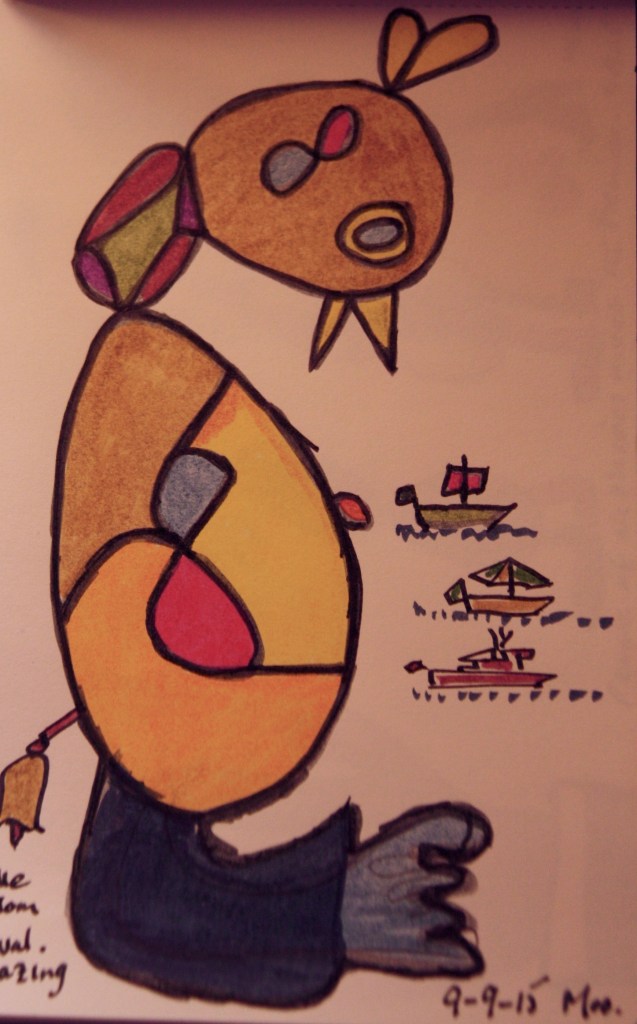
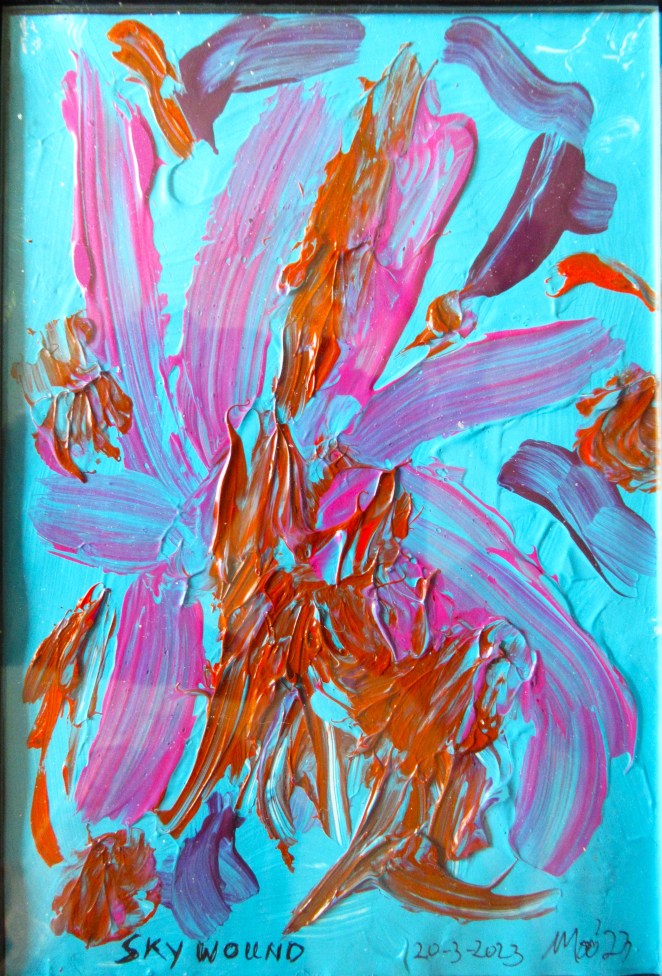
Dark Angel is the third poem in the first sequence (Crystal Liturgy) of my poetry book Septets for the End of Time. The painting, by my friend Moo, expresses his impressions of how he reacts, in paint, to my poem, in words.

“Well,” I said to Moo, “you’ve gone and done it this time. Do you think that painting really represents my poem? I see no darkness in it and certainly no angel.”

Moo gave me a long, strange look. I felt like I was looking in the mirror and seeing parts of my own soul fragmenting and falling away, like scales from my eyes.

“It’s not what the poem says,” he replied. “It’s what I think you feel as you’re writing that poem. I see the tension, the cry from the heart, the struggle to accept, and the realization that, in the end, everything is inevitable and must turn out as it will. That said, more than anything, it is the cry, de profundis, from the depth of your self that I feel. My painting depicts that cry and your suffering.”

“What if it’s not my suffering? What if it’s the suffering of Messiaen and his musicians as they play the soul music that keeps them alive?”

“But surely,” Moo replied, “that’s the whole point. Orde Amoris, according to the recent Pope who has just passed away, is love felt for the person suffering, no matter who he or she is. Pope Francis spoke in praise of the parable of the Good Samaritan. When you see someone suffering at the wayside, you stop and help that person. You don’t just walk on by. Your suffering is my suffering. When I paint your suffering I also paint my own suffering and when you grieve, then I grieve with you.”

“And when that happens, when we all grieve together, we do not grieve alone and in vain.”

“Exactly.”

Exploring the Divine in Nature

Divinity

outside us or in us
the divine is always with us

green god
of the mountain ash
garlanded now
with autumn berries

lady hollyhock
and her flock
of butterflies and bees

colibri
martyred soul
reborn
as a hummingbird

our garden
a paradise
where the creator
still strolls

some of her
many faces
glimpsed
among the leaves

in this half-light
as the sun
goes down

In Laud of Light

In Laud of Light

Sun, moon, and stars
wait, day and night,
outside my window.

I sometimes glimpse
the crackling shimmer
of Northern Lights.

They crown me
with joy and pleasure,
treasures I will treasure
until the natural end
when stars, sun, and crown
come tumbling down.

I will be left alone,
seemingly naked,
yet clothed in
an eternity of light.

Comment:

Hunter Moon in Island View, NB.
Pure chance – I looked up, and there it was.
Oh to be clothed in such a glorious light!

And then there’s the nights – KTJ

Then There’s The Nights … KTJ                

As a child my days were good.
Full of wonder and being misunderstood.
Growing and learning without knowing love.
But always guided by the Lord up above.
The days were filled with hope in my sights.

Then there’s the nights.

Trying to make sense of my life in a bed I did not own.
Fighting demons no child should ever fight alone.
Dreams of monsters under the bed.
Thoughts of not belonging filling my head.
Longing for a normal Mom and Dad.
Crying myself to sleep and feeling sad.

At 14, I thought I was grown.
Stealing my food and living alone.
Leaving behind a brief life with my dad.
Street life was hard, but it was all that I had.
The days seemed to pass by all right.

Then there’s the nights.

Fear of passing by where the dead lay to rest.
I’d stand with my thumb out and hope for the best.
I was told it was the living I should fear.
But my mind was confused
and my thoughts were unclear.
Sleeping in ditches and dreaming of a home.
No one to care for me, I was alone.

Years passed by as if in slow motion.
People came and went, playing on my emotions.
More than one marriage, with hopes of a happy home.
Each time I was sure I was done being alone.
I kept telling myself life was sunny and bright.

Then there’s the nights.

Sleeping once again in a bed I didn’t own.
Waiting for a husband who does not come home.
Anger and confusion running through my head
Wondering if he was sleeping in another woman’s bed.
I wanted to scream and demand he be true.
But you don’t have that option if someone’s abusing you.

I’ve finally made it to the last quarter of my life.
I no longer desire to be anyone’s wife.
I have my independence and a loving heart.
I want love, but I also need time apart.
To grow and learn and miss the ones I love.
I have been truly blessed by God above.

Then there’s the nights

Sometimes sleeping in a bed, I don’t care if I own.
Nights full of contentment for me and me alone.
I’ve let go of the dream of two hearts and souls
intertwined as one.
Finally, my worries and grief are done.
The rest of my journey will be full of peace and love.

Once again, I thank the good Lord above.

Comments
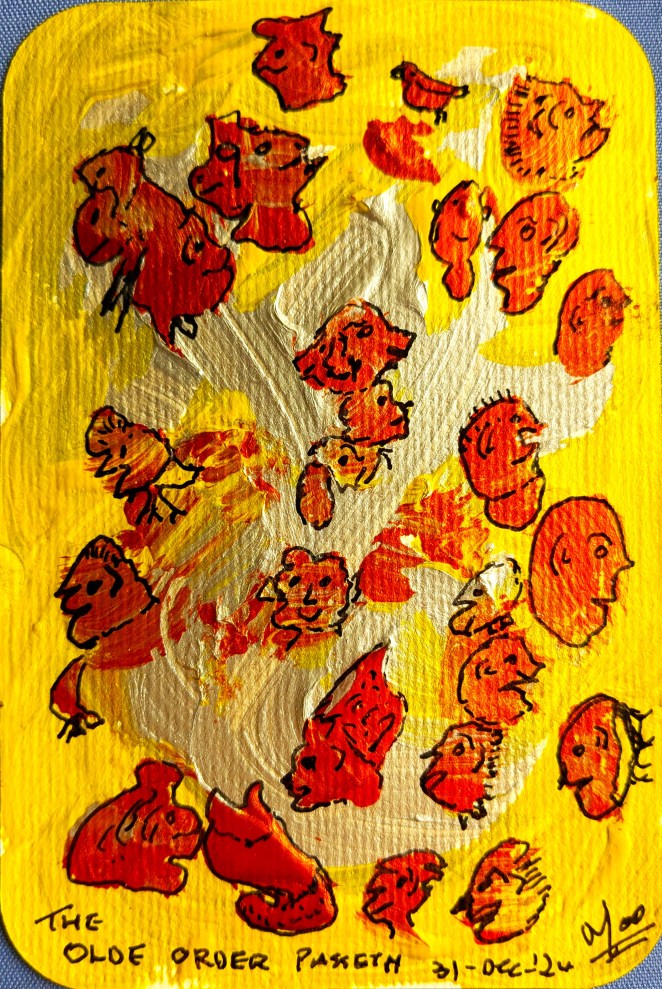
Yesterday, I posted a painting that KTJ associated with one of her poems, Addiction. Last night, my friend, Moo, painted this painting which accords with one of KTJ’s poems entitled And then there’s the nights. This is the lead poem in her first poetry collection, I am my tattoos. This linking of the verbal (poetry) with the visual (a painting) has been a technique I have used before. The movement between visual and verbal often generating a shifting pattern of colors and images in the reader’s / viewer’s mind. These collaborations between artists are very productive. Long may they continue.

NB If you, dear reader, would be interested in writing for one of Moo’s paintings, just drop me a line, or leave a note in the comments section.

What profession do you admire most and why?

Daily writing prompt
What profession do you admire most and why?

What profession do you admire most and why?

Why admire a profession? I used to admire the fire-fighters when I was in Spain. Then I discovered that a small group of them were setting fires deliberately so that they could get double pay and danger money extinguishing the fires they had set. I used to admire politicians. Then I discovered that they weren’t always honest, had their hands in other people’s pockets, used their positions to entrench and enrich themselves, and pulled all sorts of tricks to stay in power. I used to admire priests. Then I started reading horror stories of child abuse, abuse of power, negligence of priestly duties. And these things aren’t new. In The Book of Good Love, (Spain, 1330-1343) written by Juan Ruiz, the Archpriest of Hita details how the celibate priests were ordered in a letter from the pope of the time to give up the ladies with whom they were living (and with whom they had children) to return to a life of celibacy. All fictitious, of course, but also based on a truthful reality, as was the Seller of Papal Bulls (as described in Lazarillo de Tormes – Spain 1554, and published anonymously because of its anti-clerical content).

I hope, with that short selection of potential professional felonies, I have made my point. In brief, to admire the ideal of a profession is one thing. But to admire the unprofessional conduct of certain individuals who ruin the reputation of their own profession is something else entirely.

Therefore, I would propose that we change the title of this prompt from What profession do you admire most and why?, to What professional do you admire most, and why? Now the question can be answered with ease. I most admire those professionals whose profession is a vocation. They do their jobs out of love and not just for money. They are dedicated individuals who put their profession and the people they serve before their own home comforts, wants and desires.

Such unsung heroes abound. The baker who gets u at 4:00 am, arrives at the bakery at 5:00 am, bakes, prepares, and wraps the goods, until 8:00 am when the customers arrive and the shop opens. This is done at minimum wage, autumn, winter, spring, and in the summer when the heat warnings go out and the bakery is a living hell, what with the ovens and the heat dome outside. The teacher whose work does not end in the classroom, but starts outside, when class has ended, and the students really need the TLC that comes from a teacher who puts them before his/her office schedule of 30 minutes student time a week. The general practitioner who does not retire at age 55 to bask in the sun on a Caribbean Island, but who continues his work, until at age 80, he can tend his flock of patients no more, and who then retires with grace, heartfelt thanks, and love from a job well done.

These are my heroes. These are the professionals that I most admire. Not the profession, but the person who performs that profession with skill, hope, love, commitment, and a dedication that reaches out to embrace that specific professional world, whatever it is, and the people who share it.

If you were going to open up a shop, what would you sell?

Daily writing prompt
If you were going to open up a shop, what would you sell?

If you were going to open up a shop, what would you sell?

That is a very hard question to answer. I think of all the material things that everyone else can think of, but I do not want to sell commonplace things – antique furniture, paintings, books, stamps, groceries – I could go on and on, but I will resist the temptation to do so.

When I lived in Santander, Spain, the local wines were sometimes called ‘sol embotellado‘ / bottled sunshine. I wouldn’t want to open a wine shop, but I would love to bottle the essence of a warm sunny summer day and – why should I sell it? I wouldn’t. I would give it away, free of charge, to all the needy people, inner city boys and girls, the impoverished, those who live in the streets and sleep in doorways or under bridges at night. Oh the joy and happiness that would come when they opened their bottle of summer sunshine and felt the warm fresh air gather around them so they could breathe it in.

But why stop there? I would also give away ‘essence of butterflies’, that special feeling that comes on the colored wings of a butterfly and combines with the joy of flowers and the gift of taking flight. How special that would be. But sell it? It is much too valuable to sell. Put a dollar, Euro, yen, rupee, or sterling price upon it, and all its powers would vanish, like fairy dreams fading away.

Fairy dreams – yes, I would offer them as well to those who needed them. And not the sort that fade away, but those fairy dreams that suspend us in the wondrous beauty of their ethereal light. And I would bottle hope, and self-belief, and the power to change oneself from what one is to what one is destined to be. And I would add essence of self-knowledge and powder of Davey Lamp light that would enable the seekers to seek in the darkest corners of their souls and find that elusive inner self, and bring it out from the darkness. And I would stock fragrant filaments of firefly that would also allow my customers to enlighten that darkest of nights, the dark night of the soul. And a map of hidden foot paths that would allow the wanderer to wander and never get lost.

How about an elixir of happiness and joy? A quintessence of rainbows, perhaps? Or a magic lantern that would shine out from heart and eyes and enlighten the soul friends of those lucky souls who were able to locate and enter my shop of conditioners, vital vitamins, and soul magic for all those lost and lonely people. And there, that mirror on the wall – look in it, gaze deep into your own eyes, and maybe, just maybe, you will find my shop.

And “What will your shop be called?”, you ask. Look into your heart and you may find the answer engraved therein. It will be called The Gift Shop of Hope Restored. I look forward to welcoming you when you open the door and step in.

What are your daily habits?


Daily writing prompt
What are your daily habits?

What are your daily habits?

“The habit (Greek: Σχήμα, romanized: Schēma) is essentially the same throughout the world. The normal monastic color is black, symbolic of repentance and simplicity. The habits of monks and nuns are identical. Additionally, nuns wear a scarf, called an apostolnik.”

So, my daily habits are a little bit monastic. “Monks were very religious, lived simple lives and followed certain rules to discipline themselves. The monks didn’t have any possessions, they didn’t even own their own clothes and they wore a simple garment known as a habit. Monks chose to live in the monastery as they wanted to help others and worship God.”

I can’t say I am very religious, in the church-going sense, but I do live a pretty simple life. My rules and disciplines consist of daily exercises, stretching and strength, a morning wash and shave, getting dressed in my non-monkish habits – jeans, shirt, sox, shoes or sandals. Coffee and fruit for breakfast. Writing – (a) in my journal (b) on the computer (c) in my poetry book. An early lunch, usually a sandwich. A post-prandial walk around the garden with my roller, examining the hollyhocks, the yucca, and the clematis, and checking on the progress of the other flowers.

The daily routine of a monk is somewhat similar. Monks typically wake up early in the morning, often before sunrise. I wake up early, text a couple of my best friends on the cell phone beside my bed, and then I go back to sleep again. I often begin the day with a prayer or a hymn – as do the monks – “Every morning, when I wake, / oh Lord, this little prayer I make, / that thou will keep a watchful eye, / on all poor creatures born to die.” Then I begin my daily routine of work and meditation. The specific activities and schedule can vary, but generally, I spend several hours each day in work (writing) or study (reading).

I try to think like a monk – to think like a monk means to remain calm and focused under all circumstances, especially when life gets challenging. Alas, at my age, I meet challengers all through the day. Things fall to the floor – challenge – can I pick them up with my magic claw? I can’t open bottles and cans – challenge – can I do so with one of my two magic appliances? I actually have three, but one of them doesn’t work. The other two, however, are wonderful. It is almost impossible for me to open plastic wrappings – challenge – can I do so with a pair of scissors, a pocket knife, or must I, in the worst case scenario, use a genuine can opener? Good tip, that, incidentally, especially for bubble packs. There are many other challenges, the worst of which is always what to do if I fall down. We won’t talk about that – I just do my best not to fall.

I also do my best to lead a relatively simple life – I try (1) to do one thing at a time – (2) to commit whole-heartedly to my family and few close friends – (3) to simplify my life and concentrate on what I am doing – (4) to develop my mind by not indulging excessively in social media – (5) to order my existence by making lists of essentials that must be accomplished – (6) to express myself and my love for the world around me in poetry, prose, and paint – and finally, (7) to remember that, the day I was born, I took my first step on the path to death. Beyond that, I do very little more.

What makes a teacher great?

Daily writing prompt
What makes a teacher great?

What makes a teacher great?

When Moo descended from Mount Academia, he brought down with him the ten tenets to which great teachers, knowingly or unknowingly, commit. He asked me to transcribe them here, since they were in danger of being neglected and / or forgotten.

  1. Mastery of the subject – great teachers know their subjects inside out. They do not read their graduate school notes to their students, heads bowed, chins on chest, droning on in a low, boring mumble. They encourage questions and are open to debate with their students about the subject that they know so well and openly love.

    Master thy subject.

  2. Humility – great teachers are humble. They know that they are not omniscient. They also know that knowledge changes across time and that they too must change and follow new ideas. They also know, perhaps instinctively, that some of their students are as intelligent as they are. They never dismiss their young charges as idiots, fools, or lunatics to be beaten and forced into the required shape.

    Be humble.

  3. Flexibility – great teachers are flexible, not rigid. They can bend the rules, reshape the syllabus, change pace and tone to match the needs of their students. In addition, they ask their students about their needs and try to address those needs in a personal way, sometimes on a one on one basis.

    Be flexible.

  4. Reaching out – great teachers reach out to their students as a group and as individuals. They never paint themselves into the know-all corner where they alone know best, and they know, with absolute certainty, what’s best for their students. Great teachers know, above all, that one size, in great teaching, neither fits nor benefits all.

    Reach out.

  5. Equal treatment – great teachers treat their students equally. They do not fawn on the best and scorn the worst, nor do they teach by the WWII convoy system, teaching only at the speed of the slowest. By extension, great teachers try to create an atmosphere of love in learning and joy in the subject.

    Practice equality.

  6. Honesty – great teachers are honest, fiercely honest. They know their own strengths and weaknesses, their own limitations. They work on their weaknesses, striving to turn them into strengths. They also push the boundaries of their limitations, striving always to keep up with the ever-changing frontiers of knowledge.

    Be honest.

  7. Human beings – great teachers know that they are human beings and they recognize early on in their careers, that while they are teaching a subject, they are also preparing fellow humans for a life beyond the ivy-covered walls of academia. By extension, they emphasize the humanity of their students and try always to develop and sustain that humanity.

    Be human.

  8. The meaning of meaning – great teachers reach out beyond their subjects to teach the meaning of meaning. Why is the subject important? What can each individual use this hard-earned knowledge for, in their own lives? How can they reshape their own lives and create better ways of learning and living? This teams up with reaching out and enters the realm of learning for learning’s sake and love of learning and love of knowledge.

    Love thy learning.

  9. Creativity – great teachers are creative. They open their students’ minds to new ideas, fresh knowledge, better ways of doing things. They never use phrases like ‘thinking outside the box’ and they do not build better boxes, one or two sizes larger than current boxes, inside which their students must now sit, work, and think. Creative teachers tear down the walls of medieval academia and open their students’ minds to the winds of change and fresh knowledge.

    Be creative.

  10. Life long learning – great teachers teach students how to think for themselves, how to teach themselves, how to self-assess, how to check and double-check the knowledge (all too often nowadays, fake news and / or false knowledge) handed down to them from a multitude of sources, far too many of them unreliable. Great teachers teach their students to know themselves. They also teach them how to work out whether a source is a reliable fount of information, or not. In short, they teach life long learning and neither they, nor their students, ever give up hope.


    Teach Life Long Learning.

What notable things happened today?

Daily writing prompt
What notable things happened today?

What notable things happened today?

One of my best friends passed away today at approximately 2:30 pm. She had been rushed into the Hospice and perished within days of being admitted. Such things are never easy, especially when the deceased person is younger than you.

My friend was a wonderful cook. To mark her passing, I made a traditional Welsh leek and onion dish for my beloved, who pronounced it good. Concentrating on the cooking enabled me to come to terms with a loss that is not only mine, but belongs to her family and the larger writing community as well.

My friend wrote prose, but was a poet at heart. Her creativity went beyond the written page and entered into her life, her relationships, and her cooking. A ray of sunshine in the kitchen, she brought the sunshine of her life to her guests when she presented the gifted poems of her food.

The title of the prompt includes the word “things”. A mutual friend contacted me with news of her passing. I contacted two more mutual friends and we shared happy memories – horas non numero nisi serenasI count only the happy hours.

Covid came between so many of us, especially the older generation. It drove a wedge between friends, shut out mutual meeting places, destroyed regular reunions and contact. This passing of a loved one, beloved to many of us, helped us reconstruct the spider webs of friendship, allowed us to share our grief, and enabled us to see the world in a slightly different light – one of joy and happiness – joy in the love we all shared, happiness in recalling the best of those moments.

Vis brevis, ars longa.
Requiescat in pacem.
Pax amorque.

And no, Latin is not a dead language.

What is your favorite season of year? Why?

Daily writing prompt
What is your favorite season of year? Why?

What is your favorite season of year? Why?

I don’t have a favorite season of the year, nor do I have a favorite Season of the Heart. The book came out today. Hot off the press, it waits to be gifted to my friends and faithful readers.

The heart has multiple seasons, many more than the four with which we endow the earth. The seasons of the heart may occur in any order, for all them may be experienced in a single day. Many will be gifted to us in the brief moments when our modern society allows us the time to meditate and find the inner silence that generates the deepest and most sincere thoughts.

Each heart season – joy, sorrow, remembrance of the past, the dark night of the soul, despair, hope, and there are many more – will recur, some with persistence, others with less frequency.

I enjoy all of them, for different reasons. As Antonio Machado might have written – “In my heart I felt passion’s thorn. When I plucked it out, I was all forlorn for I couldn’t feel my heart at all. Now I’d rather replant that thorn. The pain was better after all.” Remember, wherever there are roses, there are also thorns.