Carved in Stone 42

Carved in Stone
42

After school, in a cul-de-sac
that backs on to the railway yards,
the street boys show me
how to hold a knife,
how to approach a man,
how to ask for a light,
for a forbidden cigarette,
while other boys,
knives in hand, lie in wait
to ambush the victim.

How old am I?
Five or six.

I would go to Woolworth’s
with my friends and distract
the shop girl while the others
stole whatever they could.

Then we would go
to the public washroom,
boys and girls together,
and share the spoils.

Something for everyone,
and everyone sworn to secrecy,
a blood cult, knives
or razor blades inserted,
and wrist pressed to wrist.

Commentary:

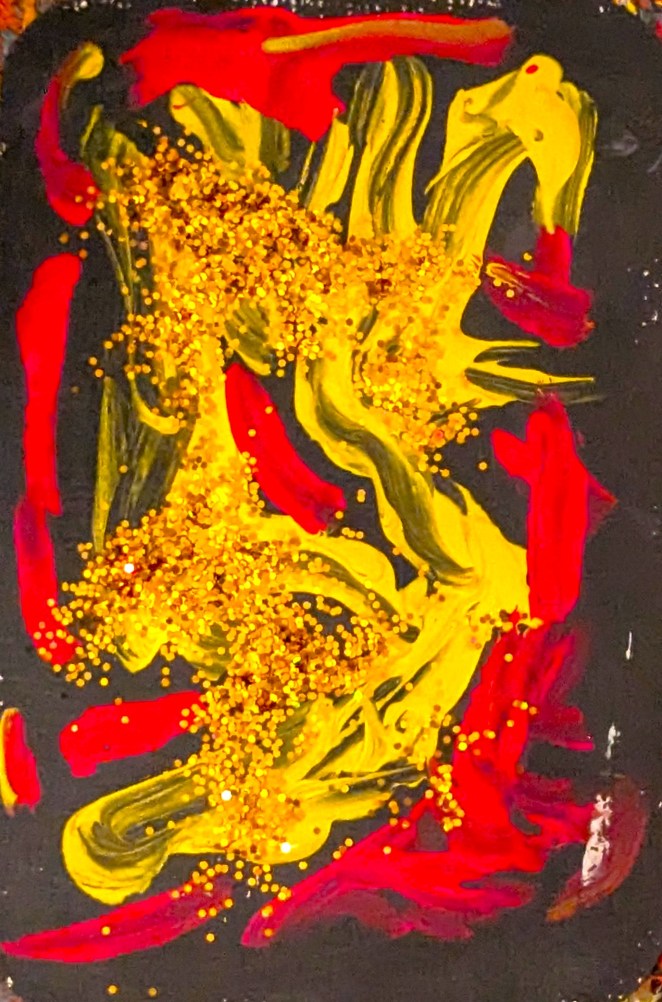
Free will or determinism? How does one escape from the back-street poverty of a run-down neighborhood and emerge from the shadows to bask in the light of the sun? Or is it all a dream, a made-up picture of a childhood that never was in a neighborhood that never existed? Vanishing point – the railway tracks fading away into the distance. Point of vanishing – to lose oneself in the mysteries of a past that never was in order to establish a future that never will be. Dream, dream, dream – all I have to do is dream!

And then there are the nightmares, when the dreams are true and the memories are so exact that you can see the blood on the razor blade and feel the almost silent slash of this particular slice of life. Secrecy – and who can tell whether I am telling the truth, or not, here in a foreign land, not the land of my fathers – and I only had one father, that I am aware of, and one mother too – where nobody knows me and the children from that imagined back street would never think of visiting.

For Jorge Luis Borges, whom I met twice, once in Bristol and once in Toronto, – Canada was a land so distant and so cold that it lacked reality. And thus I can dream my dreams, rewrite my past, reimagine myself, in whatever way I want to and I can vanish at any vanishing point I choose and emerge wherever I want to, and do it over and over and again, and who knows the truth? Over the points, over the points, and Liza none the wiser, whoever Liza happens to be!!!

Carved in Stone 32

Carved in Stone
32

I dream of winter snow
snaking its whispering way
down the highway.

Waves draw lacy curtains
across the beach.

Sandpipers wade, pecking,
probing at tide’s foaming edge,
strange writings their footprints,
punctuation,
the holes they leave
drilled in the sand.

Evening now, and a low light
casts its magic on the forest,
gilding the trees.
Dry leaves rustle.

A shadow flickers
at the edge of my eye,
my childhood –
a sea bird soaring.

Commentary:

So inadequate, the word world I create. Sound – winter snow snaking its whispering way down the highway / dry eaves rustling. Absence of sound – waves draw lacy curtains across the beach / sandpipers, with their shrill voices and constant whistling’ / the gentle hiss and buddle where the sandpipers sew their holes.

What about the other senses? I miss the sense of smell, the odors borne on the wind, the different aromas that arises from dry and wet sand, the pong that wet sea weed exudes, the perfumes of sea side grass and wild flowers … And what about touch – the sandpaper scraper of dry sand between the toes, the feel of those lacy curtains as, jeans rolled up, you paddle along the shoreline, the feel of the wind on your face when sea birds soar … and who can ever forget the salt taste of the sea upon their lips?

The Catch 22 of all writers – how much can we include? How much can we suggest? How much must we let slip by? Culture – how can we describe the sea to someone who has never seen the sea? I can ask the questions – but I must leave you to work out the answers for yourself. So inadequate, the word world I create.

Carved in Stone 30 & 31

Carved in Stone

30

A well of beauty dwells within me,
not skin deep, but buried, arcane.

A flickering candle
tethered to an altar,
shimmers at midnight,
when the Latin mass is said,
bringing me light.

In the dark, canonical hours,
shadows move beside me
as I walk long corridors
from dormitory to a chapel
filled with heady incense.

31

I kneel, dumb-founded,
as candle flames wax and wane,
their brightness enhanced
by the midnight magic
that turns doubters into believers.

Spell and symbol, each candle a star,
shining, twinkling, in a galaxy of light,
and everywhere, the incense,
overloading my brain, releasing me
to revelations way beyond
muttered responses, mumbled words.

A world of inner darkness,
yet heart and soul soar together
up to the altar’s immortal light.

My shadow flickering
on the corridor walls,
as candle in hand, half-asleep,
I return to my cold bed
where the long, chill snake
of the bamboo cane
reminds me of tomorrow’s
flagellation.

Commentary:

Shadows on the wall or candles – with which should we start? Verbal and visual – how do they blend and knit together? Does my visual take away from your visual, or does it enhance it? To what extant does my verbal and the commentary on my verbal change the nature of your original thoughts when you re-create, within your own mind, my images, both verbal and visual?

Verbal and visual – now add the sense of smell. “The incense, overloading my brain, releasing me to revelations way beyond muttered responses, mumbled words.” And now remember that I was only six or seven years old when I experienced these things. Add the Latin mass, only half understood, the cold, damp feel of walls and wood beneath the hands. A world of inner darkness, yet heart and soul soaring together up towards the altar’s immortal light.”

My words are black print on white paper. My memories flare – an aurora borealis of senses sent crackling down the spine, in and out of the mind, tumbling the brain into a world … what sort of world? An unimaginable world. One never forgotten. One never re-recreated. One that never existed. One that never could exist. One for which the young child, six or seven years old, yearns for the rest of his life. His unsatisfied life. His unsatisfying life. His meaningless life. His absurd life.

Oh pity the poor puppy, not knowing what he has done wrong, not knowing how to put things right, always inadequate, whining and cringing at his master’s feet. And always, “that cold bed where the long, chill snake of the bamboo cane reminds me of the next day’s flagellation.”

Carved in Stone 18

18

Day-dreams, cloud castles,
châteaux en Espagne.

I climb the castle tower
in Segovia, and watch
Golden Eagles flying
in the air below me.

I walk the walls in Avila,
feel the stonework, warm in the sun,
and sense the passing of time
as it slowly gathers,
like clouds in the air
when they foretell a storm.

I trace masonic signatures
on the cathedral’s central façade,
and marvel at the master carvers,
who shaped the statues.


They also created angels
and the praying pay-masters
condemned to kneel there,
seeking forgiveness for their sins,
as flickering candles mark time.

Commentary:

Avila: 3.8 kilometres of walls. 9 entrances. Inside the walls, the old city. I lived for three summers in El Rincon, a Hostal in the city centre just outside the Mercado Chico. I still dream of walking those city streets, visiting the bars each with its different customs and tapas. And I remember the tapas, each bar specializing in something different. The Rincon, a marisqueria, and I learned so much abut sea-food, its transportation, the ways of preparing and cooking it.

And while in Segovia, you look down at the Golden Eagles, in Avila, an eternity of storks looks down at you. I remember my friend, standing at the door of the Hostal and calling the storks, as they returned from a day in the fields, by the names of the churches in whose towers they built their nests.

I never thought those days would end, but end they did. As all things do. Now I must take a delight in the memories as they walk before me and call me by my name.

Carved in Stone 16 & 17

16

The Bulls of Guisando,
pre-historic, unweighable,
the bearers of Roman graffiti,
itself two thousand years old.

Were they carved as boundary markers,
or designed to designate pastures,
for horses, pigs, sheep, and bulls,
all grazing in their stone dreams?

Celtic, pre-Roman,
they speak to my Welsh blood,
and to the Irish soul
that will always be a part of me.

I place my hand
on the dimpled granite hide
and feel time coursing
beneath the stone skin.

Granite ships,
islands in a sea of time,
I sense a heart beating,
something surviving
within the stone.

17

We are powerful people,
we creative artists,
we carvers of stone,
we dreamers,
whether we dream
by day or by night.

Those of us
who dream by day,
often see our day-dreams
come true.

Commentary:

“Those of us who dream by day, often see our day-dreams come true.” Lawrence of Arabia – The Seven Pillars of Wisdom. You recognized the quote of course, wrth gwrs. Intertextuality, the weaving of words through text after text in different combinations according to our time and space. Some of us think we are original, but there are only so many plots to a play, 24 or so, if I remember my Aristotle correctly, and I have changed the number, just to test you. Oh ye of too much faith!

We think we are original, but, as Picasso said, the painters of the cave paintings, all those many years ago, created everything we artists could ever dream of. We all borrow in one way or another and originality is merely a disguised form of borrowing. The faces change, the actors change, the medium changes, the times change, but otherwise, everything else is the same. Sad, really, that we should claim originality (and fresh water) for all that water that has passed under so many bridges.

Welsh blood and Irish soul – not even original, but shared by so many in my family. Add an English education, studies and residence in Spain, France, Mexico, Canada, and the USA, and what do you have? An intellectual mongrel, that does not know its own mother, like so many other mongrels, and that shakes its coat only to shed so many multi-cultural and multi-lingual fleas.

And remember – “Great fleas have lesser fleas upon their backs to bit them, and lesser fleas have smaller fleas, and so ad infinitum.” Intertextuality – they were only playing leap-frog and one jumped over and another jumped over someone else’s back.

Last Dance

Last Dance

Ten years ago,
in the Hospice for patients,
the shy lady in the corner,
body withered by cancer,
stood up to dance.

She bowed to the band
then floated into movement,
dancing alone.

She clung to the empty air
as she once clung to her lover.

Nymphs and shepherds
played sweet music at midnight
in this room turned sacred grove,
where naiads and dryads
emerged from the shadows.

Her dance-steps
were a draught of joyous water
from the fount of eternal youth
and lasting love.

Commentary:

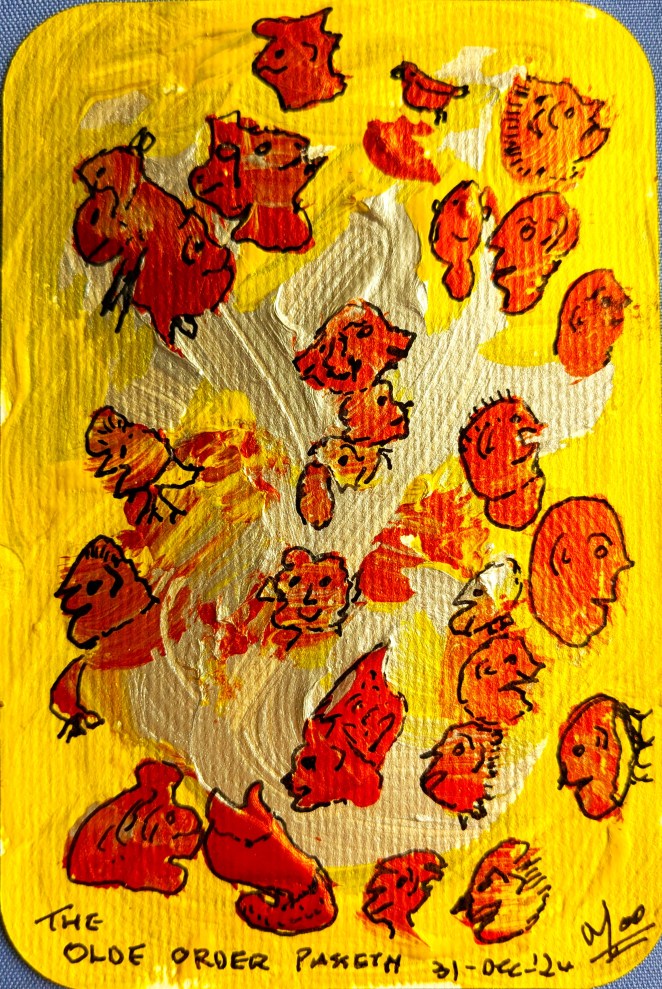
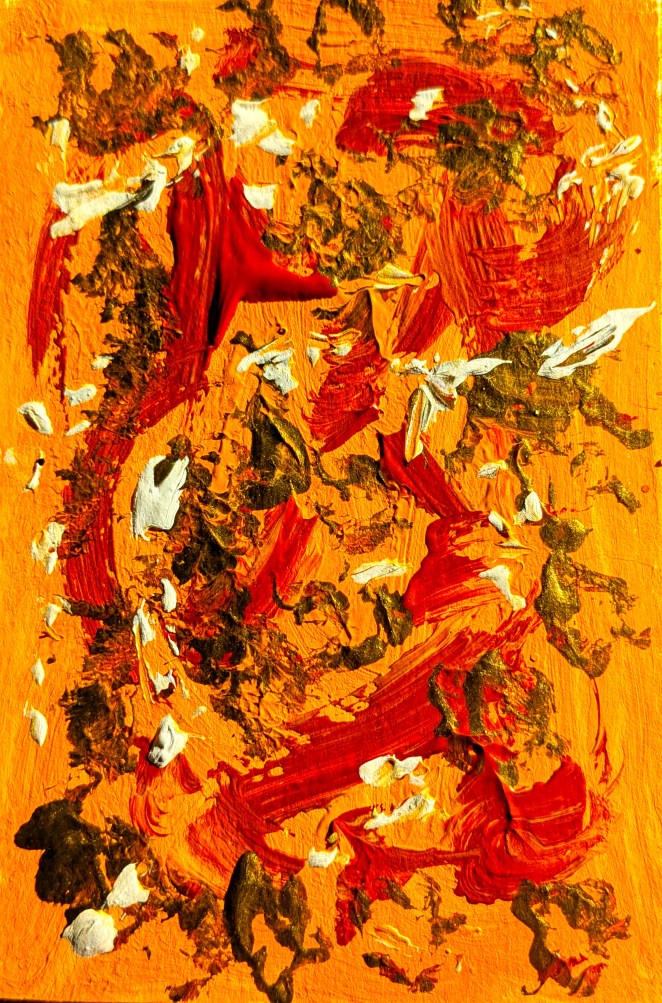
Moo offered me one of his paintings for this poem. He calls it Keep on the green side. Every Wednesday, in the hospice, a local band came in to play. Some patients danced, others sat and watched, some stood on the sidelines and listened to the music.

I had the fortune to be present at the singular performance recounted above. I never found out that lady’s name and I never saw her again afterwards. She remains a mystery, like the naiads and the dryads, and the hamadryads, who inhabited those mythological woods where so many of us dream our dreams of one last chance and one last dance.

Carved in Stone 1

My very own hand-carved verraco
Del Rincon (Avila) a Roger

Carved in Stone

1

Behold me here,
filled with a sort of shallow,
hollowed-out wisdom
accumulated over decades
while listening with my eyes
to the words and thoughts
of writers, long-dead.

Imprisoned in book pages,
do they bang their heads
against walls that bind,
or hammer with their fists
at the barred lines
of their printed cages?

These spirits long to break free,
but they choke on library dust
and pollen from verbal flowers
that bloom unseen.

Those old ones avoided
the traps of temporal power,
or, once trapped,
gnawed off a precious limb
to limp into freedom

Commentary:

Carved in Stone is the second dialog (Chronotopos II) in my Bakhtinian Dialogs with my time and my place. Clepsydra is the first Dialog. You can follow it, in its entirety, starting with this first, introductory post.

Reception Theory – I write, you read. Any meaning that you extract from my poetry will depend on your own culture and background. Tolle, Lege – Take and read. Read slowly, and with care.

I am a poet, a dreamer, if you will. These are my dreams. Tread softly on my dreams, for when you enter my world, you mingle your dreams with mine. The result, I hope, will be an interesting intellectual blend of new creativity.

The hand-carved verraco, in the photo above, was given me by my friends in the Rincon (Avila) where I spent four happy and creative summers. Never forgotten. Blessings and pax amorque.

OAS

OAS

I take up my pen to scribble
my name and a riddle in the sands,
neither seen nor understood
by folk in far off lands.

Yet here I stand on foreign strand
my body twice marooned
by friends and fate and oft of late
my achievements all lampooned.

I bid you spare a thought for me
and also for my fate:
I came, I saw, I got a job,
but retirement ain’t great.

A pittance for a pension,
a life on OAS,
a walking stick and SOS,
that’s all that’s left, I guess.

Commentary:

A Golden Oldie from way back (2013 or so). Things get worse, in many ways, but yma o hyd – we’re still here. And that’s the main thing. We need rain, more rain, and yet more rain. Yet the damp really gets to those of us who suffer from osteo-arthritis. Maybe we should put a tariff on it (250%) and then it would be priced out of existence. Then it can rain as much as it wants and the aches and pains will stay in Aix-les-Bains and not come running after me.

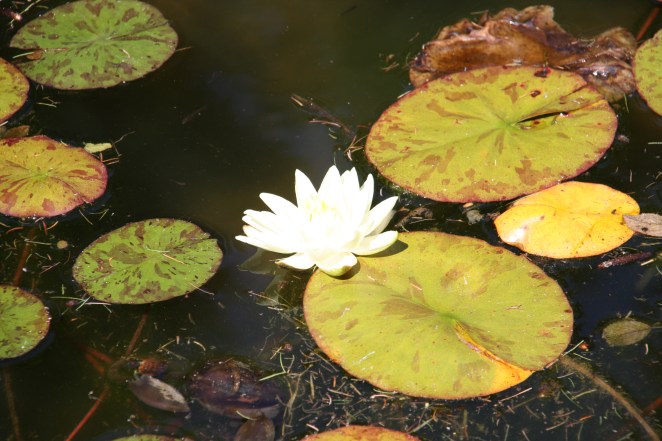
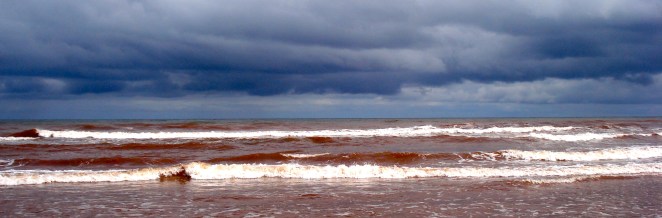
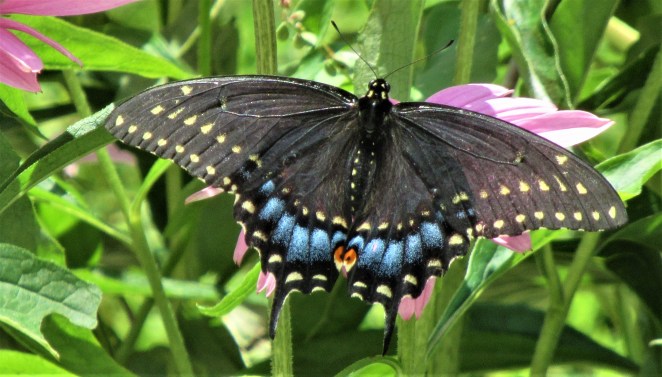
I asked Moo for a painting of rain drops falling on my head, but he didn’t have one. So I found a photograph of a real rain storm falling on the back porch, a year or so ago. We need one of those right now. Moo is nodding his head as I type. Oh dear, he just snored. He must have fallen asleep. He does much more noddy now than he used to. And so do I. Maybe I’ll do a photo of a big yawn next. Or he can paint one.

What aspects of your cultural heritage are you most proud of or interested in?

What aspects of your cultural heritage are you most proud of or interested in?

Right now, I am quite interested in (re-) learning the Welsh Language. Although I was born in Wales, I was never allowed to speak Welsh at home and my parents sent me to schools in which Welsh was never seen nor heard, let alone taught. That didn’t stop me from hearing out on the streets, reading it on the street signs, or visiting places whose names were only available in Welsh, or an Anglicized form of Welsh.

I am no longer an assiduous student of languages, but I get a Welsh Word a day by e-mail, and each word comes with an explanation of meaning and extended meanings. I also receive the words’ pronunciation and its phonetic changes (something peculiar to Welsh – they come in written form and can be quite complicated). Useful sentences are added – not long, but 3-4 seconds, repeatable ad infinitum, by reliable Welsh speakers, who often offer the variant pronunciations not only of North and South Wales but of other regions as well.

A great deal of linguistic and cultural history is wrapped up in language and the origins of the word are analyzed – sometimes going back to Indo-European, proto-Welsh, Medieval forms, and modern changes to the language. Emphasis is also placed on the survival of Welsh and its preservation, in written form, in Y Beibl Cymraeg, The Bible in Welsh. This fixed the language and helped enormously in its preservation.

I am also interested in Welsh Songs and Hymns. I already know most of the tunes having sung them in English during my childhood. Now I am learning them in Welsh and am currently working on the words to Calon Lan, one of my favorite hymn tunes. So, there you are. A new start at a very advanced age. A return to the past and an investment in the unknown future!

Love in Old Age

Love in Old Age

How do I love you? Let me count the ways.
I love you when together we start to write
for although you’re sometimes out of sight,
you’re never out of mind. So many days

we’ve spent sitting together at keyboards, tapping
at computer keys. Is this the way to please
each other, a choosing of words, a squeeze
of meaning into a smaller space, with overlapping

metaphors and images improved in ways
we never would have dreamed of? Each
to his or her own, we say. Yet we reach
out to each other over time and space,

not joined at hip or lip, but with energy and zest,
sailing similar seas, and trying our very best.

Commentary:

A Golden Oldie, the poem more than the painting. Moo is more up to date than me. He also thinks my beloved and I sit side by side, or at opposite sides of the table, gazing at each other, but not saying much. Hence his choice of cartoon – The Sound of Silence.

“Each to his or her own, we say. Yet we reach out to each other over time and space.” Sometimes silently, often with words. Silence is best – because as my hearing goes, what I hear is a mumble – like the rumble of the old Mumbles Railway – does anybody else remember that? The result of the overheard mumble is an inelegant ‘Eh?’ Too many ‘ehs’ spoil the silence. Don’t they, eh? What’s that you say, eh?

So, I am now having great fun reading a new word a day in Welsh. What a joy to pursue the language that was forbidden when I was a boy. I don’t have anyone to talk to, but that is beside the point. Reading, remembering, the old place names still there at the tip of the tongue – Brynhyfryd, Rhosili, Pwll Ddu. Each name brings with it a visual memory, usually silent, but sometimes filled with the cries of sea-gulls and the growling of corgis defending their territories. Whatever – what joy!