Carved in Stone 23 & 24

Carved in Stone

23

It isn’t true that art
lives longer than life,
for all too often art and artist
are destroyed together.

Words, all words,
and words emerge
from the silence of blood,
bone, and stone, breaking
that silence the day they are born,
and the word once spoken
cannot be recalled.

24

Here, among the ruins of my life,
I have learned how to be alone,
how to sink into silence,
how to smother at birth
that world of words,
and that world, still-born,
becomes a lost world
whirled on the silent wind that fans
the unborn fires within.

I sit here
brushed by a tadpole’s solitude
as it swims through the sultry silence
of blood, bone, and stone,
into its own metamorphosis.

The wind that blows unspoken words
tugs at the spider web of my mind
twisting and untwisting
its frayed, fragmented ends.

Commentary:

The fragility of life. The single puff that turns the dandelion into a dandelion clock. The multiple puffs that dowse the candles on the birthday cake. And then, one day, there are no more candles, no more cakes, just the heart ache of multiple absences, family and friends all gone and each of us alone with our individual loneliness.

That’s when we finally turn in and seek the inner roads that lead us to ourselves. The selves that were, the selves that are, the selves that always will be. Crack the walnut – inside is the map of a brain – your brain? If it is you will have found yourself in this labyrinth. But if it is the brain of another, you must not give up, you must seek yourself, walnut after walnut.

And when you go to the library, you must check book after book, because one day, if you are lucky, you will find the book of your life and it will tell you who you were, what you are, and what you will always be.

Carved in Stone 18

18

Day-dreams, cloud castles,
châteaux en Espagne.

I climb the castle tower
in Segovia, and watch
Golden Eagles flying
in the air below me.

I walk the walls in Avila,
feel the stonework, warm in the sun,
and sense the passing of time
as it slowly gathers,
like clouds in the air
when they foretell a storm.

I trace masonic signatures
on the cathedral’s central façade,
and marvel at the master carvers,
who shaped the statues.


They also created angels
and the praying pay-masters
condemned to kneel there,
seeking forgiveness for their sins,
as flickering candles mark time.

Commentary:

Avila: 3.8 kilometres of walls. 9 entrances. Inside the walls, the old city. I lived for three summers in El Rincon, a Hostal in the city centre just outside the Mercado Chico. I still dream of walking those city streets, visiting the bars each with its different customs and tapas. And I remember the tapas, each bar specializing in something different. The Rincon, a marisqueria, and I learned so much abut sea-food, its transportation, the ways of preparing and cooking it.

And while in Segovia, you look down at the Golden Eagles, in Avila, an eternity of storks looks down at you. I remember my friend, standing at the door of the Hostal and calling the storks, as they returned from a day in the fields, by the names of the churches in whose towers they built their nests.

I never thought those days would end, but end they did. As all things do. Now I must take a delight in the memories as they walk before me and call me by my name.

On Writing Poetry

On Writing Poetry

I sit here writing poetry
and, head in hands, I cry
at all the things I’ve left unsaid,
and then I wonder why
I wasted so much time on things
that perished before my eye.

Outside the night is dark and cold
and shadows flit and filter by.
I know that I am growing old,
that soon my story will be told,
and when it ends, I’ll die.

I know that death is not the end,
yet I do not want to die.
I want to paint the autumn trees,
the clouds that float on high,
with evening lights that stain the sky.

But rhyming is not all I do.
I often write in prose, with words
that wound, and sow dark seeds,
that root and flourish, grow like weeds,
and nourish other people’s needs.

Alas, I know not what I do,
nor yet what I have done,
nor when, nor where, the seeds
were sown, nor if they aided anyone
to turn away from the dark inside
and walk in the light of the sun.

Commentary:

A Golden Oldie that turned up on my Facebook page. So I copied it and pasted it here. What fun. I’ll probably revise it and sharpen it up a little bit. All best wishes to all my readers.

And remember, Remembrance Day is for Remembering. Both my grandfathers served in WWI and were decorated. Never forget those who sacrificed themselves to give us life and freedoms we enjoy.

Carved in Stone 16 & 17

16

The Bulls of Guisando,
pre-historic, unweighable,
the bearers of Roman graffiti,
itself two thousand years old.

Were they carved as boundary markers,
or designed to designate pastures,
for horses, pigs, sheep, and bulls,
all grazing in their stone dreams?

Celtic, pre-Roman,
they speak to my Welsh blood,
and to the Irish soul
that will always be a part of me.

I place my hand
on the dimpled granite hide
and feel time coursing
beneath the stone skin.

Granite ships,
islands in a sea of time,
I sense a heart beating,
something surviving
within the stone.

17

We are powerful people,
we creative artists,
we carvers of stone,
we dreamers,
whether we dream
by day or by night.

Those of us
who dream by day,
often see our day-dreams
come true.

Commentary:

“Those of us who dream by day, often see our day-dreams come true.” Lawrence of Arabia – The Seven Pillars of Wisdom. You recognized the quote of course, wrth gwrs. Intertextuality, the weaving of words through text after text in different combinations according to our time and space. Some of us think we are original, but there are only so many plots to a play, 24 or so, if I remember my Aristotle correctly, and I have changed the number, just to test you. Oh ye of too much faith!

We think we are original, but, as Picasso said, the painters of the cave paintings, all those many years ago, created everything we artists could ever dream of. We all borrow in one way or another and originality is merely a disguised form of borrowing. The faces change, the actors change, the medium changes, the times change, but otherwise, everything else is the same. Sad, really, that we should claim originality (and fresh water) for all that water that has passed under so many bridges.

Welsh blood and Irish soul – not even original, but shared by so many in my family. Add an English education, studies and residence in Spain, France, Mexico, Canada, and the USA, and what do you have? An intellectual mongrel, that does not know its own mother, like so many other mongrels, and that shakes its coat only to shed so many multi-cultural and multi-lingual fleas.

And remember – “Great fleas have lesser fleas upon their backs to bit them, and lesser fleas have smaller fleas, and so ad infinitum.” Intertextuality – they were only playing leap-frog and one jumped over and another jumped over someone else’s back.

Growing Old Together

Growing Old Together

You and I are growing old together.
We have been together for 59 years
and married for 54 of those.

We watch each other slowly breaking down,
the memories going,
the body parts not functioning
the way they used to.

In some ways,
it is incredibly beautiful.
In other ways,
it is so tragic, this slow waltz
around life’s dance-floor
towards who knows what
that last dance will bring?

It gets harder and harder
to find the right things to say,
sometimes to find anything to say.

There are days
when we just sit in silence,
filling in time,
doing a crossword or a sudoku,
or just gazing into space,
trying to avoid
the mindlessness
of endless adverts
on the television.

Commentary:

Not much to say, really. The poem and the photo speak for themselves, as good art always should. Sometimes the artist plans everything, and out it pops, all ready-made. On other occasions, a small miracle takes place and words and images tumble out, fluff their feathers, settle down and wow! – it’s a work of art. As long as one other person, other than me, thinks so, then I will be happy. “If I can reach out and touch just one person.”

I often wonder how many people are touched by traditional art nowadays. There is so much shock and awe out there, that the humble homely corner with its two doves or the image of an elderly couple dancing slowly around their kitchen, hanging onto each other – for what? And both of them waiting – for what, exactly? I expect it varies with each couple. But what I pity most are the lone doves, abandoned, autonomous, living on their own-some with nobody to talk to and only the TV to listen to. How many of them are out there, I wonder? When I walk around town, I see the street people, the homeless, the really lonely ones, just sitting, or slowly pushing a grocery cart with all their belongings tied up in plastic bags. Heads down, they plod on, never stopping, never looking.

“A sad life this, if full of care, we have no time to stop and stare.” W. H. Davies.

Carved in Stone 12

12

A Ruffed Grouse sought refuge
among the berries
of the Mountain Ash.

I shot him,
not with a gun,
but with a camera.

Intertextuality –
a friend borrowed the photo,
turned it into elegant brush strokes,
and now the painting
hangs on my wall,
opposite the tree
where once he sat.


A still-life
face to face with its reality
as early morning dew
forms on spider webs,
hammock-strung
between grass-blades,
bending in the wind.

And what if the spell breaks
and I can no longer see the fine seeds
of the dandelion clock kissed away
by the lisping lips of time?

What is life?
Is it just an illusion?

Commentary:

I shot him, not with a gun, but with a camera. Interesting. I have never seen the need to take the life of living creatures, except in cases of absolute necessity. And no, I have never killed, let alone for fun or sport. Shooting with a camera, that’s my ideal, and when a friend and fellow KIRA artist likes the photo and offers to paint it … well, that leads us into the nature of intertextuality, where reality becomes photo, becomes painting, becomes a text, and you, dear reader, are contemplating all those moments that join us.

The fine seeds of the dandelion clock kissed away by the lisping lips of time. This image comes from my walks in the Welsh countryside around Brandy Cove, Gower, with my paternal grandmother. “What time is it Nana?” I can still see her, bending down, plucking a dandelion, and holding it out for me to blow the seeds away – one puff, one o’clock, two puffs, two o’clock. I recall the seeds, drifting away on the summer breeze. “The Good Lord loved those dandelions,” she once told me. “That’s why He planted them everywhere.”

What will happen when the wells run dry and water runs out and there are no more dandelion seeds? How long will it be before I can no longer see them? Vis brevis, ars longa. The answer to my questions – I care, but I really don’t know.

Angel

Angel

Oh yes, I have been with them, the lost folk, the tramps, the homeless, the bag-women, all the gente perduta. I have stepped on their fingers as they sprawled on the sidewalk. I have trodden on their toes, tripped over their legs, bumped into their stiff, stumbling bodies and stepped in their wasted body fluids. I have stayed out all night, shared a pack of cigarettes, producing another pack or a bottle from the pouch beneath my wings. Such stories they tell, and they tell them in that antiquated language that I first heard hundreds of years ago. They know me now. I won’t say they trust me, but they tolerate my presence, a Jacques Cousteau voyeur, looking into the sea-depths of their despair.
            Garbed in garbage bags, thin trickles of wine and vomit slipping over their lips and cheeks, bloody bandages wound around needle wounds, they have scars at elbow and foot. I hear the warmish blood whistling its snake song through their arteries and veins but death shall have no dominion, not while I am on watch.
            I enfold myself in my wings and weep as these people, my people now, pillow their heads on bloody bandages. Their world is a world of vomit and reek, yet the edges of their shattered lives rip chunks from my hands and fingers, pluck feathers from my wings, tear holes in my heart. Needles I have seen and touched, blunt, shared between three, five, and twenty-five. Round and round, they go, slipping the thin threads of drug-dreams and tainted blood from friend to friend while the blunt points stab at bruised flesh and leathery vein until the freed blood oozes through fingers and hands clenched tight to hold and staunch.
            Night after night I have watched them searching for something just beyond their fingertips. As the late-night diners emerge from their opulent restaurants, I have seen my people fortifying shop doorways with cardboard castles. I have watched them climb inside, shut down the portcullis, and enfold themselves in the plastic that will keep them free from wind and rain. They all crave the bottle’s warmth. They fight and scratch for that which will hold them together, body and soul, that spiritual glue that binds the spirit before setting it on its drunken dreams of freedom. Kings and Queens, tumbled from their earthly thrones, they dream of the paradise they lost, yet think they can find again at the sharp point of a needle or the bottom of a bottle.
            Oh bird-on-a-wire dreams held captive in a skull-bone cage, how you yearn to grow wings, like me, to soar, to fly, to be released from the body, to at last be free …

Commentary:

This book, All About Angels, is available online at Amazon.ca. Click on the link below to purchase the book.

All About Angels
Paperback edition

Last Dance

Last Dance

Ten years ago,
in the Hospice for patients,
the shy lady in the corner,
body withered by cancer,
stood up to dance.

She bowed to the band
then floated into movement,
dancing alone.

She clung to the empty air
as she once clung to her lover.

Nymphs and shepherds
played sweet music at midnight
in this room turned sacred grove,
where naiads and dryads
emerged from the shadows.

Her dance-steps
were a draught of joyous water
from the fount of eternal youth
and lasting love.

Commentary:

Moo offered me one of his paintings for this poem. He calls it Keep on the green side. Every Wednesday, in the hospice, a local band came in to play. Some patients danced, others sat and watched, some stood on the sidelines and listened to the music.

I had the fortune to be present at the singular performance recounted above. I never found out that lady’s name and I never saw her again afterwards. She remains a mystery, like the naiads and the dryads, and the hamadryads, who inhabited those mythological woods where so many of us dream our dreams of one last chance and one last dance.

An Allegory for Gaia

Sponge in Water
an allegory for Gaia

She is in me
as I am in her –
I the sponge,
she, the water.

Our essences blend
with the promise
of an ample life
full of movement.

Eau de vie:
the water of life.

It causes me
to blossom and flourish,
to wither and perish
when her waters fail.

How lonely would I be
if she abandoned me?

What would she be,
what would she do
without me?


Commentary:

A summer without rain led to an early autumn drought. Slowly, water grew in importance. Wells in our neighborhood ran dry. We were lucky and were not affected. But we took great care not to waste water. Eau de Vie – the water of life – the water that brings life and causes life to blossom and flourish.

Without water, we are nothing. We cannot live. Then, when the rains came down, we rejoiced. We walked out into the yard and stood with our faces to the rain, looking up at the sky, mouths open, letting the water renew our hope and faith.

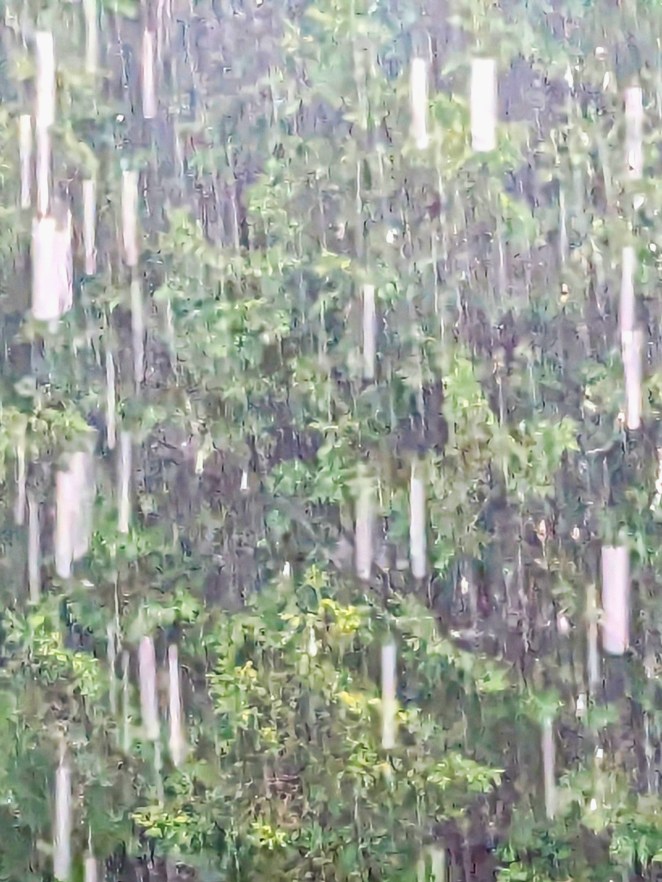
I took the photo, incidentally, from the dining table in my kitchen during a heavy rainstorm. Looking out into the garden, I saw a rush of water, so thick and heavy. Incredible. The photo hardly does it justice.

Hallowe’en

Hallowe’en

1

Today is All Hallows Eve.
Tomorrow is Oaxaca’s
Day of the Dead.
The clocks change
the day after tomorrow.

Today, it’s raining,
and rain is a trick when
it forces celebrants off the streets
and town councils vote to change
the traditional date and send
young children out trick and treating
on a dry, warmer night.

But this rain, after drought,
is a Hallowe’en treat.

It brings a promise
that the aquifers will refill
that wells will not run dry,
and above all,
it brings us hope.

2

Around us, fall thrives
and watches and clocks
will soon fall back.

Trees weep for lost leaves.
Flowers that flourished
now wither and perish.

Hollyhocks topple and fall.
Bees’ Balm is abandoned
by butterflies and bees.

3

I expect time
to change with the clocks
and my body clock
will soon be out of sync
with the tick-tock chime
that denounces each hour.

Hours that used to wound
now threaten to kill.
They used to limp along,
but now they just rush by
and I, who used to run
from point to point,
now shuffle a step at a time.

But still I live in hopes to see
the clocks spring forward
once more.


Commentary:

A great poem for Hallowe’en, even if I say so myself, and I haven’t even mentioned the Blue Jays and the Los Angeles Dodgers. Oh, woe is me. Shame and scandal in my poetry.

Game Six of the World Series on Hallowe’en – wow! – well, one team will get a treat and the other will receive a very disappointing trick. I know which team I support, but I don’t know who will win this time around.

Having said that – with substantial rain after drought, everybody in my province is a winner. And who could wish for more than that?