Dog Days

Dog Daze

1

A dry storm lays waste the days that dog my mind.
Carnivorous canicular, hydropic, it drinks me dry,
desiccates my dreams, gnaws me into nothingness.

At night a black dog hounds me, sends my head spinning,
makes me chase my own tail, round and round. It snaps at
dreams, shadows, memories that ghost through my mind.

Tarot Cards and Tea Leaves are lost in a Mad Hatter’s
dream of a dormouse in a teapot on an unkempt table.
Hunter home from the hill, I awake to find my house
empty, my body devastated, my future a foretold mess.

Desperate I lap at salt-licks of false hope but
they only increase my thirst and drive me deeper
into thick, black, tumultuous clouds. Dry lightning.
The drought continues and no raindrops fall.

Dog Daze
2

The drought continues and no raindrops fall.
Desperate I lap at salt-licks of false hope but
they only increase my thirst and drive me deeper
into thick, black, tumultuous clouds. Dry lightning.

Tarot Cards and Tea Leaves are lost in a Mad Hatter’s
dream of a dormouse in a teapot on an unkempt table.
Hunter home from the hill, I awake to find my house
empty, my body devastated, my future a foretold mess.

At night a black dog hounds me, sends my head spinning,
makes me chase my own tail, round and round. It snaps at
dreams, shadows, memories that ghost through my mind.

A heat wave lays waste the hopes that dog my days.
Carnivorous canicular, hydropic, it drinks me dry,
desiccates my dreams, gnaws me into nothingness.

Dog Daze
3

The drought continues. No raindrops fall.
No fresh water. None at all.

Dark clouds gather in the sky.
No rain falls. The ground is dry.

Grass all burned. No more hay.
How much livestock will they slay?

No rain comes, but a flash of light
sets the woods and fields alight.

Home from the fields, some farmers confess
their future is an unpredictable mess.

Desperate farmers are losing hope.
Out in the barns, they keep some rope.

The roof beams are sturdy and built high.
One little jump and problems good-bye.

Commentary:

Dog Daze 1 is a reverse sonnet. Instead of being structured 4-4-3-3 it moves in reverse 3-3-4-4. What fun to pretend to be Milton Acorn, and to turn my sonnet upside down. It should rhyme, but I abandoned rhyme in favor of metaphor a long time ago. Was I right to do so? What, if anything, catches you unawares in Dog Daze 1? Does it work for you? What would happen if we turned it upside down? You be the judge.

Dog Daze 2 is more or less the same sonnet returned to its normal stanzaic shape 4-4-3-3. In what ways has the poem now changed? Clearly there is a structural difference. Obviously some of the lines and images have changed. Is the poem stronger? Weaker? Does each one affect you in a different fashion? Do you prefer one version to the other?

Mission Impossible – How many more adaptations can we make to this poem and how would each one affect the poem and the reader’s reception of it? For example – Dog Daze 3 sees our sonnet turned into a poem composed of seven rhyming couplets. Couplets are easy to rhyme. But do they simplify the thoughts too much? Is the poem now too dark? Can you lighten the mood? How? Your mission, should you decide to accept it, is to rewrite the poem in seven non-rhyming couplets. That will make a change from the Daily Sudoku and the Cross-word puzzle. If you do take up the challenge, let me see what you do! And remember, you can make it personal to you, your life, and your garden.

We’ll Rant and We’ll Rage …

We’ll Rant and We’ll Rage …

Spring is here. An election is near. Road repair season has started.

1. Spring potholes – they are terrible and they are everywhere.

It was so bad in one area of town that people filled them with water and put out little plastic yellow ducks to float on them.

That way they could be seen, which saved the loud clunk of them being heard and felt.

In one place, some street artist used the potholes as the centerpiece for porno pictures.

Success –  early next morning, the potholes had been filled in.

2. Spring road repairs – horrific – and all too abundant.

We have a sign at the bottom of road saying “Caution – Construction  – drive carefully for the next 6 kms.”

At the 1 km mark, a lollipop person with a STOP sign. 

Ahead of us, 24 cars – behind us, the traffic line up is building. 

We wait 15 minutes.

A white half ton appears, followed by a line of cars. 

The half ton pulls into a drive ahead of us.

We count the cars as they drive past.

99 of them. Then a pause.

The white half ton reverses out of the drive and pulls up in front of us.

On his tail gate a sign that says “FOLLOW ME”.

He pulls away, and the first car follows him, as do we all.

He drives at 10-15 kph.

After 1.4 kms, we see the road works – the actual working space is less than 200 meters long.

We keep driving. 

At the 3 km mark, the white half ton turns off, into someone’s drive.

Alas, the driver of the first car has no sense of humor and doesn’t follow the leader into the drive but sets off at speed down the road.

I count the cars that are waiting to return – 59 of them and more arriving.

It has taken us close to 25 minutes to negotiate 200 meters of road repair.

3. Bridge closures – there are three bridge crossings from the south side to the north side of the river.

One is at Mactaquac, over the dam, about 15 kms up stream from the Westmoreland Bridge, the central crossing point. 

The Mactaquac crossing has been reduced to ‘one way at a time’ traffic for the last two or three years, and will stay like that for most of the summer. 

Don’t ask, they won’t tell and I can’t tell, because I don’t understand.

The third bridge is the Princess Margaret. 

It is closed to all traffic for the next five weeks and this is the third year that someone has been working on it.

So, for the next five weeks, we are all reduced to crossing the river by one bridge, the Westmoreland, unless we drive 15 kms to a ‘one way at a time’ crossing or 20 kms down river to the Burton Bridge at the Town of Oromocto.

Rage, rage, against the dying of the light!
My thanks to my good friend, Dana Webster who inspired me to write this by sending me a rant of her own. NB Click here to link Dana’s Creative World.

Intertextuality

Intertextuality

Wednesday Workshop
25 August 2021

            This is another academic word that has a simple meaning. In essence, it means texts talking to texts. Quevedo (1580-1645) writes escucho con mis ojos a los muertos’ / ‘I listen with my eyes to dead men.’ He is suggesting that, each time we read a text written by another person we enter into a dialog with that text and that author. His metaphoric conversations with the writings of the long-dead Seneca become intertextual the moment he put pen to paper and wrote about them.

This intertextuality is a key component of my writing.  You may not recognize all the phrases that I have used previously by other writers. I do. Some other readers will. Just take, as an example, the titles of some of my earlier books. The title of Broken Ghosts (Goose Lane, 1986) comes from these lines penned by the Swansea poet, Dylan Thomas (1914-1953). ‘Light breaks where no sun shines; / where no sea runs, the waters of the heart / push in their tides; and, broken ghosts with glow-worms in their heads, the things of light / file through the flesh where no flesh decks the bones.” Stars at Elbow and Foot, the title of my Selected Poems (Cyberwit.net, 2021) was also inspired by one of Dylan Thomas’s poems. “And death shall have no dominion. Dead men naked they shall be one with the man in the wind and the west moon; when their bones are picked clean and the clean bones gone, they shall have stars at elbow and foot.” The title of Though Lovers Be Lost (Kindle, 2016) also comes from this same poem, one of my favorites, obviously.

Sometimes readers are aware of these intertextual clues that I sow throughout my poems. Sometimes not. It doesn’t matter. There is a resonance in such chosen words and that resonance is there, irrespective of whether you are aware of the word-source or not. That said, the recognition and acknowledgement of intertextual relationships expands the poetic meanings of the creative world even further. It also establishes verbal links between author and author, epoch and epoch, genre and genre, thus establishing a wider intertextual network and a stronger chain of linked literary thoughts and meanings. In our creative journeys, we rarely walk alone, whether we are aware of it, or not.

The art of writing poetry about paintings is known as ekphrasis – which basically just means a verbal description of a visual work of art, whether it’s real or imaginary. The conversion of the visible (painting) to the printed page (verbal) is another link in the great chain of intertextuality, for paintings, too, are narratives with a different form of text. Other component parts are audible to verbal (alliteration, onomatopoeia), touch and feel (tactile) to verbal (as in synesthesia or the mixing of the senses) and the transfer of taste to verbal forms. Many of these transitions and transformations are present, not only in my own poetry, but in surrealism (verbal and visual) as well.

Memory

Spotify:
Remember to scroll down to the appropriate audio episode.

Memory

Marigolds, Oaxacan flowers
grown to guide the dead,
leave so many memories at my door.

Milk bottles placed on the concrete step:
every morning, sparrows peck holes
in the silver tops to drink the cream.

Memory:
its once open door
now slowly closes.

Keys no longer turn in the lock.
Sleep gathers in forgotten rooms,
falling like dust on silken flowers.

Shadows double themselves in the mirror:
recycled shades carve the shower’s glass.

Wary of shade and flame I bathe beneath
a dust-laden beam of sunlight.

Motes in my mind:
flesh and blood chessmen
playing their game
on checkered boards of day and night.

Ruins of the Heart

Spotify:
Remember to scroll down to the appropriate audio episode
.

Ruins of the Heart

Dusty paths meander under drifting clouds.
A worn-out, shadow rag, this ruined land.

An old man with a sly-eyed dog herds thin cows.
Threatened, I stoop and gather stones.

Moving targets, the dog, a shadow of dust
on burial mounds, wind-stirred with weeds.

Abandoned in this wilderness, a wild thorn
thrusts a spear through my derelict heart.

A rag-bag my own body, stitched together
with threads of long-forgotten tales.

Fear sets nightmare shadows dancing,
skeletons come alive on sculpted graves.

Carved faces, a woman, courted by men.
Which one captured her flowering heart?

Who pierced it with an arrow? Who scarred
her name letter by letter on this stone?

That first rock, freed from my fingers,
strikes hard on the canine’s cowardly frame,
setting earth’s shadows free to flee.

My Father

The Jaguar Symbol of Monte Alban, Oaxaca, Mexico.

I saw my father yesterday evening. I walked through the zócalo, opened the main cathedral doors and walked in. The doors closed behind me. I looked towards the main altar and there my father stood, motionless. The evening light shone through the engraved glass panels and illuminated him as if he were some long passed saint come back to visit me. We stared at each other, but I couldn’t open my mouth to speak. The hairs on my neck stood on end and my hands shook. When I forced my mouth open, words stuck in my throat. He wore his best grey suit over a light blue shirt and a dark blue, hand woven tie: the outfit in which I had buried him.

               Three old women, dressed in black, broke the spell. One stood in front of me and wouldn’t let me approach my father. She held a large bag of knitting in her hands and the wool spilled everywhere as she pushed me away. The second threatened me with a pair of scissors that she held in her left hand and thrust towards my face. The third smacked a tailor’s measuring rod against my father’s head.  He nodded, smiled sadly, and they all turned their backs on me and hurried away out of the cathedral and into the square.

               Just for a moment, I stood there in silence. Then I pulled the doors open and ran in pursuit of my father. The setting sun filled the square with shadows that whispered and moved this way and that, as if a whole village had come down from the hills to walk beneath the trees and dance in the rays of the dying sun. I stood on the cathedral steps and called out my father’s name, but I could see no sign of him among the cut and thrust of the shadowy crowd.

               I ran out into that crowd and pushed at insubstantial people who stood firm one moment and then melted away the next like clouds or thick mist. I came to a side street and saw real people, flesh and blood beings, a group of villagers gathered behind their band. I stopped and as I did the village elder put a live match to the taper of the rocket that he clutched between his thumb and forefinger. The taper caught on fire and the rocket soared upwards with a searing whoosh. The village band marched forward and started to play a traditional dance as the rocket clawed its way into the sky to explode with a loud knock on the door of the gods.

               Tired of grasping at shadows and afraid of this living phalanx of men that marched towards me I went back to the cathedral and knelt at the altar of La Virgen de la Soledad, the patron saint of Oaxaca. Real wax candles stood before her altar, not tiny electric lights, and I inserted five pesos in the slot, took a taper, and lit a fresh candle from an ageing one that had started to sputter. I knelt and, for the first time in years, I prayed. I prayed for the soul I had saved from extinction by lighting my candle from another’s flame. I prayed for my father and my mother and, above all, I prayed for myself.

               On the way home to my second-floor apartment where I live alone, I bought two litres of mescal, one to send me to sleep, and the other so I would survive the next morning.

Comment: A Golden Oldie that I had forgotten about. I found it among the drafts of earlier work. Monte Alban is also known as Dani Ba in the indigenous language of the region. Click on the link for more on Monte Alban. And click on this link for another piece on my father and Oaxaca. It’s a funny thing about Golden Oldies: sometimes they stick with us and are ‘unforgettable’, but sometimes they were better off left in the pile that gathers dust, like a forgotten book on a forgotten shelf. Speaking of which, have I told you about the time when …

Day 23 CV-19

IMG_1652 (2)

Day 23 CV-19
Codes and Coding

“Languages: they say that to learn another language is to gain another soul and another set of eyes through which to view the world.” I wrote these words just yesterday [Day 22 CV-22]. The words are mine, but the idea belongs elsewhere. I have borrowed it and adopted it. I would willingly attribute it to a specific author, but I do not know who said it first. I offer my apologies to the to me unknown genius who first spoke these words.

Why codes and coding? A rhetorical question, of course. But codes and coding are the basic elements through which language transfers thought, our thoughts. What is a code? Well, we know all about Morse Code and the elaborate codes through which spies from all countries communicate their needs. A code is a way of converting language, changing it, making it available to those initiated in the code and unavailable to those who have not received such initiation. Sounds simple, doesn’t it?

When I was travelling regularly to Spain for research in Spanish libraries, my first port of call was always the local barber shop. I did this for several reasons. In the first place, my Canadian haircut gave me away as a foreigner. This is the hairdresser’s code. The barber’s shop was always the centre of local gossip. Here, buzz words changed hands, politicians were discussed, all the local news was immediately available. Each of these items was a code, a code that made an insider (acceptable) versus an outsider (not to be spoken to). I remember, one summer in Madrid, not getting served in any bar or restaurant. Check haircut: okay. Check shoes: bought new pair. Check shirt, jacket, tie: all up to date. Inspect lucky customers … ah … they are all wearing a shiny brass pin showing the symbol of Madrid: El Oso y el Madroño, the bear and the strawberry tree, as seen in La Puerta del Sol.

The next bar I entered saw me sporting El Oso y el Madroño in my lapel. Qué quiere el señor? Immediate service and with a smile. These are social codes, the codes that include the winks and nudges of the upper class, the secret handshakes and foot positions, the names dropped so gently and quietly that they never shatter when they hit the floor. There are also language codes. Northrop Frye wrote The Great Code: The Bible and Literature, a study of the mythology and structure of the Bible was published in 1982. In this wonderful study, Frye showed how themes and language from the bible have influenced the structure of Western Literature, particularly that written in English. Within this code, names, themes, miracles, parables, psalms form a body of are common knowledge available to all readers who are christian and whose first language is English.

But there are other codes. Think Petracharism. Petrarch’s poetry, originally written in Italian, was widely imitated throughout Europe. Italian literature, Spanish, French, English, all dip into that code, as does Shakespeare among so many others. Think the Great Chain of Being. Shakespeare is incomprehensible in places unless you unlock this particular code. Think Platonism, Neo-Platonism, Stoicism, Existentialism … okay, so all this is academic, and I do not want to lose you in a sea of academia. So think NFL, think NBA, think NHL, think baseball, think cricket, think rugby, think darts, think all of the things we manipulate on a daily basis in our lives and think how they include some people (those who know and share our codes) and exclude others (those who are unaware of them). LBW, c&b,  c. A, b. B, st. A b. B, w, W, b, lb, dec., rsp …

This is a wonderful line of discussion. It follows along the lines of micro-language and macro-language. Macro-language is accessible to all who happen to speak that language. Micro-language in its multidinous forms incarnadine belongs ONLY to those who share the micro community, be it family, household, village, town, county, region … all that is closest and dearest to our micro-hearts.

Revisions

img_0128

Revision
“We are not writers, we are re-writers.” I do not remember who said this, but it is extremely well said. We write, yes. But then we rewrite, sometimes obsessively, again and again. But how does that rewriting process take shape? Why do we rewrite? How do we rewrite? And what do we do when we re-write? These are all vital questions.

Mechanical revisions and rewrites
This, for me, is the search for typos, punctuation errors, mis-spellings, grammar corrections, that sort of thing. Yes, we can rely on a (reliable?) editor and a not so reliable spell-check, but the editor usually costs money. Or we can learn to do it ourselves, which is what I recommend very strongly.

Grammatical revisions and expression checks
These are usually a little more difficult to deal with. Do the verb tenses check out? Are subject and verb clearly delineated? Does the wording make sense, not just to us, but to the outside reader? A second pair of eyes is always useful at this point. Also, a sense of distance from the text is useful. Leave it a day (or two) and come back to it later when he creative rush has fled the system.

Structural revisions 1
Whenever we do a structural revision, it is essential to check that the revision ties in with the rest of the piece and that we maintain consistency throughout. A simple example: I decide, on page 77 of my novel, to change my main character’s name from Suzie to Winnie. Clearly, her name has to be consistent, both backwards (1-77) and forwards (77 onwards). While this is obvious, other changes, taste, color of hair, color of eyes, height, weight, tv program preference, may not be so easy to check and double-check. But it must be done.

Structural Revisions 2
This is where we must pay attention to the vision in the re-vision. We must ask the question, what does the poem / story / chapter / text want to say? What is it actually about? Often, in the flush of creation, we write words (actions, thoughts, emotions) on the page and they flow like water from a fountain. It’s a wonderful feeling. Later, during the re-vision process, we must ask ourselves, again, deep down, what do these words mean, what are they trying to say? This is actually a slightly different question from what am “I” trying to say?
The speaking / writing voice may want to say something, but the words (and characters and actions) themselves may want to say something else. Now we are faced with a dilemma: do we write what we want to say or do we follow the intricate word-path growing from what we have written? As a beginning writer, I did the former. As a more mature (and I hope, a slightly better writer) I now do the latter.
The result is often a piece that is radically different from it’s starting point. When you listen to what the story / poem / text / characters etc are telling you and when you follow words and characters, then structure changes, paragraphs switch places, thoughts move around, expressions change. We are no longer forcing words into our meanings, we let the meanings grow out of the words. This is particularly important in short story telling and the writing of poetry. It is vitally important to the novel where any inconsistency must have a relevance to the development of action, plot and character. It is also a totally different approach to the meaning of re-vision.

Summary
I realize many writers may have difficulty accepting these points. Those trained originally in the academic world, in particular, will respond negatively to the idea of the words ‘not being forced into the correct academic shape by the quasi-omnipotent academic mind’ aka Constable Thesis Editor. However, the more creative a writer is, the more that writer will respond to the creativity that lies within both the creator and the creation that has appeared on the page and, as writers, we must never lose sight of that creative act, for it is one of the most truly wonderful things that we can do.

Comment

This is a golden oldie. However, it is still worthy of being reconsidered. Why do we revise? How do we revise? I hope this article is of use to the many out there who are looking for help and encouragement.

DIY Fridge Magnets


IMG_1197 (2)

DIY Fridge Magnets

Tired of your old fridge magnets? Worn out by dire warnings, by political slogans, by advertisements from unwanted people for even less wanted things? Join the club! I set it up yesterday: The DIY Fridge Magnet Recycling Club.

IMG_1203 (2).JPG

Take that old magnetic advertisement for ‘who-knows-what’. If you don’t like the original photo, strip it off, some peel away with great ease. Others can be coloured over. In harder circumstances, you must stick  new painting surface over the old one. I use Crazy Glue for this quite simply because, yes, I know it’s a craze idea, and yes, crazy ideas not only work, they make and save money. When you have your new surface, paint away. I have used acrylic paints but I now use marker pens. Who cares? I’m crazy anyway. Who needs selfies? Here’s a self portrait, as stuck on my fridge. Crazy eh? Now you know exactly what I mean.

IMG_1202 (3)

Read My Book

Time-Spirits.png

Read My Book

Of course, you don’t have to, if you don’t want to. More important, why spend  money on purchasing someone else’s words when you don’t have to? So here, for all you poor people, old and young, for penny-counters, penny-pinchers, and ultimate scroungers, here a is a free poetry book.

You don’t have to spend a penny (well, not in that way anyway) and all that poetry is all yours. Just click on the butterfly, decipher the words, and all my genius will be yours in the flick of a butterfly’s wings, be it Monarch, Red Admiral, Swallow-tail, or Indigo Bunting.

IMG_0713.JPG


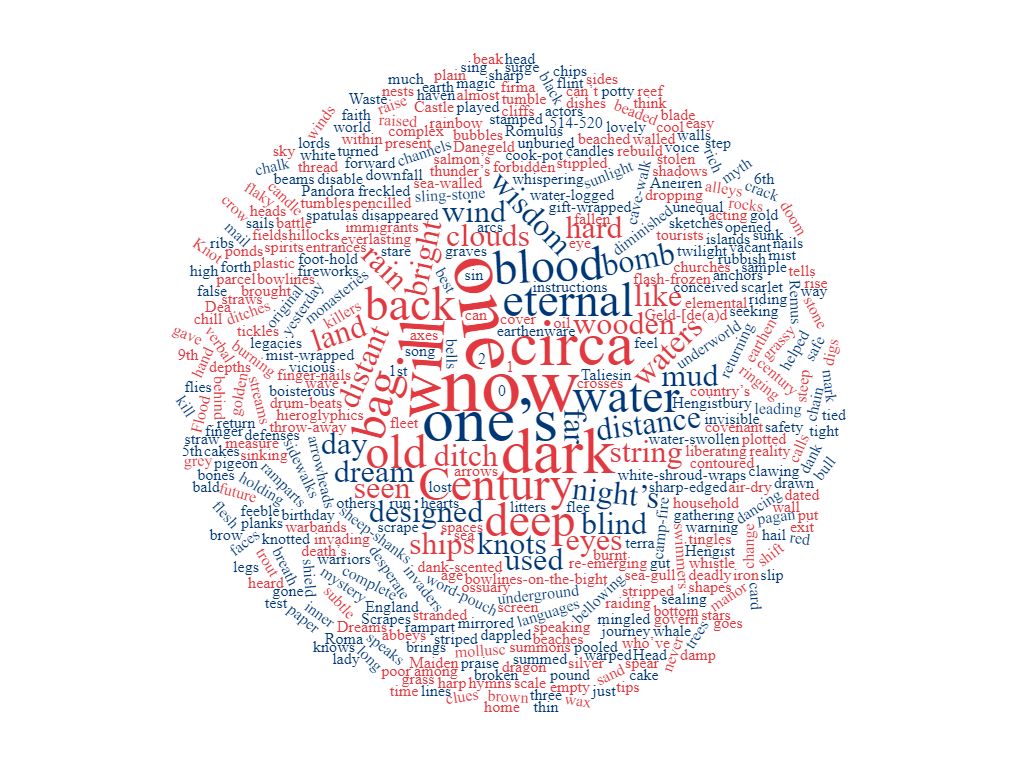
Now tell me: what exactly is a butterfly kiss, or a butterfly’s sting? Answers on a postcard and in word-cloud form. And remember: there’s more to poetry than meets the eye.

Zeitgeist 1-10.jpg