KIRA Creative Quarantine

image1 (53) - Copy

KIRA Creative Quarantine

The Kingsbrae International Residencies for Artists (KIRA) requested its alumni to consider creating a ten minute video of themselves offering an instructional lesson based  on themselves working in their specialist areas. You can click on the above link to see all the creative videos currently available. Note that two more are added each week. Here is a link to my own video on Writing a Poem. It is designed for people of any age and I hope that anyone who sees the video will enjoy it and be inspired to start putting together their own poems.

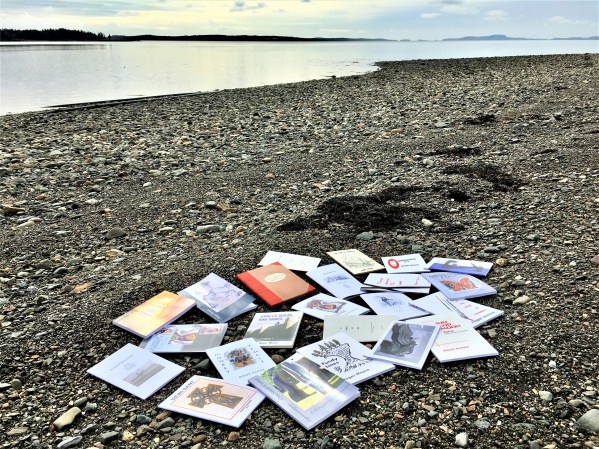
The photo above was taken by Geoff Slater, the Artistic Director at KIRA. He placed a selection of my books on the beach at Holt’s Point and Bingo: instant art from a master artist. My book Fundy Lines now sunbathes on a beach that has ready access to the beautiful Bay of Fundy.

Downsizing

image1 (53) - Copy

Downsizing
Francisco de Quevedo

I chose each book, held it in my hands for
one last time, then placed it peacefully in
its cardboard coffin. Old friends, they were
but I broke that friendship and set them
free to fulfill their promised after-me-life
on another person’s shelves. I used to love
to listen to their lilting speech, to hear sage
thoughts with open eyes and mind. I replied
to their wisdom: words penned on each page.

Mind to mind, though they had lived five
hundred years ago, I strove to engage them
in a lively conversation, Bakhtinian dialogues
within our shared time and space, and
that space my basement library with its books.

One day, a man from the university drove up
in a hearse and bore them all away. Released
to a wider world beyond my walls, they will
nourish younger minds than mine. I hope their
new owners will bless them, welcome them,
cherish them, as I have done throughout my life.
Blind now, with tears, my eyes that devoured
their words. Deaf now, these ears of mine that
heard dead men’s words, for I can listen no more.

Comment: “Escucho con mis ojos a los Muertos / I listen with my eyes to the words of the dead.” Francisco de Quevedo (1580-1645). It was a hard thing to do, that disemboweling of my library, but it had to be done. I am grateful to the Harriet Irving Library at the University of New Brunswick for taking pity on my plight and redeeming my books. Hopefully they will have all gone on to a better life. It was sad to walk past them, to watch them slowly gathering dust, like a book on a shelf, as Elvis used to sing. It was even sadder to know that I would ever be able to peruse them all again, let alone read them from from cover to cover, certainly not in this life time.

And is that my own fate, to be reduced to words on a page, to become a dusty book lying forgotten on a shelf? Pobre poetas de hoy,  wrote my friend and fellow academic poet, José María Valverde, destinados a ser polvo seco de tesis doctoral / Poor poets of today, destined to become the dry dust of doctoral theses. So: my thought for today … rise up and resist. Take an old friend off the shelf. Dust him or her off. Open the pages. Settle down for a moment or two. Breathe deep. Begin your conversation with your long lost friend. We may not be close in the flesh, distanced as we are by lock downs and separation, but we can become closer in our minds. Pick up one of my books. Dust me down. Read me. Begin that conversation. Now. Before we too are gone, swept down stream by time’s river and lost in the mists that curtain the sea.

And, just in case you thought that last line was very good and very unique and original, here’s the conversation it came from: Nuestras vidas son los ríos / que van a dar en la mar, /  que es el morir / our lives are the rivers that will flow down to the sea, which is death (Jorge Manrique, 1440-1479). I had that conversation with Jorge Manrique in Santander in the summer of 1963. His Coplas was on the pre-university reading list at Bristol University, placed there, I believe by Salvador Bacarisse who was related to a long line of Spanish musicians and poets. If memory serves me well, our first essay, in our first week, in our first year of Spanish, entailed writing a commentary on the Coplas and how to read and understand them.

Si jeunesse savait, si vieillesse pouvait / If youth knew how, if old age was able to (Voltaire). I wish I knew then what I know now. And I wish I could do now, some of the things I could do back then. Meanwhile, do not despair: pick up one of my books or browse my blog for a poem, and have a short and hopefully profitable conversation with me as you listen to my failing voice with your younger eyes.

Word without end

IMG_0937 (2)

Word Without End
Antonio Machado

Tree: rowan, mountain ash, larch, tamarack,
hackmatack, spruce, birch, maple, passerines
flying from branch to branch. Birds: more words,

woodpeckers, downy, hairy, pileated, cardinals,
finches, purple, house, golden, rain-rusted robins,
crows, aerial magicians, wondrous in flight.

Spring: fresh branch tips, tiny fox gloves, leaf buds,
folded fiddleheads soon to open their spring magic.
Open: hearts worn on sleeves, open to the world,

wounds, eyes, everything open to beauteous
sun-warmth, snow’s slow disappearance, rising river,
freshet flow freshening this Renaissance,

every day a rebirth, a new beginning,
fresh starts, the world reborn beneath a rising sun,
its yellow disc growing, the new day glowing.

The word as it was in the beginning, head in hands,
heart in mouth, words without meaning, words whirling
golden autumn leaves, words caught in a whirligig,
words all powerful in a word-world without end.

Comment: “La palabra: una palptiación honda del espíritu / The word: a deep palpitation of the spirit.” Antonio Machado (1875-1939). In The Meaning of Meaning, Bertrand Russell discusses what words mean and how they construct, with their endless associative fields, a net of emotions that take us beyond logic into new realms of meaning. As poets and creative artists, we are conscious of the emotions we attach to each word we use. If the poetry is good, then that network of emotional associations reaches out to a wider audience and draws them into our own world view. If we are less skillful, then the emotions are trapped in our own claustrophobic words and fail to reach out, to lift up from the page, to achieve take-off. As we develop as poets and writers, we become more and more aware of the ways in which the microcosm, our own world in miniature, reaches out to the macrocosm, that wider world outside. When we achieve a blend between those two worlds, even if it be in nothing more than a metaphor, nothing more than a felicitous phrase or a delicately timed rhyme, then we reach a new level, a level that we strive to retain and attain anew every time we create.

For me, many of the secrets of poetry can be found hidden in the rhythm of words, the music of their joining, the harmonies they create when they play off each other, old and older meanings reflecting off the newer meanings we give them as we shuffle them anew and put them through their paces.

img_0146-3

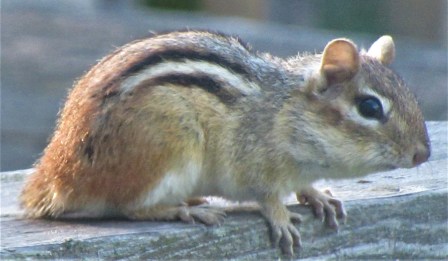
Yesterday, my beloved placed seeds on the back porch, and a chipmunk, her pet chipmunk, came and sat on her foot as he chomped the seeds. Today, this first chipmunk was followed by a second chipmunk. Patience my friends. Keep writing. Keep striving. Keep experimenting. Keep your faith and your creed. Your words will one day reach out, like seeds to chipmunks, and will sow themselves in the mind’s of your readers. And those readers will beget other readers, much as one chipmunk plus one chipmunk will eventually equal many more than two chipmunks. Oh the joy of words, the loving search for le mot juste and the meaning of meaning. In the words of the immortal Cervantes: Paciencia, y barajar / patience, and shuffle your words. The results will creep upon you one morning, unaware and, like the chipmunks, they will catch you by surprise.

Duende

F1000008

Duende
Federico García Lorca

It starts in the soles of your feet, moves up
to your stomach, sends butterflies stamping
through your guts. Heart trapped by chattering teeth,
you stand there, silent, wondering … can I? …
will I? … what if I can’t? … then a voice breaks
the silence, but it’s no longer your voice.

The Duende holds you in its grip as you
hold the room, eyes wide, possessed,
taken over like you by earth’s dark powers
volcanic within you, spewing forth their
lava of living words. The room is alive
with soul magic, with this dark, glorious
spark that devours the audience, heart
by heart. Magic ends. The maelstrom calms.

Abandoned, you stand empty, a hollow shell.
The Duende has left you. God is dead, deep
your soul’s black starless night. Exhausted,
you sink to deepest depths searching for that
one last drop at the bottom of the bottle to save
your soul and permit you a temporary peace.

Comment: “Todo lo que tiene sonidos oscuros tiene duende / All that has dark sounds has duende.” Federico García Lorca (1898-1936). García Lorca, an inspired and inspirational vocal performer, well understood those dark artistic powers that rise from a combination of earth, air, and fire to possess artists as they weave their magic, be it musical or verbal or a combination of both. Those who possess it know that they never really possess it, for it comes and goes with a will of its own and possesses them, body and soul, taking them over. Deus est in nobis /  it is the god within us, wrote the Romans with their understanding of the power of performance. And they are right. Those who possess it are changed by it, no longer know themselves, turn into something other than what they are and becoming something special. “Ah would some power the giftie gie us, to see ourselves as others see us” (Robert Burns). But what happens to us when the wondrous gift is taken away, when drab reality takes over from the glory of the stage, the spotlight, the performance of the play? That indeed is the question. And the answer varies with each of us.  I look with dismay on the comedians who, for one reason or another, when deprived of their audiences, have chosen the darkest of exits. The hollow shells of the performers who have given their all are sad things to behold. The existential emptiness that is left when the powers drain away is difficult to live with. That is why so many, faced with this darkness, akin to St. John of the Cross’ Noche Oscura del Alma / Dark Night of the Soul, chose not to live. That is not a choice that I will ever make. And I encourage all my friends to wait, to wait in patience and hope for the light, the glorious light and fire of the Duende, the Spirit that will return, will pluck us from the depths, and will raise us to the heights again.

Purple


different kinf of doorway

Purple

 I write poems
in green ink,
but I prefer
purple.

Bruised clouds
on an evening sky,
dark depths
of a rainbow glow,
Northern Lights
singing at the deep
end of their scale …

… or just a desire
to be different …
slightly different …

as if that one thing,
the color of my ink,
might tip the scales
and turn me
from mediocrity
to celebrity

with a wave
of a violet wand,
or the click
of a pair
of ink-stained
fingers.

Comment: Juan Ramón Jiménez, Nobel Prize winner and author of Platero y yo, wrote a book entitled Almas de Violeta that was published in purple ink. He also wrote a book, printed in green ink. I used to have copies of them in my library, but alas, I gave my library away, so I cannot check for the title. I often wonder whether the color of the ink makes any difference to the quality of the writing. Same question with the keyboard or the pen. Some things seem to come more easily on keyboard or screen, but really, there is something about the smooth flow of pen and ink across the page that is enchanting just in itself. Now, back to my revisions for I am not just a writer, I am a re-writer. So off I go.

Day 23 CV-19

IMG_1652 (2)

Day 23 CV-19
Codes and Coding

“Languages: they say that to learn another language is to gain another soul and another set of eyes through which to view the world.” I wrote these words just yesterday [Day 22 CV-22]. The words are mine, but the idea belongs elsewhere. I have borrowed it and adopted it. I would willingly attribute it to a specific author, but I do not know who said it first. I offer my apologies to the to me unknown genius who first spoke these words.

Why codes and coding? A rhetorical question, of course. But codes and coding are the basic elements through which language transfers thought, our thoughts. What is a code? Well, we know all about Morse Code and the elaborate codes through which spies from all countries communicate their needs. A code is a way of converting language, changing it, making it available to those initiated in the code and unavailable to those who have not received such initiation. Sounds simple, doesn’t it?

When I was travelling regularly to Spain for research in Spanish libraries, my first port of call was always the local barber shop. I did this for several reasons. In the first place, my Canadian haircut gave me away as a foreigner. This is the hairdresser’s code. The barber’s shop was always the centre of local gossip. Here, buzz words changed hands, politicians were discussed, all the local news was immediately available. Each of these items was a code, a code that made an insider (acceptable) versus an outsider (not to be spoken to). I remember, one summer in Madrid, not getting served in any bar or restaurant. Check haircut: okay. Check shoes: bought new pair. Check shirt, jacket, tie: all up to date. Inspect lucky customers … ah … they are all wearing a shiny brass pin showing the symbol of Madrid: El Oso y el Madroño, the bear and the strawberry tree, as seen in La Puerta del Sol.

The next bar I entered saw me sporting El Oso y el Madroño in my lapel. Qué quiere el señor? Immediate service and with a smile. These are social codes, the codes that include the winks and nudges of the upper class, the secret handshakes and foot positions, the names dropped so gently and quietly that they never shatter when they hit the floor. There are also language codes. Northrop Frye wrote The Great Code: The Bible and Literature, a study of the mythology and structure of the Bible was published in 1982. In this wonderful study, Frye showed how themes and language from the bible have influenced the structure of Western Literature, particularly that written in English. Within this code, names, themes, miracles, parables, psalms form a body of are common knowledge available to all readers who are christian and whose first language is English.

But there are other codes. Think Petracharism. Petrarch’s poetry, originally written in Italian, was widely imitated throughout Europe. Italian literature, Spanish, French, English, all dip into that code, as does Shakespeare among so many others. Think the Great Chain of Being. Shakespeare is incomprehensible in places unless you unlock this particular code. Think Platonism, Neo-Platonism, Stoicism, Existentialism … okay, so all this is academic, and I do not want to lose you in a sea of academia. So think NFL, think NBA, think NHL, think baseball, think cricket, think rugby, think darts, think all of the things we manipulate on a daily basis in our lives and think how they include some people (those who know and share our codes) and exclude others (those who are unaware of them). LBW, c&b,  c. A, b. B, st. A b. B, w, W, b, lb, dec., rsp …

This is a wonderful line of discussion. It follows along the lines of micro-language and macro-language. Macro-language is accessible to all who happen to speak that language. Micro-language in its multidinous forms incarnadine belongs ONLY to those who share the micro community, be it family, household, village, town, county, region … all that is closest and dearest to our micro-hearts.

Self Isolation Day 21

IMG_0638

Self-Isolation Day 21
Bakhtin’s Chronotopos
Man’s dialog with his time and place

Chronos / time + Topos / space = chronotopos: the time and space within which we live.

Chronos: this morning, when I woke up, I moved back into my own time and space. But what is my time? It was 5:45 am when I awoke, so was that my time? I stayed in what the Spanish call the duermivela, that drowsing dream-world in which we all wander, half-conscious. I stayed there until I decided to get up at 7:45 am. Was that my time? Well, yes,  all of that is / was my time. But time extends further than that. Real time is static and only exists in this second as I type the s of second, but look how it has flowed or flown. So my time drifts backwards into a knowable and then an unknowable past. I knew my parents, and my grandparents. But I know nothing of their childhood, their war days (WWI and WWII), their courting, their marriages. Their time is time lost for me. Sure, I can invent it, renew it, recreate it … but it can never be mine. All I can possess is this Second when I preSS the S key, a Second that haS already flowed paSt me, flown and gone. The same with future time. It is there, stretching out before me, for how long, I do not know. It is not yet mine, and when I come to possess it I will only posses it, really possess for those precious Seconds when I inhale, or exhale, or press the S key. And now I have bewitched you, and your concept of time, and your keyboard will never be the same.

Topos / Place: so what is my place? When I awoke this morning, it was the kennel-cave of the bed in which I hibernate each night. Then it morphed into the bathroom where I dressed and prepared for the day. After that, I walked downstairs. Descending the stairs, a step at a time, feeling for the steps with my cane, as I do, I find that each step is my place. Luis de Góngora, one of my favorite Spanish poets, wrote, a long time ago that “Cada pie mal puesto es una caída, / cada caída es un precipicio” /  each footstep, badly placed, is a fall, / each fall is like tumbling down a precipice. Ipso facto, I must take care not to fall each time I place my foot on a stair, and each stair, therefore, is my concentrate of time, and this moment of time manufactures my space.

Then there is my breakfast place, my office place, my work place. Time spent in each of these spaces is a link backwards and forwards, past, present, and future all inexorably bound in each passing second that I live.

But there are other spaces, spaces in which time flows at a different rate in objective time (the thirty minutes you spend in the dentist’s chair) and subjective time (the hours and hours those thirty minutes take to pass as each second limps by, like a three legged tortoise with gout). hen there is creative time: and creative time, especially on the computer, leads us into a different space, a sort of hyper-space, in which we hover between this place (the place of the office and the house) and that place (the place in which we create our visions and dream our dreams). Lost in that creative hyper-space we drift in a timeless amniotic sea where all time is one and all places are one and we are the masters and mistresses of our own creative universe. Y aquí, as my good friend José Hierro once told me, el tiempo no tiene sentido / here time has no meaning.

Jane Tims wrote these words to me today. “The idea that some of our words will live on, on the page… I wonder where our WordPress and Facebook words will reside in 300 years? Will some antiquities student make the headlines having managed to upload the forgotten words of people who wrote about the days of the coronavirus?”

My reply: “These are very true words, Jane. It looks like you have gifted me with the topic of tomorrow’s blog! Thank you.”

Indeed, the online medium is so ephemeral and can be wiped out in seconds. Tweets can be erased, changed, and altered. Written words and written histories have also been erased and wiped out. In our brave new world, the truth changes from day to day with no vital record attached to it. Historians always say that the conquerors write history … and when they do so they usually destroy the writings of the conquered. I think of all those Mexican Codices, destroyed by the Spanish priests on their arrival in Mexico as the works of the Devil. We know so much from the surviving ones, for example the history of Ocho Venado, born in 1063 and sacrificed in 1113 in accordance with the fifty two year annual cycle. Only five Mixtec codices now survive, one, the Vindobonensis, still bears the scorch marks from when it was plucked from the flames that were meant to devour it. Man’s inhumanity to man. How much have we lost? How much are we losing? How much will we retain? And what is truth …?

As for us and our chances of survival, another good friend of mine, the poet and philosopher José María Valverde once wrote of nosotros, los pobres poetas de hoy, destinados a ser polvo seco de tesis doctoral … we poor poets of today, destined to become the dry dust of doctoral theses. In spite of all this, it is our fortune and our duty to exist within our time and our space, to live letter by letter, painfully tapped on the keyboard, and to engage in our dialog with our own time and space, for that my friends is all we have, the single instant of that one letter S.

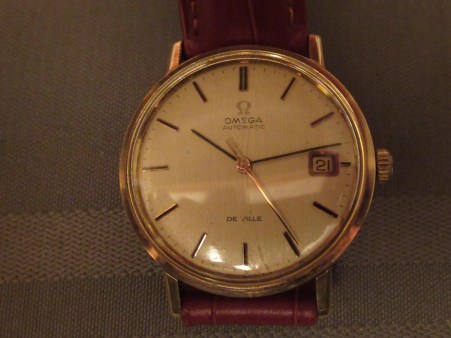
Comment: The watch in the photo belonged to my father. I wind it up and wear it on his birthday every year. It now measures my time, as it once measured his, and its place, at least once a year is on my wrist. Its function is to tell me the time. One day, it will do the same for my daughter, and then my granddaughter and they too will have their dialog with their own time and place.

Self-Isolation Day 20

IMG_1374 (2)

Self-Isolation Day 20
Novels of Action

Yesterday I wrote that “Wolfgang Kayser suggested, a long time ago, that there were three types of novels: novels of action (the easiest to write, if you have that calling).” I hope nobody took the second half of that statement “the easiest to write” too seriously. No novel worth its salt is easy to write and not everybody can write the sort of adventure story, filled with action, that drags the reader on from page to page. Part of the difficult lies in tying the end of one chapter to the beginning of the next and this is most certainly not all that easy to do. In my own case, I tend to bring closure at the end of each chapter, and that really the worst thing I can do. Why continue reading if you already have closure?

Let us look at how a master thriller writer closes his chapters. Prologue: “I will return to my Athens as soon as this mess resolves itself.” What mess? Why Athens? Where is the character now? What is happening? Read on. Chapter One: “As a double precaution, the keyboard and the door know were wiped cleaner than Petrescu’s account” What on earth has happened now? Why wipe clean the keyboard and the door knob? Which account? Why? What will happen next? Read on. Chapter Two: “Behind them, Edward Yorke’s lifeless eyes stared without comprehension at the foreman’s room and the splintered railing above him.” What has happened? Where is it all going to end? Read on. Chapter Three: “He had to move. So deciding, he opened the man’s wallet and found an address not far away?” An address? What address? Who lives there? Why is he going there? What will happen next? Read on. Chapter Four: [Summary] A crack in the wall behind a refuse bin … time for a shower … throw the victim’s pants and shirt out of the window for some bum to find … Who? What? Where? When? Why? Read on. And now for the last words of Chapter Five, the chapter that explains everything. “That hook is baited.” And this is the key … each chapter ends with a neatly baited hook that leads the reader, willy-nilly, into the next chapter. You want to know what happens next, what is on the hook, what the hook is exactly, to do that, you will have to buy the book and read it for yourselves. Look up Chuck Bowie: Three Wrongs. Muse It Up Press.

Alas, I have not yet finished with Chuck. In June, 2017, he drove to St. Andrews to visit me one afternoon while I was at KIRA. We sat by the sea-shore there and chatted about his latest novel, Body on the Underwater Road. He was working out all the details and we struggled here, and wriggled there, as we computed the many possibilities. Such good fun. So, here I am, a poet telling a story about a master story-teller-seller. How silly I am. I’ll offer up a poem instead.

Underwater Road
Chuck Bowie

We met at St. Andrews, at low tide, on
the underwater road. In secret we
shared the closed, coded envelopes of thought,
running fresh ideas through open minds.

Our words, brief vapor trails, gathering for
a moment over Passamaquoddy,
then drifting silently away. Canvas
sails flapped white sea-gull wings across the bay.

All seven seas rose before our eyes, brought
in on a breeze’s wing. The flow of cold
waters over warm sand cocooned us in
a cloak-and-dagger mystery of mist.

We spun our spider-web dreams word by word,
decking them out with the silver dew drops
proximity brings. Characters’ voices,
unattached to real people, floated by.

Verbal ghosts, shape-shifting, emerging from
shadows, revealed new attitudes and twists,
spoke briefly, filled us with visions of book
lives, unforgettable, doomed, swift to fail.

Soft waves ascended rock, sand, mud, washed
away footprints, clues, all the sandcastle
dreams we had constructed that afternoon,
though a few still survive upon the page.

And that, as the lion said, is the end of the gnus.

Comment: Three Wrongs is part of the Donovan: Thief for Hire series. Adventure series follow similar patterns: the problem, the solver (shining hero), the complication (dark arts adversary), further complications, resolution: problem solved. The Arthurian Romances set the pattern for linked adventure series back in the 12th and 13th Centuries. They were followed by the literary knights of the novels of chivalry. Perhaps the most famous of these, Amadis de Gaula / Amadis of Gaul, was imitated and parodied by Cervantes in Don Quixote. The numerous books of Amadis were followed by Son of Amadis, Nephew of Amadis, Cousin of Amadis. Perhaps nothing breeds success better than success. Think of the Sharpe series from the Peninsula War or the Hornblower books, or, more recently, Master and Captain and the recent Royal Navy series from similar times. Look out for Son of Donovan … a series coming to your bookstore soon.

Le Pont Mirabeau

Le Pont Mirabeau

Beneath Mirabeau Bridge flows the Seine
and so does our love
must I be reminded yet again
that happiness always follows pain

Let night descend let the hours sound
the days go by … I’m still around

Hand in hand let us stay here face to face
while beneath the bridge of our arms
like flowing waves our gazes interlace

Let night descend let the hours sound
the days go by … I’m still around

Love flows away like waves that flow
love flows away
hope fills us with dismay
and life passes slow

Let night descend let the hours sound
the days go by … I’m still around

Days and weeks flow by bye bye
along with former loves
and past times that did fly fly fly
they will never come back again
Beneath Mirabeau Bridge flows the Seine

Let night descend let the hours sound
the days go by … I’m still around

Comment: I spent the school year in Paris in 1962-1963 and I have always wanted to translate Le Pont Mirabeau from French into English. Today, I found both the time and energy to do so. It’s not a great translation, but it is mine. It also contains new revisions from an earlier post but note that the links in the earlier post no longer function. Click on the link above to get the French original.

Creating vs Revising

IMG_1095 (2)

Creating vs Revising

The introductory picture (above) shows revisions made to my painting by my three year old grandchild!

1. As I read my early morning messages, I realize that there are two very different processes involved in creative writing: creation and revision.

In terms of creation, I follow Graham Green and Steven King: write 500 words a day, regularly, about two pages. Then, next day, re-read them and revise them. Then continue with the next two pages. This allows a steady accumulation that is usually somewhat under the writer’s control. It also allows the writer to go back and revise while creating: an important step for both King and Green.

In terms of revision, once the book or story or manuscript is complete, different processes emerge. One is to leave some time for the manuscript to settle: this also works chapter by chapter during the writing process. The other is to start again and apply the revision process as outlined in the First Five Pages.

Each one of us will be on a different stage of what is, I hope, an enjoyable creative experience. Part of the fun is also finding out what works for us; and by us, I mean each one of us. And yes, we all need those words of encouragement … so hang in there… have confidence … and be creative …

As for revision, I started by reading The First Five pages and found that this made the revision of my own manuscript much easier. The First 5 Pages deals with items one by one and in order of priority; it also allows you, as a writer / reader / adviser to have a clear idea of where you are going with the revisions, what you are doing, and why you are doing it. I also perused other online links and found them quite useful, especially those that referred to the revision process. I recommend searching for such links, in particular, the one that tells us never to give up.

Burroway for me is an adventure. I find that when I am reading the theory, I have a tendency to get confused and lost. In addition, I do not always agree with her analyses of the chosen snippets of text. I understand what she is saying, but I do not always agree with what she has said.

Selected stories themselves are something different. Reading them allows me to gain a perspective on what I am doing and how I am doing it. Thus I can say: I can do that; or I’ve done that; or I wouldn’t want to do that. The stories then come over as a reflecting mirror in which I can see aspects of my own writing, however beautified or distorted. The theory, on its own, leaves me cold and often confused. Other people’s creativity is inspiring.

The secret, in my opinion, is to relax, to be yourself, and to continue writing as you want to write while paying attention to the small details of which I am becoming more and more aware of every day. We are all creative — or we wouldn’t be here, reading this, doing this course. The secret is to develop and polish our own creativity. We must also learn to develop our own voices and to have confidence in those creative sparks that dwell within us.

2. Writing the introduction last is a standard procedure in academia. This is partly because it isn’t until the end of the research / study that the writer really understands the substance and the intent of what s/he has been studying. Also, it is only when the work is finalized that the appropriate conclusions can be drawn and the route that one has taken can be established.

As for the order in which revisions are made, there are many rules and circumstances can change. Even when there doesn’t appear to be a plot, as such, there is a chronology and chronology can be used as a substitute for plot. There is probably some form of evolution throughout the chronology, and that should be kept in mind, too. In addition, I would assume that as the learning process “bites” so we will be better able to make our own judgement calls. The art of good teaching is to eliminate the need for a teacher.

3. Changing the perspective: letters work: they can be found, sent, received, or discovered. The identity of the writer / receiver is also interesting.

In the 13th Story, the novel which I am currently reading, the principal narrator investigates / researches her subject in local libraries, the Who’s Who, a graveyard (reading the tombstones), and many different places. She also visits the local newspaper archives and interviews other characters in the novel, much as a newspaper reporter might.

Just read, think, learn, absorb, and, above all, remember to reject that which doesn’t suit you!