
Rage, Rage
56
The irregular
heart-beat of my life
walks beside me
down new corridors.
It haunts, taunts,
and pulls the strings
of my heart,
moving me
to a place and time,
too distant to be real.
My mind
lies devastated.
My future is
a foretold mess.
Rage, Rage
56
The irregular
heart-beat of my life
walks beside me
down new corridors.
It haunts, taunts,
and pulls the strings
of my heart,
moving me
to a place and time,
too distant to be real.
My mind
lies devastated.
My future is
a foretold mess.

Rage, Rage
32
I miss
the swish and roar
of my incoming,
outgoing breath.
I miss
those Full Moon fingers
tinkling the tides
of my inner being,
making me strive
to keep myself alive.
My body’s house,
devoid of gnomes,
wolves, and pipes,
lies vacant and silent.
The full moon’s
rampant skull
empties the sky of stars
and fills my mind
with cratered shadows.
33
Strange creatures hide in the mist
that overcomes my brain.
I see the sudden flash
of sharp, lusting midnight teeth,
My heart turns into
a time bomb ticking
its irregular beat
in the cavity of my chest.
Am I a victim, then,
as Camus suggests,
or just another assassin?
A suicide bomber, perhaps,
with explosives strapped
inside my rib-cage
rather than round my chest
in a hidden vest?
Tick-a-tock
and tickety-tick-tock,
I can hear and feel
the arrhythmic clock
alarming me
as it arms itself in my chest.”Tick-a-tock
and tickety-tick-tock,
I can hear and feel
the arrhythmic clock
alarming me
as it arms itself in my chest.”
Comment:
So, Moo has just come back from wherever he’s been and wherever it was, he’s not telling me. However, he does say that I look All Shook Up. And he’s humming Elvis Presley songs at me. And the above painting is his suggestion for me for today. “Thank you, Moo. And welcome back.” He nods at me. “Good to see you two,” he says. “You spelt that wrong,” I tell him. “I didn’t,” he says. “We all know you’re a split personality and I am saying that I am pleased to see both halves of you again.” Oh, dear, you can never win with Moo. He always paints a different angle or comes round in a wiggling circle. “Ha!” he says. “At least I don’t paint myself into corners.”
Am I a victim, then, as Camus suggests, or just another assassin? Interesting suggestion. We are either murderers or victims. But I haven’t murdered anyone, that I am aware of. And I don’t feel myself to be a victim. So what is my dear friend Albert on about? Alas, he isn’t around to ask. I just have to read his books and see myself left wondering.
I guess it was all different in Paris, in the 1940, during the Nazi occupation. Anyone can talk a good game, but what do you do when the Gestapo knock on your door at 2:00 am? Good question. Existence precedes essence. We live. We survive. That’s Jean-Paul Sartre. And so is this – “L’homme n’est rien d’autre que ce qu’il fait.” Man is no more than what he does. So there you have it. It’s never what you say you might do, or how you relate things in respect – it’s all about what you are doing right now. So – ask yourself that vital question – “What am I actually doing?” The answer you give will tell you a lot of things about yourself – if you are honest in what you say.
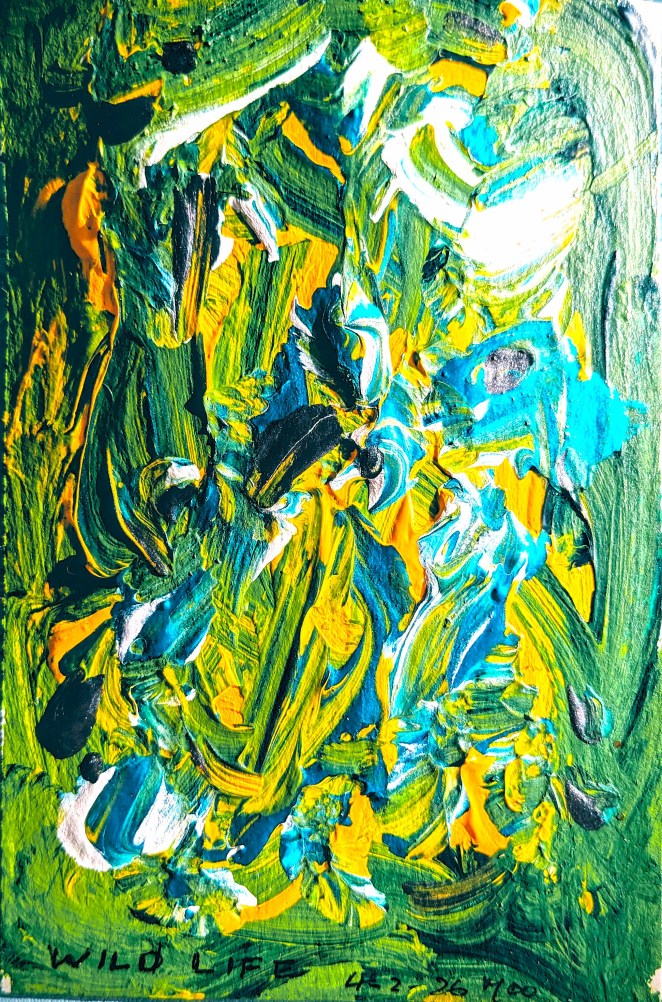
Wild Life
I see green grass
Small ponds
Winding roads
Patches of sorrow
Turquoise blues
Hills to climb
Softness
Strength
Flowers blooming
A small animal
Covered in feathers
An eye
Keeping watch
Purity of white
Ekphrastic Poem
©
Yolande Essiembre
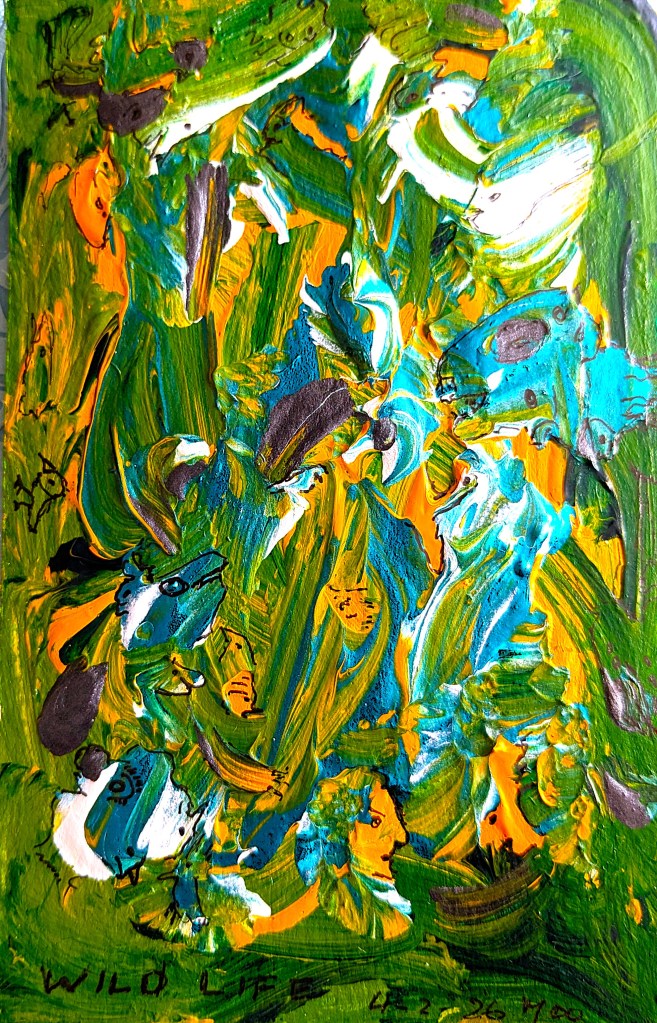
Comment:
My good friend Yolande Essiembre sent me her Ekphrastic poem after viewing this morning’s painting by Moo. Wild Life II is a better representation of the colours of the original. However, Moo added in some (what he calls!) helpful touches – the black shapes that reinforce the suggestions of the original. Yolande wrote her poem based on Version I – but with the stronger colors of version II. Magic – oh what a tangled web we weave when first we practice to deceive. And all artists weave their webs of deceit. As Cervantes says – Tanto la mentira es mejor, cuanto más parece verdadera. / The closer it approaches the truth, the better the lie.
Imitatio – imitation – one of the bedrocks of classical rhetoric. “Imitation is the best form of flattery”. Flattery, yes, but what we find, in art above all, is that there exists only one original. However good the copy, the flattery – the imitation, if you prefer – it is never as good as the original. The original of this painting exists in one time and one place. The two deceptions are not the original. In fact, Wild Life I no longer exists because Moo has repainted it. It has turned into Wild Life II.
So many questions – which version do you prefer – I or II? De gustibus non est disputandum. There is no arguing about taste. Which is the better version? Well, each viewer must choose. But remember, each version is a deception, and each deception is a lie. And there is only one original. Oh what a tangled web we weave.
But we can, I hope, agree on one thing – Yolande’s verbal version (which I publish here with her permission) is verbally picture perfect. It is how she sees the painting. It is what the painting means to her.
Thank you so much Yolande. Moo and I hope to publish your words and visions more often. With your permission. we will do so.
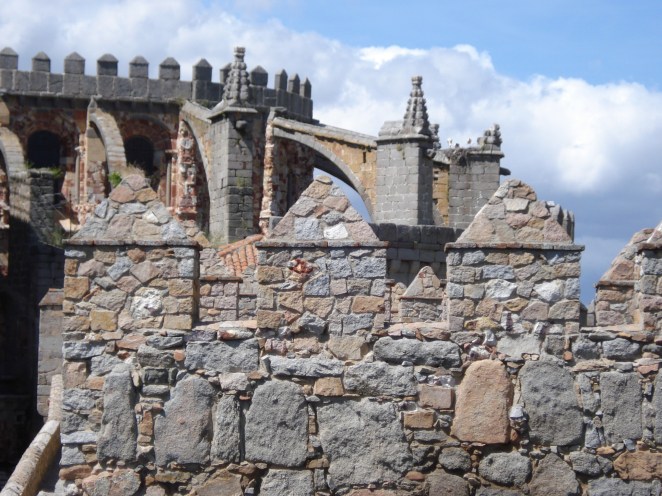
Carved in Stone
70
Where can I survive
in this harsh world
where poetry and ideas
struggle to be free,
a world in which
the great literary myths
have been destroyed?
Where mass media rules,
sensationalizes, lies,
falsifies the power and glory
of words, now used
not to delight and educate,
but to manipulate.
A treacherous world
in which an evil genius rules
and constantly misleads us.
71
An Age, not of Enlightenment,
but of Endarkenment,
this is not the world
in which I want to live.
My chosen world
is that quiet corner,
outside El Rincón
in the Plaza Zurraquín,
by the Mercado Chico,
in Ávila, Spain,
where leaves and confetti
dance to the wind’s tune.
A world of mystery and dream,
personal perhaps,
but well known to
all of those dreamers
who have the eyes to see
and the heart to stand still
and listen.
Commentary:
“There is no earth, no heaven, no extended body, no magnitude, no place and that nonetheless I perceive these things and they seem good to me. And this is the most harrowing possibility of all, that our world is commanded by a deity who deceives humanity and we cannot avoid being misled for there may be systematic deception and then all is lost. And even the most reliable information is dubious, for we may be faced with an evil genius who is deceiving us and then there can be no reassurance in the foundations of our knowledge.” René Descartes (1596-1650).
Cervantes wrote about such times in Don Quixote. Do we see what others see? What is truth and what is fiction? How do we approach and understand authority? What do we believe and why do we believe? Are they windmills or giants, wineskins or warriors, a flock of sheep or an invading army? “Only believe, and thou shalt see” – but what do we believe and why do we believe. “The fault, dear Brutus, lies in ourselves, not in the stars, that we are underlings,” Shakespeare, from one of his many plays.
Carved in Stone
67
At night, on the cool
sea-shore of my dreams,
the calls of shore-birds
at Ste. Luce-sur-Mer
are borne on the wind.
High-pitched, they are,
like the voices of children,
or of men and women,
in distress.
I walk on the sand
at low tide and a lone gull
flies past my head,
battering itself
against the wind’s cage
with outraged, sturdy wings.
68
Sunset.
Sea mists descend.
The church on the headland
steps in and out of darkness.
Shadows gather, persistent.
Gulls surround a lone heron.
It clacks its beak in anger
forcing the gulls to scatter.
These words are not my words.
They came to me in the speech
of birds hidden in the foliage,
or carried on a feathered plume
sprung from the osprey’s wing.
Some came from the click
of the crab’s claw as he dug
deeper into the sand
a refuge where he thought
he could live safely.
Commentary:
Sunset. Sea mists descend. The church on the headland steps in and out of darkness. And so do I. I seek clarity, but there is no clarity when the sea mist descends, just the blurred image and the clouded thought. The cloud of unknowing, one philosopher called it, many years ago, and it is still with us. Especially when the sunlight fades and we are left wandering in the mists of unknowing.
“Is it here, you ask, or over here?” Well, if you do not know, I cannot tell you. But I will ask you this, and think very carefully before you answer – does the answer come from outside of you, given by another, or does it come from the deep, sacred intimacy of your own soul? The answer to that question will tell you all you need to know, one way, or the other.
These words are not my words. They came to me in the speech of birds hidden in the foliage, or carried on a feathered plume sprung from the osprey’s wing. Some came from the click of the crab’s claw as he dug deeper into the sand a refuge where he thought he could live safely. Sunset. Sea mists descend. The church on the headland steps in and out of darkness.
Carved in Stone
64
I cannot bring you
the sounds and smells
of my own backyard,
let alone those of Oaxaca.
The pungent odour
of the first drops of rain,
falling from a blue sky
into dry dust.
The tang of bees’ wax candles,
burning in the cathedral’s darkness
where la Virgen de la Soledad
clad in black velvet sequined with stars
stands on guard in her small side chapel
Nor can I bring you the high notes
sung at the golden altar
in Santo Domingo
by the old woman, dressed in black,
who sings here every day.
The central market
is a bustle of bursting scents,
rooftop goats snicker above me,
my neighbor’s German Shepherd
patrols the roof-garden
and growls in my ear.
Commentary:
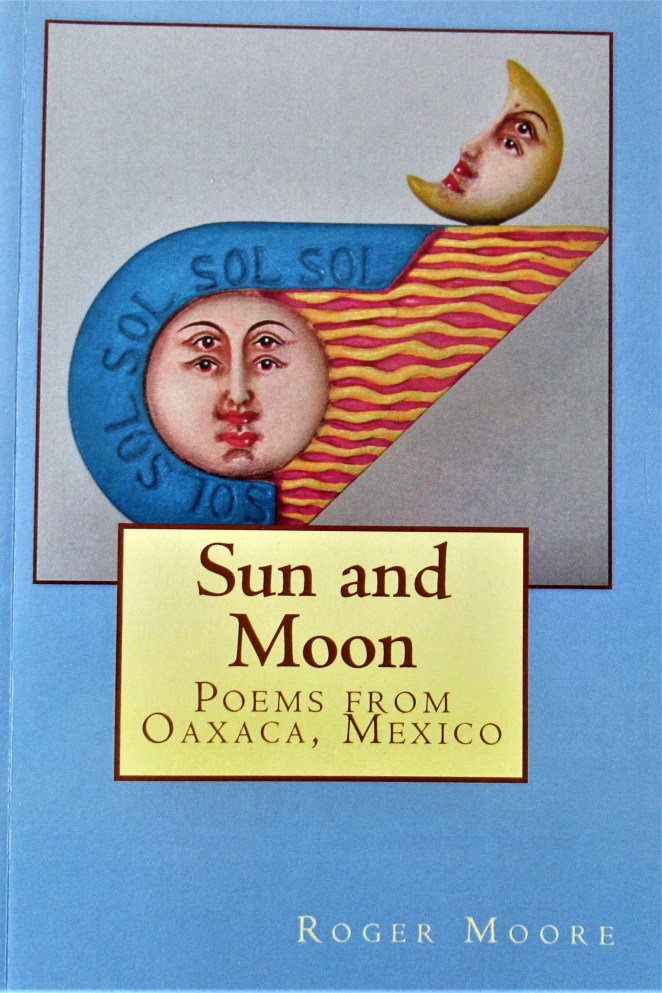
Sun and Moon is the first book in the Oaxacan Trilogy – Sun and Moon, At the Edge of Obsidian, Obsidian 22. I travelled to Oaxaca for 6-8 weeks each year between 1995 and 2001. I taught there and also researched the language, the culture, and the Mixtec Codices. Quite simply, my Oaxacan experiences changed my artistic, linguistic, educational, and cultural life. How? I earned to distinguish between what I could, and couldn’t do. A simple lesson, but one that needs to be understood at the deepest level of understanding.
The lessons took in all of my five senses – touch – dry dust, carved wood and stone, the tares in woven blankets -, taste – mole, flor de calabaza -, sight – the castillo burning -, sound – animals, goats and sheep, herded to the market-, smell – the central market is a bustle of bursting scents – hearing – rooftop goats snicker above me. A select few that blended with music of guelaguetza and the dancing that accompanied the village bands. But the experience(s) went beyond that. I began to realize, deep down, who I was, what I was, and, perhaps more importantly, what I wasn’t, what I could never be a part of, what separated myself from the other, the other whom I loved, who loved me, but who could never be a part of me.

Carved in Stone
44
The old man, withered,
last house on the left,
leaning on his garden wall,
coughing, spitting up
coal dust and blood.
He’s not old, when you get close,
just grown old, underground,
where emphysema
and pneumoconiosis
devour men and boys.
He spits on the side walk.
Mining souvenirs,
Max Boyce calls them,
and they appear
every time the young man,
turned suddenly old,
starts to cough.
He can’t walk far,
wearing carpet slippers,
soft and furry,
just leans on the wall.
He fell, or was pushed,
into the trap at an early age,
when the coal seams
had grown so thin,
that only a small boy
could kneel before
the coal black altar
of the underground god
and, with a pick and shovel,
he learned to carve and shape
the long, slow death
contained in those seams.
Commentary
Moo’s painting, Coal Face, adorns the front cover of Carved in Stone, Chronotopos II. Coal Face is not the denigration of Black Face, white men pretending to be black by dyeing their faces, although they have some similarities. In Welsh Mining, the coal face is where the men used to dig when, with their shovel and their pick and their little lamp and wick, they knelt to dig out the coal. Knelt, because there was no standing room, deep down underground. Then, when the seams grew thinner, and the men could no longer reach them, the young boys were sent underground.
A day underground left men and boys with coal dust seamed into their bodies, especially their hands and their faces. Hence the triple meaning of black face – where the coal is dug, what men and boys looked like after a day’s work, and the blackening of their faces by white men, for the fun of it.
Faces are one thing, coal dust in the lungs is another. The result – emphysema and pneumoconiosis devour men and boys. Black lung, some call it. “And every time he coughs, he gets a mining souvenir” – a black spot coughed up on the sidewalk – Max Boyce.
Child labor, minimum wage, living wage, work that kills, slowly and silently, – what can I say? Forgive me, for I can say no more.

Carved in Stone
30
A well of beauty dwells within me,
not skin deep, but buried, arcane.
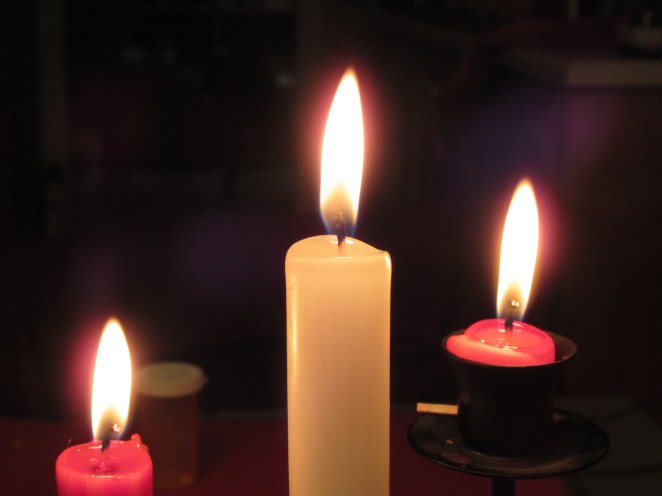
A flickering candle
tethered to an altar,
shimmers at midnight,
when the Latin mass is said,
bringing me light.
In the dark, canonical hours,
shadows move beside me
as I walk long corridors
from dormitory to a chapel
filled with heady incense.
31
I kneel, dumb-founded,
as candle flames wax and wane,
their brightness enhanced
by the midnight magic
that turns doubters into believers.
Spell and symbol, each candle a star,
shining, twinkling, in a galaxy of light,
and everywhere, the incense,
overloading my brain, releasing me
to revelations way beyond
muttered responses, mumbled words.
A world of inner darkness,
yet heart and soul soar together
up to the altar’s immortal light.
My shadow flickering
on the corridor walls,
as candle in hand, half-asleep,
I return to my cold bed
where the long, chill snake
of the bamboo cane
reminds me of tomorrow’s
flagellation.
Commentary:
Shadows on the wall or candles – with which should we start? Verbal and visual – how do they blend and knit together? Does my visual take away from your visual, or does it enhance it? To what extant does my verbal and the commentary on my verbal change the nature of your original thoughts when you re-create, within your own mind, my images, both verbal and visual?
Verbal and visual – now add the sense of smell. “The incense, overloading my brain, releasing me to revelations way beyond muttered responses, mumbled words.” And now remember that I was only six or seven years old when I experienced these things. Add the Latin mass, only half understood, the cold, damp feel of walls and wood beneath the hands. A world of inner darkness, yet heart and soul soaring together up towards the altar’s immortal light.”
My words are black print on white paper. My memories flare – an aurora borealis of senses sent crackling down the spine, in and out of the mind, tumbling the brain into a world … what sort of world? An unimaginable world. One never forgotten. One never re-recreated. One that never existed. One that never could exist. One for which the young child, six or seven years old, yearns for the rest of his life. His unsatisfied life. His unsatisfying life. His meaningless life. His absurd life.
Oh pity the poor puppy, not knowing what he has done wrong, not knowing how to put things right, always inadequate, whining and cringing at his master’s feet. And always, “that cold bed where the long, chill snake of the bamboo cane reminds me of the next day’s flagellation.”

Carved in Stone
25
I speak to a generation I will never see,
as others, in the past, have spoken to me.
They spoke through their prison bars
in manuscripts and books,
or told me, in hieroglyphics,
of ages disappeared,
their secrets lost, and gone.
Who now will listen, with their eyes,
as I listened with mine, for my world
is not their world,
nor can their world be mine.
And yet the same moon,
finger-nail thin, or gibbous,
waxes to full, then wanes,
in search of its rebirth.
26
What are words?
Is it the language that speaks,
not the author, as Barthes tells us?
Or do I write these words,
and who am I,
who sits mouse in hand,
fingers on keyboard,
tapping these words?
Do I not speak to the readers?
Yet how could I speak to them,
for the printed word
cannot ring out from the page.
And what are my words,
but soap bubbles,
blown by an old man
in his second childhood,
through an iron ring?
Or are they soft letters
of snaking snow,
lisping their whispered words
along the inner highways
of the listening mind?
Meaning – the readers
must recreate it,
illusions, delusions, and all,
in their own creative minds.
Commentary:
Meaning – each reader must recreate it. We come from so many cultures, so many languages, so many backgrounds. And yet I write in one language, one of the several I speak. I know only too well how words shift, shuffle, change their meanings. I know how innuendo, culture, religion even, changes the meaning of words. So who am I to say – this, and this only, is the correct meaning of the words carved in stone. Even the words and the symbols carved in stone are open to interpretation.
“Patience,” said Miguel de Cervantes, “and shuffle the cards.” Of course, wrth gwrs, he wrote those words in Spanish, and he placed them in the mouth of one of his characters. And now I am repeating them and placing them in your minds. For you, each one of you, must shuffle the words, shuffle their meanings, adapt them to your own minds and cultures, and come up with the meanings, the multiple meanings, that you can attach to my words.
“And what are my words, but soap bubbles, blown by an old man in his second childhood,
through an iron ring?” Answer that question and perhaps you can solve the riddle of the universe. But to whose satisfaction? Words carved in stone – but what is the stone, who quarries the stone, who carves the words in the stone, and who descends from the mountain with what words carved in stone?
Meaning – each reader must recreate it, illusions, delusions, and all, in his or her creative minds.

14
The sun throws shadows
across the cathedral’s face.
Crosses, arrows, stars,
masonic symbols
hammer-and-chiseled
into the granite sea-cliff
of the entrance way,
reveal the signatures
of the master masons
who laboured here.
And not just here,
for they traveled everywhere,
adding their stone signatures
to those of the other workmen
who left a piece of themselves,
carved in stone.
15
In the cathedral
of Santiago de Compostela,
Maese Pedro sculpted
a statue of himself,
a figurine, small,
low down, facing the main altar.
Students rub noses with him
before their exams,
when they look for luck
having forsaken their studies.
Illiterate people
consult these carvings
in the same way the educated
seek knowledge in their books.
16
The Bulls of Guisando,
pre-historic, unweighable,
the bearers of Roman graffiti,
itself two thousand years old.
Commentary:
… workmen who left a piece of themselves, carved in stone … I couldn’t find my masonic markings from the cathedral in Avila, so I added the words carved into one of the Bulls of Guisando instead. Amazing how people want to make a little bit of themselves eternal – in the sense that we extend our names, our graffiti, our messages beyond our lifetime and, stones thrown into a pond, who knows how long the ripples from those tiny word-waves will endure?
So, what’s it all about, Alfie? And which Alfie are we referring to, the one who burnt the cakes or the (in)-famous gorilla in Bristol Zoo, who went missing? And how many Alfies are there out there? And why buy an Alfie-Romeo when you can buy a neat tombstone for a much smaller sum of money and have it remind people of you long after you have gone?
Silly questions, really, but this is what poetry is for, to open up the curious mind and to dig warrens for bunny rabbits so that the hunters of curiosities can dig their ways down and find whatever they shall find. But do we ever find what we are looking for when we first start out? Good question. Carve your answers into a piece of rock and leave it by the roadside to see what happens to it. Or else, you can write a message, stick it in a bottle, and send it out to sea to float on the waves. Put my name on it, along with yours, and maybe, one day, it will arrive at my doorstep in Island View and, if I am still here, I will reply to you by the same method.
 rogermoorepoet