Rag Doll

A rag doll with button eyes and a patched outfit sitting against a wooden post near pink rose bushes in a garden at dusk.
A well-loved rag doll leans against a wooden post surrounded by blooming roses at twilight.

Big Brother read my mind
and painted the picture

Rag Doll

Jack Pine Sonnet

They fought over her
whenever they met
each one holding her
by a leg or an arm

An eternal tug of war
a terrestrial dog fight
with no truce called
and neither giving in

One day they went
a step too far and tore
the doll in two neither happy
with an arm and a leg each

as for the rag doll
torn apart in fury
she was discarded
thrown in the garbage

when nobody was looking
one child returned
rescued the rag doll
sewed her back together
and filled her with love

Comment:

Tragic, really, and really tragic. A reversed Judgement of Solomon in so many ways. An Allegory applicable to so many situations in this tiny, overcrowded world of ours. Every night, on the television, we can watch hour after hour of shows like this – minus the last stanza. Some endings can never be happy.

One night, for the fun of it, I counted all the deaths, shooting and murders on selected shows over a three or four hour period. I saw over 150 violent deaths. What sort of legacy are we leaving our children, our grandchildren. And what will their children learn in their turn? Food for thought to be taken three times a day while avoiding exposure to reality – or is this the alternative reality to which we will all be exposed?

Rain

Rain

Rain walks thick lines
down the window pane.
The waters below the dam
churn like white shirts
tumbled up and down
in nature’s laundromat.

The radio calls for rain,
more rain, four inches,
they say,
in the next two days.

The moose have already
migrated to higher,
drier ground.
They stand on the highway,
head to head with cars,
stubborn and steaming
in the never-ending rain.

Comment:

It’s raining, it’s pouring, the old man is snoring.
He bumped his head on the top of the bed
and won’t get up until morning.

Mindfulness

Mindfulness

Poems arrive, as silent as the deer
that troop through my garden.

Some times they hurry past,
and catch them if you can.

Sometimes, they stay, wait, nibble
 at an overhanging branch.

Just when you think you can
reach out and grasp them,
they sense the bark of a dog,
the sigh of the wind
through leafless trees.

You blink, and they have gone.

Was your camera ready?
Was your note book open,
your pen in your hand?

Or did they flit away like dreams
 in the morning when the sun
comes into the bedroom
and sparks diamond fires
from the lashes that stand guard?

Nights

Nights

There are nights
when the trees
seem to whisper
your name,

cautioning you
against the wind’s
knife edge.

“What have I done,”
you ask,
“to merit this?”

The soft fall
of burnt brown leaves
weeps over
your woodland grave.

You will walk
these woods
no more, save
on a frosty night

when deer shiver
beneath naked trees
and the moonbeam’s
icy blade.

Comment:

Poems arrive, as silent as the deer that troop through my garden. Some times they hurry past, and catch them if you can. Sometimes, they stay, wait, nibble at an overhanging branch. Just when you think you can reach out and grasp them, they sense the bark of a dog, the sigh of the wind through leafless trees. You blink, and they have gone.

Was your camera ready? Was your note book open, your pen in your hand? Or did they flit away like dreams in the morning when the sun comes into the bedroom and sparks diamond fires from the lashes that guard your eyes?

House of Dreams

House of Dreams
(1 & 2)

1

The clematis unfolds
bruised purple on the porch.

Jazz piano:
beneath the black
and white hammers
of ivory keys,
old wounds crack open.

A flight of feathered notes:
this dead heart
sacrificed on the lawn.

I wash fresh stains
from my fingers
with the garden hose.

2

The evening stretches out
a shadow hand.

I feel my heart
squeezed like an orange
by long, dark fingers.

Somewhere,
the whitethroat
trills its guillotine
of vertical notes.

I flap my hands in the air.

They float there,
white butterflies,
amputated
in sunlight’s
net.

Comment:

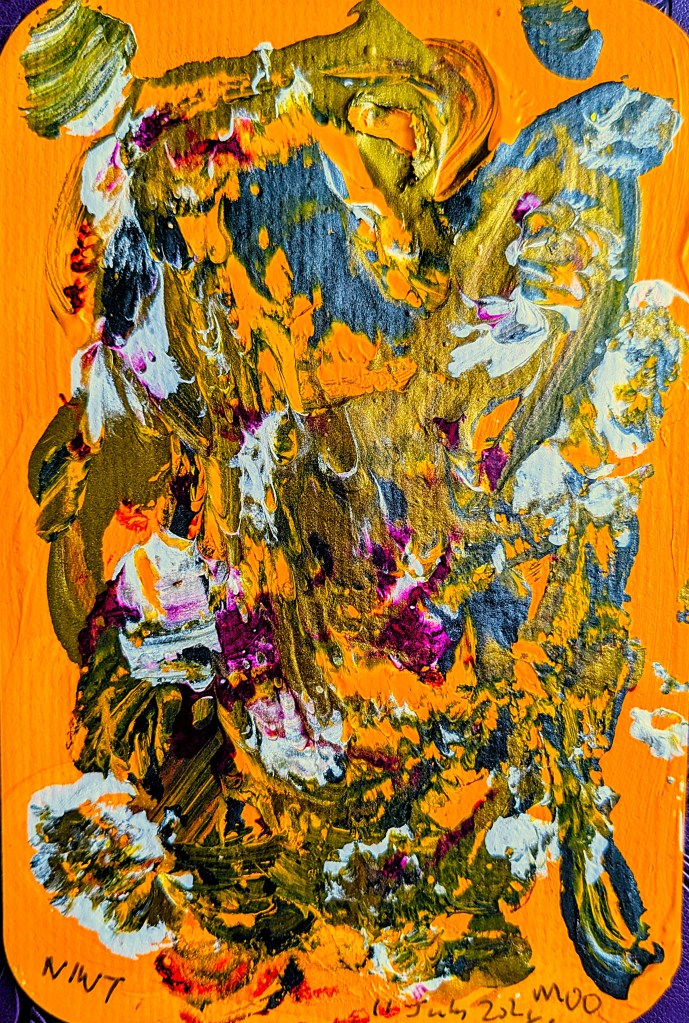
So, rogermoorepoet.com returns to poetry. Happy days are here again! And Moo is happy too. I need hardly tell you he has been so upset since I started using AI to generate my images for me. Oh dear. He has been very Moo-dy (sic) recently. “But you don’t have a drawing of a clematis,” I told him. “Neither do you,” he replied. “That’s a holly hock.” “At least it’s the right color.” “How about if I find you a purple painting?” He smiled a shy, half smile. “Sure,” I said. “I don’t want to lose the human touch completely.” “I should hope not.”

So he present ed me with this painting. “It’s called u-r-my-sunshine,” his smile lit up the room and we were both happy. Joy to the world – it’s +5C here today and the sun is shining. In my heart. And in Moo’s eyes. We are all glad that joy has not forsaken us!

Rage, Rage 59

Rage, Rage
59

You cannot hide
when the black angel comes
and knocks on your door.

“Wait a minute,” you say,
“While I change my clothes
and comb my hair.”

But he is there before you,
in the clothes closet,
pulling your arm.
You move to the bathroom
to brush your teeth.

Now,” says the angel.

Your eyes mist over.
You know you are there,
but you can no longer see
your reflection in the mirror.

Comment:

The last poem in the series and Rage, Rage against the dying of the light is over and done. Many of you will recognize the title from Dylan Thomas’s poem Do not go gentle into that dark night. I guess the theme itself has become part of the Welsh culture. And now we have exported it to New Brunswick, Canada, and perhaps beyond.

I bought The Black Angel, pictured above, in Avila, Spain. It is a plaster cast of one of the Angels in Roger Van der Leyden’s paintings, if I remember correctly. Here is the angel’s face in close up.

She or he brings a promise of rest and peace, a freedom from earthbound woes and sorrows. She stands on the shelf above the fireplace insert in our sitting room and brings blessings to the house. I look at her every time I light the fire. And she smiles down and blesses me. I think of her as a lady, but her peace and beauty outweigh any formal signs of sex.

As for that reflection in the mirror, well, I don’t have one of me. But her is a photo to reflect upon:

Raining in Avila and puddles in the street. Now you see me, now you don’t. But I am there, holding the camera, and looking down at the water where —- rain has stopped play. The bails have been removed. Old Father Time has gone back to the Pavilion at Lord’s, and the cricket game is over for the day.

Rage, Rage 58

Rage, Rage
58

“What is this sound?”
It is your own death sighing,
groaning, growing
while you wait for it
to devour you.

“What is this feeling”
It is the itch of your own skin
wrinkling and shrinking,
preparing to wrap you
in the last clothes you’ll wear.

“What is this taste?”
It is the taste of your life,
bottled like summer wine
once sweet tasting,
now turning to vinegar.

“What is this smell?”
It is waste and decay,
the loss of all you knew
and of all that knew you.

“That carriage outside?”
It is the dark hearse
come to carry you
to your everlasting home.

Comment:

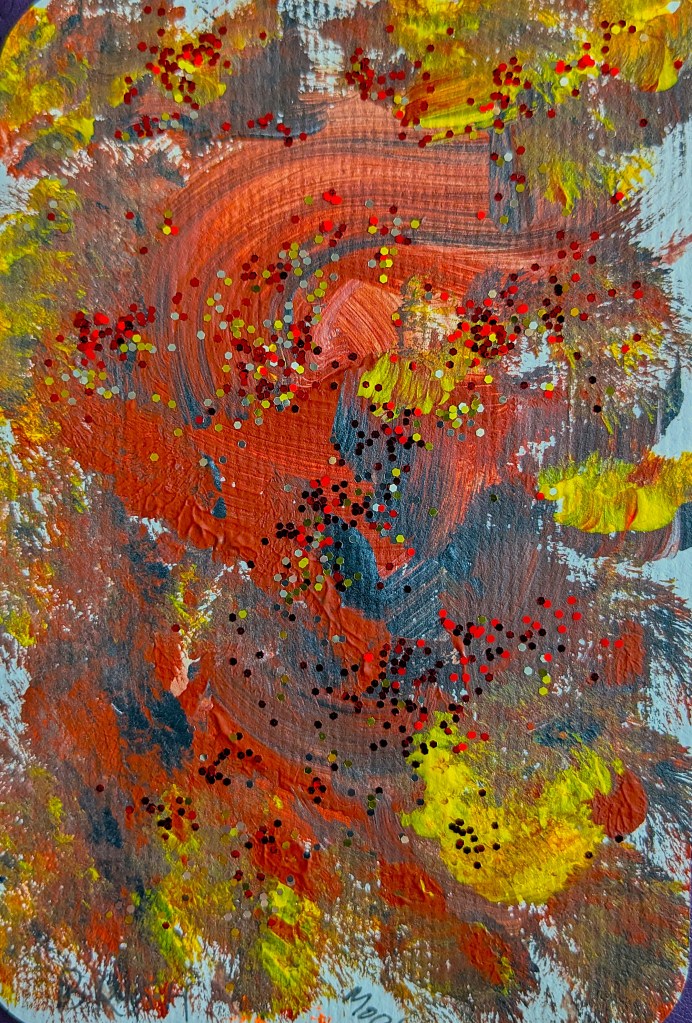
Moo thinks that his portrait of me is perfectly good for this poem. He told me not to rage, rage against the accuracy of the portrait, but he did tell me to rage, rage against the lack of paper. Où est le papier, indeed. As for the rest of it, he said it’s the same for everyone, so stop making a fuss about it. “You’ve got one last bottle of mescal on the shelf,” he told me. “I know. I’ve seen it. Just swig it down, worm and all, and you’ll have nothing to worry about.”

Oh dear. The worm in the bottle. They used to sell the gusanos in Oaxaca’s mescal street at a price of five for ten pesos. I used to buy a two litre coke bottle, filled with mescal from a barrel, and drop ten worms in it. They made yellow streaks as they descended through the liquid. Sweet dreams when you chewed on that lot – and an end to your worries. El brujo, the witch doctor, told me to stick a marijuana plant in the bottle of mescal and when the leaves turned white to rub the liquid into my arthritic knees. “Which doctor was that?” one of the tourists in my apartment block asked me. But I didn’t tell her. Nor did I do it. A waste of good mescal. And to think I now have one last half bottle left. And one little squirmy, crunchy, chewy worm.

Speaking of chewy, crunchy – I had never eaten chapulines, fried grasshoppers, until I went to Oaxaca. I didn’t like the look of them. At the first party I attended was confronted by the host who demanded I eat some. I told him they were taboo, against my religion. He shrugged. When he, and the other guests lost interest in my presence, I tried a couple. They were delicious. A real delicacy. I loved their crunchy little legs.

I guess one is always afraid of the unknown – the gusano in the mescal, the chapulines on the plate, that first plate of calamares en su tinta – squid in its own ink. I love bara lawr – Welsh laver bread – or Welsh caviar, as Richard Burton used to call it. I also know that people who have never eaten bara lawr won’t go near it – it looks like cow pats – but luckily doesn’t taste like them. Don’t ask me how I know. Some people get over their fear of the unknown, others don’t. I guess we’ll just have to wait and see what happens.

Rage, Rage 55

Rage, Rage
55

I walk on thin ice
at the frayed edge
of my life.

I search for the key
that will re-wind me,
but I fail to find it.

Who will winch up
the pendulums on
my grandfather clock,
resetting it
in spring and fall?

Who will watch
time’s sharp black arrows
as they point the path
of moon change
and the fleeting hours?

Each hour wounds,
or so they say.
Who will tend me
when that last one kills?

Comment:

Omnia vulnerant, ultima necat. / Each one wounds, the last one kills. That’s how the Romans thought about the collection of hours that make up a day. An interesting way of putting it. In lapidarian fashion. Four words that are worth a whole book of philosophical thought.

What is this thing called time? Good question, and one which is being asked more and more. Clearly time does not flow evenly within the human mind, though it is remarkably regular on the clocks we have invented to mark time for us. And remember, there are many types of time – seasonal time – spring time, summer time, autumn time, winter time. Strange that autumn – or fall as I have now learned to call it – is the only one that doesn’t have the word time attached to it.

And what about time changes – spring forward, fall back – when we change our clocks in order to make the most of daylight hours. A tedious process for many of us. I see some provinces are rejecting those changes and sticking to the same time, all the year round, from season to season. Personally, I would prefer life without those time changes, as would many of my friends.

Celestial time also known as sidereal time – the time as showed by the planets as they seem to march around the earth in the terra-centric universe. Rephrased, the positions of the planets as the earth turns slowly round the sun in the helio-centric universe.

Then there is the personal time of individual experience. An hour watching football or rugby on the tv set passes much more quickly than an hour passed in the doctor’s waiting room or the dentist’s chair. Of course, an hour watching a five day cricket test can also be a slow process, unless England are playing Australia in the Ashes. As one friend of mine commented, a long time ago, “I thought those English cricketers were unfit. But I’ve never seen anyone go out to bat and come back to the pavilion so quickly. They must be super-fit.” Alas, their cricketing problem, as usual, was centered on the three cants – can’t bowl, can’t bat, can’t catch.

En fuga irrevocable huye la hora.
La que el mejor cálculo cuenta
en lectura y lección nos mejora.

Irrevocable is the hour’s flight.
The one that counts the most
in learning or reading improves us.

Francisco de Quevedo
(1580-1645)

And remember – the hours fly by and your time is limited – spend it wisely and enjoy each and every day to the full limits of your abilities.

Rage, Rage 48


Rage, Rage
48

I carry memories
and scars like a snail
wears its shell
and I leave behind me
a slither of silver words.

I’m a broken gramophone,
needle stuck in a groove
repeating the same verses
again and again.
This repetition
drives me insane.

My thoughts just drift.
My body is a ship
in the doldrums,
no wind to fill its sails.

I pick up my paint brush
and paint myself –
lonely and blue
as idle as a long-lost lamb,
alone with nothing to do.

Comment:

The alienation of an alien nation – and I wonder if they really are here, those aliens. So many strange happenings in my life. The silver slither of words drags me through so many lost moments in time. Fray Luis de León, I spoke to him last night, asked me the question – “Es más que un breve punto / este bajo y torpe suelo comparado / con aquel gran transunto / do vive mejorado / todo lo que es, lo que será, lo que ha pasado?”

It’s a lovely verse in Spanish, but not so easy to translate into English. Let’s try – first, word for word – “Is it more than a small dot this low and stupid soil compared with that great sky world where now lives improved all that is, all that will be, and all that has happened?”

A comment on the translation – first, the length of the sentence and the way in which it is complicated by inversions and ideas expressed in words which have little direct translation. Then there is the expression – 1. a small dot – un breve punto – a short moment in time. 2. low and stupid soil – este bajo y torpe suelo – clumsy earth below. That clarifies, a little the meaning. 3. that great sky world – aquel gran transunto – that great sky above. 4. where – do [short for donde – to keep the syllable count] – where – 5. lives improved – vive mejorado – lives a better life.

Here goes: “Is this clumsy earth below more than a short moment in time compared with that great sky above where now lives a better life all that is, all that will be, and all that has happened?” Not great, but we can live with it.

As Miguel de Cervantes said “To read in translation is to look at the reverse side of a tapestry.” So, to imagine the real side of the tapestry we need to count our syllables – they don’t match. We need to measure the length of our lines. They don’t match. We need to sharpen our metaphors and images – they don’t really match. And, last but not least, we have to imagine the Platonic, Terra-Centric universe in which the sun moves around the earth and the earth is the centre of all life.

I should add the cultural association of words. In every language, each word has an “associative field of cultural meanings”. Those “associative fields” differ from language to language. So, even getting the verbal meaning correct means that you do not necessarily get the cultural associations right. In fact, it’s almost impossible to do so. It’s a fascinating world and one which I have explored in various academic articles.

I would like to take cultural meanings a step further. In Don Quixote, II, 11 – I quote from J. M. Cohen’s Penguin translation of 1950 (rpt 1961) – Don Quixote says to Sancho ” … if I remember rightly, you said that she [Dulcinea] had eyes like pearls, and eyes like pearls suit a sea-bream better than a lady” (p. 533). I will leave aside, for now, Sancho’s comic mixing of the Petrarchan metaphors and concentrate on the single word sea-bream. To compare someone’s eyes to those of a sea-bream is comical in English. However, the word has several associative fields in Spanish which are worthy of deeper study. Secondary meanings of a sea-bream – besugo – include 1. a mild insult, as in no seas besugo / don’t be a fool / an idiot / stupid. 2. Diálogo de besugos – two people talking and neither one listening to the other. 3. Ojos de besugo – a blank or dazed expression. Quite simply, the translation besugo > sea-bream functions at the literal level, but by no means at the cultural level of the associative fields.

Alas, some days I’m a broken gramophone, needle stuck in a groove, repeating the same things again and again. Maybe one day I will get them right. And maybe I won’t. Better minds than mine have struggled with translating Spanish (poetry) into English (poetry), and most have failed. Many, dismally. We won’t mention names. Sometimes the best translations are not translations at all, but poems that recreate the original in the target language. I am quite happy with my translation of the meaning of Fray Luis de León’s poem – but how sad would be any attempt to transfer the verse form from Spanish to English? Five lines of seven and eleven syllables each – wow! Go for it. But remember – fools rush in where angels fear to tread.

Never mind. Maybe tonight I’ll have another little chat with Fray Luis de León and Miguel de Cervantes, Quevedo too, if I am lucky. Maybe their English will be good enough to give me a few hints. I’ll let you know later if any one of them does come to visit.