Let us begin, as usual, by asking, what do we mean by ‘mission’? Here are some examples of the meaning of mission. (a) an important assignment carried out for political, religious, or commercial purposes, typically involving travel. (b) the vocation or calling of a religious organization, especially a Christian one, to go out into the world and spread its faith. (c) any important task or duty that is assigned, allotted, or self-imposed. (d) an important goal or purpose that is accompanied by strong conviction; a calling or vocation.
I can happily dismiss (a) and (b) from the start. I do not consider an assignment to be a mission, not in my case anyway. I am not one to wander the world, good book in hand, heart on sleeve, convincing people to believe what I believe. That said, I can work with (c) and (d) because, as a life-long teacher, who was offered, at various time, an array of other jobs, I am happy to say that I was a teacher by vocation, by calling. Teaching was my mission. My mission was accomplished.
I taught, in Canada, from 1966 to 2009. Then I reached retirement age. On June 30, 2009, I was a teacher. On July 1, 2009, I was nothing. The shock was enormous. It took me a long time to recover and discover that no, my life was not over, and yes, I had many other things to do. Thankfully they all involved teaching, in one way or another. I used my teaching / research experience to sit on the editorial boards of various learned journals. I even edited a couple of them. I also translated, usually from Spanish to English, and worked with the translations of other people. I also wrote articles on teaching and on creativity.
Creativity gradually took me over. I offered workshops on prose and poetry, wrote and edited books, penned introductions for other writers, and even published some books by other people, usually my family or close friends.
There was never much money in teaching or in creative writing. I always did it for love – love of the subject, love of learning, love of the students, love of watching them grow and develop. When I work one-on-one with another writer, or with a small group of writers, that love is still there. Alas, as I grow older (much older!), I feel the ability to motivate slipping away. The will, the vocation if you like, is still there, but body and mind are growing weak, and that, my friends, is the saddest thing of all.
Dark Angel
He will come to me, the dark angel, and will meet me face to face.
He will take all that I own, for my wealth is only temporary: health, wealth, possessions are all on loan.
My house, my wife, my car, my daughter, my grand-child, my garden, my trees, my flowers, my poetry, my works of art. I use the possessive adjective knowing full well that these things are only on loan. I will never be able to preserve and possess them.
I even rent this aching heart, these ageing, migrant bones, this death that has walked beside me, step by step, every day since the day that I was born.
My death alone is mine. It belongs to nobody else. It will be my sole possession. It will soon be the only thing I have ever really owned.
Comment:
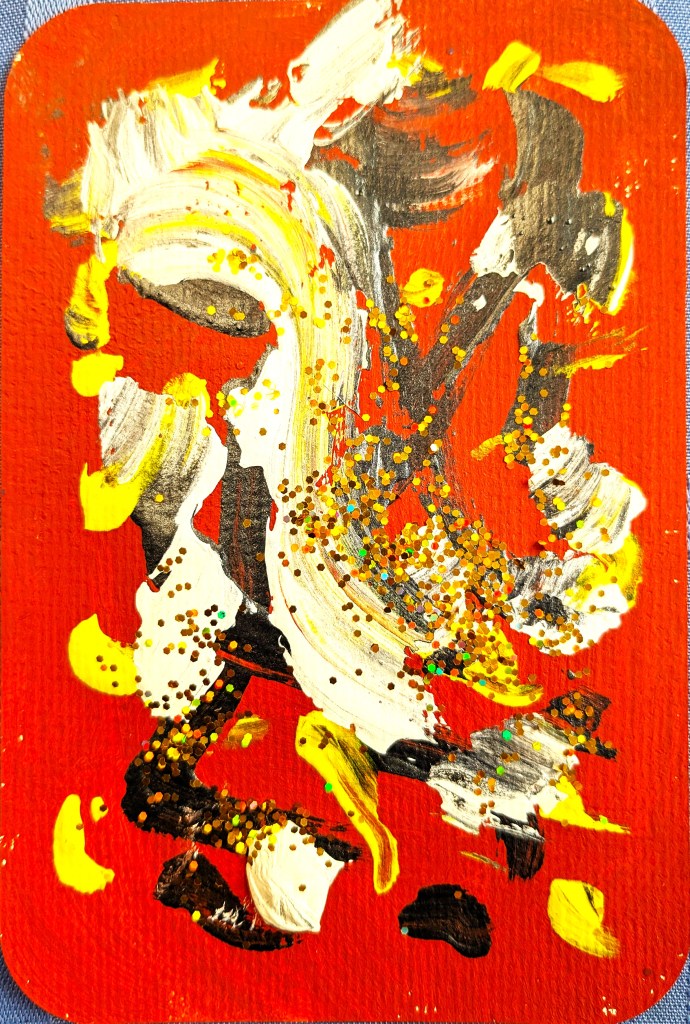
Dark Angel is from my poetry book – Septets for the End of Time / Poems for the end of Time. The lead painting in today’s blog is by my friend, Moo, and he calls it Storm-Me.
What are your thoughts on the concept of living a very long life?
A simplistic question in so many ways as so many definitions are needed. How long is long? 100 years? 200 years? Back to 1066 to watch the Battle of Hastings? 1588 to see the Spanish Armada sailing up the channel? 1815 to see the Battle of Waterloo and talk with Wellington and Napoleon – why not? I am Anglo-Welsh and New Brunswick is bilingual, French and English, so why shouldn’t I – or anyone else who wants to live such a long life – have a talk with both of them?
And does living a very long life include the concept of being healthy, and happy, and wise, and not living in squalor or poverty or in a permanent war zone? How about being kept in an incubator, or an iron lung, or on permanent life support? How long is long under those (or similar) conditions. And what about friends and family? In the Celtic myths, men who visit the fairies in Ireland and live and eat with them, come back to reality [now define that word in this day and age] only to find their friends and families long dead and gone. So what would the conditions of the ‘return’ be like if a long life meant watching the passing of everyone and everything you know or returning to a world you no longer recognized?
And change is so rapid nowadays. AI is developing so quickly, how can anyone keep up? I know that as I slow down (mentally and physically) I understand less and less about the machines I use, including my Nexus Rollator. Does a ‘very long life’ include sipping from the Fountain of Youth? Or does it consist of an enlarged old age – post molestam senectutem, nos habebit humus – after a troubled old age, the earth will have us. I am sure we all recognize Gaudeamus igitur, in Latin, and its theme of Ubi sunt qui ante nos in mundo fuere – where now are those lived in this world before us, and if we don’t, then how swiftly we have forgotten the power of Latin is with its memorable phrases and omnipresent seeds of memento mori .
For me the question is a clear one – do you wish for quantity (a very long life) or quality (a very happy and successful one, even if it is a bit shorter)?
A close friend of mine, one of the most honest and courageous people that I have known, suffering in a horrific way from terminal cancer, asked for, and received, MAID (Medical Assistance In Dying). It was a long legal and medical process to get MAID, involving famiy members, lawyers, doctors, and many other things. As the Romans used to say mors omnia solvit– death resolves everything. My friend and his family preferred to shorten life – on their own terms – rather than prolong it under such prolonged suffering and torment. My friend, I salute you and your family and commend you for your bravery.
So, define the terms within which that very long life would be lived – and then ask yourself the question once more. Because as it stands right now, with no further understanding, the answer should only be “depends”. And remember, lives are like swimming pools – they have shallow ends and deep ends. All too often when you talk about life and the end of life, so much depends.
Comment:
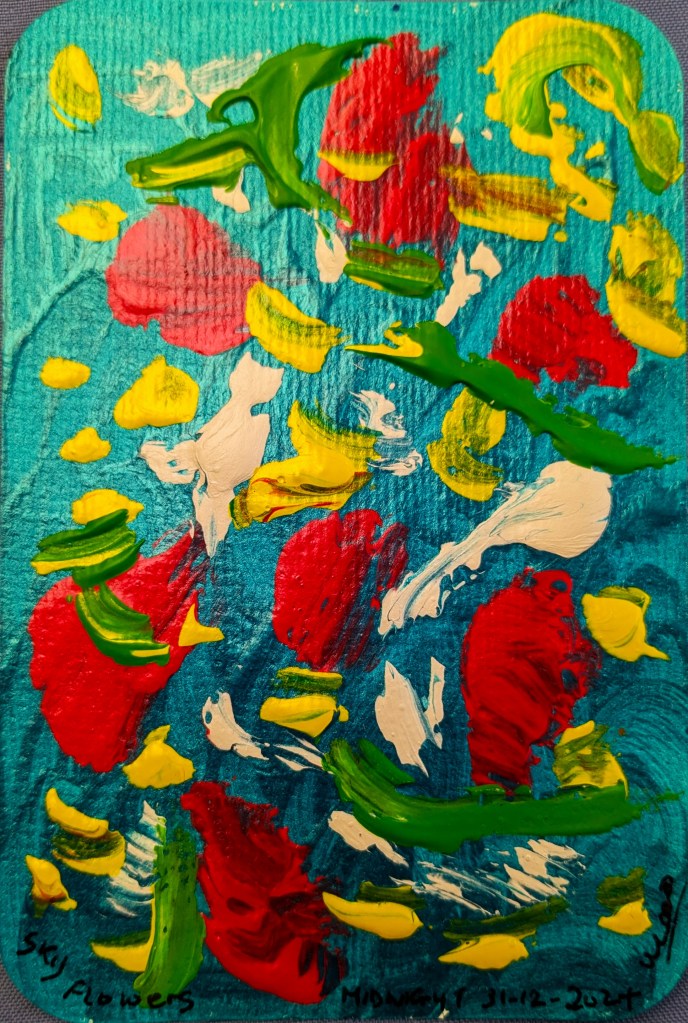
I must thank my friend, Moo, for his depiction of the fireworks from New Year’s Eve. Sky Flowers, he calls it. The fireworks have gone already – but – vis breve, ars longa – his painting still survives.
The jaws that bite, the claws that snatch, the hands grasping you through the railings as you scuttle upstairs.
Those same hands descending, beating, shaking you, back and forth, a rag doll, then thrusting you into that cold, dark cupboard beneath the stairs, no story, your childhood reality.
And now, those dreams come back and you lie awake watching as the grey revenants return and the nightmares repeat themselves, again and again.
And return they will, until that final curtain call, when the stage turns black, and you’ll never be taunted, haunted, and hunted ever again.
Comment: On Thursday night we discussed the difference between poetry of play and poetry that expresses the authenticity of being. Into which category does this poem fall. Intertextuality – the idea of texts talking to texts. How many different texts can you count, talking to each other in this poem that may even be a Jackpine Sonnet?
I took a wrong turn along the way and got where I didn’t want to go. Oh no! But there I was, stuck in a land I didn’t understand.
Snow fell all around. No sound. The forest silent. Trees asleep. Snow rising higher. Ankle deep. Obstacles. No path around.
I tried to speak. No sound came. I couldn’t sing. I couldn’t hum. Silently, I cried, but no help came.
I saw so many things I couldn’t name. When I tired of playing this lost soul game, I knew I was the one to blame.
Comment: And yes, I have been lost. Absent without leave for a whole month – 11 November – 11 December. Where did I go? I still don’t know. I owe the above photo to my friend and Beta reader, KTJ.
What on earth do you mean by energy? And why should energy be associated with things? For example, today’s painting (above) is by my friend Moo. He calls it Joy to the World. It is indeed a joyous painting, full of light and creative energy. The photo does not do justice to the painting, which sparkles and reaches out to draw the viewer in. We must never underestimate the energy that comes from the creativity and art that creative people put into their art works. It is like bread cast upon the waters – it will return tenfold. The world would be a sad place if we lost our powers of creativity and invention. May we always keep them close by us, and turn to them when the skies are grey – for with our ingenuity and skills we can always turn those grey skies blue again. It just takes time, trust, belief, creativity, and a little bit of energy.
Or is the prompt referring to the energy that comes from food? Vonnegut refers to such energy as comes from the breakfast of champions. Was that really Scott’s Porridge Oats? Certainly used to be – and all those caterwauling bagpipes puffing out their oaten tunes. More foods, please. Cornish Hens and Kedgeree, unzipped bananas, eggs – preferably fresh and free range – boiled, poached, scrambled, fried, or served in various types of omelets … energy from food – oh, I could go on and on and on … caws wedi pobi, cennin a tatwys … tortilla espanola, paella de mariscos, calamares en su tinta … chapulines from Oaxaca … food as a source of energy … wow! And who said the foods had to be written in English?
Mind you, an alternate source of energy is the current news cycle. When not a storm in a tea-cup, sugared or un-sugared, it is ferocious and opinionated enough to set people banging their heads against the walls so the pain will come from an alternate source. And noise demands energy – energy in (and also garbage) and energy out (mainly garbage), and all that rage, fury, wind, despair, blather, generated by written, printed, spoken, televised, radio borne waves of noise. We could start a wind farm if we trapped the blatherings of congress, the senate, the houses of parliament.
Meanwhile, we live in a large house, almost a barn really. Some of our friends call it our hacienda. They are the ones who speak no Spanish and can’t pronounce Quevedo correctly, even though I’ve known them for a quarter of a century. Actually, strictly speaking, most of them are ex-friends now. Many went AWOL when I retired and the rest disappeared, fates unknown, during Covid.
That house has an electric furnace that warms us in winter and circulates cool air, in summer, from the basement (cool) to the upstairs bedrooms (warm). We also have a fireplace insert that burns wood. But we only use that in emergencies (power loss during cold weather or storms) or for decoration (the yule log) at Christmas and over the New Year.
A large house means large heating bills. About ten years ago, we installed a wonderful heat pump that serves the whole house. It heats in winter and cools in summer. It also halves (or more) our electricity bills. Most of the house functions on electricity, hydro-electricity from the dam at Mactaquac, just up the road. No coal-fired furnaces for our electric supply. We do, however, have the ability to connect to a petrol-driven generator. But we rarely, if ever use it and that, too, is for emergency use only.
Otherwise, many of the things we use on a daily basis – computers, cell phones – can be battery driven (when the power fails) and those batteries can be charged in the car (during emergencies) or from reserved chargers hidden away. The car itself is a normal gas engine – nothing special – as is the snow blower. We do not use solar power – nor wind power – but we do have candle power and our fireplace insert can be used for heating food and boiling water.
So there, as a challenge to your lack of clarity, you have a clear account of my many sources of different types of energy. Oh, and don’t forget, I am energized by earing your prompts apart and chomping them into tiny pieces.
They drove me there, passed through the gates, unpacked my trunk, chatted with the head, shook my hand, then drove away.
The metallic clang of the closing gates still lives with me.
How old was I? Six? Seven? I no longer know and there’s nobody left alive to tell me.
I remember so well the woodgrain on the desk, the carved initials, the loneliness that bit, the barred windows of that empty classroom.
2
An only child, taken away, left among strangers?
Why, why, why? Doubt’s pinball bounces round my empty skull.
What am I? Who am I? Why am I?
How did I become whatever it is that I became?
mea culpa mea culpa mea maxima culpa
Was I the one to blame?
Comment: I prefer it as two poems, rather than a poem and a commentary. It may even be better written in the third person. I’ll have to think about that! It’s always a good way to work. Thank you to all who commented, by email or otherwise! Your comments always help me think, and re-think.
They drove me there, passed through the gates, unpacked my trunk, chatted with the head, shook my hand, then drove away.
The metallic clang of the closing gates still lives with me.
How old was I? Six? Seven? I no longer know and there’s nobody left alive to tell me.
I remember so well the woodgrain on the desk, the carved initials, the loneliness that bit, the barred windows of that empty classroom.
Comment: Looking back, I wonder just how and why I ended up in a series of boarding schools, starting when I was only six years old. What does that abandonment do to an only child, taken away, and left among strangers? I still have nightmares and wake up screaming, from time to time.
Why, why, why? The pinball of doubt bounces round the interior of my head as I struggle to plot different paths, different ways, how life could have, might have, been so different.
I guess that schooling, force fed, made me what I am. But then the pin ball starts again – what am I? Who am I? Why am I? And how did I become whatever it is that I became? Mea culpa, mea culpa, mea maxima culpa – was I then the one to blame?
Dystopian – how does one plan to design the city of the future in, for example, Syria, Gaza, Ukraine, a war-torn African country? There are wars and rumors of wars. What sort of future city does one design in the aftermath of a nuclear war? Bunkers for the elite? Underground tunnels? Radiation free zones? MAD – Mutually Assured Destruction – and who would be alive to inhabit one of those cities? The ultra-rich might escape on their super-yacht-space-crafts. But where would they go? And for how long would they survive? And what sort of cities would they build when they got to wherever they were going? From some of the rumors that I am hearing, the multi-billionaires are already building those -super-survival-Noah’s-Ark-Bunker Cities in various parts of our world as it is now. A water world? A dust storm world? A radio-active world? First, define the future, and then we can design for it.
And remember how many times, during and after the first Iraq war, we have heard generals and politicians boasting that ‘we bombed them back to the stone age.’ Just think about that. The stone age. Primitive in the extreme. No electricity, no running water, no regular food supply, no weapons other than sticks and stones, no bronze (that age came later), no iron (that age came later), no medicine, no doctors, no hospitals … think twice before you celebrate ‘bombing anyone back to the stone age’, because that might just happen to you, over the next few years. And remember, if everybody turns off all sources of light, we will be entering a very dark age indeed.
Utopian – Voltaire’s Candide – “everything is for the best in the best of all worlds.” Great. Now re-read the paragraph above. Even if our desired Utopian world avoids a nuclear holocaust and turns out to be the best of all worlds, we are still looking at climate change, rising seas – with the accompanying joy of developing new waterfront properties!??? as someone phrased it recently – over-population, mass population shifts, a dwindling set of natural resources, a scarcity of food and, more important, a scarcity of drinking water, and a tremendous division between the ultra-rich and the super poor. We are also dealing with forever plastics, polluted water, air pollution, the extinction of vital and diverse species, and so many more problems. A Utopia, perhaps, but a Dystopian Utopia, not a total disaster, but a Utopian world walking the plank towards a shark-infested sea.
So, tell me, how do we design the city of the future? A super-charged Noah’s Ark, space ship city, sailing to Planet B because we have flooded Planet A with so many devastating Dystopian indulgences? A deep-earth bunker, or linked set of bunkers, way below the earth, where a select community think they can ride out the coming storm? And what if our planet disintegrates and becomes just another dust cloud, its debris floating in the universe?
I would like to think that my own city of the future would be a small one-roomed, wooden cottage, buried six feet deep, in the peace and quiet of a rural cemetery. But who will bury me, if the world around me perishes and I survive only to fulfill my human fate, and die? I would also welcome a fiery end with my ashes scattered in the peace of the countryside, or in my own garden. Then I think of the wildfires currently consuming large parts of the world and I wonder if any of that will survive. Moreover, can a welcome grave in an enormous graveyard be considered a city of the future? If it can, get planning.
Mors omnia solvit / death solves everything. Indeed it does. And it will solve this question, this problem, and the future city, that I will never design or inhabit, unless, along with Blake, “we build Jerusalem, in England’s green and pleasant land.” If England’s Green and Pleasant Land still exists. And from what I am reading in the dystopian English press, there is little chance of that! And anyway, I live in Canada, so what has England’s polluted and dystopian land got to do with me?
I have a question for you. Recently I purchased a book by Forrester- The African Queen. I enjoyed the movie years ago and thought I would like to read the story. The main actors were great. The book highlighted that it showed what it was like being a female during the war, (1) which when I look back on now is one of its main points.
My question or thought on this book is tied around the library system. When I lived in Fredericton I wanted to give a bunch of books to the library, their first question to me was, “How old are the books? I told her and she said anything over five years in not being accepted. (2)
I wondered about this and the fact that many books in school are being removed, (3) how can we tell how much we have progressed? (4)
I don’t like prejudice but it seems we are throwing out too much. (5) Any thoughts on this. I don’t mind some of the history being trashed (6) because for Canada the consentation is for Quebec and Ontario.
Roger’s Response
(1) It’s also about the role of the nun in society. How do ‘holy women’ function in a male society? It sets some of the many questions we are now being faced with, but doesn’t really give any answers. It’s a long time since I saw that film. I don’t think I ever read the book – the themes might well change in print. They are present (some of them) in The Handmaid’s Tale.
(2) The library system seems to have rules and an etiquette all its own. When I donated books to the library, they accepted some for their collections, but set others up for sale on the book tables by the door. My guess is that certain books are ‘best sellers’ and will be read, others are ‘dust gatherers’ and won’t be. They want the former, not the latter. They also have specialized collections. If the books fit the specialized collections, great. If they don’t, then they hit the unwanted category and are moved on. This is particularly true of the UNB Library System.
(3) This is an entirely different question, and one with very deep roots. It deals, in part, with the question of control – quis custodiet ipsos custodies – who shall guard the guards, who shall program the programmers? By controlling what people read, you control their thoughts. One of the worst signs of this was the book burnings of the Spanish Inquisition (15th – 16th – 17th centuries). The Jews were expelled from Spain in 1492. (And the Arabs / Moors, in 1609). Prior to that, these people were ‘processed’ by the Inquisition. The original Inquisition was Papal, aimed at instructing the priesthood in Rome in how to interpret the Catholic Catechism. It was corrupted in Spain (under Fernando and Isabelle) by the Spanish Inquisition, a sort of secret police, which worked rather like the Gestapo in WWII. One of their jobs was to ensure that people who had converted to Catholicism, to avoid deportation, stayed converted and didn’t revert to their old religion, even in secret. Another was to ensure that reading material, religious material, and cultural material, particularly after 1527 (Martin Luther and his 97 theses) when the Reformation started, were all in line with the accepted Catholic thoughts of the time. All books about to be published were sent to the Inquisitorial Censor who vetted them and either approved them, or asked for changes. If he (they were all men) saw the slightest sign of dissent or heresy. Don Quixote, Book One, Chapter Six (DQ,I,6), deals with the book burnings of DQ’s personal library. In certain of the States (down south) books are already being banned. A similar ban, in certain States, that touches us closely, is the banning of Margaret Atwood’s The Handmaid’s Tale.
(4) “There is no earth, no heaven, no extended body, no magnitude, no place and that nonetheless I perceive these things and they seem good to me. And this is the most harrowing possibility of all, that our world is commanded by a deity who deceives humanity and we cannot avoid being misled for there may be systematic deception and then all is lost. And even the most reliable information is dubious, for we may be faced with an evil genius who is deceiving us and then there can be no reassurance in the foundations of our knowledge.” René Descartes (1635)
Descartes expresses this much better than I can. It is one of the major dangers of the age in which we live. How do we distinguish between reality and alternate realities? Which reality is the real reality? What is, or isn’t, fake news? How do we tell? Who do we believe? And why do we believe them?
(5) Another part of the problem is that ‘certain people’ – who don’t believe in science and who exploit people’s scientific ignorance to their own advantage – are willing to destroy the foundations of our knowledge. Burn everything down, they say, and start again. The new starting point is to impose what they believe upon everybody around them. This is a huge and crucial problem that threatens us, as individuals. It also threatens the foundations of our knowledge, as well as the very world in which we live – climate change vs denial of climate change – profits over people, versus government of the people, for the people, by the people. Once one starts asking such questions and looks at the AI systems with their immense persuasive powers and their seemingly uncontrollable spread of Mis-information and Dis-information, then one starts to realize how serious the problem is.
(6) Those who ignore history are doomed to repeat it – Santayana (the Spanish philosopher, I think). However, we must, in certain circumstances, adjust our current beliefs to current realities. Immigration is a major issue – as is how we deal with people, like me, who come from different cultures and beliefs? Not everything written in the past suits our current world view.
I have been looking at old Westerns – “The only good injun is a dead one” (John Wayne). Really? I know some wonderful people in our first nations communities and I have taught them and worked with them and have often been taught by them. “Shoot first and ask questions afterwards.” Really? I won’t comment further on that one, without reflecting on the number of automatic weapons floating around in our socuiety. So many people are being killed by them.
All of this comes down to the big question – freedom of information or the release of just enough information to persuade other people of what we believe and what we want them to believe. Power and Control. Knowledge is Power – Michael Foucault. Control that knowledge and you have power over the people. Noam Chomsky has written widely on this – and his books have been banned in the USA. Bertrand Russell too – The Meaning of Meaning, for example, and his establishing – along with A. J. Ayer – of the doctrine of logical positivism – the removal by means of mathematics of all the emotional content of words.
My friend, you have opened a can of worms. Long may they wriggle and squirm.
Scour the news for an entirely uninteresting story. Consider how it connects to your life. Write about that.
Scour the news – what on earth does that mean? Let’s begin with scour – If you scour something such as a place or a book, you make a thorough search of it to try to find what you are looking for. Rescue crews had scoured an area of 30 square miles. Synonyms: search, hunt, comb, ransack. Search, hunt, scour, ransack – well? Which one are you after? And how long have I got? Question: what am I looking for? Answer: an entirely uninteresting story. What a tremendous waste of my time. And, when you get to my age, time is precious.
As for the news, well, what on earth do you mean by that? I speak several languages fluently. Am I looking for an entirely uninteresting piece of news in all of them? As one of the Two Ronnies used to say “You’re having me on, aren’t you? You’re having me on.” Let’s just stick to one language – English. Then let us ponder for a moment the meaning of the news. How many newspapers do you wish me to purchase and peruse? I am not a millionaire, you know. Or do you want me to listen to the news on the radio or the television? If so, how many channels? How about sending me online? I love the thought of that. There are thousands of websites out there filled with all kinds of news, good bad, indifferent, fake, artificial? And you want me to scour them all in search of, and I quote “an entirely uninteresting story”! Pull the other one, as the old comedians used to say, ‘”it’s got bells on”.
I’ll tell you what I’ll do. I’ll scour your prompt, that’s what I’ll do. Having given it a brief analysis, I declare it entirely uninteresting. Next I’ll consider how it links to my life. Well, sorry, it doesn’t. If I were to follow it through, I’d be sitting here for hours, wearing my fingers out on the keyboard. So, what’s the link between your prompt and my life? A total waste of time, that’s what. Sorry, I have better things to do with my life. Like reading Shakespeare – “Friends, Romans, Countrymen, and prompt readers, lend me your shovels. I come to bury this prompt, not to praise it.”