Butterflies

IMG_1053 (2).JPG

Butterflies

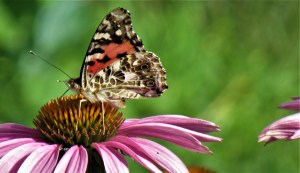
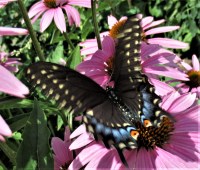
Here today and gone tomorrow. Ephemeral. Like all of us ‘poor creatures, born to die’ (as Dylan Thomas once wrote in Under Milkwood). It seems strange to look back on last summer’s photos and to remember that yes, they were here, those butterflies. Outside the window. Perching on the flowers. Showing their varied colors. Alive. Vibrant. Raising and lowering their wings.

Once upon a time, a long time ago, when I wore a grey suit and lived in a concrete, four-walled cell that they called an office, I was asked if I would edit a new journal for one of the institutions with which I was involved. ‘Sure,’ I said. ‘That would be great.’ ‘We’ll need you to submit a title and a theme,’ they said. ‘Sure,’ I said. ‘Of course I will.’

I thought about many things: titles, themes, topics, writers … Then I thought about other journals with which I had been involved in various capacities. Then I considered walking in the footsteps of the Journal of Higher Education with all of its cutting-edge articles and high-powered inspiration. I breathed a sigh of frustration, then of relief. ‘Got it,’ I said, and the Journal of Lower Expectations was born.

Alas, it was a butterfly that never spread its wings. ‘Your services will not be needed,’ came the curt reply when I submitted the title.

Think about it: a couple of years back, there were no bees in the garden: CCD (Colony Collapse Disorder). Last year, there were no birds. The feeders stood empty, and bird flu was the cry on everyone’s lips and the plague on every bird’s beak. Ephemeral. Butterflies on a rock. Australia burns and people are rescued from the beaches where they have taken refuge in the sea. Everyone, everywhere, now needs to live with lower expectations.
IMG_1058 (2).JPG

Butterflies and birds and bees: will they be back next summer? Who knows? I certainly don’t. But then, I am a true agnostic. I have no scientific background worth speaking of and neither ax no knife to grind on this topic. I genuinely do not know where we are heading. But I believe least those who protest most, especially when they bluster and bluff and try to pull the cocoon of disbelief over my eyes by shouting loudly their point of view. I have eyes. I can see, even if there are no butterflies, birds, or bees to be seen. Alas: I can still see and suffer their absence.

Please
will ye no come back again?”
Poor kangaroos, kookaburras, koalas,
wallabies and platypus ducks.
IMG_1047 (2).JPG

We will miss you so much if you any of you,
let alone all of you,
along with the butterflies, birds, and bees,
go AWOL.

Black and White

IMG_1519.JPG

Black and White

There is a moment in winter photography when the world of color turns to black and white. Color is still there, but today it travels incognito, anonymous. The world is formed by shapes, trees draping their branches, snow weighing them down, dressing them in wedding gowns for their marriage with the new year spirits that haunt sunlit, moonlit snowbanks and dance across the snow. Even the clouds exist to give a soft, quiet dramatic touch to the winter beauty that visits the garden. And yes, it will always be there, even if we are not here to see it because it will carry on without us. As for us, we are secondary, mere witnesses to winter’s beauty and the nature that surrounds us.

IMG_1554.JPG

Amateur photographers can sometimes capture this effect in a moment of luck (or occasional inspiration). Great painters have always known this art of the minimal. El Greco drew light from darkness, his portraits often finding their own fire and lighting up from within.  Caravaggio, too, knew the values of chiaro-oscuro, light and dark, black and white. Velasquez was the master of the spotlight that highlighted the eggs frying in the pan, the hand of the water-carrier. Goya, in his etchings [The Disasters of War, The Caprichos] and dark paintings, drew mood and anguish from this contrast between light and dark, black and white.

image1-1.jpeg

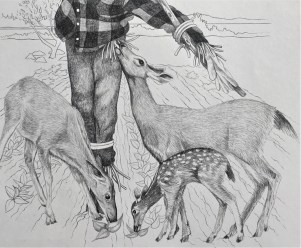
My friend Geoff Slater has caught such a moment in his sketches for Scarecrow. Above he catches the precise moment when the scarecrows, male and female, reach out to each other, and beneath a Van Gogh planetary sky, dare to dream of mobility and love. The dream world: so important to us all and especially to the creative artist who dwells in each of us. Deus est in nobis, the Latin poets used to say, it is god within us. The god of black and white who transforms the world into color and light.

image3 (10)

Black and white, light and dark, winter trees, Clare, two scarecrows, deer and crows: labors of love that reach out and catch us unawares, blowing our hearts wide open, letting in the sun and the wind and the ever present joy of seeing things, seizing them, sizing them up, in black and white.

image2 (15)

Deer Dance

IMG_1572.JPG

Deer Dance

They came with the snow, of course. Last year there were seven, this year six of them sniffed their cautious way, step by step, into the yard. I looked out of the bedroom at 3:00 am, and there they were, standing beneath the mountain ash and reaching up to the lower branches to snaffle the berries. They also dug into the snow and ate the fruit that had fallen beneath the tree. The night was cold and dark. I didn’t want to risk the camera and have the flash or the laser beam frighten them so I just stood and watched.

Next morning, I wondered if it had all been a dream. Then I saw the dance-steps in the snow. They have been back a couple of times now and this morning Clare spotted seven, in the early morning light, ghosting their almost perfect camouflage through the trees. So now we have a couple of questions: are there two groups this year, one of six and one of seven? Or had the seventh deer from last year rejoined the group?

We think the group of six has larger deer while the group of seven has two seemingly smaller ones. But this may be a trick of moon light and shifting moon shadows. Climate change: the local deer at sixes and sevens. What would Ocho Venado, the Oaxacan / Mixtec King known as Eight Deer, think of it? Ah, a conundrum indeed. And when and if I work out any answers, I will let you know.

Let it snow ….

IMG_1532 (2).JPG

Let it snow …

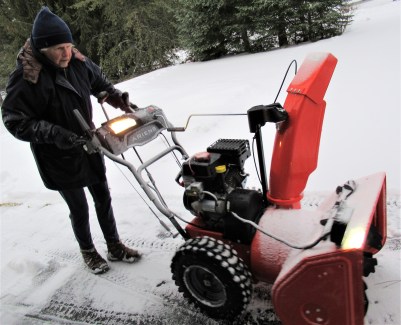
A New Year, a new snowblower, and the same beautiful handy-person. Luckily I can cook, so when the hard work is done, that handy-person can sit down to hot tea and buttered crumpets. Oh the joys of retirement. Some never retire, though, and a handy-person’s work is never done. Mind you, cooking, for me, is a joy, not a chore, so I don’t ever think of it as ‘work’, that nasty, old-fashioned Anglo-Saxon four-letter word. In fact, come to think of it, teaching and research were joys, never chores. As a result, I have never done a day’s work in my life. Nor did I ever want to.

IMG_1526 (2).JPG

And that’s what I wish you all for the New Year: brave blossoms that stand out against a snowy background, joys that make each day a pleasure and never a grind, happiness that drowns out the daily sorrows of this Vale of Tears through which we are passing, and a clock without hands, so that you never have to count the hours as the days tick slowly by.

IMG_1571 (2).JPG

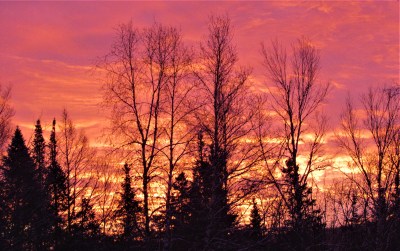
May each morning fill you with joy, happiness, and a sense of adventure. And may the evening sky fill you with peace and contentment for a day well lived.

On Editing

IMG_1095 (2).JPG

On Editing

Some editors are really very good. They take the initial idea of the artist and polish it, turning what was an average piece into a great one. Others are not so good and turn an average piece into an automatic rejection.
On my kitchen wall hangs a line-painting by Geoff Slater representing one of last year’s hollyhocks from my garden. He gave it to us as a Christmas present, and I am very proud of it. Finley loved it too. She followed with great glee the white line that starts and ends Geoff’s painting. Then she stared at me.

“What are you doing?”
“I’m writing a story.”
“What’s it about?”
“A thin red line.”
“Oh!”

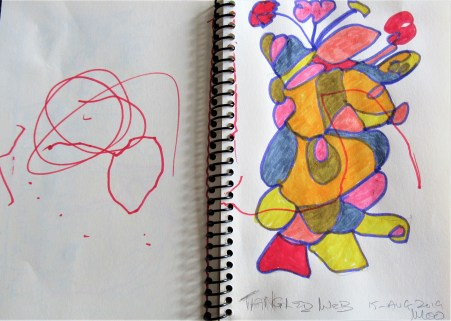
A little bit later, I saw my pens and pencils strewn across the table. My sketch book lay open and I noticed that an editor had edited some of my work. My thin red line had morphed from illusion to reality and there it lay, twisting in and out of the tangled web I had created the day before. Clearly, my average creation needed the touch of a four year old editor and apprentice line-drawer to move from average to genius.

Oh the joy and creativity of a four year old! It took Picasso nearly fifty years to learn to draw like that again. And here’s another painting by this prodigious four year old. I got this one for Christmas last year, too. Alas, it is not signed.

“Don’t you want to add some more?” My daughter asked her daughter.
“No. It’s finished.”
And so have I.

IMG_0228 (2)


Springle Dance

IMG_1258 (2)

Springle Dance

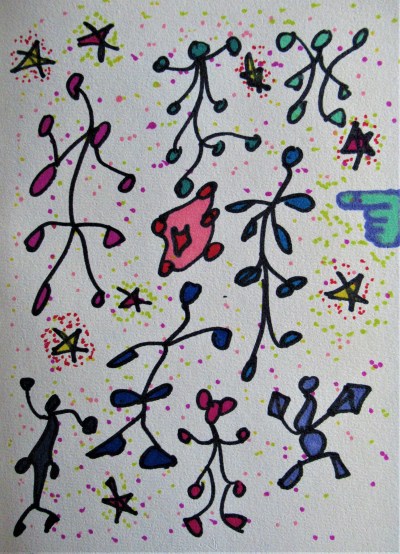
I guess the title comes from Tolkien where the Hobbits begin an energetic dance at Bilbo’s Party. Or something like that. Mine is a Fall Girl Dance. The hand on the right points to the poor misshapen heart as it moves between fall leaves and colorful dancing sprites and spirits that help it on its way. Where is it going? Who knows where the autumn leaves go once they leave the tree? The bodies fall to the ground, obviously. We rake them into dry, crisp piles and our children and grand-children dive into those leaf-piles, scattering them everywhere so we have to rake them up again. Think of them, the children, as forming leaf angels, a bit like snow angels, but, like the broken heart, a great deal more fragmented.

Try as I might with camera and photo shop, the colors are never quite what they were when I splashed them haphazardly, like September rain and wind-blown leaves, across the page. But life is like that: memories are discolored and distorted, old photos turn sepia, old folk turn white and grey and wrinkled and fragile, like withered leaves from the tree of life. And this is life, real life. We live it every day. Each dream, a flower, each moment a leaf, and every moment the only one we ever truly experience.

So savor those moments, both the good and the bad. They are yours and nobody else’s. Your like is what happens to you. Sometimes it is bitter with salt and vinegar and lemon juice. Sometimes it is toxic and poisonous. But it is yours. It is your chalice to drain as you stand in the garden, feeling betrayed. Like it or not, this is you. Then there are the dream moments: sugar and spice and everything nice. On those days, when the sun shines, it’s away with slugs and snails, and puppy-dog tails and hello hollow world, I see you for what you are and I welcome you for what you are. And yes, you can meet with triumph and disaster, and you can treat those two impostors just the same. You are more powerful than the forces around you. Centre yourself. Find yourself. Heal your broken heart as it wanders among the springle dancers sent to bring you peace and comfort.

Look for your self. Find your self. Be your self. You and your self are stronger than any woes that may beset you. Seek the light … and you will find it.

On the beach

On the beach


IMG_0564 (2)

IMG_0565 (2)

Comment:

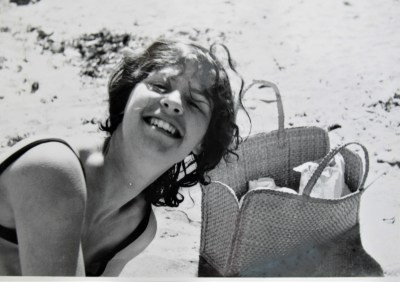
A daylight photo and a moonlit poem: I wonder how that came about? I guess we must have been beach-combing in the moonlight. It’s so long ago that I have forgotten the links between photo and poem. That said, Clare and I had spent a couple of weeks together in Santander (Spain) the previous summer, when we got engaged.

‘O bahía de Santander: tan bella bajo la luna’ / “oh Bay of Santander, so beautiful beneath the moon” as the Santander poet Gerardo Diego writes. And yes, Santander under a full moon: Mataleñas, the Segunda Playa, Jardines del Piquío, La Magdalena, the Bay of Santander itself, with Peña Cabarga in the background … there is something about beaches and midnight and moonlight which transcends the warmth of a summer’s day. It’s a sort of Midnight Magic that creates a madness of wonder in the blood. Imagine: all those silver fish, swimming their underwater roads, and rising to the surface, to ripple softly along the moon-path. Wander-lust / wonder-lust: sometimes buried words will not rise to the surface and those oh-so-precious moments of supreme poetry are lost among street lights, advertisements for this and that, street signs and the sort of stop signs that stop you and numb your mind into the dumb acceptance of daily reality: la vie quotidienne.

Memories: will they all vanish with us when we go? Of course they will. Many are fading now as we sit here at our desks, in our offices, before our computer screens. The grey screen hustle and bustle pushes memories, light and bright, back into the darkest corners. Where do I get off the bus, the train? Which number is it? Where is the office? Who am I meeting today and at what time? Did I shut the door behind me? Did I pack the children’s lunch? Did I let the cat out? And if so, out of which bag?

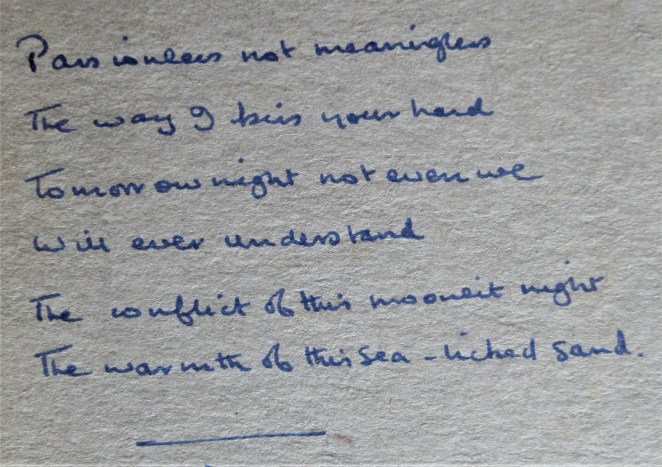
passionless not meaningless
the way I take your hand
tomorrow night not even we
will ever understand
the conflicts of this moonlit beach
the warmth of this sea-licked sand

PS. There, see, I told you I couldn’t read my own handwriting. Kiss / take; night / sand. Oh dear, the old grey cells are playing chess with my mind again: P-K4 / e2-e4 … whatever next? Well, I warned you!!!!


Beach Heat

IMG_0572 (2).JPG

Beach Heat

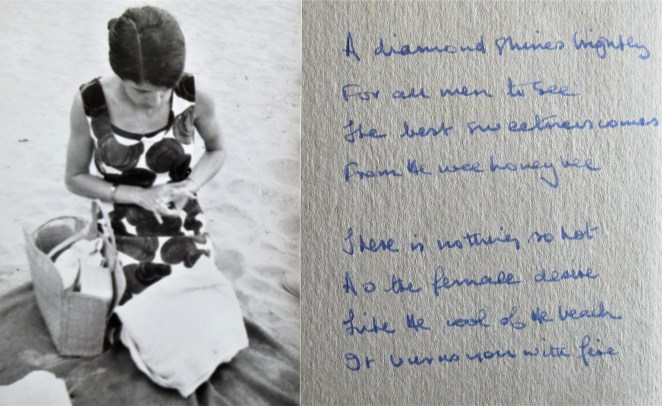
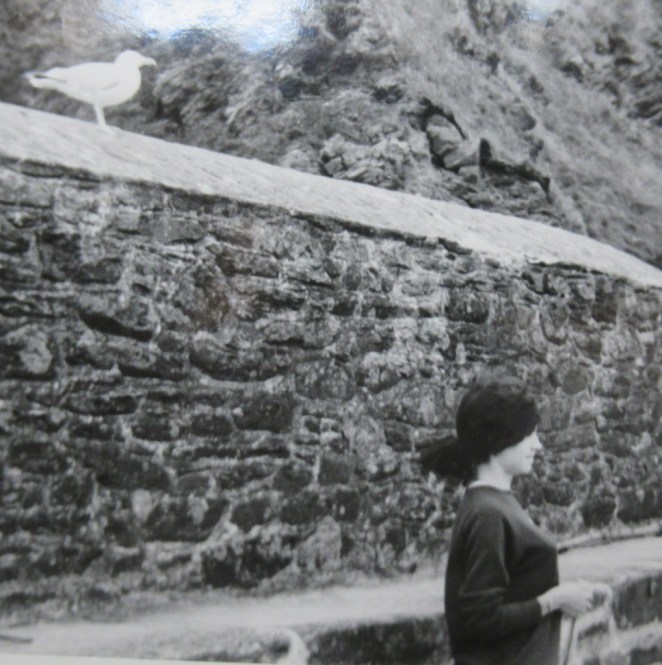
This is the beach at Goran Haven, with Clare, on the sands, trying not to lose her engagement ring. It’s still with us, in spite of having left it in a washroom on the 401. When one of the support columns of the solitaire broke, we found the stone lying on the floor of the car … that was another close call. As for the poem, well, I suppose it is one of mine.

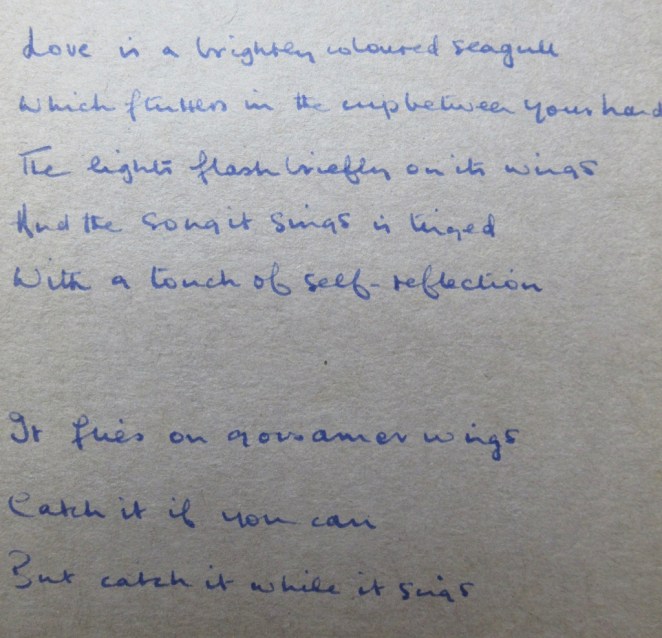
The enlightened may recognize its structure as belonging to The Book of Good Love / El Libro de Buen Amor, written in the 14th Century (1330-1343, according to some, though it may be a little later, 1347?), by Juan Ruiz, El Arcipreste de Hita. This early verse imitates the rhythms and sequences of Juan Ruiz’s poem: In praise of small women. Not that Clare is small: she is taller than me, and always has been. She is also younger than me and hasn’t manage to catch me up yet. She is cleverer too, but don’t ever tell her that I told you that. Life might become unbearable. Not admitting that little secret is what keeps me going.

I take it you can read my handwriting. If not, ask politely, and I will add a typed version that is more understandable. Ask nicely, mind! None of that “yore ‘andritin’ is atrooshus’ stuff, sort of, loike.”

PS: I didn’t have a very good camera in those days. As for my current cameras: wow! How the world has changed. As we have changed with it.

PPS: Indeed I have received comments, not very complimentary, on my handwriting. Oh dear. Don’t worry I can’t always decipher it myself, even with my glasses on. Thank you all my friends and anonymous correspondents. So, here comes the translation into print.

A diamond shines brightly
for all men to see
the best sweetness comes
from the wee honeybee

There is nothing so hot
as the female desire
like the cool of the beach
it burns you with fire


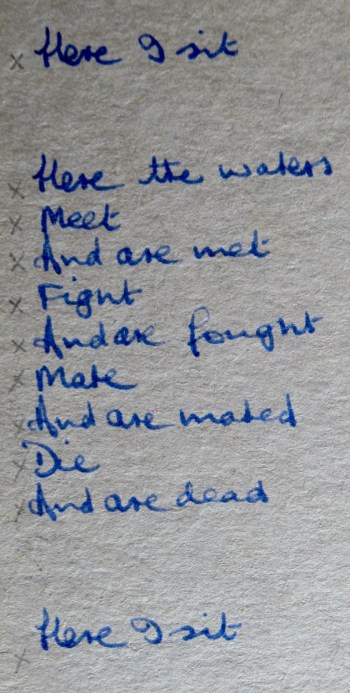
Here

jLwRzd1BSwOGRYRVEcPwSA_thumb_2891.jpg


RrcBUdIhRESRs2CwUmEmJA_thumb_2892.jpg

Comment:

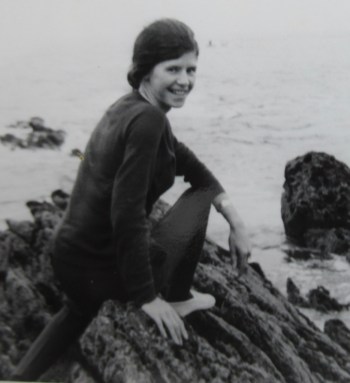
Another photo and poem from this early series (1966) while I still lived in the UK. Like Cervantes, I always wanted to be a poet. Like him, I may always be disappointed by my poetry. However, my beloved has never disappointed me.
This photo was taken at Dodman’s Point, close to where the Spanish Armada was first sighted in 1588. Dodman’s Point / Dead Man’s Point.
In 1988, a computer ran all the tides and all the times of the Armada’s progression up the English Channel, all based on those tides and the annotations of them in the sometimes seemingly haphazard English and the Spanish logs. Seemingly haphazard: because in spite of telling the time by water clocks (clepsidras) and marked candles, and in spite of the ten day calendar difference, and in spite of all the other different differences, these were real sailors and they lived and died according to the tides, the tides that the computer can track, all the way back to 1588, even as it can track the stars and their original positions when Stonehenge was first built in 3500 BCE.
I have stood on the temple mounds in Oaxaca. I have visited Maiden Castle. I have walked on Hengistbury Head and lain in the scrapes of the reindeer people. We underestimate the intelligence of our ancestors and, by extension, of many indigenous people, at our peril. And we over-estimate our own abilities as we destroy the very world in which we live.