Scars

IMG_1095 (2)

Scars

It’s just a tiny splinter, lodged in my little finger. I take a needle from my sewing kit, put on my glasses, and break the skin around the small black spot in an effort to dig the splinter out.

Suddenly, the vision changes and I am back in my grandfather’s house. My father has bent me over his knee and is jabbing at the splinter in my thumb with a needle from my mother’s sewing kit.

“Hold still,” he pushes me down with the elbow of his left arm, then thrusts the needle again and again into the now bleeding spot on my thumb. “Hold still. Stop wriggling.”

“You’re hurting me.”

“Good.”

My mother comes into the room and inspects my thumb.

“Put your glasses on,” she tells my father. “At least you’ll be able to see what you’re doing.”

“Ow, ow!” I struggle with each piercing thrust of the needle but my father only holds me tighter.

Back in the present, I can hardly see this other splinter, let alone pull it out of my little pinky. I have broken the skin, so I place a band aid over the spot. Hopefully, the plaster will draw the splinter out, it usually does, quite painlessly. I put my sewing kit away and check my right thumb. My age-old splinter, still in there, winks its little black eye back at me from beneath the tear-filled eyelid of its tiny white scar.

We bear so many scars. Not all of them are visible.

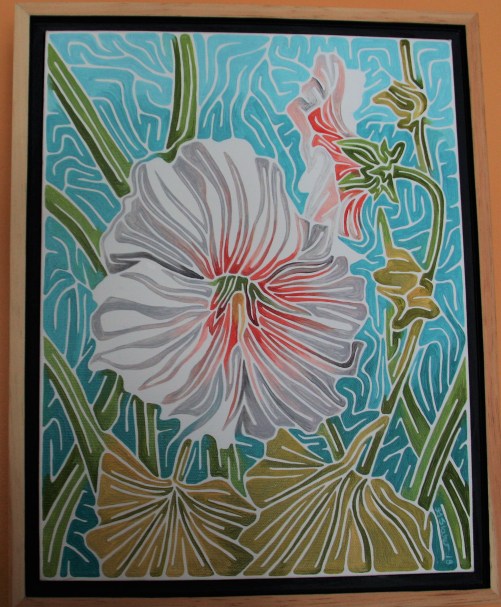
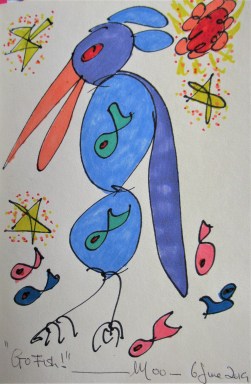
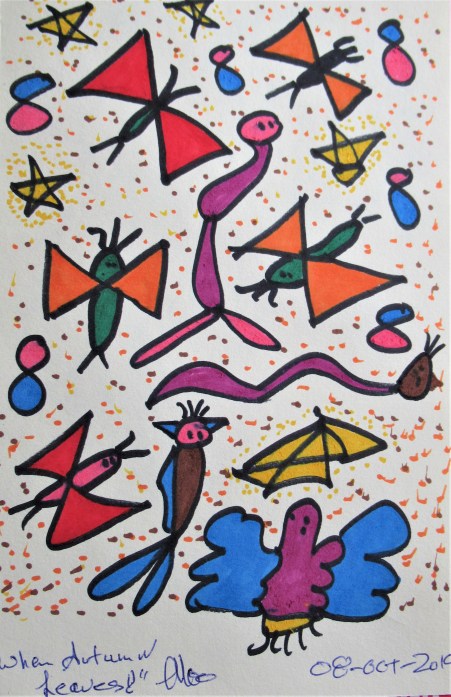
Comment: So my granddaughter decided that she could polish up and improve my drawing notebook (top photo). And she did. Proof positive that a red pen in the hands of a young lady can work wonders. The thin red line of life, that link that joins us generation to generation, stretches back to times that only I can remember, stretches forward into times that I will never see. I wonder what my grandfather thought when he sat on his chair by the old Welsh fire and I climbed up, onto his knee. “Grandpa, tell me a story.” And he always did: “Once upon a time …  there was a thin red line …” And look, there’s my grandfather’s old chair down in my basement in Island View, New Brunswick, Canada. It’s a long way from my grandfather’s old home in Swansea. Just think, I used to climb up on the back of that chair, while he was sleeping, and blow on the bald spot on the back of his head … one long thin red line of inherited mischief …

18581930_1306791786107970_4016640231053970709_n-1

Limpet

fundy 05 mist+wolfepipers 081

Limpet

… like a limpet at the sea side
she clings to her inner rock
as the incoming tide
causes waters to rise,
threatening
to sweep her away.

A wind charges
over the bay,
brings a wave-surge,
white water urgent,
crashing against rocks.

Rock-face showered
and shocked,
the little limpet
clinging on,
knowing that this
is the way
limpets survive,
day after day,
generation
after generation.

Comment: We must also survive and we do so by hanging on as long as possible. The tides may rise, the mists come in, storms may send waves to come breaking over us … but they will not break us because we are limpets. So, imitate those limpets, cling to your rocks and hang on. However grim the situation might seem, the night will end, day will come, and we will survive. And remember that old Irish drinking song: “If Moonshine don’t kill me, I’ll live till I die.” And so will we all. And until then, enjoy the sunshine and the moonshine. This is your life, your planet, your set of circumstances. Hang in there and hang on, for as long as possible. Look for the good things in your life and when you find them, celebrate them and make the most of them. Remember the sundial: I count only the happy hours. Seek and you will find: for there is goodness all around you, even when the night seems to be at its darkest.

Butterflies


IMG_1053 (2)

Butterflies

“Poetry gives permanence to the temporal forms of the self.”
Miguel de Unamuno.

… butterflies … temporal forms … fluttering …
existing for one sweet day … they perch … spread
their wings … fan us with their beauty … flourish …
catch our attention … then caught by a gust
tear their wings on a thorn … and perish … blink
your eye and they are gone … yet reborn … they
cluster and gather in dusty ditches …
congregate on bees’ balm … smother Black-Eyed
Susan and Cape Daisy … shimmer in shade …
butterflies by day … fireflies by night …
terrestrial stars floating in their forest
firmament … dark tamarack … black oak … bird’s
eye maple … silver birch … impermanence
surrounds us … dances beneath stars … sings with
robins … echoes the owl’s haunting cry …
eternity held briefly in our hands …
then escaping like water or sand … black
words on white paper capturing nothing …
… my dialog … my time … my place … butterflies …

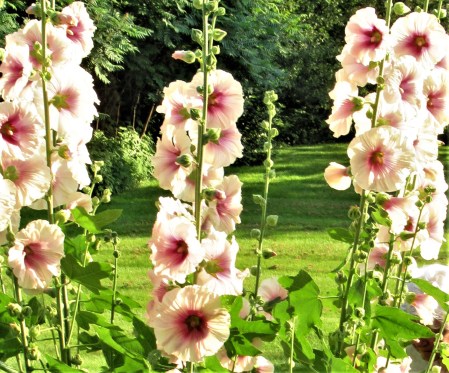
Comment: This is another golden oldie that gains in meaning day by day as the lock down continues. Miguel de Unamuno (1864-1936) was a respected academic, philosopher novelist, essay writer, story-teller and powerful poet. He is probably most famous internationally for the philosophy he espoused in The Tragic Sense of Life. Other works of his include Our Lord Don Quixote and Niebla / Mist. The photo shows one of the butterflies that adorn the garden by my kitchen window each summer.

Hope

image1-1

Hope

Faith, hope, and charity
help us see with much more clarity.

We have faith in a vaccine cure,
though when it will happen,
we can’t be sure.

Charity comes from the rank and file
serving in supermarkets with a smile,
doctors and nurses work the day round.
On night shifts too, they can be found.

The garbage men, patrolling the street,
keeping homes and gardens neat,
tidy, clean and rubbish free,
helping to restore our sanity.

Police and army play their part
keeping us six feet apart,
doing the work we cannot do,
helping all not just the few.

Essential people, women and men,
bringing life back to normal again.

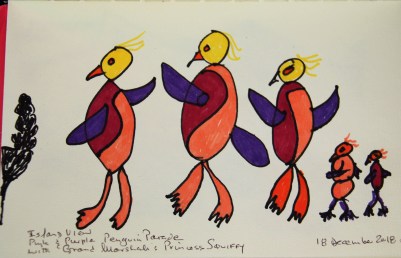
Comment: Many thanks to line painter Geoff Slater for this wonderful drawing from Scarecrow, one of my favorites. Scarecrow is a joint production between Geoff and I, with his drawings illustrating my story. This is the moment when Scarecrow dares to dream and hope that he will soon find and dance with his own beloved. Even in this current world of stress and sorrow, we are still allowed to have our hopes and dreams. Dream on my friends. Hope on. Hopefully this nightmare will soon be over.

Writing a Poem Video


cropped-39948917_706398923049634_3046174897211441152_o-1.jpg

Writing a Poem

The KIRA artists (Roger Moore, June, 2017) were invited to make a video on the ways in which they worked. Here is my KIRA video. This is the first time I have ever made a video of myself. I am not into selfies (wrong generation) and had to be ‘persuaded’ to do this. The instructions were simple: something easy that anyone could do under lock down or in a home-schooling situation. I hope you enjoy the show!


Easter Sunday

IMG_1776 (2)

Easter Sunday

Easter Sunday: such a joyful day.
Last night the deer came out to play.
Good Friday’s snow is going away.

The Queen’s ‘Happy Easter’ was said at home.
The Pope held mass all alone in Rome.
I’m writing this poem and I’m home alone.

We’re locked down at home and so is the cat.
This morning she threw up her food on the mat,
three hoicks and a yuck and then a wet splat!

The snow is melting. The sun’s in the sky.
Rain is forecast and the river is high.
Let’s hope I stay well: I don’t want to die.

I know that I’ll die, sooner or later,
but if at all possible, let it be later,
‘cos I’m not quite ready to meet my creator.

Maybe he’s like me, with a tear of sorrow
for all things undone and left till tomorrow.

I do hope he’s a procrastinator
not a ‘do-it-right-now’ style of dictator.


IMG_1336 (2)


Hibiscus

IMG_1777 (2).JPG

Hibiscus
Day 26 CV-19

The hibiscus lives downstairs. We bought it years and years ago. A tiny plant in the florist’s shop, we brought it home. When we placed it here, by the window, we were horrified to see it was covered with tiny spider mites. Gradually, in spite of all our efforts, it lost its flowers and then, one by one, its leaves. After Clare had magicked the spider mites away, she nourished that one last leaf. “If that goes, the plant goes,” she told me. “It cannot survive without leaves.” It took time and daily care and attention, true TLC, but a second leaf appeared, and then a third. Now, each winter, it puts out flowers and fills the room with joy and light.

IMG_1776 (2).JPG

More important, in these dark times it fills us with hope and the knowledge that however bad things may appear to be, we can hang on, we can survive. We can be present in every second that we are given and that we can, and must, enjoy every moment to the full. Condemned to a certain death, our hibiscus survived to remind us of the miracle of life, for life is stronger than death, and hope is stronger than despair, and spring and summer are stronger than winter, even if it seems to be ‘our winter of discontent’.

IMG_1774


Deer

IMG_1783 (2).JPG

Deer
CV-19 Day 24

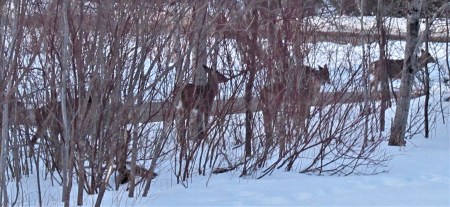
I woke up this morning, looked out of the window at a grey, sunless day, and saw this deer at the foot of the garden, abut 50 feet away. I couldn’t believe it. Thirty years we have lived in this house, and I have never seen a deer sleeping in the yard before. Well, it wasn’t sleeping. It’s eyes were open, the head was turning, and the ears flickered with every step I took. What a way to start the day.

IMG_1786 (2).JPG

Then I did a double-take and blinked. What I thought was a rock, to the first deer’s left, was another deer, also lying down. I realized it wasn’t a rock when it wiggled its ears. Behind the first deer and above it, scarcely visible among the trees is a third deer. You’ll have to look hard to see it, but it’s there. I apologize for the qualities of the photos, but grey day, early morning light, and shooting threw fly netting at a well camouflaged deer does not guarantee high artistic quality, as you will understand.

IMG_1784.JPG

Actually, the third deer is more clearly visible in this photo. It also shows a little bit more of the late-winter / early spring landscape. Then, when I got downstairs, lo and behold, a fourth deer underneath the fir tree. From a lower angle, I could only just sight it through the bars of the porch.

IMG_1787 (2).JPG

Again, my apologies: but what a morning … four deer, ‘nesting’ in the garden, where I have never seen deer before, except wandering through.

IMG_1740 (2).JPG


Day 23 CV-19

IMG_1652 (2)

Day 23 CV-19
Codes and Coding

“Languages: they say that to learn another language is to gain another soul and another set of eyes through which to view the world.” I wrote these words just yesterday [Day 22 CV-22]. The words are mine, but the idea belongs elsewhere. I have borrowed it and adopted it. I would willingly attribute it to a specific author, but I do not know who said it first. I offer my apologies to the to me unknown genius who first spoke these words.

Why codes and coding? A rhetorical question, of course. But codes and coding are the basic elements through which language transfers thought, our thoughts. What is a code? Well, we know all about Morse Code and the elaborate codes through which spies from all countries communicate their needs. A code is a way of converting language, changing it, making it available to those initiated in the code and unavailable to those who have not received such initiation. Sounds simple, doesn’t it?

When I was travelling regularly to Spain for research in Spanish libraries, my first port of call was always the local barber shop. I did this for several reasons. In the first place, my Canadian haircut gave me away as a foreigner. This is the hairdresser’s code. The barber’s shop was always the centre of local gossip. Here, buzz words changed hands, politicians were discussed, all the local news was immediately available. Each of these items was a code, a code that made an insider (acceptable) versus an outsider (not to be spoken to). I remember, one summer in Madrid, not getting served in any bar or restaurant. Check haircut: okay. Check shoes: bought new pair. Check shirt, jacket, tie: all up to date. Inspect lucky customers … ah … they are all wearing a shiny brass pin showing the symbol of Madrid: El Oso y el Madroño, the bear and the strawberry tree, as seen in La Puerta del Sol.

The next bar I entered saw me sporting El Oso y el Madroño in my lapel. Qué quiere el señor? Immediate service and with a smile. These are social codes, the codes that include the winks and nudges of the upper class, the secret handshakes and foot positions, the names dropped so gently and quietly that they never shatter when they hit the floor. There are also language codes. Northrop Frye wrote The Great Code: The Bible and Literature, a study of the mythology and structure of the Bible was published in 1982. In this wonderful study, Frye showed how themes and language from the bible have influenced the structure of Western Literature, particularly that written in English. Within this code, names, themes, miracles, parables, psalms form a body of are common knowledge available to all readers who are christian and whose first language is English.

But there are other codes. Think Petracharism. Petrarch’s poetry, originally written in Italian, was widely imitated throughout Europe. Italian literature, Spanish, French, English, all dip into that code, as does Shakespeare among so many others. Think the Great Chain of Being. Shakespeare is incomprehensible in places unless you unlock this particular code. Think Platonism, Neo-Platonism, Stoicism, Existentialism … okay, so all this is academic, and I do not want to lose you in a sea of academia. So think NFL, think NBA, think NHL, think baseball, think cricket, think rugby, think darts, think all of the things we manipulate on a daily basis in our lives and think how they include some people (those who know and share our codes) and exclude others (those who are unaware of them). LBW, c&b,  c. A, b. B, st. A b. B, w, W, b, lb, dec., rsp …

This is a wonderful line of discussion. It follows along the lines of micro-language and macro-language. Macro-language is accessible to all who happen to speak that language. Micro-language in its multidinous forms incarnadine belongs ONLY to those who share the micro community, be it family, household, village, town, county, region … all that is closest and dearest to our micro-hearts.

Self-Isolation Day 22 / Ducks

Empress 070

Self-Isolation Day 22
22 =Ducks, Patos in Spanish.

Ducks, because the 2 and the 2 seem to float together like a pair of ducks or a pair of Swans. How did Swansea get it’s name? Some say it was because handsome white swans used to swim on the salt waters of the bay: Swan+sea. Other’s say that  was on account of a battle where a man called Swain lost his eye: Swain’s Eye = Swansea. Oh dear, it’s so much easier in Welsh: Abertawe, the mouth of the river Tawe.

Speaking of Welsh, this is the 290th consecutive day that I have done my Welsh lessons. I guess the pandemic has helped over the last few weeks. Nowhere to go, nothing to do, and all those Welsh memories bringing a fresh light to enlighten the darkness that is Corona Virus aka Covidis-19.

Language Teaching: never easy. And I should know after 43 years of teaching Spanish in Canadian universities (1966-2009). Relevance and irrelevance: how do we teach meaningful things? Good question. Dw i eisiau prynu’r crwban ddu fach / I want to buy the little black tortoise. Very useful. I bet they use that phrase on the streets of Llanelli and Abertawe every day of the week. How about Mae’r ddraig coch yn callu smwddio bob wythnos / The red dragon is able to do the ironing every week. Well, well: I suppose I did remember these two wonderful phrases. I am sure I will use them the next time I go to Cardiff.

I much prefer the Welsh of St. David: Gwnewch y pethau bychain mewn bywyd / Do ye the little things in life or Byddwch lawen a chadwch eich ffyd a’ch credd / Be joyful and keep your faith and creed. These two quotes from the patron saint of Wales are full of meaning, especially at this oh-so-difficult juncture in all our lives. Funny really: I laugh at the first two, the dragon and the tortoise, but without them, I would probably never have arrived at the Original Welsh of St. David / Dewi Sant.

Languages: they say that to learn another language is to gain another soul and another set of eyes through which to view the world. We view the world through our languages. Limit the language and we limit the world. Reduce the language, any language, to its lowest common denominator, and we reduce and diminish the world around us. Sparrows, juncos, chickadees, Cedar Waxwings, robins, mourning doves, crows, hawks (Cooper’s Hawk, Sharp-Shinned Hawk, Marsh Hawk) are all reduced to birds. Mountain Ash (Russian or European), Birch, Hackmatack, Tamarack, Spruce … all these are reduced to trees, nothing more and nothing less than trees.

Think about language. Savor language. Roll it round your mouth. Taste it on your tongue. Use the correct names for things. Expand your vocabulary. Do not be satisfied with Grade 9 English. Learn. Advance. Develop. Carry a dictionary (Y geiriadur Gymraeg newydd) and look up words, learn their meanings, learn how to spell them. Never give up. Do not be satisfied, ever, with the lowest level of existence. Flower, flourish, rise up and fight for your own self-education, for your own language, for your own destiny, for your own rights!