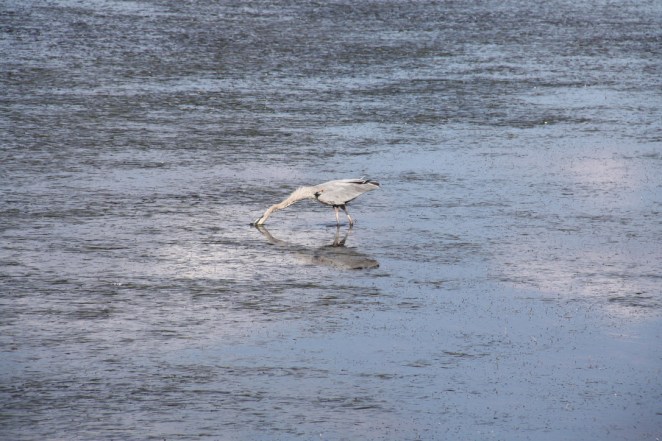
A great blue heron, half-buried in the sand, lies, covered in flies.
What words could I carve in sand beside his grave?
What words would I carve on mine? What could anyone say?
I guess I could say that I was happy, in spite of the pain, but would I do it all again?
Commentary:
I guess I could say that I was happy, in spite of the pain, but would I do it all again? – Good question, and I have no answer to that question. Is life circular? Do we pass on from existence to existence, learning as we go? Some religions think so. Do the participants and believers have a choice? That I do not know.
Would we, like the English cricket team currently in Australia, make the same mistakes again and again, never learning from each dismissal, never learning from the blows given to another’s body or head? All good questions. Or would we learn from each life, each circumstance, slowly ascending a sort of Platonic Ladder until we climbed to the highest level of perfection? Who knows? I most certainly don’t. Nor do I know where the light and the flame go when I blow out the candle.
So many mysteries, as the fate of my little bird was a mystery, as the fate of the fish in the first photo was also a mystery. Albert Camus – meurtriers ou victimes? Are these the only choices that we have, to be the predator or the prey? I most certainly hope not. Libre albedrío – free will in the Calderonian world of the seventeenth century in Spain. But how free are we? What cultural and developmental chains bind us, pull us down, and are we surrounded by our childhood and our culture, and our education, in such a way that we have little or no choice in how we think and what we do?
Answers by air mail, please, and tied to the back of a great blue heron, preferably the one in the upper photo, not in the lower one!
My very own hand-carved verraco Del Rincon (Avila) a Roger
Carved in Stone
1
Behold me here, filled with a sort of shallow, hollowed-out wisdom accumulated over decades while listening with my eyes to the words and thoughts of writers, long-dead.
Imprisoned in book pages, do they bang their heads against walls that bind, or hammer with their fists at the barred lines of their printed cages?
These spirits long to break free, but they choke on library dust and pollen from verbal flowers that bloom unseen.
Those old ones avoided the traps of temporal power, or, once trapped, gnawed off a precious limb to limp into freedom
Commentary:
Carved in Stone is the second dialog (Chronotopos II) in my Bakhtinian Dialogs with my time and my place. Clepsydra is the first Dialog. You can follow it, in its entirety, starting with this first, introductory post.
Reception Theory – I write, you read. Any meaning that you extract from my poetry will depend on your own culture and background. Tolle, Lege – Take and read. Read slowly, and with care.
I am a poet, a dreamer, if you will. These are my dreams. Tread softly on my dreams, for when you enter my world, you mingle your dreams with mine. The result, I hope, will be an interesting intellectual blend of new creativity.
The hand-carved verraco, in the photo above, was given me by my friends in the Rincon (Avila) where I spent four happy and creative summers. Never forgotten. Blessings and pax amorque.
The Red Zone: it’s a familiar concept. Monday Night football talks about it all the time.
“Success percentage in the Red Zone, offense and defense.”
It’s not just football. Other sports, soccer, rugby, have their red zones. So does life, my life, for better or for worse, and now I know I’m in the Red Zone.
I can see the goal line. I can feel the tension rising. I know the clock’s ticking down. I can sense it, but can’t see it. I no longer know the score, and I don’t know whether I’m playing offense or defense.
They tell me it’s a level playing field, but every day they change the rules, and today I wonder what the heck’s the name of the game I’m playing.
35 … to save myself I must grasp it firmly as I would a nettle not with my hands but with my teeth
but my hands are tied behind my back a cloth is bound over my eyes and I cannot see …
36
… I struggle and squirm until released I float ashore and stand on the sea wall calling out to the moon begging her not to hide her scarred face
I entreat the ebbing tide to carry me with it out to sea past the island beyond the lighthouse into deep water
waves stronger than any
thing I have known thrust rough fingers under my arms lift me up then drag me down
to the depths where I can finally rest in peace …
Commentary:
Mors omnia solvit – death solves everything. But does it? What about the crossword, the jigsaw puzzle, the unsolved ? What about the problem of life itself? What is it? How does it function? And what is that poor bird doing lying on its PEI beach half-covered in sand? What problems did he have solved?
” my hands are tied behind my back, a cloth is bound over my eyes and I cannot see” … so how can I tell where I am going and why I am going there? Simple questions – yet there are no answers, none that are given to me anyway. And who am I to reason why? Is my detiny, as always, to just do and die?
I do not know. The bird on the beach does not know. The ebbing tide doesn’t know, or care what it carries out with it. And what are we anyway? Why do we search for meaning in the meaningless? For answers in the absurd? And why does Sisyphus roll his rock up the hill, release it, then walk back down, pick it up and carry it up again? And why must we imagine that Sisyphus is happy? Our daily work – ce boureau sans merci – why should we be thankful for it? Because there is nothing else? Because otherwise we would be abandoned? Or just because?
Oh, ho-ho-ho-ho, tell me if you know, who the… where the … why …. the what for … where did that one go? Even poor old Alf and dear old ‘Erbet, somewhere on the Somme, didn’t know the answer to that one. And they had their little dugout made a mess of by a bomb. Well, at least they found another hole, but when that other shell went over, it left them still wondering! And don’t we all?
He told me to read, and plucked my left eye from its orbit. He slashed the glowing globe of the other. Knowledge leaked out, loose threads dangled. He told me to speak and I squeezed dry dust to spout a diet of Catechism and Confession.
He emptied my mind of poetry and history. He destroyed the myths of my people. He filled me with fantasies from a far-off land. I live in a desert where people die of thirst, yet he talked to me of a man who walked on water.
On all sides, as stubborn as stucco, the prison walls listened and learned. I counted the years with feeble scratches: one, five, two, three.
For an hour each day the sun shone on my face, for an hour at night the moon kept me company. Broken worlds lay shattered inside me. Dust gathered in my people’s ancient dictionary.
My heart was like a spring sowing withering in my chest It longed for the witch doctor’s magic, for the healing slash of wind and rain.
The Inquisitor told me to write down our history: I wrote … how his church … had come … to save us.
Commentary:
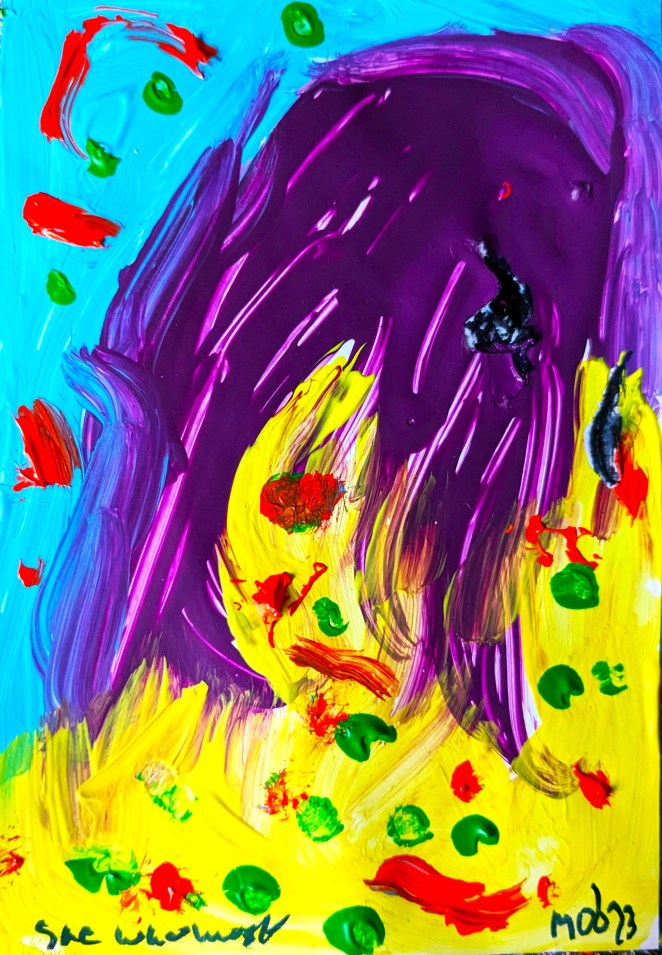
No wonder the little girl in Moo’s painting looks so sad. She must have read this poem and understood how the exercise of power and authority, be it religious or secular, can effect those upon whom it is exercised. Times change, but so many things remain the same. The pendulum swings, and it moves from chaos to order and back again. The meaning of meaning – how we define chaos and how we define order define who we are.
Birds of a feather flock together. Manners maketh the man. Wonderful sayings. But fine words do not necessarily make for fine men or women at that. Serpents and senators, both can speak with forked tongues. It is up to us to apply discourse analysis and distinguish between what they say and what they actually mean. As my friend Jean-Paul Sartre once said – “L’homme n’est rien d’autre que ce qu’il fait.” A man is nothing more than what he does. His deeds reveal his true inner self – and remember – the plumage doesn’t necessarily make the bird.
“Poetry explains itself. If it doesn’t, it’s inexplicable.” Pedro Salinas.
I entered this collection of poems for the Alfred G. Bailey Awad (poetry manuscript), WFNB, 2025. Alas, it did not win an award, but the judge, Kathy Mac, made some excellent suggestions as to how I might improve the manuscript. I have followed her advice to the best of my ability.
Carved in Stone is the second dialog (Chronotopos II) in my Bakhtinian Dialogs with my time and my place. Clepsydra, Chronotopos I, won third place in the Bailey Award (2025) and has already been published. I have one, possibly two, more Dialogs planned.
Reception Theory – I write, you read. Any meaning that you extract from my poetry will depend on your own culture and background. Tolle, Lege – Take and read. Read slowly, and with care.
I am a poet, a dreamer, if you will. These are my dreams. When you enter my world, you mingle your dreams with mine. The result, I hope, will be an interesting intellectual blend of new creativity. Pax amorque.
1
Behold me here, filled with a sort of shallow, hollowed-out wisdom accumulated over decades while listening with my eyes to the words and thoughts of writers, long-dead.
Imprisoned in book pages, do they bang their heads against walls that bind, or hammer with their fists at the barred lines of their printed cages?
These spirits long to break free, but they choke on library dust and pollen from verbal flowers that bloom unseen.
Those old ones avoided the traps of temporal power, or, once trapped, gnawed off a precious limb to limp into freedom.
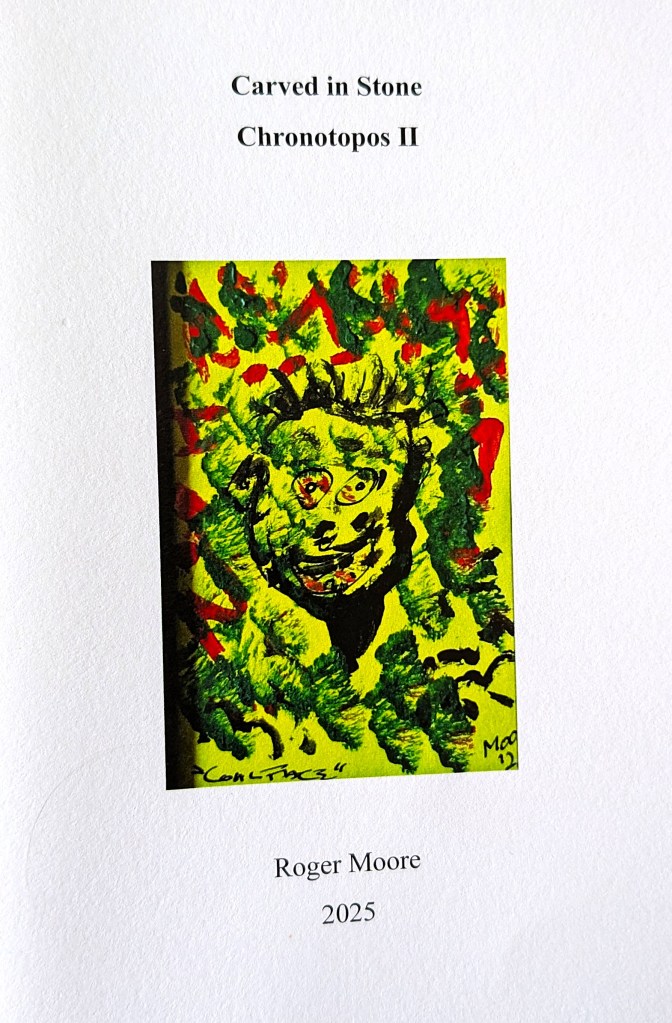
Comment: The cover painting, painted for me by my friend Moo when he read the manuscript of this book, is called Coal Face. It refers to the young Welsh boys in the Rhondda coal fields, aged 8-12 years old, who went down the mines to work at the coal face. This happened when the coal seams grew thin and only small children had the ability to work at the coal face and carve and mine the coal. Here are the relevant verses (44 – 45).
44
The old man, withered, last house on the left, leaning on his garden wall, coughing, spitting up coal dust and blood.
He’s not old, when you get close, just grown old, underground, where emphysema and pneumoconiosis devour men and boys.
He spits on the side walk. Mining souvenirs, Max Boyce calls them, and they appear every time the young man, turned suddenly old, starts to cough.
He can’t walk far, wearing carpet slippers, soft and furry, just leans on the wall.
He fell, or was pushed, into the trap at an early age, when the coal seams had grown so thin, that only a small boy could kneel at the coal face before the black altar of the underground god.
There, with a pick and shovel he learned to carve and shape those seams.
45
No candles burned at that altar. A single match, let alone a candle flame, would spell the end, if gas leaked from the seam.
Only the canaries, confined in their cages, sang songs.
Doomed, like the blind pit ponies, never to see the light of day, they lived out their lives down there.
So many died underground, unable to get out, buried alive, before they were even dead.
Clepsydra relates a process of identity loss, as time’s passing removes the people closest to the eroding narrator. Its consistent form – the manuscript is one long poem made up of 48 sections of varying length, each of which begins and ends with an ellipsis – provides a framework in which the narrator strives to describe how their sense of self drains away, drop by drop, the way the liquid in a clepsydra (a water clock) marks the passing of time. Amazingly, the poems convey existential dread through remarkably vivid and grounded images of things like “seals basking in sunshine, / knowing themselves, being themselves, / thinking themselves safe, / kings and queens of their seal-dom, / never questioning” (19) and “…an osprey, sudden, the swoop, / turned into a stoop, water shattered, total immersion, then emerging, / lusty thrust of wings, claws clasping, / prey imprisoned” (20). Sense slides in and around the sounds of the words as well as in their dictionary meanings. In Clepsydra the author rigorously plumbs a difficult subject: the loss of subjectivity.
Exhortation
Thank you for the privilege of reading your poetry manuscript, Clepsydra. I was quite taken with all of its virtues: a meaningful concept, carried out in an impressive form which is followed both rigorously and nimbly in each section.
Introduction
The National Museum of Wales, in Cardiff, had a working Clepsydra that fascinated me. School children could enter free, and every week day, during the school holidays, I would visit the museum and also the Clepsydra.
I have built the structure of the Clepsydra into the verses of this book. The words flow down, from left to right, just like the waters of the Clepsydra. Sometimes they overflow the line, and sometimes they hold back, just a little. This visual construction fortifies the idea of the ebb and flow of time, water, and memories.
I first met the poetic image of the Clepsydra in the poetry of Antonio Machado – No temas. Tú no verás caer la última gota que en la clepsidra tiembla. / Never fear. You will not see the fall of the last waterdrop that trembles in the clepsydra. I have, for better or for worse, repeated this theme throughout the poetic dialog.
I would like to thank the judge, the poet Kathy Mac, for her comments and her excellent suggestions. I have followed most of them in this revision of the original manuscript. My thanks go to all who have read Clepsydra at one time or another.
Clepsydra
1
… time, and my own place not this dry museum filled with dust
its ghosts, running rampant, raging silent over ancient artefacts
the clepsydra dreaming time like its liquid slipping through clay fingers
runnels of water ebbing flowing continually running down
earthen-throated its hour glass structure
each terracotta bowl lower than the one before
a mini-cataract a constant waterfall second by second time dwindling away…
I have a question for you. Recently I purchased a book by Forrester- The African Queen. I enjoyed the movie years ago and thought I would like to read the story. The main actors were great. The book highlighted that it showed what it was like being a female during the war, (1) which when I look back on now is one of its main points.
My question or thought on this book is tied around the library system. When I lived in Fredericton I wanted to give a bunch of books to the library, their first question to me was, “How old are the books? I told her and she said anything over five years in not being accepted. (2)
I wondered about this and the fact that many books in school are being removed, (3) how can we tell how much we have progressed? (4)
I don’t like prejudice but it seems we are throwing out too much. (5) Any thoughts on this. I don’t mind some of the history being trashed (6) because for Canada the consentation is for Quebec and Ontario.
Roger’s Response
(1) It’s also about the role of the nun in society. How do ‘holy women’ function in a male society? It sets some of the many questions we are now being faced with, but doesn’t really give any answers. It’s a long time since I saw that film. I don’t think I ever read the book – the themes might well change in print. They are present (some of them) in The Handmaid’s Tale.
(2) The library system seems to have rules and an etiquette all its own. When I donated books to the library, they accepted some for their collections, but set others up for sale on the book tables by the door. My guess is that certain books are ‘best sellers’ and will be read, others are ‘dust gatherers’ and won’t be. They want the former, not the latter. They also have specialized collections. If the books fit the specialized collections, great. If they don’t, then they hit the unwanted category and are moved on. This is particularly true of the UNB Library System.
(3) This is an entirely different question, and one with very deep roots. It deals, in part, with the question of control – quis custodiet ipsos custodies – who shall guard the guards, who shall program the programmers? By controlling what people read, you control their thoughts. One of the worst signs of this was the book burnings of the Spanish Inquisition (15th – 16th – 17th centuries). The Jews were expelled from Spain in 1492. (And the Arabs / Moors, in 1609). Prior to that, these people were ‘processed’ by the Inquisition. The original Inquisition was Papal, aimed at instructing the priesthood in Rome in how to interpret the Catholic Catechism. It was corrupted in Spain (under Fernando and Isabelle) by the Spanish Inquisition, a sort of secret police, which worked rather like the Gestapo in WWII. One of their jobs was to ensure that people who had converted to Catholicism, to avoid deportation, stayed converted and didn’t revert to their old religion, even in secret. Another was to ensure that reading material, religious material, and cultural material, particularly after 1527 (Martin Luther and his 97 theses) when the Reformation started, were all in line with the accepted Catholic thoughts of the time. All books about to be published were sent to the Inquisitorial Censor who vetted them and either approved them, or asked for changes. If he (they were all men) saw the slightest sign of dissent or heresy. Don Quixote, Book One, Chapter Six (DQ,I,6), deals with the book burnings of DQ’s personal library. In certain of the States (down south) books are already being banned. A similar ban, in certain States, that touches us closely, is the banning of Margaret Atwood’s The Handmaid’s Tale.
(4) “There is no earth, no heaven, no extended body, no magnitude, no place and that nonetheless I perceive these things and they seem good to me. And this is the most harrowing possibility of all, that our world is commanded by a deity who deceives humanity and we cannot avoid being misled for there may be systematic deception and then all is lost. And even the most reliable information is dubious, for we may be faced with an evil genius who is deceiving us and then there can be no reassurance in the foundations of our knowledge.” René Descartes (1635)
Descartes expresses this much better than I can. It is one of the major dangers of the age in which we live. How do we distinguish between reality and alternate realities? Which reality is the real reality? What is, or isn’t, fake news? How do we tell? Who do we believe? And why do we believe them?
(5) Another part of the problem is that ‘certain people’ – who don’t believe in science and who exploit people’s scientific ignorance to their own advantage – are willing to destroy the foundations of our knowledge. Burn everything down, they say, and start again. The new starting point is to impose what they believe upon everybody around them. This is a huge and crucial problem that threatens us, as individuals. It also threatens the foundations of our knowledge, as well as the very world in which we live – climate change vs denial of climate change – profits over people, versus government of the people, for the people, by the people. Once one starts asking such questions and looks at the AI systems with their immense persuasive powers and their seemingly uncontrollable spread of Mis-information and Dis-information, then one starts to realize how serious the problem is.
(6) Those who ignore history are doomed to repeat it – Santayana (the Spanish philosopher, I think). However, we must, in certain circumstances, adjust our current beliefs to current realities. Immigration is a major issue – as is how we deal with people, like me, who come from different cultures and beliefs? Not everything written in the past suits our current world view.
I have been looking at old Westerns – “The only good injun is a dead one” (John Wayne). Really? I know some wonderful people in our first nations communities and I have taught them and worked with them and have often been taught by them. “Shoot first and ask questions afterwards.” Really? I won’t comment further on that one, without reflecting on the number of automatic weapons floating around in our socuiety. So many people are being killed by them.
All of this comes down to the big question – freedom of information or the release of just enough information to persuade other people of what we believe and what we want them to believe. Power and Control. Knowledge is Power – Michael Foucault. Control that knowledge and you have power over the people. Noam Chomsky has written widely on this – and his books have been banned in the USA. Bertrand Russell too – The Meaning of Meaning, for example, and his establishing – along with A. J. Ayer – of the doctrine of logical positivism – the removal by means of mathematics of all the emotional content of words.
My friend, you have opened a can of worms. Long may they wriggle and squirm.
A double meaning of course / wrth gwrs. (a) to be in a place of grief and (b) to do something in place of grief i.e. instead of grief. Take your pick. One of my close friends immediately called it Chains. I replied – Ray Charles – “Take these chains from my heart and set me free.” Sometimes, with a great effort, we can do that ourselves. But, if the hole we have dug for ourselves, or that has been dug for us, is too deep, then we may need help.
Creativity is always a help. Painting and poetry, for me. And sometimes the hand of friendship, reaching out from the anonymity of hyperspace – the space beyond the space in which I live and with which I hold my Bakhtinian Dialog what he calls my chronotopos – my dialog with my time and place. Alas, sometimes it is a monolog – and then, when I get not reply, either from time nor from place, I feel an existential grief.
Door
A door slammed shut in my heart.
That closed door left me outside, shivering in the cold.
Now I no longer know who or what I am.
The shadow of nothingness wraps its black shroud around my shoulders.
Dark night of the heart, and me alone, walking an unlit road with no end in sight.
(a) The shadow of nothingness is Meister Eickhard’s Umbra Nihili. A reference to the medieval philosopher.
(b) The dark night of the heart is a reference to St. John of the Cross’s dark night of the soul, part of the Via Purgativa, the mysterious road walked by the Mystics.
“You can’t write about life if you haven’t lived it.” Words of wisdom from the poet who wrote The Old Man and the Sea.
“But,” I hear you say, “what did he know about writing? He never took any courses that taught him how to write, nor held a certificate from a prestigious school that guarantees quality. Nor was he a poet, he only wrote prose.”
And yet, the prestige of that ivy-covered, ivory tower leads poets… I pause for a moment… – to where exactly? Into debt, of course, and also down the paved path of their own destruction.
What kind of life do they live, those writers, who only exist within their cerebral boxes, and never step outside them unless they are ordered to build an even bigger box?
Have they walked with street-walkers in Madrid? Have they sat beside the poorest of the poor, in Oaxaca, shivering in thin cotton clothing beneath falling snow? Have they visited Madrid’s Plaza de España, stepping high to avoid the blunt, bloodied needles, shared, to take away the pain? Have they pan-handled in Yorkville or slept in sleeping bags, by the Royal York, in the snow, at 40 below, on the gratings above the Subway?
“The unexamined life is not worth living,” some say Socrates said. But what I think is ‘the unlived life is not worth examining.” Tear down the walls that inhibit and limit you. Go out into the world and see what others see and feel. Only then, come back, stab your pen into your veins, fill it with your blood, and set before us what was done to you, what you experienced, how you survived, and what you felt.
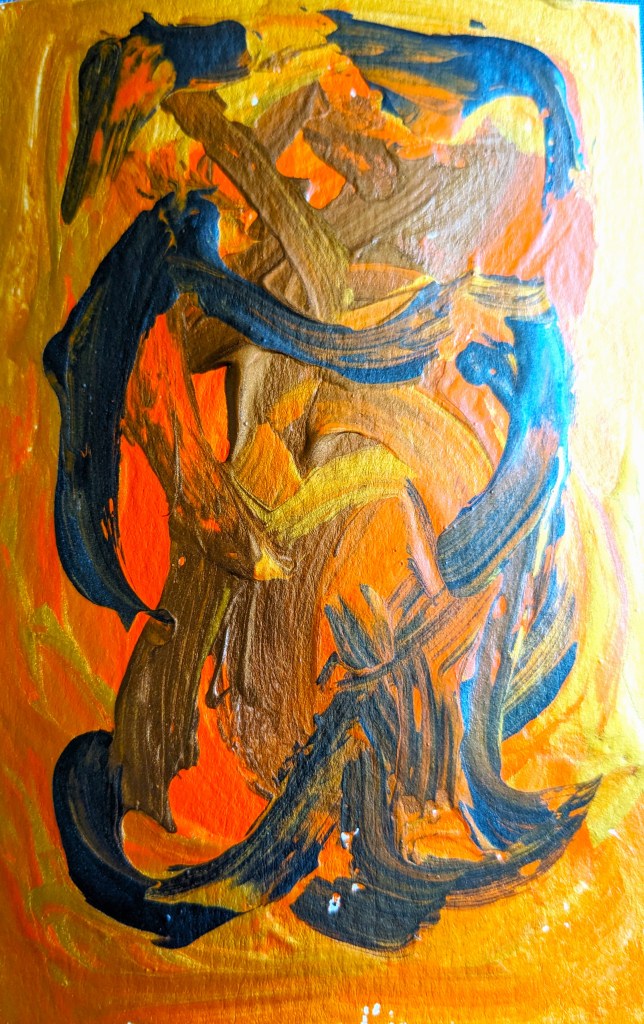
Comment: Once again I thank my friend Moo for his illustration – Building Bigger Boxes. It goes well with the theme of this rant, or is it a poem? A verbal rant to echo a visual rant, perhaps, or vice versa.





 rogermoorepoet