Things


Things

I fumble in my mind for things
long lost in an upper attic.
I can no longer read the words
I wrote. What does this mean?

At night I dream of things
beyond my reach. My fingers
clutch but cannot clasp
those clouds that clutter.

Who, oh who, the owl cries,
can free the mice that nibble
through my mind and set me
gnawing at my own soul?

Once upon a time, a long
time ago, I thought I saw light
at the end of the tunnel.
I travelled on a ghost train.

The light I saw was a gaslight
ghosting my mind with fictional
fantasies of an illusive kingdom
that would never be mine.

Elusive, these memories of things
that never were, but might have been.
Will o’ the wisps dancing shadows
on the salt-marsh of my unknown life.

Commentary:
Memory loss. I guess it happens to all of us at one time or another. One of my long-lost friends visited yesterday and between us we could hardly put two consecutive memories together. Every other sentence was punctuated with a pause – ‘Now, when did that happen?’ ‘What was his name? I can’t remember now.’ ‘Me neither.’

I am not particularly worried by such happenings. I am a poet and a story-teller. Sometimes, I forget the truth – so what? – I just go ahead and reinvent it, tickling it here, sticking a spot of paint there, adding a word or two, or a magic moment. I often remind myself of Oscar Wilde when he created a magic moment of verbal ingenuity – “I wish I had said that, Oscar.” “You will, Roger, you will.”

Best of all, even in those moments when personal memories fail me, literary magic returns. I think of Dylan Thomas and his words spring to my mind – ‘time has ticked a heaven round the stars’. Wonderful. Or Francisco de Quevedo ‘soy un fué, y un será, y un es cansado.’ / ‘Tired I was, tired I am, tired I always will be.’ My own translation from the summer of 1963 when José Manuel Blecua introduced me to the poem, or rather Blecua introduced the poem to me, in that summer’s courses of the UIMP.

So, according to this theory, even when you feel lost, you are never really lost, because there are an enormous number of people living inside your head, who who will step out from the shadows, when needed, and give your memory a little boost. But don’t get too carried away. Think too of José María Valverde and his poetic premonition: ‘Pobres poetas de hoy, destinados a ser polvo seco de tesis doctoral.’ / ‘Poor poets of today, destined to be the dry dust of doctoral theses.’ (My translation).

Dust to dust and ashes to ashes – ‘Serán ceniza, pero tendrá sentido. Polvo serán, pero polvo enamorado.’ Quevedo, of course. But you didn’t need me to tell you that. You might need me to help you with the translation, though – ‘Ashes they’ll be, but ashes with feeling. They will be dust, but dust that burns with love.’ (My translation, with a little bit of exaggeration [sorry, don Francisco!] just at the end.)

Where did my mojo go-go?

Where did my mojo go-go?

Wow! My first post since January 8, 2025. What on earth has happened to me? Good question – I just don’t know.

Today’s painting, from the last day of 2024, is taken from The Idylls of the King, Tennyson. “The olde order changeth lest one good custom should corrupt the world.”

This quote is used in my Old Boys magazine at the end of each school year when the students leave the college and go out into the real world. This happened to me in 1962 – 63 years ago. Certainly I changed, and for the better, without the college. Whether the college changed or not, in my absence, I really don’t know. I suppose it did. It became co-educational, quite the thing for a boys’ boarding school. It expanded into larger grounds. It tore down at least two of the old houses, including the one in which I boarded for four years. I read about these things, but I have only been back on one or two occasions, so I don’t really know. And living in Canada, I rarely see any old boys from the school. They don’t cross the pond to visit me.

I receive the old school magazine regularly, by e-mail. However, I no longer recognize faces or places, unless the places are totally unchanged since I was there. And not many of them are. The most important page for me has become the obituaries, and I study with care those who have passed on before me and those who remain. I grieve when I see the names of old friends. But I grieve even more when I see the names of people so much younger than me falling by the wayside.

As for that mojo of mine, well, I guess that writing on a regular basis has become more and more difficult. “Don’t sit with your head in your hands thinking of time past,” says the Spanish poet. Yet time past seems preferable, in many ways, to time future. I am beginning to feel a bit like a pin-cushion, on account of all the needles now being stuck into me. Perhaps that’s where all my mojo went? Still, for anyone interested, I am still here. Still happy. I am working on my latest novel and I have two books of poetry waiting to be published. So maybe my mojo hasn’t done a bunk, just my blog mojo! I shall have to kick start it. Or maybe I’ll get that little yellow duck who wears blue gumboots to stand on a brick and give me a hearty booted boost. Yup! That should do the trick.

And so, in the words of Dylan Thomas, “I’ll take a bow, and say ‘good-bye’ but just for now.

What public figure do you disagree with the most?

Daily writing prompt
What public figure do you disagree with the most?

What public figure do you disagree with the most?

Some definitions please. What is a public figure? There are several statues in my local park. Are these public figures? If they are, how do you, or I, disagree with them when they can’t reply to our questions? Their mere presence, is that enough? Their historical past? Their figures now cast in bronze or stone? The crimes they committed (in our current opinion) from a time in which they did good (their society’s position)? “Judge not lest ye be judged!” We are all walking on thin ice and I do not wish to be the one who casts the first stone.

What is a public figure? A politician – provincial, regional, national, international? A TV personality? A film star? A rapper? A musician? A teacher? A preacher? A newscaster? A hockey player? A baseball star?

And how do you define disagreement? How do you disagree, and in what ways, with Beethoven’s Ninth Symphony and the Song of Joy, even if you are a Beatle and can sing “Roll over Beethoven” or mimic it on a Tuesday night in the local bar at a Karaoke show?

How do you define the most without defining the category and nature of disagreement? Mozart vs Bach vs Beethoven vs Vaughan Williams? Wordsworth vs Byron vs Donne vs Dylan Thomas? So let us go back to the beginning, and ask again “What is a public figure?” “How do you define disagreement? And how do you categorize “the most”?

Goya vs Velasquez vs Turner vs Dali vs Picasso?

“What’s the definition of Baroque?” “When you’re out of Monet.” Come on, you’re joking, aren’t you. “You’re having me on, aren’t you? You’re having me on.” “Pull the other leg. It’s got bells on.”

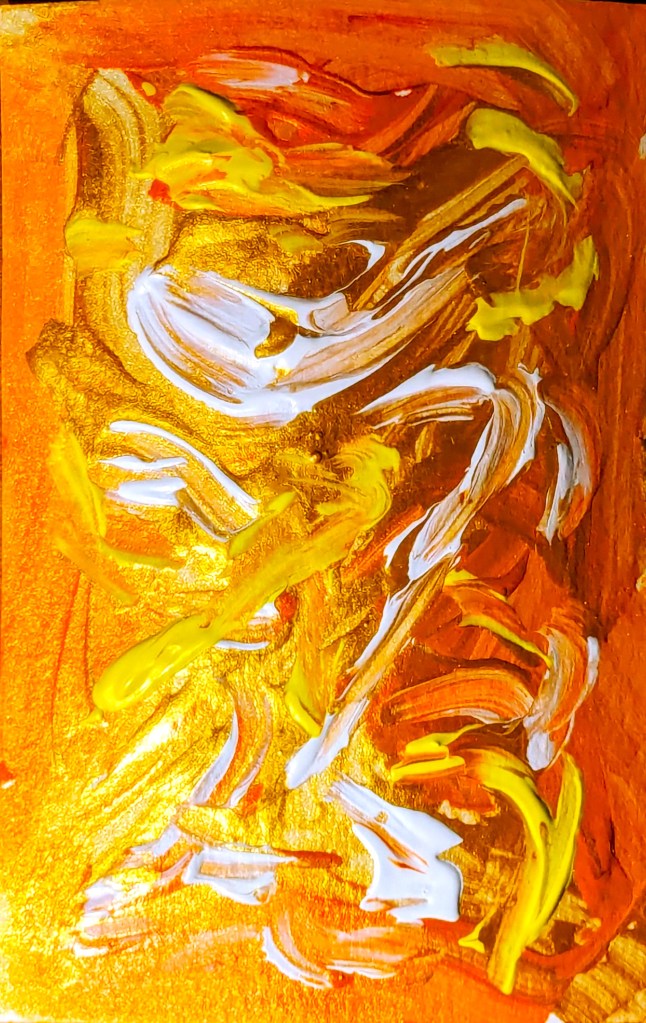
And I offer a nod of gratitude to The Two Ronnies and my good friend, Moo, who painted the painting that leads into this blog. He called it “In search of enlightenment.”

And no, I don’t disagree with him. But is he a public figure? Or just a figment of my imagination? And if he is a figment of my imagination, what, dear reader, are you?

Who are your favorite people to be around?

Daily writing prompt
Who are your favorite people to be around?

Who are your favorite people to be around?

Creatives – because creative people need support in their creativity and need to believe in themselves and in their creations. I wrote two days ago about Rejections and Silence – while both are needed by creatives – rejections to help perfect and polish – and silence in which to create – too many rejections and too much silence can result in alienation, depression, and the suppression of creative acts.

“We few, we happy few, we band of siblings!” Not quite what Harry said before the Battle of Agincourt, yet can we, the readers, be absolutely certain that what Shakespeare said he said was actually what he said? But we share the spirit of creativity with creators big and small, famous, infamous, and struggling. That is why we need to band together, to support each other, and to ensure that creativity isn’t killed by the straitjacket of a nine to five job, or longer, or the multi-employment that has become so necessary just to survive in our diminished and diminishing world.

“What is this life if, full of care, we have no time to stand and stare?” wrote W. H. Davies, one of the great Welsh poets. And he concluded this poem with a parallel couplet: “A sad life this, if full of care, we have no time to stand and stare.”

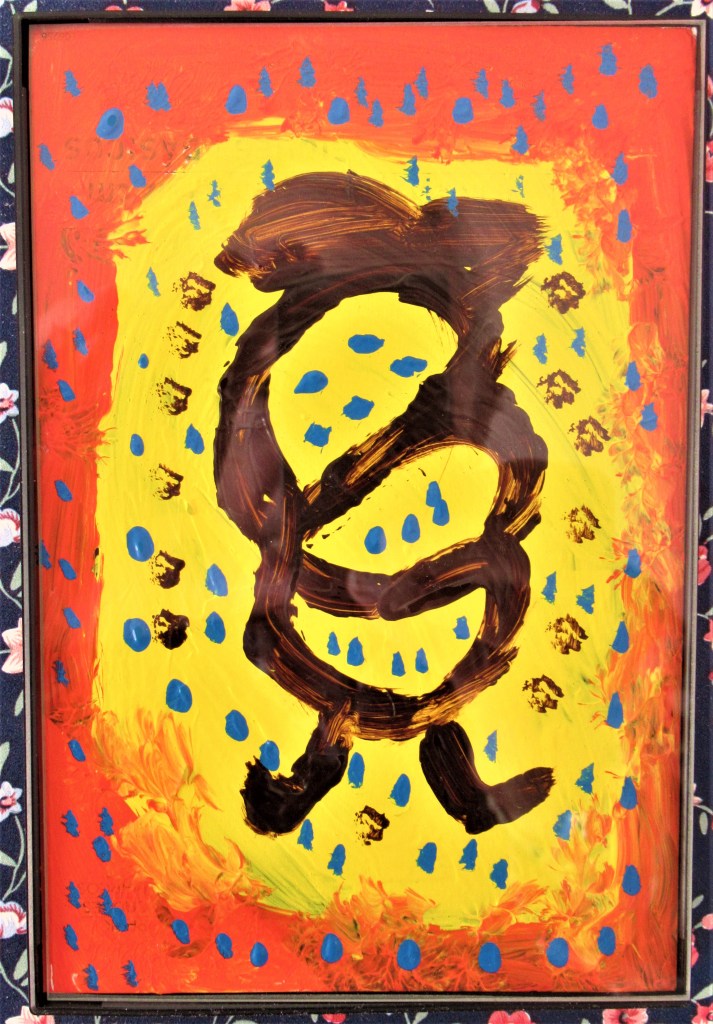
I hope you like the painting that heads this prompt that is turning into a joyous rant. It is by one of my creative friends, the poet-painter Moo. He calls it Spotted Coppers and he painted it last night after watching the Midsomer Murders episode that dealt with the theft of valuable Spotted Copper Butterflies. Intertextuality – one text leads to another, and the butterfly becomes a TV episode becomes a painting by a friend becomes a rant prompted by my computer and written by me.

That is the circle of creativity and it blends into the circle of friendships, and creative artists are both competitors and friends, for “whether creativity survives or no, I’m sure is only touch and go.” Another line that another great Welsh poet, this time Dylan Thomas of Swansea, might almost have said.

So, who are my favorite people to be around? Creative people, of course, with all their passions, energy, warts, flaws, and their constant need of encouragement and support.

What relationships have a positive impact on you?

Daily writing prompt
What relationships have a positive impact on you?

What relationships have a positive impact on you?
I think one of my poems answers this question best. I write “one of my poems” but it is really my ‘free’ translation of one of Francisco de Quevedo’s sonnets – Retirado en la paz de estos desiertos. I have changed the poem slightly, but I am sure Don Francisco (1580-1645) will excuse Don Roger’s impoverished effort (2023).

On Loneliness
29 December 2023

Resting in the peace of these small rooms,
with few, but welcome books together,
I live in conversation with my friends,
and listen with my eyes to loving words.

Not always understood, but always there,
they influence and question my affairs,
and with contrasting points of view,
they wake me up, and make me more aware.

The wisdom of these absent friends,
some distant from me just because they’re dead,
lives on and on, thanks to the printed word.

Life flits away, the past can’t be retained.
each hour, once past, is lost and gone,
but with such friends, I’m never left alone.

The painting, by my friend Moo, is called Fiat Lux – Let There Be Light. It is reminiscent of Dylan Thomas’s poem, Light breaks where no light shines. Intertextuality – Quevedo drew inspiration from the Stoics. I drew inspiration from Quevedo. Moo drew inspiration from Dylan Thomas. The nature of creativity and its continuing links throughout the ages shines clearly through these wonderful associations.

We’ll rant and we’ll roar…

We’ll rant and we’ll roar

Rant, I say, rant and rage away, rage, rage against
the death of friendship, and loathing built now
on what was once holy oath and undying love.
This is a blood sport where even the spectators
are spattered with the refined frenzy of friends
turned into fiends and foes, and this is a protest,
a rant against love that doesn’t last, that doesn’t stand
the test of time, against families that break up,
against a society that breaks them up, driving wedges
and knives between people once bound
by the puppet strings of love, against relationships
that can no longer continue, against the rattling
of dead white bones in empty cupboards where skeletons
dance their way into legal daylight and the spectators
 call for more: more blood, more money, more blood money,
and the engagement diamond is a blood diamond now,
a tarnished garnet, and where is the Little Old Lady
of Threadneedle Street, that spire inspired needle
that will stitch their world back together,
and stitch you back together when you’ve been shocked
out of your own ruby-sweet rose-tinted world
and torn into little bits in their oh-so-bitter one,
the biters bitten and those bitten biting back in return,
 a new world this world of snapping turtles,
turtles standing on the back of turtles, and turtle after turtle
all the way down until this carnival world puts down
its dead clown mask and turns turtle in its turn.

Comment: My thanks to Brian Henry for publishing this on Quick Brown Fox.

Click here for Roger’s reading on Anchor.
We’ll rant and we’ll roar

Into the Sunset

Into the Sunset

So, the writing is back. I have reformatted The Nature of Art and the Art of Nature and am now checking it through one last time before I send it to the publishers. This feels good. I haven’t stopped painting though. Luckily the original, hanging on the wall, looks better than the photo. My angles are all wrong and the colours are definitely not as sharp as in the original. As I always said, when introducing Spanish Art via slides and photos: “Do not trust the imitations. Go back to the original.” Easier said than done, especially when the original may be tucked away in a foreign museum hidden in a small town. As Dylan Thomas once said of Swansea Museum: “it’s the sort of museum that ought to be in a museum.”

As for the Introduction of Art, and please note I do not write ‘the teaching of art’, here’s my article on my career as an art facilitator! ‘In the beginning was the picture and the picture was in the book.’ I guess my art career ran parallel to my career as a facilitator of Spanish literature, prose, theatre, and poetry. Some things you can present and introduce. But no, you cannot teach them, not unless you are completely without humility and understanding.

Now that’s what it is meant to look like!

Intertextuality

Intertextuality

Wednesday Workshop
25 August 2021

            This is another academic word that has a simple meaning. In essence, it means texts talking to texts. Quevedo (1580-1645) writes escucho con mis ojos a los muertos’ / ‘I listen with my eyes to dead men.’ He is suggesting that, each time we read a text written by another person we enter into a dialog with that text and that author. His metaphoric conversations with the writings of the long-dead Seneca become intertextual the moment he put pen to paper and wrote about them.

This intertextuality is a key component of my writing.  You may not recognize all the phrases that I have used previously by other writers. I do. Some other readers will. Just take, as an example, the titles of some of my earlier books. The title of Broken Ghosts (Goose Lane, 1986) comes from these lines penned by the Swansea poet, Dylan Thomas (1914-1953). ‘Light breaks where no sun shines; / where no sea runs, the waters of the heart / push in their tides; and, broken ghosts with glow-worms in their heads, the things of light / file through the flesh where no flesh decks the bones.” Stars at Elbow and Foot, the title of my Selected Poems (Cyberwit.net, 2021) was also inspired by one of Dylan Thomas’s poems. “And death shall have no dominion. Dead men naked they shall be one with the man in the wind and the west moon; when their bones are picked clean and the clean bones gone, they shall have stars at elbow and foot.” The title of Though Lovers Be Lost (Kindle, 2016) also comes from this same poem, one of my favorites, obviously.

Sometimes readers are aware of these intertextual clues that I sow throughout my poems. Sometimes not. It doesn’t matter. There is a resonance in such chosen words and that resonance is there, irrespective of whether you are aware of the word-source or not. That said, the recognition and acknowledgement of intertextual relationships expands the poetic meanings of the creative world even further. It also establishes verbal links between author and author, epoch and epoch, genre and genre, thus establishing a wider intertextual network and a stronger chain of linked literary thoughts and meanings. In our creative journeys, we rarely walk alone, whether we are aware of it, or not.

The art of writing poetry about paintings is known as ekphrasis – which basically just means a verbal description of a visual work of art, whether it’s real or imaginary. The conversion of the visible (painting) to the printed page (verbal) is another link in the great chain of intertextuality, for paintings, too, are narratives with a different form of text. Other component parts are audible to verbal (alliteration, onomatopoeia), touch and feel (tactile) to verbal (as in synesthesia or the mixing of the senses) and the transfer of taste to verbal forms. Many of these transitions and transformations are present, not only in my own poetry, but in surrealism (verbal and visual) as well.

On Being Welsh

On Being Welsh
in a land ruled by the English

On Being Welsh
in a land ruled by the English

is available at the following links:

https://www.amazon.ca/dp/9388319842

https://www.amazon.com/dp/9388319842

A shortened version of this manuscript was awarded first place in the David Adams Richards Awards for a prose manuscript by the Writers’ Federation of New Brunswick, 2020.

Individual stories have been published in Anti-Lang (M. T. Head), West Coast Short Story Slam (Teeth), and on commuterlit.com (Remembrance Day).

Individual stories have won awards as follows: Butterflies (Honorable Mention, Atlantic Short Story Competition, Writers’ Federation of Nova Scotia), Auntie Gladys (Finalist, Wordfeast NB, Postcard Stories), Message in a Bottle (Honorable Mention, WFNB Creative Non-Fiction), The Key (Finalist, CBC Short Story Competition), Letting Go (First Place, WFNB Douglas Kyle Memorial, short story).

I would like to thank Lucinda Flemer, Primum Mobile, the first mover, who brought together the KIRA artists and turned them into a creative community. These artists include Geoff Slater and Chuck Bowie, both of whom have influenced the writings in this book. A special thank you must go to Ginger Marcinkowski, my Beta reader, who really deserves an Alpha Grade for all her help and understanding.

I would also like to thank Dr. Karunesh Kumar Agarwal (Managing Editor) Cyberwit.net for his editing skills and his invitation to participate in this poetry series.

Donna Morrissey, award winning Canadian author and judge of the 2020 D. A. Richards Award, wrote the following about my winning submission.

Judge’s Judgement: “This writer’s prose is eloquent, lyrical and beautiful. His stories are disturbing and memorable. It is an evocative journey through the deeply seeing eyes of an old man, and back through his tormented and deeply felt self as a beaten boy. There were times I held my breath against his suffering, and times I applauded his courage to keep on living. At all times I was held by the strength of such writing as would allow me those sparse and limited visuals to the bruising of the flesh whilst leading me directly into the tendered heart. Congratulations.” 

The Story: Set in Tara Manor, a boutique hotel in St. Andrews, New Brunswick, the narrator searches for a story he can write. He rejects the stories and myths of other people and indigenous races, only to discover that he must be the subject of his own tale. It is a story of childhood abuse, first at the hands of his own family and then in Catholic and Protestant boarding schools in Wales where he was sent at the early age of six. It tells of a growing self-distancing from the world, including self-harm and attempted suicide, and then of self-discovery, understanding, and self-forgiveness, far from his Welsh homeland, in the Maritime beauty of Atlantic Canada.

Editor’s Comment: No doubt, here in these poems we are impressed by the ease and strength of the rhythm. Several of these poems show the passionate flight of profound imagination. The poems have poignant force of true feeling. All poems are irresistibly powerful.

Author’s Comment: Poems or stories? Both really, for On Being Welsh is composed of poetry written, not in verse, but in prose. Prose poems then, or poems in prose. How could I write anything but poetry when I come from the same town in Wales as Dylan Thomas and Vernon Watkins. I too was born with music in my heart and poetry on my lips.

On Being Welsh

On Being Welsh in a land ruled by the English

This is now published and in my hands. I do not yet have full details on links and where and how to purchase, but I will put them up as soon as I have them. Meanwhile, I am grateful to my cover artist, who always does such a great job, and to my editor, Dr. Karunesh Kumar Agarwal (Managing Editor) Cyberwit.net. What a pleasure it has been to work with him. The cover picture, incidentally, is An Only Son.

I am now working on my next book, Stars at Elbow and Foot. I am sure many will recognize the title as coming from a line of a man born in the same town in Wales as I was: Dylan Thomas. The island in the picture is the only Island visible in Island View, incidentally. Alas, I do not have a picture of my cat, though I may put one on my next cover.

Ah yes, time to celebrate. I guess we’ll open a barrel of wine tonight. Hopefully we won’t finish it one sitting. I’d be lying if we did. This incidentally is the bodega where I got baptized. If you haven’t got baptized in a Spanish bodega, you haven’t lived. I’ll tell you about it sometime. How I miss that verdejo! Unfortunately, the verdejo didn’t miss me, and that’s how I got baptized. ‘Ya te hemos bautizado!’ “Que sea yo, y no el vino.” And if you understand that, you speak pretty good Spanish or Spanish pretty good … and you probably have an evil mind, just like mine.

Here I am, on the sea-shore, selling C-shells and thinking about my evil mind. But remember, my evil mind is mine, and it’s a one-of-a-kind. You go and find your own. And watch out for those Saint John C-gulls.

Go on, buy one and read it.
I dare you.