F-f-f-all

IMG_1337 (2).JPG

F-f-f-all

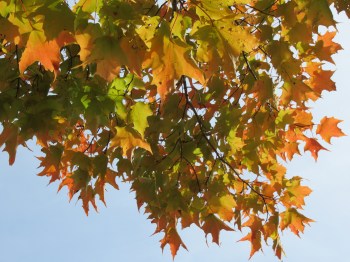
Not as good as the real thing, but the best I can do in five minutes with a set of felt pens. I am bewildered by the presence of so many colors, sometimes on the same tree and there are not enough pencils in y pencil box to do anything other than approximate.

IMG_1287.JPG

The light is incredible. Sometimes the tree seems to have stored all the summer sunshine in its leaves and, rain or shine, the light comes pouring out to enlighten us.

IMG_1283.JPG

And those reflections … the Beaver Pond doubles the color, turning the trees upside down and fragmenting their foliage, this way, that way. Pointillistic at one point, impressionistic at another, almost never cubist, although we can sense tilting planes in this upside-down surreal world that leaves us snatching at each new imposed reality of color and light.

IMG_1329.JPG

Stand beneath the trees. Look up through those leaves. Watch the light raining down, glimpses of blue between the orange, red, yellow, green and tawny leaves. I don’t have enough names for their colors. Green: what is green, what does it mean? I can see it, feel it, crumple it between my fingers if I am quick enough to catch a falling leaf … but what is it exactly, and what does it mean?

IMG_1318 (2).JPG

Espejismo and doble espejismo: the viewing of the world through a mirror, understanding what is a shadow and taking it for the real thing. And here, the shock of each red leaf turned into a shark’s bite of blood within still waters. Two worlds really: the top half normal and the bottom half turned upside down, leaf turned to color and color turned to a crimson streak.

IMG_1318 (3).JPG

There, see, catch them quick before they are gone, these autumn northern lights, this floating aurora borealis, this word picture trapped in these oh-so clumsy, oh-so fragile, oh-so imperfect words. Perfection, imperfection, and words and pencils shuffled to create the unreality of an autumn dream.


On Editing

IMG_1095 (2).JPG

On Editing

Some editors are really very good. They take the initial idea of the artist and polish it, turning what was an average piece into a great one. Others are not so good and turn an average piece into an automatic rejection.
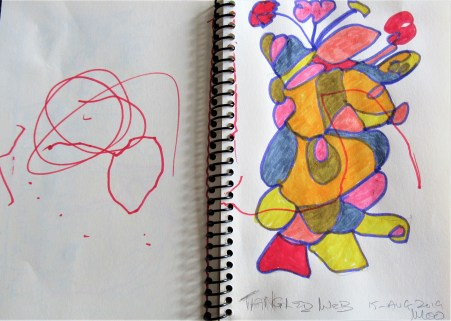
On my kitchen wall hangs a line-painting by Geoff Slater representing one of last year’s hollyhocks from my garden. He gave it to us as a Christmas present, and I am very proud of it. Finley loved it too. She followed with great glee the white line that starts and ends Geoff’s painting. Then she stared at me.

“What are you doing?”
“I’m writing a story.”
“What’s it about?”
“A thin red line.”
“Oh!”

A little bit later, I saw my pens and pencils strewn across the table. My sketch book lay open and I noticed that an editor had edited some of my work. My thin red line had morphed from illusion to reality and there it lay, twisting in and out of the tangled web I had created the day before. Clearly, my average creation needed the touch of a four year old editor and apprentice line-drawer to move from average to genius.

Oh the joy and creativity of a four year old! It took Picasso nearly fifty years to learn to draw like that again. And here’s another painting by this prodigious four year old. I got this one for Christmas last year, too. Alas, it is not signed.

“Don’t you want to add some more?” My daughter asked her daughter.
“No. It’s finished.”
And so have I.

IMG_0228 (2)


On the beach

On the beach


IMG_0564 (2)

IMG_0565 (2)

Comment:

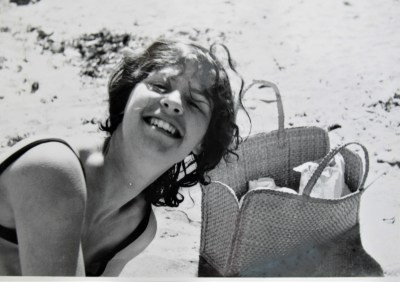
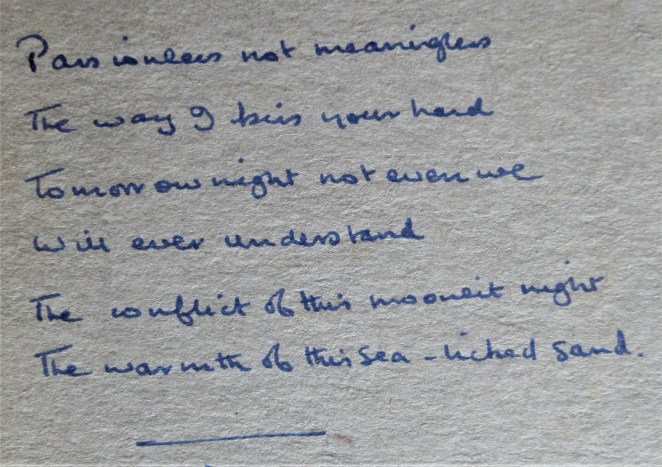
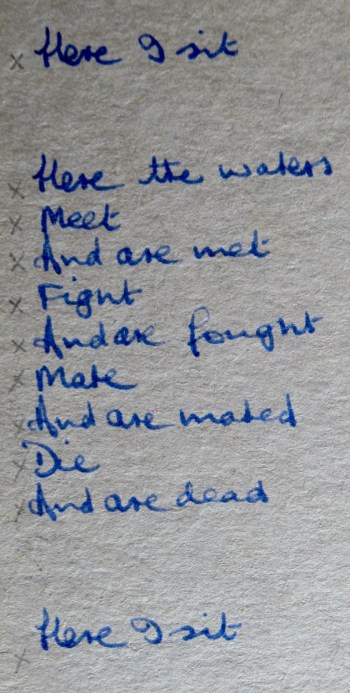
A daylight photo and a moonlit poem: I wonder how that came about? I guess we must have been beach-combing in the moonlight. It’s so long ago that I have forgotten the links between photo and poem. That said, Clare and I had spent a couple of weeks together in Santander (Spain) the previous summer, when we got engaged.

‘O bahía de Santander: tan bella bajo la luna’ / “oh Bay of Santander, so beautiful beneath the moon” as the Santander poet Gerardo Diego writes. And yes, Santander under a full moon: Mataleñas, the Segunda Playa, Jardines del Piquío, La Magdalena, the Bay of Santander itself, with Peña Cabarga in the background … there is something about beaches and midnight and moonlight which transcends the warmth of a summer’s day. It’s a sort of Midnight Magic that creates a madness of wonder in the blood. Imagine: all those silver fish, swimming their underwater roads, and rising to the surface, to ripple softly along the moon-path. Wander-lust / wonder-lust: sometimes buried words will not rise to the surface and those oh-so-precious moments of supreme poetry are lost among street lights, advertisements for this and that, street signs and the sort of stop signs that stop you and numb your mind into the dumb acceptance of daily reality: la vie quotidienne.

Memories: will they all vanish with us when we go? Of course they will. Many are fading now as we sit here at our desks, in our offices, before our computer screens. The grey screen hustle and bustle pushes memories, light and bright, back into the darkest corners. Where do I get off the bus, the train? Which number is it? Where is the office? Who am I meeting today and at what time? Did I shut the door behind me? Did I pack the children’s lunch? Did I let the cat out? And if so, out of which bag?

passionless not meaningless
the way I take your hand
tomorrow night not even we
will ever understand
the conflicts of this moonlit beach
the warmth of this sea-licked sand

PS. There, see, I told you I couldn’t read my own handwriting. Kiss / take; night / sand. Oh dear, the old grey cells are playing chess with my mind again: P-K4 / e2-e4 … whatever next? Well, I warned you!!!!


Here

jLwRzd1BSwOGRYRVEcPwSA_thumb_2891.jpg


RrcBUdIhRESRs2CwUmEmJA_thumb_2892.jpg

Comment:

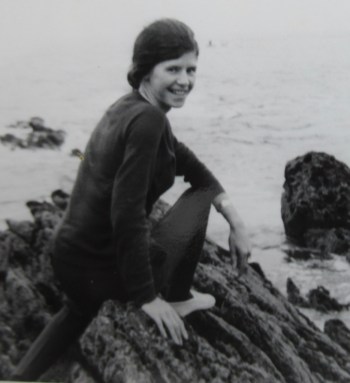
Another photo and poem from this early series (1966) while I still lived in the UK. Like Cervantes, I always wanted to be a poet. Like him, I may always be disappointed by my poetry. However, my beloved has never disappointed me.
This photo was taken at Dodman’s Point, close to where the Spanish Armada was first sighted in 1588. Dodman’s Point / Dead Man’s Point.
In 1988, a computer ran all the tides and all the times of the Armada’s progression up the English Channel, all based on those tides and the annotations of them in the sometimes seemingly haphazard English and the Spanish logs. Seemingly haphazard: because in spite of telling the time by water clocks (clepsidras) and marked candles, and in spite of the ten day calendar difference, and in spite of all the other different differences, these were real sailors and they lived and died according to the tides, the tides that the computer can track, all the way back to 1588, even as it can track the stars and their original positions when Stonehenge was first built in 3500 BCE.
I have stood on the temple mounds in Oaxaca. I have visited Maiden Castle. I have walked on Hengistbury Head and lain in the scrapes of the reindeer people. We underestimate the intelligence of our ancestors and, by extension, of many indigenous people, at our peril. And we over-estimate our own abilities as we destroy the very world in which we live.

bpnichol

IMG_1002 (2)

The day I met bpnichol

I picked him up at Freddy airport,
drove him home for lunch, Clare’s
home made Lasagna, discussed
on the phone. He wasn’t Vegan

Tousled, tangled hair, mangled maps,
Toronto streets and squares drummed
up with coded words wrapped in magic,
he signed my copy of his Martyrology.

His saintly street speech spoke like
grid-locked gears grinding on downtown
city streets, one step at a time, where no
apocalyptic horsemen ever rode.
Oh, the root, toot, hoot, flurry, scurry,
sounds simmering, spurring them on.

After lunch, we drove to the Beaver
Pond in Mactaquac. Swallows dipped
and dived, wetting their beaks. Crows
perched on barren ship mast tree-trunks
stripped of all foliage, coughing warnings.

Strong wing-pulse of the flying osprey
homing to the nest. A great blue heron
walked silent, stilting its grey way through
cool, green shade and shallow waters.

A wordy wilderness tumbled wild from
our questing minds. Images grew starry
flowers. Magic metaphors mushroomed
along tangled New Brunswick trails. No
trace of tarmac and Toronto, the big city.

Comment:

bp was a Toronto poet, still is in my books.
Hence the blue jay.
A good friend.
I miss him.

Angels

IMG_1245 (2).JPG

Angels

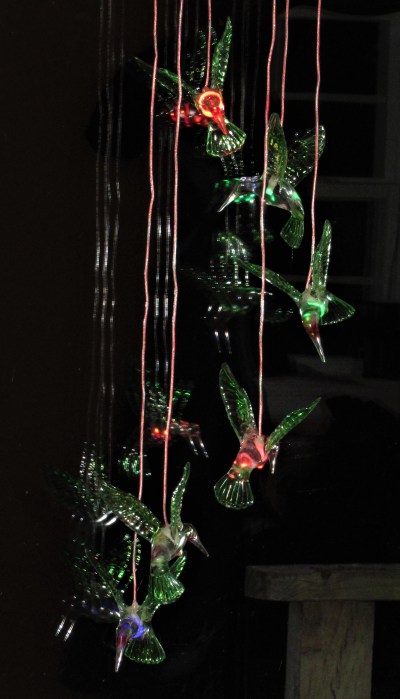
So easy to believe in them when you see them dance, at midnight, when stars sparkle and the world seems dark. They light up everything you know, turn your world inside out, make you believe in things you never thought you would believe in.

So many people can no longer see them. For all too many, the angels have fled, have abandoned the world, leaving it in darkness. Where are they, where have they gone? They are still here, my friends, they are still with us. It’s a question of vision and belief, above all, belief.

So, what is holding you back? Why can’t you see them when they are there, before your eyes, dancing on moonbeams, sunbeams, fluttering before you, begging you to believe, to open your eyes, to seize them as they flit to and fro. Look at them, gathered on that pinhead, on the button of your blouse. They love you, they want you, they need you … and you need them, you know you do.

So hold out your hands, open your heart, let the sun shine in, let moonlight bless and caress you, and may all your dreams be filled, not with shadows, but with the bright light of angels.


Autumnal


IMG_1258 (2).JPG

Autumnal

Skeletal rattle of autumn trees their crisp,
leaves fallen beneath barren branches.
Rat-a-tat rap of dead bone music dries out
flowers, shakes seed pods. Summer’s end
yammers its ruby-sweet, rose-tinted world
where petalled hope and October carnival,
with its ghoulish goulash, mish-mash mix
far-fetched mismatched face. Gruesome
uniforms, fairy-faced, gauze-winged, facile.

Cadaverous danse macabre of death mask
clowns posing distorted in a hall of mirrors
for selfies. The drowned moon needs a kiss
of life. Last night, she peeped through my
window and nuzzled me. This morning my
head is full of mystery, poetry, and dreams.
I analyse them. None of them make sense.

Shower (A Selfie)

IMG_1256 (2).JPG

Shower
(A Selfie)

I smell. I whiff. I gloriously stink.
My arms, my feet, my crotch, reek with beauty.
This is me. I am still alive. I’m rank.
The time has come, the Walrus said, to take
a shower. I strip. I weigh. I obey.

Hot water streams. Bathroom steams up. I draw
faces on grey glass, smiling, glum. Soft soap
works its miracle turning Japanese
nylon into a rough body cloth that
rubs and cajoles all putrid dirt away.

Butterfly from its chrysalis, I step
from the shower, sniff with caution, and stench
no more. I am clean. I no longer pong.
My body has been taken over by
perfumes no longer mine. Who am I now?

I am no more myself. I am no more
my own gorgeous underarm muscular
ripeness. I have left my odor circling
in the soap suds and drifting down the drain.
What a pain. It will take me a week or
more to start smelling like myself again.

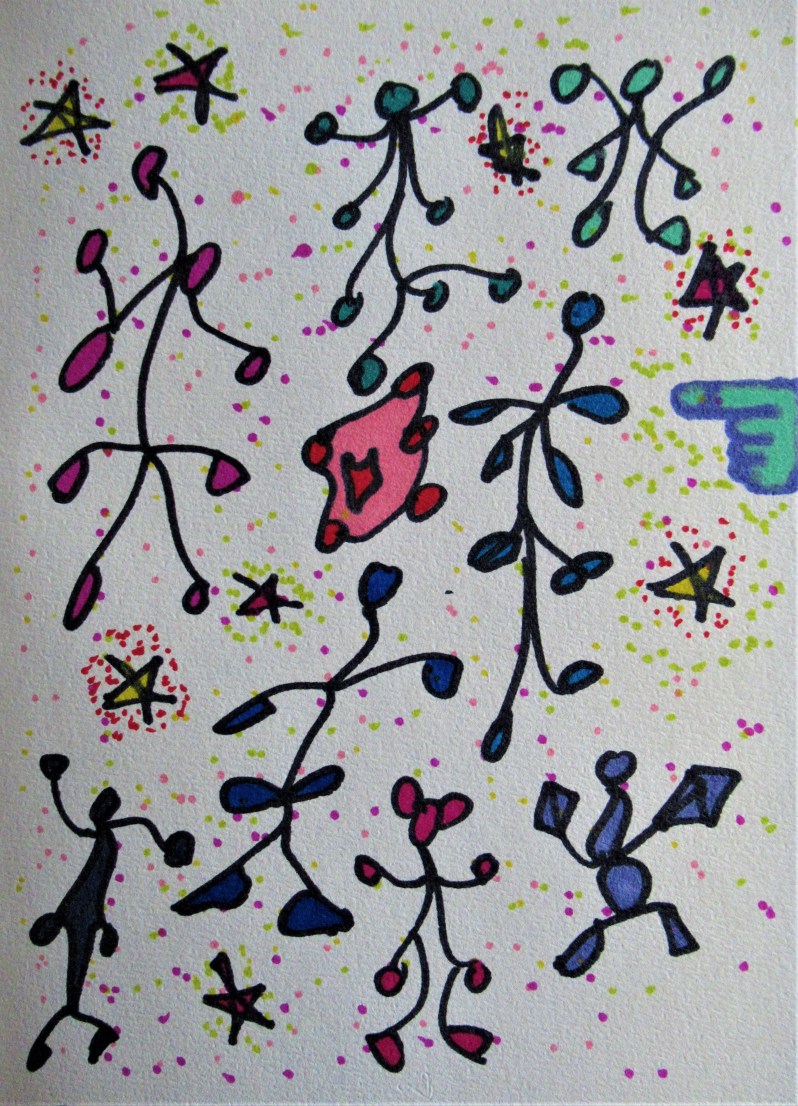
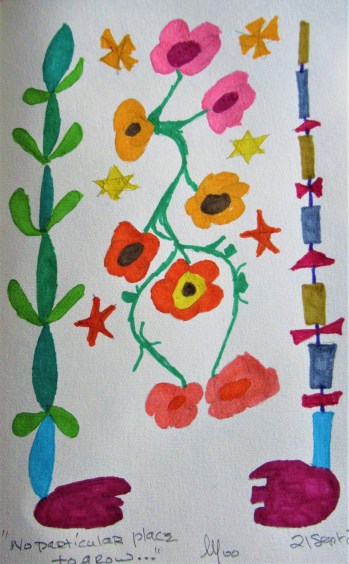
Comment: The cartoon is today’s effort. I looked out of the window and saw all the garden plants with ‘no particular place to go’ and that’s how it is sometimes, especially at this time of year, the summer behind, us fall present , and the winter ahead. We are left with the tiding up, the readying for next year, a sense of sorrow, and a feeling of hope that yes, the garden will return and yes, we will be here to witness it.

So, what are the figures in my cartoon saying to each other? Well, they have been reading the wise words of my olde friend, Oscar Wilde. “Be yourself,” he told them, ” everybody else is taken.” What are they you ask? They are themselves, as I am myself, and you are yourself, and yes, I am very happy to be who I am. And of course, everybody else is taken, so who and what is there left for us to be?

On the outside

IMG_0192

On the Outside Looking In …

I walked home on my own. As usual. I’d hated the church Christmas party with all its trumped-up noise, childish games, and artificial gaiety.
The priest, formidable yet effeminate in his long black skirted robe, had made us sit in a circle on the floor, legs crossed. He stood inside that circle and placed a bar of chocolate on the wooden boards. Then he walked around the group and whispered a word in each boy’s ear.
“You must wait until you hear your secret word,” he explained. “Then one of you, when I speak that word, whoever it happens to be, may have the chocolate bar,” he stared at us, large, yellowed, horsey teeth, no hair, eyes golden, fierce, like an eagle’s, beneath bushy eye-brows. “When you hear your secret name, you must run and grab the chocolate bar. Understood?”
I had come to the party on my own as both my parents worked. The mums and dads who had brought their offspring to the party leaned forward in keen anticipation. The boys all nodded.
“Are you ready?” The priest watched us as we nodded and then he shouted “Alligator!”
Nobody moved.
“Elephant!” The boys shuffled forward, like inch worms, hands twitching, fingers flexing and grasping.
“Tiger!” A sigh emerged from multiple mouths. Some of the boys licked their lips.
“Lion!” One boy moved, but the priest shooed him away. “Sit down. That wasn’t your word.”
“M-m-mouse!” The boys heaved, a sea-wave about to crest and break.
“I do love this game,” said the priest to the parents. “And so do the boys, don’t you boys?”
“Yes, father …” came the chorus.
“Monkey!” All the boys, except one, leapt into springy action. They dived, crawled, leaped to their feet, ran … a surging heap of boys writhed on the floor as the chocolate bar was torn apart and the long-awaited fights ensued.
All the boys moved, except me. I just sat there.
“I said ‘Monkey,’” the priest frowned at me. “That’s your word. When I say ‘Monkey’, you join in with the other boys and fight for the chocolate bar.”
I shook my head.
“Have some Christmas fun. Join in the game.”
I again shook my head.
“Why not?”
“It’s not right. You’re just mocking us.  I want to go home,” I stood up and walked out of the church hall. I turned at the door and saw the priest glaring at me while a mound of boys continued to scrummage on the floor.
As I walked home, it started to snow. Not the pure white fluffy snow of a Merry Christmas Card, but the dodgy, slippery mixture of rain, snow, and ice pellets that turned the streets of my little seaside town into an ice rink. I turned up the collar of my coat, bowed my head, and stuffed my hands into my pockets. Two houses before my own, I stopped.
A neighbor’s house. With a window lit up in the gathering dark. I drew closer, pressed my nose against the window and looked in. A Christmas tree, decorated with lights, candles, more decorations, a fire burning on the hearth, two cats curled up warm before the fire, presents beneath the tree, stockings hanging from the mantelpiece. For a moment, my heart unfroze and I felt the spirit of Christmas. Then I thought of my own house. Cold and drafty. No lights, no decorations. No fire. The snowball snuggled back into my chest and refused to melt.
When I got home, our house stood chill and empty. My parents were out at work and the fire had died. Nothing was ready for Christmas. I sat at the kitchen table, took out my colouring book and began to draw.
When my mother came home, I showed her my drawing.
“Very nice,” she said, barely glancing at it.
“But mum, you haven’t really looked.”
She stared at the picture again. This time, she saw the Christmas tree and the lights, the cats and the candles, the decorations and the presents.
But she never noticed the little boy standing outside the house in the falling sleet, peering in through the window.

On Learning Welsh

IMG_1238 (2).JPG

On Learning Welsh
            Here I sit, an old man now, in front of my computer, learning at last my mother tongue, Welsh. English is the language of the invaders, the mine-owners, the men who own the steel works and foundries, and who rule this land with a fist of coal inside an iron glove. Welsh is the tongue of farmers and fishermen, of the villagers who live on the hills and tend the sheep and plant potatoes in tiny small holdings where only the fittest children survive.
My mother’s father was the last of us to speak Welsh. It was banned in our house because it was bad for the kids. In a working-class household, Welsh, be it language or accent, was a barrier to success. And success came from imitating your English betters, and climbing upwards, like a vine, or Jack on his beanstalk, until you achieved the impossible and talked and looked and dressed like them.
Sitting here, I have discovered the beauty of simple words, not so much their meaning as their sound, the way they flow, the poetry of remembered rhythms:
Cwmrhydyceirw, the Valley of the Leaping Stag, though legend has it that ceirw was really cwrw, and cwrw is beer, and its real name was the Valley of the Brown Stream Frothing like Beer.
Words have their own music, even if you cannot pronounce them properly: Mae hi’n bwrw glaw nawr yn Abertawe / it’s raining now in Swansea. Mae’r tywydd yn waeth heddiw / the weather’s worse today. Bydd hi’n dwym ddydd Llun / it will be warm on Monday. Why, oh why, in Wales, do we always talk about the weather?
Place names also have their own magic: Llantrisant, Llandaff, Dinas Powis, Gelligaer, Abertawe, Cas Newydd, Pen-y-bont … Meaning changes when you switch from one language to another:  gwyraig ty / a housewife, gwr ty / a househusband, a concept of equality that has ruled Welsh lives since Julius Caesar invaded Albion, coming from Gaul with his legions in 55 BC.
            Un deg chwech, dau deg saith, tri deg wyth, naw deg naw … The photographer asks me to speak in English, then in French, then in Spanish, then in Latin, and lastly in Welsh. He checks the memory card in his camera and looks puzzled.
“You put on a new face each time you speak a different language,” he tells me. “Look, this is when you spoke French.” He shows me the photo and yes, I look happy.
“And this is when you spoke Latin.” He holds out the camera and I see myself on the screen. I look ever so grim. English, French, Spanish, Latin, Spanish, and Welsh: all different and each language is a new a map carved into my face.  Am I a clown, then, a comedian, a chameleon to wear so many masks and to slip so easily from one to another? Which, then, is my language and where is the Old Red Sandstone from Wales into which I can carve my memories and my dreams? More important, which of those many tongues will shape my story as I sculpt each letter of my tale?