Hummingbirds

IMG_1237 (2).JPG

Breaking News:

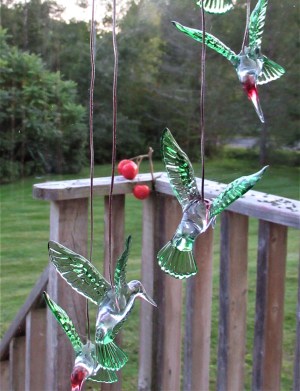
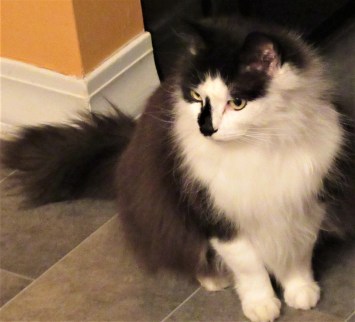
A swarm of hummingbirds is attacking ripening tomatoes in Island View. They were first spotted by Princess Squiffy, our attack cat. Unfortunately, they were outside and she was inside, so she couldn’t get at them. and scare them away.

Further Development:

IMG_1243.JPG

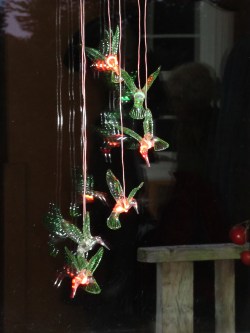
Those hummingbirds must have been high on something: they were glowing and humming in the dark. Radio active tomatoes, perhaps? Or could this be a trick of the light or a joker’s hoax? Please post your answers in the comments section.

Conclusion:

Whatever: Princess Squiffy is not perturbed. David Suzuki, when consulted, said he had no opinion on the matter. Is that really David Suzuki? It looks like Foo Man Chew, to me.

IMG_1063 (2).JPG

Invisible Scars


SD 16

Invisible Scars

            Our minds absorb words as blotting-paper soaks up ink. Phrases carve beehives deep in our inner circuits. No te preocupes / don’t worry. Yet tone and carry are different in each language and the comfort-blanket serenity of no te preocupes does not translate.
Nor do the catcalls from the soccer, aimed equally at opponent and referee, and tumbling raucous from the stands where people sit. Shrill whistles sound in the bull ring: a matador who seems afraid to approach this particular bull for reasons only known to him, yet his shakiness visible to all who watch and understand what they are seeing.
The Cordobés answers the telephone he places on the bull’s nose, yet fails to approach between the horns and his sword rebounds off bull bone: pincha hueso. Each one wounds, the last one kills. El Viti, stately, graceful, an elderly churchman proud of his vocation and always willing to perform to perfection the weekly ceremony of the sacrifice. The boos when the bull enters the ring, stumbles, and comes up lame and limping. The cheers that accompany the arrival of the seventh bull. The refusal to eat meat that has been slaughtered in the bullring, even though it is advertised outside the butcher’s: tenemos solomillo de toro de lidia / we have tenderloin steaks from fighting bulls. Bulls who have led the best of lives, fed on the tenderest pastures by flowing streams. Bulls grown for slaughter and public sacrifice.
Guernica. The bull fight in the sand-filled square. Except it wasn’t a fight, it was more a circus. The slippery pig. The hens and chickens. The rabbits and hares. All the animals running scared. The animals released, one by one, and the spectators jumping into the ring, really a square, one by one, and chasing down the animals, taking them home for dinner, if they could catch them.
Then the bigger beasts. The mule, ferocious, jumping into the air, kicking four tormentors, one with each leg, and biting a fifth with his teeth. No fearful, clucking chicken this, nor the cow who came after with her padded horns. Participants moved more carefully now. She watched them from her querencia the place where she chose to fight to the death. She knelt, scraped off the rubber balls that covered her horns. Re-armed, she charged and the crowd scattered, all but one young kid, caught, fallen to the ground, the cow standing over him, ready to gore again.
Sixteen years old, an outsider, I jumped with others over the barrier, twisted this away and that, thumped the cow’s side, smelled her fury, her fear, the whole soured being that emanated from her. Together, we hustled her, bustled her, dragged her kicking, butting, from the ring, backwards, pulled by the tail.
Visible scars of damaged animals. Scars of the participants. That young man who broke his leg. That old man, inebriated, stuffed with food and drink, who loosened his belt to move more freely. We watched as his pants slipped from his waist to fall around his knees and trap him, just as the cow charged. He survived but will bear the scars forever, some visible, many not.
Long summer days, on the Sardinero, the Segunda Playa, playing soccer. Different rules, different skills, different swear words: I carry a dictionary tucked into my bathing trunks and refuse to play while I look up the words spat at me by my opponent. Good heavens, I think, is that anatomically possible? The ball bounces away on the hard, sand ridges. I chase it and steadily dehydrate under the hot sun. A sea-salt wind desiccates my body. My mouth fills with salt water when I swim out to retrieve the ball from the sparkling sea. My tongue sticks to the inside of my mouth. When I spit, I spit dry and everyone laughs. Now I am totally dry, shiver, and no longer sweat. Now I am no longer my self, but I’ll never be one of them.


Ste. Luce-sur-mer

PEI + bockle 2008 059.jpg

Ste. Luce-sur-Mer
(1995 &1996)

marooned and listless
monarch of all he surveyed
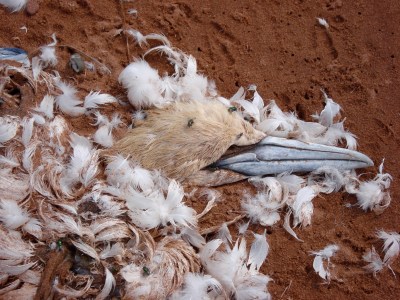
this ancient sea-side crab
caught naked on a wave-wet beach

surrounded by thronging gulls
their powerful beaks
pulling at the carapace
half-buried in the sand

moment of truth
the second the oyster’s
protective vacuum breaks
the crab sucked from the sand

battered the scattered body
spread over crisp sheets
pillowed on mermaid-hair
claws that once clicked

silent now hushed
listen to the tide
watch the wind’s footprints
walking on warm summer sand

St. Patrick

Empress 314 (2).jpg

St. Patrick

At Tara Manor, a long way from the Emerald Isle,
bold deer emerge at night to nibble the Hosta
Lilies and desecrate lawn and flowerbeds. They
arrive all curious, ears twitching, tails raised,

a wonder for some, a plague for others, culled,
last year, to no effect, with mothers giving birth
this spring to triplets and twins. Dead in a ditch

they resemble the Irish Elk, raised from damp,
peat bogs, or long-dead moose, white rib-cages
air-filled, ghosts galloping down Ghost Road.

He didn’t establish aquaculture. Salmon,
bringers of Celtic wisdom, spirit beings not
to be confused with commercial products,
but repositories of knowledge, swimming

Wikipedias to be consulted like oracles and
relied upon in difficult times. Where now do
we go to trust the truth, CNN, Fox News, CBC,
The Daily Gleaner, The Telegraph-Journal?

Commentary:

Yesterday’s post  https://rogermoorepoet.com/2019/08/26/think-about-it/  started a dialog about whom do we trust for information and how and why do we trust them. Today’s poem continues the same theme, but in a different format and with very different words and intent. Traditional wisdom, and the time to think things out carefully, is lost, save among the indigenous. Our times demand speed, hurry, instant decisions, merciless schedules f do, do, do, and little time for think, think, think.

What is this life, if full of care, / we have no time to stand and stare?” The Newport / Cas Newydd (Wales) poet |W. H. Davies expressed this well in his poem Leisure, full version here:  https://en.wikipedia.org/wiki/Leisure_(poem)  Stop the world, I want to get off. Many have made the request, few have managed it. Yet all of us feel, at one stage or another, the need to ‘get away from it all’. So, what are you going to do about it? Do you even have five minutes to sit down and think … answers to be written on rice paer, folded neatly, and floated out to sea in a pea green boat manned (if that’s the right word) by an owl and a pussy cat.

IMG_0790 (2)

DIY Fridge Magnets


IMG_1197 (2)

DIY Fridge Magnets

Tired of your old fridge magnets? Worn out by dire warnings, by political slogans, by advertisements from unwanted people for even less wanted things? Join the club! I set it up yesterday: The DIY Fridge Magnet Recycling Club.

IMG_1203 (2).JPG

Take that old magnetic advertisement for ‘who-knows-what’. If you don’t like the original photo, strip it off, some peel away with great ease. Others can be coloured over. In harder circumstances, you must stick  new painting surface over the old one. I use Crazy Glue for this quite simply because, yes, I know it’s a craze idea, and yes, crazy ideas not only work, they make and save money. When you have your new surface, paint away. I have used acrylic paints but I now use marker pens. Who cares? I’m crazy anyway. Who needs selfies? Here’s a self portrait, as stuck on my fridge. Crazy eh? Now you know exactly what I mean.

IMG_1202 (3)

Ghosts

IMG_1055 (2)

Ghosts

My grandfather would wheeze, then cough, as he leaned on the old black dresser in the Welsh kitchen with its vast, cast iron fireplace. “As black as the hobs of hell,” he would say, and “as warm as our kitchen.” It was full of nooks and crannies where pasties and pies could stay warm, soup cauldrons could hang from iron chains, and copper kettles could whistle wild tunes and call us all to endless cups of tea. Sergeant-major tea: so strong and filled with so much sugar that a tea-spoon could stand upright and never fall over. Gassed in the First World War, my grandfather was always out of breath and each time he coughed, he brought up a tiny part of his lungs. “One day,” he announced between wheezes, “there’ll be nothing left.”
Twice a day, my grandfather would roll up the newspaper and brandish it like a conductor’s baton. The first time would be when I came home from school and it was time to do my homework. The second time would be after supper when it was time for me to go to bed. Each time he rolled up that newspaper, he would tap it gently on the dresser to get my attention, and then he would speak those famous words: “Let battle commence.” I would fight to escape to the street to play with my friends. I would fight to stay on my feet and I never, never wanted to go to bed. I hated to be entrenched alone, upstairs, in the cold shadows of that ghostly no-boys-land where I could hear mice and rats scuffling behind the dugout walls and smell the sour smells of old age and illness that stalked my dreams.
“Up the wooden hill to Bedfordshire,” my grandfather would sing, conducting with his baton and pointing to the stairs. I was never afraid of him. He was dark, strong, tall, and very gentle, a great man in his own right, one of those tall men who would always stoop to help a little child. If I was too troublesome, he would start to cough. And if he started to cough, the pink phlegm would come and he’d spit it into the red and blue polka-dot handkerchief he always carried. The pink phlegm caused consternation and in the ensuing panic, I would bolt for the stairs, go up to my room, undress, put on my pajamas, and bury myself in the vast double bed I shared with my grandmother. My grandfather’s bed was in the middle room downstairs. I didn’t realize then, as I do now, that he could no longer climb those stairs up which I scuttled.
After a while, I left of my grandfather’s house and went back to live with my father. One day, my grandfather, as he prophesied, coughed too much and that was the end of him. After the funeral, my father took me back to see my grandmother. Aunties and uncles, cousins, family friends that I didn’t know, neighbors known and unknown, spilled over the house in an invasion of tears and grief. After the friends had gone, my father and I decided to leave and the family gathered on the doorstep to wave us goodbye. I waved back to them all. “Goodbye,” I shouted. “Goodbye aunties, goodbye uncles, goodbye grandmother.” I paused. My grandfather stood there waving to me. “Look: there he is. I knew he couldn’t have gone.” I pointed and waved. “Goodbye grandfather!”
“Don’t be stupid. He’s not there,” my father said. “He’s dead.”
“I can see him,” I said. “He’s there. I can see him.”
“He’s not there. He’s dead.” Tears ran down my father’s face.
Sitting here, writing these words, I can still  see my grandfather, standing on that doorstep, waving goodbye. And I can still feel my father’s long dead, shadowy hands reach down, grab me by the shoulders and shake me, shake me, shake me, until I too am crying and the ghosts of my milk teeth are again rattling in my head.


IMG_1063 (2).JPG


Things

18581930_1306791786107970_4016640231053970709_n-1

Things I carry with me

            That old black cast-iron stove, wood-fired, that baked the best ever breads and cakes and warmed the bungalow on cold, summer mornings. The Welsh dresser with its age-blackened rails that displayed the plates, and cups, and saucers. The old tin cans that ferried the water from the one tap located at the end of the field. Full and wholesome, its weight still weighs me down as I carry it in my dreams. The Elsan toilet from the shed by the hedge and the shovels that appeared, every so often, as if by magic, as my uncle braved the evening shadows to dig a hole on the opposite side of the field, as far from the bungalow as possible.

            The outhouse at the end of the garden. The steps down to the coal cellar where they went when the sirens sounded, to sleep in the make-shift air raid shelter, along with the rats and mice that scurried from the candles. The corrugated iron work shop in the garden where my uncle built his model ships, the Half-Penny Galleon and the Nonesuch. The broken razor blades I used to carve my own planes from Keil Kraft Kits, Hurricanes and Spitfires, an SE5, and once, a Bristol Bulldog. Twisted and warped, they winged their ways into nobody’s skies, though once we built a paper kite that flew far away in a powerful wind and got tangled in a tree. The greenhouse from which I stole countless tomatoes, red and green. Kilvey Hill towering above the window ledge where the little ones sat when there were more guests than chairs in the kitchen. The old bombed buildings across the street. The bullet holes in the front of the house where the Messerschmidt strafed us.

            The old men spitting up coal dust from shrivelled lungs. The widows who took in lodgers and overnight travelers. The BRS lorries, parked overnight, that littered the street. The steep climb upwards into those lorries. The burrowing under dirty tarpaulins to explore the heavy loads, and many other things. The untouchable, forbidden drawer where the rent money waited for the rent collector’s visit. The old lady, five houses down who, when the shops were shut, sold warm Dandelion & Burdock and Orange pop for an extra penny a bottle.  The vicious, snub-faced Pekinese that yapped fierce defiance from the fortress of her lap. The unemployed soccer referee who on Saturdays walked five miles to the match and five miles back just to save the bus fare, his only financial reward. My father’s shadowy childhood. His first pair of shoes, bought at five years old, so he wouldn’t go barefoot to school.

            Wet cement molded onto the garden wall, then filled with empty bottles to be smashed when the cement set solid. The coal shed where the coal man delivered the coal: cobbledy-cobbledy, down the hole. The outside toilet with its nails and squares torn from yesterday’s newspaper. The lamp-lighter who lit the lamps every evening as the sun went down. The arrival of electricity. The old blackout curtains that shut in the light and shut out the night. The hand rolled fabric sausage that lay on the floor by the door and kept the heat of the coal fire in the kitchen. The kitchen itself with its great wooden chair drawn up by the fire. That chair: the only material possession I still have from that distant past.

Herding Cats

IMG_0790 (2)

Herding Cats

Finley herds cats. At least, she thinks she does.
She spots them with an eager eagle eye,
then herds them, Murdoch, Logan, and Jenkins.

Murdoch sleeps on top of the cabinet.
“Come down,” Finley shrieks. Logan seems to sleep
beneath the settee. “Come out,” Finley pleads.

Jenkins catalogues himself between books.
Finley can’t find him. She climbs on a stool.
Murdoch opens a round grey eye, checks the
distance between them, and goes back to sleep.

Finley gets down from the stool and searches
for Logan and Jenkins. They have disappeared.
IMG_0032

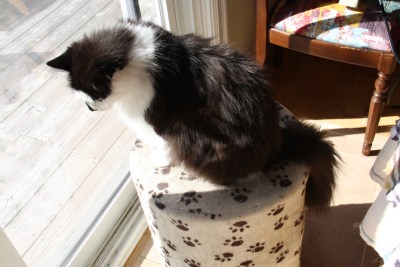
Commentary: Finley loves cats and misses the three she has left behind her in Ottawa. She wants to cuddle Princess Squiffy but Princess Squiffy aka Vomit does not like noisy little girls who pursue her shrieking loudly. Result: we have hardly seen PS for nearly a week. She hides throughout the day in those mysterious priest-holes known only to catholics and cats, and waits for nightfall and an almost quiet house. Soft and silent, she emerges from the shadows where she has been hiding to sleep at the foot of the bed.

PS doesn’t love me either, but she has become so needy of quiet, respectful human contact that she has started to tolerate me, just a little bit. She raises her ears instead of flattening them and plumes out her tail, just to encourage me. Now she permits me to touch her gently and scratch her in her favorite spots, behind the ears and at the root of the tail. I look on this as a great favor … but I still think she scorns me completely, showering me with  total disdain most of the time.

“Moo,” Finley asks me. “Do you have a pussy cat?”
“Yes, Finley.”
“Where is she?”
“I don’t know.”
“Is she hiding?”
“Yes, Finley.”
“Can I see her?”
“If you can find her …”

And the great cat hunt begins: upstairs, downstairs, in my lady’s chamber. Goose steps everywhere, but there is no sign of the cat.

“Moo.”
“Yes, Finley.”
“Are you sure you’ve got a cat?”
“Yes, Finley. I’m sure.”
“I want to play with her.”
“I’m sure she’ll come out and play with you one day soon.”
“I don’t think you’ve got a cat, Moo.”

Seeing is believing / ver es creer. Whether seeing is believing, or not, what we don’t want to see is A’r gath wedi sgrapo Finley bach / the cat has scratched little Finley. Oh the joys of learning Welsh, especially as the day drags on, the cat cannot be found, and Mae’r baban yn y crud yn crio / the baby in the cradle is crying and tears of sadness blend slowly into snores, as the cat creeps up from her hiding place in the basement, pushes open the door, mews for her last food, and cuddles up beside me on the chair beside which I type.

Here is a link to Sosban Fach sung  Welsh by Cerys Matthews.  Turn your sound on and up and enjoy!

https://parallel.cymru/sosban-fach/?lang=en


IMG_0425

Yellow

IMG_0617

Yellow

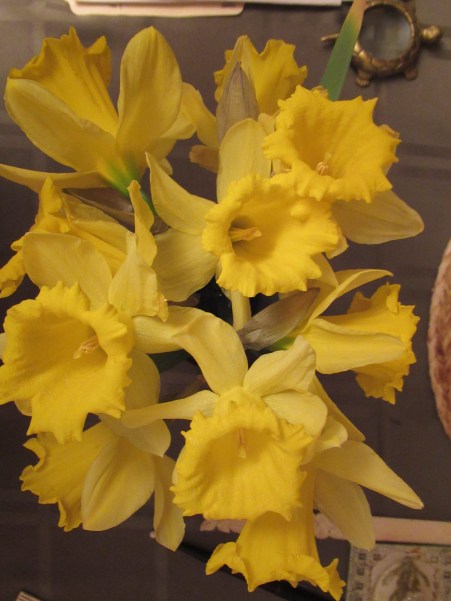
Sunshine and daffodils: my grand-daughter
paddles in the kitchen sink. Her mother
washes feet and dishes. “Sit,” Finley says,
and “stand,” following the words with actions.

“Yellow,” she says, “yellow,” as daffodils
fill the computer screen to shine in that
far-off kitchen five hundred miles away
by road, but immediate by I-Pad.

“Yellow,” Finley repeats, “yellow.” Soon
in that distant province where spring arrives
so much earlier than here, she will see
daffodils dancing their warm weather dance,

tossing their heads to gold and yellow trumpets,
fresh, alive, and young in the soft spring breeze.

Commentary: Not a large vocabulary, back then … yellow … yellow hair, yellow jello, yellow dog, yellow cat, yellow daffodils, well, we got that one right anyway. So, she is here now, yet again, with an enlarged vocabulary and two feet taller. She comes shopping with me, swings on the shopping cart, runs everywhere, will not sit still, slips and slides like stones in a slate quarry. She takes my cane, I call it a walking stick, and thwacks it in the air, a danger to sundry and all. Knows what she wants: not this, not that, no, yes, THIS … and points with a sticky finger at whatever it is that has caught her fancy.

She runs away from me, and I cannot catch her. I stand there quietly, waiting for her to return. And she does, with a squeal and a shriek and cries of joy after even a brief absence. We talk magic. I say I am invisible, and she cannot see me. She says she is invisible, but I poke her in the ribs with my index finger and she squeals again. Magic, she says, you can do real magic. I nod. Me too, she says. And she is the real magician for she is four years old and has me bewitched.

Read My Book

Time-Spirits.png

Read My Book

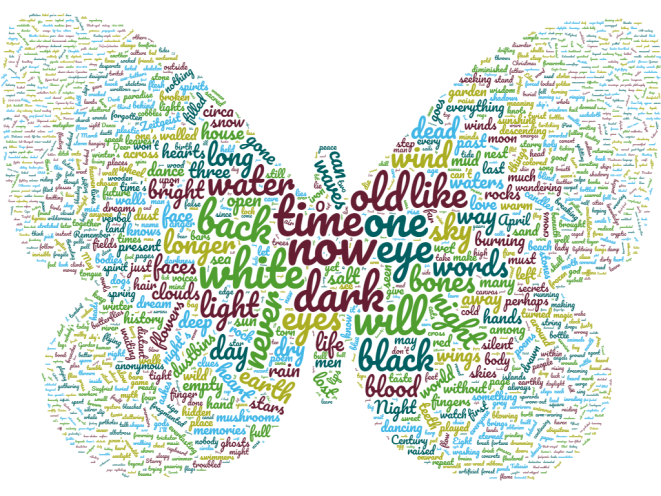
Of course, you don’t have to, if you don’t want to. More important, why spend  money on purchasing someone else’s words when you don’t have to? So here, for all you poor people, old and young, for penny-counters, penny-pinchers, and ultimate scroungers, here a is a free poetry book.

You don’t have to spend a penny (well, not in that way anyway) and all that poetry is all yours. Just click on the butterfly, decipher the words, and all my genius will be yours in the flick of a butterfly’s wings, be it Monarch, Red Admiral, Swallow-tail, or Indigo Bunting.

IMG_0713.JPG


Now tell me: what exactly is a butterfly kiss, or a butterfly’s sting? Answers on a postcard and in word-cloud form. And remember: there’s more to poetry than meets the eye.

Zeitgeist 1-10.jpg