Autumn Leaves

Autumn Leaves

I used to run,
jump, and catch them
in mid-air,
one, two, three
in each hand.

Now
I stand and wait
for them to fall
and land, perhaps,
on my clothes
or catch in my hair

the Leprechaun luck
of my Irish heritage,
so long-denied,
with its pot of golden leaves
waiting for me
at summer’s cast-off
rainbow’s end.

Commentary:

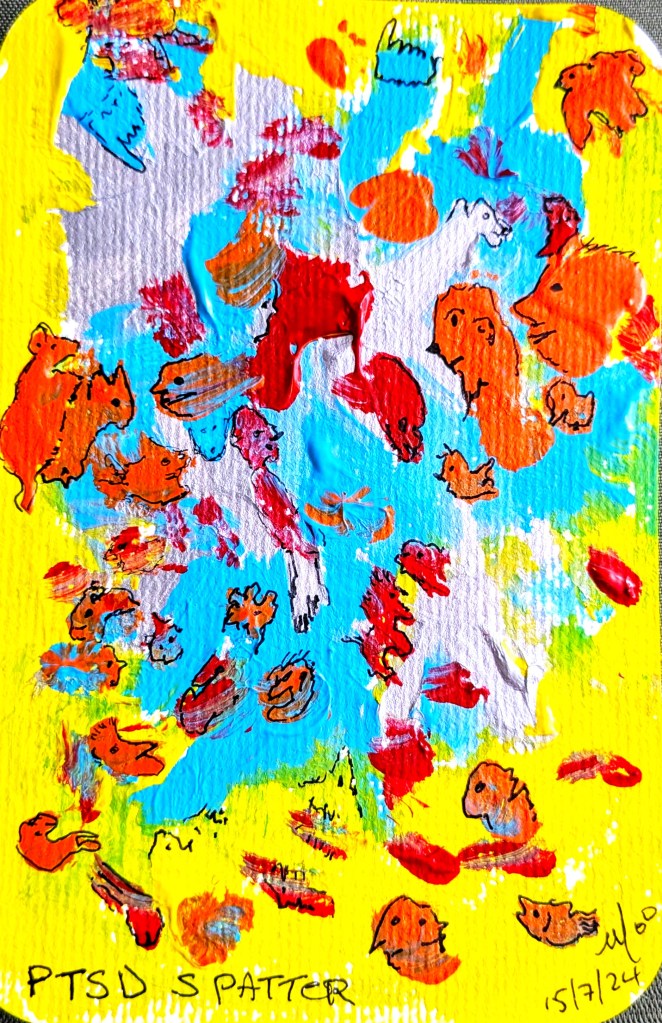
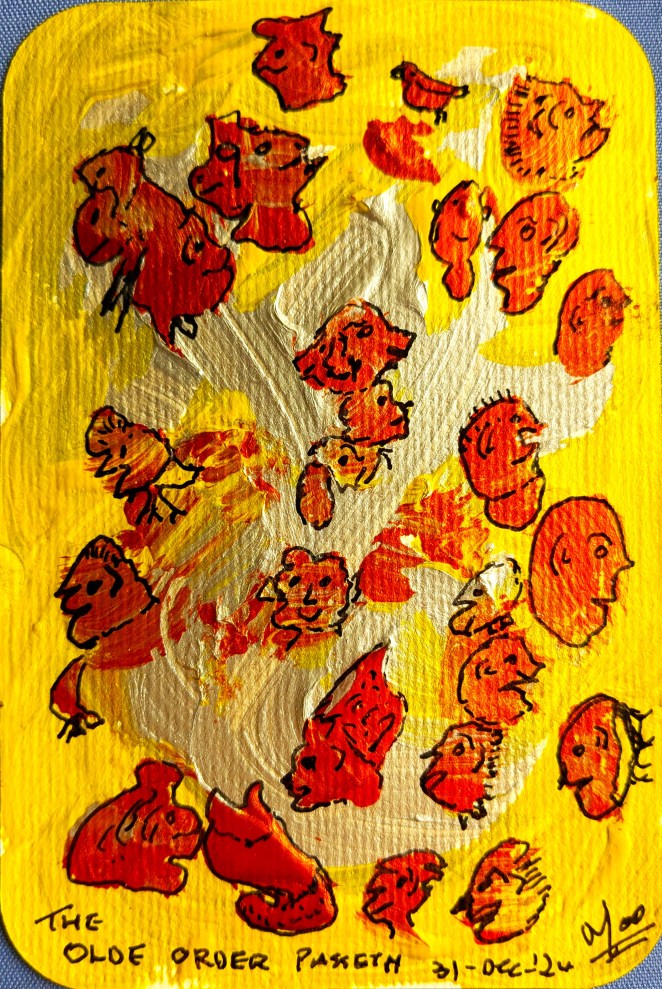
Autumn Leaves, but where does it go to. Good question. Moo asked me that the other day. I just had to tell him that I didn’t know. However, he did offer me the perfect painting for the fall and the changing leaves. Fall Folly Age. I never realized that he could play with words like he plays with paint. Anyway, I know that last winter he painted a picture of little white dots with wings. “What are they?” I asked him. “Snow flies,” he replied. “You know, when the snow flies …” “When the snow flies do what?” “I don’t know.” Moo and I live in a mysterious world, as you have probably come to realize.

Any way, the combination of fall foliage and fall folly age is quite a good one and it shows the folly of ageing and trying to chase down falling leaves when gadding about in the garden with two sticks, one in each hand. Of course, in case you don’t like that painting, and I hope you do like it, because I do, then here’s another one for you.

The text reads – “Autumn leaves – catch them if you can – while you can -and close the door behind her – when she leaves.” Oh witty Moo. Painting and occasional poetry too.

Dog Days

Dog Daze

1

A dry storm lays waste the days that dog my mind.
Carnivorous canicular, hydropic, it drinks me dry,
desiccates my dreams, gnaws me into nothingness.

At night a black dog hounds me, sends my head spinning,
makes me chase my own tail, round and round. It snaps at
dreams, shadows, memories that ghost through my mind.

Tarot Cards and Tea Leaves are lost in a Mad Hatter’s
dream of a dormouse in a teapot on an unkempt table.
Hunter home from the hill, I awake to find my house
empty, my body devastated, my future a foretold mess.

Desperate I lap at salt-licks of false hope but
they only increase my thirst and drive me deeper
into thick, black, tumultuous clouds. Dry lightning.
The drought continues and no raindrops fall.

Dog Daze
2

The drought continues and no raindrops fall.
Desperate I lap at salt-licks of false hope but
they only increase my thirst and drive me deeper
into thick, black, tumultuous clouds. Dry lightning.

Tarot Cards and Tea Leaves are lost in a Mad Hatter’s
dream of a dormouse in a teapot on an unkempt table.
Hunter home from the hill, I awake to find my house
empty, my body devastated, my future a foretold mess.

At night a black dog hounds me, sends my head spinning,
makes me chase my own tail, round and round. It snaps at
dreams, shadows, memories that ghost through my mind.

A heat wave lays waste the hopes that dog my days.
Carnivorous canicular, hydropic, it drinks me dry,
desiccates my dreams, gnaws me into nothingness.

Dog Daze
3

The drought continues. No raindrops fall.
No fresh water. None at all.

Dark clouds gather in the sky.
No rain falls. The ground is dry.

Grass all burned. No more hay.
How much livestock will they slay?

No rain comes, but a flash of light
sets the woods and fields alight.

Home from the fields, some farmers confess
their future is an unpredictable mess.

Desperate farmers are losing hope.
Out in the barns, they keep some rope.

The roof beams are sturdy and built high.
One little jump and problems good-bye.

Commentary:

Dog Daze 1 is a reverse sonnet. Instead of being structured 4-4-3-3 it moves in reverse 3-3-4-4. What fun to pretend to be Milton Acorn, and to turn my sonnet upside down. It should rhyme, but I abandoned rhyme in favor of metaphor a long time ago. Was I right to do so? What, if anything, catches you unawares in Dog Daze 1? Does it work for you? What would happen if we turned it upside down? You be the judge.

Dog Daze 2 is more or less the same sonnet returned to its normal stanzaic shape 4-4-3-3. In what ways has the poem now changed? Clearly there is a structural difference. Obviously some of the lines and images have changed. Is the poem stronger? Weaker? Does each one affect you in a different fashion? Do you prefer one version to the other?

Mission Impossible – How many more adaptations can we make to this poem and how would each one affect the poem and the reader’s reception of it? For example – Dog Daze 3 sees our sonnet turned into a poem composed of seven rhyming couplets. Couplets are easy to rhyme. But do they simplify the thoughts too much? Is the poem now too dark? Can you lighten the mood? How? Your mission, should you decide to accept it, is to rewrite the poem in seven non-rhyming couplets. That will make a change from the Daily Sudoku and the Cross-word puzzle. If you do take up the challenge, let me see what you do! And remember, you can make it personal to you, your life, and your garden.

Poisoned Pawn

Poisoned Paw

Openings are so important.
They should be magnets
drawing the opposition in,
but sometimes they’re whirl-pools
dragging you down.

You try to hold your breath,
but you must breathe deep, let go,
go with the flow and prepare for
whatever awaits you in the deep.
Down there, it’s a different world.

Light breaks its black and white bishops,
and the knights walk a forked path
when not pinned down. When you lose
do you mourn for the simplicity of draughts,
or Fox and Hounds or do you strive
to establish, once more, your light in the dark,
down there, where no sun shines.

You are the glow-worm,
glowing where no light glows.
You are the line, the sinker, the hook,
the bait, the temptation that encourages
your opponents to sacrifice their own peace,
 to join you, and together, to swim, or drown.

Commentary:

My family didn’t play much chess. I bought my first chess set when I was ten years old, at Boot’s the Chemist, down by the market, in Swansea. I also bought Harry Golembek’s book The Game of Chess. I still have both the set and the book, seventy years later. Descriptive notation. Absolutely bewildering. I stared at the chart that gave the code names of every square and remained totally confused. I had to look up each square, from its notation, locate it on the chart, then move the piece on my board into the appropriate position. And remember, each side had exactly the same format – QR1, QKt1, QB1, Q1, K1, KB1, KKt1, KR1. Not quite a mirror image as the squares reversed themselves on the other side of the board.

I remember clearly the day that ‘Light broke where no light shone.’ I looked at the maze of numbers, and suddenly the pattern clicked into shape in my mind and I understood the whole idea of descriptive notation. Boundary Knowledge – you cross a boundary after days of bewilderment, and enter a new phase of enlightenment ‘light breaks where no light shines’. When I watched the film, The Poisoned Pawn, I remembered my own learning days in chess. Great fun, that particular opening. Do we take the poisoned pawn, or do we leave it? I will leave you to decide. But remember, it’s not called the poisoned pawn for nothing, damned if you do and damned if you don’t!

I used descriptive notation throughout my school days. I had one particular friend in boarding school who also played chess. We slept in the same dormitory, two beds apart. After lights out, no talking, no reading. Prefects prowled at night to enforce the rules. After lights out, one of us would call out ‘P-K4’ and thus the game started. We weren’t exactly talking, so it wasn’t easy to catch us. Every night, we played the game in our heads. A great memory trainer. Occasionally we managed to finish a game – not often – we were both too wary of Fool’s Mate and the simple early traps! Each day, during one of the school breaks, we would restart the game of the night before, from memory, and then play it to its end. We very rarely forgot the moves we had made and we virtually never disagreed on the board position.

This was totally unlike chess with my family. The grown-ups would all gather round the board. Their object was to distract me, to move pieces when I wasn’t looking, to remove (MY) pieces and leave me in a desperate situation. “‘Knock, knock!’ ‘Who’s that at the door? Go and look.” And off I would go to return to a battlefield that had totally changed its shape and mood. I would carefully reconstruct it, piece by piece, square by square. But I have never forgotten the black looks, the accusations of cheating, the fury of the old ones being beaten by the younger generation. In the end, nobody within the family would play me, unless I gave them a handicap by removing a rook or one of the bishops.

I didn’t discover algebraic notation until I lived first in France, and then in Spain. Algebraic notation. Each of the 64 squares had its own letter and number and, as a result, there was no way to confuse the position of the pieces. Staunton chess sets in England became a variety of different piece shapes on the continent and I often lost games when I forgot that the pawn had one circle, the bishop two, and the queen three, but they all looked like. Many a time I gave up a bishop thinking it was a pawn – oh that poisoned pawn again.

Now, in my dotage, I play chess against the computer. I haven’t played a live opponent for years. But I do have a chess book collection and I have played Fisher’s best games, and Fisher vs Spassky, and I have studied the Russians and how they play and think – very differently from me. And so, in my old age, I sit at the chessboard of my life, and I move the pieces here and there, and remember old friends, and how we shifted across the shifting boards of our days. So many pieces have dropped from life’s chessboard, but a few of us are left, and we move more slowly, but we wander on and on.

PS Moo, sometimes slow in understanding, offered me several paintings that suggested the aftermath of the Poisoned Prawn. When I explained the basics of chess to him, he said he didn’t have a chess painting he could recommend, so he suggested this painting – the correct way to teach. ‘You can’t teach chess,’ I said, ‘it is so instinctive.’ I took one look at the right way to teach and loved it. Here we go The Right Way to Teach! X – WRONG!

Time Flies

Time Flies

… bends like a boomerang,
flies too rapidly away,
limps back to the hand.

Endless this shuffle of unmarked
days dropping off the calendar.

Hands stop on the clock.
The pendulum swings:
time and tide stand still,
do not move.

The print in my grandma’s house:
seemingly moving seas,
sails swelled out,
the ship stays firm in its frame.

‘As idle as a painted ship
upon a painted ocean.’

Our garden fills
with brightly colored birds
and red and grey squirrels.

Light and dark
switch back and forth
each day
a twin of the day before.

The TV screen hangs out
the daily washing.
Tired, worn out shadow,
their faces boring us
with shallow wit
and hand-me-down wisdom.

Time:
an albatross around the neck,
an emu, an ostrich, a dodo,
an overweight bumble bee,
too clumsy, too heavy to fly.

“Time flies?”
“You can’t.
They fly too fast.”

Commentary:

My friend Moo told me he was ‘all shook up’ when I read him this poem. I don’t think Moo’s too smart. He thought All Shook Up was written by the Rolling Stones when they went out moss gathering during the Fredericton Harvest Festival, but I said no, it was definitely written by Buddy Holly on an off-day when he was playing cricket. It wasn’t okay in those days to play croquet.

The last three lines come from an examination question in the General Paper, “S” Level, as it used to be. “Punctuate this sentence – time flies you can’t they fly too fast” – of course, they should have said, “in exactly the same way we want you to. Corrections and alternative versions will not be accepted.” What did they think I was? A mind-reader? I wasn’t. I was a teenager having a field day in the national examinations. I would love to have been a fly on the wall when they marked my paper.

In the biology exam, they gave each one of us a Brussel Sprout and asked us to draw it and tell us as much as we could about it. Of course, I ate mine, and I said it tasted a little bit dry and needed some salt. Then I drew a mess of potage, all yellow and green with chewed up squiggles, and added “That’s what the sprout probably looks like right now.” I failed that exam too. Didn’t even get a part mark for ingenuity, though the science teacher said I could have a glow of satisfaction. Very useful after lights out in a boarding school, I can tell you.

I can’t remember if Moo went to that school with me or not. I don’t think he did. I think he drifted into my life a little bit later. He wasn’t a painter at that stage, just a half-starved philosopher doomed to live in a garret. Of course, once he started painting houses, he made money. It’s amazing how many people will pay you for painting their houses. Of course, that was before they invented plastic siding.

About now you realize that I live in a strange world all of my own and a lot of people live in it with me. You, too, if you enjoyed reading this. Long may the ‘strange world of me, you, and Moo’ continue. I’d send you a penny for your thoughts, but they have gone out of circulation. I can’t even sing you a song of sixpence these days either. Silver sixpences have walked the dodo path too.

This Vessel in which I Sail

This Vessel in which I Sail

Trapped in this fragile vessel, with the pandemic
a passenger waiting to board, I drift from port to port,
looking for a haven, safe, to have and to hold me.

No harbour will let me dock. “No room at this inn,”
they say. “No haven here.” They wave me away.

Now I have no destination. Aimless, I float and every
where I go the message is: “No vacancy: no room at all.”

Unwanted, abandoned, I wander with wind and waves,
my only friends seals, porpoises, and whales.
I walk the whale road, leaving a frail, white wake behind.

This vessel has become a gulag now, a prison
camp where I exist just to survive. Each hour of each day
endless, boundless, like this shadowy, haunted sea.

Today there is no motion, no goal. What is there to achieve
but survival? Each day’s journey is sufficient unto itself.

Commentary:

Moo’s cartoon, Naval Gazing, dates from 2015. That year I spent eight weeks in Moncton at the Georges Dumont, gazing at my navel while waiting for my anti-cancer radiation treatment. Naval gazing / navel gazing, indeed. Good one, guys. You make a great pairing.

The poem dates from 2020 when Covid stalked the streets and we wore masks when we were not confined to our houses. I thought of the tour ships, wandering the seas, with the disease on board, and no port wanting them. It was a strange time.

Golden Oldies, then, both poem and painting. There are signs, small at present, but still visible, that such days are on their way back. We must each ask the question – What is there to achieve but survival? Hopefully we will come up with a similar answer – Each day’s journey is sufficient unto itself. Journey well and journey safely, my friends.

Why do you blog?

Why do you blog?

Good question. And there’s no easy answer. I guess, in my case, that my computer and my teaching (I have been retired for 16 years) were closely linked. I used programs like Blackboard and WebCT to teach hybrid courses, online and in the classroom. The online factors – chat groups, info sharing, course analysis – backed up the in-class material and gave students a space in what was, back then, late 20th Century, a new, but rapidly developing teaching space and style.

I found the development of a web page allowed me to preserve course notes, to construct class material, to allow students to access material (in their own time and space) and many found this useful. I also encouraged students to build their own web pages (and this was in the twentieth century, remember!). I also told them that they would probably, long term, find the web page building more important than the material that I was teaching them, for my material, like that of many other teachers, had a limited shelf life, and was not carved in stone and everlasting. This was particularly true as rapidly changing times, methodologies, and students – often from different cultures and with different styles of learning and levels of knowledge – spelled the end of the single course outline imposed, top down, on all members of the class.

When I retired from teaching, I kept the web pages I had built. Then, some five or six years after retirement, I decided to start a blog, rather than just have a webpage. Now, blogging has become a habit. Not an incurable one – just this year I missed four months ‘blog time and space’ on this web page / blog of mine.

But is this web page of mine a blog? Not really. I don’t sell anything on it, rather I give my books away to friends who wish to read them. I don’t charge for accessing my ideas, my thoughts, my creativity, my poetry, my photos, my paintings, my philosophy. My oh my, look at all those ‘my -s’!

At this point in time I am wondering whether to continue blogging or not. I have been approached by many people who wish to enrich themselves by enriching my webpage so I can then enrich myself. But I neither want nor need that. Rather, I follow the philosophy of Miguel de Unamuno, the great Spanish philosopher. “If I can reach out and help just one person,” he said, “I will not have lived in vain. And I guess that’s why I blog – to reach out on the off-chance that one or two of my words will touch someone in a meaningful fashion and help them to understand the world a little bit better and even, maybe, to help reshape their lives.

Do you play in your daily life? What does ‘playtime say to you?

Daily writing prompt
Do you play in your daily life? What says “playtime” to you?

Do you play in your daily life? What does ‘playtime say to you?

Poesía de juego y poesía que expresa la autenticidad del ser / poetry as play and poetry that expresses the authenticity of being. For me, poetry is play. However, it is far more than just ‘play‘ – because it is a play that expresses the authenticity of my being.

I write in my journal on a daily basis. As I write, I sometimes spot little gems, thoughts or word clusters that can be turned into poems. For me, playtime is when I start to elaborate the words (signifiers) and turn them into thoughts (signified). The meaning may be the message, but the words that carry the message are the building bricks of the poetry of play which sometimes, with a happy Midas touch, turns into the poetry of gold that expresses the authenticity of who and what I am.

But play is also what I do when I paint. And sometimes I sit beside my mirror image friend, Moo, and paint with him. While Moo is great with colours, he is sometimes at a loss for words. Then I help him by playing with words, shuffling them around, until he finds the title that he wishes for his poems. Sometimes I consult, on Moo’s behalf, with other friends, and they are the ones who join in the game, and settle the dispute by agreeing upon the name that Moo will finally choose for his painting.

But, speaking of painting, there is no play better than the game of making meaning out of color [does it really matter how you spell it? ] and shape while taking a line for a walk and turning it into something playful yet meaningful. Mix and match, and stitch and patch, and then add the lines and title that ease the metamorphosis of color into shape and meaning.

There are other games I play to help fill in the daily gaps that have entered my post-retirement life. Online games of patience, crosswords, chess games with their intricate patterns of red and white or light and dark. Then their [now it does matter how you spell there!!!] are mining games when I dig deep into other people’s poetry and search among the gems of Octavio Paz, Antonio Machado, Dylan Thomas, John O’Donohue, Milton Acorn, Valverde, Quevedo, St. Teresa of Avila, Gongora, Sor Juana, Cervantes, or many other friends, their voices now silences, with whom I speak with my eyes, in order to find something that inspires me to play yet another game – hunt the symbol.

Re-reading Rudyard Kipling is a game too. “Do you like Kipling?” “No, I never Kipple.”And in books like Kim, the great game of life goes on and on, and Kipling’s signifiers (words) turn into a signified (meaning) that is warped by my creative mind and changed into my ideas of a new game in which hunt the symbol turns into the game of Brillig where the slithey troves of new words, fresh words, are reborn into my game-world and emerge from their game-whirled into my own word-play conversation with my own thyme and plaice [or should that be time and place?] And long may Moo and I play that game!

What would your life be like without music?

Daily writing prompt
What would your life be like without music?

What would your life be like without music?

Very quiet.

I consulted Moo, my favorite artist, on this one and he said that the above answer was much too brief and slightly cynical.
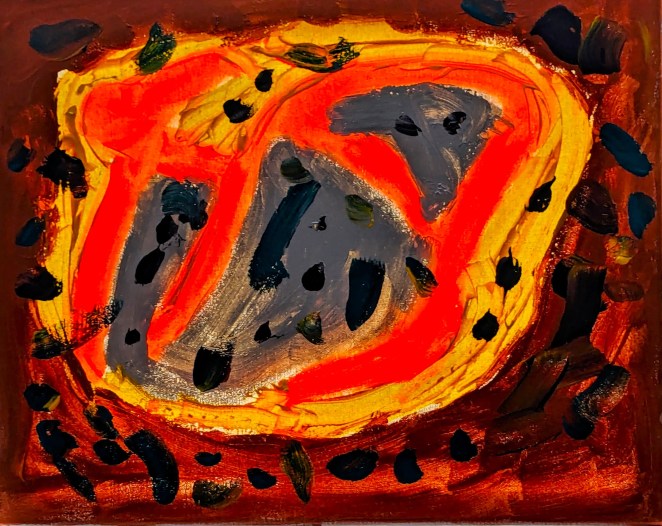
“Look,” he said to me, “this is today’s painting. It’s called Walking on Air.”
“Walking on air?” I queried.
“Yup,” he replied – “I hear music, but there’s no one there.” Then he told me to listen quietly to his painting. And I did. But nothing happened.
“I can’t hear a thing,” I told him.
“How many people do you see inside the painting?” he asked.
“About four,” I replied. “A girl with long red hair, a little girl with a little curl, right in the middle of her forehead, an old man, all hunched up, running away from something, and someone on the left hand-side, at the bottom, but I’m not sure what they’re doing.”
“Idiot,” he said to me. “Open your mind, not just your eyes. Look again. Now what do you see?”
“The same people, and there may be a couple more. How many people do you see, Moo?” “None. That’s why I hear music, because there’s no one there.”
“You’re having me on, aren’t you? You’re pulling my leg? You’re taking the…”
“Easy now,” he grinned maliciously, ” you don’t want your next word to be taken and used in evidence against you, do you? Now, look out of the window. What do you see?”
“I see blossoms…”
“But the trees are bare,” he smiled. “Do you toss and turn in your bed at night?”
“I do. And I’ve gone and lost my appetite.”
“I bet those stars shining in the skies last night, will be shining in your eyes tonight.”
“My golly, Moo, I think they might be. You know, you are a genius.”
“I am indeed. But I usually travel incognito. And listen…”
“Wow. I hear someone singing softly, and the voice is coming from the painting… but…”
“I know. There’s no one there.”

How quiet would my life be without music? As quiet as it would be without art, poetry, a sense of humor, friends who laugh with me, not at me, and people like you, who read this, and don’t think that I am totally insane. Oh yes, and if there was no music in my life, there would be no Great Starts to the Day, and no Poems for the End of Time.

A Touch of Frost

A Touch of Frost

1

Cooler nights
have brought
a touch of frost
to higher ground.

At night,
temperatures fall.
By day,
they build.

I watch as Autumn,
finger on lips,
tiptoes
through the garden.

2

With a wave of its wand,
winter threatens.

A gust of wind
swirls the leaves,
bears tufts of snow
dancing round the tree.

I watch
as my grandchild grows,
my child grows older.

She has a gentle
touch of frost,
a grey fringe
at the curl’s roots.

When I glance
in the mirror,
I see the full effects –
drifts of snow
gathered on my head.

I look
at my beloved.
Her hair –
a crab apple tree
in full spring bloom.

Comment:
Nice to add a new poem of my own to this poetry page. Today’s poem came as a result of discovering Moo’s painting – A Touch of Frost. Painting and poem, painter and poet – a great collaboration.

And then there’s the nights – KTJ

Then There’s The Nights … KTJ                

As a child my days were good.
Full of wonder and being misunderstood.
Growing and learning without knowing love.
But always guided by the Lord up above.
The days were filled with hope in my sights.

Then there’s the nights.

Trying to make sense of my life in a bed I did not own.
Fighting demons no child should ever fight alone.
Dreams of monsters under the bed.
Thoughts of not belonging filling my head.
Longing for a normal Mom and Dad.
Crying myself to sleep and feeling sad.

At 14, I thought I was grown.
Stealing my food and living alone.
Leaving behind a brief life with my dad.
Street life was hard, but it was all that I had.
The days seemed to pass by all right.

Then there’s the nights.

Fear of passing by where the dead lay to rest.
I’d stand with my thumb out and hope for the best.
I was told it was the living I should fear.
But my mind was confused
and my thoughts were unclear.
Sleeping in ditches and dreaming of a home.
No one to care for me, I was alone.

Years passed by as if in slow motion.
People came and went, playing on my emotions.
More than one marriage, with hopes of a happy home.
Each time I was sure I was done being alone.
I kept telling myself life was sunny and bright.

Then there’s the nights.

Sleeping once again in a bed I didn’t own.
Waiting for a husband who does not come home.
Anger and confusion running through my head
Wondering if he was sleeping in another woman’s bed.
I wanted to scream and demand he be true.
But you don’t have that option if someone’s abusing you.

I’ve finally made it to the last quarter of my life.
I no longer desire to be anyone’s wife.
I have my independence and a loving heart.
I want love, but I also need time apart.
To grow and learn and miss the ones I love.
I have been truly blessed by God above.

Then there’s the nights

Sometimes sleeping in a bed, I don’t care if I own.
Nights full of contentment for me and me alone.
I’ve let go of the dream of two hearts and souls
intertwined as one.
Finally, my worries and grief are done.
The rest of my journey will be full of peace and love.

Once again, I thank the good Lord above.

Comments
Yesterday, I posted a painting that KTJ associated with one of her poems, Addiction. Last night, my friend, Moo, painted this painting which accords with one of KTJ’s poems entitled And then there’s the nights. This is the lead poem in her first poetry collection, I am my tattoos. This linking of the verbal (poetry) with the visual (a painting) has been a technique I have used before. The movement between visual and verbal often generating a shifting pattern of colors and images in the reader’s / viewer’s mind. These collaborations between artists are very productive. Long may they continue.

NB If you, dear reader, would be interested in writing for one of Moo’s paintings, just drop me a line, or leave a note in the comments section.