Book of Life

Book of Life

When I lost my place, I tied my hanky in a knot,
to help me remember the number of my page.
Last night I looked in pockets and sleeve, but
I couldn’t remember where I put my hanky.

At midnight the stars dropped liquid fires and they
pooled like letters on the fresh snow of my dreams.

One night I caught some falling stars and I joined them
together, one by one, till they stretched their daisy chain
across the garden. Words grow like flowers in the Spring.

Once I could accelerate the universe. But now I slow
down when I spell my name. There is a circlet of gold
on the sky’s bright brow. What gave these stars the right
to write my future in expanding letters? A satellite moves
in a straight line, north to south and starlight crumbles
in the wake of artificial knowledge spanning the eye ball
of the planet.  Who will repair these broken tunes? Who
will glue these scattered notes back into the piano’s frame?

My tongue stumbles against my teeth and trips on my lip.
A leaf of fire scorches the deep bell sound of my throat.

Commentary:

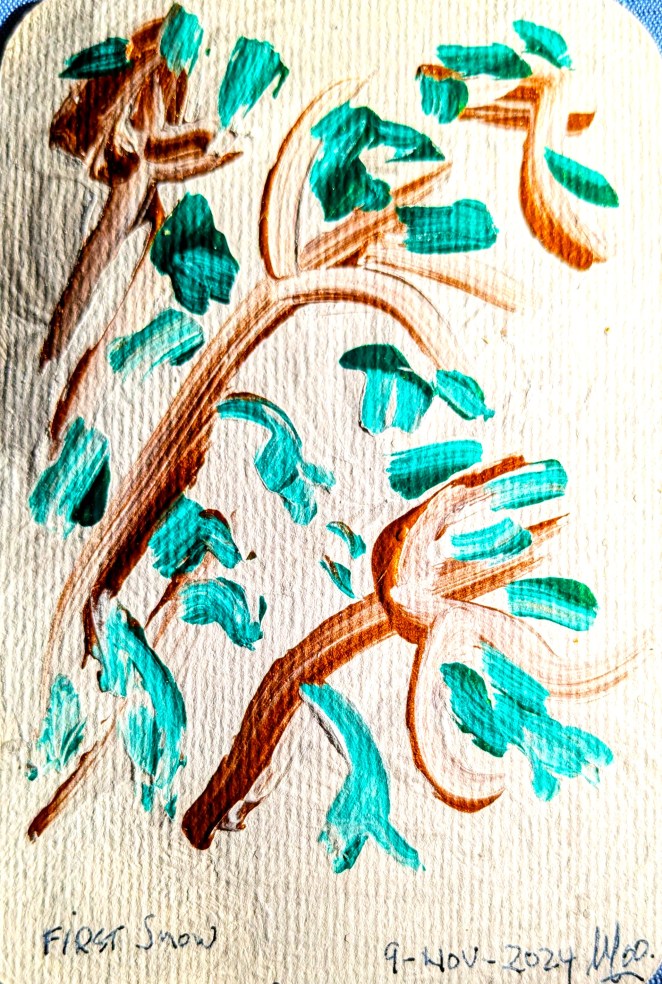
I looked over my shoulder, backward into time and space, and discovered this poem, penned more than a quarter of a century ago and abandoned in an old folder. Moo tells me he hasn’t painted for some time – I wondered if he was on a rotating striking, like our posties (Canadian for mail men and women), but he assured me that he had been sleeping, not sleep-walking in circles. Anyway, he felt inspired, put paintbrush to postcard and gave new life to my Book of Life. Thank you, Moo.

Do you remember when we used to tie knots in our hankies to remember what we had to do? Paper tissues put an end to that. No point in tying a knot in a soggy tissue, even if you could. And as Francisco de Quevedo told us – no point in looking in your hanky after you’ve used it. No point in searching for diamonds and emeralds, let alone pearls of wisdom, they just won’t be there. Good one, Franky. Of course, he was writing in Spanish, not English and my translation can’t do him justice.

It used to be fun watching the night sky out here in Island View. So clear – the satellites passed overhead and followed different paths from the stars. No Platonic dancing to ethereal music for them. Tone deaf, the lot of them, cutting their own little paths across the night sky. We used to get Northern Lights too, Aurora Borealis. They were always spectacular. Great crackling curtains of light hanging down from the heavens almost to the rooftops. Moo wishes he could paint everything h sees. I wish I could write down in verse every thought I think. If each of us had our wishes fulfilled, we’d have two books of life – one in color and one in black and white!

Raven

Raven

When Raven flies through his trap door in the sky, a light bulb clicks off in my head and I fall into darkness. Is there some safety net before oblivion? Raven’s claws scar crow’s feet on a fingernail moon. His bleak black beak widens the hole in my head and the Easter egg of my skull shows thin blue cracks. Outside my window, the river moves backwards and forwards with the tide. Raven shrugs at cancerous creatures, promising nothing. He soars into clear skies in search of his private exit and extinguishes sun, moon, and stars, plunging our world into blackness. The light on the point picks out a heron, mobbed by a clacking ring of gulls. The sea mist wraps the real world tight in its cloak. Now sea and lighthouse, heron and gulls, are distant things of memory. Raven, shoulders hunched, stands like a stone, an anthracite block hacked out from the coal seam in my mind, hand carved from feathers and my forefathers’ blood.

Commentary:

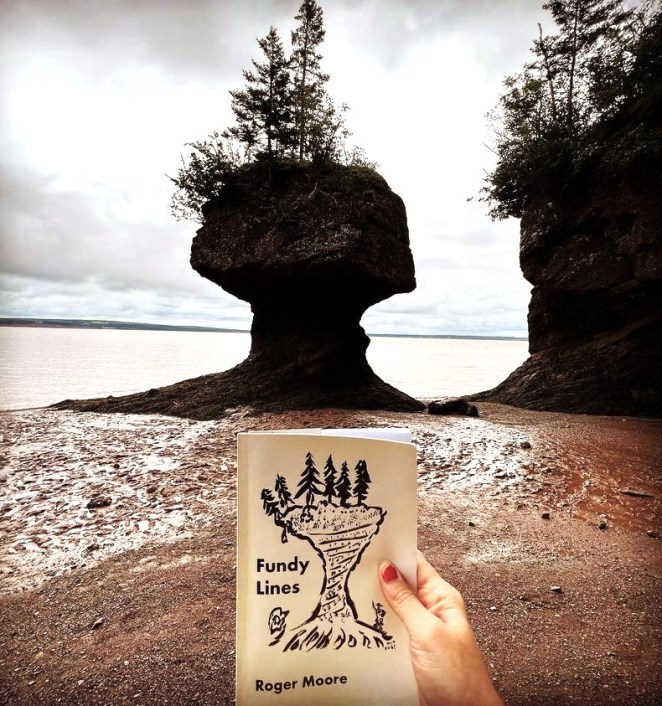
I had forgotten all about this poem in prose. It comes from Fundy Lines, if I remember correctly. Photo credit (below) to one of my former students, an excellent poet herself, who took the trouble to locate the correct rock and then take a photo of book and rock together.


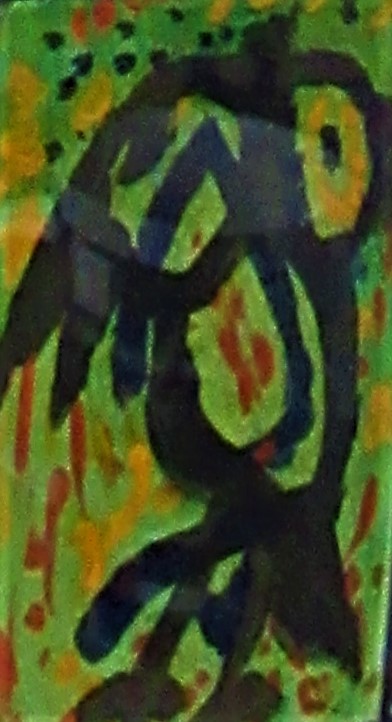
Moo thought his painting of a dark shape that looks a little bit like a bird of ill-omen would be just what this prose poem needed. Maybe he’s right. I trust him with his choice of paintings. Well, most of the time anyway. He can be a bit ‘off’ from time to time, but mostly we form a good team, especially where Surrealism is concerned.

I guess Raven formed part of my Surreal sequences. I really do enjoy Surrealism. The mixing of metaphors, for example, the unexpected meeting of a sewing machine with a carving knife and an umbrella on an operating table. And look what Raven’s up to. He discovers a trap door in the sky. Well, that would be very useful, if we had wings and could fly. Then he turns off the light bulb in my head. I didn’t even know I had one in there. I guess Raven, like coyote and zopilote is a bit of a Trickster. Next he changes into a woodpecker and widens the hole in my skull. Poor old me – avian trepanning – no wonder I have problems! My head becomes an Easter Egg and has cracks in it giving birth to what? Some mad ideas, I guess, pecking their way out into the wonderful world in which Moo and I live in perfect harmony with my beloved and our cat. And look at all those Welsh mining memories – lignite, house coal, steam coal, anthracite, jet – and remember, when the coal comes from the Rhondda down the Merthyr – Taff Vale line, I’ll be there.

It will be a long way from Canada to Taff’s Well. Maybe Raven will be kind and fly me there, through his Island View trap door that has direct access to the trap door just above Castell Coch, the Fairy Castle of my childhood. That would be faster, and easier, than my old two-wheeler Raleigh bicycle with it’s Sturmey-Archer three gear click on the handlebars. I bet Raven can fly faster than I can pedal. And if I could have pedaled as fast as Raven flies, downhill and uphill, I would have been King of the Mountains and an all time winner of the Tour de France. Now that would have been surrealistically surreal, seeing me as a cereal winner, with my snap, crackle, and pop! Not that my dad would have been happy. He never was happy with anything I did!

Tell us about a time when you felt out of place!

Tell us about a time when you felt out of place!

I think it would be much easier to tell you about a time when I felt as if I was in my proper place. There were so few of them. As for the original question – Tell us about a time when you felt out of place – I think that a time should be replaced by the many times. Learning languages has always been more of a pain than a pleasure, for me, anyway. In the Basque Country, Northern Spain, at first with my parents, and then on my own. Sitting at the table or standing in the kitchen, listening to people chattering away in Spanish some days, in Basque, on other occasions. I was reduced to interpreting looks, smiles, scowls, meaningless sounds … how could I have felt that I was in my proper place? Etiquette – I knew nothing about their etiquette. Culture – I knew nothing about their culture and they knew even less about mine. I lived in a world where waves of sound battered at my body and I stood there, a rock on a seemingly deserted linguistic beach, being gradually worn down by the endless waves and the eroding tides. How could I have felt anything but ‘out of place’?

The same thing happened when I became immersed in French culture. I spent some time in the South of France, in an area where Provencal was still spoken. Between the two languages and the differing accents, I was lost, lost, lost.

Something similar happened when I came to Canada. Here, it wasn’t the language that baffled me, but the culture. I remember trying to learn to skate. My cousin played Junior “B” hockey and volunteered to teach me. Well, I learned very slowly (a) to keep my balance and (b) to move forwards very slowly. However, I couldn’t skate back wards and I couldn’t stop. In spite of that, I decided to try and play hockey. The park close to where I lived in Toronto had a frozen area where the little kids played shinny. I asked if I could join in. After three falls and a total inability to stick handle in any known fashion, they stuck me in goal. I used the goalie’s stick to try and stand up. After the third or fourth goal, one five or six year old whisked up to me, stopped in a sideways shower of ice, and said “Sir, please sir, you’re allowed to use the stick to stop the puck, you know.” I retired from ice hockey soon after that, and from skating. I did learn to cross-country ski, though. I also earned the name Wapiti (white-tailed deer) long before I saw one or knew what it meant.

And that is all just scratching the surface. I could say more, so much more. But I’ll control myself.

Clepsydra 18-20

18

… as free as the birds
     a sky full at North Cape
          where shores retreat
               year after year
 
the big red mud diminishes
     under advancing waters
          sea-threatened cliffs
               undermined roads
                    houses
                         the lighthouse

gulls follow the fishing boats
     herring gulls
          blotting out
               sun and sky
                    above the reef

with its seals
     basking in sunshine
          knowing themselves
               being themselves
                    thinking themselves safe

kings and queens
     of their sealdom
          never questioning …

19

… an osprey
     sudden the swoop
          turned into a stoop

water shattered
     total immersion
          then emerging
               with lusty thrusts of wings

claws clasping
     imprisoned prey
          prised from the sea
               raised to the skies
                    up and away
                         murderer and victim

oblivious below
     the black horse
          with cart and farmer
               gathering seaweed

all of them
     having no doubts
          safe in the security
               of their roles …

20

… while lost in the labyrinth
      I searched for a thread
               on life’s loom

a thread woven
     by an unknown
          unseen hand
               a hand and thread
                    I could never control

yet one day
     that thread
          will lead me out
               from the dark

then shall I see
     the sun’s great candle
          beneath which red rocks
               wave and water battered
                    crumble

here at North Cape
     in a way that nobody
          can understand …

Commentary:

The osprey “emerging with lusty thrusts of wings, claws clasping, imprisoned prey prised from the sea, raised to the skies, up and away, murderer and victim.” The words are based on the photograph. A quiet day, somebody shouted, and pointed, and clickety-click, I was lucky enough to capture the whole thing on my digital camera. This one shot summarizes it all.

The stanzas (16 & 17) that precede this moment are available here. Clepsydra, the book, is one single poem, one single sentence, that rambles on and on. Each stanza stands alone, each poem (numbered) stands alone, and the whole book stands alone as a single sentence summarizing what I have seen and where I have been. Bakhtinian Chronotopos – my dialog with my time and my place. In this case, my many dialogs with my multiple times and multitudinous places.

Albert Camus lent me the phrase ‘murderer and victim’. ‘Nous sommes, ou meurtrier ou victime‘. Quoted from memory. I hope I am not too far wrong. My memory fades as I age. Louis Aragon suggested I borrow his line “rois tombés de leurs chariots” – that I found in his collection Il ne m’est Paris sans Elsa. Here, I have applied it to the seals at North Cape, PEI – “seals – basking in sunshine – kings and queens of their sealdom.” Intertextuality – texts talking to texts and recalling segments of texts within other texts.” Wonderful. Alas, I fear the coming days when the memory may no longer be so clear. ‘What will be, will be’ said the Osprey as he pulled the flounder from the sea and carried him too his nest in a nearby tree.

Autumn Leaves

Autumn Leaves

I used to run,
jump, and catch them
in mid-air,
one, two, three
in each hand.

Now
I stand and wait
for them to fall
and land, perhaps,
on my clothes
or catch in my hair

the Leprechaun luck
of my Irish heritage,
so long-denied,
with its pot of golden leaves
waiting for me
at summer’s cast-off
rainbow’s end.

Commentary:

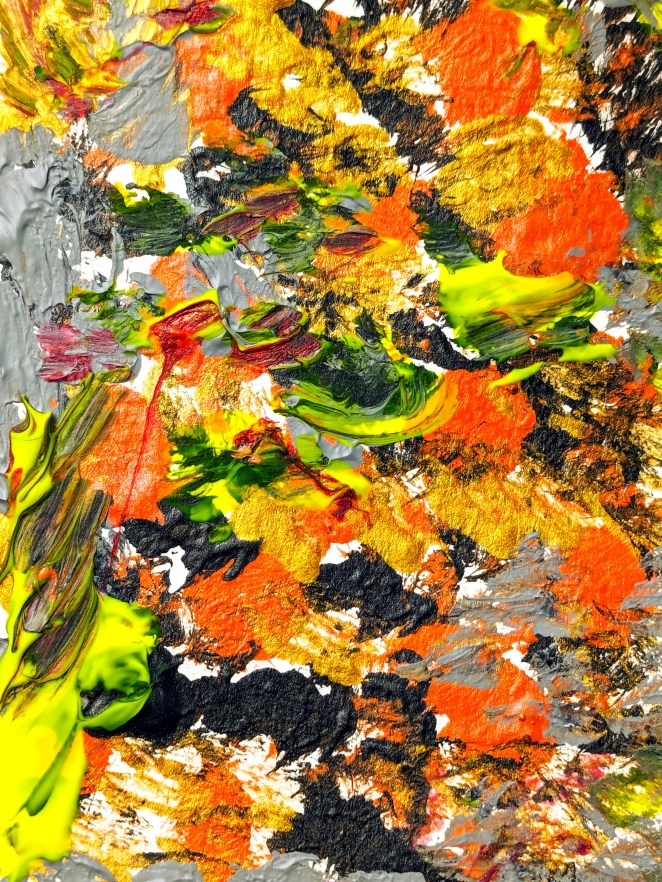
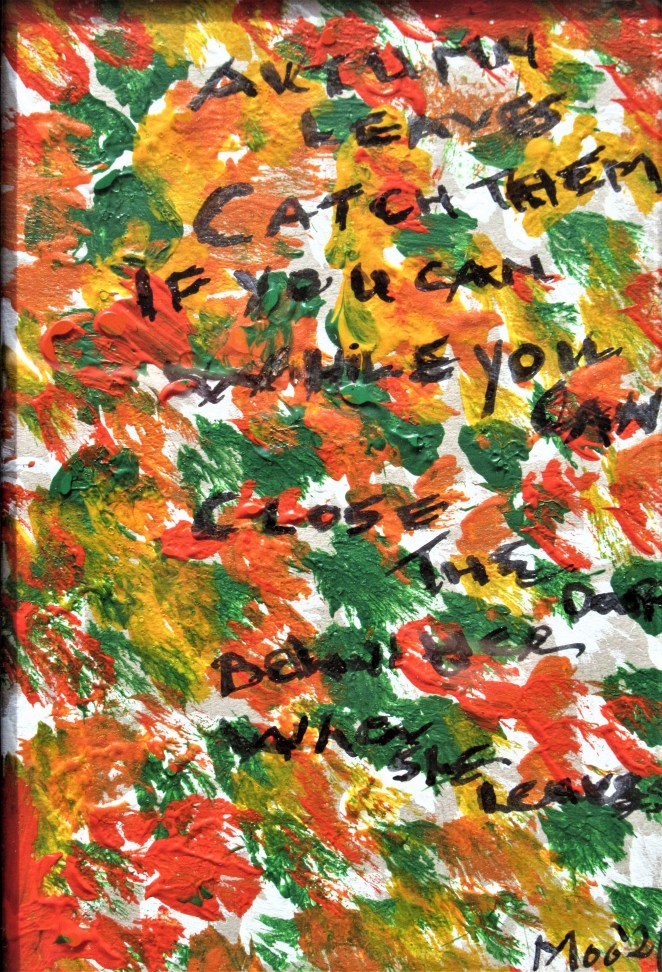
Autumn Leaves, but where does it go to. Good question. Moo asked me that the other day. I just had to tell him that I didn’t know. However, he did offer me the perfect painting for the fall and the changing leaves. Fall Folly Age. I never realized that he could play with words like he plays with paint. Anyway, I know that last winter he painted a picture of little white dots with wings. “What are they?” I asked him. “Snow flies,” he replied. “You know, when the snow flies …” “When the snow flies do what?” “I don’t know.” Moo and I live in a mysterious world, as you have probably come to realize.

Any way, the combination of fall foliage and fall folly age is quite a good one and it shows the folly of ageing and trying to chase down falling leaves when gadding about in the garden with two sticks, one in each hand. Of course, in case you don’t like that painting, and I hope you do like it, because I do, then here’s another one for you.

The text reads – “Autumn leaves – catch them if you can – while you can -and close the door behind her – when she leaves.” Oh witty Moo. Painting and occasional poetry too.

Dog Days

Dog Daze

1

A dry storm lays waste the days that dog my mind.
Carnivorous canicular, hydropic, it drinks me dry,
desiccates my dreams, gnaws me into nothingness.

At night a black dog hounds me, sends my head spinning,
makes me chase my own tail, round and round. It snaps at
dreams, shadows, memories that ghost through my mind.

Tarot Cards and Tea Leaves are lost in a Mad Hatter’s
dream of a dormouse in a teapot on an unkempt table.
Hunter home from the hill, I awake to find my house
empty, my body devastated, my future a foretold mess.

Desperate I lap at salt-licks of false hope but
they only increase my thirst and drive me deeper
into thick, black, tumultuous clouds. Dry lightning.
The drought continues and no raindrops fall.

Dog Daze
2

The drought continues and no raindrops fall.
Desperate I lap at salt-licks of false hope but
they only increase my thirst and drive me deeper
into thick, black, tumultuous clouds. Dry lightning.

Tarot Cards and Tea Leaves are lost in a Mad Hatter’s
dream of a dormouse in a teapot on an unkempt table.
Hunter home from the hill, I awake to find my house
empty, my body devastated, my future a foretold mess.

At night a black dog hounds me, sends my head spinning,
makes me chase my own tail, round and round. It snaps at
dreams, shadows, memories that ghost through my mind.

A heat wave lays waste the hopes that dog my days.
Carnivorous canicular, hydropic, it drinks me dry,
desiccates my dreams, gnaws me into nothingness.

Dog Daze
3

The drought continues. No raindrops fall.
No fresh water. None at all.

Dark clouds gather in the sky.
No rain falls. The ground is dry.

Grass all burned. No more hay.
How much livestock will they slay?

No rain comes, but a flash of light
sets the woods and fields alight.

Home from the fields, some farmers confess
their future is an unpredictable mess.

Desperate farmers are losing hope.
Out in the barns, they keep some rope.

The roof beams are sturdy and built high.
One little jump and problems good-bye.

Commentary:

Dog Daze 1 is a reverse sonnet. Instead of being structured 4-4-3-3 it moves in reverse 3-3-4-4. What fun to pretend to be Milton Acorn, and to turn my sonnet upside down. It should rhyme, but I abandoned rhyme in favor of metaphor a long time ago. Was I right to do so? What, if anything, catches you unawares in Dog Daze 1? Does it work for you? What would happen if we turned it upside down? You be the judge.

Dog Daze 2 is more or less the same sonnet returned to its normal stanzaic shape 4-4-3-3. In what ways has the poem now changed? Clearly there is a structural difference. Obviously some of the lines and images have changed. Is the poem stronger? Weaker? Does each one affect you in a different fashion? Do you prefer one version to the other?

Mission Impossible – How many more adaptations can we make to this poem and how would each one affect the poem and the reader’s reception of it? For example – Dog Daze 3 sees our sonnet turned into a poem composed of seven rhyming couplets. Couplets are easy to rhyme. But do they simplify the thoughts too much? Is the poem now too dark? Can you lighten the mood? How? Your mission, should you decide to accept it, is to rewrite the poem in seven non-rhyming couplets. That will make a change from the Daily Sudoku and the Cross-word puzzle. If you do take up the challenge, let me see what you do! And remember, you can make it personal to you, your life, and your garden.

Poisoned Pawn

Poisoned Paw

Openings are so important.
They should be magnets
drawing the opposition in,
but sometimes they’re whirl-pools
dragging you down.

You try to hold your breath,
but you must breathe deep, let go,
go with the flow and prepare for
whatever awaits you in the deep.
Down there, it’s a different world.

Light breaks its black and white bishops,
and the knights walk a forked path
when not pinned down. When you lose
do you mourn for the simplicity of draughts,
or Fox and Hounds or do you strive
to establish, once more, your light in the dark,
down there, where no sun shines.

You are the glow-worm,
glowing where no light glows.
You are the line, the sinker, the hook,
the bait, the temptation that encourages
your opponents to sacrifice their own peace,
 to join you, and together, to swim, or drown.

Commentary:

My family didn’t play much chess. I bought my first chess set when I was ten years old, at Boot’s the Chemist, down by the market, in Swansea. I also bought Harry Golembek’s book The Game of Chess. I still have both the set and the book, seventy years later. Descriptive notation. Absolutely bewildering. I stared at the chart that gave the code names of every square and remained totally confused. I had to look up each square, from its notation, locate it on the chart, then move the piece on my board into the appropriate position. And remember, each side had exactly the same format – QR1, QKt1, QB1, Q1, K1, KB1, KKt1, KR1. Not quite a mirror image as the squares reversed themselves on the other side of the board.

I remember clearly the day that ‘Light broke where no light shone.’ I looked at the maze of numbers, and suddenly the pattern clicked into shape in my mind and I understood the whole idea of descriptive notation. Boundary Knowledge – you cross a boundary after days of bewilderment, and enter a new phase of enlightenment ‘light breaks where no light shines’. When I watched the film, The Poisoned Pawn, I remembered my own learning days in chess. Great fun, that particular opening. Do we take the poisoned pawn, or do we leave it? I will leave you to decide. But remember, it’s not called the poisoned pawn for nothing, damned if you do and damned if you don’t!

I used descriptive notation throughout my school days. I had one particular friend in boarding school who also played chess. We slept in the same dormitory, two beds apart. After lights out, no talking, no reading. Prefects prowled at night to enforce the rules. After lights out, one of us would call out ‘P-K4’ and thus the game started. We weren’t exactly talking, so it wasn’t easy to catch us. Every night, we played the game in our heads. A great memory trainer. Occasionally we managed to finish a game – not often – we were both too wary of Fool’s Mate and the simple early traps! Each day, during one of the school breaks, we would restart the game of the night before, from memory, and then play it to its end. We very rarely forgot the moves we had made and we virtually never disagreed on the board position.

This was totally unlike chess with my family. The grown-ups would all gather round the board. Their object was to distract me, to move pieces when I wasn’t looking, to remove (MY) pieces and leave me in a desperate situation. “‘Knock, knock!’ ‘Who’s that at the door? Go and look.” And off I would go to return to a battlefield that had totally changed its shape and mood. I would carefully reconstruct it, piece by piece, square by square. But I have never forgotten the black looks, the accusations of cheating, the fury of the old ones being beaten by the younger generation. In the end, nobody within the family would play me, unless I gave them a handicap by removing a rook or one of the bishops.

I didn’t discover algebraic notation until I lived first in France, and then in Spain. Algebraic notation. Each of the 64 squares had its own letter and number and, as a result, there was no way to confuse the position of the pieces. Staunton chess sets in England became a variety of different piece shapes on the continent and I often lost games when I forgot that the pawn had one circle, the bishop two, and the queen three, but they all looked like. Many a time I gave up a bishop thinking it was a pawn – oh that poisoned pawn again.

Now, in my dotage, I play chess against the computer. I haven’t played a live opponent for years. But I do have a chess book collection and I have played Fisher’s best games, and Fisher vs Spassky, and I have studied the Russians and how they play and think – very differently from me. And so, in my old age, I sit at the chessboard of my life, and I move the pieces here and there, and remember old friends, and how we shifted across the shifting boards of our days. So many pieces have dropped from life’s chessboard, but a few of us are left, and we move more slowly, but we wander on and on.

PS Moo, sometimes slow in understanding, offered me several paintings that suggested the aftermath of the Poisoned Prawn. When I explained the basics of chess to him, he said he didn’t have a chess painting he could recommend, so he suggested this painting – the correct way to teach. ‘You can’t teach chess,’ I said, ‘it is so instinctive.’ I took one look at the right way to teach and loved it. Here we go The Right Way to Teach! X – WRONG!

Time Flies

Time Flies

… bends like a boomerang,
flies too rapidly away,
limps back to the hand.

Endless this shuffle of unmarked
days dropping off the calendar.

Hands stop on the clock.
The pendulum swings:
time and tide stand still,
do not move.

The print in my grandma’s house:
seemingly moving seas,
sails swelled out,
the ship stays firm in its frame.

‘As idle as a painted ship
upon a painted ocean.’

Our garden fills
with brightly colored birds
and red and grey squirrels.

Light and dark
switch back and forth
each day
a twin of the day before.

The TV screen hangs out
the daily washing.
Tired, worn out shadow,
their faces boring us
with shallow wit
and hand-me-down wisdom.

Time:
an albatross around the neck,
an emu, an ostrich, a dodo,
an overweight bumble bee,
too clumsy, too heavy to fly.

“Time flies?”
“You can’t.
They fly too fast.”

Commentary:

My friend Moo told me he was ‘all shook up’ when I read him this poem. I don’t think Moo’s too smart. He thought All Shook Up was written by the Rolling Stones when they went out moss gathering during the Fredericton Harvest Festival, but I said no, it was definitely written by Buddy Holly on an off-day when he was playing cricket. It wasn’t okay in those days to play croquet.

The last three lines come from an examination question in the General Paper, “S” Level, as it used to be. “Punctuate this sentence – time flies you can’t they fly too fast” – of course, they should have said, “in exactly the same way we want you to. Corrections and alternative versions will not be accepted.” What did they think I was? A mind-reader? I wasn’t. I was a teenager having a field day in the national examinations. I would love to have been a fly on the wall when they marked my paper.

In the biology exam, they gave each one of us a Brussel Sprout and asked us to draw it and tell us as much as we could about it. Of course, I ate mine, and I said it tasted a little bit dry and needed some salt. Then I drew a mess of potage, all yellow and green with chewed up squiggles, and added “That’s what the sprout probably looks like right now.” I failed that exam too. Didn’t even get a part mark for ingenuity, though the science teacher said I could have a glow of satisfaction. Very useful after lights out in a boarding school, I can tell you.

I can’t remember if Moo went to that school with me or not. I don’t think he did. I think he drifted into my life a little bit later. He wasn’t a painter at that stage, just a half-starved philosopher doomed to live in a garret. Of course, once he started painting houses, he made money. It’s amazing how many people will pay you for painting their houses. Of course, that was before they invented plastic siding.

About now you realize that I live in a strange world all of my own and a lot of people live in it with me. You, too, if you enjoyed reading this. Long may the ‘strange world of me, you, and Moo’ continue. I’d send you a penny for your thoughts, but they have gone out of circulation. I can’t even sing you a song of sixpence these days either. Silver sixpences have walked the dodo path too.

This Vessel in which I Sail

This Vessel in which I Sail

Trapped in this fragile vessel, with the pandemic
a passenger waiting to board, I drift from port to port,
looking for a haven, safe, to have and to hold me.

No harbour will let me dock. “No room at this inn,”
they say. “No haven here.” They wave me away.

Now I have no destination. Aimless, I float and every
where I go the message is: “No vacancy: no room at all.”

Unwanted, abandoned, I wander with wind and waves,
my only friends seals, porpoises, and whales.
I walk the whale road, leaving a frail, white wake behind.

This vessel has become a gulag now, a prison
camp where I exist just to survive. Each hour of each day
endless, boundless, like this shadowy, haunted sea.

Today there is no motion, no goal. What is there to achieve
but survival? Each day’s journey is sufficient unto itself.

Commentary:

Moo’s cartoon, Naval Gazing, dates from 2015. That year I spent eight weeks in Moncton at the Georges Dumont, gazing at my navel while waiting for my anti-cancer radiation treatment. Naval gazing / navel gazing, indeed. Good one, guys. You make a great pairing.

The poem dates from 2020 when Covid stalked the streets and we wore masks when we were not confined to our houses. I thought of the tour ships, wandering the seas, with the disease on board, and no port wanting them. It was a strange time.

Golden Oldies, then, both poem and painting. There are signs, small at present, but still visible, that such days are on their way back. We must each ask the question – What is there to achieve but survival? Hopefully we will come up with a similar answer – Each day’s journey is sufficient unto itself. Journey well and journey safely, my friends.

Why do you blog?

Why do you blog?

Good question. And there’s no easy answer. I guess, in my case, that my computer and my teaching (I have been retired for 16 years) were closely linked. I used programs like Blackboard and WebCT to teach hybrid courses, online and in the classroom. The online factors – chat groups, info sharing, course analysis – backed up the in-class material and gave students a space in what was, back then, late 20th Century, a new, but rapidly developing teaching space and style.

I found the development of a web page allowed me to preserve course notes, to construct class material, to allow students to access material (in their own time and space) and many found this useful. I also encouraged students to build their own web pages (and this was in the twentieth century, remember!). I also told them that they would probably, long term, find the web page building more important than the material that I was teaching them, for my material, like that of many other teachers, had a limited shelf life, and was not carved in stone and everlasting. This was particularly true as rapidly changing times, methodologies, and students – often from different cultures and with different styles of learning and levels of knowledge – spelled the end of the single course outline imposed, top down, on all members of the class.

When I retired from teaching, I kept the web pages I had built. Then, some five or six years after retirement, I decided to start a blog, rather than just have a webpage. Now, blogging has become a habit. Not an incurable one – just this year I missed four months ‘blog time and space’ on this web page / blog of mine.

But is this web page of mine a blog? Not really. I don’t sell anything on it, rather I give my books away to friends who wish to read them. I don’t charge for accessing my ideas, my thoughts, my creativity, my poetry, my photos, my paintings, my philosophy. My oh my, look at all those ‘my -s’!

At this point in time I am wondering whether to continue blogging or not. I have been approached by many people who wish to enrich themselves by enriching my webpage so I can then enrich myself. But I neither want nor need that. Rather, I follow the philosophy of Miguel de Unamuno, the great Spanish philosopher. “If I can reach out and help just one person,” he said, “I will not have lived in vain. And I guess that’s why I blog – to reach out on the off-chance that one or two of my words will touch someone in a meaningful fashion and help them to understand the world a little bit better and even, maybe, to help reshape their lives.