Rage, Rage 32 & 33

Rage, Rage
32


I miss
the swish and roar
of my incoming,
outgoing breath.

I miss
those Full Moon fingers
tinkling the tides
of my inner being,
making me strive
to keep myself alive.

My body’s house,
devoid of gnomes,
wolves, and pipes,
lies vacant and silent.

The full moon’s
rampant skull
empties the sky of stars
and fills my mind
with cratered shadows.

33

Strange creatures hide in the mist
that overcomes my brain.
I see the sudden flash
of sharp, lusting midnight teeth,

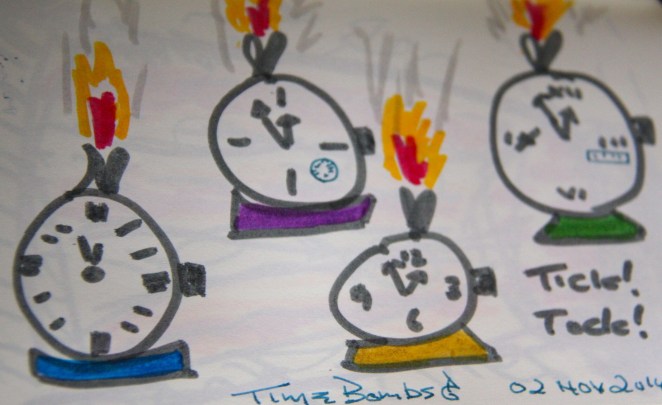
My heart turns into
a time bomb ticking
its irregular beat
in the cavity of my chest.

Am I a victim, then,
as Camus suggests,
or just another assassin?

A suicide bomber, perhaps,
with explosives strapped
inside my rib-cage
rather than round my chest
in a hidden vest?

Tick-a-tock
and tickety-tick-tock,
I can hear and feel
the arrhythmic clock
alarming me
as it arms itself in my chest.”Tick-a-tock
and tickety-tick-tock,
I can hear and feel
the arrhythmic clock
alarming me
as it arms itself in my chest.”

Comment:

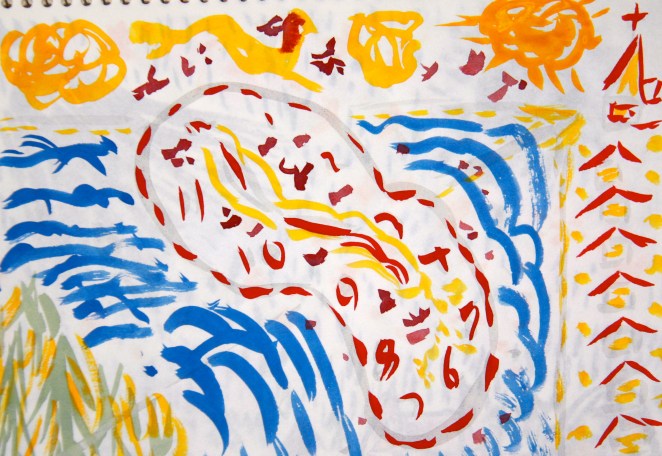
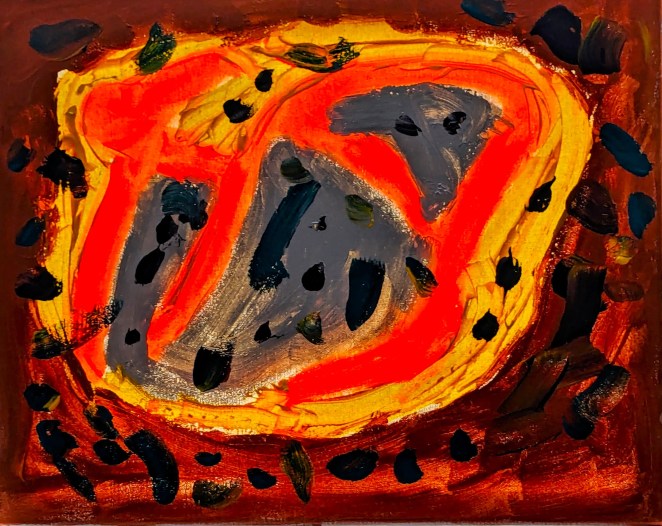
So, Moo has just come back from wherever he’s been and wherever it was, he’s not telling me. However, he does say that I look All Shook Up. And he’s humming Elvis Presley songs at me. And the above painting is his suggestion for me for today. “Thank you, Moo. And welcome back.” He nods at me. “Good to see you two,” he says. “You spelt that wrong,” I tell him. “I didn’t,” he says. “We all know you’re a split personality and I am saying that I am pleased to see both halves of you again.” Oh, dear, you can never win with Moo. He always paints a different angle or comes round in a wiggling circle. “Ha!” he says. “At least I don’t paint myself into corners.”

Am I a victim, then, as Camus suggests, or just another assassin? Interesting suggestion. We are either murderers or victims. But I haven’t murdered anyone, that I am aware of. And I don’t feel myself to be a victim. So what is my dear friend Albert on about? Alas, he isn’t around to ask. I just have to read his books and see myself left wondering.

I guess it was all different in Paris, in the 1940, during the Nazi occupation. Anyone can talk a good game, but what do you do when the Gestapo knock on your door at 2:00 am? Good question. Existence precedes essence. We live. We survive. That’s Jean-Paul Sartre. And so is this – “L’homme n’est rien d’autre que ce qu’il fait.” Man is no more than what he does. So there you have it. It’s never what you say you might do, or how you relate things in respect – it’s all about what you are doing right now. So – ask yourself that vital question – “What am I actually doing?” The answer you give will tell you a lot of things about yourself – if you are honest in what you say.
Rage, Rage 28 & 29

Rage, Rage
28

Two small gnomes
camped, one in each
of my lungs.

All night long
they played
their squeeze-box,
wheeze-box concertinas,
never quite in unison.

Sometimes they stamped
their feet and my body
rattled in time
with their dance steps.

Their wild night music
caught in my throat
and I coughed
unmusical songs
that spluttered
and choked me.

29

This morning, the bailiff,
Mr. Koffdrop, evicted
the two gnomes from my lungs.

Landlord Bodie
placed an ad on Kiji.

He rented the free space
in the left lung
to a tiny bag-piper
who took up residence
by my heart.

All night this piper piped me
a highland pibroch
on his whisky-worn pipes.

Comment:

All night this piper piped – and there is nothing stranger than having a clogged up, congested chest and hearing your own breath whistling in and out of your lungs. It certainly kept me awake. And I lay there remembering all the pipers I have ever heard piping. One very special one, from the Canadian Black Watch, gifted me the last image “a highland pibroch on his whisky-worn pipes”. A flask in his jacket and a nip every now and then to keep the music and the energy flowing. Scotch of course. None of the Japanese or Irish whisky varieties for that kilt-clad friend of mine. I can hear him now, as I type these lines – “A drop before ye go?”

As for the accordion, well, I have always liked the small, hand-held ones – squeeze boxes – wheeze boxes – and did those lungs of mine ever squeeze and wheeze. I called them Mr. Teasy-wheezy and Mr. Teasy-squeezy. And all night long they serenaded me. And I lay there, wide awake, not even drowsing, watching  Orion gradually striding his lonely way towards the western horizon. No rest for those afflicted with the squeezy-wheezy lung syndrome. And long may it stay away.

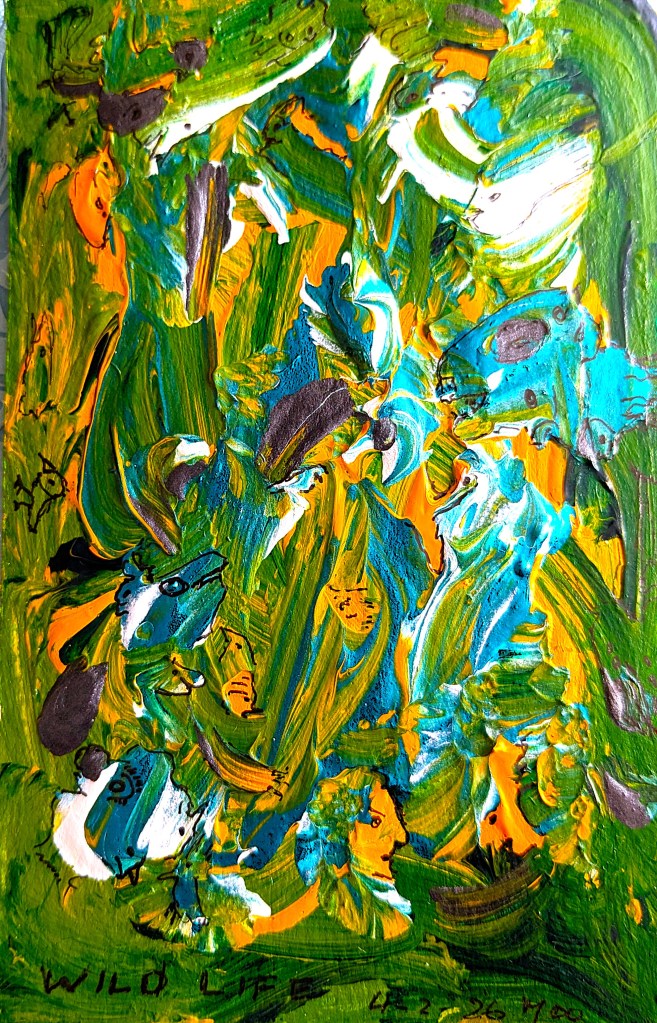
Wild Life

Wild Life

I see green grass
Small ponds
Winding roads
Patches of sorrow

Turquoise blues 
Hills to climb
Softness
Strength 

Flowers blooming
A small animal
Covered in feathers 

An eye
Keeping watch
Purity of white

Ekphrastic Poem
©
Yolande Essiembre

Comment:

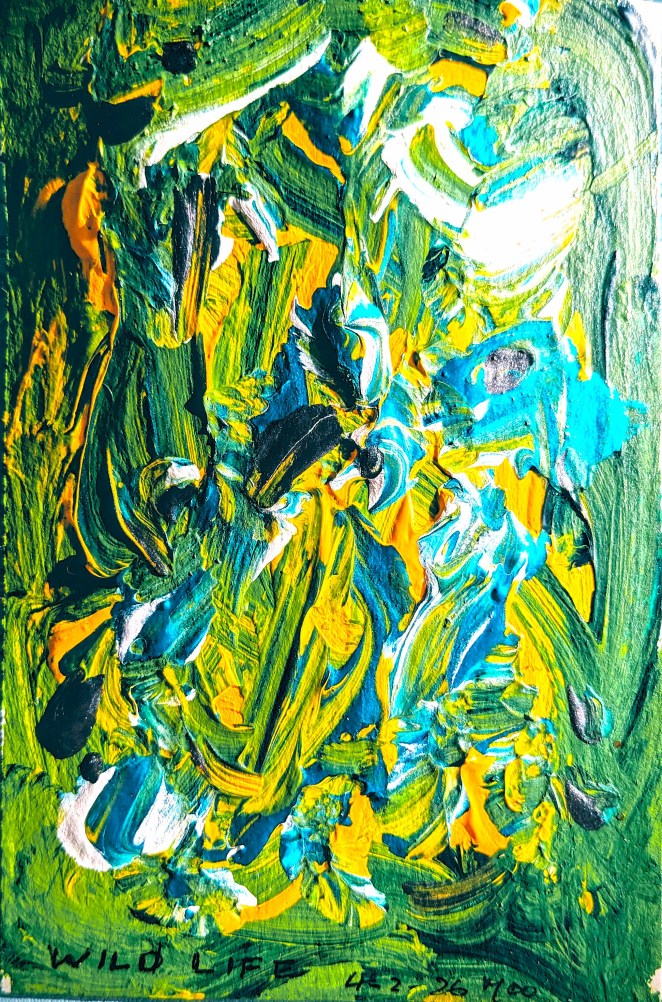
My good friend Yolande Essiembre sent me her Ekphrastic poem after viewing this morning’s painting by Moo. Wild Life II is a better representation of the colours of the original. However, Moo added in some (what he calls!) helpful touches – the black shapes that reinforce the suggestions of the original. Yolande wrote her poem based on Version I – but with the stronger colors of version II. Magic oh what a tangled web we weave when first we practice to deceive. And all artists weave their webs of deceit. As Cervantes says – Tanto la mentira es mejor, cuanto más parece verdadera. / The closer it approaches the truth, the better the lie.

Imitatioimitation – one of the bedrocks of classical rhetoric. “Imitation is the best form of flattery”. Flattery, yes, but what we find, in art above all, is that there exists only one original. However good the copy, the flattery – the imitation, if you prefer – it is never as good as the original. The original of this painting exists in one time and one place. The two deceptions are not the original. In fact, Wild Life I no longer exists because Moo has repainted it. It has turned into Wild Life II.

So many questions – which version do you prefer – I or II? De gustibus non est disputandum. There is no arguing about taste. Which is the better version? Well, each viewer must choose. But remember, each version is a deception, and each deception is a lie. And there is only one original. Oh what a tangled web we weave.

But we can, I hope, agree on one thing – Yolande’s verbal version (which I publish here with her permission) is verbally picture perfect. It is how she sees the painting. It is what the painting means to her.

Thank you so much Yolande. Moo and I hope to publish your words and visions more often. With your permission. we will do so.


Carved in Stone 72 & 73

Carved in Stone
72

Is this world I create real?
Of course it isn’t.

It exists only in my head,
and on the page,
but perhaps, one day,
you too will see
the things I have seen.

Yet the world I describe
is as unreal as the words
from which it is woven.

73

Heraclitus once wrote
we can never bathe
in the same river twice
.

This is the Catch 22
faced by all poets,
to remember,
and to try to recreate.

Shadow hands on cave walls,
colored pictographs on gesso,
hieroglyphics on papyrus,
ink on paper, raw words,
and in the end,
everything reduced
to these three little letters
carved in stone –

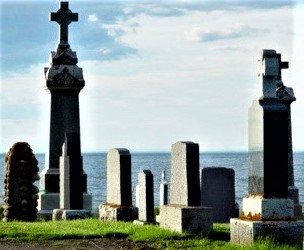
RIP

Commentary:

If you have read this far, we have walked a long journey together – 73 verses that comment on life and the meaning of life. Hard reading in places, easy in others. I trust you have enjoyed the journey and found some stops and resting points along the way in which to contemplate the ways in which the threads of your own life intermingle with mine.

Throughout this journey, I have tried to use a four step process. (1) Verbal – the poems themselves. (2) Visual – photos that intertwine with the verbal. (3) A Commentary – that goes beyond the verbal and visual and opens up the ideas a little more. (4) A Dialog between myself – the poet – and Moo – the visual artist who has so frequently loaned me his paintings when he thinks they illustrate my words.

It’s been a topsy-turvy journey through what Bakhtin calls a world of carnival, where little is at it seems, and the world is turned upside down. That said, we have a clear choice – to slide down the downside of this life, or to scale the upside, to contemplate, with joy and happiness, the world from those heady heights.

Blessings. Pax amorque.
And thank you for travelling with me.

Banks of the Seine

Banks of the Seine

Gnawing at the carcass of an old song,
my mind, a mindless dog, chasing its tail,
turning in circles, snapping at the fragment
of its own flesh, flag flourished before it,
tournons, tournons, tournons toujours,
as Apollinaire phrased it, on a day
when I went dogless, walking on a mind-leash
before the Parisian bouquinistes who sold,
along the banks of the Seine, such tempting
merchandise, and me, hands in pockets,
penniless, tempted beyond measure,
by words, set out on pages, wondrous,
pages that, hands free, I turned, and turned,
plucking words, here and there, like a sparrow,
or a pigeon, picks at the crumbs thrown away
by pitying tramps, kings, fallen from chariots,
as Éluard wrote, and me, a pauper among riches,
an Oliver Twist, rising from my trance, hands out,
pleading, “Please, sir, can I have some more?”

Commentary:

Intertextuality – how many different texts can you recognize in this one piece of verse? I can count six reminiscences of other poets, ones that have influenced me to a lesser or greater extent. A couple of novelists lurk in the shadows as well. Fascinating, eh? Do these voices echo in any other ears than mine? Good question – and does it matter if they do or they don’t? The main thing is that they harmonize, the old world with the new, the centuries that went before with the one that is with us now. Quevedo – “Vivo en conversación con los difuntos y escucho con mis ojos con los muertos.” I live in conversation with the defunct and I listen with my eyes to the dead.

And look at that painting. No, not the Banks of the Seine, but the banks of the Fundy, near St. Andrews. And it’s Moo, at his best, doing a cross between a cartoonist, a genuine artist, a surrealist, and an amateur artist who lends his paintings to friends when they want a picture of water, or a river bank, or something or someone else that will add to the intertextuality of his works. Yea, Moo. Go Team Moo, go. Long may you survive and work together.

Carved in Stone 16 & 17

16

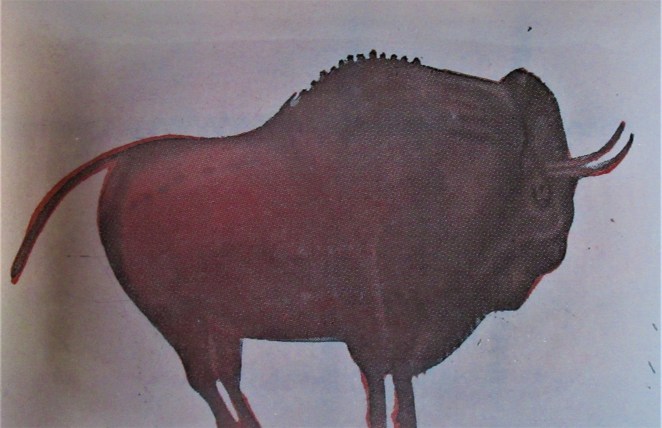
The Bulls of Guisando,
pre-historic, unweighable,
the bearers of Roman graffiti,
itself two thousand years old.

Were they carved as boundary markers,
or designed to designate pastures,
for horses, pigs, sheep, and bulls,
all grazing in their stone dreams?

Celtic, pre-Roman,
they speak to my Welsh blood,
and to the Irish soul
that will always be a part of me.

I place my hand
on the dimpled granite hide
and feel time coursing
beneath the stone skin.

Granite ships,
islands in a sea of time,
I sense a heart beating,
something surviving
within the stone.

17

We are powerful people,
we creative artists,
we carvers of stone,
we dreamers,
whether we dream
by day or by night.

Those of us
who dream by day,
often see our day-dreams
come true.

Commentary:

“Those of us who dream by day, often see our day-dreams come true.” Lawrence of Arabia – The Seven Pillars of Wisdom. You recognized the quote of course, wrth gwrs. Intertextuality, the weaving of words through text after text in different combinations according to our time and space. Some of us think we are original, but there are only so many plots to a play, 24 or so, if I remember my Aristotle correctly, and I have changed the number, just to test you. Oh ye of too much faith!

We think we are original, but, as Picasso said, the painters of the cave paintings, all those many years ago, created everything we artists could ever dream of. We all borrow in one way or another and originality is merely a disguised form of borrowing. The faces change, the actors change, the medium changes, the times change, but otherwise, everything else is the same. Sad, really, that we should claim originality (and fresh water) for all that water that has passed under so many bridges.

Welsh blood and Irish soul – not even original, but shared by so many in my family. Add an English education, studies and residence in Spain, France, Mexico, Canada, and the USA, and what do you have? An intellectual mongrel, that does not know its own mother, like so many other mongrels, and that shakes its coat only to shed so many multi-cultural and multi-lingual fleas.

And remember – “Great fleas have lesser fleas upon their backs to bit them, and lesser fleas have smaller fleas, and so ad infinitum.” Intertextuality – they were only playing leap-frog and one jumped over and another jumped over someone else’s back.

Carved in Stone 13

13

What is life?
Is it just an illusion,
as Calderón tells us,
and nothing but a dream?

And what is time?
Does it bend, as Dalí shows us
when his surreal clock breaks into pieces,
time and numbers flying off
as it explodes over a waterfall?

Another clock folds –
a pancake draped
over the bough of a tree.
 
Time – a water clock,
a marked candle,
a grandfather clock,
with Roman numerals,
and time marching,
round and round,
erasing the past,
establishing a future
that will itself
soon be erased.

And what am I
but a moment on time’s clock,
a drop in the clepsydra,
a striation on a flickering candle,
a piece of roughly polished sea-glass
perched on a lonely beach?

Commentary:

Well, Moo has done me proud this time. Two early paintings, both depicting aspects of time, as conceived by Moo. In the first, time is seen as a tick-tock time bomb, or rather a set of tick-tock time-bombs. In the second, in imitation of Salvador Dali (Moo always set his sights high!), a clock going over a water fall and the hours flying off the clock face as time bends. So, tell me if you can, what is time?

Perhaps more important, what is life? Is it a dream, an illusion? And if it is a dream, what happens when we wake up? I know what happens when I wake up – I get up and go pee. Is that to be my final reality? By extension, is life our only reality? Or is our life a series of lives, as some religions would persuade us? And if a cat has nine lives, how many lives do we have? Can they be numbered? Or, like innumerable onions, do we peel away layer after layer? And if so, what is in the centre of the onion when we finally get down that far?

And why do some people write center while others write centre? Is life an illusion, a play? If so does it take place in a theatre or a theater? Or is really a sort of metatheatre or metatheater, life in rings, like the onion, lay after lay, layer after layer? Oh dear, this is all much too complicated. I’ll ask Moo to paint me a painting of life and we’ll see what he comes up with. He’s a bit lazy at the moment and his paint brush has the bends and refuses to cooperate. It’s probably made of cat bristles, and is untrainable and almost impossible to train, let alone to herd. Never mind. We’ll abandon all this for now and give the cat the task of training Moo to paint another painting.

Carved in Stone 12

12

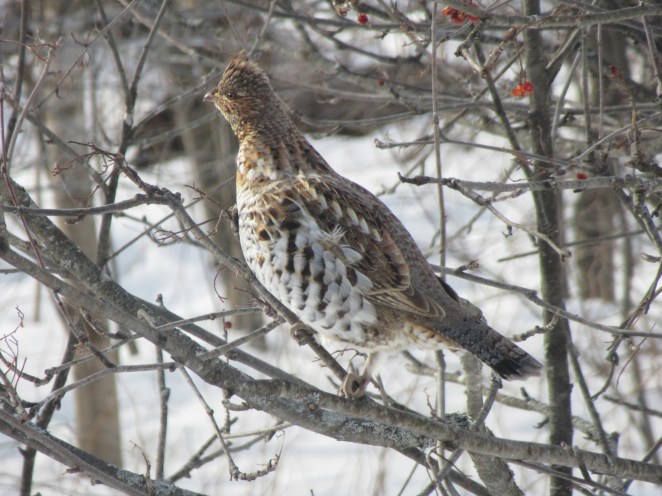
A Ruffed Grouse sought refuge
among the berries
of the Mountain Ash.

I shot him,
not with a gun,
but with a camera.

Intertextuality –
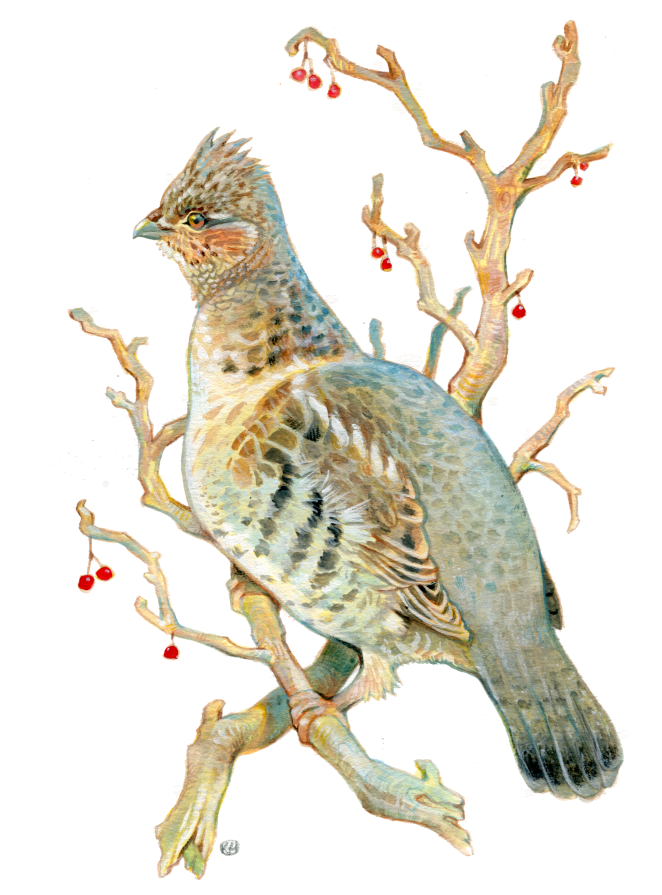
a friend borrowed the photo,
turned it into elegant brush strokes,
and now the painting
hangs on my wall,
opposite the tree
where once he sat.


A still-life
face to face with its reality
as early morning dew
forms on spider webs,
hammock-strung
between grass-blades,
bending in the wind.

And what if the spell breaks
and I can no longer see the fine seeds
of the dandelion clock kissed away
by the lisping lips of time?

What is life?
Is it just an illusion?

Commentary:

I shot him, not with a gun, but with a camera. Interesting. I have never seen the need to take the life of living creatures, except in cases of absolute necessity. And no, I have never killed, let alone for fun or sport. Shooting with a camera, that’s my ideal, and when a friend and fellow KIRA artist likes the photo and offers to paint it … well, that leads us into the nature of intertextuality, where reality becomes photo, becomes painting, becomes a text, and you, dear reader, are contemplating all those moments that join us.

The fine seeds of the dandelion clock kissed away by the lisping lips of time. This image comes from my walks in the Welsh countryside around Brandy Cove, Gower, with my paternal grandmother. “What time is it Nana?” I can still see her, bending down, plucking a dandelion, and holding it out for me to blow the seeds away – one puff, one o’clock, two puffs, two o’clock. I recall the seeds, drifting away on the summer breeze. “The Good Lord loved those dandelions,” she once told me. “That’s why He planted them everywhere.”

What will happen when the wells run dry and water runs out and there are no more dandelion seeds? How long will it be before I can no longer see them? Vis brevis, ars longa. The answer to my questions – I care, but I really don’t know.

Clepsydra 43 & 44

43

… a mouth stopped with silence
     a pen that can’t write

a river that won’t flow
     no safe place at night

when I lit that candle
     I turned out the light

and sat in the stillness
     all flickering with fright

to whom can I turn
     to make things right

silent in the darkness
     I yearn for a light

a moth in life’s flame
     I flare and burn bright
 
scorching a hole
     in the shade of the night …

44

… but to lose my language
     is to lose my butterfly soul
          as it flutters to reach
              life’s sweet-scented rose

does the soul leave
     the body at night

released from its prison
     of earthbound clay
          does it wander
               in dreams
                    among the stars

Commentary:

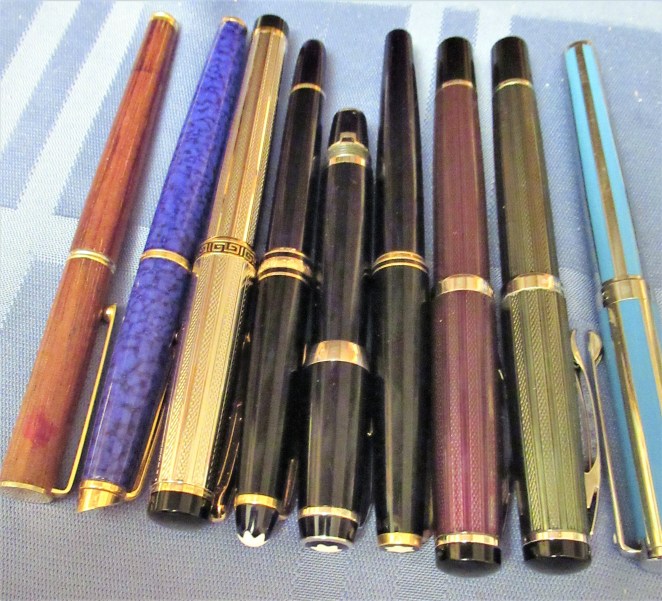
“Cette plume n’est pas une plume.” This pen is not a pen. A mere photo of a pen, and I won’t be able to write a word with it. Nor will you. Not that it matters, for we are nearly at the end of our journey. Only eight more sections remain, and then the poem will be done.

I thank all of you who are travelling this road with me. Not much longer. The poem is coming to its end.

Clepsydra 41 & 42

41

… fire flares on the water
     rivers and lakes blaze
          that sound is a monster
               a dragon descending
                    breathing fire

so swift so powerful
     come sudden
          from nowhere
              yet another disaster
                   with its ravenous roar         

the dragon refuses to move on
     until sated
          but who could satisfy
               that monster
                    destroy its will
                         defeat its power

will Lac Megantic
     ever be the same
          after all these years
               of grief and tears

will fading memories
     be all that remain …


42

… a stillness between words
    tranquil movements
         the world suspended in space
               soundless the night
                    drenched in silent light

 Aurora Borealis
     draws gaudy curtains
          across the night sky

I can hear my heart beat
    as time softly sifts

a celestial hour glass
     this sky filled
          with unimaginable light
               breaking coloured waves

lit up
     with mysterious flowers
          so graceful
               when decked out
                    in light

 the moon returns
     turns into a mirror

          its silver boat
               suspended in space

silent its light
     enlightening
          the heart’s dusky craters

dawn’s silent glory
     will be here soon
          pointing the silent path
               to even more light …

Commentary:

Ten years or so since the disaster at Lake Megantic. I am sure it affected everyone who followed the news, saw the pictures, and bore witness to the power of conflagration. Moo offered me his painting called Burning Birbi. A Birbi is a Koala Bear in one of the Aboriginal Languages. When the fires hit New South Wales, the Eucalyptus Trees started to fire. When in danger, the Birbi climbs the eucalyptus trees, higher and higher, followed, of course, by the fire. A fate inescapable. Just like the Megantic Disaster. Word has it that it could, and should, have been prevented. I cannot (will not) comment on that here. I will just stress the fear that we all have, those of us who live in a drought stricken province (New Brunswick) surrounded by trees.

The closest wildfire to us, in Island View, was about 31 kilometres away. The closest trees are about 30 feet away from the house. Much too close for comfort. Curtains of flame and smoke, rising up to stain the skies. And the smell of burning also inescapable. Stay indoors, I say. Shut the windows. And hope that nothing comes your way!

Fire, controlled, brings heat, warmth, light. The Northern Lights bring spectacular light flooding down from the skies, not rising up. You can almost hear the sky crackling as the light curtains shift and shimmer and dance their way across the horizon. Fire and Fire Light – beautiful when we can control them, but oh-so-destructive when they flame and flare, out of control.

Do not despair. Just remember we need each other, all of us, each one of us. Together we can overcome most things. Isolated and alone, like the lone koala at the top of his tree, it is much, much more difficult to survive. Select your friends carefully. Maintain contact with them. And be there for each other in times of need, for, as we say in Wales – “a friend in need, is a friend in deed.”