What makes you laugh?

Daily writing prompt
What makes you laugh?

What makes you laugh?

The current state that the world is in. Seems like a strange answer, doesn’t it? Wars, famine, plagues, diseases, fire, flood, earthquakes, drought, what is there to laugh at? All of it, of course. Because if I didn’t laugh at it, I would cry. And crying – well, there just aren’t enough tears, are there? Anyway, as the Reader’s Digest used to say “Laughter is the best medicine.” So, if we want to heal the world, we must first learn to laugh at it.

In fact, there are many things we should be laughing at – politics and politicians, for one. Or is that two? Chuckling away – it’s hard to tell them apart nowadays. In fact, if we laughed right out loud at the folies bergeres who masquerade as wise men, can-can dancers who actually can’t-can’t, and decision makers who really can’t decide, then that laughter would be the last straw that would break the camel’s back and dump them all on their backsides in the desert where they belong. There, they would be voices ‘crying in the wilderness’, crying indeed, for deprived of their privileges, none of them would be laughing. But we would. And we’d probably be a great deal better off.

New words also make me laugh. Homicide, femicide, domicide, ecocide, countrycide – tell me, who makes up these names? Who keeps popping them into the dictionary? And if they mean what I think they mean, we should all be on our knees, praying and weeping. It’s like fake suicide. That happens when push comes to shove, and the subsequent defenestration is deemed a suicide.

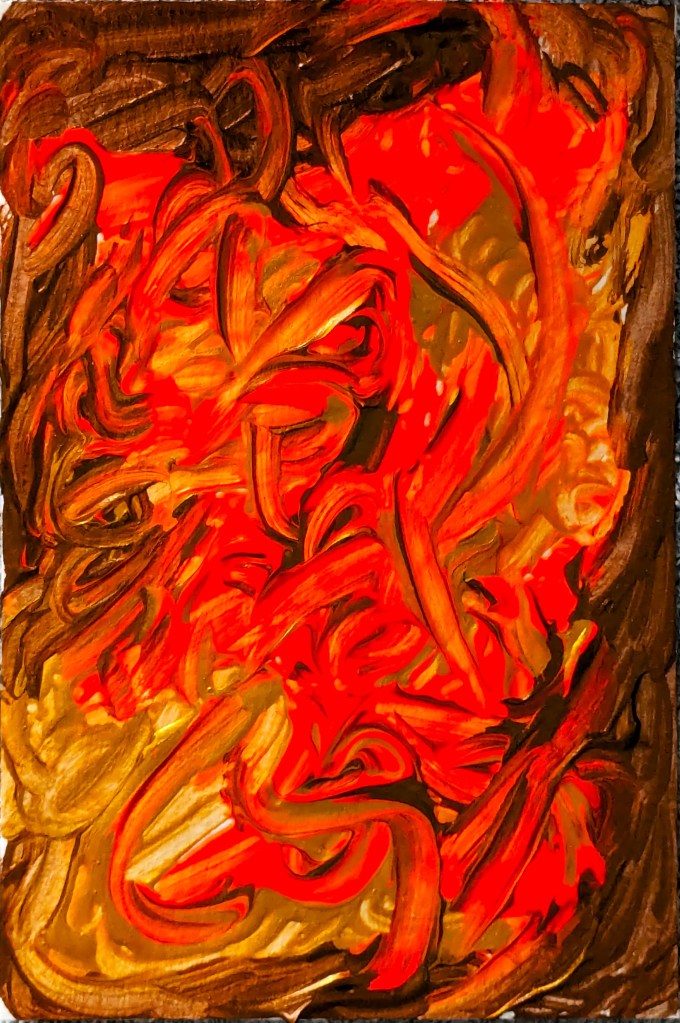
Look at Moo’s painting, Burning Birbi. Now that is something to really make you cry. Moo tells me he was going to call it Burning Bush, but then he remembered all the poor birbis who were burned to death in the Australian Bush Fires. They ascended the eucalyptus trees for safety, and there, of course, they met their sad and tragic fate, while trying to escape the conflagration. I can laugh many things off. But not the fate of those cuddly little Koalas, brought to the edge of destruction by our treatment of their natural habitat.

Welsh proverb – “Laugh and the world laughs with you. Cry, and you cry alone.” So, I am laughing at it all. I have to – or else I will suffer a break down. So, laugh with me, and let the real losers cry in the wilderness, hermits all, abandoned to their lonesome own-somes.

How has technology changed your job?

Daily writing prompt
How has technology changed your job?

How has technology changed your job?

I suppose I must begin by saying that, having retired fifteen years ago, I no longer have a job. So, Technology has not changed my job at all. However, when I was actually working full time, technology made an enormous impact on my work.

Keeping up with the Jones’s! I travelled to Oaxaca, Mexico, on a faculty exchange program in 1995 and was astonished to find that the Escuela de Idiomas of UABJO, had better computer and technology features than I did in my home university. I was way behind the Oaxacans in what I taught and how to deliver it. How to catch up, that was the question!

In 1996, I started a Multi-Media Certificate at the University of New Brunswick, completing it in 1999. As a result of this certificate, my beloved and I built our first web pages and produced our first Quevedo Online Bibliography. This also enabled me to start teaching a course entitled Mexico Online. This course took place in the university’s computer laboratory and, instead of requiring written papers, it asked the students to create their own web pages and to do their own online research.

This was the first step into the brave new world of WebCT, Blackboard, and the many other web platforms that rapidly became available, often at great cost to the student. Student costs – well, they skyrocketed. So, I did my best to cut them down. Texts, especially literary texts, in online format, for free. A formal course outline, online, discussed with the students each term, and changed in accordance with each class’s particular needs. This guaranteed that teaching and learning were both flexible, and did not become bogged down by the trap of the one course, set “in electronic stone” for all eternity. This is a trap into which far too many teachers fall. The everlasting course, as it was in the beginning, is now, and ever shall be, taught without further changes and with no end, amen. No thought, no development, and knowledge a static state.

But technology also changed the teaching environment. We began with the static classroom with rows and rows of desks looking down on the stage where the professors, at the podium, performed their annual circus acts of passing knowledge from their notes to the students’ notes, without it passing through anybody’s head, as my first prof in my first university once told the class.

Then we moved to the chairs and tables classroom, where the professors could, if they chose, wander among the students, get to know them by their names, and create a dynamic small group teaching environment in which each individual received increased professorial attention if and when needed.

Enter Technology. The Computer screen replaced the black, green, white board (I have scrawled with chalk and marker pens on all of them). Classrooms became fixed spaces again. And the computer program doubled with, or replaced, the formal lecture. Static knowledge delivered to stationary students sitting and passively watching.

They were called smart classrooms. My favorite moment of the day? When I stood up and asked the class if this was indeed a smart classroom. Yes sir, they always replied. I would tap on the wall and ask the wall – “What’s two plus two?” The class would wait and wait. No answer. I would ask again. No answer. “Not such a smart classroom, then,” I would tell them.

Technology is great, as a tool for genuine teaching and learning. But it brings problems with it, as we are beginning to find out. Brainwashing, false information, erroneous material that misleads, quite often deliberately … Quis custodiet ipsos custodies? Who shall police the police? Who shall program the programmers? Perhaps the Romans, all that time ago, had it right. Caveat emptor – buyer beware.

When you were five, what did you want to be when you grew up?

Daily writing prompt
When you were five, what did you want to be when you grew up?

When you were five, what did you want to be when you grew up?

I attended an international research conference on Quevedo, a long time ago, when I was teaching full time. A senior researcher, at the reception, heard me speaking and spoke to me – “Excuse me, and forgive me for asking, but I love your accent. Where did you grow up?” The question took me by surprise and, slightly off-balance, I replied – “I don’t think I have yet.” I assume the laughter was provoked by whatever my fellow academics were quaffing at the time.

Yet the answer lies very close to the truth. When I was four or five years old, one of the local priests asked me a similar question – “What do you want to be when you grow up?” At that stage of my life, I lived in a very strange world. All around me, my family seemed to fight like cats and dogs. I watched my dog chasing cats, and thought that women were cats and men were dogs. And all they ever did was chase one another and fight. I didn’t want to live a life like that. “I never want to grow up,” I told that priest. “You have to grow up,” the priest replied. “Everybody has to grow up.” “Peter Pan didn’t,” I said. “And I won’t either.”

I have tried, like Picasso, to see worldly things through they eyes of that child who has always lived in me. Sometimes, it is not easy to do so. The bitterness of the adult world creeps in and my world is flooded by those same old conflicts that have been there ever since I can remember. Fray Luis de Leon wrote about them when, after five years, he was finally released from imprisonment by the Spanish Inquisition.

“Aqui la envidia y mentira / me tuvieron encerrado,” he penned. “Here, envy and lies / kept me imprisoned.” Rather than the rat race of the adult world, he chose to follow the “hidden path trodden by the few wise sages who have lived in this world.” He also chose to be surrounded by simplicity and the child-like pleasures of a solitary life in which he found himself “ni envidiado, ni invidioso” / “neither envied nor envious.”

And there you have it, drawn from the mind of a five year old child and framed in the words, more or less, of a an excellent Spanish poet, whose work, dating from the 16th. Century, borders on the mystical nature of pantheistic theological thought.

The painting, incidentally, is by my artist friend, Moo, and he calls it Pi in the Sky. You can think what you like about that and interpret it in any way you want. I hope Moo never grows up either.

Spirits

Spirits

Neon Orange, the tube said. I tried it out last night and this is what emerged. I call it Spirits, but that is really short for “We are spirits in the material world.” I have always loved that idea. So, how many spirits can you count in this painting? “Big ones, small ones, some as big as your head” – whatever that means. This is certainly a very different palette for me and the start of another set of experiments.

I have often wondered what that spirit world would look like. Perhaps they are all present in our material world? No wonder this planet of ours is so over-crowded! Or maybe they are spread across the universe and that is why the universe is expanding, to make room for them all, and even more of them in the making and on their way.

Is speculation as much fun as peculation? I can certainly do the former, but I’ve never done the latter. So, I guess I’ll never know. Never mind – life long learning – if somebody gifts me with enough of their money, one day I may speculate and peculate, and then I’ll find out, if I’m not found out first.

In the meantime, I guess I’ll stick to being a free spirit in a world that gets more materialistic every day. And this is my slogan – “Free spirits of the world, unite!” If there were enough of us, we could take it over, the world. Freeing it is one thing. Managing it afterwards might not be so much fun. I guess I’ll stick to speculation!

What movies or TV series have you watched more than 5 times?

Daily writing prompt
What movies or TV series have you watched more than 5 times?

What movies or TV series have you watched more than 5 times?

How do you define a TV series? If you mean ALL the episodes of, let us say, Coronation Street, I have to admit that I haven’t watched the whole series once, let alone five times. However, since I can recall Ena Sharples, Minnie Caldwell, and Martha Longhurst, and since I can also recall Ken Barlow as a schoolboy, I guess I have seen more than five, individual episodes over the last sixty years or so. I remember watching it on our black and white tv, very grainy, during the school holidays. Lots of strange, new advertisements, and ITV the only rival to the BBC.

Other TV series, of which I have seen at least five separate episodes, include Dr. Who, Last Tango in Halifax, Doc Martin, Midsomer Murders, and many others, including Watch With Mother, The Woodentops, Muffin the Mule, Sooty, Bill and Ben, and The Magic Roundabout. I can’t imagine watching Sooty hit Harry Corbett with a hammer five consecutive times! In the same show, yes, but I don’t think Harry Corbett, or I would survive watching a continuous loop of the series five times. “Oh no, Sooty. Don’t hit me with the hammer.” Whack! “Ouch!”

The same with films. I used to love going to the movies with my daughter. I took her to see Bambi one night. That movie was sold out so we watched Rocky instead. I can’t remember what number it was, but I do remember us chanting Bambi! Bambi! Bambi! as the blows in the boxing ring flew thick and fast. We were still chanting it when we drove home.

Another movie that we watched several times – The Time Bandits. I still have dreams of the horse breaking through the bedroom wall and into the child’s sleeping room. Scrooge, in one of its many reinventions, is a Christmas favorite, as is The Sound of Music, and A Child’s Christmas in Wales. I guess I might have seen them more than five times, though I usually get bored with the repetition and take a break and move away. Stagecoach is another family favorite and I have seen it in black and white as well as in color. But whether I have seen it more than five times is a good question.

Having said all of that, the one movie that my daughter and I did see on at least ten separate occasions was Labyrinth. I was researching in Spain at the time. We went to see it several times in Madrid. Then, when we moved to Granada, we saw it there, at least three times. At the beginning, I had to translate every phrase. “What are they saying now, dad?” But during our ninth viewing, in Almeria, I started to explain something in English and my daughter said: “Hush, dad. I’m trying to listen to the movie.”

So, there you are. Labyrinth wins, hands down, with ten full viewings, all in Spanish. But I have never seen it in English. And that’s today’s trip down memory lane. Thank you for reading this far (if you have) and goodbye.

What is the last thing you learned?

Daily writing prompt
What is the last thing you learned?

What is the last thing you learned?

I watched Doc Martin last night, Season 1, Episode 1 – Going Bodmin. And here’s the painting of the excellent state of Bodminism. Offers of less than $10,000 for the original will be turned down. As for me, I think I am slowly going Bodmin. And why shouldn’t I? A merry road, a mazy road, that night when we did tread, all the way to Bodmin Moor, by way of Beachy Head.

So, what is the last thing that I learned? That I too am “Going Bodmin” – slowly, bit by bit, and having such great fun along the way. I have drawn the portraits of some of my fellow Bodminists whom I meet along the way. Maybe you can recognize one or two of them.

I guess going Bodmin is like going on a pilgrimage, to Santiago de Compostela, say, or like the Medieval Trip to Jerusalem. This modern pilgrimage can start anywhere in the UK as long as it ends in Nottingham, in one of Olde England’s oldest pubs, a spider-web-filled cavern known, of course, as The Trip to Jerusalem. This was, once upon a time, the start of the pilgrimage to the Holy City. Now it is the end of the pilgrimage from Bristol City.

Well, that was the road I ran back in 1966 when we ran a road relay from Bristol University Students’ Union to Stamford Bridge, down to Hastings, and back to Bristol. King Harold Marched from Stamford Bridge (where he defeated Harold Hard Loki) to Hastings (where he was conquered by Willy the Conker) in 1066. Alas, I don’t think the Trip to Jerusalem was open then, so he couldn’t stop in for a quick one on the way down. Might’ve won the battle if he had. Caught looking up to see where the spider webs were, I guess.

So, the last thing I learned was that I am going Bodmin! Did you learn anything from this blog? If you did, let me know what it was, and remember, it’s a long way to Tip-a-rary, but it’s a merry road and a mazy road when you’re heading for Bodmin Moor.

If you could be someone else for a day, who would you be, and why?

Daily writing prompt
If you could be someone else for a day, who would you be, and why?

If you could be someone else for a day, who would you be, and why?

My instant response was – I would be a billionaire, names don’t matter, then transfer a couple of million to myself, then back out of the alternate persona for another day, and there I would be – rich and happy, my old self once more. Then I started thinking – ‘billionaires don’t do things like that’ – then I really started thinking. How much of my alternate persona would I take over? Would I be myself in another body? Or would I be that person, privileged, hard, caring only for myself and my fortune, sparing nobody as I strove for my ultimate desire, the Noah’s Ark of a bunker that would protect me from the oncoming disaster that I was myself encouraging to happen? Enough, I said to myself. That’s not for me.

I thought about it during the night, in those elusive moments between waking and sleeping, that half-sleep contained in the Spanish duermivela. And then the light bulb flashed and I knew who I would be.

I have always wanted to visit Australia. The cost, the length of the flight, the rigors of the journey, the fear of DVT, have all prevented me from making that voyage – quite simply a flight too far. But what if I could be my cousin Frances, in Sydney, for a day? I have never met most of her family, and this would be a wonderful chance for me to do so. I would see her husband, George, in close-up. Also her four children, two of whom I have never seen except in photos. I could also meet their partners, and the grand-children, and all of that merely by waking up in another body on another continent. If I timed it right, I might even manage to visit the Sydney Opera House and see the harbour bridge, or catch a test match, or a rugby international – the red lights are flashing – overload – overload – overload -!!! Too much – too greedy – KISS – Keep It Simple Stupid – !!!

Seeing the family, experiencing her daily life, looking at her garden, so beautiful in the photos, maybe even sinking my fingers into that rich earth, that would be more than enough. Ayer’s Rock – Uruburu – Alice Springs, the Fremantle Doctor, my cousins in Perth and Bundaburg, they will have to wait. Sydney and my closest family, that will be more than enough.

But how much will I retain upon my return? How much will I remember? And what will happen to Frances? Will she become me and be forced to suffer our Canadian winter, for a day, while I rejoice in her Australian summer? So many questions.

Too many questions. Maybe I’ll just be myself, after all, as Oscar Wilde says “Be yourself. Everybody else is taken.” I’ll just be myself and to the above offer I will reply: “Thanks, but no thanks. I just want to be me.”

You’re writing your autobiography. What’s your opening sentence?

Daily writing prompt
You’re writing your autobiography. What’s your opening sentence?

You’re writing your autobiography. What’s your opening sentence?

The End.

Why did I write that? Because I like reading T. S. Eliot – Four Quartets – “In my beginning is my end.” If that statement be true, then, ipso facto, The End must be my first sentence, because that’s my beginning. Eliot converted to Catholicism – and, according to the Jesuits, “The end justifies the means” – so, when we start with the end we are justifying the writing (the means) of all that led us there.

You don’t like my logic, you say? Why not? It is as straight as the corkscrew I hold in my hand when I am threatening to add the contents of a bottle of wine to my autobiography. Is a bottle’s end in it’s beginning? Of course it is. If you don’t open the bottle, you can’t finish it. If you don’t start it, you cannot end it, so in the beginning lies the end.

Oh the mysteries of mysticism, those truths that know no logic and follow no known paths from their beginning (via purgativa), through their middle (via iluminativa), to their end (via unitiva). Or is life and truth a circle that has no end? In which case wherever I begin the circle of my autobiography, there too is my end.

In my end is my beginning and in my beginning is my end.

Mors omnia solvit.
The End.

What are three objects you couldn’t live without?

Daily writing prompt
What are three objects you couldn’t live without?

What are three objects you couldn’t live without?

Oh this is so easy and so obvious. Every verb needs a subject and most verbs need an object. Can you imagine living a life in which no verb has an object? Indescribable. And how about an indirect object? Or a direct or indirect object pronoun? And now let us move on to the object of a preposition…

Wow! And now I must choose three out of those five? What are you trying to do to me? This is so cruel. It’s why I always fail IQ tests – there are so many answers that do not fit the desired paradigm of the programmers who set the questions and the appropriate answers. Are we all to be programmed then? And who shall program the programmers?

Or do you wish me to choose three inanimate things? If you did, you should say so in a clear and understandable fashion. An inkwell? A quill? A piece of paper? Salt or sand to scatter on wet ink? How many people out there remember post office pens, also called scratch pens, also called dip pens? There was a time when life without such objects was unthinkable.

And why stop at objects? What would life be without subjects?

Oscar Wilde once stated he could make a pun about any subject. A voice came out from the audience “Queen Victoria”. “The Queen, sir,” bellowed Oscar, “is not a subject.”

“Oh, Oscar,” I said to him, “I wish I had said that.” “You will, Roger,” he replied. “You will.”

And I just did.

Who are your favorite people to be around?

Daily writing prompt
Who are your favorite people to be around?

Who are your favorite people to be around?

Creatives – because creative people need support in their creativity and need to believe in themselves and in their creations. I wrote two days ago about Rejections and Silence – while both are needed by creatives – rejections to help perfect and polish – and silence in which to create – too many rejections and too much silence can result in alienation, depression, and the suppression of creative acts.

“We few, we happy few, we band of siblings!” Not quite what Harry said before the Battle of Agincourt, yet can we, the readers, be absolutely certain that what Shakespeare said he said was actually what he said? But we share the spirit of creativity with creators big and small, famous, infamous, and struggling. That is why we need to band together, to support each other, and to ensure that creativity isn’t killed by the straitjacket of a nine to five job, or longer, or the multi-employment that has become so necessary just to survive in our diminished and diminishing world.

“What is this life if, full of care, we have no time to stand and stare?” wrote W. H. Davies, one of the great Welsh poets. And he concluded this poem with a parallel couplet: “A sad life this, if full of care, we have no time to stand and stare.”

I hope you like the painting that heads this prompt that is turning into a joyous rant. It is by one of my creative friends, the poet-painter Moo. He calls it Spotted Coppers and he painted it last night after watching the Midsomer Murders episode that dealt with the theft of valuable Spotted Copper Butterflies. Intertextuality – one text leads to another, and the butterfly becomes a TV episode becomes a painting by a friend becomes a rant prompted by my computer and written by me.

That is the circle of creativity and it blends into the circle of friendships, and creative artists are both competitors and friends, for “whether creativity survives or no, I’m sure is only touch and go.” Another line that another great Welsh poet, this time Dylan Thomas of Swansea, might almost have said.

So, who are my favorite people to be around? Creative people, of course, with all their passions, energy, warts, flaws, and their constant need of encouragement and support.