Dog Daze

Dog Daze

Memories deceive me with their half-remembered shows, shadow shapes shifting over the walls with a flick of the magician’s fingers. What magic lantern now slips its subtle slides across night’s screen? Desperate I lap at salt-licks of false hope that increase my thirst and drive me deeper into thick, black, tumultuous clouds. A pandemic storm lays waste to the days that dog my mind. Carnivorous canicular, hydropic, it drinks me dry, desiccates my dreams, gnaws me into nothingness. At night a black dog hounds me, sends my head spinning, makes me chase my own tail, round and round. It snaps at dreams, shadows, memories, anything that ghosts through my mind. Hunter home from the hill, I return to find my house empty, my body devastated, my future a foretold mess. Tarot Cards and Tea Leaves are lost in a Mad Hatter’s illusion of a dormouse in a teapot raking runes from an unkempt lawn.

Commentary:

Well, what a muddle. Images flying everywhere, in and out, like Von Richthofen’s flying circus of WWI fame. And look at that last line! Tarot Cards and Tea Leaves are lost in a Mad Hatter’s illusion of a dormouse in a teapot raking runes from an unkempt lawn. No wonder Moo said “Nein!” when I asked him if he had a painting to illustrate this one. In fact, he quoted Salvador Dalí at me: “There’s no difference between you and a madman, except that some days, you aren’t mad.” I guess this implies that some days I am.

“Ah well,” said Mrs. Thomas calling her son Arwel in for tea. Welsh joke. Many won’t get it. Arwel didn’t and he didn’t get his tea either. Never mind. Those things happened a long time ago when the world was so much younger, and, dare I say it, wiser! Actually, there’s nothing wrong with the world itself. The problem, as always, just like the old woman who lived in a shoe, it’s the madmen who inhabit the shoe that are the problem. And when the shoe’s sole needs a nail, who is going to come and glue it back together. Not me, said the red squirrel, laughing. And he always laughs. As soon as it gets cold he tucks into my garage and it’s a devil of a job to get him out again.

What’s worse, he insists on building nests in my car engine. That’s three times now. And it costs money to dig those nests out. Not to mention the mess. First time, I didn’t even know he was in there until the windscreen wiper on the driver’s side started to fail. Then the whole watering system broke down. I took it to the garage, and the garagemen said “I hope you’re getting rent money, you’ve got a tenant.” Anyway, he got rid of the squirrel and the nest. But the little blighter must have followed me home, because a few days later he was back in there again. He’s in there now. I can hear him chuckling as I type this.

Dog Daze, indeed. I wish I had my doggy back. Alas, as you can see from the photo, he crossed the rainbow bridge to his doggy paradise, leaving me to contend with a garage full of ham-fisted red squirrels. No wonder my head is spinning around and I am chasing my own tail, round and round. At least he’s single, that squirrel. I don’t know what I’d do if he got married. I know my maths ain’t no good (nor is my English), but where squirrels are concerned, I am pretty sure that 1 + 1 = 6 or more and a foretold mess.

Carved in Stone 53

Carved in Stone
53

Nor do I belong
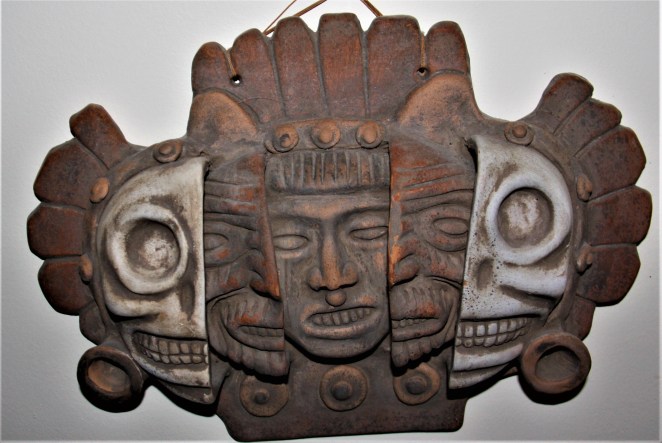
in the Aztec city of Tenochtitlán
with its cruel stone gods.

Built originally
in the middle of a great lake,
it defied all comers, and held
the mighty Cortés at bay.

Human sacrifices, night and day –
what is it that makes some people,
carve and shape the living flesh
of others, as if it were wood or stone?

Who could admire a culture,
based on human sacrifice,
death, blood flowing,
just to keep the sun in the sky,
red at its dawning,
westering in the evening
into a sea of blood.

Commentary:
“Man’s inhumanity to man.” Robbie Burns, if I remember correctly. Thus it was and thus it always will be. Man’s need for space, for room around him. The need to establish himself and his own tribe and oust the other. The need to target the other to prove the weakness of those who do not belong. So many ways to target, including humor and jokes, all pointed at the targeted individual.

“What’s the most dangerous job in Ireland?” – “Riding shotgun on the garbage truck. “The jokes never change, just the targets. For Ireland, substitute England, France, Canada, Wales, Scotland. For a country, substitute a town – Fredericton, Island View, Saint John, London, Cardiff, Dublin, Paris. Okay, so they are cities, not towns, but you know what I mean.

Let’s change the joke. “How do you get the [choose one or more] English, Irish, Scottish, French, Welsh, Germans, Italians, out of your front yard?” “Put your garbage cans in your back yard.” And so it goes on and on. Like old Father Thames, who just keeps rolling along, down to the deep blue sea.

Why, I ask myself, why, why, why, do we have to diminish someone else in order to appear strong ourselves? Is it just human nature? Is it the nature of some people? Do all people behave in the same way? If you have the answers, or any answer, the same instructions as usual, send it to me on the back of a postcard, by dog sled, via the North Pole. And if you’re feeling generous, put a $5 bill in the envelope. It will help me pay the lawyer’s bill for suggesting such outrageous nonsense.

Fire Storm

Fire Storm

Yesterday, it was difficult to breathe.
We inhaled dust and ashes as smoke
from forest fires scuttled towards us,
carried piggy-back on a strong west wind.

Today, the wind herds clouds into aerial castles,
pinnacles and pyramids piled upwards,
tall ships’ canvases painted dark, thundery,
raised by fierce wedges thrust beneath them,
lofting them into darkening skies.

Beyond a certain height, water becomes ice.
Particles group together. Hail stones form,
small at first, growing ever larger
until the very air can no longer bear
their weight. Golf ball big, they tumble down
the sky’s steep ladder and fall to earth.

The dry drum roll of distant thunder rumbles.
A scissor-slash of light shreds black skies.
An executioner’s hay wain rolls towards us,
a runaway train destined to tear our lives
apart. It leaves us helpless, clamoring for safety,
our world torn apart, our earth sore wounded.

Death scythes away, downing rich and poor alike.
Who now knows which way thrown dice will fall?
The dye’s sharp edge, once cast, cuts like a blade.
Hail stones clatter on the roof, battering us down.

Carved in Stone 44

Carved in Stone
44

The old man, withered,
last house on the left,
leaning on his garden wall,
coughing, spitting up
coal dust and blood.

He’s not old, when you get close,
just grown old, underground,
where emphysema
and pneumoconiosis
devour men and boys.

He spits on the side walk.
Mining souvenirs,
Max Boyce calls them,
and they appear
every time the young man,
turned suddenly old,
starts to cough.

He can’t walk far,
wearing carpet slippers,
soft and furry,
just leans on the wall.

He fell, or was pushed,
into the trap at an early age,
when the coal seams
had grown so thin,
that only a small boy
could kneel before
the coal black altar
of the underground god
and, with a pick and shovel,
he learned to carve and shape
the long, slow death
contained in those seams.

Commentary

Moo’s painting, Coal Face, adorns the front cover of Carved in Stone, Chronotopos II. Coal Face is not the denigration of Black Face, white men pretending to be black by dyeing their faces, although they have some similarities. In Welsh Mining, the coal face is where the men used to dig when, with their shovel and their pick and their little lamp and wick, they knelt to dig out the coal. Knelt, because there was no standing room, deep down underground. Then, when the seams grew thinner, and the men could no longer reach them, the young boys were sent underground.

A day underground left men and boys with coal dust seamed into their bodies, especially their hands and their faces. Hence the triple meaning of black face – where the coal is dug, what men and boys looked like after a day’s work, and the blackening of their faces by white men, for the fun of it.

Faces are one thing, coal dust in the lungs is another. The result – emphysema and pneumoconiosis devour men and boys. Black lung, some call it. “And every time he coughs, he gets a mining souvenir” – a black spot coughed up on the sidewalk – Max Boyce.

Child labor, minimum wage, living wage, work that kills, slowly and silently, – what can I say? Forgive me, for I can say no more.

Joy of Words

Joy of Words

If the words won’t come, don’t worry.
Sooner or later, they will arrive, driving
down in flurries. Think wind-driven leaves
or the soft white whisper of snaking snow.

There is a moment when all sounds cease
and you can be at one with your inner self,
there, where summer sunshine twinkles
and soft rains bring forth clarity and joy.

What are words anyway, but soap bubbles
emerging from an iron ring to rise in
child-hood’s skies, soaring, dying, around
the cloudy thrones of sun-kissed clouds.

We, their so-called creators, are left below,
building cotton-wool castles spun from air.

Commentary:
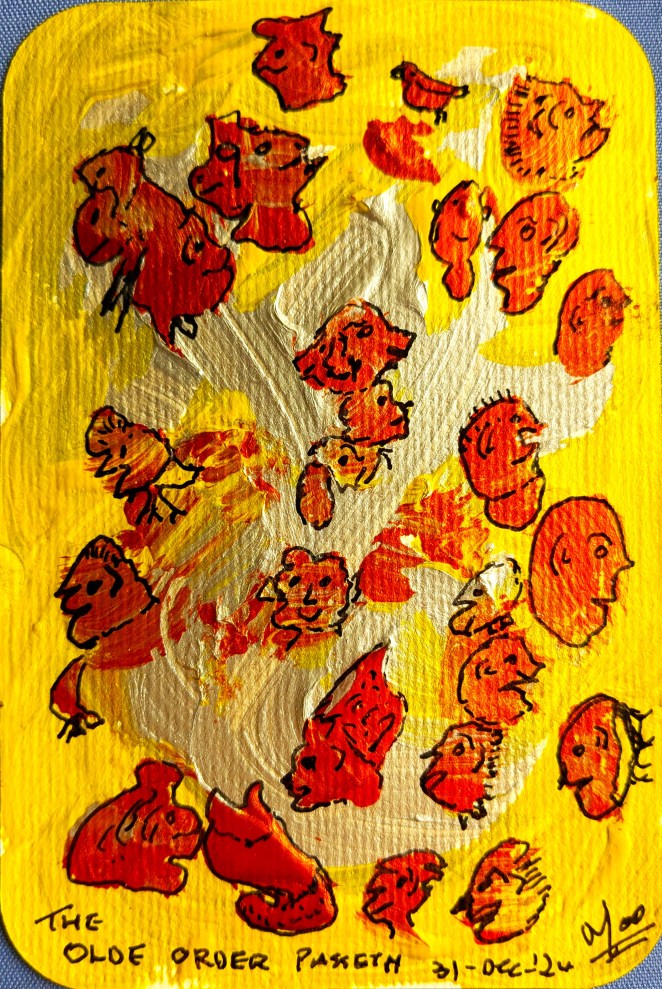
Moo suggested I use this painting of his to illustrate this poem. He called it originally The Olde Order Passeth, but the original phrase, from Tennyson’s Idylls of the King, should really be The Olde Order Changeth, lest one good custom should corrupt the world.

And yes, things do change. Here we have a fourteen line sonnet. Structure giving order to chaos. And words change, the world changes, our thoughts change, the weather changes. Hymns Ancient and Modern – Age and decay in all around I see, oh thou who changeth not, abide with me.

And what do we do when we meet with change? Weather – I change my clothes. There is no such thing as bad weather, only inadequate clothing. It used to be a useful saying, that one, but not any longer. When change changes into disaster, it is a very different kettle of fish. Thoughts change – mine just did. A useful phrase suddenly becomes an inadequate reaction to a changing situation. The world changes – sometimes for better, sometimes for worse, but how do we, each one of us, confront that change? How do we adapt to it?

I know far too many people who, like the ostrich, bury their heads in the sand and pretend that change is not all around us, that the world is the same as it always was. We humans are experts at adapting. We must adapt. But how do we adapt? Each one of us must answer that question in his or her own way. The alternative is to close our eyes, bury our heads, and pretend that nothing is happening.

Another alternative is to seek within for that moment when all sounds cease and you can be at one with your inner self, there, where summer sunshine twinkles and soft rains bring forth clarity and joy. Perhaps that is the world the ostrich discovers when he removes himself from this world and enters that other one beneath the sand. Who knows? Not even the ostrich, I would guess.

Carved in Stone 19 & 20

19

The Spanish Civil War –
one brother pro-Franco, and the other,
imprisoned for a quarter of a century.

They locked him, with two dozen men,
in a deep cell below the convent
of San Marcos de León.

All save him were executed.
He spent our time together
telling me how guilty he felt
because he survived.

20

So many died standing blind-folded
with their backs to unforgiving stone walls,
because they refused to believe
what the enemy told them to believe.

Nobody spoke for them.
Who can speak for those who carry
the candle or board the tumbril,
or see the hooded executioner draw near?

The axe approaches. The gallows draw closer.
The guillotine falls. The single eye of each rifle
stares at the victim’s chest.

Commentary:

I find it hard, very hard, to talk about these two stanzas (19 & 20). I remember two of Goya’s paintings, The Second of May and the Third of May. The Third of May says everything that I cannot say. So, I will just leave you with two paintings to google and one photo of an unforgiving stone wall, with the gateway filled in. Pax amorque – we all need peace and love – I can say that, for we all need it.

Growing Old Together

Growing Old Together

You and I are growing old together.
We have been together for 59 years
and married for 54 of those.

We watch each other slowly breaking down,
the memories going,
the body parts not functioning
the way they used to.

In some ways,
it is incredibly beautiful.
In other ways,
it is so tragic, this slow waltz
around life’s dance-floor
towards who knows what
that last dance will bring?

It gets harder and harder
to find the right things to say,
sometimes to find anything to say.

There are days
when we just sit in silence,
filling in time,
doing a crossword or a sudoku,
or just gazing into space,
trying to avoid
the mindlessness
of endless adverts
on the television.

Commentary:

Not much to say, really. The poem and the photo speak for themselves, as good art always should. Sometimes the artist plans everything, and out it pops, all ready-made. On other occasions, a small miracle takes place and words and images tumble out, fluff their feathers, settle down and wow! – it’s a work of art. As long as one other person, other than me, thinks so, then I will be happy. “If I can reach out and touch just one person.”

I often wonder how many people are touched by traditional art nowadays. There is so much shock and awe out there, that the humble homely corner with its two doves or the image of an elderly couple dancing slowly around their kitchen, hanging onto each other – for what? And both of them waiting – for what, exactly? I expect it varies with each couple. But what I pity most are the lone doves, abandoned, autonomous, living on their own-some with nobody to talk to and only the TV to listen to. How many of them are out there, I wonder? When I walk around town, I see the street people, the homeless, the really lonely ones, just sitting, or slowly pushing a grocery cart with all their belongings tied up in plastic bags. Heads down, they plod on, never stopping, never looking.

“A sad life this, if full of care, we have no time to stop and stare.” W. H. Davies.

Carved in Stone 10 & 11

10

Firelight dances,
bringing things back to life.

Each morning,
I take time to empty my mind
of those restless cats
I herd at night as they shimmy
through my troubled dreams.

By day, each cat
throws a different shadow
that parades before me
in the sweetness of soft sunlight
where a honeyed sweetness reigns
and no bitterness dwells.

My own cat haunts me,
purring for butter,

sitting there, staring,
eyes wide open, hypnotic.

What, I wonder,
does she really want
as she turns her back,
walks away,
and stalks a different prey
among my books?

11

Does she hear the clock’s dry tick
and sense the Roman numerals
marching round, left – right – left,
always in step
with the pendulum’s sway.

Does she recall migrating birds
or those gaudy summer butterflies,
fanning their wings
as they perch on Cone Heads,
Bees’ Balm, Black-eyed Susans,
generic butterflies,
specific flowers,
planted by my own hands?

I often ask myself –
“What does she know
that I don’t know?”

Commentary:

A strange thing knowledge. I have learned the hard way that “the more I know, the more I know I don’t know.” Just look at today’s second stanza. I would love to know more about, and understand better, migrating birds, summer butterflies, especially the lovely Monarchs that fly at Mexico and back, the flowers themselves, the way language substitutes the generic (butterflies, flowers) for the specific (Red Admirals, buttercups), and as for that cat, I really would like to know what she knows that I don’t know. I have never been able to train her, but she has certainly managed to train me!

And I would love to understand humor and laughter. Slapstick aside, humor is one of the cultural secrets that travels least in translation. Jokes in French or Spanish just do not translate well into English. It takes a deep cultural and linguistic knowledge to grasp foreign humor at first glance.

Take today, for instance. I drove the car to the garage to change the tires from summer to winter. I asked the garage guy, my friend, if he would drive me home, and he said he would. He got i the passenger side and I drove home. Then he drove the car back to the garage. He opened the garage doors, drove the car in, turned the engine off, hoisted the car up, and changed the tires. When he’d finished, he tried to start the engine. No luck. He called me – “Where’s the key?” “In my pocket!” I replied. We were having such fun chatting we never thought to offer or request the car key when we exchanged drivers. Well, we are all still laughing about it.

When I got into the house, even the cat was laughing, and as for that cat, I really would like to know what she knows that I don’t know. Maybe, it’s just that we humans, especially as we age, aren’t as clever as we sometimes think we are. Some things, I guess, I’ll never know.

Carved in Stone 8 & 9

8

Primeval places,
both light and dark,
surround us.

Dark depths inhabit
the human heart,
and woe betide us if we forget
that eternal darkness
and allow it to thrive again,
for what we believed dead,
will surely rise once more,
and return at night,
to haunt our dreams.

9

One day I abandoned
the temporal quest and left behind
mindless quarrels, bitter strife,
and envious, petty jealousies.

Surrounded by light and trees,
I now confront fall’s splendours,
harvesting golden days,
collecting and storing them,
safe from ravaging storms.

I seek a distant, but honest truth,
that moves, relentless,
through time’s mists.
It sometimes reveals itself
in the low sun’s spotlight
and each enlightenment
lends meaning to many good things
I thought had been lost.

Yet they still linger,
their shadows flickering
across the walls of memory’s cave.

Commentary:

I spoke to a good friend tonight, he shall remain anonymous, just like Anonymous Bosch, and he encouraged me to continue with my blog and my commentary.

Dark night of the soul – yes, we all have them. We question ourselves, our worth, our place in the world and we ask ourselves the five Ws – five W’s – West Indies only had three Ws – Worrell, Walcott, and Weekes – so we add another two, just for ourselves.

Who am I? What am I? Where am I? When am I? Why am I? How many of us ask ourselves those questions and how often do we do so? Like many of us, I am afraid, and I ask myself those questions more and more often as I age. We all do, unless we are non-sentient beings and just waffle along from show – click -to show -click- to show click – to show!

So, if you are reading this – ask yourself the 5 Ws. Who am I? What am I? Where am I? When am I? Why am I? If you can’t be bothered, click to another blog. However, if you are willing to be engaged, send me a snail mail or a husky mail, by sled, via the north pole. I am sure it will get here quicker than Canada Post.

Carved in Stone 6 & 7

6

At Westbury White Horse,
I wandered among unkempt mounds,
forgotten graveyards,
ancient barrows, their secrets
buried deep underground.

I walked to the horse’s eye,
stood there, then sat on the hill’s edge
to watch the sun drown
in a river of blood that turned
the White Horse red.

Shadows encroached.
A creeping chill came over me.
I started to shiver, not with cold,
but with the icy fear that someone,
something, evil and powerful,
long dead, but risen again, lurked,
hidden in the ground mists,
that rose as I fled,
not daring to look back.

7

But that fear,
deep-seated as it was,
could not match the terror I felt
as the sun set
over Badbury Rings.

An ancient horror
reigned over that place.

Mist warriors, visible
only from the waist up,
their weapons drawn,
charged towards me.

I felt chill fingers
clutching my heart, gripping it,
and tightening their hold.
I fled from them in the half-light.

Ancient powers linger long
in spite of charms, spells,
and exorcisms.

No wonder so many ancient tribes
shattered the legs of their dead
so they could not rise up
and walk again.

Commentary:

According to Wikipedia, the Westbury White Horse or Bratton White Horse is a hill figure on the escarpment of Salisbury Plain, approximately 1.5 mi (2.4 km) east of Westbury in Wiltshire, England. Standing at the northern edge of Bratton Downs, on a steeply sloping hillside below an Iron Age hill fort, it is the oldest of eight white horses in Wiltshire. The white horse has long been revered in European mythology. In Celtic traditions, it was associated with the Otherworld, acting as a guide between the realms of the living and the dead. In many myths, the white horse represented purity, power, and the ability to traverse spiritual boundaries.

I love visiting these sites. However, they need bright sunshine and warm weather. When the light starts to fail and the day grows cold, strange feelings emanate from the ruins. Many people have commented on this phenomenon and there are reports of sightings, such as the one that I associate with my visit to Badbury Rings. I went there late one afternoon, and as the evening drew in and the air grew colder, I and my companions felt a sudden (and totally inexplicable) fear. One look, and we ran as fast as we could back to the car park, got into the car, and sped away. None of us have ever forgotten that strange experience.