On Loneliness

Loneliness

58 What relationships have a positive impact on you?

I think one of my poems answers this question best. I write “one of my poems” but it is really my ‘free’ translation of one of Francisco de Quevedo’s sonnets – Retirado en la paz de estos desiertos. I have changed the poem slightly, but I am sure Don Francisco (1580-1645) will excuse Don Roger’s impoverished effort (2023).

On Loneliness
29 December 2023

Resting in the peace of these small rooms,
with few, but welcome books together,
I live in conversation with my friends,
and listen with my eyes to loving words.

Not always understood, but always there,
they influence and question my affairs,
and with contrasting points of view,
they wake me up, and make me more aware.

The wisdom of these absent friends,
some distant from me just because they’re dead,
lives on and on, thanks to the printed word.

Life flits away, the past can’t be retained.
each hour, once past, is lost and gone,
but with such friends, I’m never left alone.

And there are so many of those literary friends. I still read Rudyard Kipling and I have just finished Kim, Captains Courageous, Stalky and Co., Puck of Pook’s Hill, and Rewards and Fairies. I read these first when I was nine or ten years old, and I return to them regularly. Other friends include Garcilaso de la Vega, Fray Luis de León, St. John of the Cross, Quevedo, Góngora, Calderón, Miguel de Unamuno, Antonio Machado, various members of the Generation of 1898, the majority of the poets from the Generation of 1927… and these are just my Spanish literary friends. I have French friends, English friends, Anglo-Welsh friends, Canadian friends, Mexican friends, and, in translation, many, many more. My relationship with each of these friends has had an impact upon me.

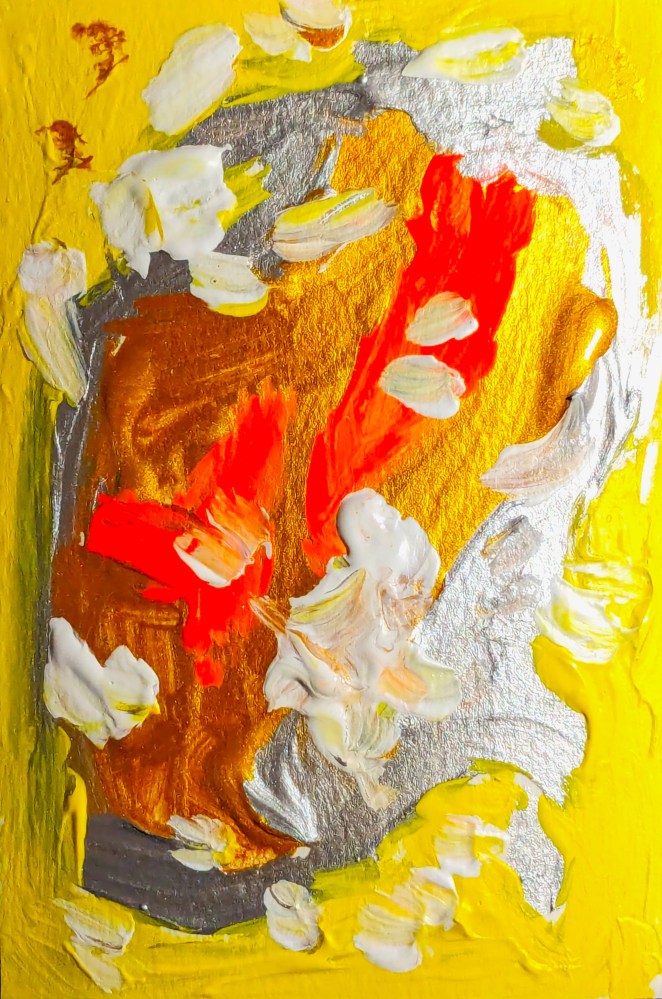
A recent painting, by my friend Moo, is called Fiat Lux – Let There Be Light. It is reminiscent of Dylan Thomas’s poem, Light breaks where no light shines. Intertextuality – Quevedo drew inspiration from the Stoics. I drew inspiration from Quevedo. Moo drew inspiration from Dylan Thomas. The nature of creativity, and its continuing links throughout the ages, shines clearly through these wonderful associations. Long may they continue, and may others enjoy them and be influenced by them as much as I have.

Comment:
The funny thing is that I do not remember writing this blog prompt, nor do I remember having translated Quevedo’s poem into English. I wonder how many other forget-me-nots there are out there. Or, to be more precise, in my books and in my notes. A treasure trove – that’s my guess. Borges wrote of Quevedo that he was more a library than an author, and I am beginning to think that way about my self. A strange world, this, one in which the creator abandons, and then forgets, his creations. Perhaps we should change the image – not so much a library as an orphanage, and so many lost and abandoned orphans wandering around The Little World of Don Rogelio.

Silence

Silence

Pain stops at the edge of silence
and silence is the sound of sunlight
breaking against the walls of the room
in which I sit and listen, in silence,
waiting for the notes to begin again.

Silence, yes, yet my silence lies broken
by the renewed intrusion of the clock,
by the electric hum from lights and heating.

Ghostly noises break into my thoughts:
cheers from a distant tennis court,
those eternal advertisements
that invade my innermost being.

What triviality now shatters
the Messiaenic mood that wrapped me
for a moment in a many-colored cloak
woven from musical oblivion.

Time’s teeth start to gnaw again
and the grandfather clock
nibbles at my soul, extracting
its essence in a surge of sound,
tick-tock, tick-tock.

Westminster Chimes choke
life from the hour and ring
the tick-tock knell that files
my life away, second by second,
minute by minute, day by day.

Comment:

Silence is the fifth poem in the first sequence (Crystal Liturgy) of my poetry book Septets for the End of Time.

“So,” said Moo, “today I offer this painting where the title, Sound of Silence, fits well with the title of your poem. That said, I am not sure that the painting itself, qua painting, is as suitable as earlier pairings. De gustibus non est disputandum / there is no arguing about taste. I guess you either like something or you don’t.”

“It certainly isn’t in your usual style. In fact, it looks more like a colored pencil sketch than a painting. Where did you draw the title from?”

“Actually, it’s from one of your poems about Avila, in Spain, the city where, or so they say, you can hear the silence. You complained about all the noise that you found, especially the church bells, in that otherwise silent city.”

“Ah yes. I remember that poem. And I’ll never forget the sound of the bells echoing from wall to wall in those narrow, medieval streets. Bells from all the churches inside the walls of the city, tolling at exactly the same time, calling the faithful to prayer.”

“And that is one of the differences between us that I mentioned yesterday. My paintings, whatever they depict, are always silent. I have heard you read your poems out loud on Spotify and I have also heard other people reading them on your behalf, not always successfully. Poetry is designed not only to be read silently, but also to be read out loud, before an audience. Painting, on the other hand, is always silent. It does not speak, nor can it be heard. A painting is just there, in two dimensions, powerful, if you are lucky, weak and wobbly if the artist does not fulfill his task.”

“Interesting, dear Moo. And the images that I draw from Messiaen’s music are interesting too. For musical notes, without words, change into images within the listener’s mind, and then, when heard by the poet in me, become verbal images upon the page. Fascinating.”

“It is. Some time soo we must talk about intertextuality, the ways in which one artistic form or text can influence another. Hopefully, you’ll find a poem and I’ll find a painting that illustrate just that.”

What relationships have a positive impact on you?

Daily writing prompt
What relationships have a positive impact on you?

What relationships have a positive impact on you?
I think one of my poems answers this question best. I write “one of my poems” but it is really my ‘free’ translation of one of Francisco de Quevedo’s sonnets – Retirado en la paz de estos desiertos. I have changed the poem slightly, but I am sure Don Francisco (1580-1645) will excuse Don Roger’s impoverished effort (2023).

On Loneliness
29 December 2023

Resting in the peace of these small rooms,
with few, but welcome books together,
I live in conversation with my friends,
and listen with my eyes to loving words.

Not always understood, but always there,
they influence and question my affairs,
and with contrasting points of view,
they wake me up, and make me more aware.

The wisdom of these absent friends,
some distant from me just because they’re dead,
lives on and on, thanks to the printed word.

Life flits away, the past can’t be retained.
each hour, once past, is lost and gone,
but with such friends, I’m never left alone.

The painting, by my friend Moo, is called Fiat Lux – Let There Be Light. It is reminiscent of Dylan Thomas’s poem, Light breaks where no light shines. Intertextuality – Quevedo drew inspiration from the Stoics. I drew inspiration from Quevedo. Moo drew inspiration from Dylan Thomas. The nature of creativity and its continuing links throughout the ages shines clearly through these wonderful associations.

Intertextuality

Intertextuality

Wednesday Workshop
25 August 2021

            This is another academic word that has a simple meaning. In essence, it means texts talking to texts. Quevedo (1580-1645) writes escucho con mis ojos a los muertos’ / ‘I listen with my eyes to dead men.’ He is suggesting that, each time we read a text written by another person we enter into a dialog with that text and that author. His metaphoric conversations with the writings of the long-dead Seneca become intertextual the moment he put pen to paper and wrote about them.

This intertextuality is a key component of my writing.  You may not recognize all the phrases that I have used previously by other writers. I do. Some other readers will. Just take, as an example, the titles of some of my earlier books. The title of Broken Ghosts (Goose Lane, 1986) comes from these lines penned by the Swansea poet, Dylan Thomas (1914-1953). ‘Light breaks where no sun shines; / where no sea runs, the waters of the heart / push in their tides; and, broken ghosts with glow-worms in their heads, the things of light / file through the flesh where no flesh decks the bones.” Stars at Elbow and Foot, the title of my Selected Poems (Cyberwit.net, 2021) was also inspired by one of Dylan Thomas’s poems. “And death shall have no dominion. Dead men naked they shall be one with the man in the wind and the west moon; when their bones are picked clean and the clean bones gone, they shall have stars at elbow and foot.” The title of Though Lovers Be Lost (Kindle, 2016) also comes from this same poem, one of my favorites, obviously.

Sometimes readers are aware of these intertextual clues that I sow throughout my poems. Sometimes not. It doesn’t matter. There is a resonance in such chosen words and that resonance is there, irrespective of whether you are aware of the word-source or not. That said, the recognition and acknowledgement of intertextual relationships expands the poetic meanings of the creative world even further. It also establishes verbal links between author and author, epoch and epoch, genre and genre, thus establishing a wider intertextual network and a stronger chain of linked literary thoughts and meanings. In our creative journeys, we rarely walk alone, whether we are aware of it, or not.

The art of writing poetry about paintings is known as ekphrasis – which basically just means a verbal description of a visual work of art, whether it’s real or imaginary. The conversion of the visible (painting) to the printed page (verbal) is another link in the great chain of intertextuality, for paintings, too, are narratives with a different form of text. Other component parts are audible to verbal (alliteration, onomatopoeia), touch and feel (tactile) to verbal (as in synesthesia or the mixing of the senses) and the transfer of taste to verbal forms. Many of these transitions and transformations are present, not only in my own poetry, but in surrealism (verbal and visual) as well.

A Thought for the New Year

Couldn’t find a photo of Don Quixote so I attached this instead. A suitable symbol for Brexit!

A Thought for the New Year

“Sábete, Sancho, … Todas estas borrascas que nos suceden son señales de que presto ha de serenar el tiempo y han de sucedernos bien las cosas, porque no es posible que el mal ni el bien sean durables, y de aquí se sigue que, habiendo durado mucho el mal, el bien está ya cerca.”
Miguel de Cervantes : Don Quixote de la Mancha.

“Know this, Sancho, … All these squalls that beset us are signs that the weather will soon clear up and better things will come to us, because it isn’t possible for good or ill to endure, and from here it follows that, these ills having lasted so long, good times are now close.”
My translation.

Comment: This quote was sent to me by Marina, my close friend from Avila, with whom I have maintained contact, even though it is now twelve full years (2008-2020) since we last saw each other and talked, except on Messenger. Break ups and lost and absent friends and families: it seems to be the story of my life. And how could it be otherwise when one is a migrant who emigrates and immigrates and passes on and through, rarely resting in the same place for long? I guess it is also the story of the Intelligentsia: those whose learning and understanding and life experience moves them out from one place and into many others. Cualquier tiempo pasado fue mejor / any time from the past was better. Hiraeth: the knowledge that the past is lost, save in our minds, and can never be recovered, even though sometimes we wish so badly to do so. The Intelligentsia: always dissatisfied, both with the past which they can never recreate and which they view through the pink lens of nostalgia and with the present which is never as beautiful as that pastel pink past, that in reality probably never existed. Toda la vida es un sueño y los sueños sueños son / The whole of life is a dream and dreams are just dreams, and nothing more (Calderon de la Barca).

Don’t Look Out

Don’t Look Out the Window

Don’t look out the window, you don’t want to
know what’s lying out there. Don’t look out.

Play ostrich. Place your head in the sand,
pretend there’s nothing there to worry you.
Pretend you can see the missing PPE,
the vanished masks, the surgical gloves,
the sanitized hand-wash that everybody needs.
Just don’t look out the window. Don’t look out.

Pretend there’s nothing out there. Deny that
nearly two million people are ill.
Deny that a hundred thousand have died,
not in vain, but from ignorance and vanity
 and a total denial of scientific truth.
Just don’t look out the window. Don’t look out.

Just look at these walls that surround you.
Smile back at the smiling faces, the nodding heads,
the puppet-string politicians who agree with
every piece of nonsense that issues, meaningless,
from empty mouths. Surround yourself with people
who believe what you believe, who think and do like you,
fellow narcissists and bullies, cheats and liars,
who have deceived and stolen, lied like you, to build
enormous fortunes while they have cheated on
their wives, gone bankrupt, and borrowed shady money
in questionable deals with shabby, foreign banks.
Don’t look out the window. Don’t look out.

All those employees know a bum deal
when they are on the sharp end of one.

But nobody speaks out and nobody,
but nobody, dares open those curtains
for fear of seeing that reborn beast,
its hour come at last,
slouching down the streets.
Close your eyes. Don’t look out the window.
Don’t look out.

Comment: I rarely comment on political events, let alone write poems about them. That said, I do not consider this poem to be a political statement. For me, the key to the poem can be found in the final five lines beginning with ‘for fear of seeing …’. I have explored inter-textuality before in these pages. I hope the reference to W. B. Yeats’ poem The Second Coming, is clear.

Intertextuality

Zeitgeist 1-10

Intertextuality

Intertextuality is the dialog that takes place between texts or as Merriam-Webster explains it: “the complex interrelationship between a text and other texts taken as a basic to the creation or interpretation of the text.”

Often we write from an intertextual perspective when we respond to other writers and their thoughts and imagery. This is why, in the creative process, reading can be as important as writing. Reading expands our vocabulary. It reinforces some of our own opinions and challenges others. Without reading, we are lonely rocks in sunless seas.

To be creative, we need to be aware of what others are writing and how they view the world we inhabit. When we read creatively we read with an eye to improving our creativity and our structures. We look for new ideas, new images, new words, new ways of expressing our thoughts.

Often we think we are being original when in fact we are re-processing, just as I am now, the ideas of other people. Given the nature of modern media, we are not always aware of all the multiple sources of our material: telephone, twitter, blogs, radio, television, newspapers (less and less), books, chapbooks, magazines, e-sources, lectures, chat groups, Facebook, and general conversations with other people who are also unaware of their sources. Thus ideas abound, float in the air, circulate and recirculate, submerge and resurface, shift their shapes and colors.

As writers we dip into that enormous moving mass of current and past culture and creativity and we choose our narrative lines, our characters, our structures, our images, our metaphors. As Jean-Baptiste Poquelin, better known as Molière, once wrote, “Mes idées? Je les prends où je les trouve.” My ideas? I take them from wherever I find them.

Imitation is the best form of flattery. Indeed it is. We cannot, however, borrow wholesale and just copy. Miguel de Cervantes borrowed the first five chapters of Don Quixote (the first sortie) from an earlier entremés entitled El Entremés de los romances. For a very long time, critics thought that Cervantes was the author of both pieces: they are very similar. However, even a quick analysis also shows that they are very different. The language of the entremés is much older while the conversion of theatre into narrative distinguishes them at a very basic level. Cervantes borrowed: but in borrowing, he adapted, he changed, he took the old form and converted it into something new and completely original. Nevertheless, we are still aware of the origins of the great novel that has many other borrowings woven into its fabric.

So, we indulge in intertextuality when we engage in a dialog with other texts and ‘borrow’ from other authors. To be original, we have to take that borrowing and turn it into something entirely different, something that becomes a part of ourselves and no longer exists as a part of that other text. Intertextuality is not copying. If we take a text in its entirety, if we ‘copy’, then we must acknowledge the source. However, when we indulge in a dialog with a text, when we transform a text, when we are ourselves transformed by a text, then that is a totally different situation. Think of the links between Akira Kurosawa’s 1954 film, The Seven Samurai, and its offspring, the 1960 western entitled The Magnificent Seven. They are very similar in so many ways … and yet they are so very different.

While intertextuality refers more to the larger elements of character and narrative structure, it also exists at the level of metaphor and image. Sometimes, without thinking, we use metaphors that we have heard before. Often we like the sound of a group of words, shuffle them around, and come up with a new meaning for them, a new metaphoric reality. This too is intertextuality.

At its best it is a very valuable addition to our creative tool kit.

While on the topic of creativity, let us spare a thought for our needs for creative time and space. We cannot create when we lack the blessings of time and space. Creativity is greatly hindered when we go hungry and need to complete back-breaking work just to sustain our lives and feed our families. Our relative wealth and leisure is a blessing: without them, we would be floundering in the pre-industrial world of subsistence farming, working at manual labor from dawn to dusk.

Let us spare a thought too for those oral societies that existed when people could not write. Or those early societies in which only the few, the happy few, were educated to the level at which they could actually read and write.

Intertextuality is a blessing, not a curse. Use it wisely, use it well.

Comment: I would like to thank Meg Sorick who suggested that I expand an earlier conversation that we had on the topic of Intertextuality.