Rage, Rage 20

Rage, Rage
20

Words emerge
from the silence 
of blood and bone.

They break that silence
the day they are born.

Silence, once broken,
cannot be repaired
and a word once spoken
cannot be recalled.

The greatest gifts –
knowing how and when
to sink into silence,
knowing how to be alone
in the middle of a crowd,

So many word-worlds
smothered at birth
and those worlds, dismissed,
forgotten, still-born,
their names never spoken.

Comment:

So, are you paying attention? Did you notice anything? Has something gone missing? Moo tells me that he doesn’t think anyone will notice what I have. Can you prove him wrong? Good question! Whatever, as they say, or “So what?” as Miles Davies plays. Or, as Buddy Holly once sang “I guess it doesn’t matter any more.”

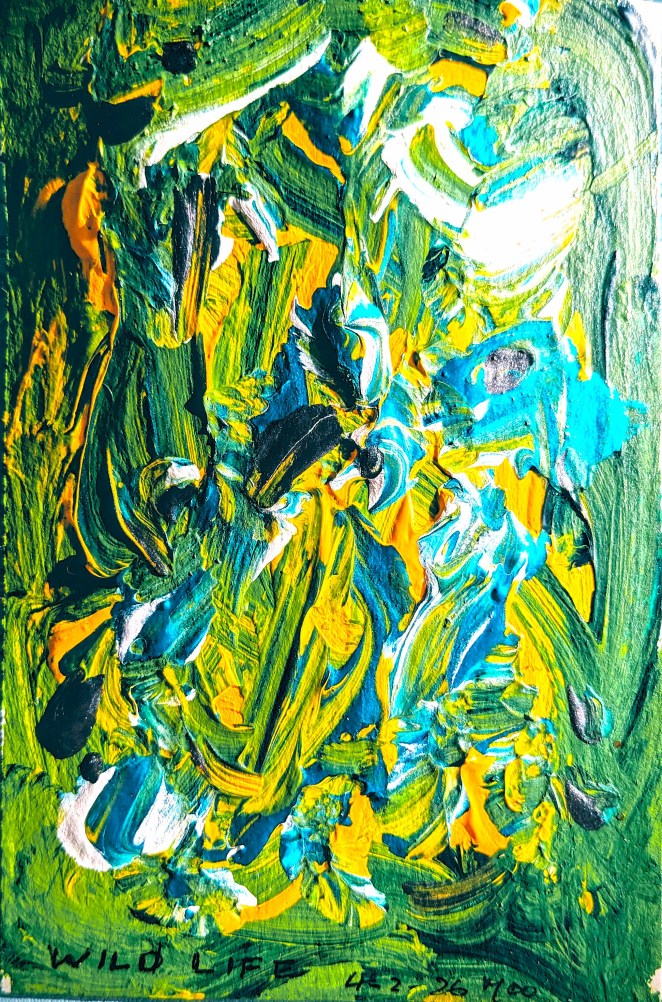
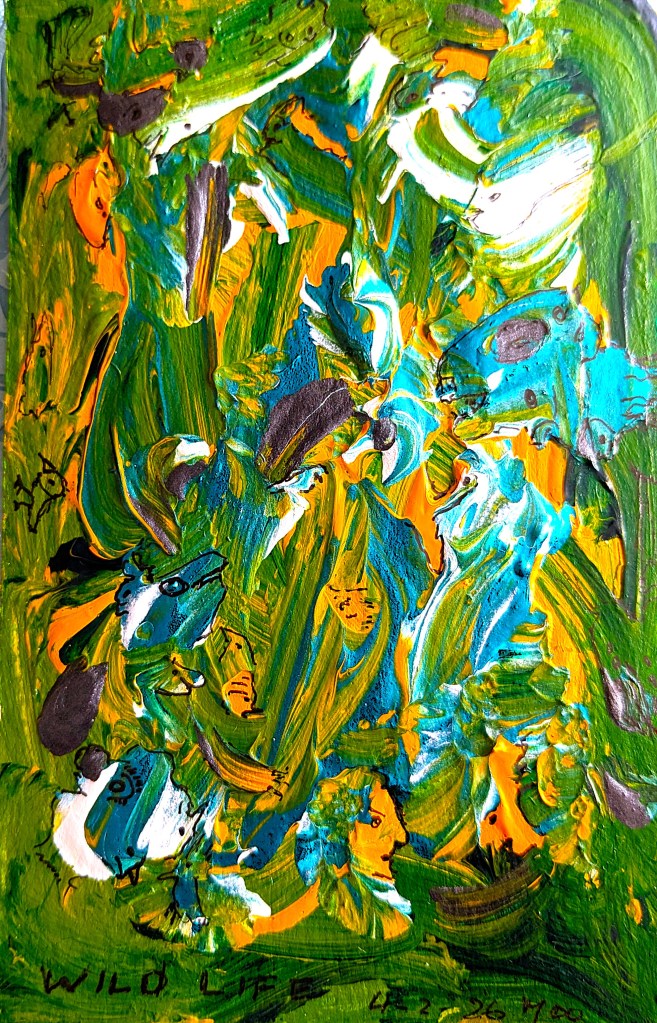
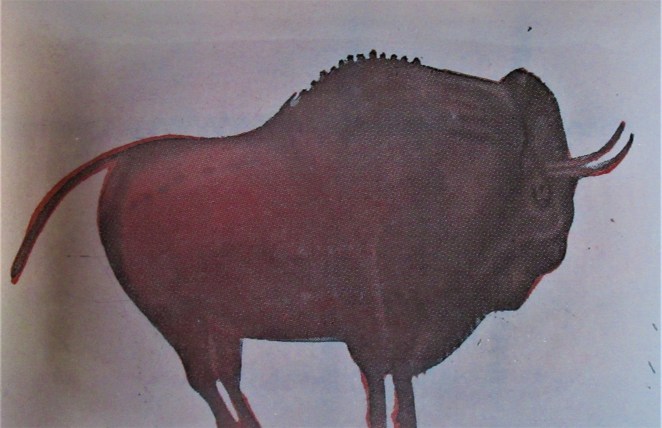
Moo wants me to tell you that he painted this painting last night. He calls it No More Blues. Guess what? There are no blue shades in it. Cunning, eh? And daylight hours are back up to 9:30 – 9.5 hours sunlight on this cold, wintry day. And it is cold at -14C. On the other hand, Moo’s painting is toasty warm and you can hold up your chilled fingers and warm them on his painted fires.

As for me, I am having great fun preparing my writing for competitions that I never win. I am also paying to enter them. But I choose carefully nowadays – so many publications and competitions want so much money just for sending them a manuscript they will possibly never read and probably (nay, almost certainly) reject. I am so happy that I do not have to live off my earnings. I have 17 books on KDP Amazon and guess what? I received $3.61 in earnings in 2025. And I must declare it on my tax forms. I hope it doesn’t send me up a tax bracket!

I guess it’s a case of Fly me to the stars and let me see what writing pays on Jupiter and Mars. Not much probably. I bet they don’t read poetry in any of those Mars Bars I am always reading about. That said, I wonder what language Mars Barmen speak? And do they have Mars Bar Flies, like we have Bar Flies here on earth? Oh the wonders of language and the Joy of Words. The Joy of Six, as well – and that’s Sex in Latin. Get the joke? Oh, to be multilingual, now that spring’s a coming. Easy now. Don’t get too excited. And look at all those little white angels flying in Moo’s painting.

Rage, Rage 10

Rage, Rage
10

My body’s house
has many rooms
and you, my love,
are present in them all.

I glimpse your shadow
in the mirror, and your breath
brushes my cheek
when I open the door.
Where have you gone?

I walk from room to room,
but when I seek,
I no longer find
and nothing opens
when I knock.

Afraid, sometimes,
to enter a room,
I am sure
you are in there.

I hear your footsteps.
Sometimes your voice
breaks the silence
when you whisper my name
in the same old way.

Comment:

Rage, Rage – and still I rage against the dying of the light and, like Dylan Thomas, ask the ageing of this world not to go gentle into that dark night. Yet, as my beloved and I age, we watch day’s shadows growing longer, and night stealing steadily along. What can we do?

Well, since the winter solstice, we can start counting the minutes as each day adds a minute or two and gifts some more light and strength to the sun. Sunrise today – 8:03 AM. Sunset today – 5:09 PM. That means 9 hours and 6 minutes of sunlight. Well, it would, if it weren’t cloudy, with a cold wind, and a dropping temperature. My guess is that it will get dark much before it ought to. And that’s not nice – no respect!

Of course, my beloved is a sun bunny and a Leo, and she perishes in these shortened days. I was born in them and they don’t affect me as badly as they do her. But I can still Rage, Rage, because there is so much to rage about – icy streets, the usual potholes, roads that hide ice beneath a thin covering of snow, some strange drivers who don’t seem to have bought winter tires. Oh yes, I love them. One came twisting and turning down the same side of the road as me only this morning. Luckily he hit the snow bank before he hit me. But, I ask you, what was he thinking?

So there’s Rage, and Rage Rage, and also Road Rage. Way to go! I think we should call a national rage day and all stay home for 24 hours, just to cool us all down for a bit. Oh dear, that might lead to cabin fever – and that would be an outRage.

Rage, Rage 2 & 3


Rage, Rage
2

These problems start the day
you realize you are alone.
Your beloved goes away,
for a holiday,
to be with your daughter
and grandchild.

Now the house and the cat
are yours, and yours alone.
No problem you say and
everyone believes you.

You jumped in the car,
drove daughter, and child,
holidays done,
to the airport.

Your beloved went with them,
her holiday about to begin.
And that’s when it all began.

3

When I come back home
from leaving them at the airport,
the front door stands open.

I thought I had closed it
when we left.
I tip-toe in and call out
“Is anybody there?”

Echo answers me –
‘… there, there, there …”

Commentary:

Raymond Guy LeBlanc, one of my favorite Acadian poets, published his poetry book, Cri de Terre, in 1972. My painter friend Moo, who also likes Acadian poetry, borrowed the title and changed it slightly when he painted this painting – Cri de Coeur. Earth Cry / Heart Cry.
What is all creativity, visual of verbal, but a cry from the land or a cry from the heart? Sometimes it is more than a cry – it becomes a clarion call, a shout out, a calling out.

So many of us are born with creativity in our hearts. So few of us carry that creativity, be it verbal or visual, into the adult world, a world that all too often grinds us down and sifts us out. We become grey people in grey clothing sitting behind grey desks beneath artificial lighting, doing grey jobs that slowly turn us into nine to five (or longer) dusts.

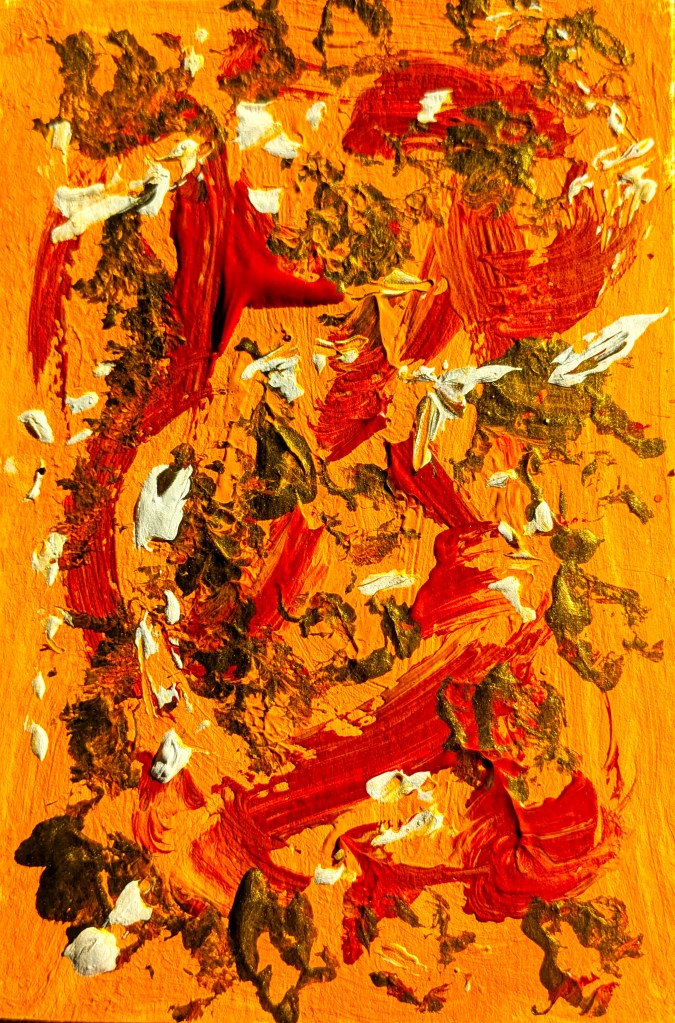
Moo has promised me a series of red paintings for this sequence. We shall see how he does. Red for anger, red for age, a red flag for danger, a red rag to wave at the raging bull of life, to provoke it, then bring it under control.

Nadolig Llawen – Welsh for Have a Joyous Festive Season. You can add other languages, as you wish. But above all remember Pedro Calderon de la Barca’s words – “Life is a dream and dreams are nothing but dreams.” One day, we shall all wake up. Artists and dreamers, grey ghosts and people of straw and dust.


Carved in Stone 72 & 73

Carved in Stone
72

Is this world I create real?
Of course it isn’t.

It exists only in my head,
and on the page,
but perhaps, one day,
you too will see
the things I have seen.

Yet the world I describe
is as unreal as the words
from which it is woven.

73

Heraclitus once wrote
we can never bathe
in the same river twice
.

This is the Catch 22
faced by all poets,
to remember,
and to try to recreate.

Shadow hands on cave walls,
colored pictographs on gesso,
hieroglyphics on papyrus,
ink on paper, raw words,
and in the end,
everything reduced
to these three little letters
carved in stone –

RIP

Commentary:

If you have read this far, we have walked a long journey together – 73 verses that comment on life and the meaning of life. Hard reading in places, easy in others. I trust you have enjoyed the journey and found some stops and resting points along the way in which to contemplate the ways in which the threads of your own life intermingle with mine.

Throughout this journey, I have tried to use a four step process. (1) Verbal – the poems themselves. (2) Visual – photos that intertwine with the verbal. (3) A Commentary – that goes beyond the verbal and visual and opens up the ideas a little more. (4) A Dialog between myself – the poet – and Moo – the visual artist who has so frequently loaned me his paintings when he thinks they illustrate my words.

It’s been a topsy-turvy journey through what Bakhtin calls a world of carnival, where little is at it seems, and the world is turned upside down. That said, we have a clear choice – to slide down the downside of this life, or to scale the upside, to contemplate, with joy and happiness, the world from those heady heights.

Blessings. Pax amorque.
And thank you for travelling with me.

Carved in Stone 61 & 62

Carved in Stone
61

Water through the water clock,
water off a duck’s back,
the waters of life,
continually flowing,
trapped in our children
and their children,
and the love we create
never lost, just circling,
like the hands of the clock,
like the planets and stars.

But who will wind up
the clockwork universe,
and tend the mechanism
that balances planets and stars?

What will happen
when the clockwork
finally runs down,
the last candle is snuffed,
and the water clock dries up?

62

Whoever, whatever remains
will be left to contemplate
Ozymandias with his two vast
and trunkless legs of stone,
standing in the desert.

“Look on my works,
ye mighty, and despair.”

Commentary:

“Look on my works, ye mighty, and despair.” Well, Moo does have a sense of humor after all. I thought he did. From Ozymandias to the meaning of “works” to the destiny of the work we did. What a journey. It goes from the joy of the children who build a snowman to the warm spring wind that melts him to the crows and the dog who do what crows and doggies do. Intertextuality – the links between verbal and visual and think about it – such strange things happens in Moo’s creative mind.

But what do we leave behind? Think about it. Only the wake of the ship in which we sail. The wake – that white trail we leave behind us, on the surface of the sea, slowly vanishing as we also vanish, pulling away into the unknown that always lies ahead. Moo is right – so many things disappear out of the frame of the painting. “There are no pockets in shrouds” said the preacher in the hospital where I took my father, so long ago for treatment.

And even if there were, how would you fit a snowman, several crows, a cardinal, and the rear end of a dog into the pocket? “Contemplate Ozymandias with his two vast and trunkless legs of stone, standing in the desert. Now contemplate the fate of the snowman. Now look on my works, ye mighty, and despair.”


Carved in Stone 59 & 60

Carved in Stone
59

St. David of Wales once said,
“Do ye the little things in life.” 

I do, and I wander
along the banks of the River Taff,
admiring how wild daffodils
flourish each spring, in Wales.

Young, I run on the beaches,
Brandy Cove, Pwll Ddu, Langland,
Caswell, Swansea Bay,
and, as I write these words,
I hear my footsteps
echoing back through time.

Baudelaire’s words ring in my mind,
“Creativity is nothing more nor less
than childhood recovered at will.”

Or, as Pablo Picasso said,
“I have spent my life
learning to see, paint,
and write again, like a child.”

And on and on I go –
child-hood, youth, maturity, age,
then back to my second childhood,
when I can recreate
that youthful world
in all its joyous beauty.

60

Does life flows through me,
like water in a clepsydra?

Does it flicker like a candle
guttering on a church altar?

Is it circular, like a sundial,
or the Roman numerals
on the face of the clock?

Am I just flesh and blood,
doomed to blossom and flourish,
then wither and perish?

Or will some small part of me
linger on, an unchained melody,
with all my memories slowly erased.

Commentary:

Moo’s daffodils are painted and potted, not growing wild at all. They are still the national flower of Wales and they still grow wild, in the spring, in Blackweir Gardens and beside Roath Park Lake. At least, I hope they do. I haven’t been back to check for 37 years now. Maybe things have changed, and the daffodils have gone the way of the sky lark, the cuckoo, the cowslips, and the bluebells. I wonder if the foxes still wear gloves? Let me know if you know the answer to that one. Just write “I do” on the back of the usual postcard. And you know what to do with it.

As for me, I am moving into my second childhood and, in may ways it is so much better than my first one. Here, I am free to look back on my life, to harvest my memories, to paint what I want – well, what Moo wants, anyway – and to think my own thoughts. Thank heavens Moo doesn’t think for me, though he does get his fingers covered in paint when he reads my mind and puts paintbrush to postcard, and designs his designs.

I feel very sorry for Moo. I guess he never had a childhood, so therefore, ipso facto, he can never have a second one. How much he is missing even he doesn’t know. How could he? Mysterious Moo – I like that idea. Sólo el misterio nos hace vivir, sólo el misterio. Only the mystery keeps us alive, only the mystery. And if you guessed that the author was Federico García Lorca, then you can award yourself a glow of satisfaction, for I have no prizes to hand around.

But hold on a moment, that was the title of one of Lorca’s drawings, so he was the artist, yes, but maybe not the author. Picky, picky nit-picky! Another of the joys of second childhood – annoyingly spotting the minor slips of other second-childhood thinkers – and never, never ever admit the mistakes you might, or might not make, are your own. Blame someone else. There’s always somebody out there whether to own up to your errors, especially if the price is right.

Carved in Stone 56 & 57

Carved in Stone
56

I stand before the Tzompantli,
the Aztec Skull Racks
in the ruins of the Great Temple
in Mexico City,
and gaze in wonder,
at the multiple meanings
of these decorated deaths.

57

At Teotihuacan,
I climb the Sun Pyramid,
with its carved serpent,
slithering sideways,
as the sun moves.

I heave myself upwards,
panting, sweating,
and when I get to the summit,
I sit there, feet over the edge,
and I feel my heart thumping
as I fight to regain my breath.

Now, I feel purified,
cleansed, sweated dry,
as I watch poor mortals
struggle as I did
to take that final step.

I imagine them laid
on the sacrificial stone,
their chests carved open.

Each beating heart,
when extracted,
will cover altar, priest, and sky,
with a fountain of blood,
so hard those hearts
are pounding. Blood seeds
shoot into the sky
to revive the setting sun
as it drowns in its own blood.

Commentary:

Incredible, looking back, those moments in Mexico when I came face to face with a culture, so old, so alien to me, that I had difficulty coming to terms with it. I do not understand human sacrifice. Nor do I understand the mentality of the conquistadores who held the Aztec Emperor’s feet to the fire and burned them to the bone, leaving him alive. And still he would not tell them the secrets of the kingdom.

“The setting sun as it drowns in its own blood.” A nod to Charles Baudelaire, of course, – “Le soleil s’est noyé dans son sang qui se fige.” Wonderful how these images stay with us. Sunrise – and the sun is born in blood – sunset and the sun sets in its own blood. And was it really true that only the blood of humans, drawn through human sacrifice, sometimes voluntary, sometimes not, would keep the sun in the sky?

And there we go – in blood we were born, in blood we will probably die – all hail the power of blood – unless of course / wrth gwrs – it is contaminated. And what will happen to us then?

Banks of the Seine

Banks of the Seine

Gnawing at the carcass of an old song,
my mind, a mindless dog, chasing its tail,
turning in circles, snapping at the fragment
of its own flesh, flag flourished before it,
tournons, tournons, tournons toujours,
as Apollinaire phrased it, on a day
when I went dogless, walking on a mind-leash
before the Parisian bouquinistes who sold,
along the banks of the Seine, such tempting
merchandise, and me, hands in pockets,
penniless, tempted beyond measure,
by words, set out on pages, wondrous,
pages that, hands free, I turned, and turned,
plucking words, here and there, like a sparrow,
or a pigeon, picks at the crumbs thrown away
by pitying tramps, kings, fallen from chariots,
as Éluard wrote, and me, a pauper among riches,
an Oliver Twist, rising from my trance, hands out,
pleading, “Please, sir, can I have some more?”

Commentary:

Intertextuality – how many different texts can you recognize in this one piece of verse? I can count six reminiscences of other poets, ones that have influenced me to a lesser or greater extent. A couple of novelists lurk in the shadows as well. Fascinating, eh? Do these voices echo in any other ears than mine? Good question – and does it matter if they do or they don’t? The main thing is that they harmonize, the old world with the new, the centuries that went before with the one that is with us now. Quevedo – “Vivo en conversación con los difuntos y escucho con mis ojos con los muertos.” I live in conversation with the defunct and I listen with my eyes to the dead.

And look at that painting. No, not the Banks of the Seine, but the banks of the Fundy, near St. Andrews. And it’s Moo, at his best, doing a cross between a cartoonist, a genuine artist, a surrealist, and an amateur artist who lends his paintings to friends when they want a picture of water, or a river bank, or something or someone else that will add to the intertextuality of his works. Yea, Moo. Go Team Moo, go. Long may you survive and work together.

Carved in Stone 53

Carved in Stone
53

Nor do I belong
in the Aztec city of Tenochtitlán
with its cruel stone gods.

Built originally
in the middle of a great lake,
it defied all comers, and held
the mighty Cortés at bay.

Human sacrifices, night and day –
what is it that makes some people,
carve and shape the living flesh
of others, as if it were wood or stone?

Who could admire a culture,
based on human sacrifice,
death, blood flowing,
just to keep the sun in the sky,
red at its dawning,
westering in the evening
into a sea of blood.

Commentary:
“Man’s inhumanity to man.” Robbie Burns, if I remember correctly. Thus it was and thus it always will be. Man’s need for space, for room around him. The need to establish himself and his own tribe and oust the other. The need to target the other to prove the weakness of those who do not belong. So many ways to target, including humor and jokes, all pointed at the targeted individual.

“What’s the most dangerous job in Ireland?” – “Riding shotgun on the garbage truck. “The jokes never change, just the targets. For Ireland, substitute England, France, Canada, Wales, Scotland. For a country, substitute a town – Fredericton, Island View, Saint John, London, Cardiff, Dublin, Paris. Okay, so they are cities, not towns, but you know what I mean.

Let’s change the joke. “How do you get the [choose one or more] English, Irish, Scottish, French, Welsh, Germans, Italians, out of your front yard?” “Put your garbage cans in your back yard.” And so it goes on and on. Like old Father Thames, who just keeps rolling along, down to the deep blue sea.

Why, I ask myself, why, why, why, do we have to diminish someone else in order to appear strong ourselves? Is it just human nature? Is it the nature of some people? Do all people behave in the same way? If you have the answers, or any answer, the same instructions as usual, send it to me on the back of a postcard, by dog sled, via the North Pole. And if you’re feeling generous, put a $5 bill in the envelope. It will help me pay the lawyer’s bill for suggesting such outrageous nonsense.

Carved in Stone 50

Carved in Stone
50

Here, in the castle of my own home,
I sit and write and patiently wait
for the enemy’s superior forces
to arrive and overwhelm me.

But death is not the enemy.
He is the friend
who has walked beside me
every day, since the day
that I was born.

I know him and I trust him,
though I am unaware
of when he will come to call
and I am ignorant of the shape
he will finally take.

Commentary:

Francisco de Quevedo, the 17th Century Spanish Neo-stoic and Metaphysical poet, wrote “the day I was born I took my first step on the path to death.” And so it is, with all of us. Sometimes we are able to choose our paths, sometimes they are forced upon us, sometimes they appear – with choices – and we make our selection and move on.

There are so many roads to travel. For Antonio Machado (Spain, Generation of 1898) there is no road. There is only a wake upon the sea – “Caminante, no hay camino, solo hay estela sobre el mar.” We must look back, to see where we have come from and where we have been. But there are many other possible paths, beside that of the sea – gravel paths, cobbled ways, log trucking roads in the Canadian Forest, cattle roads, transhumance roads, winding roads, straight Roman roads, roads that run up hill, down hill, or twist and bend following the paths of rivers.

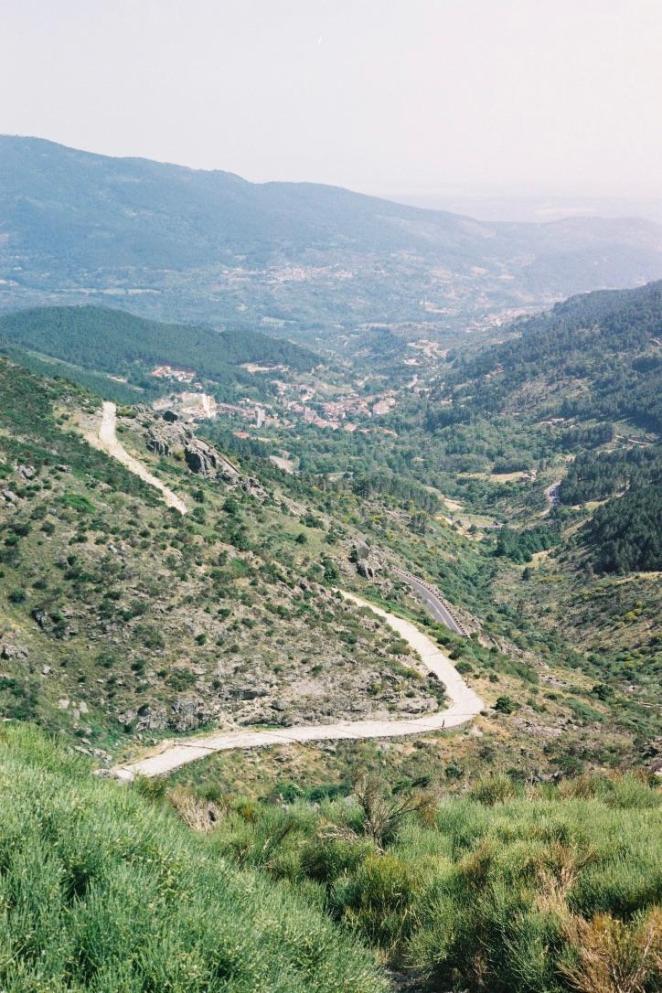
The picture above shows the old Roman Road that leads to the Puerto del Pico, in the province of Avila. It followed the contours of the hill and formed part of the Ruta de la Plata, the road that took Latin American silver from Seville to the Spanish capital in Madrid. Look carefully and you can see the modern highway that runs parallel to the old Roman road. Nowadays, that older road is used for transhumance, the movement of cattle from the valleys in the winter to the hills in the summer. The same road, the same pass, so many different uses, and the road a wake upon the path of so many lives.