Past Glories Restored

Ryan and Don Roger

10

Past Glories Restored

            What is it about madmen like Don Quixote that they find it hard to live in the present and always want to see themselves restore past glories however impossible it is to do so? The search for the beauty and peacefulness of the past is always with us. Many seek the perfection of the Garden of Eden, but wise men know that Adam and Eve were expelled from the garden by an angel with a fiery sword, never to return.

            Jorge Manrique (1440-1479) begins his Coplas por la Muerte de su padre with the statement that “a nuestro parescer, cualquier tiempo passado fué mejor.” / It seems to us that any past time was better. Why do poets and madmen always look back to the past, all too often with a view to recreating that which can never be recreated?

            François Villon (1431 – 1463?) asks, in his famous refrain to La Ballade des Dames de Jadis – “Mais où sont les neiges d’antan!” / Where are last year’s snows! Indeed, the theme of ubi sunt / where is – where are is a constant throughout literature. And where is last year’s snow? Can you tell me? It certainly isn’t in our aquifer. I didn’t even use the snowblower last year. Tell me, where did the snow go? I live in Canada, and we didn’t see it. So where did it go?

            Marcel Proust (1871-1922) searched for those lost times in his novel À la recherche du temps perdu. This can be translated directly as In Search of Lost Time. It also occurs, more poetically as Remembrance of Things Past. Unfortunately, the word Remembrance rather cancels out the idea of Search, not to mention the twin ideas of recalling and re-establishing. However, in the case of the madman, Don Quixote, it can be argued that all those meanings are correct. But what exactly does Don Quixote want to restore?

            Above all, Don Quixote wishes to restore the lost age of knight errantry. He is besotted by the fantasy tales of these knights errant and believes that he can be one himself and restore their glory with the force of his arm alone.  In DQI, II/2, The knight addresses the ‘ladies of easy virtue’ at the inn in these terms: “I beg you, ladies, not to fly, nor to fear any outrage; for it ill fits or suits the order of chivalry which I profess to injure anyone, least of all maidens of such rank as your appearance proclaims you to be.’ His language, which was unintelligible to them, made them laugh more. So, knights errant protect women, especially damsels in trouble, and women of easy virtue. That is one of their most important tasks.

            In DQI, IV/4, our knight meets the boy, Andrés, who is being whipped by his master, the farmer. Don Quixote stops the thrashing and makes the man promise to pay the boy the wages that are owed him. The farmer promises to do so, but when Don Quixote leaves, he ties Andrés to a tree and whips him so soundly ‘that he laves him for dead.’ Protect the innocent, then, is another task, one at which Don Quixote fails miserably, as we will see later.

            In addition to restoring the high ideals of the ancient order of knights errant, Don Quixote also wishes to keep the words and deeds of the ancient romances / ballads alive, and this he does throughout the book. His constant quoting of passages and deeds from the books of chivalry, those that have driven him mad, serves to keep them alive. As we said earlier, you can burn the individual books, and destroy them, but you cannot destroy the ideas they contain. Don Quixote, in his constant and lively embodiment of those books serves to keep them, and their ideals and ideas, vibrant in the eyes and the minds of the readers.

            Cervantes, perhaps a wiser man than many, restructures the theme by rejecting it – no hay pájaros en los nidos de antaño / there are no birds in last year’s nests. However, as we shall see, it doesn’t stop Don Quixote the madman, from searching for the glories of past times and from fighting for them in an effort to restore them.

And don’t forget Guillaume Apollinaire (1880-1918), who perished in WWI – “Ni temps passés ni les amours reviennent / sous le Pont Mirabeau coule la Seine.” “Nor past times nor past loves return / beneath Mirabeau Bridge flows the Seine.”

Comment:

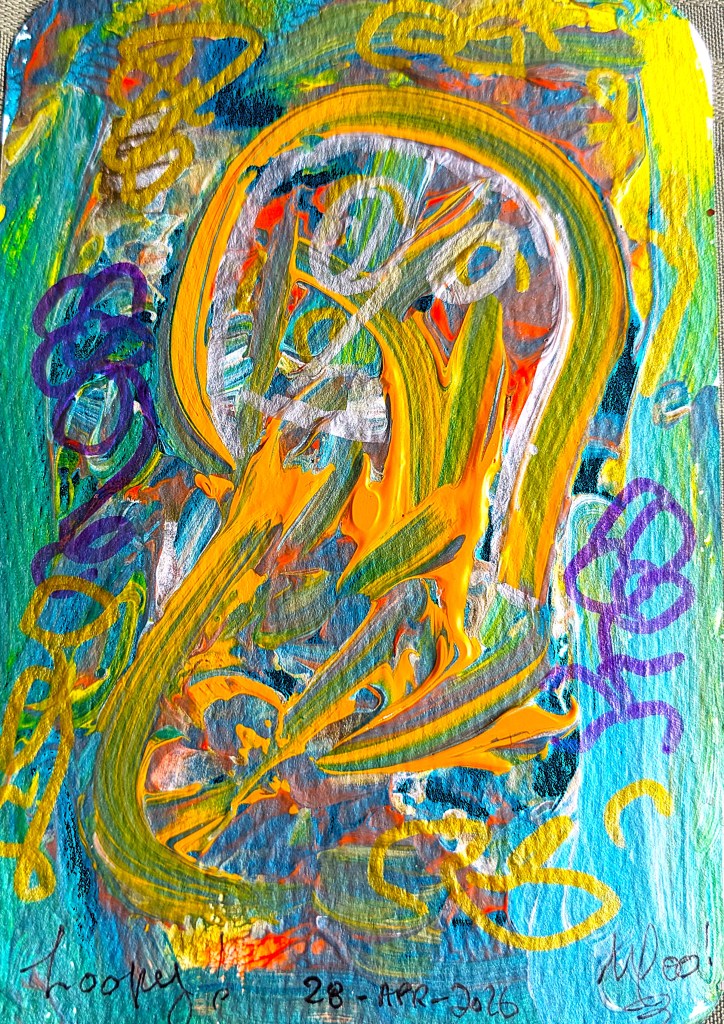
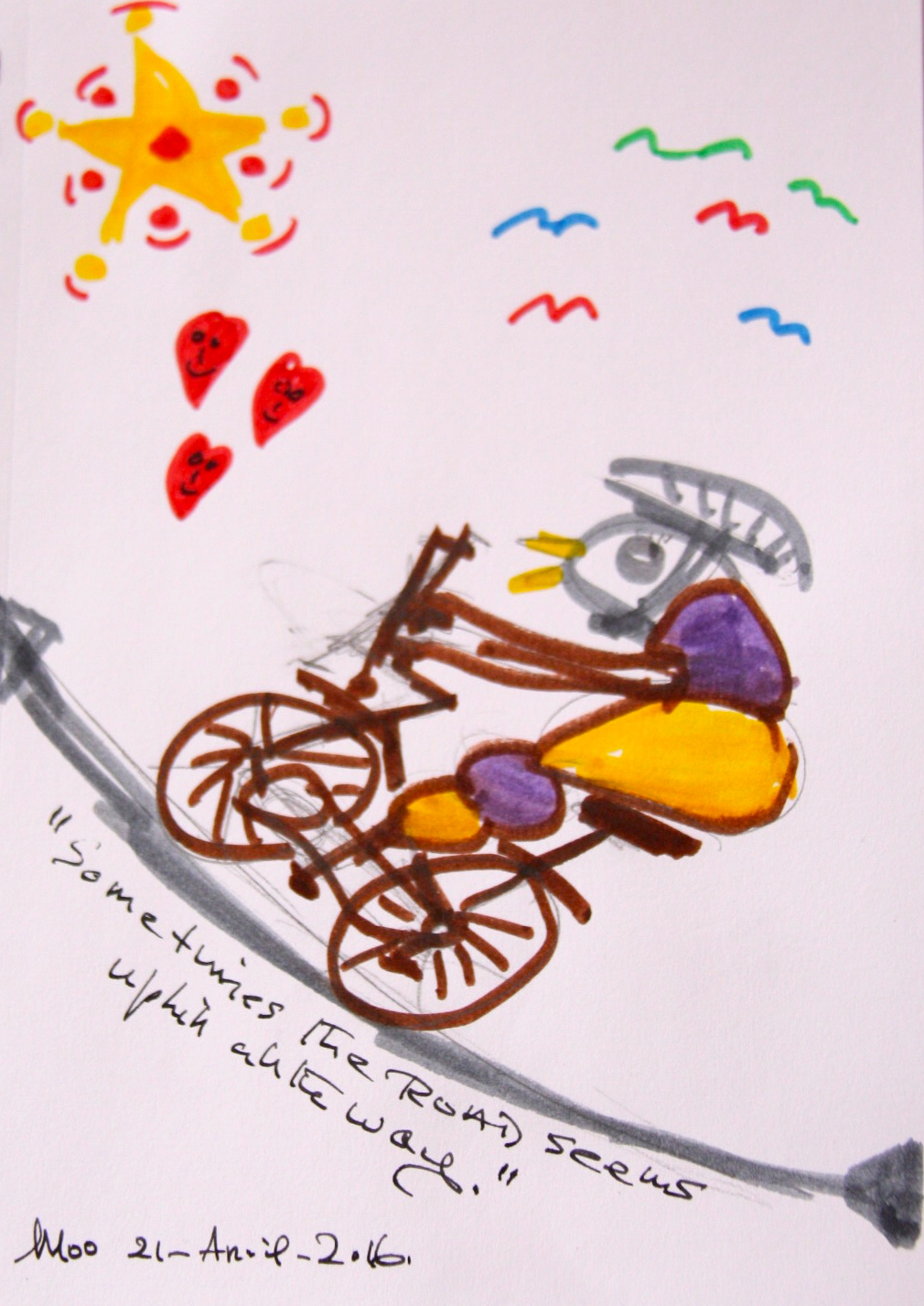
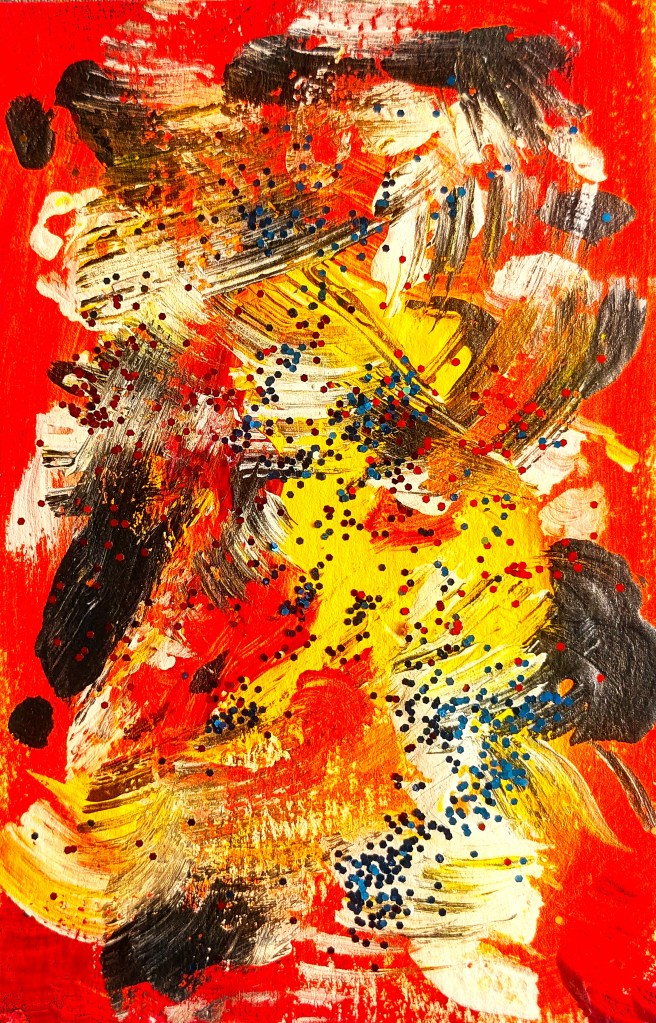
We don’t need a comment really except that The Olde Order Changeth Lest One Good Custom Should Corrupt the World. Interpret that as you will. And as Moo says to Ryan in the presence of Don Roger – “Hey, Ryan, look at all those changes in my painting.”

House of Dreams 5 & 6

House of Dreams

5

A leaf lies down
in a broken
corner
and fills me
with a sudden
silence.

I revise
our scrimshaw history
carving fresh tales
on the ivory
of new found bones.

6

A vixen
hunts for my remains.

She digs deep
at midnight
unearthing
the decaying teeth
you buried with
my borrowed
head.

Comment:

None of this makes sense. Why should it? Don’t ask me to explain it to you. Who am I to tell you what to think and what to do? You are not in elementary school now. Teacher is not leaning over you, teaching you how to shape letters with a pen, telling you to color in red, or yellow, or orange.

Learning – tell me what have you learned? Have you learned to think for yourself? Have you learned that life is mysterious, joyful, sad? Do you not know it can also be incredibly dangerous? Fear not the thunder. Rejoice in the rain and snow. Open your eyes to the world around you and be joyous wherever you go.

Meditation

I am the gatherer of words,
the weaver of wooly clouds.

I am the sheep dog
who shepherds the flock
in and out of the field.

I am the corgi
who snaps at the heels
of cows and pigs,
too small to be noticed.

I am the butterfly
turned into an eagle
who soars into the sky
and gazes on the sun
with an open eye.

Tell me,
my friend,
what and who
are you?

House of Dreams 3 & 4

House of Dreams
3 & 4

3

The light fails
fast, I hold up
shorn stumps
of flowers
for the night
wind to heal.

The pale magnolia
bleeds into summer:
white petals
melting on the lawn
like snow.

Sparrow sings
an afterlife
built of spring
branches.

4

Pressed between
the pages of my dream:
a lingering scent –
the death of last
year’s delphiniums –
the tall tree
toppled in the yard –
a crab apple flower-

a shard of grass
as brittle
as a bitter tongue
at winter’s
beginning.

Comment:

“La poesía se explica sola, si no, no se explica.” Pedro Salinas. Poetry explains itself. If it doesn’t, it can’t be explained.

This quote suggests that the poem is a self-contained entity that must be accepted and understood on its own terms. This is particularly true when metaphor rules and feelings and meaning are contained within the poem’s enunciation. In addition, the musicality of words can never be ignored. The rhythm they bear within them speaks for itself.

Show don’t tell – easy advice, but what exactly does it mean? So many people say so many different things. A cliché is always the simplest form of criticism.

“I don’t understand your poem,” Moo tells me.
“Neither do I,” I reply, “and I wrote it.”

“I don’t understand your painting,” I tell Moo.
“Neither do I,” Moo replies. “And I painted it.”

Words of wisdom.

Breathe deep.
Look and listen.
Don’t think.
Feel.

Hear the smell of color.
Touch the emanating light.
Taste the dry leaves crackling.

See the words shaping,
carving themselves
deep into your dream.

House of Dreams

House of Dreams
(1 & 2)

1

The clematis unfolds
bruised purple on the porch.

Jazz piano:
beneath the black
and white hammers
of ivory keys,
old wounds crack open.

A flight of feathered notes:
this dead heart
sacrificed on the lawn.

I wash fresh stains
from my fingers
with the garden hose.

2

The evening stretches out
a shadow hand.

I feel my heart
squeezed like an orange
by long, dark fingers.

Somewhere,
the whitethroat
trills its guillotine
of vertical notes.

I flap my hands in the air.

They float there,
white butterflies,
amputated
in sunlight’s
net.

Comment:

So, rogermoorepoet.com returns to poetry. Happy days are here again! And Moo is happy too. I need hardly tell you he has been so upset since I started using AI to generate my images for me. Oh dear. He has been very Moo-dy (sic) recently. “But you don’t have a drawing of a clematis,” I told him. “Neither do you,” he replied. “That’s a holly hock.” “At least it’s the right color.” “How about if I find you a purple painting?” He smiled a shy, half smile. “Sure,” I said. “I don’t want to lose the human touch completely.” “I should hope not.”

So he present ed me with this painting. “It’s called u-r-my-sunshine,” his smile lit up the room and we were both happy. Joy to the world – it’s +5C here today and the sun is shining. In my heart. And in Moo’s eyes. We are all glad that joy has not forsaken us!

Book Burnings

Hooded figures holding torches surround a bonfire of burning books and scrolls.
A group of cloaked figures stands in a dimly lit stone courtyard as they burn ancient scrolls and books in a large central fire.

Image generated by AI


Ryan and Don Roger


5

Book Burnings

            In 1492, the Spanish Jews were given the choice of conversion to Catholicism or of being expelled from Spain. Many chose to leave. Those who converted, and remained, were kept under constant supervision. In an effort to stamp out their faith, their books were condemned to the flames by the Spanish Inquisition. A similar burning of the books in Don Quixote’s library occurs in DQI, 6. Is book burning effective? Some people think so. Other people aren’t so sure.

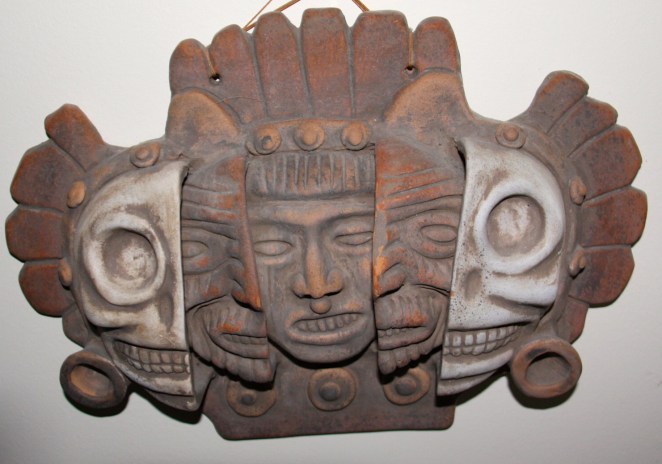
            The Spanish conquest of Mexico, led by Hernán Cortés, concluded on August 13, 1521, when Spanish forces and their native Tlaxcalan allies captured the Aztec capital of Tenochtitlan and emperor Cuauhtémoc, marking the end of the Aztec Empire and the beginning of Spanish colonial rule. The country was then called New Spain. 

Mexico is famous for its codices. These are fan-fold picture histories, drawn on vellum covered with gesso, of tribal conquests, social norms, tables of the gods, in fact a whole cultural and historical record of pre-Hispanic Mexico. The Zouche-Nuttal codex, for example, sets out the conquests of Ocho Venado / Eight Deer, nicknamed Garra de Tigre / Tiger Claw, a Mixtec warrior, who lived between 1063 and 1115. Five of the Mixtec codices survive. Many, many more were burned. The cover of the Vindobonensis shows the burn marks where some daring person pulled the codex from the flames and saved it. Without such saved codices, we would have much less knowledge of pre-Hispanic Mexico.

            Why is this anecdote important? Because prior to the invention of printing, in 1474, manuscripts were written by hand. Yes, some were copied, but many copies were single and unique. Burn the manuscript, destroy the knowledge it contains. Post 1474, with the printing of multiple copies of books, the individual book might be destroyed, but some books would survive from the printing sequence. Apply this to Don Quixote’s library and we note several things. First, Don Quixote’s copies are destroyed. Second, other copies of his books survive elsewhere. In addition, although Don Quixote’s books are burned the ideas in those books survive in the knight’s head and he lives by their rules. Those ideas are spread throughout the history of his adventures to everybody with whom he comes in contact. Conclusion – you can destroy the books. You cannot destroy the ideas that those books contained.

            Ray Bradbury, in Farhenheit 451, describes the burning of books in his dystopian novel. 451F incidentally is the temperature at which paper burns. The books are burnt in Bradbury’s world, but the book people survive. The book people are those who memorize their books and are able to quote them from memory and pass them on orally to other people.

            And people protect their books. How? By placing them in small rooms within their houses and walling up those rooms so that the books could not be found. This happens in DQI, VI – 6. Don Quixote awakes, goes to find his library, but it has disappeared. The housekeeper swears that a sage enchanter descended on a dragon and the library vanished in a puff of smoke. Don Quixote believes the metatheatrical lie and acts as if it were the truth. He then bemoans the fact that he is pursued by malignant sorcerers. These evil enchanters will pursue him throughout the novel whenever he wakes up from his illusions and is faced by reality. Clearly, the sage enchanters have robbed him of his moment of glory (illusion) and reduced him to sorry (the truth).

            Curiously enough, a 16th Century walled-up library was found in a house in Barcarrota, Spain not so long ago. The books were hidden, probably from the Inquisition, so that their owner could escape prosecution. The discovery sheds light on how individuals hid literature from the Inquisition during the 16th century in Spain. It also illustrates how closely Cervantes followed the reality of his times when writing the Quixote.

            You can destroy books. But it is very difficult to destroy the ideas they contain. In this fashion, although the burning of that one book ends the life of that particular volume, it rarely ends the life of the ideas contained within its covers. We might not recognize the names of the characters that Don Quixote quotes from his memory of those histories, but many of the people who encounter the knight during his adventures know them and remember them. Amadis of Gaul is never dead, not when his name lives on. The same is true of King Arthur and his Knights of the Round Table. King Arthur is said to fstill be alive and can be seen in the shape of a White Crow, bran gwen, in Welsh. And even Walt Disney knew, and profited from, the legend of the sword in the stone.

We will also see, as we continue our journey, that in the same way that tall oaks grow out of small acorns, large parts of later events found in the Quixote already have their seeds sown in these early chapters. Metatheatre, illusion and reality, authorship and censorship, truth and falsehood, waking events and dream sequences – and that is just the start.

Rage, Rage 59

Rage, Rage
59

You cannot hide
when the black angel comes
and knocks on your door.

“Wait a minute,” you say,
“While I change my clothes
and comb my hair.”

But he is there before you,
in the clothes closet,
pulling your arm.
You move to the bathroom
to brush your teeth.

Now,” says the angel.

Your eyes mist over.
You know you are there,
but you can no longer see
your reflection in the mirror.

Comment:

The last poem in the series and Rage, Rage against the dying of the light is over and done. Many of you will recognize the title from Dylan Thomas’s poem Do not go gentle into that dark night. I guess the theme itself has become part of the Welsh culture. And now we have exported it to New Brunswick, Canada, and perhaps beyond.

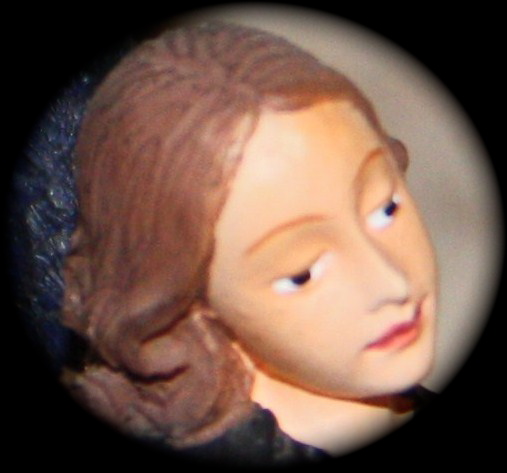
I bought The Black Angel, pictured above, in Avila, Spain. It is a plaster cast of one of the Angels in Roger Van der Leyden’s paintings, if I remember correctly. Here is the angel’s face in close up.

She or he brings a promise of rest and peace, a freedom from earthbound woes and sorrows. She stands on the shelf above the fireplace insert in our sitting room and brings blessings to the house. I look at her every time I light the fire. And she smiles down and blesses me. I think of her as a lady, but her peace and beauty outweigh any formal signs of sex.

As for that reflection in the mirror, well, I don’t have one of me. But her is a photo to reflect upon:

Raining in Avila and puddles in the street. Now you see me, now you don’t. But I am there, holding the camera, and looking down at the water where —- rain has stopped play. The bails have been removed. Old Father Time has gone back to the Pavilion at Lord’s, and the cricket game is over for the day.

Rage, Rage 58

Rage, Rage
58

“What is this sound?”
It is your own death sighing,
groaning, growing
while you wait for it
to devour you.

“What is this feeling”
It is the itch of your own skin
wrinkling and shrinking,
preparing to wrap you
in the last clothes you’ll wear.

“What is this taste?”
It is the taste of your life,
bottled like summer wine
once sweet tasting,
now turning to vinegar.

“What is this smell?”
It is waste and decay,
the loss of all you knew
and of all that knew you.

“That carriage outside?”
It is the dark hearse
come to carry you
to your everlasting home.

Comment:

Moo thinks that his portrait of me is perfectly good for this poem. He told me not to rage, rage against the accuracy of the portrait, but he did tell me to rage, rage against the lack of paper. Où est le papier, indeed. As for the rest of it, he said it’s the same for everyone, so stop making a fuss about it. “You’ve got one last bottle of mescal on the shelf,” he told me. “I know. I’ve seen it. Just swig it down, worm and all, and you’ll have nothing to worry about.”

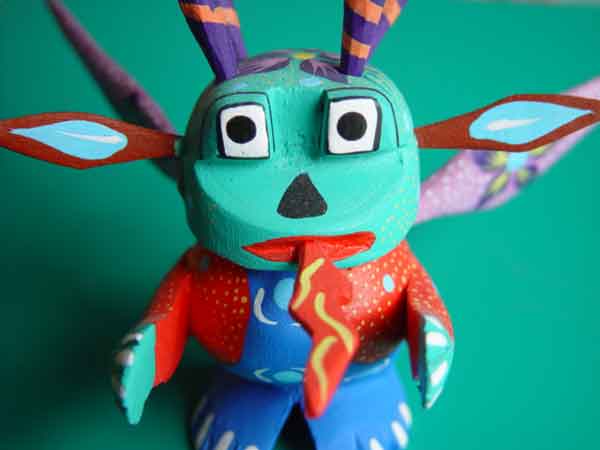
Oh dear. The worm in the bottle. They used to sell the gusanos in Oaxaca’s mescal street at a price of five for ten pesos. I used to buy a two litre coke bottle, filled with mescal from a barrel, and drop ten worms in it. They made yellow streaks as they descended through the liquid. Sweet dreams when you chewed on that lot – and an end to your worries. El brujo, the witch doctor, told me to stick a marijuana plant in the bottle of mescal and when the leaves turned white to rub the liquid into my arthritic knees. “Which doctor was that?” one of the tourists in my apartment block asked me. But I didn’t tell her. Nor did I do it. A waste of good mescal. And to think I now have one last half bottle left. And one little squirmy, crunchy, chewy worm.

Speaking of chewy, crunchy – I had never eaten chapulines, fried grasshoppers, until I went to Oaxaca. I didn’t like the look of them. At the first party I attended was confronted by the host who demanded I eat some. I told him they were taboo, against my religion. He shrugged. When he, and the other guests lost interest in my presence, I tried a couple. They were delicious. A real delicacy. I loved their crunchy little legs.

I guess one is always afraid of the unknown – the gusano in the mescal, the chapulines on the plate, that first plate of calamares en su tinta – squid in its own ink. I love bara lawr – Welsh laver bread – or Welsh caviar, as Richard Burton used to call it. I also know that people who have never eaten bara lawr won’t go near it – it looks like cow pats – but luckily doesn’t taste like them. Don’t ask me how I know. Some people get over their fear of the unknown, others don’t. I guess we’ll just have to wait and see what happens.

Rage, Rage 55

Rage, Rage
55

I walk on thin ice
at the frayed edge
of my life.

I search for the key
that will re-wind me,
but I fail to find it.

Who will winch up
the pendulums on
my grandfather clock,
resetting it
in spring and fall?

Who will watch
time’s sharp black arrows
as they point the path
of moon change
and the fleeting hours?

Each hour wounds,
or so they say.
Who will tend me
when that last one kills?

Comment:

Omnia vulnerant, ultima necat. / Each one wounds, the last one kills. That’s how the Romans thought about the collection of hours that make up a day. An interesting way of putting it. In lapidarian fashion. Four words that are worth a whole book of philosophical thought.

What is this thing called time? Good question, and one which is being asked more and more. Clearly time does not flow evenly within the human mind, though it is remarkably regular on the clocks we have invented to mark time for us. And remember, there are many types of time – seasonal time – spring time, summer time, autumn time, winter time. Strange that autumn – or fall as I have now learned to call it – is the only one that doesn’t have the word time attached to it.

And what about time changes – spring forward, fall back – when we change our clocks in order to make the most of daylight hours. A tedious process for many of us. I see some provinces are rejecting those changes and sticking to the same time, all the year round, from season to season. Personally, I would prefer life without those time changes, as would many of my friends.

Celestial time also known as sidereal time – the time as showed by the planets as they seem to march around the earth in the terra-centric universe. Rephrased, the positions of the planets as the earth turns slowly round the sun in the helio-centric universe.

Then there is the personal time of individual experience. An hour watching football or rugby on the tv set passes much more quickly than an hour passed in the doctor’s waiting room or the dentist’s chair. Of course, an hour watching a five day cricket test can also be a slow process, unless England are playing Australia in the Ashes. As one friend of mine commented, a long time ago, “I thought those English cricketers were unfit. But I’ve never seen anyone go out to bat and come back to the pavilion so quickly. They must be super-fit.” Alas, their cricketing problem, as usual, was centered on the three cants – can’t bowl, can’t bat, can’t catch.

En fuga irrevocable huye la hora.
La que el mejor cálculo cuenta
en lectura y lección nos mejora.

Irrevocable is the hour’s flight.
The one that counts the most
in learning or reading improves us.

Francisco de Quevedo
(1580-1645)

And remember – the hours fly by and your time is limited – spend it wisely and enjoy each and every day to the full limits of your abilities.

Rage, Rage 49 & 50

Rage, Rage
49

Waiting in the doctor’s office,
I hear two old women
gossiping about friends
and family, the intimate
details all laid out
to fester in my fertile mind.

Never will I be able
to put faces to those girls
with breast cancer,
to the women
weighed down
with diabetes,
to the old men
with their strokes
and heart attacks.

50

“Just one of those things,”
one of them whispers,
“my husband gone
leaving me alone
with the grandkids.”

“Is it four years? Or five?
I remember his name,
but I forget his face.”

“And our fourteen-year-old,
her belly already swelling …”

“You’ll cope somehow …”

Silence wraps its scarf
around their flapping mouths.
I think of all my own lost loves,
buried before their proper time.

Lives and worlds end …
new ones begin.

Comments:

Lives and worlds end … new ones begin. How true it is. The olde order changeth lest one good custom should corrupt the world. Tennyson, I believe, from Idylls of the King. King Arthur and his knights of the round table. Each of them rode into that dark night, some quickly, some more slowly, but all were lost, as so many things are lost.

That was also the heading of the departures section of my old school magazine. At the end of the year, pupils left the school, many graduating, never to return, and the old order did indeed change. The fourth formers moved up to the fifth, the fifth to Transitus, then to the sixth, and finally, the scholarship students arrived in Ichabod. Ichabod, Ichabod, the glory that used to be. I look at old school photos and I wonder what became of so many of my childhood friends. The website for my old school also contains an obituary section. I consult it, every so often, to see who else has passed on. Fewer names than I would expect. Not everybody keeps in touch. I am in contact with few old boys from school, but nobody from my undergraduate university. Ships passing in the night, all of us. Our conversations lost in the mists of time.

The old order changes and the language changes with it too. When I was visiting Spain regularly, my first stop, every year, would be the local barber’s shop. I just sat there and listened while I waited to get my haircut, Spanish style. I listened for the new buzz words, the names that now floated around, the latest jokes, the ideas that were currently in fashion. Change is everywhere.

Covid changed the Spanish language, gave it a whole new set of terms that I do not recognize. The same thing happens with English, French, any language. French is not the same in Moncton, New Brunswick, as it is in Shediac. And the Acadian Peninsula is slightly different. As is the language of Grand Falls, and that of Little Falls, aka Edmundston, the capital of the Republic of Madawaska. The language also changes close to the border of Quebec where Joual can be heard. Same thing along the St. Lawrence river and out from Matane to Mont Albert and beyond. Small changes, sea changes, enormous varieties of change.

I often wonder what is happening in Wales both to Welsh itself and to the English language as it is spoken there. English in Swansea / Abertawe was never the English of Llanelli, nor was it the English of the Rhondda Valleys. How could it be? And Cardiff / Caer Dydd was always different. As was Newport / Cas Newydd. I haven’t been back there since 1988. 38 years of change – friends gone, family gone, nobody left. I couldn’t bear to stay in a hotel in a town where once I lived in my family’s homes.

How does one end a rant like this? In silence, of course. For silence wraps its silken around flapping mouths. I think of all my own lost friends and loves, buried so long ago, many before their proper time.