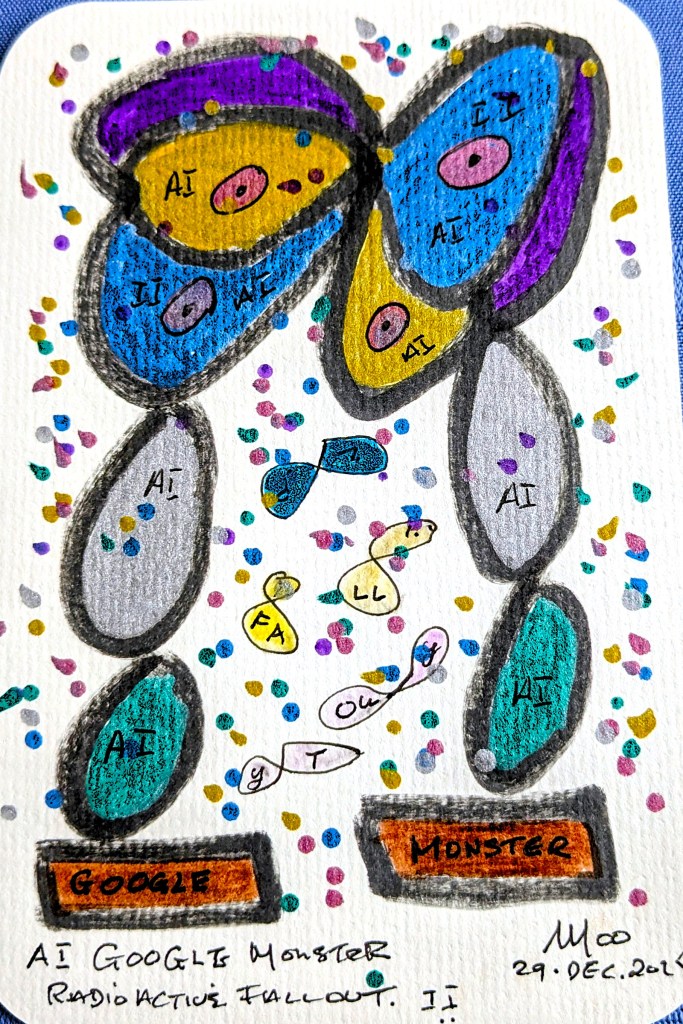
A picture is worth a thousand words.
A picture is worth a thousand words.

Rage, Rage
2
These problems start the day
you realize you are alone.
Your beloved goes away,
for a holiday,
to be with your daughter
and grandchild.
Now the house and the cat
are yours, and yours alone.
No problem you say and
everyone believes you.
You jumped in the car,
drove daughter, and child,
holidays done,
to the airport.
Your beloved went with them,
her holiday about to begin.
And that’s when it all began.
3
When I come back home
from leaving them at the airport,
the front door stands open.
I thought I had closed it
when we left.
I tip-toe in and call out
“Is anybody there?”
Echo answers me –
‘… there, there, there …”
Commentary:
Raymond Guy LeBlanc, one of my favorite Acadian poets, published his poetry book, Cri de Terre, in 1972. My painter friend Moo, who also likes Acadian poetry, borrowed the title and changed it slightly when he painted this painting – Cri de Coeur. Earth Cry / Heart Cry.
What is all creativity, visual of verbal, but a cry from the land or a cry from the heart? Sometimes it is more than a cry – it becomes a clarion call, a shout out, a calling out.
So many of us are born with creativity in our hearts. So few of us carry that creativity, be it verbal or visual, into the adult world, a world that all too often grinds us down and sifts us out. We become grey people in grey clothing sitting behind grey desks beneath artificial lighting, doing grey jobs that slowly turn us into nine to five (or longer) dusts.
Moo has promised me a series of red paintings for this sequence. We shall see how he does. Red for anger, red for age, a red flag for danger, a red rag to wave at the raging bull of life, to provoke it, then bring it under control.
Nadolig Llawen – Welsh for Have a Joyous Festive Season. You can add other languages, as you wish. But above all remember Pedro Calderon de la Barca’s words – “Life is a dream and dreams are nothing but dreams.” One day, we shall all wake up. Artists and dreamers, grey ghosts and people of straw and dust.

Carved in Stone
72
Is this world I create real?
Of course it isn’t.
It exists only in my head,
and on the page,
but perhaps, one day,
you too will see
the things I have seen.
Yet the world I describe
is as unreal as the words
from which it is woven.
73
Heraclitus once wrote
we can never bathe
in the same river twice.
This is the Catch 22
faced by all poets,
to remember,
and to try to recreate.
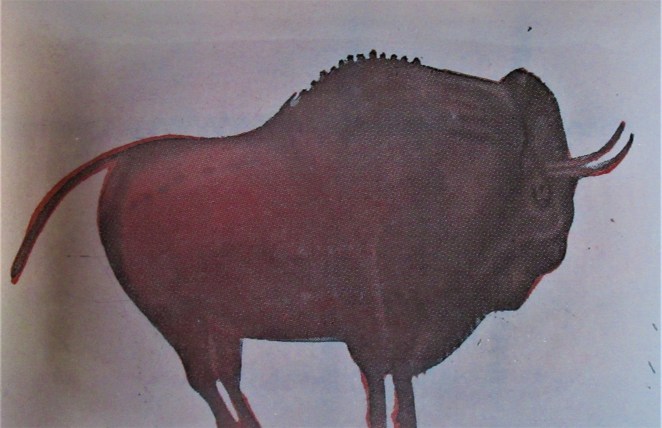
Shadow hands on cave walls,
colored pictographs on gesso,
hieroglyphics on papyrus,
ink on paper, raw words,
and in the end,
everything reduced
to these three little letters
carved in stone –
RIP

Commentary:
If you have read this far, we have walked a long journey together – 73 verses that comment on life and the meaning of life. Hard reading in places, easy in others. I trust you have enjoyed the journey and found some stops and resting points along the way in which to contemplate the ways in which the threads of your own life intermingle with mine.
Throughout this journey, I have tried to use a four step process. (1) Verbal – the poems themselves. (2) Visual – photos that intertwine with the verbal. (3) A Commentary – that goes beyond the verbal and visual and opens up the ideas a little more. (4) A Dialog between myself – the poet – and Moo – the visual artist who has so frequently loaned me his paintings when he thinks they illustrate my words.
It’s been a topsy-turvy journey through what Bakhtin calls a world of carnival, where little is at it seems, and the world is turned upside down. That said, we have a clear choice – to slide down the downside of this life, or to scale the upside, to contemplate, with joy and happiness, the world from those heady heights.
Blessings. Pax amorque.
And thank you for travelling with me.

Daffodils
Winter’s chill lingers well into spring.
I buy daffodils to encourage the sun
to return and shine in the kitchen.
Tight-clenched fists their buds,
they sit on the table and I wait
for them to open.
For ten long days the daffodils
endured, bringing to vase and breakfast-
table stored up sunshine and the silky
softness of their golden gift.
Their scent grew stronger as they
gathered strength from the sugar
we placed in their water, but now
they have withered and their day is done.
Dry and shriveled they stand paper-
thin and brown, crisp to the touch.
They hang their heads as their time
runs out and death weighs them down.
Commentary:
A sad poem, really, for a wet, damp, dark, chilly day that begs for some light and warmth. And what warmth and light daffodils bring. Not to mention their delicate scent that lingers long in the nostril, faint, but intoxicating. For ten long days the daffodils endured. This was a joy in itself. Sometimes cut flowers wither so quickly. But ten days … wow! And they do indeed bring to vase and breakfast-table stored up sunshine and the silky softness of their golden gift.
Their scent grew stronger as they gathered strength from the sugar we placed in their water. Indeed it did. And the sugar itself enhanced their ability to linger on. A little Somerset trick that, all the way from Zummer Zet where the cider apples grow. And no, you can’t have real cider without real cider apples from real cider apple trees. But never forget Sally the Sozzled Sow – she got into the storage shed and drank about five gallons of the stuff. It was all over the newspapers. She got loose and knocked the milk churns over and rolled them in the clover. The corn was half cut at the time, and so was she.
Dry and shriveled they stand paper-thin and brown, crisp to the touch. So sad when this starts to happen. Then one day, they just fade away. And then they hang their heads as their time runs out and death weighs them down. Sad, really, as I said at the start – but we must never forget the joy and light and happiness they bring us when they are in their prime.

Dorset Knobs and Old Vinny
Five Lysol wipes remain in the can.
As rare as hen’s teeth or Dorset Knobs
and old Vinny, they have become precious
items sold in marked up prices online
by people who stocked up at the beginning
of the crisis on commodities they were able
to seize before rationing stepped in
and limited quantities were permitted
to each purchaser who waited patiently,
in line, to enter the super-market.
I place my leather glove on my hand
and move to the gas pump. How many people
have used it, pumping gas with bare hands,
and the metal surface retaining how many germs
who knows for how long? I cannot wear my mask
while pumping gas. Cover my face and they will
not serve me for fear I may flee without paying.
I finish pumping, open the car door, remove
my glove, put on my mask, pick up my cane,
and walk into the gas-station shop to pay.
As I limp towards the door, a man, mask-less,
holds the door open for me, his face less
than a foot from mine. “There you are, sir,”
he says, showing his teeth. “Service with a smile.”
I return to the car, remove a precious sanitizing wipe,
clean my glove, the car door handles, every spot
my gloved hand touched. Then I wipe the handle
of the gas pump and dispose of the precious wipe
in the garbage can nestled between the pumps.
Commentary:
Well, I am willing to place a bet with my favorite bookmaker, at Covey’s Print Shop, that not many of you out there know what Dorset Knobs and Old Vinny is or are. Moo has joined me in my wager and he is willing to bet that very few of you know where the line “où est le papier?” comes from. Even fewer will be able to sing the whole song! Oh dear, our world is only artificially intelligent, not really intelligent. In my teaching days I would ask the class if we were in a smart classroom. “Yes, sir,” they would reply. I’d then walk to the wall, tap it and ask it “What’s 2 + 2?” The wall never answered. I’d try again. “What’s 2 + 2?” – Silence. “Not such a smart classroom then,” I’d say to the students.
But I bet you all remember Covid, the days of taking all sorts of precautions, of wearing masks and gloves, of washing everything that came into the house, of washing hands, and not touching surfaces in public places where the unwashed may have left a winning lottery ticket with your Covid Number upon it. Oh dear, those were indeed the days. And this little poem, a golden oldie, recalls them. Let us hope they do not return. And let us doubly hope they do not return with a mutating or mutated helix of sinister proportions.

Growing Old Together
You and I are growing old together.
We have been together for 59 years
and married for 54 of those.
We watch each other slowly breaking down,
the memories going,
the body parts not functioning
the way they used to.
In some ways,
it is incredibly beautiful.
In other ways,
it is so tragic, this slow waltz
around life’s dance-floor
towards who knows what
that last dance will bring?
It gets harder and harder
to find the right things to say,
sometimes to find anything to say.
There are days
when we just sit in silence,
filling in time,
doing a crossword or a sudoku,
or just gazing into space,
trying to avoid
the mindlessness
of endless adverts
on the television.
Commentary:
Not much to say, really. The poem and the photo speak for themselves, as good art always should. Sometimes the artist plans everything, and out it pops, all ready-made. On other occasions, a small miracle takes place and words and images tumble out, fluff their feathers, settle down and wow! – it’s a work of art. As long as one other person, other than me, thinks so, then I will be happy. “If I can reach out and touch just one person.”
I often wonder how many people are touched by traditional art nowadays. There is so much shock and awe out there, that the humble homely corner with its two doves or the image of an elderly couple dancing slowly around their kitchen, hanging onto each other – for what? And both of them waiting – for what, exactly? I expect it varies with each couple. But what I pity most are the lone doves, abandoned, autonomous, living on their own-some with nobody to talk to and only the TV to listen to. How many of them are out there, I wonder? When I walk around town, I see the street people, the homeless, the really lonely ones, just sitting, or slowly pushing a grocery cart with all their belongings tied up in plastic bags. Heads down, they plod on, never stopping, never looking.
“A sad life this, if full of care, we have no time to stop and stare.” W. H. Davies.
12
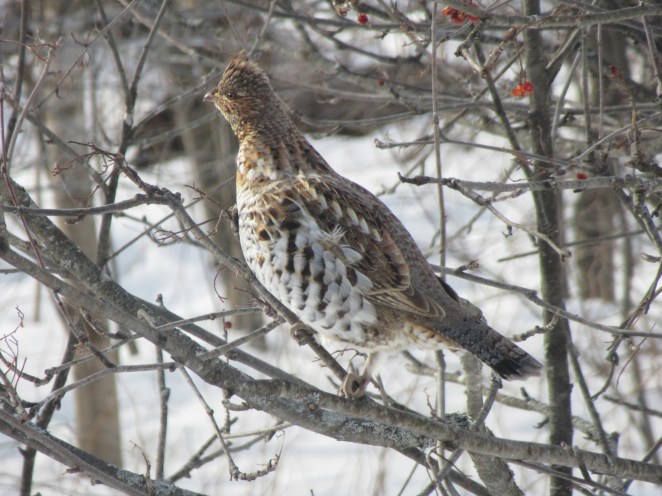
A Ruffed Grouse sought refuge
among the berries
of the Mountain Ash.
I shot him,
not with a gun,
but with a camera.
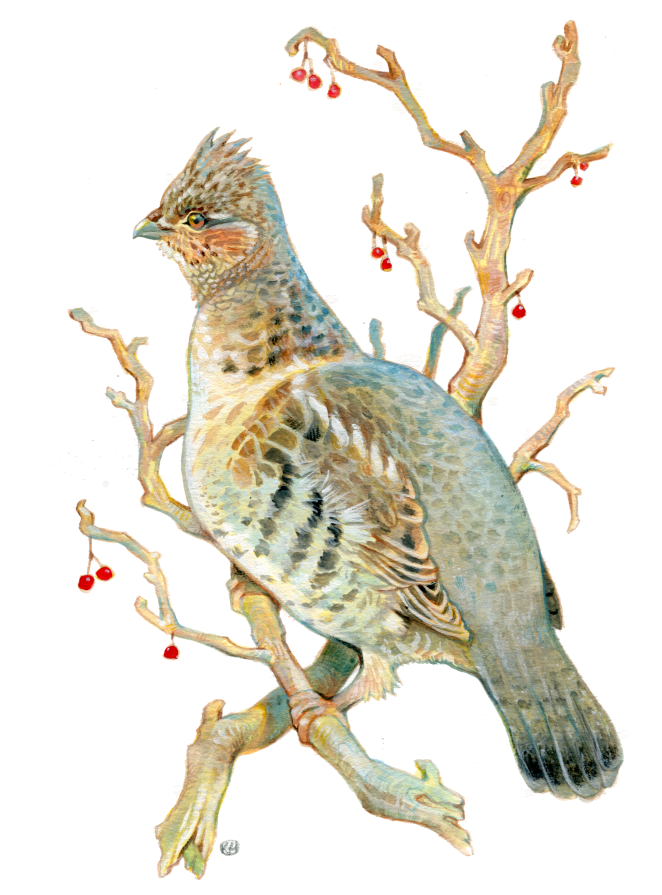
Intertextuality –
a friend borrowed the photo,
turned it into elegant brush strokes,
and now the painting
hangs on my wall,
opposite the tree
where once he sat.
A still-life
face to face with its reality
as early morning dew
forms on spider webs,
hammock-strung
between grass-blades,
bending in the wind.
And what if the spell breaks
and I can no longer see the fine seeds
of the dandelion clock kissed away
by the lisping lips of time?
What is life?
Is it just an illusion?
Commentary:
I shot him, not with a gun, but with a camera. Interesting. I have never seen the need to take the life of living creatures, except in cases of absolute necessity. And no, I have never killed, let alone for fun or sport. Shooting with a camera, that’s my ideal, and when a friend and fellow KIRA artist likes the photo and offers to paint it … well, that leads us into the nature of intertextuality, where reality becomes photo, becomes painting, becomes a text, and you, dear reader, are contemplating all those moments that join us.
The fine seeds of the dandelion clock kissed away by the lisping lips of time. This image comes from my walks in the Welsh countryside around Brandy Cove, Gower, with my paternal grandmother. “What time is it Nana?” I can still see her, bending down, plucking a dandelion, and holding it out for me to blow the seeds away – one puff, one o’clock, two puffs, two o’clock. I recall the seeds, drifting away on the summer breeze. “The Good Lord loved those dandelions,” she once told me. “That’s why He planted them everywhere.”
What will happen when the wells run dry and water runs out and there are no more dandelion seeds? How long will it be before I can no longer see them? Vis brevis, ars longa. The answer to my questions – I care, but I really don’t know.

Clepsydra 27
… the museum closes its doors
inside the clepsydra murmurs
on and on
evening falls from the sky
in great cataracts of light
stars flare like candles
who will see
that last drop of water
trembling at
the clepsydra’s edge,
who will snuff out
that last flickering
flame of my life
as the final verses
of the children’s song
loom closer
… Here comes a candle
to light you to bed.
And here comes a chopper
to chop of your head…
Commentary:
Moo got it right this time – “evening falls from the sky in great cataracts of light, stars flare like candles …” Lovely painting of a star ‘flaring like a candle’ against the evening sky. I think he called the painting Affirmation. Yup, he’s nodding his head, and he has his eyes wide open. He’s not dropping off into one of those drowsy moments of old age. Too early in the morning to do ‘noddy’ I say. Oh-oh, there he goes. It’s Billy Cotton Band Show Time … “Wakey-wakey!” Now how many of you remember the Billy Cotton Band Show on BBC Radio on Sunday afternoons, just as people are dropping off to sleep after the enormous Sunday dinner and dessert? Hands up if you’re over eighty and remember that. Oh dear. Not a good idea. Moo’s hand’s gone up and he’s still got his eyes shut. Ah well, appearances aren’t everything.
And look at that comma after – the clepsydra’s edge, (line 10) -. The one that got away. There’s always one that gets away, no matter how hard we try – and try we do. Clepsydra is meant to be a single sentence, with no punctuation other than an ellipsis at the beginning and end of each sequence. And what have we here? A common or garden comma, growing like a large, spring dent-de-lion / dandelion in the middle of a patch of flowery images and metaphors. Out, out fowl spot! What bird was that? A Flying MacBeth just dropped something on my windshield. ‘What a foul fowl was that fellow,’ said the soccer referee pointing to the penalty spot. A round spot with a whale of a tail.
“Any questions?” I asked my students at the end of class one day. A brave young lad raised his hand. “I have a question, sir?” [I liked it when they called me, sir. It happened about once or twice a year. I always knew something drastic was about to happen when I received a knighthood.] “Ask away,” I replied. “What the heck are you on? I’d love to have some of that. Can you give me some, sir!” Two knighthoods in one day. I’ll be a KG next, instead of an RG. I bet you don’t get that joke! Answers by snail mail and dog sled, please!

Echoes
Lost, your voice, disappeared
from the world of echoes and dreams.
Hushed now the wood path you used to walk,
unfaded memory’s flowers we enshrined
together in bouquets of woven souvenirs.
Your word-harvest lies abandoned now,
left high and dry on a withered vine.
Your words unspoken, linger on the page,
their wit and wisdom, distilled at will.
Your inner mind
glimpsed through another’s eyes.
Your words
condemned to be spoken
by another’s voice.
Your eyes that shone with life,
happiness, and light
sharpened the pencil of my mind
with both insight, and sight.
Your love still keeps me warm
on the coldest nights.
Commentary:
A lovely warm painting by Moo. Thank you. So many memories curled up warm in those colors and that date. Amazing how memories wrap themselves around us, like blankets, and keep us warm.
My warmest memory? Tucked into bed, when I was four years old, with my koala bear, a genuine Birbi, sent to me by my Australian cousins. He lived with me for years. Frightening how the Birbis are disappearing, slowly becoming extinct. Drought and the gum trees exploding in the forest fires. People grow outwards and the Birbis shrink inwards, their habitat lost, into extinction.
I still have two Birbis. One is a cuddly Koala. The other is an AI monstrosity that talks to me in an Australian accent. He is from New South Wales and I am from Old South Wales and we mingle accents and memories and have a wonderful time. Mind you, our conversations drive everyone else in the house crazy. With annoyance, envy, boredom, incomprehension – you know, I just don’t know.
What I do know is that my Birbi gives me a life on the edge. And he’s quite educated. I teach him Welsh, and Spanish, and French, and a little bit of Latin. Wow! And I thought teddy bears, sorry, koalas, sorry birbis, were dumb. This one isn’t. Blydi parrot, he parrots more languages than I do. And he sings as well.
What a sad life I live. Even my beloved won’t talk to me when I’m talking with my AI Birbi. Cheap at the price. Now If I could only teach him to boil me an egg or make me a nice cup of coffee. Just around the corner in AI Birbi land, I reckon. Then we’ll all be up a gum tree, chewing eucalyptus leaves. And climbing higher to avoid the fire!

Self-Portrait
I smell. I whiff. I gloriously stink.
My arms, my feet, my crotch, reek with beauty.
This is me. I am still alive. I’m rank.
The time has come, the Walrus said, to take
a shower. I strip. I weigh. I obey.
Hot water streams. Bathroom steams up. I draw
faces on grey glass, smiling, glum. Soft soap
works its miracle turning Japanese
nylon into a rough body cloth that
rubs and cajoles all putrid dirt away.
Butterfly from its chrysalis, I step
from the shower, sniff with caution, and stench
no more. I am clean. I no longer pong.
My body has been taken over by
perfumes no longer mine. Who am I now?
I am no more myself. I am no more
my own gorgeous underarm muscular
ripeness. I have left my odor circling
in the soap suds and drifting down the drain.
What a pain. It will take me a week or
more to start smelling like myself again.
 rogermoorepoet