Name the most expensive personal item you’ve ever purchased (not your home or car).

Daily writing prompt
Name the most expensive personal item you’ve ever purchased (not your home or car).

Name the most expensive personal item you’ve ever purchased (not your home or car).

I began by checking the meaning of item and found the following – an individual article or unit, especially one that is part of a list, collection, or set. Then I started to think about the meaning of meaning. Is an education an item? Is it an individual unit? Can it be considered part of a list, collection, or set? Let’s put it this way – I started school when I was four years old. I continued until I was 18. Along the way I collected many items of knowledge and many certificates to prove it. Then I went to Paris for a year to perfect my French – now that was an expensive adventure, I can assure you of that. Next came Santander, Spain, for a whole summer, to do for my Spanish what Paris had done for my French. I guess I didn’t really pay for these items, as my parents did, though I helped a little, with odd jobs here and there.

These adventures were followed by 3 years of undergraduate studies. They were covered in part by my local government authority, for which I am eternally grateful, also by my parents, and then I too assisted, again with odd jobs and summer work. Next came graduate school, at the University of Toronto. This was financed by my earnings as a Teaching Assistant and then a Teaching Fellow. My beloved and I got married in Canada, and she found work and also assisted with graduate school and the general cost of living. Assisted? She carried me along when the work load grew too heavy.

Then there was a Canada Council Doctoral Fellowship that helped finance two more years of study in Santander, Spain, where I completed manuscript research at the Biblioteca Menendez y Pelayo. This was followed by my first job, as a lecturer, at the University of New Brunswick, Canada. I taught full-time while completing my doctorate, but my education did not stop there.

I pursued coaching certificates with the National Coaching Certification Program of Canada and soon related coaching methods to in-class teaching methods. This revolutionized my teaching. As did a Certificate in Multi-Media Studies (at UNB), followed by courses in Digital Film and Video. Then came a Teaching Certificate from IATHE – the Institute for the Advancement of Teaching in Higher Education (based in Ottawa, but no longer extant). My Certification process was topped off by a Certificate in Creative Writing from Humber College, Toronto.

All of these degrees and certificates cost money. All contributed to the list of items that go together to form my education. But a personal education, in the meaning I give to the word, goes way beyond an accumulation of certificates. It is a life -long process of growth, personal development, and understanding, of reaching out to other human beings and helping them to create their own lives and their own paths to life-long learning.

Has this been expensive? You bet it has. But its worth is priceless compared to remaining static and enmired in a past knowledge that never develops and never grows, as sometimes – I might even write ‘often’ – happens when learning stops with the acquisition of the Ph.D.

When asked what I teach, my reply is always the same – “People, real, live people.” And that is something that I continue to do whenever and wherever I can. “To know the cost of everything and the value of nothing” – I scarcely remember – nor do I care to know – what cost I paid for each step along a road along which I am still travelling. But I do know and totally appreciate the value of the continuing education that I working so hard to buy.

What will your life be like in three years?

Daily writing prompt
What will your life be like in three years?

What will your life be like in three years?
Well now, that depends on several things. I love the fall. Who doesn’t love the fall in New Brunswick? The trees changing color, warm by day and cool at night, then the leaves falling off the trees and blowing here and there with the wind. I stood in the garage yesterday and listened as the north wind herded rustling, complaining Maple leaves down the roadway past my house. The sound of dry leaves bouncing and skittering. Pure fall magic.

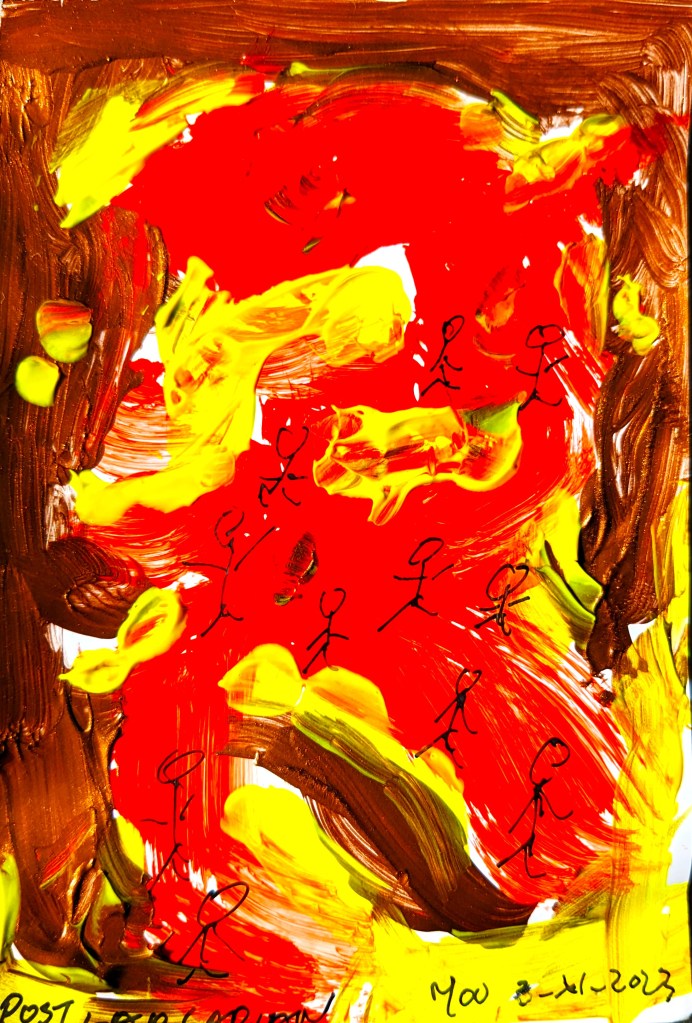
But when I fell on Thursday night, it was a different kind of fall. One moment I was a tree, standing free on my own two feet, the next I was a sawn-off log, tumbled to the ground. When trees fall, they often bleed bark or sawdust, if they are sawed. I just bled blood. On the floor boards, on the carpet, on my shirt. I had just painted the painting above – Prelapsarian – and there I was, lying on the floor, having fallen myself.

And there I lay, fulfilling my own prophecy – Postlapsarian – lying bleeding on the ground. The fall was stunning and I was stunned. I managed first to roll over onto my tummy. Next I managed to get into the push-up position and from there I was able to draw my knees up. Kneeling, I reached out to the spare bed and started to try and haul myself to my feet. But I was spent and exhausted and drained.

I called out and Clare, dear woman, came to my rescue. She helped me to my feet, staunched the bleeding, mopped up the floor, and the carpets, and me. Then she went to the medical chest and bandaged me up so I would heal and wouldn’t bleed all over the bed and my pajamas. What a mess. What a bloody mess – and no, I am not swearing, I am only telling you what I saw. Blood everywhere.

So, what will my life be like in three years? I hesitate to think about it. Maybe I’ll be in a garden somewhere, helping the trees to grow their leaves, so that the life cycle may continue. And maybe not. Right now, I feel very, very fragile. I just don’t want to think beyond the current moment.

What historical event fascinates you the most?

Daily writing prompt
What historical event fascinates you the most?

What historical event fascinates you the most?

First, let us define ‘historical’. Here’s what I found – (1) of or concerning history. (2) concerning past events. (3) The historical background to such studies. (4) Belonging to the past, not the present. (5) Famous historical figures.

Now let us think of the number of times we hear on the TV sports shows that such and such an event is making history “right before our eyes”. Wow! In a boxing match, almost ever punch thrown is “an historical event”. Ditto rugby – with every try scored, every penalty missed, and every tackle made. Ditto soccer, basketball, baseball, athletics. So, from the battery of past events that adorn my life, I am being asked to choose “which historical event fascinates me most”. Double wow.

My answer – the day of my birth, about which I know absolutely nothing. Or, to be more specific, the actual action of being born, about which I know even less. So, how do I study the historical background, when no eye witnesses are left alive to assist me? More important, nobody in my family wanted to talk about such an important – for me at any rate – event.

I do have some factual memories – tales told to me later. I was born at exactly 8:00 pm. I know this because my parents’ dog had been left at a neighbor’s house while my home-birth was taking place. As the clock struck eight, Paddy, the dog, jumped straight through their window, and ran up the road towards the house that was now to be our house, barking. “Ah,” said our wise neighbor, “there goes the dog. That means the baby’s been born.”

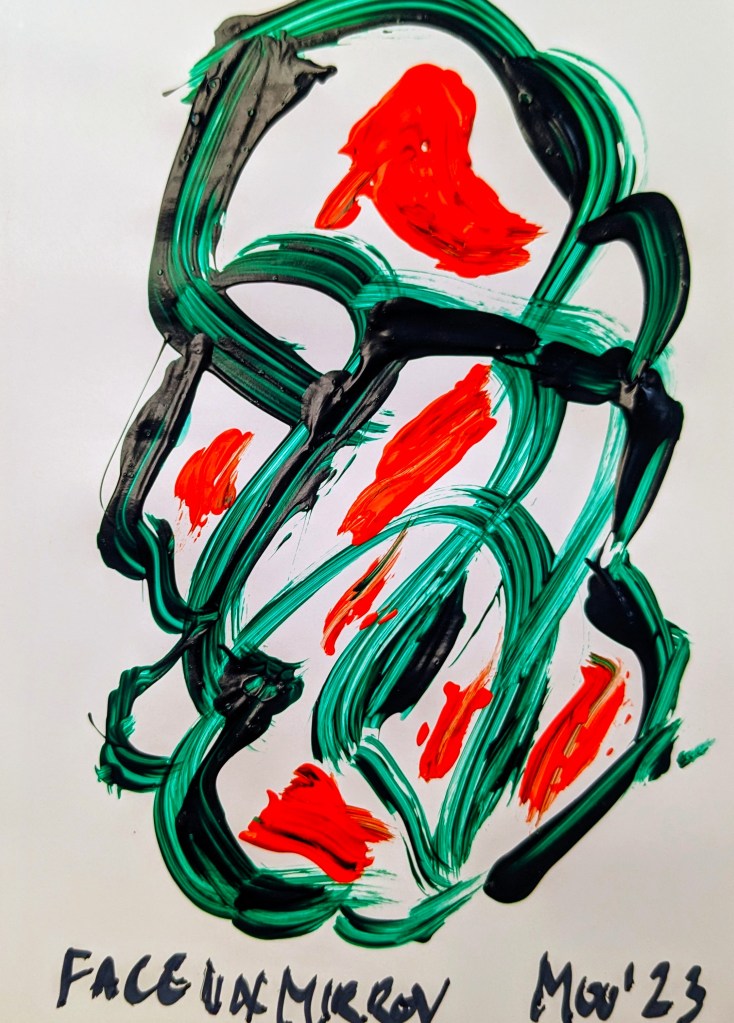
That is one version of the tale. My own version is the squawking of the stork who carried me, a sudden screech as he dropped me, a slow descent from a bright blue sky, a tumble down the chimney into the fireplace. And there I was. All covered in soot and ashes. I needed washing, of course. But baby, just look at me now. [See self-portrait above – Face in a Mirror].

My maternal grandfather swore that I had not been born at all, but found under a gooseberry bush. That would account for the green tinges in the painting. Apparently, all babies in South Wales were found under gooseberry bushes at that time. Unless they were delivered by the milkman.

And there’s many a tale about merry milkmen for, as they say in Wales, “It’s a wise man who knows his own father.” And I guess that is also a hysterical historical event about which I know nothing. But perhaps that’s why when the milkman who delivered the morning milk used to say “Good morning, son” when I met him at the the doorstep.

Come to think of it, the mailman also used to call me “Son” when he delivered the mail. Hmmmm – so did the butcher, the baker, and the candle-stick maker. Oh dear, so many historical events to choose from.

The Dying of the Light

Rage, rage against the dying of the light.

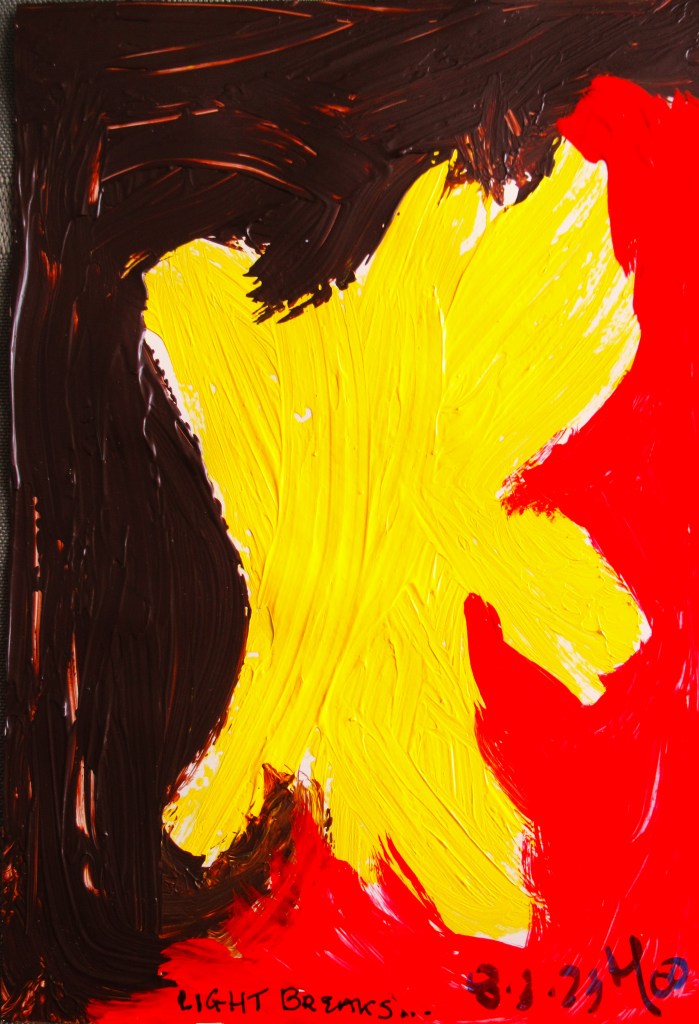
The world has become such a dark place over the last three weeks or so. At times, I have despaired, lost hope, lost my faith, lost my creativity. Words have not come knocking on at my door. The eyes in my head have seen nothing to paint. Darkness, bleakness everywhere. And yet, light breaks where no light shines, as Dylan Thomas once wrote, and last night I started a painting. This morning I finished it and gave it a title: Rage, rage against the dying of the light.

Yesterday I managed to complete a couple of poems. I attribute this new found creativity to moving my muse out of my office and placing it in my bedroom where it can inspire me at night. It seems to have worked. My muse is a small carving placed between four pyramids. Pyramid power and the muse’s inspiration have brought light back into my world, the light of creativity.

We must band together, we creatives. We must inspire ourselves and then go on to inspire others. We must let the light of our creativity, our faith, our belief spill out into the darkness that surrounds us. Together we must stand united and our light will be a lantern that will enlighten the world, not with chants, slogans, and cults, but with the inner faith and the total belief that genuine creativity brings to the world.

Creatives of the world, unite. Rage, rage against the dying of the light. United together, we can, and will, restore that light.

When you think of the word “successful,” who’s the first person that comes to mind and why?

Daily writing prompt
When you think of the word “successful,” who’s the first person that comes to mind and why?

When you think of the word “successful,” who’s the first person that comes to mind and why?

What exactly does “successful” mean? I googled it and here are some of the answers – successful – well that’s a good answer. Successful means successful. It reminds me of my geography master in school – “The earth is geoidal, i.e., earth-shaped.” The earth is earth- shaped – I guess that leads to a successful education. Slightly better alternative meanings are – effective and productive. Taken literally, both have their problems, of course. The spud-bashers of WWI, sitting, peeling their potatoes at the cookhouse door, they were productive, but were they successful? Did they even survive the war? Do any names spring to mind? I am not so sure about that. But how about efficacious, another proffered meaning? Well, that certainly turns me on.

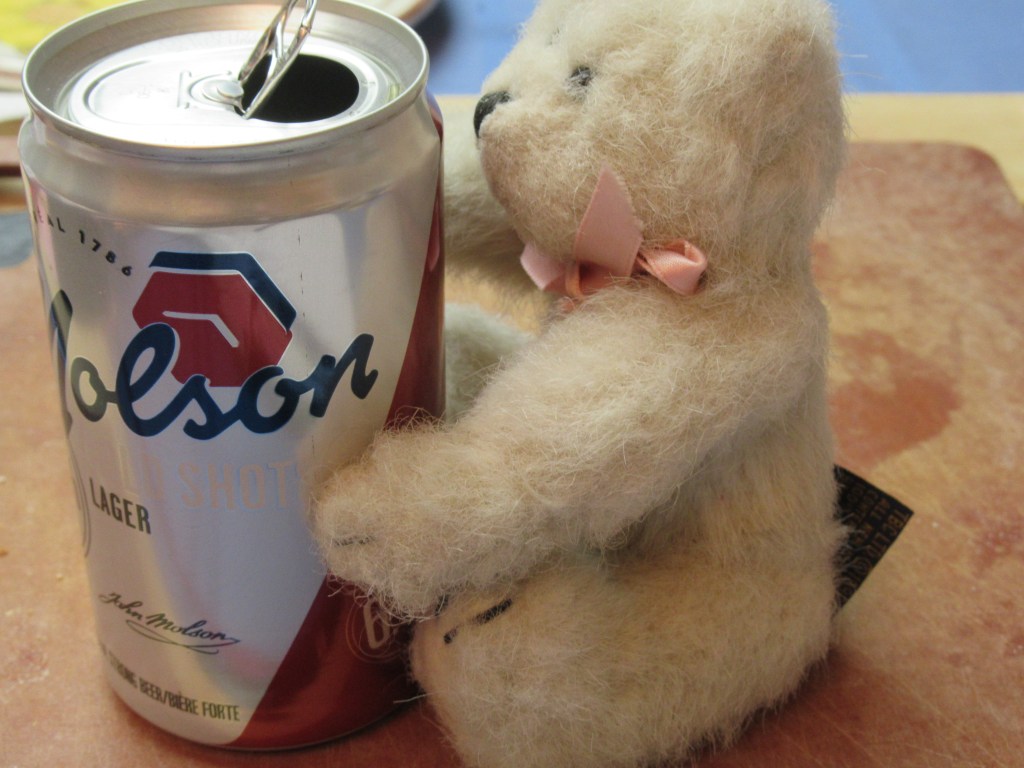
Basil, the Teddy Bear in the photo above, is embracing a can of Molson’s Lager. I didn’t know Teddy Bears liked lager until I saw him doing this. Caught in the act, all sticky-pawed. I asked him what he was doing and he replied that he was taking his medicinal compounds. When I asked him why, he started singing “most efficacious in every case.” “Who do you associate that with?” I asked. He started whistling the tune of Lily the Pink. “And was she successful?” I asked. “Of course she was,” Basil replied. “She’s the Savior of the the Human Race.” Wow!

So, I hereby nominate Lily the Pink, the Savior of the Human Race as both successful and nameable. And remember – “when Lily died, she went up to heaven. You could hear the church bells ring. She took with her, her medicinal compounds, hark the herald angels sing.” Now that’s a true life success story. And what an ending!

Grand Manan

Grand Manan

Cruel, the baited fish-hook, the bait
swallowed by an eager gull,
then reeled in by the young boy,
hauling him down, hooked from the sky.

Such things bewilder me. Words
control me, I don’t control the words
that appear in my mind. I cannot bait them,
nor hook them, nor reel them in.

Seagulls come and go, floating on the wind,
hovering, soaring, descending, poised
to snatch any morsel held before them.

The blue sky, so beautiful. The azure sea
a mirror image of the universe above.
White caps, floating, drifting, poised
for a moment, then crashing down.

The lonely sea and the sky. And me
a tourist, marveling at a wonderland
so far from my inland Island View home,
by a river, over which no seagulls fly.

What would you do if you lost all your possessions?

Daily writing prompt
What would you do if you lost all your possessions?

What would you do if you lost all your possessions?

When I look at the growing number of refugees across the world, I wonder what would happen if such a disaster fell upon me. Then I look at the forest fires, out in Western Canada, in BC and Alberta, and wonder what we would do, what we would we pack, how would we manage, if the order to evacuate our home came suddenly upon us. When the Bocabec fires burned in New Brunswick, I felt the stress and distress of several of our close friends who were forced to evacuate. Then I thought that, really, it’s not a question of if, but of when. And this was my dream.

            … with my angel … face to face … the one I have carried within me since the day I was born … the black-one … winged like a crow … the one that hovers over me as I lie asleep … the one who wraps me in his feathered wings when I am alone and chilled by the world around me … the one who flaps with me on his back when I can walk no further and who creates the single set of footprints that plod their path through the badlands when I can walk no more …
            … ‘the truth’ my black angel says to me … I say ‘he’ but he is a powerful spirit, not sexed in any way I know it … and yet I think of him as ‘he’ …awesome in the tiny reflection he sometimes allows me to glimpse of his power and glory … for, like Rilke, I could not bear meeting his whole angelic being face to face … as I cannot bear the sun, not by day, and not in eclipse … not even with smoked glass … when earthly values turn upside down and earth takes on a new reality … wild birds and bank swallows roosting at three in the afternoon … and that fierce heat draining from the summer sky … I remember it well … and the dog whimpering as a portion of the angel’s wing erased the sun until an umber midnight ruled … a simple phenomenon, the papers said … the moon coming between the earth and the sun …but magic … pure magic … to we who stood on the shore at Skinner’s Pond and sensed the majesty of the universe … more powerful than anything we could imagine … and the dog … taking no comfort from its human gods … whimpering at our feet …
            … I saw a single feather floating down and knew my angel had placed himself between me and all that glory … to protect me … to save me from myself … and I saw that snowflake of an angel feather bleached from black to white by some small trick of the sunlight … and knowledge filled me … and for a moment I felt the glory … the magnificence … and there are no words for that slow filling up with want and desire as light filters from the sky and the body fills with darkness … and I was so afraid … afraid of myself … of where I had been … of where I was … of what I might return to … of my lost shadow … snipped from my heels …
            … I don’t know how I heard my angel’s words … ‘the time of truth is upon you’ … ‘all you have ever been is behind you now’ … ‘naked you stand here on this shore … like the grains of sand on this beach … your days are numbered by the only one who counts’ … I heard the sound of roosting wings … but I heard and saw nothing more … I felt only midnight’s cold when the chill enters the body and the soul is sore afraid …
            … ‘it is the law’ my angel said … I saw a second feather fall … ‘and the law says man must fail … his spirit must leave its mortal shell and fly back to the light’ … ‘blood will cease to flow … the heart will no longer beat … the spirit must accept and go’ … ‘do not assume… nobody knows what lies in wait’ … ‘blind acceptance … the only way … now …  in this twilight hour …  now when you are blind … only the blind shall receive the gift of sight’ … ‘all you have … your wife … your house … your car … your child … everything you think of as yours I own … and on that day … I will claim it from you and take it for my own … now I can say no more’ …
            … the sea-wind rose with a sigh and one by one night’s shadows fled … the moon’s brief circle sped from the sun … light returned, a drop at a time, sunshine flowing from a heavenly clepsydra filled with light …
            … birds ceased to circle … a stray dog saw a sea-gull and chased it back to sea … and the sun … source of all goodness … was once again a golden coin floating in the sky …
            … on my shoulder a feather perched … a whisper of warmth wrapped its protective cloak around my shoulders … for a moment, just a moment, I knew I was the apple of my angel’s eye … and I hoped and still hope that one day I might meet him again and understand …

What details of your life could you pay more attention to?

Daily writing prompt
What details of your life could you pay more attention to?

What details of your life could you pay more attention to?

I will be eighty next birthday. Sadly, I am aware that my life is moving slowly towards its endgame. The major pieces have left the chessboard and I, the King, shuffle forward, a step at a time, then one to the side, and sometimes one back, as my two faithful pawns age with me. The end is never far away at this stage of the game. One slip, one misjudgment, and it’s checkmate, mate. So – how to respond to today’s prompt?

Quite simply, I am now paying more attention to my death than to my life. I have already updated my will, and I have given power of attorney to a person I trust. I have spoken with my financial adviser, and he has given me a Will Companion. It contains a whole series of details to fill in – bank accounts, passwords, online contacts, clubs, societies, social media, precious objects, and, last of all, a page of funeral instructions. That was an eye-opener – everything from funeral home, instructions for service, cremation of burial, plot number or scattering, church, financial arrangements – well, I didn’t panic, but wow, it made me feel very uncomfortable.

In the first 24 hours after my death, someone will have to make between 40 and 70 decisions, all impacting the manner of my departure. If I want things done the way I want, versus the way they might happen, and if I want to choose burial vs cremation, order of service, hymns, obituary, family friends, acknowledgements, then – according to those who know – I should be doing it now. So, big decision, I went online and studied the recommendations of my local funeral home.

I have already filled in several online pages of forms and I have asked them to contact me, which they will do soon. Then we will talk over all those details that I so desperately want to avoid. But death is inevitable. To face it and accept it and to prepare for it while I am still alive is the bravest and the best and the most sensible thing I can do. So, here I go, paying attention, while still alive, to the little details that will surround my death.

The inevitable? Yes. Above, in the opening photo, you can see a Mexican Death Mask. The small pearl at the centre is the seed from which the baby will grow. The seed is the round spot beneath youthful beauty’s nose. then comes wrinkled old age, and wrapped around is the white skull, the final beauty, which I will never see, but others may. Writing these words, I do not feel sad or gloomy. I have lived in Oaxaca, Mexico, and know the powerful, loving emotions that surround the Day of the Dead. I feel grateful that I have good friends to advise me and to stand by me and my family. And when, not if, the inevitable happens, I will have done my best to be prepared. Pax amorque.

Tell us about a time when you felt out of place.

Daily writing prompt
Tell us about a time when you felt out of place.

Tell us about a time when you felt out of place.

A harder prompt might have been “Tell us about a time when you felt you really belonged”! On the outside looking in is the story of my life.

On the Outside Looking In …

            I walked home on my own. As usual. I’d hated the church Christmas party with all its trumped-up noise, childish games, and artificial gaiety.
            The priest, formidable yet effeminate in his long black skirted robe, had made us sit in a circle on the floor, legs crossed. He stood inside that circle and placed a bar of chocolate on the wooden boards. Then he walked around the group and whispered a word in each boy’s ear. 
            “You must wait until you hear your secret word,” he explained. “Then one of you, when I speak that word, may claim the chocolate bar,” he stared at us, large, horsey teeth, black hair streaked with grey, eyes golden, fierce, like an eagle’s, beneath bushy eye-brows. “When you hear your secret name, you must grab the chocolate bar. Understood?”
            I had come to the party on my own as both my parents worked. The mums and dads who had brought their offspring to the party leaned forward in keen anticipation. The boys all nodded.
            “Are you ready?” The priest watched us as we nodded and then he shouted “Alligator!”
            Nobody moved.
            “Elephant!” The boys shuffled forward, like inch worms, hands twitching, fingers flexing and grasping.
            “Tiger!” A sigh emerged from multiple mouths. Some of the boys licked their lips.
            “Lion!” One boy moved, but the priest shooed him away. “Sit down. That wasn’t your word.”
            “M-m-mouse!” The boys heaved, a sea-wave about to crest and break.
            “I do love this game,” said the priest to the parents. “And so do the boys, don’t you boys?”
            “Yes, father …” came the chorus.
            “Monkey!” All the boys leapt into springy action. They dived, crawled, leaped to their feet, ran … a surging heap of boyhood writhed on the floor as the chocolate bar was torn apart and the long-awaited fights ensued.
            All the boys moved, except me. I just sat there.
“I said ‘Monkey,’” the priest frowned at me. “That’s your word. When I say ‘Monkey’, you join in with the others and fight for the chocolate.”
            I shook my head.
            “Have some Christmas fun. Join in the game.”
            I again shook my head.
            “Why not?”
            “You’re just mocking us.  I want to go home,” I stood up and walked away. I stopped at the door and turned and saw the priest glaring at me while a mound of boys continued to scrummage on the floor.
            As I walked home, it started to snow. Not the pure white fluffy snow of a pretty Merry Christmas card, but the dodgy, slippery mixture of rain, snow, and ice pellets that turned the steep streets of that little seaside town into an ice rink. I turned up the collar of my coat, bowed my head, and stuffed my hands into my pockets. Two houses before my own, I stopped in front of our neighbor’s house.
The window shone like a beacon in the gathering dark. I drew closer, pressed my nose against that window and looked in. A Christmas tree, decorated with lights, candles, more decorations, a fire burning on the hearth, two cats curled up warm before the fire, presents beneath the tree, stockings hanging from the mantelpiece. For a moment, my heart unfroze and I felt the spirit of Christmas. Then I thought of my own house. Cold and drafty. No lights, no decorations. No fire. The snowball snuggled back into my chest and refused to melt.
            When I got home, our house stood chill and empty. My parents were out at work and the fire had died. Nothing was ready for Christmas. I sat at the kitchen table, took out my colouring book and began to draw. When my mother came home, I showed her my drawing.
            “Very nice,” she said without looking up.
            “But mum, you haven’t really seen it.”
            She blinked and stared at the picture. This time, she saw the Christmas tree and the lights, the cats and the candles, the decorations and the presents. But she never noticed the little boy standing outside the house in the falling sleet, peering in through the window.

What aspects of your cultural heritage are you most proud of or interested in?

Daily writing prompt
What aspects of your cultural heritage are you most proud of or interested in?

What aspects of your cultural heritage are you most proud of or interested in?

This dragon is not a dragon, well, it’s not a Welsh Dragon anyway. So, let us change the question – What aspects of your cultural heritage are you least proud of? Now that changes the perspective totally. I guess that I am least proud of the fact that, although born in Wales, I was never allowed to speak Welsh as a child. I speak with an English accent because I was sent to school in England so I wouldn’t even speak English like a person born in Wales. I am not proud of that aspect of my cultural heritage.

But I am proud of one little thing that stems from that Welsh cultural heritage – learning how to speak Welsh in my old age. It’s not easy to do that, here in Canada, but the internet carries many blessings, one of which is the learning of ‘foreign’ languages. Strange that Welsh should be considered a foreign language for somebody born in Wales. Something else not to be proud of, I suppose. Here’s my story.

Here I sit, an old man now, in front of my computer, learning at last my mother tongue, Welsh. I have discovered the beauty of simple words, not so much their meaning as their sound, the way they flow, the poetry of remembered rhythms: Cwmrhydyceirw, the Valley of the Leaping Stag, though legend has it that ceirw was really cwrw, and cwrw is beer, and its real name was the Valley of the Brown Stream Frothing like Beer.

Words have their own music, even if you cannot pronounce them properly: Mae hi’n bwrw glaw nawr yn Abertawe / it’s raining now in Swansea. Mae’r tywydd yn waeth heddiw / the weather’s worse today. Bydd hi’n dwym ddydd Llun / it will be warm on Monday. Place names also have their own magic: Llantrisant, Llandaff, Dinas Powis, Gelligaer, Abertawe, Cas Newydd, Pen-y-bont … Meaning changes when you switch from one language to another:  gwyraig ty / a housewife, gwr ty / a househusband, a concept of equality that has ruled Welsh lives since long before Julius Caesar invaded Albion, coming from Gaul with his legions in 55 BC.

The photographer asks me to smile. He wants me to say ‘cheese’ so I say it in French [fromage], then Spanish [queso], then Italian [formaggio]. “No, no, no,” he shakes his head. “I want to catch the real you. Try again.” So I say it in Welsh [caws]. He checks the memory card in his camera and looks puzzled.

“Your facial expression changes each time you speak a different language,” he tells me. “Please, won’t you just say ‘cheese’ in English? I want the real you.”

French, Spanish, Italian, then Welsh: all different and he wants the real me. Each language carves a new a map into my face.  Am I a clown, then, a comedian, a chameleon to wear so many masks and to slip so easily from one to another? And who am I, this stranded immigrant, marooned on a foreign shore that has finally become my home? Who or what is the real me?

“Cheese!” I say in desperation. “Got it,” he grins. “At last, I have captured the real you.”