What brands do you associate with?

Daily writing prompt
What brands do you associate with?

What brands do you associate with?

I have been thinking about my parents a great deal recently. Earlier this week it was my my mother’s birthday. She would have been 110 years old. Funny how, as we age, our own minds turn back to the past. So, today’s prompt – What brands do you associate with? – gets an instant answer – none really.

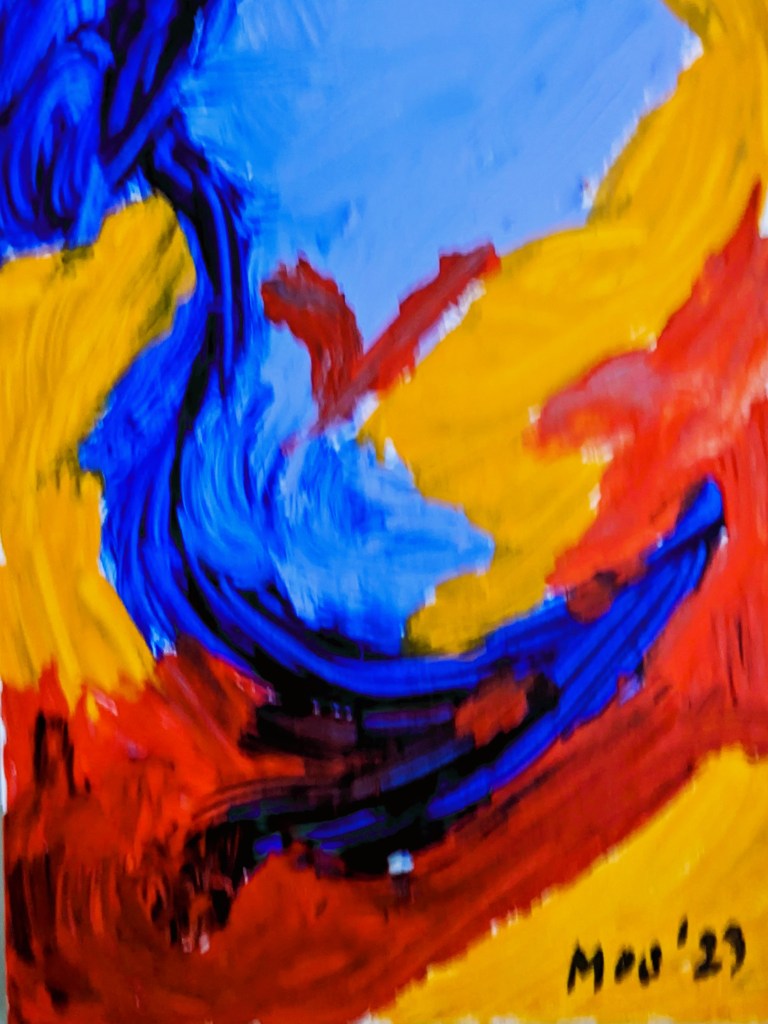
And yet, and yet, there is one. A long, long time ago, my father let me into a big secret: all the shops in our little sea-side town had signs that announced – Jones and Son, or Roberts and Son, or Edwards and Son. “Well, son,” he said, “I have a son, and it’s you. It is time I showed you my little secret.” He took out his pen, unscrewed the cap, and carefully drew an M. Then he drew a W beneath it, taking care that the ends joined neatly. Finally he drew the letter J. It bisected the letters so that the drawing in my painting above was produced: blue-black ink on white paper. “What is it dad?” I asked. “It’s my brand,” he proudly said. “Those are my initials. “I would love to establish something, use this as a brand name, and have ‘and Son‘ written beneath it.”

I didn’t understand. I can’t remember how old I was, but it was in the days when Shorty the Deputy [I pronounced it De-Putty, much to the amusement of my elders] Sherriff ruled the range in my colored comic books. “A brand? Why do you want a brand? Are you going to own a ranch and brand your cattle?” That ended the conversation. The brand was never mentioned again, until, now, but I have never forgotten it.

So, there is one brand with which I associate myself, my father’s brand. I entitled the painting remeMBEr in honour of my father, of his failed dreams, and of the dreams he achieved, including the initials MBE [Member of the British Empire]. The medal itself, together with the letter from King George VI is included among my family treasures. So, there we go – that’s the brand I associate with, my father’s brand.

Share a lesson you wish you had learned earlier in life.

Daily writing prompt
Share a lesson you wish you had learned earlier in life.

Share a lesson you wish you had learned earlier in life.

I wish I had learned earlier how hard it is to grow old and how difficult it is to prepare for it. My first serious rugby injury, age 16, torn cartilage in left knee. Doctor’s advice: give the game up now. Later, you’ll regret it if you don’t. My response: I’m tough. 60+ years later, my left knee still creaks and I rub ointment in every morning. My second serious rugby injury, age 20, damaged lower back. Doctor’s advice: give the game up now. You’ll regret it later if you don’t. My response: I’m tough. 60 years later, my back really hurts. I rub ointment in every morning, take pain killers, and stretch. Same with hips, from kicking! One of my rugby friends, about the same age as me, has two knee replacements, one shoulder replacement, and one hip replacement. If he’s not the $6,000,000 man, he must be pretty close.

But there is a story beyond that story. I was sent to a series of boarding schools and no, I didn’t go there willingly. In the summers, I travelled abroad to learn foreign languages that were foreign to others but became familiar to me. I never saw my grandparents as they aged. Often, when they died, I was in school, or away on the continent. I never understood the ageing process. I never witnessed the natural decay of those whom I loved. I never learned that lesson. When I left university, I emigrated, and the same sequence happened with my parents. I was never there when it mattered. I was always somewhere else. And when I was there, I heard the usual litanies: “This never happens when you are not here. It’s your fault.” Or else, “this wouldn’t have happened if you had been here.” Told to me by a close relation at my mother’s funeral. I flew back home, though it was never really my home, to be present for that.

But what is the lesson that I wish I had learned earlier? Alas, there is not just one lesson, but a series of lessons. How to deal with the ageing process. How to face sickness and ill health in age. How to face diminishment with grace and humor. How to accept the natural process that occurs whether we want it to or not. How to face the gradual decline in someone, close to you, your life companion whom you really love. How to face the fear of passing (FOGO to some) and how to pass that lesson on to our own young ones. How to face my own end and how to die with as much dignity as possible.

What’s your all-time favorite album?

Daily writing prompt
What’s your all-time favorite album?

What’s your all-time favorite album?

My stamp album, of course. I am old enough to remember the joy of receiving letters from friends and pen-pals in far-away places with strange sounding names and oh, the joy of those colored squares of paper stuck in the top, right hand corner of the envelopes.

Then there were stamp dates, and stamp parties, where we gathered and swapped stamps, each trying to improve his or her collection. Not that I remember many young ladies saving stamps in those days, it seemed to be a boys only sport, like Conkers. I guess that was because those games were all dependent on one-up-man-ship. And yes, we have boycotts (some of them even open the batting for England), but I have never heard of girlcotts or one-up-woman-ship. I guess there are flaws in the language, all languages. Ceilings as well, probably – the height of linguistic folly.

Then there were stamp competitions when we could take our collections, more or less specialist, and show them off to our friends, admirers, and bitter rivals, hoping to gain fame and fortune. I for one never did. But I learned so much about the world, the rapidly changing world, as maps changed, borders changed, kings and queens changed, countries changed their names, divided their borders and morphed into something else.

Don’t forget those FDCs – First Day Covers – with their postal histories, not to mention the little booklets with the tear-out pages telling us all about Peter Rabbit, Flopsy Bunny, Mrs. Tiggy Winkle. and a dozen other tales. And then there were the special stamps – the penny blacks with their multiple Maltese Crosses, the Queen Victoria 9d green (mint), the Sea Horses, the French Painting Series, the Spanish Civil War stamps, issued on, and by, both sides of the conflict, and you mustn’t forget my own face as it appears on a Mexican do-it-yourself stamp, photo taken in Oaxaca, and the stamp sent back to Fredericton, NB, Canada, just for the fun of it.

My own stamp collection now sits in a cupboard, all covered in dust. I guess it is worthless. Nobody sends or receives letters anymore. Nobody collects stamps. Used stamps are now so much rarer. And those pristine new issues, so bright and cheerful, have never felt the lick of a lover’s tongue. And those envelopes have never borne the imprint of our secret messages – SWALK – PHTR – ICWTSY – and so many other little joys of a life that is long past, but never forgotten.

Share a story about the furthest you’ve ever traveled from home.

Daily writing prompt
Share a story about the furthest you’ve ever traveled from home.

Share a story about the furthest you’ve ever traveled from home.

Once upon a time, I lay in the sea, at midnight, in Brandy Cove, and I watched the moonlight lap over the waves as I lay there. I began to relax and felt the moon rise. Then I rose up with it, just like Cyrano de Bergerac, and I rose, rose, rose, up into the sky until I was level with the moon.

Was this the furthest I have traveled from home? No.

Once upon a time I climbed with Don Quixote and Sancho Panza upon the back of Clavileño and I rose up, up, up into the skies until I danced among the seven sisters, the Pleiades, and counted them, one by one. Sancho told me they were little goats, all colored differently. “And look,” he said. “That’s the earth, down there, as small as an orange pip.”

Was this the furthest I have traveled from home? No.

A long time ago, I visited Stonehenge and marveled at the temple my ancestors had created there to tell the time and worship the sun. Seven thousand years ago, they told me. I closed my eyes and dreamed I was back there with them, digging the post holes and raising the stones.

Was this the furthest I have traveled from home? No.

I also visited Hengistbury Head in Dorset. There I discovered the scrapes the Reindeer People had scratched in the chalky soil nearly ten thousand years ago. Older than Stonehenge, I lay down in the rocky soil high above what is now the English Channel. My mind went back in time. The waters slowly receded and I saw green grass where herds of reindeer crossed the meadows that still attached Albion to the mainland of Europe.

Was this the furthest I have traveled from home? No.

Once upon a time, I truly traveled and visited Avila. I wandered among the ancient ruins of the pre-Christian monuments. There I stroked the granite of the Toros of Guisando, and watched the ever-lasting storks as they nested in the towers of all the churches. I also walked the Roman Road at the Puerto del Pico. When I ran my hands over the bodies of the verracos, I marveled upon how far away from home I found myself, and how small the world really was.

Was this the furthest I have traveled from home? No.

Once upon another time, I really traveled, this time by plane. I flew to Oaxaca, Mexico, and went back a thousand years or more in time. I read the Pre-Columbian Mixtec Codices, climbed the temples, visited the tombs, consulted a witch doctor, drank mescal, ate chapulines, and entered a world beyond my world.

Was this the furthest I have traveled from home? I no longer know. But I do know that el mundo es un pañuelo – the world is a handkerchief, as the Spanish say. Yes indeed. It is a small, small world. Alas, too many people are blowing their noses into it right now and I see and grieve for this, even when I am at home.

Low Ebb

Low Ebb

We have been apart too long, my love,
night’s dark corridor lying between us
and neither of us approaching the other
when doors close and blinds are drawn.

The way to the heart of the matter is not
an easy path to walk, not any more.
Our secret ways and dreams lie cold
upon chill, empty sheets and pillows.

Each day the tide revives the beach,
flowing out, abandoning its wet debris
for the sun to perform its magic: fresh
seaweed drying above warm sand.

Sea-birds bury their beaks, writing claw
letters as crabs burrow, dig deep, waiting
for the tide to return and re-create
its alternate reality of dreamy waters.

Half of my bed performs its nightly duty.
The other half lies cold, empty, lonely.
No sea-life wanders there, not even in
my most creative dreams of sun and sand.

Comment: The loneliness of old age is compounded by many factors, including ill-health, sleeplessness, and the need to sleep in separate rooms. How many homeless people suffer that loneliness, and more, and at ages much less than ours? And then there’s the distress of trying to live in poverty, to survive from day to day, with safety net that will not protect us, if we chance to fall. A sad world then, as Polly Toynbee points out in today’s Guardian.


What do you enjoy most about writing?

Daily writing prompt
What do you enjoy most about writing?

What do you enjoy most about writing?

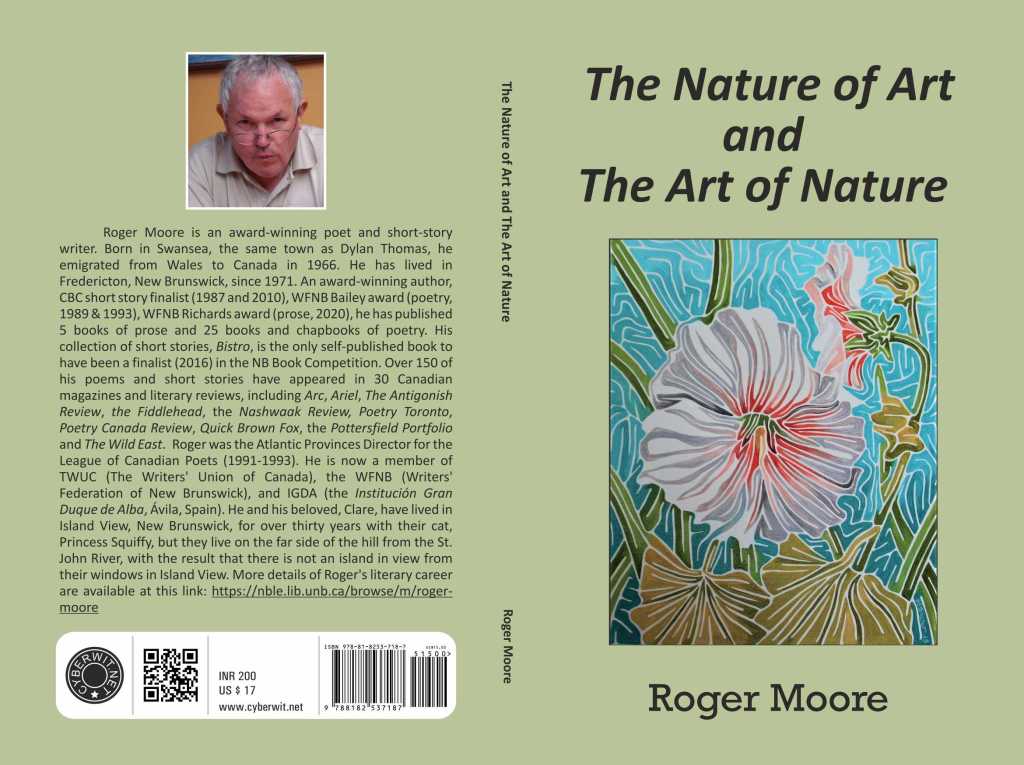
I love it when a special friend reads one of my books and then takes it to the place where it was composed, and sends me a wonderful photograph of the book cover and the exact spot, at Hopewell Cape, where the cover was drawn. Wow! That is so special. Thank you, Sara, my friend and accomplice, for making even more art out of art and involving nature in the process.

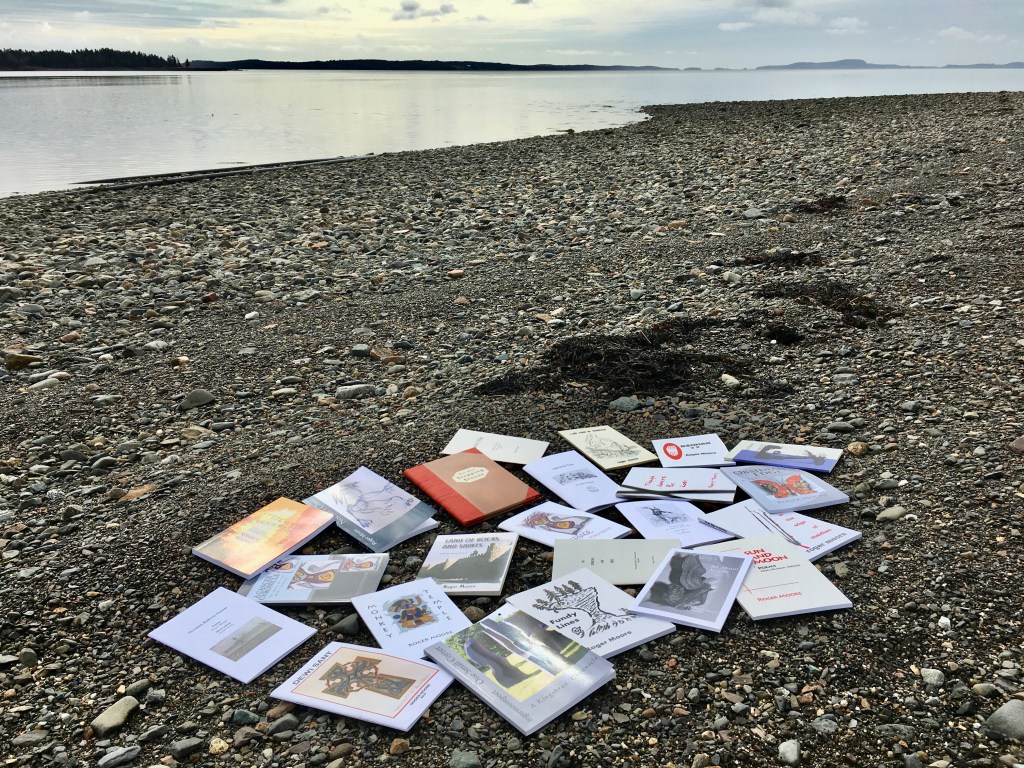
Other friends have done similar things. Here is a collection of my books on the sea shore at Holt’s Point. And yes, Fundy Lines is in there as well. Can you spot it? Another very good friend, Geoff, contributed this very meaningful photo. So much of my life, there, upon the sea shore, waiting for the tide to come in.

This book, and its cover, are also very special indeed. And here’s why.

Still Life with Hollyhock
Geoff Slater

How do you frame this beaver pond,
those paths, those woods? How do you
know what to leave, what to choose?
Where does light begin and darkness end?

Up and down: two dimensions. Easy.
But where does depth come from?
Or the tactility, the energy, water’s
flow, that rush of breathless movement
that transcends the painting’s stillness?

So many questions, so few answers.
The hollyhock that blooms in my kitchen
is not a real hollyhock. Intertextuality,
visible and verbal: this is a poem about
a painting of a digital photograph of a
hollyhock, a genuine flower that once
upon a time flourished in my garden.

A still life, naturaleza muerta in Spanish,
a nature morte in French, a dead nature,
then, portrayed in paint and hung alive,
on display, in this coffin’s wooden frame.

So, what do I enjoy most about writing? Everything – for whenever creative people create they draw in others into a web of intertextuality that spins its way from mind to mind and, especially in Canada, links shore to shore to shore.

Revisions

Revisions

Very little in the creative life turns our perfect first time through. That’s why we revise – revision is necessary. Here is my revision of Heartbreaking. Click here for the original version. Can you spot the difference between the two?

Heartbreaking

How many have broken their hearts,
reading what I have written, as I have
broken mine, reading what others wrote?

My words reach out, naked, stripped
of false trappings, fake images,
my flesh and blood damp on the page.

Who knows where my words will land,
on fertile ground, on desert sand, or will
they lie on dry, stony paths, infertile?

So many people now scorn living words,
preferring those dull, dry, three-word chants,
that hypnotize as fists are raised and clenched.

Beauty, love, life coffined in a tiny box,
outside of which, they can no longer think.

This is my revision of Rebirth – click here for the original version.

Rebirth

“El mundo nace
cuando dos se besan.”
Octavio Paz

A new world is born
when two people kiss.
The hummingbird sips
at the hollyhock’s lips.
Bee enters the blossom
and, sated, comes out.
A butterfly perches,
flutters its wings.

The sun enters a cloud:
radiance is born.
Silver linings
morph to gold.
The sun’s needle stitches
the world together.

Oh to be a part of Eden,
Paradise born anew,
in the moment when
lip meets lip and the tongue
is a twister, touching down.

Two hearts in a whirl,
their world aflame,
new shapes are born.
Wild flowers swaying
in an age-old dance.
Life’s journey renewed,
not always by chance.

Fascinating things revisions, as you can see from my revisions to the painting which opens this post. Now you can spot the differences

Write about a random act of kindness you’ve done for someone.

Daily writing prompt
Write about a random act of kindness you’ve done for someone.

Write about a random act of kindness you’ve done for someone.

Sir Alex Ferguson, one of soccer’s greatest managers, once said that it wasn’t the victories he remembered, but the defeats. So it is with my own coaching career – it’s the losses I recall. Same thing with random acts of kindness. There have been many, too many to count. I will not paper my e-walls with glowing memories of past kindnesses. But what about those random acts of kindness I failed to do? Here’s one of them.

            Crave More: I hate those words. I always choose a cart with the shop’s name on the handle. I can handle that. I can’t handle a shopping cart that screams Crave More at me every time I stoop down and place another item in the wire grid. If stores were honest, they would inscribe their shopping carts with a sign that said Think More, Crave Less, and Save Your Money. I bet that would quickly cut into profits.

            Anyway, there I was, in La-La-Land, leaning on my cart, still half asleep, when this ghost drifted towards me. “Help me,” it said. “I’m hungry. I need food.” I woke up from my dream, looked at the ghost, tall, skeletal thin, cavernous eyes and cheekbones protruding, gaps in the teeth, grey face drawn and lined. The single word “Sorry” came automatically to my lips. Then I felt shame. I looked at him again. “I only carry plastic.” The excuse limped heavily across the air between us. I saw something in his eyes, I knew not what, and I turned away.

            Then, as I walked away, I added 100 lb of muscle to the scarecrow frame. Took forty years away. Filled his body with joy and pride, and remembered how he played when I used to coach him, hard and fast, but true. I ran my hand through the card index of former players that I had coached. I knew their moves, and attributes, the way they played the game, their stronger / weaker side, their playing strengths, their weaknesses. I remembered him holding up the Champion’s Cup. But I couldn’t remember his name.

            I pushed the cart all over the store in a frantic search for him. I went to the ATM and took out cash. I could hand it to him. I could tell him he had dropped it. I went through a thousand scenes. I could invite him to the snack bar. I could tell him to buy what he needed and follow me to the check out lane where I would add his purchases to my cart. I looked everywhere. He was nowhere to be seen.

            A single opportunity. One chance. That’s all we get. Miss it, and we blow the game. Take it, and we win the Championship and hold up the Cup.

How would you describe yourself to someone who can’t see you?

Daily writing prompt
How would you describe yourself to someone who can’t see you?

How would you describe yourself to someone who can’t see you?

Well, that would depend on why they couldn’t see me. “Those who have eyes, but cannot see.” Many have stood beside or before me, looked into my eyes, as I looked into theirs, and never saw me. “The most difficult role in the play is that of the fool,” said Don Quixote, “for he who would play the fool must never be one. So many people saw me deliberately playing the role of the fool and forgot the above quote. They also forgot what Antonio Machado wrote: “The eye you see is not an eye because you see it, it is an eye because it sees you.” And there you have it: why would I bother describing myself to people of that ilk, so stupid and blind with their own limited wisdom, that they couldn’t see me anyway.

Keenan’s Well, by Seamus Heaney, is a wonderful poem. It tells us about Rosie Keenan, his blind from birth neighbor, who played the piano and sang all day. She let them touch her books, like books of wallpaper, and feel the letters of braille by means of which she was able to read. They allowed her to touch their faces with her oh-so-sensitive fingers, and she said she saw them, as well as knowing them by their voices. When he read her a poem about Keenan’s well, she told him that she, blind from birth, ‘could see the sun shining at the bottom of it now.”

How would you describe yourself to someone who can’t see you? I wouldn’t waste my time and energy trying to do so.