I Can’t Complain!

I can’t complain!

Why not? Everybody else does.

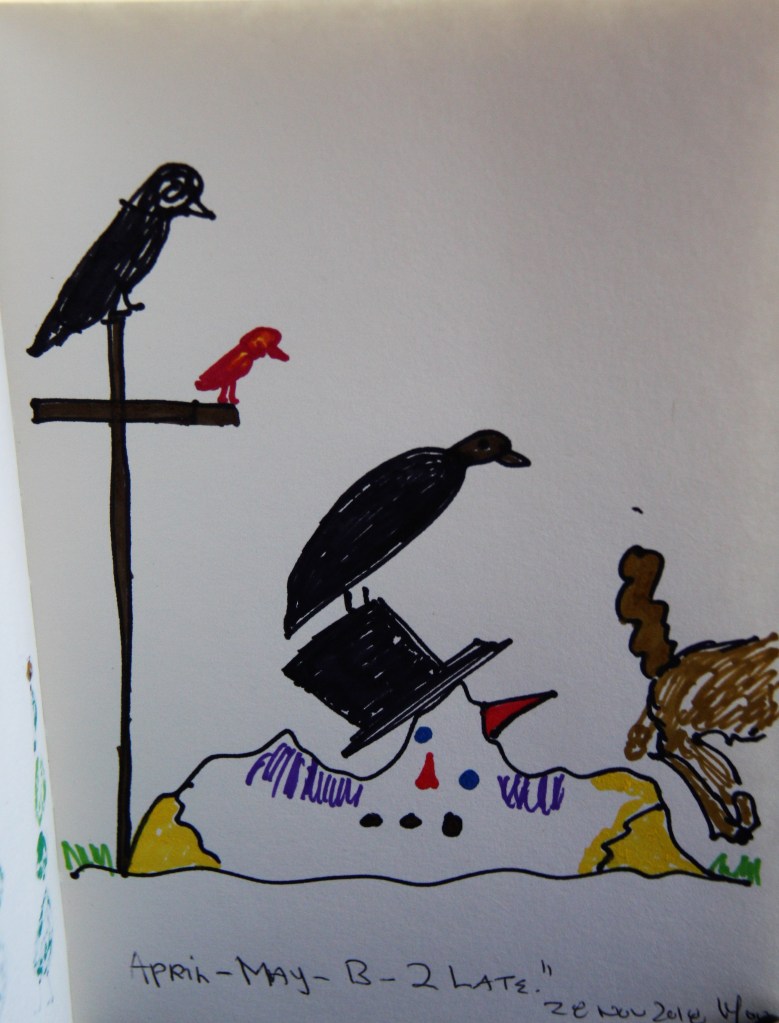
Sun Absence Depression – People complain about the absence of the sun – and so do I. Five sun appearances between early December and the end of January. A sun glimpse, so to speak, pale coin between clouds, a sudden shadow that appears on the wall and vanishes before you can catch it. Do these count? Sun glimpses, mind you, and even less sunny days.

Snow, Sleet, Ice Pellets, Freezing Rain – Take your choice. The snow itself isn’t too bad. The snow blower takes care of that. But not when it rains on top of the snow, then freezes. Not when ice pellets weight it down and make it the consistency of wet sand on a wintry beach. My neighbor broke his snow blower trying to shift the mess. I was willing to risk the snow blower, but not my health. I couldn’t even get the blower out of the garage and into the mess that masqueraded as snow. I sat on the back bumper of the car, huffed and puffed, and decided not to risk it. And as for the freezing rain – my beloved had to put crampons on her shoes to be able to walk the ice and take the garbage to the end of the drive. As for blowing the ice that had fallen on the snow – the snow blower grunted, and groaned and complained as it slipped and slid all around – and so did I.

Rejection – Dejection – “Paper your walls with rejections.” Well, I won’t do that as we have just had the walls repainted. That said, when I checked my progress files this morning, out of 95 submissions, 93 had been rejected. Does the 2% make up for the 98%? Well, 5 more rejections and I’ll let you know.

Inflation – Gas. Luxury foods. Alcohol. You name, it and I will complain about it. And if I don’t, every day I go out shopping I see and hear someone complaining about the rising cost of just about everything out there. Being on a more or less fixed pension doesn’t help much either. Luckily, we don’t have to make choices yet, like some pensioners, and working people, are doing in the Untied Kingdom [sick]. Eat or heat? Food or medicine? Dog food or cat food? They have been staples for pensioners in the UK for a long, long time. Cheap and nourishing, though prices are rising, and taste disguised in a nice curry sauce. I kid you not.

Top Ten – well, I guess I could go on and on. But I won’t. Four reasons to cry are enough. Today, the sun is shining (positive). The overnight temperature was -25C / -13F, but it’s rising in the sunshine -15C / +5F as I type (positive), and I don’t have to go out in the cold (very positive), and I don’t have to snow blow today (very, very positive). So, may we all walk on the sunny side of life, find a silver lining to each and every cloud, and carry on regardless. It’s better than the alternative.

On Life and Living

On Life and Living

“To live is the rarest thing in the world. Most people exist, that is all.”
Oscar Wilde

To live, to really live, what does it mean? I guess that depends on each one of us, our backgrounds, our education, our culture. W. H. Davies wrote one of my favourite poems “What is this life, if full of care, we have no time to stand and stare.” To know how to live is also to know how to stand and stare, how to make time for oneself, how to take joy in the simple things.

But what if the simple things are no longer accessible or ‘within easy reach’ as my poet friend, Jane Tims, would phrase it? When the cost of living rises, when we cannot afford to heat our homes, when we have to choose between eating or heating, or between food and medicine, can we truly be said to be living? Then, like it or not, existence, in the words of Sartre, precedes essence, and the very act of existing, surviving, maintaining body and soul together, takes over from any thoughts that may strike us, any time we may have to stand and stare.

Do the little things in life, said St. David of Wales, Dewi Sant. But what happens when so many of these little things are taken away from us? Some of us are lucky, privileged, blessed – and we are able to heat the house, run the car, meet a sudden unexpected bill. We do not have to choose between heat or eat, between food or medicine. Others are not so fortunate. They may have lost their homes. They may not have a car, or they may be living in it. Their transport may be a metal trolley, ‘borrowed from a shopping mall before it was lost’. Their only unexpected bill may be the Old Bill, coming to arrest them for loitering, with or without intent. For these people, on a daily basis, an hourly, basis, life’s hard choices are upon them. They are faced every day with a very different choice in answer to Hamlet’s question – ‘to be or not to be?’.

I see them, the people making those choices, sitting on the sidewalk outside the super-market, plastic coffee cups before them. Heads down, eyes closed, scarcely able to look me in the eye. I see them at the traffic lights, holding up their cardboard signs. I look at them as they sit there or stand there or walk up and down, sitting, standing, staring at the traffic.

They also give a new meaning to the last couplet of W. H. Davies’ poem – “A sad life this, if full of care, we have no time to stand and stare.” They have the time to sit, and stand, and pace, and stare – indeed they do – but do they live, or do they just exist? And for how long? These are the real questions.

Warm in the Kitchen

Warm in the Kitchen

This early morning, the only warm place in the house is the kitchen, close to the fire, with all the doors closed. The black-out curtains from the Second World War are still in place and hang languidly over ill-fitting windows that let cold air into the house. They must be pulled back in preparation for that first glimpse of day-light. Your elders move in and out, letting in the cold air as they open and close the doors at either end of the warm space where the fire is just taking hold.

Your grandfather banked it overnight with black sea-coal and then he raked the fine, grey ash, with its still smouldering lumps of charcoal, into a warm mound, ready for paper, kindling, coal, and the match. He has also placed a newspaper over the fireplace to create a draft. If the fire doesn’t catch soon, he will throw some sugar onto the embers to aid the blaze. The fire will suddenly flare into life and the room will be quickly warmed. In the meantime, the kitchen, though warmer than anywhere else in the house, is still slightly chilly because the damp night cold has invaded and made everything wet and slick.

It’s great when you’re at your grandparents’ house, but when we are back in ours, my father and mother always leave early, to go to work.

When I was younger, they had to feed me, but I soon learned to make my own breakfast from whatever I found in the fridge. Now I can use a frying pan. I fry bacon first, and then, when I have plenty of bacon fat, I fry bread, eggs, sausage, black pudding, kidneys, tomatoes, mushrooms, and anything else I can find, including laver bread.*

Before I know it, I have become a latch-key kid and, when I am hungry at home, I fry myself an all-day breakfast: eggy-bread or fried egg-with-its-hat on doused in HP sauce for lunch, all washed down with tea to which I add condensed milk and sugar.

But this morning, they have made breakfast for me: porridge. “Porridge, porridge, skinny and brown, / waiting for breakfast when I come down.” And I hate porridge, especially burnt porridge, with a passion, and yes, they’ve burned the porridge again. I hold a cup of hot tea in my hands. I breathe in the steam and it loosens up my chest. The china cup warms my fingers. I prod at the porridge, feed some to the canine mouth that dwells unseen beneath the table, and stuff myself full of toast. Whatever I eat, when the food is inside me, I feel much, much warmer and now I am ready for the rest of the day.

*Laverbread Bara lawr in Welsh: edible Gower sea-weed, a delicacy often called Welsh Caviar.

A Winter Awakening

A Winter Awakening            

You hate the Christmas holidays. You always have and I expect you always will. Broken promises litter the ground like so many new year’s resolutions, made and then set aside in a jumble of wrapping paper, party hats, and empty, smelly beer bottles. So vicious, these early morning calls, your father pinching your ear or tugging your hair, then stripping back the clothes and leaving you lying there, the cold air invading your bed, shocking your toes, tweaking the small hairs on arms and legs.

You reach out to the bedside chair, grab your shirt, socks, and pants and stuff them between your legs where it’s still nice and warm.  Then you pull the bedclothes up to your chin and your day clothes lie between your thighs, a teddy bear bundle gradually warming you up again. You wriggle down into the bed, and try to go back to sleep, but it doesn’t work.  A great shout from downstairs: “Breakfast is ready!”

Now comes the tricky bit: staying under the covers, wriggling out of your pyjamas, putting on your shirt, your pants and your socks while still staying warm beneath the blankets. Then, a porpoise breaking the surface, you burst out of bed, pull on your trousers and a sweater, and you run downstairs to the kitchen the warmest room in the house, where breakfast is waiting.

Boxing Day

They’re not Boxing Gloves – but they could be. Photo by my friend Geoff Slater.

Boxing Day


            By the time I get up, the gloves are really off and the sparring has begun in earnest. I hear angry, raised voices, walk downstairs to the kitchen, and a hush falls on the room. Knife-edge glances slice their menacing ways through the thickening atmosphere.
            Time for boxing: on my left, in the blue corner, my mother, smoking what is probably her second packet of the day. A thin haze of grey smoke escapes from her bruised lips and a cloud of exhaled fumes crowns her head with a murky halo. On my right, in the red corner, my father. White-faced, hungover yet again, truly into the spirits of Christmas. He breathes heavily, like a Boxer Dog in the mid-summer dog-days, snoring and snorting at a bitch in heat. In the middle, my grandfather, the referee. He is keeping the combatants apart, creating a tiny breathing space so the true Spirit of Christmas can disentangle itself from those false Christmas Spirits and bring peace to earth again for at least sixty seconds between each round.
            I look around the heaving, seething, threshing silence of a room where conversation has suddenly ceased. The fire is burning merrily. Beside it, tongs, poker, and small shovel stand to attention. On the hearthstone, the little red brush, with its long handle lies in ambush. This is what my father uses to beat me when he can’t be bothered to take off his leather belt. Scorch marks from the hot coal fire sear the handle and back of the little red brush. I threw it on the fire one day, hoping to see the end of it. Of course, it was rescued from the flames, resurrected, and I got beaten for that act of rebellion too.
            “It’s all your fault!” My father breaks the silence, pointing at me. His red-rimmed eyes blazing with a sudden and renewed anger. He starts to rise, but my grandfather steps between us.
            “Go and see your granny,” grandpa tells me. “She’s in the kitchen. Go now!” He points to the kitchen door.
            I run a gauntlet of staring eyes and go to my gran. As I shut the door behind me, voices rise higher in the room I have just left. Boxing Day, indeed. The gloves are off. The battle has begun again. My grandfather has evacuated me from no-boy’s-land and, for a moment, I am no longer trapped in the mud-filled, cratered, shell-holes between the trenches, the uncut barbed-wire barriers, the poached-egg eyes peering through periscopes and spying on me from the parental and priestly parapets above the wooden duck-boards that line the floor on the far side of the room and keep the enemies’ feet clear of mud and water.

Annie Verse Airy

Annie Verse Airy

Some I remember, some I forget. This one I don’t forget. 56 years ago today, Clare and I got married in Ontario. She had been six days in Canada and the vicar asked us if she were a mail-order bride. We said ‘no’ – for we had known each other for five years at that point and had been officially engaged for 17 months.

Ontario snow-belt snow, they called it. Six feet had already fallen on the banks of Lake Huron, and six more inches fell on our wedding day. How do I know? Well, I guess I must have been there. And ar gwaeth a pawb a pophet, rh’y n’i yma o hyd – and in spite of people and things, we are still here.

I wonder how many are left to remember that day. Clare and I do, obviously. Our daughter does. How many others? I hesitate to count – and it would probably take only one hand. No names, mind. Our wedding was very quiet. A family affair. Clare and I and our Canadian family who emigrated here after WWI, in 1919-20. They offered us their hearts, their home, and their hospitality. They also made all the arrangements and, since we had very little money, covered most of the minimal costs.

Our honeymoon was very brief – two nights in the town’s only hotel, and then back to Toronto on Boxing Day. The reality of the need to survive sunk in very quickly. We have no photos of the ceremony – couldn’t afford a photographer. No honeymoon, other than that brief hotel stay. No palm trees. No Caribbean Island. No white sand beaches. And we were much better off without them for, from the very first day we had to work together to survive and make a success of our lives. Luck and hard work walked hand in hand with us, and here we are, 56 years later, still together, still going strong. We will celebrate very quietly. At the appropriate time, we will light a candle together and raise a glass of wine, as we have done, every year, on Christmas Eve.

Now, as we age, each day is precious. We take few photos. We still haven’t had a honeymoon, let alone a second one. But, as the old song says, “we have travelled the road, sharing our load, side by side”. And we will continue to do so, for as long as we possibly can.

A Month Ago

A Month Ago

A month ago, on November 23, I posted my last message on this blog. Since then, nothing. Silence.

For thirty days and thirty nights the world has been as silent as the painting I posted above. It has been as silent as snow flakes circling. As quiet as the ribbons tied silently together. Nothing stirred. Nothing moved. Nothing.

Can an absence be a presence? Sometimes it is, for example, when we lose a tooth, a family member, or a friend. In their absence, we lament the loss of their presence. With a tooth, we run the tongue around the empty space, noticing the tenderness of the flesh, the hollow within the gum.

It’s the same with friends. They go AWOL. Move on. Forget their promises of eternal friendship. They become the empty space where the tooth once stood. At first we grieve. Then we become used to their absence. Then, one day, we realize that their voices have fallen silent and then they are friends no more.

Right now, there is a hollow in my life. An absence. I cannot put my finger on what is missing, absent, as always, without leave. Maybe it is the Christmas beliefs that dogged my childhood. Maybe it is the emptiness that warns of oncoming storms, each one greater than the one before. Maybe it is just the premonition, the suspicion, that all is not well with the world.

This year we gave more money than ever before to the Feed a Family Fund. Then we sent extra money to the local foodbank. Everywhere we see that the social ball of string is unwinding and ends no longer meet. It seems our society no longer has the will or the means to justify any ends, except selfish ones. Is it everyone for themselves, then, and the devil take the hindmost? Sometimes it feels like it.

I have seen the hindmost, human beings they are, just like you and me, except they are wrapped in blankets, begging at traffic lights, sitting outside the supermarket, a coffee cup at their feet, hoping for a penny to drop. Where have all the pennies gone? Gone to the smelters everyone. So they wait for a nickel to drop, or a dime, or even a quarter.

Covid-19 and all its subsequent derivations may well have been at the heart of all this. The isolation. The masking. The distancing. The fear of the unknown. The fear of the stranger in our midst. We have become used to living with those fears. We still have Covid-19 and its variations, some with long term complications. We now have a virulent flu as well. And there are various viral infections circulating.

The Apocalypse? Not yet. The Apocalypse has four horsemen and I have only mentioned three. So – where is the fourth one hiding? When will he appear? What will he look like? Maybe he’s lurking in a food bank, an unrepentant Grinch preparing to steal the food? Perhaps he hides in an unheated house? Can he be spotted at the dinner table, where the parent or parents are not eating, so that a child may eat?

I throw these questions out. Outside my window, clouds gather and snow starts to fall. I listen carefully. But all I can hear is the silence to which I have grown accustomed.

Silence

Silence

Words emerge from the silence
of wood and stone. They break
that silence when they are born.

Silence, once broken, cannot
be repaired. A word once spoken
cannot be recalled.

The greatest gift is to know
how to be alone amidst the crowd,
how to sink into silence.

A world of words smothered
at birth and that world, unborn,
dismissed, forgotten, still-born.

A lost world of words whirled
on the silent wind that fans
the unborn fire within you.

The spider web of the mind
blown clear by the wind
that blows unspoken words.

The sultry silence of wood and stone,
the hush of the tadpole swimming
into its own metamorphosis.

Click for Roger’s reading on Anchor.
Silence

Wilderness

Wilderness

This wilderness wasn’t a wilderness
until they arrived and called it ‘wild’.

They constructed roads, ran boats
up and down our rivers,
built bridges, fenced fields,
built stone buildings, desecrated
the curves of the land
with square shapes and right angles,
razor sharp lines that ‘tamed it,’
they said, but we said ‘destroyed it’.

Where now the spring salmon runs?
The dam that put the river in chains
drove all those fish away.

Upstream, down stream,
towards the river and away from it,
the four cardinal points
brought ruin to our sense of direction.

Where now the land’s lost soul,
the ancient paths our people walked?

In place of the circles we built from stone,
the stones that pointed the time of sky,
that tracked the seasons,
and planting time and harvest time,
they gave us clockwork clocks.

Yes, they tamed this wilderness,
but they broke it down and we watched,
helpless, as they stole its soul.

Click here for Roger’s reading on Anchor.
Wilderness

Loss

Loss

By the time I remembered your name
I had forgotten your face,
and then I couldn’t recall
why I wanted to talk to you
in the first place.

Words and phrases bounce,
water off a duck’s back.
They sparkle like a high tide
rejected by the retriever
as he shakes his coat dry
on emerging from the sea.

This book I read is a word parcel,
a clepsydra of droplets,
a rainbow strung with colored beads,
each scouring a bull’s eye
on the world’s taut literary hide.

Mapa mundi of forgotten lands,
I trace dark landmarks
on the back of scarred hands
and wonder why I have never visited
faraway places with strange-sounding names.

Tourist guide to a failing memory,
I track the trails of drifting ships
as their white sails vanish,
blank butterflies from a distant summer,
floating over a darkening horizon.

Click here for Roger’s reading on Anchor.
Loss