Carved In Stone

Carved in Stone

Brief Introduction

“Poetry explains itself. If it doesn’t, it’s inexplicable.” Pedro Salinas.

I entered this collection of poems for the Alfred G. Bailey Awad (poetry manuscript), WFNB, 2025. Alas, it did not win an award, but the judge, Kathy Mac, made some excellent suggestions as to how I might improve the manuscript. I have followed her advice to the best of my ability.

Carved in Stone is the second dialog (Chronotopos II) in my Bakhtinian Dialogs with my time and my place. Clepsydra, Chronotopos I, won third place in the Bailey Award (2025) and has already been published. I have one, possibly two, more Dialogs planned.

Reception Theory – I write, you read. Any meaning that you extract from my poetry will depend on your own culture and background. Tolle, Lege – Take and read. Read slowly, and with care.

I am a poet, a dreamer, if you will. These are my dreams. When you enter my world, you mingle your dreams with mine. The result, I hope, will be an interesting intellectual blend of new creativity. Pax amorque.

1

Behold me here,
filled with a sort of shallow,
hollowed-out wisdom
accumulated over decades
while listening with my eyes
to the words and thoughts
of writers, long-dead.

Imprisoned in book pages,
do they bang their heads
against walls that bind,
or hammer with their fists
at the barred lines
of their printed cages?

These spirits long to break free,
but they choke on library dust
and pollen from verbal flowers
that bloom unseen.

Those old ones avoided
the traps of temporal power,
or, once trapped,
gnawed off a precious limb
to limp into freedom.

Comment:
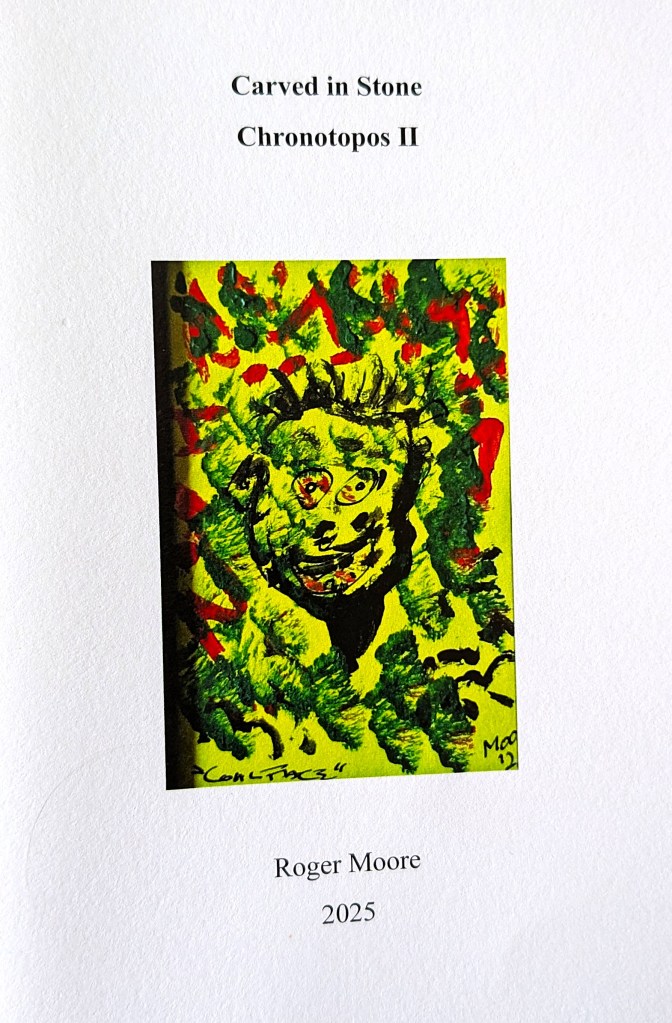
The cover painting, painted for me by my friend Moo when he read the manuscript of this book, is called Coal Face. It refers to the young Welsh boys in the Rhondda coal fields, aged 8-12 years old, who went down the mines to work at the coal face. This happened when the coal seams grew thin and only small children had the ability to work at the coal face and carve and mine the coal. Here are the relevant verses (44 – 45).

44

The old man, withered,
last house on the left,
leaning on his garden wall,
coughing, spitting up
coal dust and blood.

He’s not old, when you get close,
just grown old, underground,
where emphysema
and pneumoconiosis
devour men and boys.

He spits on the side walk.
Mining souvenirs,
Max Boyce calls them,
and they appear
every time the young man,
turned suddenly old,
starts to cough.

He can’t walk far,
wearing carpet slippers,
soft and furry,
just leans on the wall.

He fell, or was pushed,
into the trap at an early age,
when the coal seams
had grown so thin,
that only a small boy
could kneel at the coal face
before the black altar
of the underground god.

There, with a pick and shovel
he learned to carve and shape
those seams.

45

No candles burned at that altar.
A single match, let alone
a candle flame,
would spell the end,
if gas leaked from the seam.

Only the canaries,
confined in their cages,
sang songs.

Doomed,
like the blind pit ponies,
never to see the light of day,
they lived out their lives
down there.

So many died underground,
unable to get out,
buried alive,
before they were even dead.

What is your favorite form of physical exercise?

Daily writing prompt
What is your favorite form of physical exercise?

What is your favorite form of physical exercise?

As the arthritis gets worse and the pain grips more and more, I am not sure that I have any favorite form of physical exercise. Perhaps getting in and out of the whirlpool bath? Getting out after a half hour or so soaking, is easy enough. But getting in, after a couple of days without one – well, that can be a bit of a pain.

Then there’s getting up in the morning. That is exercise in itself. Hauling myself out of bed. Limping to the bathroom. Doing some s-t-r-e-t-c-h-i-n-g when I remember too. Painful to do, but I usually feel usually a bit better afterwards. Don’t forget the obstacle race of making it, half-asleep, to the bathroom during the night. Then there’s getting dressed in the morning and that’s always an interesting exercise. Sometimes I need help with socks, or shirt, especially after a bath. Shoes are always a wrestling match, as are shorts and jeans. What used to take me about 90 seconds, now takes closer to ten or fifteen minutes. Hardly aerobic!

And speaking of aerobics, physical exercise can also refer to anaerobic and an / aerobic with lactic acid build up. Lactic acid and the ensuing cramps have never been anyone’s favorite form of physical exercise, unless they are masochists instructed by a sadistic coach, as sometimes happens.

The stairs are always a great physical exercise. Easiest is walking safely downstairs in the morning. But there is always the fear of a fall, especially with the turn round the Newell post at the bottom. And then there’s climbing up again safely at night. That takes longer and longer, one painful foot lift at a time.

Cooking has become a physical exercise too. Peeling the vegetables and cutting them up can be quite vigorous. Standing at the stove cooking, gently stirring the food, that is good exercise, as is setting the table and serving the food.

But perhaps my favorite exercise is what the Abulenses call El paseo de la nevera. This is to get up, to walk to the fridge, and to grab another can of beer or open a new bottle of wine. Maybe that is my favorite form of physical exercise, that and the repeated elbow lift and flex that is necessary to drain the can or the bottle or the glass. And don’t forget, there’s always the pinch of salt and the over-the-shoulder salt throw, always necessary with this style of blogging, where everything you read should be taken with a large pinch of salt.

We’ll Rant and We’ll Rage …

We’ll Rant and We’ll Rage …

Spring is here. An election is near. Road repair season has started.

1. Spring potholes – they are terrible and they are everywhere.

It was so bad in one area of town that people filled them with water and put out little plastic yellow ducks to float on them.

That way they could be seen, which saved the loud clunk of them being heard and felt.

In one place, some street artist used the potholes as the centerpiece for porno pictures.

Success –  early next morning, the potholes had been filled in.

2. Spring road repairs – horrific – and all too abundant.

We have a sign at the bottom of road saying “Caution – Construction  – drive carefully for the next 6 kms.”

At the 1 km mark, a lollipop person with a STOP sign. 

Ahead of us, 24 cars – behind us, the traffic line up is building. 

We wait 15 minutes.

A white half ton appears, followed by a line of cars. 

The half ton pulls into a drive ahead of us.

We count the cars as they drive past.

99 of them. Then a pause.

The white half ton reverses out of the drive and pulls up in front of us.

On his tail gate a sign that says “FOLLOW ME”.

He pulls away, and the first car follows him, as do we all.

He drives at 10-15 kph.

After 1.4 kms, we see the road works – the actual working space is less than 200 meters long.

We keep driving. 

At the 3 km mark, the white half ton turns off, into someone’s drive.

Alas, the driver of the first car has no sense of humor and doesn’t follow the leader into the drive but sets off at speed down the road.

I count the cars that are waiting to return – 59 of them and more arriving.

It has taken us close to 25 minutes to negotiate 200 meters of road repair.

3. Bridge closures – there are three bridge crossings from the south side to the north side of the river.

One is at Mactaquac, over the dam, about 15 kms up stream from the Westmoreland Bridge, the central crossing point. 

The Mactaquac crossing has been reduced to ‘one way at a time’ traffic for the last two or three years, and will stay like that for most of the summer. 

Don’t ask, they won’t tell and I can’t tell, because I don’t understand.

The third bridge is the Princess Margaret. 

It is closed to all traffic for the next five weeks and this is the third year that someone has been working on it.

So, for the next five weeks, we are all reduced to crossing the river by one bridge, the Westmoreland, unless we drive 15 kms to a ‘one way at a time’ crossing or 20 kms down river to the Burton Bridge at the Town of Oromocto.

Rage, rage, against the dying of the light!
My thanks to my good friend, Dana Webster who inspired me to write this by sending me a rant of her own. NB Click here to link Dana’s Creative World.

Son Spots

Sun Spots

A painting and a poem dedicated to an only child who, in spite of all his achievements, was never good enough to earn the love of his parents.

Emptiness

The emptiness of air
          leaves the birch standing there,
framed by a space
          that will fill with chatter
and a flock of birds.

When evening comes,
          darkness frames the ash.
It sparkles
          with the gold dust of stars,
that swim through space.

Beneath snow’s empty page,
          grass and flowers root.
They will grow green tongues
          and rage next spring
at the coverlet
          keeping them in place.

A touch of warmth.
          Tiny flowers start to show.

What language do they speak
          as they spread their petals
and let fresh spring words flow?

My head fills with emptiness.
          My mouth is a silent space.

I sit and wait for words
          to break like sea waves
and create, who knows what,
          when they fill that empty place
within my heart and head.

Kipper Kapers

Kipper Kapers

Old Welsh Intelligence Test Question: “Does a kipper swim folded or flat?”

5-4-3-2-1 –
Time’s up, Ladies and Gentlemen.
So – what’s your answer?

Yes? No? Maybe? I don’t know?
It’s a trick question of course / wrth gwrs. And Kippers can play tricks on you too as they flipper and flapper, and flip and flop. Especially if you eat them late at night.

So this is a painting of a midnight Kipper Kaper Attack, when you want to sleep, but can’t, because you don’t know the answer to the kipper IQ test and all those little kippers are capering around and making fun of you and mocking you.

How do you avoid a Kipper Kaper Attack when the bad dreams start and the Kippers Kaper? Well, you answer this next Welsh IQ test question. “Adam and Eve and Pinch Me when down to the river to swim. Adam and Eve got drowned. Who do you think was saved?”

And if you answer “Pinch Me!” Then I will, and when I do, you’ll wake up, and you’ll be safe from another Kipper Kaper attack until the next time you eat them.

There – simple isn’t it?

Old Wounds

Old Wounds


“The slow wound
deepens with the years
and brings no healing.”

The Minister. R. S. Thomas

How deep time’s wounds
have cut and carved,
not just in flesh and bone,
but in the embers
of that slow-burn fire
 they call the heart.

Memory and mind
have also played their part.

Some days, those wounds
don’t ache at all.

But there’s no real healing,
and a moment of madness,
a knife-edged finger nail,
careless, in the dark,
opens them up again
to bleed afresh
and remind us
of the frailty of the flesh.

Comment:
The opening quote, from the Welsh poet, R. S. Thomas, made me aware of so many sad things that have happened in my life. Usually they lie dormant, asleep like an ancient volcano. Occasionally they erupt, and memory’s hot lava breaks through to the surface and spills like blood. Hard as I may try to control those moments, they are, in essence, uncontrollable. The scars itch. I scratch them with sharp finger-nails, and the old wounds open and bleed again.

Magnolia

Magnolia

She stands there, at the garden gate, waiting for me.
I can see the scene, the flower beds, the magnolia
bleeding, in Wales, its soft, spring snow of ivory pearls.

Some fall on her head, crowning her with a beauty
more precious than frankincense or myrrh. Petals
also perch their pure, ermine cape on her shoulders.

She walks towards me, eyes shining, arms open.
Then, the vision fades and she drifts away, leaving me
alone, my face bathed in the tears of her passing.

For pass each other by, we did. Ships in the night,
trains rushing through a tunnel of darkness, bathed,
for an instant, in the constellation of a station’s light.

Now, when I try to go back and to recreate that scene,
I find an empty garden, fallen leaves, and winter’s cold.

Comment:
I have been struck recently by the number of published articles that speak of post-Covid loneliness and the difficulties of re-establishing old friendships that fell by the wayside, let alone establishing new ones. It seems to get harder and harder, as we age, to leave our post-Covid isolation, to get out of our new comfort zones – sometimes so limited and limiting – and to make new friends. As we age, our minds go backwards and we return to earlier days and happier memories. Yet all too often those memories are tinged with the sepia sadness of old photos, from a non-digital age, faded and stained.

Who is the most famous or infamous person you have ever met?

Daily writing prompt
Who is the most famous or infamous person you have ever met?

Who is the most famous or infamous person you have ever met?

First, some definitions. What exactly does ‘met’ mean? I met you yesterday, for example. How long was the meeting? A nod and a passing of ships in the night? A stop and a handshake and a brief conversation? Or a genuine meeting of minds when people know each other reasonably well and can be considered ‘friends’? Infamous – that is relatively simple. Meanings, in my quick check, include – well known for some bad quality or deed, eg an infamous war criminal. Well, I have certainly never met any of those, not that I am aware of anyway. What does famous mean? Here’s one definition – famous implies little more than the fact of being, sometimes briefly, widely and popularly known. How wide is widely? How popular is popularly? Never mind. Let’s give it a go.

Brief encounters – I met several famous people briefly. Gento, from Santander, the Real Madrid soccer player and possibly the best winger of his time. John Charles, the Welsh soccer player, born in Swansea, and a good friend of my father. I met him once, briefly, in a Cardiff Street and my father presented me to him. Federico Bahamontes, the first Spanish cyclist to win the Tour de France. I met him, very briefly indeed, outside his bicycle shop in Toledo.

Longer encounters – these include the Spanish poet, Jose Hierro, who taught me Spanish, over three summers, in Santander at the UIMP. I also met Jose Manuel Blecua at that university and he introduced me to the poetry of Francisco de Quevedo. At the University of Toronto I had the good fortune to take courses from Erich von Richthofen, Geoffrey Stagg, Keith Ellis, J. H. Parker, and Diego Marin, each of them famous in their own way, with excellent academic reputations and publications. At Bristol University, I briefly met Jorge Luis Borges, whom I met again at the U. of T. a couple of years later. Academia and literature formed a happy blend in which to meet people who were famous within their own fields.

The same is true of the sporting life. While enjoying Cross-country running at Bristol University and while running for Bristol Athletic Club, I met Martin Hyman, Basil Heatley, Eddie Strong, John Boulter, and several other athletes of international renown. The same thing with rugby. Names that I can drop include Don Rutherford, Full Back for England and the British Lions, with whom I took a coaching course at Bisham Abbey. Welsh rugby personalities that spring to mind include Ray Williams, Billy Hullin, ‘Buck Rogers’, and several other luminaries of whom Alun Priday, Dai Watkins, and Elwyn Williams spring to mind.

But does any of this matter? I remember going to a poetry reading in Avila, Spain. This is what happened after the reading.

After the Reading

Many names were dropped and lay scattered on the floor.
Some of them broke. Others bounced back to their feet
and walked around stiffly, smiling unhappily.

Sugar and saccharine, unnamable sweetness, honeydew melon,
all lay on the ground, with empty shells, hollow metaphors,
accumulated clichés, vague imagery, the blanched bones of poets
that once wore life’s armour of grammar and blood.

When the cleaner came, she summoned a broom
and it swept away the remains:
dust without love, cigarettes butts and smoke,
nothing and nothingness, emptiness, empty nests, shadows of dreams,
living words, dead, now lying in a common grave.

The meaning of meaning – meeting and knowing, famous and infamous, names pulled from a hat like a rabbit and then dropped to the ground where they prick up their ears and scamper away. Yes, I have (briefly) met several famous people. But I know only a few really well. Sometimes, I wonder if I ever really met them, or knew them, and then I ask myself, did any of them know me, or remember me at all? Maybe that should be the larger question!

What historical event fascinates you the most?

Daily writing prompt
What historical event fascinates you the most?

What historical event fascinates you the most?

First, let us define ‘historical’. Here’s what I found – (1) of or concerning history. (2) concerning past events. (3) The historical background to such studies. (4) Belonging to the past, not the present. (5) Famous historical figures.

Now let us think of the number of times we hear on the TV sports shows that such and such an event is making history “right before our eyes”. Wow! In a boxing match, almost ever punch thrown is “an historical event”. Ditto rugby – with every try scored, every penalty missed, and every tackle made. Ditto soccer, basketball, baseball, athletics. So, from the battery of past events that adorn my life, I am being asked to choose “which historical event fascinates me most”. Double wow.

My answer – the day of my birth, about which I know absolutely nothing. Or, to be more specific, the actual action of being born, about which I know even less. So, how do I study the historical background, when no eye witnesses are left alive to assist me? More important, nobody in my family wanted to talk about such an important – for me at any rate – event.

I do have some factual memories – tales told to me later. I was born at exactly 8:00 pm. I know this because my parents’ dog had been left at a neighbor’s house while my home-birth was taking place. As the clock struck eight, Paddy, the dog, jumped straight through their window, and ran up the road towards the house that was now to be our house, barking. “Ah,” said our wise neighbor, “there goes the dog. That means the baby’s been born.”

That is one version of the tale. My own version is the squawking of the stork who carried me, a sudden screech as he dropped me, a slow descent from a bright blue sky, a tumble down the chimney into the fireplace. And there I was. All covered in soot and ashes. I needed washing, of course. But baby, just look at me now. [See self-portrait above – Face in a Mirror].

My maternal grandfather swore that I had not been born at all, but found under a gooseberry bush. That would account for the green tinges in the painting. Apparently, all babies in South Wales were found under gooseberry bushes at that time. Unless they were delivered by the milkman.

And there’s many a tale about merry milkmen for, as they say in Wales, “It’s a wise man who knows his own father.” And I guess that is also a hysterical historical event about which I know nothing. But perhaps that’s why when the milkman who delivered the morning milk used to say “Good morning, son” when I met him at the the doorstep.

Come to think of it, the mailman also used to call me “Son” when he delivered the mail. Hmmmm – so did the butcher, the baker, and the candle-stick maker. Oh dear, so many historical events to choose from.

Rites of Passage

Rites of Passage

Summer slid silently away. Autumn’s
harvest is upon us. Slowly the mountain ash
is stripped of its fruit, from top to bottom.

Robins flit from branch to branch until
the whole tree shakes with bouncing birds
pouncing on the few remaining berries.

Berries gone now. Leaves will soon follow.
The Farmer’s Almanac forecasts a long, cold
winter, filled with wind, ice, and snow.

All too soon, the deer will appear, ghosting
their silent steps at wood’s edge. They’ll arrive
at dusk and wander all night, just to keep warm.

At dawn, they’ll leave, having exercised their
ancient rites of passage, the routes engraved
in their racial memory since the dawn of time.

When my time is up, I too shall follow them
into the lonely silence of that long, wintry night.
Restless, or at peace, I’ll hope for dawn’s light.