Dog Days

Dog Daze

1

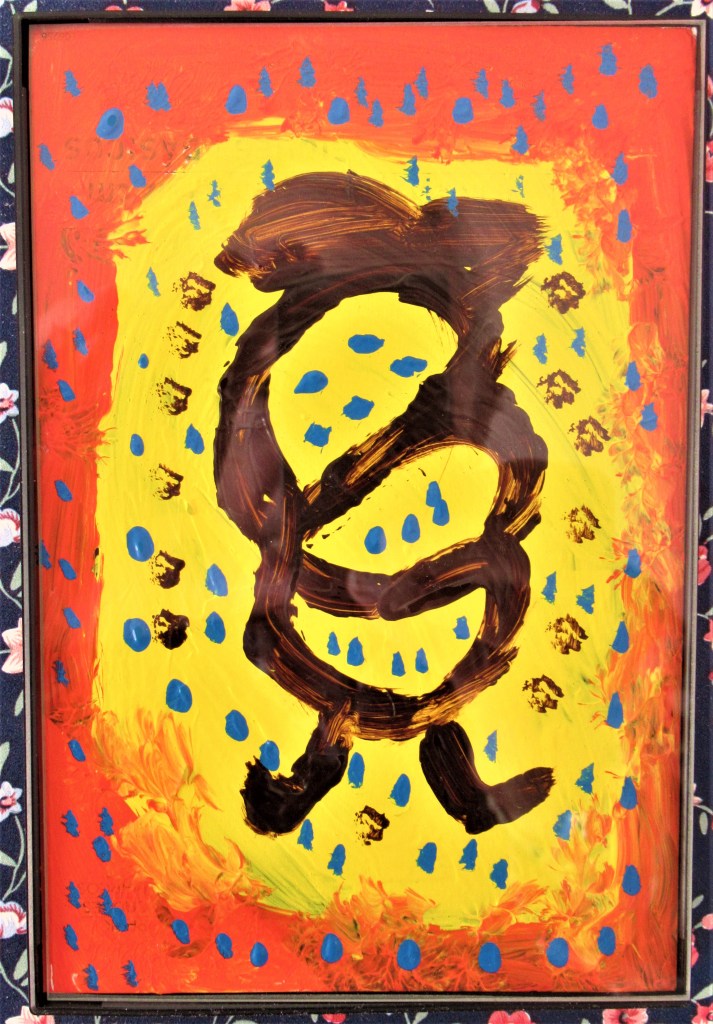
A dry storm lays waste the days that dog my mind.
Carnivorous canicular, hydropic, it drinks me dry,
desiccates my dreams, gnaws me into nothingness.

At night a black dog hounds me, sends my head spinning,
makes me chase my own tail, round and round. It snaps at
dreams, shadows, memories that ghost through my mind.

Tarot Cards and Tea Leaves are lost in a Mad Hatter’s
dream of a dormouse in a teapot on an unkempt table.
Hunter home from the hill, I awake to find my house
empty, my body devastated, my future a foretold mess.

Desperate I lap at salt-licks of false hope but
they only increase my thirst and drive me deeper
into thick, black, tumultuous clouds. Dry lightning.
The drought continues and no raindrops fall.

Dog Daze
2

The drought continues and no raindrops fall.
Desperate I lap at salt-licks of false hope but
they only increase my thirst and drive me deeper
into thick, black, tumultuous clouds. Dry lightning.

Tarot Cards and Tea Leaves are lost in a Mad Hatter’s
dream of a dormouse in a teapot on an unkempt table.
Hunter home from the hill, I awake to find my house
empty, my body devastated, my future a foretold mess.

At night a black dog hounds me, sends my head spinning,
makes me chase my own tail, round and round. It snaps at
dreams, shadows, memories that ghost through my mind.

A heat wave lays waste the hopes that dog my days.
Carnivorous canicular, hydropic, it drinks me dry,
desiccates my dreams, gnaws me into nothingness.

Dog Daze
3

The drought continues. No raindrops fall.
No fresh water. None at all.

Dark clouds gather in the sky.
No rain falls. The ground is dry.

Grass all burned. No more hay.
How much livestock will they slay?

No rain comes, but a flash of light
sets the woods and fields alight.

Home from the fields, some farmers confess
their future is an unpredictable mess.

Desperate farmers are losing hope.
Out in the barns, they keep some rope.

The roof beams are sturdy and built high.
One little jump and problems good-bye.

Commentary:

Dog Daze 1 is a reverse sonnet. Instead of being structured 4-4-3-3 it moves in reverse 3-3-4-4. What fun to pretend to be Milton Acorn, and to turn my sonnet upside down. It should rhyme, but I abandoned rhyme in favor of metaphor a long time ago. Was I right to do so? What, if anything, catches you unawares in Dog Daze 1? Does it work for you? What would happen if we turned it upside down? You be the judge.

Dog Daze 2 is more or less the same sonnet returned to its normal stanzaic shape 4-4-3-3. In what ways has the poem now changed? Clearly there is a structural difference. Obviously some of the lines and images have changed. Is the poem stronger? Weaker? Does each one affect you in a different fashion? Do you prefer one version to the other?

Mission Impossible – How many more adaptations can we make to this poem and how would each one affect the poem and the reader’s reception of it? For example – Dog Daze 3 sees our sonnet turned into a poem composed of seven rhyming couplets. Couplets are easy to rhyme. But do they simplify the thoughts too much? Is the poem now too dark? Can you lighten the mood? How? Your mission, should you decide to accept it, is to rewrite the poem in seven non-rhyming couplets. That will make a change from the Daily Sudoku and the Cross-word puzzle. If you do take up the challenge, let me see what you do! And remember, you can make it personal to you, your life, and your garden.

Things


Things

I fumble in my mind for things
long lost in an upper attic.
I can no longer read the words
I wrote. What does this mean?

At night I dream of things
beyond my reach. My fingers
clutch but cannot clasp
those clouds that clutter.

Who, oh who, the owl cries,
can free the mice that nibble
through my mind and set me
gnawing at my own soul?

Once upon a time, a long
time ago, I thought I saw light
at the end of the tunnel.
I travelled on a ghost train.

The light I saw was a gaslight
ghosting my mind with fictional
fantasies of an illusive kingdom
that would never be mine.

Elusive, these memories of things
that never were, but might have been.
Will o’ the wisps dancing shadows
on the salt-marsh of my unknown life.

Commentary:
Memory loss. I guess it happens to all of us at one time or another. One of my long-lost friends visited yesterday and between us we could hardly put two consecutive memories together. Every other sentence was punctuated with a pause – ‘Now, when did that happen?’ ‘What was his name? I can’t remember now.’ ‘Me neither.’

I am not particularly worried by such happenings. I am a poet and a story-teller. Sometimes, I forget the truth – so what? – I just go ahead and reinvent it, tickling it here, sticking a spot of paint there, adding a word or two, or a magic moment. I often remind myself of Oscar Wilde when he created a magic moment of verbal ingenuity – “I wish I had said that, Oscar.” “You will, Roger, you will.”

Best of all, even in those moments when personal memories fail me, literary magic returns. I think of Dylan Thomas and his words spring to my mind – ‘time has ticked a heaven round the stars’. Wonderful. Or Francisco de Quevedo ‘soy un fué, y un será, y un es cansado.’ / ‘Tired I was, tired I am, tired I always will be.’ My own translation from the summer of 1963 when José Manuel Blecua introduced me to the poem, or rather Blecua introduced the poem to me, in that summer’s courses of the UIMP.

So, according to this theory, even when you feel lost, you are never really lost, because there are an enormous number of people living inside your head, who who will step out from the shadows, when needed, and give your memory a little boost. But don’t get too carried away. Think too of José María Valverde and his poetic premonition: ‘Pobres poetas de hoy, destinados a ser polvo seco de tesis doctoral.’ / ‘Poor poets of today, destined to be the dry dust of doctoral theses.’ (My translation).

Dust to dust and ashes to ashes – ‘Serán ceniza, pero tendrá sentido. Polvo serán, pero polvo enamorado.’ Quevedo, of course. But you didn’t need me to tell you that. You might need me to help you with the translation, though – ‘Ashes they’ll be, but ashes with feeling. They will be dust, but dust that burns with love.’ (My translation, with a little bit of exaggeration [sorry, don Francisco!] just at the end.)

Solitary 1 & 2

Solitary 1 & 2

1

They drove me there,
passed through the gates,
unpacked my trunk,
chatted with the head,
shook my hand,
then drove away.

The metallic clang
of the closing gates
still lives with me.

How old was I?
Six? Seven?
I no longer know
and there’s nobody
left alive to tell me.

I remember so well
the woodgrain on the desk,
the carved initials,
the loneliness that bit,
the barred windows
of that empty classroom.

2

An only child,
taken away,
left among strangers?

Why, why, why?
Doubt’s pinball
bounces round
my empty skull.

What am I?
Who am I?
Why am I?

How did I become
whatever it is
that I became? 

mea culpa
mea culpa
mea maxima culpa

Was I the one to blame?

Comment:
I prefer it as two poems, rather than a poem and a commentary. It may even be better written in the third person. I’ll have to think about that! It’s always a good way to work. Thank you to all who commented, by email or otherwise! Your comments always help me think, and re-think.

What historical event fascinates you the most?

Daily writing prompt
What historical event fascinates you the most?

What historical event fascinates you the most?

First, let us define ‘historical’. Here’s what I found – (1) of or concerning history. (2) concerning past events. (3) The historical background to such studies. (4) Belonging to the past, not the present. (5) Famous historical figures.

Now let us think of the number of times we hear on the TV sports shows that such and such an event is making history “right before our eyes”. Wow! In a boxing match, almost ever punch thrown is “an historical event”. Ditto rugby – with every try scored, every penalty missed, and every tackle made. Ditto soccer, basketball, baseball, athletics. So, from the battery of past events that adorn my life, I am being asked to choose “which historical event fascinates me most”. Double wow.

My answer – the day of my birth, about which I know absolutely nothing. Or, to be more specific, the actual action of being born, about which I know even less. So, how do I study the historical background, when no eye witnesses are left alive to assist me? More important, nobody in my family wanted to talk about such an important – for me at any rate – event.

I do have some factual memories – tales told to me later. I was born at exactly 8:00 pm. I know this because my parents’ dog had been left at a neighbor’s house while my home-birth was taking place. As the clock struck eight, Paddy, the dog, jumped straight through their window, and ran up the road towards the house that was now to be our house, barking. “Ah,” said our wise neighbor, “there goes the dog. That means the baby’s been born.”

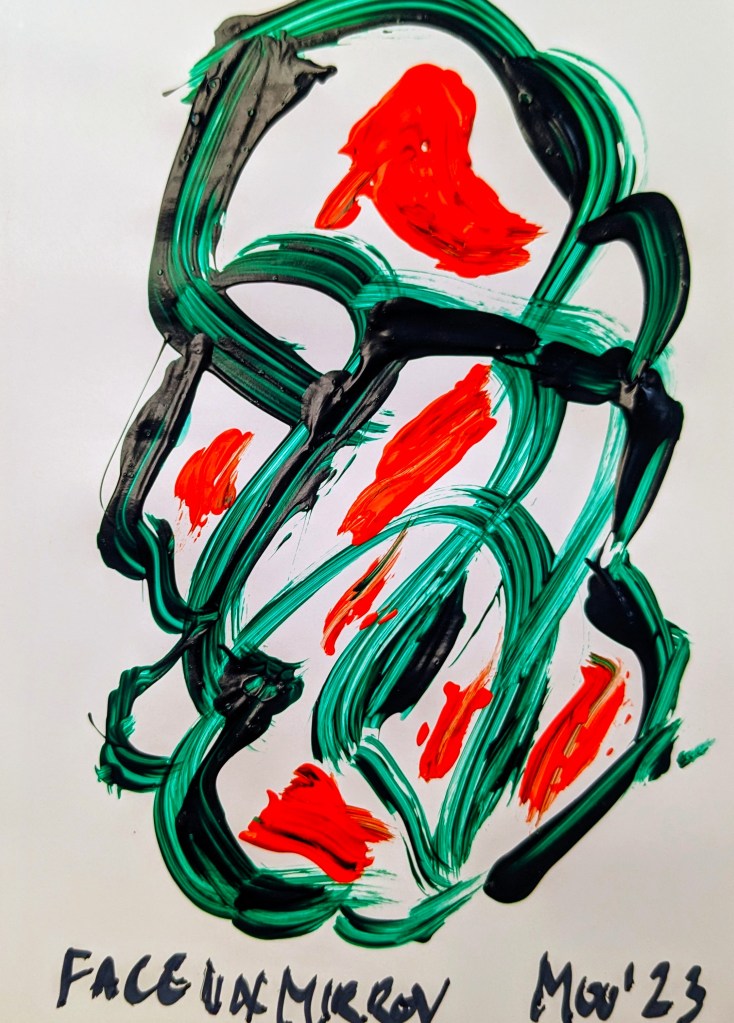
That is one version of the tale. My own version is the squawking of the stork who carried me, a sudden screech as he dropped me, a slow descent from a bright blue sky, a tumble down the chimney into the fireplace. And there I was. All covered in soot and ashes. I needed washing, of course. But baby, just look at me now. [See self-portrait above – Face in a Mirror].

My maternal grandfather swore that I had not been born at all, but found under a gooseberry bush. That would account for the green tinges in the painting. Apparently, all babies in South Wales were found under gooseberry bushes at that time. Unless they were delivered by the milkman.

And there’s many a tale about merry milkmen for, as they say in Wales, “It’s a wise man who knows his own father.” And I guess that is also a hysterical historical event about which I know nothing. But perhaps that’s why when the milkman who delivered the morning milk used to say “Good morning, son” when I met him at the the doorstep.

Come to think of it, the mailman also used to call me “Son” when he delivered the mail. Hmmmm – so did the butcher, the baker, and the candle-stick maker. Oh dear, so many historical events to choose from.

Flight

Flight

Such a miracle: those first steps to flight
taken by the cormorant over water.
That first one heavy, creating ripples,
the second one lighter, and the third one
scarcely touching the water.

The need to take flight lies deep within me.
Fleeing from what? Flying towards what?
Who knows? All I know is that the future
lies ahead where my bird’s beak points and
the past, a rippling wake, lies behind me.

That white water, trailing its kite’s tail,
tells me where I have been. Machado’s
voice calls out from the past: “Traveler,
there is no road, just a wake across life’s sea.”

Comment: The photo is a golden oldie, one of the first I ever posted on this blog. The poem is part old, part new. In reality, it is a revision, completed today, of the earlier poem associated with that old blog post. It is interesting to compare the two visions – with those seven extra years of creative experience between them. Let me know what you think!

A special thank you to my long-time friend, Dale Estey, for commenting and suggesting an improvement for the fourth line. Spot if if you can!

Revisionism

Revisionism

Chalk on a blackboard.
Black, red, blue, green markers
on a white board.

Here comes the eraser.
The board is wiped clean,
or almost clean, figures,
letters, blurred, just about
ready for the next class.
This happens again and again.

What remains?
Notes in a student’s book?
Memories of a lesson
in tedious boredom,
the teacher droning on and on.

“Knowledge:
that which passes from my notes
to your notes,
without going through anyone’s head.”

Yesterday’s lessons:
dry dust of a doctoral thesis.

Revisionism:
“What color is the blackboard?”
“Last year, it was green, but
this year, the blackboard is white.”

Click here for Roger’s reading on Anchor.
Revisionism

Rain Stick Magic

Nunca llueve en los bares /
it never rains in the bars.

Sympathetic Magic
aka
Rain Stick Magic

“Rain, we need rain.”
The bruja whirls her rain stick.
Rain drops patter one by one,
then fall faster and faster
until her bamboo sky fills
with the sound of rushing water.

An autumnal whirl of sun-dried cactus
beats against its wooden prison walls.
Heavenwards, zopilotes float
beneath gathering clouds.
Rain falls in a wisdom of pearls
cast now before us.

Scales fall from my eyes.
They land on the marimbas,
dry beneath the zocalo‘s arches
where wild music sounds
its half-tame rhythms,
sympathetic music released,
like this rainstorm,
by the musician’s magic hands.

Comment: Bruja: witch, witch doctor; Oro de Oaxaca: mescal, the good stuff; Zopilote: Trickster, the turkey vulture who steals fire from the gods, omnipresent in Oaxaca; Marimbas: a tuned set of bamboo instruments. But you knew all that!

Click on this link to hear Roger’s reading.
Rain!

Self-portrait with flowers

Self-portrait with flowers

I walk past the Jesuit Church
where the shoe-shine boys store
polish, brushes, and chairs overnight.
I walk past the wrought-iron bench
where the gay guys sit, caressing,
asking the unsuspecting to join them.

Nobody bothers to ask me for a match,
for a drink, for charity, for a walk
down the alley to a cheap hotel.

The witch doctor is the one who throws
the hands of all the clocks into the air
at midnight, in despair.
He’s the one who leaves this place,
and returns to this place, all places being one.

The witch doctor sees little things
that other men don’t see. He reaches out
and flicks a fly away from my nose.
“It too has lost its way,” he sighs.

I think I know who I am,
but I often have doubts when I shave,
rasping the razor across my chin’s dry husks.
The witch doctor, my lookalike, my twin,
stares back at me from my bathroom mirror.

Three witches dance on the waning soap dish.
One spins the yarn, one measures the cloth,
one wields the knife, that will one day sever
the thread of I, who the same as all
poor creatures, was born only to die.

You too must one day look in that mirror,
oh hypocrite lecteur,
mon semblable, mon frère.

Type on this link for Roger’s reading.
Self-portrait with flowers

Comment: My thanks to all those who click on earlier poems and express their liking for them. I am particularly pleased when an earlier poem lacks a voice reading. Then I can revisit it, rethink it, rewrite it, record it, and speak it aloud. Here’s the link to the earlier version of the poem Charles Baudelaire. Fast away the old year passes, and we must renew ourselves, our thoughts, and our poetry for the new year soon to be upon us. To all my readers, old and new, welcome to that world.

Poetry or Prose?

Poetry or Prose?
Wednesday Workshop
22 September 2021
Patos de setiembre.

When I write, I do not distinguish between poetry or prose. More often than not I think in terms of the rhythm and musicality of the words I am using, if the words sound right, when read out loud, they probably are. Here is a prose poem, Cage of Flame. It is written in prose, but it’s meaning is dependent on imagery, metaphors, associative fields, and musicality. Read it as you would any piece of prose, in sentences, following the guidance of the grammar. Read it two or three times quietly to yourself then, when you have grasped the poem’s rhythms, try reading it out loud. If you want to know how I would read this poem, check my recorded readings on my blog, Spotify or SoundCloud.

Cage of Flame

Now you are a river flowing silver beneath the moon. High tide in the salt marsh: your body fills with shadow and light. I dip my hands in dappled water. Twin gulls, they float down stream, then perch on an ice-floe of half-remembered dreams. Eagle with a broken wing, why am I trapped in this cage of flame? When I turn my feathers to the sun, my back is striped with the black and white of a convict’s bars. Awake, I lie anchored by what pale visions fluttering on the horizon? White moths wing their snow storm through the night. A feathered shadow ghosts fingers towards my face. Butterflies stutter against a shuttered window. A candle flickers in the darkness and maps in runes the ruins of my heart. Eye of the peacock, can you touch what I see when my eyelids close for the night? Last night, the black rock of the midnight sun rolled up the sky. The planet quivered beneath my body as I felt each footfall of a transient god.

Clearly the above is prose because it has no line breaks. But what happens when we break that prose into shorter lines and turn it into a poem?

Cage of Flame

Now you are a river flowing
silver beneath the moon.
High tide in the salt marsh:
your body fills with shadow and light.
I dip my hands in dappled water.

Eagle with a broken wing,
why am I trapped in this cage of flame?
When I turn my feathers to the sun,
my back is striped with the black
and white of a convict’s bars.

Awake,
I lie anchored by what pale visions
fluttering on the horizon?
White moths wing their snow
storm through the night.
A feathered shadow ghosts
fingers towards my face.
Butterflies stutter against
a shuttered window.
A candle flickers in the darkness
and maps in runes the ruins of my heart.

Eye of the peacock,
can you touch what I see
when my eyelids close for the night?
The black rock of the midnight sun
rolled up the sky.

Last night, the planet quivered
beneath my body and I felt
each footfall of a transient god.

            It seems to be the same text, but is it? And what happens if we change those line breaks? It will change the external structure of prose > to poem > to new poem, but it will not alter the internal structures that survive all format changes. Does the rhythm stay the same in both cases? It certainly does when I read it, but how about you? Poetry or prose? And what’s the difference anyway if the words roll off your tongue and metaphors, mystery, and magic rule?

Comment:
Clearly poetry and prose are not interchangeable, for they both fulfill different functions. The classical difference is often said to lie between history, what actually happened, and poetry, the formal arrangements of words in song. This seemingly simple definition becomes blurred, of course, when history, written in prose, is confused with epic, the retelling of history in poetic form. Prose fiction is a much later development and it is Miguel de Cervantes who gives us, in Don Quixote, his own Renaissance solution: “La épica también puede escribire en prosa” / the epic can also be written in prose. The mingling of poetry and prose underlines the use of rhetorical tropes in writing. Later, Baudelaire will offer us us his Petits poèmes en prose thus gifting the world with prose poems. Much of what I write is prose poetry or poetry in prose. Rhythm, metaphor, allusions, alliteration, similes, intertextuality all combine to decorate my writing. And yes, I am very clear about what I am trying to do.