Monkey’s Clockwork Universe

Monkey’s Clockwork Universe


Some days, monkey winds himself up
like a clockwork mouse.
Other days he rolls over and over
with a key in his back like a clockwork cat.

Monkey is growing old and forgetful.
He forgets where he has hidden the key,
pats his pockets, and slows right down
before he eventually finds it
and winds himself up again.

One day, monkey leaves the key
between his shoulder blades
in the middle of his back.

All day long,
the temple monkeys play with the key,
turning it round and round,
and winding monkey’s clockwork,
tighter and tighter,
until suddenly the mainspring breaks
and monkey slumps at the table –
no energy, no strength,
no stars, no planets, no moon at night,
the sun broken fatally down,
the clockwork of his universe
sapped, and snapped.

Commentary:

I guess we normal human beings, not the monkeys who live in the Monkey Temple, think of this as a sort of mental and physical burn out. It can happen to anyone really. You don’t have to be a monkey. But if you live in a clockwork universe where you clock in at nine and clock out at five, and regulate everything – your eating, your breathing, your visits to the loo – by the tick of the tick-tock work clock, then I guess this can happen to you.

Escarmentar en cabeza ajena – a lovely Spanish proverb that means ‘to learn from the blows delivered to another’s head’. Much better to let this poor monkey teach you that yes, you have to take breaks or, like monkey, you will break down. You must learn to pace yourself, not to be put upon by others, and to look after yourself. Because, if you don’t, others will take advantage of you and push you to, and beyond, your limits. Don’t learn that lesson the hard way, by ending up broken, run down, and in hospital. Learn from monkey’s experience. Keep the key hidden. Don’t let other people see it, or steal it, or wind you up with it.

Life is hard enough anyway. Look after yourself first. And then you will be much better able to look after other people – especially your family and friends – when they need your help. A difficult lesson to learn, especially in this world of multi-tasking where too many people hold too many low-paying jobs and work long, long hours, day after day, just to make ends meet.

There is no escape from the clockwork labyrinth, you think. Alas, that too is true, all too often. But escape you must. Somewhere, Ariadne’s thread will lead you out. You must seek it, even in the darkness and the gloom. Once found, it will lead you out from the darkness and back into the light. And that is what we must all hope for and work for. Pax amorque – and blessings.

Time Flies

Time Flies

… bends like a boomerang,
flies too rapidly away,
limps back to the hand.

Endless this shuffle of unmarked
days dropping off the calendar.

Hands stop on the clock.
The pendulum swings:
time and tide stand still,
do not move.

The print in my grandma’s house:
seemingly moving seas,
sails swelled out,
the ship stays firm in its frame.

‘As idle as a painted ship
upon a painted ocean.’

Our garden fills
with brightly colored birds
and red and grey squirrels.

Light and dark
switch back and forth
each day
a twin of the day before.

The TV screen hangs out
the daily washing.
Tired, worn out shadow,
their faces boring us
with shallow wit
and hand-me-down wisdom.

Time:
an albatross around the neck,
an emu, an ostrich, a dodo,
an overweight bumble bee,
too clumsy, too heavy to fly.

“Time flies?”
“You can’t.
They fly too fast.”

Commentary:

My friend Moo told me he was ‘all shook up’ when I read him this poem. I don’t think Moo’s too smart. He thought All Shook Up was written by the Rolling Stones when they went out moss gathering during the Fredericton Harvest Festival, but I said no, it was definitely written by Buddy Holly on an off-day when he was playing cricket. It wasn’t okay in those days to play croquet.

The last three lines come from an examination question in the General Paper, “S” Level, as it used to be. “Punctuate this sentence – time flies you can’t they fly too fast” – of course, they should have said, “in exactly the same way we want you to. Corrections and alternative versions will not be accepted.” What did they think I was? A mind-reader? I wasn’t. I was a teenager having a field day in the national examinations. I would love to have been a fly on the wall when they marked my paper.

In the biology exam, they gave each one of us a Brussel Sprout and asked us to draw it and tell us as much as we could about it. Of course, I ate mine, and I said it tasted a little bit dry and needed some salt. Then I drew a mess of potage, all yellow and green with chewed up squiggles, and added “That’s what the sprout probably looks like right now.” I failed that exam too. Didn’t even get a part mark for ingenuity, though the science teacher said I could have a glow of satisfaction. Very useful after lights out in a boarding school, I can tell you.

I can’t remember if Moo went to that school with me or not. I don’t think he did. I think he drifted into my life a little bit later. He wasn’t a painter at that stage, just a half-starved philosopher doomed to live in a garret. Of course, once he started painting houses, he made money. It’s amazing how many people will pay you for painting their houses. Of course, that was before they invented plastic siding.

About now you realize that I live in a strange world all of my own and a lot of people live in it with me. You, too, if you enjoyed reading this. Long may the ‘strange world of me, you, and Moo’ continue. I’d send you a penny for your thoughts, but they have gone out of circulation. I can’t even sing you a song of sixpence these days either. Silver sixpences have walked the dodo path too.

Water

Water

Here, in Island View, my lawn’s parched grass
longs for water, long-promised but never drawing near.
Do my flowers remember when the earth slept without form
and darkness lay upon the face of the deep?

The waters under heaven gathered into one place.
When they separated, the firmament appeared.
Light sprang apart from darkness
and with the beginning of light came the word,
more words, and then the world …

… my own world of water in which my mother
carried me until her waters broke
and the life sustaining substance drained away
throwing me from dark to light.

In Oaxaca, water was born free, yet everywhere
lies imprisoned in bottles, in jars, in frozen cubes,
its captive essence staring out with grief-filled eyes.

A young boy on a tricycle pedals the streets
with a dozen prison cells, each with forty captives:
forty fresh clean litres of drinkable water. He holds
out his hand for money and invites the villagers
to pay a ransom, to set these prisoners free.

Real water yearns to be released, to be spontaneous,
to trickle out of the corner of your mouth,
to drip from your chin, and fall to the ground.

It is a mirage of palm trees upon burning sand.
It is the hot sun dragging its blood red tongue across the sky
and panting for water like a great big thirsty dog.

Commentary:

This year, spring came with lots of rain. At one stage it looked like the waterlogged plants in our flower beds would all drown. Then, just before summer came, the rain went away and we suffered day after day of unbearable heat followed by nights during which the temperatures scarcely dropped.

As a result, the woods dried up and dry lightning strikes started fires. At one stage close to forty wild fires burned, many out of control. Entry to the woods was forbidden by law. Gradually, the fire-fighters fought back, extinguished the fires, one by one, and reclaimed control. I hope everyone realizes the enormous debt we owe to those brave men and women who risk their lives to save not only our lives, but our houses and our properties.

The fires have gone now. We had a day’s rain, 11 mms fell, but it’s not enough. We need more, a great deal more. We need to soak the trees, the grass, and to feed the streams and rivers. We also need to refill the aquifers on which life on earth, as we know it, depends. We need deep ends in our pools, not the shallow ends of depends, when it depends on whether or not the skies open and the heavenly waters fall.

CBC radio last night – farmers say they have lost their winter hay. How will the animals survive our winters with the hay fields burned and dry? One farmer said that, having no hay himself, it would cost him a minimum of $55,000 to bring in hay – if he could find anyone to sell it to him. Unfortunately, the same is true across the Maritimes – drought, forest fires, and a lack of winter hay. Spare a thought (and a prayer or two) for all those poor creatures, born to die, who will suffer this winter on account of this summer’s heat.

Apocalypse when?

Apocalypse When?

A strange, milk-cloud sky, skimpy, with the sun
a pale, dimly-glowing disc and my pen scarce
casting a shadow as the nib limps over the page.

Out on the west coast, fires still range free and this
is the result, these high, thin clouds casting a spider
web cloak over the sun face and darkening the day.

The west coast: five or six hours by plane and three
whole days to get there by train, even longer by bus,
all chop and change with multiple stops.

The wind blew and the clouds came widdershins,
backwards across the continent. Today they reached
across the ocean to claw the sun from European skies.

It is indeed a small world after all. Isostasy:
you push the balloon in here, and it bulges out
over there in the place you least expected.

Now we are all interconnected in an intricate network
of a thousand ways and means. What does it all mean?
Ripples ruffle the beaver pond’s dark mirror.

The forest mutters wind-words, devious and cruel,
that I sense, but cannot understand. High in the sky
clouds turn into horsemen on plunging steeds.

Fear, fire, flood, foe, poverty, pandemic, crops destroyed,
unemployment, and, waiting in the wings, the threat of civil
unrest, leading to the apocalypse and the war to end all wars.


If you were going to open up a shop, what would you sell?

1. If you were going to open up a shop, what would you sell?

That is a very hard question to answer. I think of all the material things that everyone else can think of, but I do not want to sell commonplace things – antique furniture, paintings, books, stamps, groceries – I could go on and on, but I will resist the temptation to do so.

When I lived in Santander, Spain, the local wines were sometimes called ‘sol embotellado’ / bottled sunshine. I wouldn’t want to open a wine shop, but I would love to bottle the essence of a warm sunny summer day and – why should I sell it? I wouldn’t. I would give it away, free of charge, to all the needy people, inner city boys and girls, the impoverished, those who live in the streets and sleep in doorways or under bridges at night. Oh, the joy and happiness that would come when they opened their bottle of summer sunshine and felt the warm fresh air gather around them so they could breathe it in.

But why stop there? I would also give away ‘essence of butterflies’, that special feeling that comes on the colored wings of a butterfly and combines with the joy of flowers and the gift of taking flight. How special that would be. But sell it? It is much too valuable to sell. Put a dollar, Euro, yen, rupee, or sterling price upon it, and all its powers would vanish, like fairy dreams fading away.

Among other things, I would also like to offer the gift of the joy of words. Colors, in the imagination of Blake, were ‘sky wounds’. What joy to take a normal word, add a second word to it and create a new verbal image – ‘sky wounds’. And what happens when the sky is wounded, you ask. Well, the wound opens, the blood pours out and ‘le soleil se couche dans son sang qui se fige’ ‘the sun sets in its own congealing blood’. Baudelaire, if I remember correctly, from Les Fleurs du Mal. What beauty in those new images. What joy in remembering and recreating them. I would bottle such gifts and give them away in my shop.

Fairy dreams – yes, I would offer them as well to those who needed them. And not the sort that fade away, but those fairy dreams that suspend us in the wondrous beauty of their ethereal light. And I would bottle hope, and self-belief, and the power to change oneself from what one is to what one is destined to be. And I would add essence of self-knowledge and powder of Davey Lamp light that would enable the seekers to seek in the darkest corners of their souls and find that elusive inner self, and bring it out from the darkness. And I would stock fragrant filaments of firefly that would also allow my customers to enlighten that darkest of nights, the dark night of the soul. And a map of hidden foot paths that would allow the wanderer to wander and never get lost.

How about an elixir of happiness and joy? A quintessence of rainbows, perhaps? Or a magic lantern that would shine out from heart and eyes and enlighten the soul friends of those lucky souls who were able to locate and enter my shop of conditioners, vital vitamins, and soul magic for all those lost and lonely people. And there, that mirror on the wall – look in it, gaze deep into your own eyes, and maybe, just maybe, you will find my shop.

And “What will your shop be called?”, you ask. Look into your heart and you may find the answer engraved therein. It will be called The Gift Shop of Hope Restored. I look forward to welcoming you when you open the door and step in.

Comment
1. The number at the beginning of this post, refers to its position in The Book of Everything. In that book, I have included 100 blog prompts (The Book of Everything) and 11 more (and a little bit extra) to give a total of 111 responses to prompts. Each one is a little bit crazy, just as this one is. But what fun to read, and write, and think slightly differently.

The Book of Everything

Discourse Analysis
and
The Meaning of Meaning

Words have dictionary definitions that allow us to agree on what they mean. In this fashion, when I say ‘my grandmother’, you automatically know that I am referring either to the mother of my mother (maternal grandmother) or the mother of my father (paternal grandmother). This is the dictionary meaning of the word ‘grandmother’.

But words have lives of their own, and their meaning changes when used by individuals. You, the reader, never knew my grandmothers. You never will. They both passed away a long time ago. I loved them both, but for very different reasons, and to me they were as different as different can be.

This means that when you, the reader of these words, reach the word ‘grandmother’, the faces you see, the emotions you feel, the memories conjured up by that word are totally different from mine. Same word, same dictionary definition, different personal memories, experiences, relationships. In addition, the role that our grandmother(s) played in our lives will be very different too. That role may vary from culture to culture, from language to language, and from the social structure of the changing society in which we live.

For example, when I first went to Santander, Spain, I visited a family who lived in a large, detached house that contained three generations of the family – grandmother and siblings, father and mother, grandchildren, and an assortment of aunts and uncles. No need for babysitters in that household. Everybody had a vested interest in the development of the young ones and the older ones received tender, loving care, twenty-four hours a day, every day of the week.

I lived from time to time in the same town as my own grandparents. I saw them regularly, but rarely on a daily basis. When my parents sent me to my first boarding school, age six (if I remember correctly), I lost contact with my family. My paternal grandfather died when I was away at school. My maternal grandmother died while I was away at school. My paternal grandmother died when I was living in Spain. My maternal grandfather died when I was living in Canada. Alas, after those early years, I scarcely knew them. My experience, then, was so different from that of other people.

When I moved to Canada, the Atlantic Ocean separated me from my parents. My daughter, born in Canada, grew up with no close knowledge of her grandparents. The word ‘grandmother’ did not mean the same to her as it did to the grandchildren in Santander, or to me. How could it? All those miles between the families, and visits limited to a couple of weeks every other year at best. Although the dictionary meaning is always the same, what a difference in the emotional meanings for each person using that word.

Discourse Analysis, the way I use it, builds not on the dictionary meanings of words, but on their emotional and personal resonance. I take the standard, dictionary meaning of words, twist it, look for meanings at different levels, and then build an alternative narrative on that changed meaning. I have great fun doing so.

Part of that verbal fun comes from my childhood. I listened to Radio Shows like The Goon Show and Beyond Our Ken. Giles’ Cartoons gave my names like Chalky White, the skeletal school teacher, or Mr. Dimwitty, a rather dense teacher in another school. These shows also twisted the meaning of words and drew their humor from such multiple meanings. The Goon Show – “Min, did you put the cat out?” “No, Henry, was it on fire?” Or on an escaped convict – “He fell into a wheelbarrow of cement and showed every sign of becoming a hardened criminal.” Or from Beyond Our Ken – “My ear was ringing. I picked it up and answered it. ‘Ken here, who am I speaking to?’ ‘Larry Choo.’ ‘Ah, Choo.’ ‘Bless you, Ken.’ Verbal scenes like these – it’s hard to get visual pictures from listening to the radio – remain engraved in my memory banks. More than engrained, they become part of the verbal system from within which I write.

This system includes Direct Discourse, Indirect Discourse, and the Twisted Discourse of an Inventive Mind that still wishes to create. It also comes from Francico de Quevedo’s Conceptismo, from Ramón del Valle-Inclán’s esperpento, and from certain aspects of Albert Camus’s Theory of the Absurd, all blended with the poetry of Jacques Prévert and the songs of Georges Brassens. This from the latter – “Tout le monde viendra me voir pendu, sauf les aveugles, bien entendu.” Everyone will come to see me hanged, except the blind of course.

This is not always easy humor, nor is it a comfortable way to see the world. But it is a traditional one with a long literary history. The title of my book goes back to Francisco de Quevedo, of course, who, in 1631, in Madrid, published El libro de todas las cosas y otras muchas más / The book of everything and a lot more things as well. Don Roger turns to his good friend Don Francisco whenever he needs a helping hand.

The pieces themselves were first published on my blog rogermoorepoet.com. They have been revised, and I have added some more pieces in a similar vein. Tolle, lege – Take and read.  Above all, enjoy this world of mine, with its subtle and not so subtle humor, its sly digs at many of our follies, and its many forms of creativity.

The Book of Everything
and
a little bit extra

Click on the title to purchase this book.

What’s your favorite recipe?

What’s my favorite recipe?

I find it hard to talk about my favorite recipe at a time when so many people in this world of ours are desperately short of food. I get regular messages from the local food bank – can I help them out? And I try to do my best. Alas, my pittance is a drop in the ocean of want and need.
Our local supermarkets have food baskets that you can add to your food bill. These will then be handed over to those who distribute food to the needy. Then there are the checkouts where I am regularly asked if I will add $2 to my bill for the food bank. I usually give $5 or $10.
I see old men sitting at the entrances to stores, a coffee cup before them with some petty cash in it. I also see homeless, workless people at traffic lights with signs held up, asking for cash.
I don’t want to start on war zones, on the accidental-on-purpose starvation of people, on the targeted destruction of homes, animals, and crops. Nor do I want to contemplate the rising prices of what used to be staple groceries and are now becoming luxury items – olive oil, meat, coffee.
While I can still afford some, but not all, luxuries, far too many people can’t. And yet you ask me what is my favorite recipe? Well, here goes –

Take one pound of charity, stir in a pound of love, add a spoon full of humanity, mix with half a pint of the milk of human kindness, sprinkle the mix with a half cup of sugar – to take away some of life’s bitterness, pepper it with ground Good Samaritanism – to add some neighborly love, and complete it with essence of humanity – to remind us that we are still human. Then distribute it, free of charge, everywhere you possibly can but, above all, not just to the needy, but to those who are capable of changing the situation, but for some reason or other, refuse to do so.
Pax amorque.

What is your favorite form of physical exercise?

Daily writing prompt
What is your favorite form of physical exercise?

What is your favorite form of physical exercise?

As the arthritis gets worse and the pain grips more and more, I am not sure that I have any favorite form of physical exercise. Perhaps getting in and out of the whirlpool bath? Getting out after a half hour or so soaking, is easy enough. But getting in, after a couple of days without one – well, that can be a bit of a pain.

Then there’s getting up in the morning. That is exercise in itself. Hauling myself out of bed. Limping to the bathroom. Doing some s-t-r-e-t-c-h-i-n-g when I remember too. Painful to do, but I usually feel usually a bit better afterwards. Don’t forget the obstacle race of making it, half-asleep, to the bathroom during the night. Then there’s getting dressed in the morning and that’s always an interesting exercise. Sometimes I need help with socks, or shirt, especially after a bath. Shoes are always a wrestling match, as are shorts and jeans. What used to take me about 90 seconds, now takes closer to ten or fifteen minutes. Hardly aerobic!

And speaking of aerobics, physical exercise can also refer to anaerobic and an / aerobic with lactic acid build up. Lactic acid and the ensuing cramps have never been anyone’s favorite form of physical exercise, unless they are masochists instructed by a sadistic coach, as sometimes happens.

The stairs are always a great physical exercise. Easiest is walking safely downstairs in the morning. But there is always the fear of a fall, especially with the turn round the Newell post at the bottom. And then there’s climbing up again safely at night. That takes longer and longer, one painful foot lift at a time.

Cooking has become a physical exercise too. Peeling the vegetables and cutting them up can be quite vigorous. Standing at the stove cooking, gently stirring the food, that is good exercise, as is setting the table and serving the food.

But perhaps my favorite exercise is what the Abulenses call El paseo de la nevera. This is to get up, to walk to the fridge, and to grab another can of beer or open a new bottle of wine. Maybe that is my favorite form of physical exercise, that and the repeated elbow lift and flex that is necessary to drain the can or the bottle or the glass. And don’t forget, there’s always the pinch of salt and the over-the-shoulder salt throw, always necessary with this style of blogging, where everything you read should be taken with a large pinch of salt.

Do lazy days make you feel rested or unproductive?

Daily writing prompt
Do lazy days make you feel rested or unproductive?

Do lazy days make you feel rested or unproductive?

How on earth do you define a lazy day? If a Lazy Boy is a chair, what is a Lazy Day? Is it something like a Lazy Rocker? Or a Lazy Twister? ‘Come on, let’s twist again’! Is it no more than a lazy, hazy, crazy day of summer, as the song would have it? In which case, is it possible to have a lazy day when summer has gone, the days grow cold, and autumn is on the way? And who is having the lazy day, anyway? And is that a lazy painting I see before my eyes?

Enjoying retirement, as I am, busy or not, I feel quite rested, most of the time. As for being productive or unproductive, well! I feel productive when I post an answer to a blog prompt. So today, I am being productive. Ipso facto, I suppose I am not being lazy, though the sun is shining outside, the leaves are actually staying on the trees, after the overnight frost, and are not hurrying and scurrying and busying themselves in falling to to the ground. It’s a lazy leaf day – they are definitely not being productive. If they were, they would be littering the yard for me to tidy them up and then they would be productive by making me labour, and I would not be having a lazy day, because I would be busy picking up the leaves, putting them into piles, then waiting for the busybody wind to stop being lazy and to interfere with my work and scatter leaves around the garden again.

So, back to the original prompt – Do lazy days make you feel rested or unproductive? Let us give a totally non-committal, political answer – after all, it is the election season – and say – “It depends”. It depends on the multiple meanings of a lazy day, rested, productive, or unproductive. If the hen doesn’t lay an egg, is she being lazy and unproductive? Or does she feel fulfilled and rested? I could ask any one of the dozen or so eggs I keep resting in the fridge. Oh boy, do they have a restful time, lying there, eggs-in-waiting. And what are they waiting for? That joyous moment when they appear in public, are cracked open and whisked into omelets or scrambled like the brain – rested, rusted, busy, productive or unproductive – of anyone so twisted that they would write anything like this in response to a simple prompt. A simple prompt, you say? Now that’s a great departure point – what do you mean by a simple prompt? Answers on an egg-shell fragment please!

Ah yes, it’s another busy, productive day and my scrambled brains, like the scrambled eggs I devoured for breakfast, are all as busy as little bees can be, even though the bees are now out of season and there are none left in the garden. And with that I bid you farewell, au revoir, or is it adieu? I’m too lazy to care? Please choose whichever buzz word suits you best!

What things give you energy?

Daily writing prompt
What things give you energy?

What things give you energy?

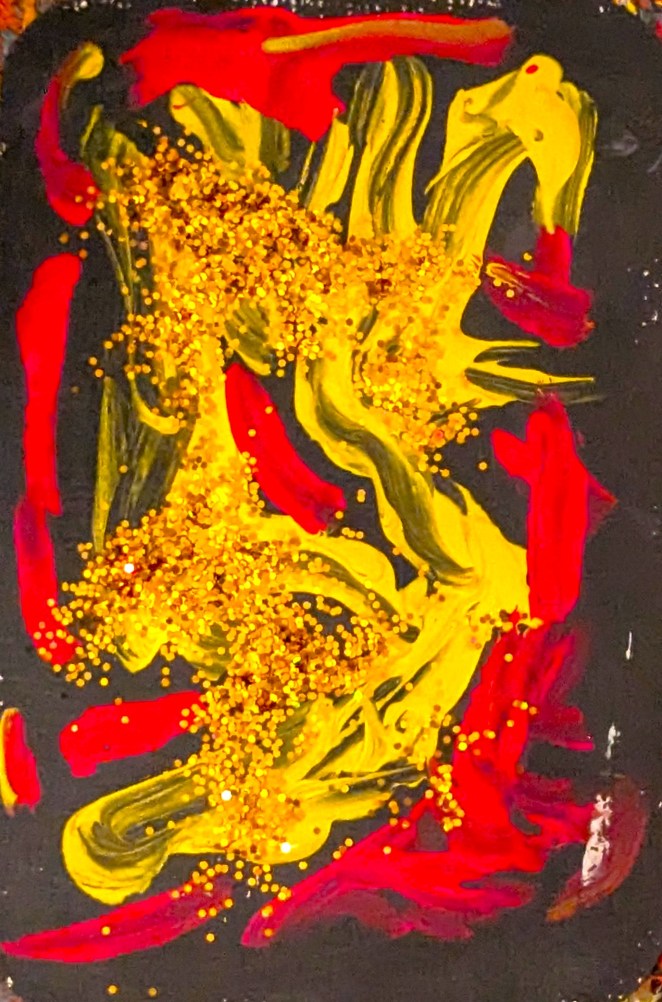
What on earth do you mean by energy? And why should energy be associated with things? For example, today’s painting (above) is by my friend Moo. He calls it Joy to the World. It is indeed a joyous painting, full of light and creative energy. The photo does not do justice to the painting, which sparkles and reaches out to draw the viewer in. We must never underestimate the energy that comes from the creativity and art that creative people put into their art works. It is like bread cast upon the waters – it will return tenfold. The world would be a sad place if we lost our powers of creativity and invention. May we always keep them close by us, and turn to them when the skies are grey – for with our ingenuity and skills we can always turn those grey skies blue again. It just takes time, trust, belief, creativity, and a little bit of energy.

Or is the prompt referring to the energy that comes from food? Vonnegut refers to such energy as comes from the breakfast of champions. Was that really Scott’s Porridge Oats? Certainly used to be – and all those caterwauling bagpipes puffing out their oaten tunes. More foods, please. Cornish Hens and Kedgeree, unzipped bananas, eggs – preferably fresh and free range – boiled, poached, scrambled, fried, or served in various types of omelets … energy from food – oh, I could go on and on and on … caws wedi pobi, cennin a tatwystortilla espanola, paella de mariscos, calamares en su tintachapulines from Oaxaca … food as a source of energy … wow! And who said the foods had to be written in English?

Mind you, an alternate source of energy is the current news cycle. When not a storm in a tea-cup, sugared or un-sugared, it is ferocious and opinionated enough to set people banging their heads against the walls so the pain will come from an alternate source. And noise demands energy – energy in (and also garbage) and energy out (mainly garbage), and all that rage, fury, wind, despair, blather, generated by written, printed, spoken, televised, radio borne waves of noise. We could start a wind farm if we trapped the blatherings of congress, the senate, the houses of parliament.

Meanwhile, we live in a large house, almost a barn really. Some of our friends call it our hacienda. They are the ones who speak no Spanish and can’t pronounce Quevedo correctly, even though I’ve known them for a quarter of a century. Actually, strictly speaking, most of them are ex-friends now. Many went AWOL when I retired and the rest disappeared, fates unknown, during Covid.

That house has an electric furnace that warms us in winter and circulates cool air, in summer, from the basement (cool) to the upstairs bedrooms (warm). We also have a fireplace insert that burns wood. But we only use that in emergencies (power loss during cold weather or storms) or for decoration (the yule log) at Christmas and over the New Year.

A large house means large heating bills. About ten years ago, we installed a wonderful heat pump that serves the whole house. It heats in winter and cools in summer. It also halves (or more) our electricity bills. Most of the house functions on electricity, hydro-electricity from the dam at Mactaquac, just up the road. No coal-fired furnaces for our electric supply. We do, however, have the ability to connect to a petrol-driven generator. But we rarely, if ever use it and that, too, is for emergency use only.

Otherwise, many of the things we use on a daily basis – computers, cell phones – can be battery driven (when the power fails) and those batteries can be charged in the car (during emergencies) or from reserved chargers hidden away. The car itself is a normal gas engine – nothing special – as is the snow blower. We do not use solar power – nor wind power – but we do have candle power and our fireplace insert can be used for heating food and boiling water.

So there, as a challenge to your lack of clarity, you have a clear account of my many sources of different types of energy. Oh, and don’t forget, I am energized by earing your prompts apart and chomping them into tiny pieces.

Comment – revised, Sunday, 22 September 2024.