Tiz-Woz Days

Tiz-Woz Days

Well, it’s been a couple of Tiz-Woz days sitting here, looking out of the window, waiting for the results of the bone scans I underwent a week or so ago. I should be getting the results next Monday, on my father’s birthday. He would have been 111 years old and I always celebrate his birthday by wearing either his watch or the one he gave me for my own 21st birthday, way back when.

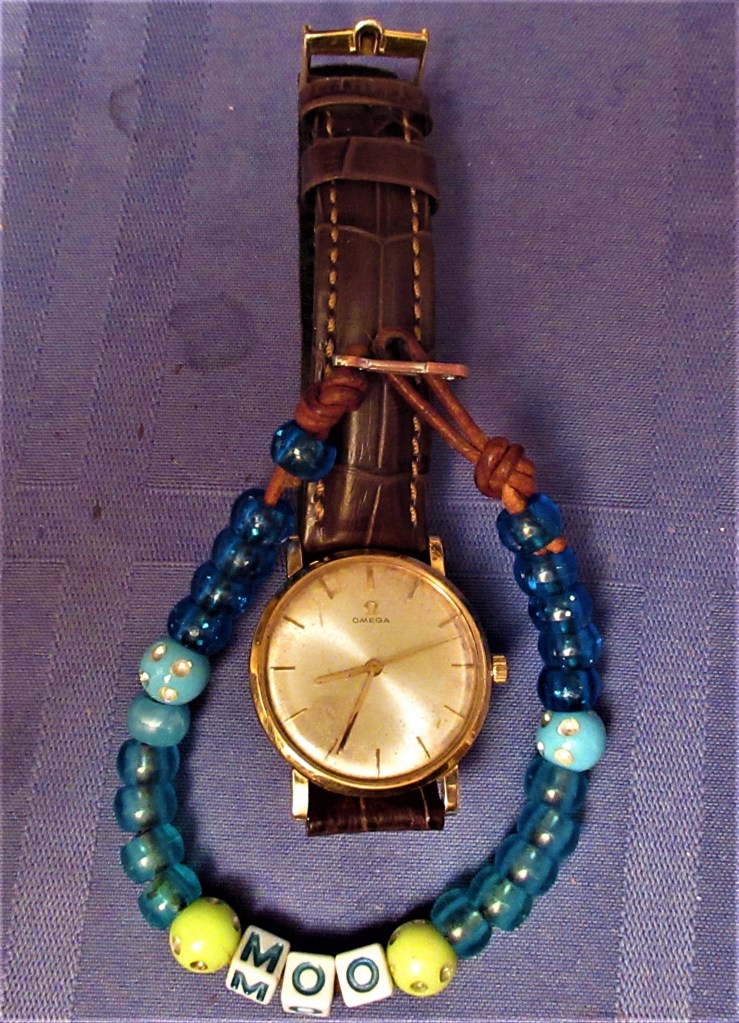
This is a very special photo. It shows my 21st birthday watch together with the bracelet, with my name on it, that my grand-daughter made for me when she was four years old. Four generations of memories sitting on my wrist. I think she put my nick-name (nom de plume) on the bracelet in case I forget who I am. She knows it can happen in old age. The four dots are to remind me that she was four when she made this present for me.

Allan Hudson very kindly interviewed Jane and I for his blog: the South Branch Scribbler.

Here’s today’s article.

South Branch Scribbler: Branching out with New Brunswick Authors Jane Tims and Roger Moore. (allanhudson.blogspot.com)

This is my first interview with Allan.

http://allanhudson.blogspot.com/2016/02/guest-author-roger-moore-story-plus-4q.html

This is the second one. Today’s is my third appearance on his blog.

http://allanhudson.blogspot.com/2016/02/guest-author-roger-moore-story-plus-4q.html

Thank you Allan, for all you hard work on behalf of New Brunswick writers.

And here’s the latest book to be added to my collection. Thank you Dr. Karunesh Agarwal.

Click on the link below to peruse my books for sale.

Books for Sale

Duende

Spotify
Remember to scroll down to the correct audio episode.

Duende
“Todo lo que tiene sonidos oscuros tiene duende.”
“All that has dark sounds has duende.”
Federico García Lorca (1898-1936)

It starts in the soles of your feet, moves up
to your stomach, sends butterflies stamping
through your guts. Heart trapped by chattering
teeth, you stand there, silent, wondering: can I?
will I? … what if I can’t? … then a voice
breaks the silence, but it’s not your voice.

The Duende holds you in its grip as you
hold the room, eyes wide, possessed,
taken over like you by earth’s dark powers
volcanic within you, spewing forth their
lava of living words. The room is alive
with soul magic, with this dark, glorious
spark that devours the audience, soul
and heart. It’s all over. The magic ends.

Abandoned, you stand empty, a hollow shell.
The Duende has left you. Your God is dead. Deep
your soul’s black starless night. Exhausted,
you sink to deepest depths searching for that
one last drop at the bottom of the bottle to save
your soul and permit you a temporary peace.

Click on the link below to peruse my books for sale.

Books for Sale

Mirror Image

Spotify
Remember to scroll down to the correct audio episode.

Mirror Image
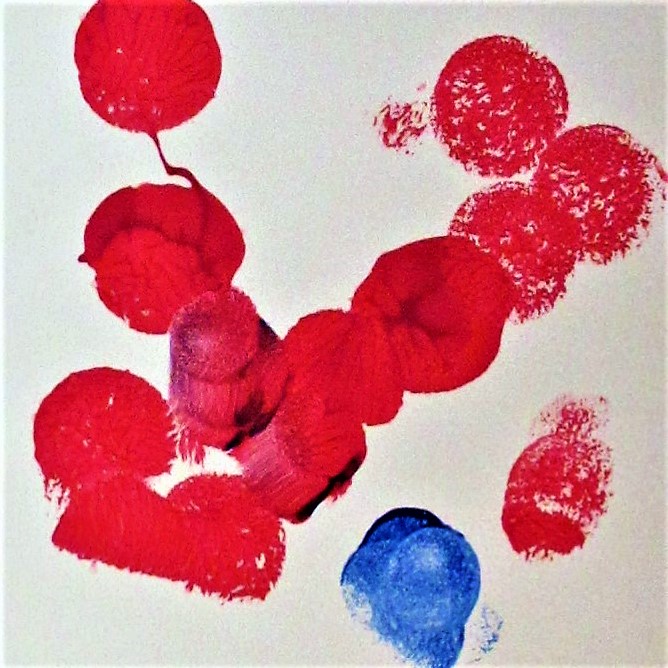
(on seeing the outline
of a painting on the reverse side
of my painted note-book page)

What price these corkscrew lines,
reversed, seen through a glass, darkly,
the wrong side of a tapestry,
all twisted threads and imaginings,
no clear pattern of thought
or design, as if designated by an errant
hand and signed by a man with a mission
to bewilder, confuse, muddle, shock,
turn inside out, back to front, upside down
all our notions of what is what,
and who is when, and why, and where?

Yet there is meaning to this madness,
a sense of a blind man trapped underground
in the labyrinth of his darkened mind
with only a thin thread of belief
to guide him, upwards and outwards,
away from the torrid torment of doused flames,
the damp spark’s midnight glow,
the search for substance in a new world,
insubstantial in a neologism, whirled
through inner spaces and spun, guileful,
out of the back of the hand to spin,
this way, that way, who knows which way,
according to the moment of delivery,
the angle of acceptance,
the untrained brain of the recipient,
tottering on the brink of a world
with a definite end: the suicide of logic.

Click on the link below to peruse my books for sale.

Books for Sale

Spring

Spotify:
Remember to scroll down to the appropriate audio episode.

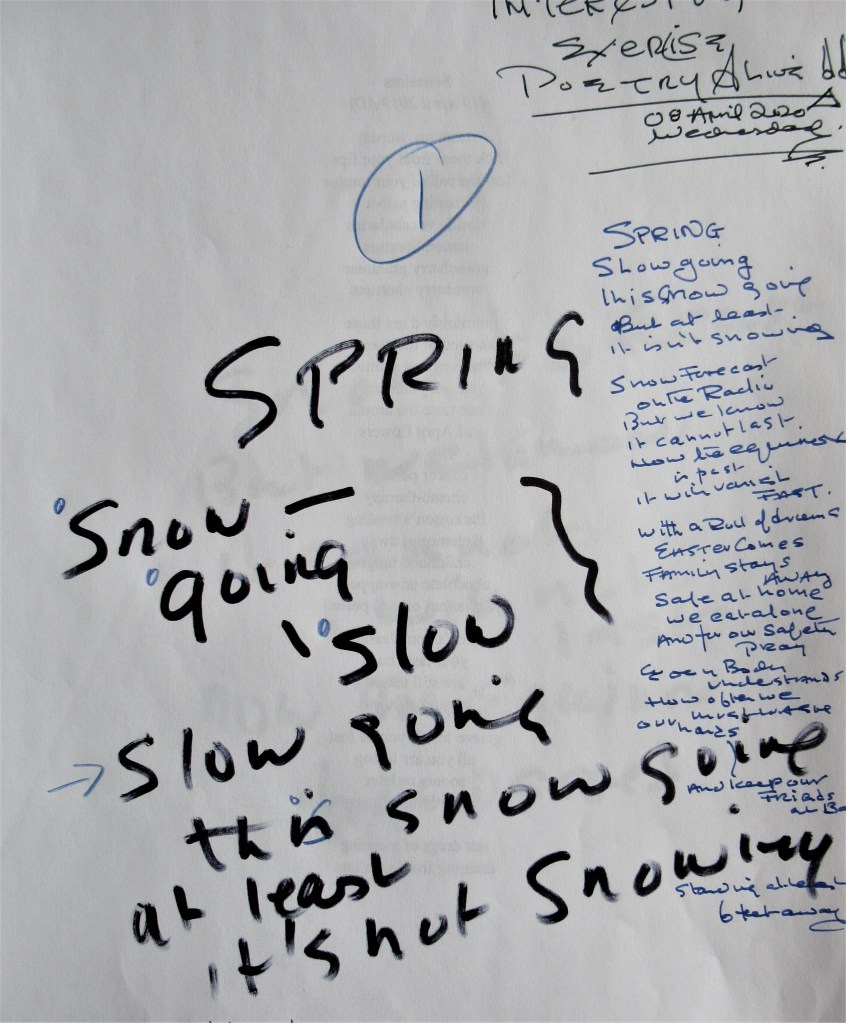
Spring

Slow going
this snow going,
but at least
it isn’t snowing.

Snow forecast
on the weather show,
but we all know
it cannot last,
now the equinox
is past.

With a roll of drums
Easter comes,
but friends and family
stay away.

So all alone
and safe at home
we’ll spend
our Easter day.

Everybody understands
how often we must
wash our hands.

Don’t go unmasked,
even when asked,
and all our friends
must safely stay
at least six feet away.

Comment: I just received this poem as a memory on Facebook. Interesting. I remember writing it, online, a year ago today, and what a fun time I had. Here’s the link to the video. I loved being involved in the creative experience. It was my first poetry video. I do hope you like it.

Empress of Ireland

Empress of Ireland
Poems from Ste. Luce-sur-mer

is available at the following link:
Click here to purchase Empress of Ireland

The Empress of Ireland

The poems which have come together to form the Empress of Ireland were begun in Ste. Luce-sur-mer, Quebec, in May 2002. It was off-shore from Ste. Luce, in the early hours of the morning of the 29th of May, 1914, that the Empress of Ireland collided, in dense fog, with a converted Norwegian collier whose bows had been strengthened for ice-breaking. There were approximately 15 minutes between the moment of impact (1:55 am) and the moment the Empress caught fire and sank (2:10 am). Although the disaster has received little international attention, more passengers perished in this accident (840) then in the loss of the Titanic (832) or the sinking of the Lusitania (791).

Introduction to the Empress of Ireland

Click on the link below to read an early post with a new sound recording of
A Survivor lights a candle
https://rogermoorepoet.com/2020/11/23/a-survivor-lights-a-candle/

I first heard voices in the cries of the sea birds on the beach at Ste. Luce-sur-mer.

Borne on the wind, over the sigh of the waves, they seemed high-pitched, like the voices of children, or of men and women in distress. These were lost voices, the cries of people alone and frightened by the dark. I heard them calling to me.

That night, there were knocks at my cabin door and finger nails scratched at my window. Tiny sounds, almost beyond the range of human hearing: the snuffling of puppies when they turn over in their sleep and tug at each other, whimpering in their dreams.

“Who’s there?”

I started from my sleep. But there was only the wind and the waves as the tide’s footsteps climbed a moonbeam path to ascend the beach. When I walked on  the sand next day, at low tide, there was a whispering behind my back. Little voices crying to be set free.

“Who’s there?”

A lone gull flew past my head and battered itself against the wind’s cage with outraged sturdy wings.  That night, the mist descended. The church stepped in and out of its darkness and shadows gathered, persistent, at my door.

I walked out into the night and saw a lone heron surrounded by gulls. It was as if an adult, clamoured at by children, was standing guard over the beach. Then I saw the shadows of little people searching for their parents, the shapes of mothers and fathers looking for their off-spring, lost among the grains of sand.

Beyond them, on the headland, the church stood tall above the shadows. I saw grandmothers and grandfathers, their lips moving in supplication, kneeling before the granite cross which stands above the sea. As I approached, they turned to me, opened their mouths, mouthed silent words, then disappeared.  When I went back to bed, faces and voices visited me in my dreams. When I got up next morning, they came to me in the speech of birds hidden in the foliage, in the words dropped by the osprey’s wing, in the click of the crab’s claw as he dug himself deeper into the sand.

“Release us”

“Speak for us!”

“Set us free!”

The words of the M Press of Ire are not my words. They could never be my words. Foundered words, they are, rescued from the beach, and dragged from the high tide mark with its sea weed, carapace, charred wood, old rusted iron, and bright bones of long dead animals polished by the relentless action of wind, sea and sand.

Niche

Jane gave me the honor of writing the foreword to her book and I did so with great pleasure.

Jane Tims: Niche. KDP.
Book Review

Niche, the fourth poetry book published by Jane Tims, is a neat configuration of six segments that elaborate and illustrate the poet’s original definition of the multiple meanings of her title word niche. It is very difficult to separate the author from the act of narration as her keenly observed and skillfully executed drawings, together with their verbal representation on the page, are so autobiographical and so much an extension of her artistic and professional abilities that the objective separation of writer and text is scarcely possible. It is hard to forget that Jane Tims was, and to a great extent, still is, a highly competent professional botanist. The harnessing of the professional botanist, with her unique drawing skills and scientific knowledge, to the poet and auto-biographer is a key factor in the reading and interpretation of this text in which acute observation blends with an intimate knowledge of the observed botanical world, both flora and fauna, and this allows the poet, in her role of poetic narrator and lyrical voice, to weave a network of poems that are, at one and the same time, objective and intensely subjective.

The author emphasizes this when she writes in the Preface that “In biological terms, the niche is the quality of a space occupied by a living thing, the sum total of physical, nutritional, biological, psychological and emotional needs gathered together in one place.” She also reminds us that in human terms “niche can be a metaphor for home, community or personal space” and it is within these metaphoric spaces that the poetry text is elaborated. The text becomes a linked mixture of visual drawings, iterative thematic imagery and associative fields, all centred on the multiple meanings of niche. These terms are both biological and human in nature and the poet’s named world meets at this juncture between the human and the natural.

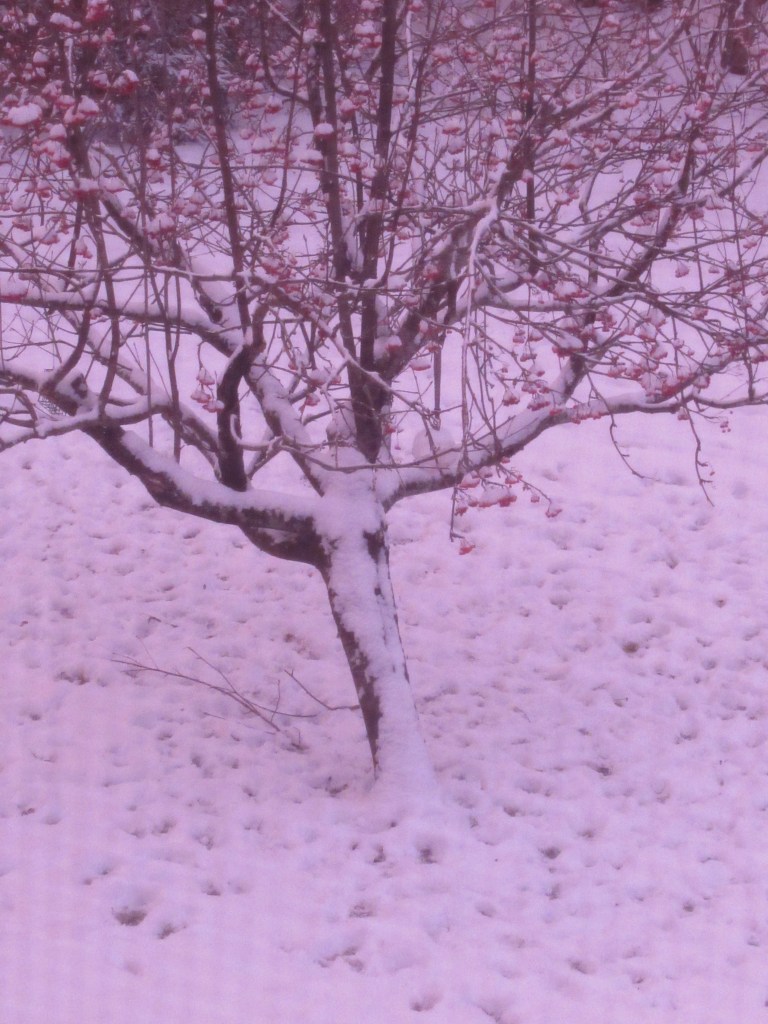
The section occupying space (1-19) bears the subtitle satisfying need and begins with a setting out of what this means in the following 12 poems and 4 accompanying drawings. The poem ‘apples in the snow’ with its companion drawing stands out for me. The section strategy, subtitled solidifying position (21-43) outlines in poetic terms, how plants, animals, and humans ensure their own survival. The section praying for rain, subtitled, avoiding danger and discomfort (45-68), offers views on discomforts and dangers. It also opens the discussion—relocate or stay where we are? The section mapping the labyrinth or places I have occupied (69-83), which contains the wonderful sentence “When I get lost on the road ahead, I look to the road behind me,” throws open the multiple meanings of home. The section new ways for water, subtitled coping with change (85-98), offers a double landscape, first, external, the things seen, touched, examined, remembered and described, and then the internal landscape that reflects upon them and is reflected in them. Finally, forgetting to move, with its subtitle getting comfortable (99-111), presents an autobiography that links observer (the twin personage of author and narrator) to observed (nature, both flora and fauna, and the added element of autobiography and self) via the symbiotic relationship of botanist to botany.

Two moments stand out for me. (1) Sadness is in seeking the space that is never found. (2) Loneliness is in trying to return to a space once occupied but no longer available. The whole concept of the Welsh word hiraeth is summed up in these two lines. Carpe diem, Jane Tims’ poetry indeed seizes the day and, with its minute, intense observation, it preserves so many precious moments. It also pays attention to that which has been lost, those moments that are irretrievable. They will vary for each reader, but hopefully, like me, you will take great pleasure in discovering them for yourself.

Comment: Brian Henry of Quick Brown Fox picked up this review and published it on QBF. Thank you, Brian and thank you Jane, you both do me great honor. Here’s the link: Niche on QBF 14 March 2021

Gaza Street

This is the original version. It is much better than the revision that I posted earlier. Sometimes, when we revise, we lose the freedom of thought and association that comes with the early version. Message: keep your variations and keep an open mind. Over-elaboration is the poet’s worst enemy.

Wingless in Gaza Street

amputees deprived of flight
they flutter grounded in the gutter

galley slaves chained to broken oars
they ply blunt stumps relentlessly

shorn of strength and beauty
their once glorious shuttles weave dark circles

my mouth is a full moon open in a round pink circle
bone and its marrow settle in subtle ice

futile fragility of the demented heart pumping
its frequency of fragmented messages

frail beauty torn from its element of air
this brightness of moths drowning in inky depths

the seven o’clock news brought to you
from an otherwise deserted street.

Clematis

Not clematis, but bruised clematis clouds.
I’ll keep looking.
Maybe I’ll find the real things.

The clematis unfolds bruised purple on the porch. Beneath the black and white hammers of ivory keys, old wounds crack open. A flight of feathered notes: this dead heart sacrificed on the lawn. I wash fresh stains from my fingers with the garden hose while the evening stretches out a shadow hand to squeeze my heart like an orange in its skin. Somewhere, the white throat sparrow trills its guillotine of vertical notes. I flap my hands in the air and they float like butterflies, amputated in sunlight’s net. The light fails fast. I hold up shorn stumps of flowers for the night wind to heal and a chickadee chants an afterlife built of spring branches.
Pressed between the pages of my dream: a lingering scent; the death of last year’s delphiniums; the tall tree toppled in the yard; a crab apple flower; a shard of grass as brittle as a bitter tongue at winter’s end. I know for sure that a dog fox hunts for my heart. Vicious as a vixen, the fox digs deep at midnight, unearthing the dried peas I shifted from bowl to bowl to measure time as I lay in bed. I sense a whimper at the window, the scratch of a paw. I watch a dead leaf settle down in a broken corner and it fills me with sudden silence.
Midnight stretches out a long, thin hand and clasps dream-treasures in its tight-clenched fist. The lone dove of my heart flaps in its trap of barren bone and my world is as small as a pea in a shrunken pod. Or is it a dried and blackened walnut in its wrinkled shell of overheating air? Sunset, last night, was a star-shell failing to fire. Swallows flew their evensong higher and higher, striving for that one last breath lapped from the dying lisp of day. Its last blush rode red on the clouds for no more than a second’s lustrous afterglow.
I lower the delphiniums, body after body, into their shallow graves. Night’s shadows weave illusions from earth’s old bones and rock becomes putty, malleable in the moonlight. Midnight readjusts her nocturnal robes and pulls bright stars from a top hat of darkness. Winged insects with human faces appear with the planets and clutter the owl’s path. Night swallows the swallows and creates more stars. The thin moon hones its cutting edge into an ice-cold blade.

Now that’s a clematis bruise!

On Re-reading Quevedo’s Poetry

IMG_0190

On Re-reading Quevedo’s Poetry

Was that where my life went,
a spent candle trailing dark studies
among the packed lines of your poems?

And you, was your life gutted by that
same guttering candle by whose light you
scrawled your tight black spider rhymes?

Were they all meaningless, your insights
and my words? So few now know who
you were and what you represented
and I, your scholar, a mere shadow of your
shadow struggling in the straggling
light of a far-off continent, far from content
at knowing so much about you. Intent
I was on spreading light and the word
to a world that thinks the two of us absurd.

Our world is spinning on its edge, placed
on the perimeter of space, and going nowhere.
Specks of dust we sit and contemplate
the vastness of what exactly: our fortunes,
our spirits, our houses, our power, our lands?
Out there, in the vastness that surrounds us,
worlds without end will never know we existed.

Bleak and blank our names, our deeds, our status,
the statues they raise in our praise. And what of
our thoughts, those sparks of electricity
that link us lip to ear and mind to action
and each of our actions transformed by a dance
performed by circling planets that shape our wills?

Who programs that universe now? Who plays
what trivial games of snakes and ladders
in which we are the dots and dashes, pinballs
among a million trillion strings of flashing lights?