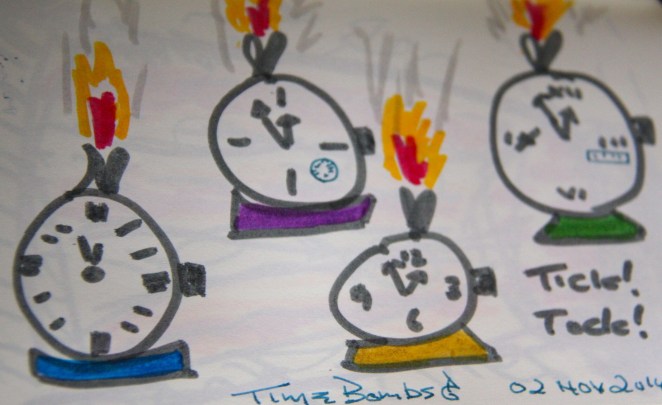
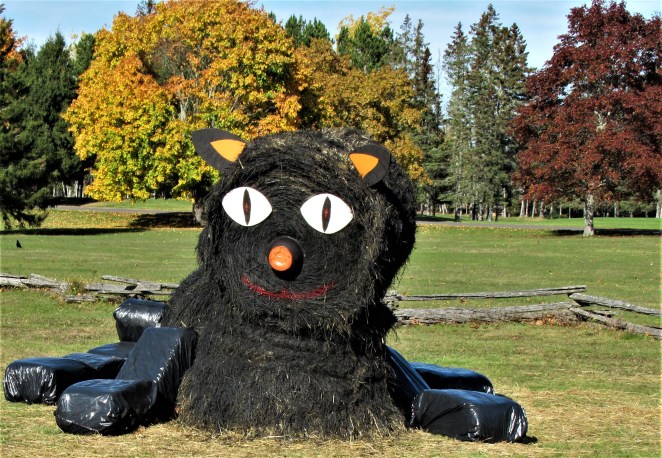
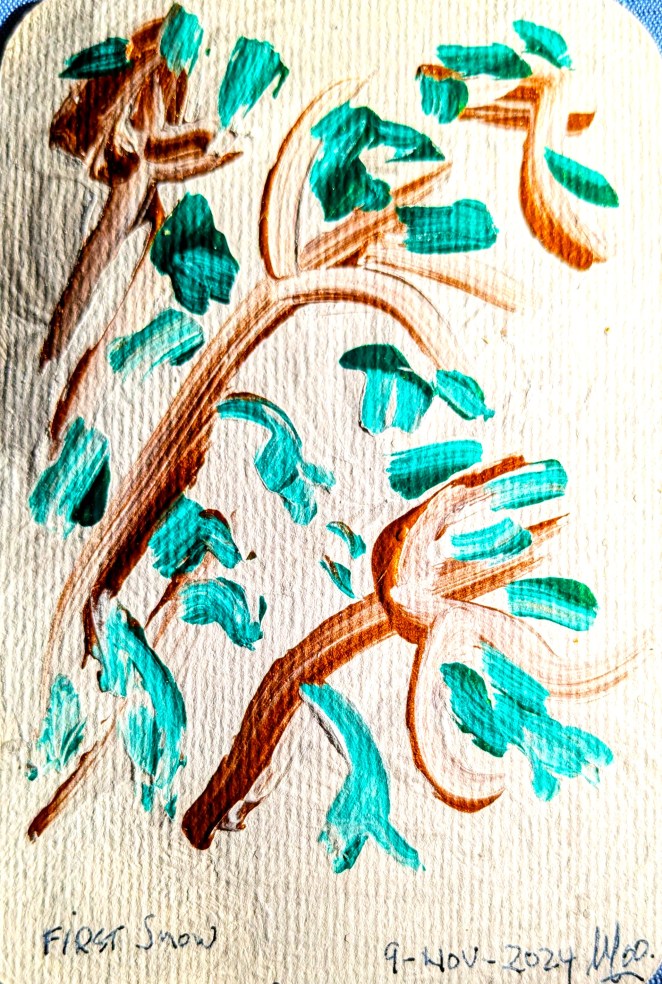
Hallowe’en

Hallowe’en

1

Today is All Hallows Eve.
Tomorrow is Oaxaca’s
Day of the Dead.
The clocks change
the day after tomorrow.

Today, it’s raining,
and rain is a trick when
it forces celebrants off the streets
and town councils vote to change
the traditional date and send
young children out trick and treating
on a dry, warmer night.

But this rain, after drought,
is a Hallowe’en treat.

It brings a promise
that the aquifers will refill
that wells will not run dry,
and above all,
it brings us hope.

2

Around us, fall thrives
and watches and clocks
will soon fall back.

Trees weep for lost leaves.
Flowers that flourished
now wither and perish.

Hollyhocks topple and fall.
Bees’ Balm is abandoned
by butterflies and bees.

3

I expect time
to change with the clocks
and my body clock
will soon be out of sync
with the tick-tock chime
that denounces each hour.

Hours that used to wound
now threaten to kill.
They used to limp along,
but now they just rush by
and I, who used to run
from point to point,
now shuffle a step at a time.

But still I live in hopes to see
the clocks spring forward
once more.


Commentary:

A great poem for Hallowe’en, even if I say so myself, and I haven’t even mentioned the Blue Jays and the Los Angeles Dodgers. Oh, woe is me. Shame and scandal in my poetry.

Game Six of the World Series on Hallowe’en – wow! – well, one team will get a treat and the other will receive a very disappointing trick. I know which team I support, but I don’t know who will win this time around.

Having said that – with substantial rain after drought, everybody in my province is a winner. And who could wish for more than that?

Carved in Stone 2

2

How many free thinkers
stumble up the gallows’ steps
or take that short walk,
candle in hand,
to the executioner’s block?

Some take a longer trip,
in a tumbril along French streets
lined with howling,
slogan-chanting citizens,
en route to the guillotine.

Heads, already severed,
welcome them with sightless eyes,
a strange harvest for straw baskets.

Hearken to the swish of stone
against steel as the executioner
sharpens the blade that will swiftly fall,
then rise, only to fall again.

The horse-drawn cart
creaks towards its inevitable end,
filled, standing room only,
with unfortunates trapped
by whatever rising tide
hurled them against the razor rocks
of their imminent mortality.

Commentary:

Flower Pot Rocks along the Fundy Coast. One of the most beautiful spots in New Brunswick, a province with so many other beauty spots. It’s hard to believe that I was standing on the seabed when I took that photo. It’s also hard to believe that the Fundy Tide, one of the highest, if not the highest, in the world, rises to the tree line, at the top of the photo, way above the sand.

If you go to the Fundy, consult the Tide Tables with care. You do not want to get stuck in the Fundy mud. Nor do you want to be one of the unfortunates trapped by whatever rising tide hurls you against the razor rocks of your imminent mortality.

Carved in Stone 1

My very own hand-carved verraco
Del Rincon (Avila) a Roger

Carved in Stone

1

Behold me here,
filled with a sort of shallow,
hollowed-out wisdom
accumulated over decades
while listening with my eyes
to the words and thoughts
of writers, long-dead.

Imprisoned in book pages,
do they bang their heads
against walls that bind,
or hammer with their fists
at the barred lines
of their printed cages?

These spirits long to break free,
but they choke on library dust
and pollen from verbal flowers
that bloom unseen.

Those old ones avoided
the traps of temporal power,
or, once trapped,
gnawed off a precious limb
to limp into freedom

Commentary:

Carved in Stone is the second dialog (Chronotopos II) in my Bakhtinian Dialogs with my time and my place. Clepsydra is the first Dialog. You can follow it, in its entirety, starting with this first, introductory post.

Reception Theory – I write, you read. Any meaning that you extract from my poetry will depend on your own culture and background. Tolle, Lege – Take and read. Read slowly, and with care.

I am a poet, a dreamer, if you will. These are my dreams. Tread softly on my dreams, for when you enter my world, you mingle your dreams with mine. The result, I hope, will be an interesting intellectual blend of new creativity.

The hand-carved verraco, in the photo above, was given me by my friends in the Rincon (Avila) where I spent four happy and creative summers. Never forgotten. Blessings and pax amorque.

Clepsydra 49 & 50

49

… I am walking backwards
     a step at a time
          into my second childhood


my face in the mirror
     is no longer that of the little boy
          I used to be


I open so many boxes
     stored in my mind’s attic
          but find only dust and ashes
               the burnt-out remains
                    of long-gone days …


50

… sitting in the car
     waiting for my beloved
          to finish her shopping

who are they
     these faceless people
          these ghosts
               who look at me
                    then avert their eyes

I see their faces
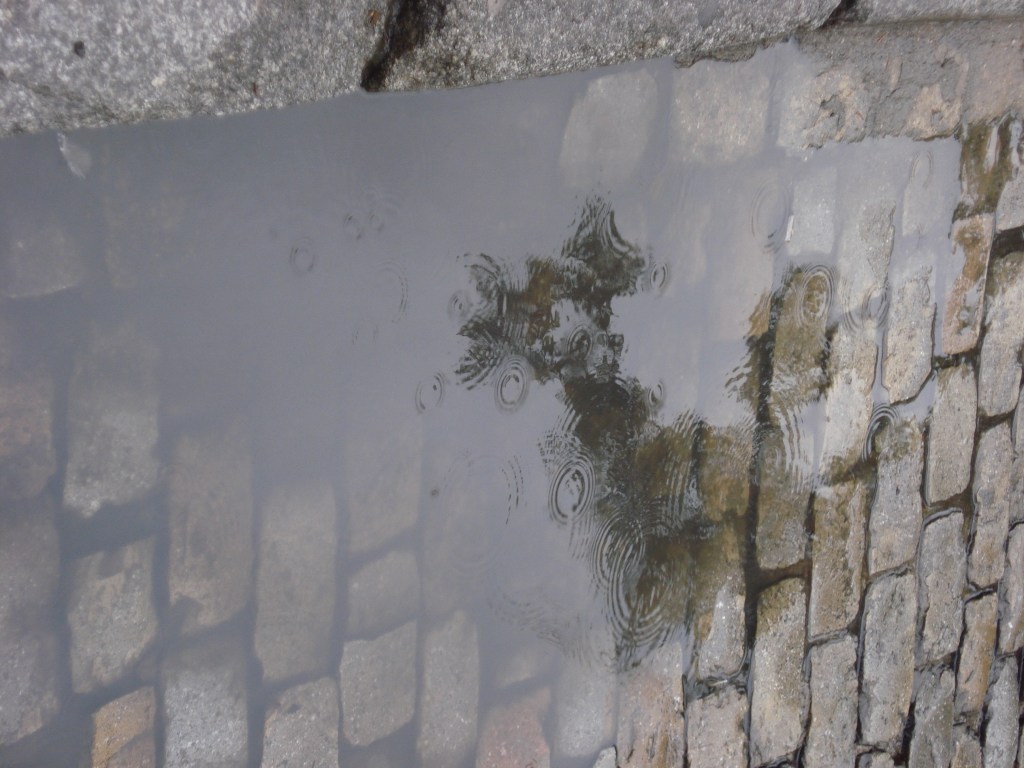
     distorted in the puddles
          left by last night’s rain

why don’t they speak to me
     why do they always
          avoid my eyes

is it the blue sticker
     in the windscreen …  

Commentary:

I see their faces distorted in the puddles left by last night’s rain.

Clepsydra 37 & 38

37


… now I am absent from myself
     but can an absence
          be a presence

 I guess it can
     like when I lose a tooth
          I lament the loss of its presence
               and run my tongue
                    around the tender gum

a space where my tooth once stood
     where the candle flame
          once flickered and flared
               before it disappeared …

38

… I grieve for my mother
     standing in the garden
          her magnolia bleeding
               ivory petals
                    as soft as spring snow

some settled on her head
     crowning her
          with youthful beauty
               as she walked towards me
                    eyes shining arms held out

yet when I try
     to recapture that scene
          I only see a winter garden
               with withered blossoms
                    on a leafless tree …

Commentary:

“Can an absence be a presence?” Good question I asked Moo that and he showed me several paintings of trees in winter and vacant faces that he had knowingly filled with sorrow. But I preferred the image of “I only see a winter garden with withered blossoms on a leafless tree.” So I chose my own photo. Moo was very upset and asked me to put in one of his winter paintings anyway, so here it is.

Now Moo is very happy, and he needs to be, because he has had a bad day. I am so glad I am not Moo when he has a bad day. His cardiologist wanted Moo to wear a Holter. Moo didn’t want to wear one. But he listened to his specialist, and obeyed. He was very stressed when he went into the hospital. The acquisition of the Halter was meant to take 15 minutes, maximum. Moo sent 75 minutes sitting in a cold room with no shirt on, terminals attached, and no Holter available. “Can an absence be a presence?” Indeed it can. And Moo is still very upset and very stressed. Nobody’s fault. Things happen. “The candle flame once flickered and flared before it disappeared.” Now you see it, now you don’t. And Moo laments the absence of what should have been a presence and then became a delayed presence. Oh fickle life and times!

I still grieve for my mother, standing in the garden, her magnolia bleeding ivory petals as soft as spring snow. I remember that some settled on her head crowning her with youthful beauty as she walked towards me, eyes shining arms held out. Yet when I try to recapture that scene I only see a winter garden with withered blossoms on a leafless tree. Maybe Moo, with all his stressed out Moo-ds saw that scene more clearly than I did. So, Moo boosts me, and I boost Moo, and that’s what best friends always do. So you go out and boost your best friend too. Blessings and blossoms. And may you all help each other to fare well.

Great Blue Heron

Great Blue Heron

The blood light draining from the sky
midges of color
skimming the beaver pond
colors skipping across the lake
the water alive with color

the low moon skinny dipping
across the surface each ripple
a leaf of stained glass
torn from a cathedral window

twin sticks angled
stark in the water
poised on thin stilts
waiting

this angel now
stripped of all garments
save a blue-grey gown
feathered around her

Commentary:

I love the great blue herons (GBH). They appear from nowhere, perch for a while, then vanish. So many on PEI. One evening I counted 60 or 70 in the bay. Such stealth. Such patience. Such beauty. Then a quick strike and GBH – grievous bodily harm to some small fish or frog invading their fishing space.

They build colonies in the trees by the waterside yet each creates its own free space when they fish in the waters. Flying, such power, such grace. Sharp beak our front, legs out behind, and the power surge of their wings thrusting them onwards.

Such a pleasure to stand still, to watch them and to thrill to the sudden spearing lurch of the attack. The house we borrowed in PEI had a little stream at the back. A GBH fished there. Quietly. Unseen. Scarcely moving the waters. A loner, just like me and mine. An only. As we are. Stately in his loneliness. As my beloved is in hers As I am in mine. A shadow on the waters. A shadow, while the sun still shines.

Clepsydra 33

33

… but the light cannot last forever
     so where do I go
          when the door in my head
               slams shut
         
then I know
     I have lost the key
          to my mind’s labyrinth
               I struggle
                    but I realize
                         there’s no escape

Ariadne’s thread
     the one that should lead me
          out of the labyrinth
               turns into a woven web
                     trapping me
                         leading nowhere

the minotaur
     half-bull – half-man
          bellows
               stifles all thoughts

my heart turns to stone
     indigestible
          in the throat’s gorge
               or the stomach’s pit
                    and my mouth’s
                         too dry to spit

in this starless night
     when fear descends with the dark
          a guillotine slices its way
               through muscle and bone
                    to sever all hope

no glow worm
     can worm its way
          into my mind
               to enlighten the path …

Commentary:

“… the minotaur, half-bull, half-man, bellows and stifles all thoughts …” I asked Moo for a painting of a Minotaur, but he didn’t have one. So I pottered about and found this photo of Los Toros de Guisando, a pre-Roman set of sculptures, in the Province of Avila, carved by the Celts. Not exactly a Minotaur, but certainly a set of taurine images that baffle with their size, silence, and presence. Indeed, they conjure up the images of the poem’s next verse ” … stone, indigestible in the throat’s gorge or the stomach’s pit …”

This is the cave painting, circa 5,000 BC of a bull, as found on the wall of the Caves of Altamira. Alas, he cannot bellow. Or should I say, Thank heavens, he can neither bellow nor pursue us. He stands silent on his cave wall. This photo comes from a glass ash tray my father purchased as a souvenir when we visited those caves (circa 1963-65, before they were closed to the public). Intertextuality – this bull as text and the long history of his multiple appearances. Metaphor and magic, mysterious and marvelous.

The idea that “religion is a glow-worm that glows in the darkness” is a metaphorical observation on the nature of faith. Its most famous expression comes from the German philosopher Arthur Schopenhauer. The statement suggests that religion appears most valuable and needed when people are in a state of ignorance, uncertainty, or despair.” Wikipedia – AI Generated. Our poet, that’s me, in case there are any doubts, refers back to this idea when he writes “no glow worm can worm its way into my mind to enlighten the path”. This too links back to the poetry of St. John of the Cross and his references to the dark night of the soul when hope seems lost and we despair of everything. Then we link to Goya’s etching – The Sleep of Reason – “when reason sleeps, monsters are born.”

However dark the night, someone has walked this way before us. We can follow in their footsteps and hope for the dawn. When it arrives, we can rejoice. But never forget the law of circularity, what goes round, comes round. Night will come back, the way will again be dark, but the light will always return once more. Images and symbols, metaphors and mystery, even the unspeakable can be spoken in the ways in which the ancient artists, sculptors, painters, saints, and philosophers have shown us.

Clepsydra 31 & 32

31

… I become more aware
     of the world
          outside my mother’s womb

I listen to the house’s heartbeat
     the occasional creak
          intruding rarely
               the house inhaling
                    exhaling

 I pay attention
     to my own bodily sounds
          my heart rate slowing
               increasing

now I can hear
     the faint tick-tock
          of a distant clock

a sunray illuminates
     a dust mote
          that dances before my eyes

light without sound
     silent butterfly wings
          seeking celestial light …

32

… did I write
          these words for me
               or did I write them
                    for someone else

does it matter
     when the only thing that counts
          is the beauty released,
               when the butterfly breaks free
                    and takes flight …

Commentary:

“The only thing that counts is the beauty released when the butterfly takes flight.” Sounds beautiful, doesn’t it? Just like the old poetic adage “beauty is truth and truth beauty.” But is it true? There are some very ugly truths and it is very hard to beautify them, even though we do our best to do so. I have always hated simplicities like “lipstick on a pig” or “silk purse out of sow’s ear”. And then there’s ‘a rose by any other name would smell as sweet.’ Probably true. Yet an ugly truth is still an ugly truth however much the spin doctors try to spin it.

And for whom does a poet (he in this case, the poet being me) write his poetry? Did I write those words for me, or for someone else? Good question. I certainly wrote them in the hopes that someone, somewhere, perhaps you, whoever you are, might read them. But I don’t know you, can’t know you, how could I know you? But if I don’t know you, how could I write for you? Did Cervantes write the Quixote for himself, or for his readers? And who were his readers, did he know them? He certainly didn’t know me, because he passed away on April 23, 1616, same date as William Shakespeare and the Inca Garcilasso de la Vega. The same date, you notice, but not the same day! Puzzle that one out, if you will. Meanwhile, he died 328 years, give or take a month or two, before I was born, so I don’t think he had me in mind as he penned his words, much as I didn’t have you (specifically) in mind, as I penned mine.

Carpe diem – seize the day. Don’t wase it on such idle philosophical speculations. Speculation / peculation – go buy yourself a lottery ticket – you may even win the jackpot. Of course, if you wish, you can be like me. I never buy lottery tickets and that would put money in my pocket every week (think of it as winnings!) except I never take it out. And remember – “Keep your water weak and your cider strong, keep your hands in your pockets and you won’t go wrong.”

Clepsydra 28 & 29

28

… diagnosed
     with a terminal illness
          called life
               I know it will end
                    in death

I have seen many
     pass that way
          two-legged humans
               four-legged friends
                    and none have come back

I recall
     holding the dog’s shaved paw
          while the vet slipped
               that last redeeming needle
                    into the exposed vein

the dog’s eyes
     pleaded for release
          her tongue licked my hand
               oh so trusting
                    even at that
                         for me
                              so bitter end

and did the poor dog know
     what was coming
          did she live her life
               as I have led mine
                    waiting for that last word
                         to be spoken
                              the last order given …

29

… two of us
     me and my death
          walking side by side
               everywhere
                    sharing the same bed
                         sleeping between
                              the same sheets

I wonder if
     we dream
          the same dreams

my death
     how would I greet him
          when he came
               as executioner
                    not friend

I re-create him as a man
     or as a dark angel
          with all-comforting wings

is he open-eyed,
          while I am blindfolded
               not knowing the way
                    afraid of falling

this death
     is it cruelty
          or merely love               

the path is ahead is new
     and totally unknown …

Commentary:

Many of the images in these two pieces are exercises in intertextual examples, Stanza 29 in particular, drawn from the Neo-Stoicism of Francisco de Quevedo (1580-1645). His advice, set out in poem after poem, is to embrace death before it comes. Prepare for it, mentally, and be aware that it is the natural end of life. As Dylan Thomas also writes, “Every morning when I wake, oh Lord this little prayer I make, that thou wilt keep thy watchful eye on all poor creatures born to die.” The Dunvant Male Voice Choir gives us this version of it. Remember to turn your sound on! I like this version, not just for the music, but also for the views over one of my favorite childhood beaches, Rhossili and the Worm’s Head, not far from my home in Gower.

As I grow older and creakier, as my ailments accumulate, one by one, so I realize that indeed I have been “diagnosed with a terminal illness called life.” It’s funny to think of life as a terminal ailment. “Take two Tylenol and when you wake up tomorrow morning you’ll be feeling much better.” And yes, like every sane person “I know it [this terminal ailment] will end in death.” So, don’t be sad. Carpe Diem – seize each day and enjoy every one of them to the best of your ability. Remember the inscription on the Roman Sundial – horas non numero nisi serenas – I count only the happy hours. Whatever you do, have no regrets. If you do have some, make your peace with them now – or as soon as you possibly can. And, when the call comes, go willingly. Step with pride and joy onto that new and unknown path that will lead you to an eternity of joy, acceptance, and love.
                   

Clepsydra 27

Clepsydra 27

… the museum closes its doors
     inside the clepsydra murmurs
          on and on

evening falls from the sky
     in great cataracts of light
          stars flare like candles

who will see
     that last drop of water
          trembling at
               the clepsydra’s edge,

who will snuff out
     that last flickering
          flame of my life
               as the final verses
                    of the children’s song
                         loom closer

Here comes a candle
     to light you to bed.
          And here comes a chopper
               to chop of your head…

Commentary:

Moo got it right this time – “evening falls from the sky in great cataracts of light, stars flare like candles …” Lovely painting of a star ‘flaring like a candle’ against the evening sky. I think he called the painting Affirmation. Yup, he’s nodding his head, and he has his eyes wide open. He’s not dropping off into one of those drowsy moments of old age. Too early in the morning to do ‘noddy’ I say. Oh-oh, there he goes. It’s Billy Cotton Band Show Time … “Wakey-wakey!” Now how many of you remember the Billy Cotton Band Show on BBC Radio on Sunday afternoons, just as people are dropping off to sleep after the enormous Sunday dinner and dessert? Hands up if you’re over eighty and remember that. Oh dear. Not a good idea. Moo’s hand’s gone up and he’s still got his eyes shut. Ah well, appearances aren’t everything.

And look at that comma after – the clepsydra’s edge, (line 10) -. The one that got away. There’s always one that gets away, no matter how hard we try – and try we do. Clepsydra is meant to be a single sentence, with no punctuation other than an ellipsis at the beginning and end of each sequence. And what have we here? A common or garden comma, growing like a large, spring dent-de-lion / dandelion in the middle of a patch of flowery images and metaphors. Out, out fowl spot! What bird was that? A Flying MacBeth just dropped something on my windshield. ‘What a foul fowl was that fellow,’ said the soccer referee pointing to the penalty spot. A round spot with a whale of a tail.

“Any questions?” I asked my students at the end of class one day. A brave young lad raised his hand. “I have a question, sir?” [I liked it when they called me, sir. It happened about once or twice a year. I always knew something drastic was about to happen when I received a knighthood.] “Ask away,” I replied. “What the heck are you on? I’d love to have some of that. Can you give me some, sir!” Two knighthoods in one day. I’ll be a KG next, instead of an RG. I bet you don’t get that joke! Answers by snail mail and dog sled, please!