On what subject(s) are you an authority?

Daily writing prompt
On what subject(s) are you an authority?

On what subject(s) are you an authority?

First, I would like a definition of an authority. Here’s what I found – 1. the power or right to give orders, make decisions, and enforce obedience – as in “he had absolute authority over his subordinates”. 2. a person or organization having power or control in a particular, typically political or administrative, sphere as in – “the health authorities”. Isolating the words enforcement, power, and control, I am delighted to say that no, I am not an authority on anything, and I have no control over anyone. Also, I am not a monarch, and I have no subjects.

What happens if we change the meaning of the words slightly and ask another question? Here is a suggestion from the online Cambridge Dictionary – searching for an answer to my question “What is an example of authority on the subject? – I found this – The phrase “authority on the subject” is correct and usable in written English. You can use this phrase to describe someone who has extensive knowledge or experience on a particular topic. For example, “Dr. Smith is considered an authority on the subject of modern psychology.”

Now this becomes a very interesting question and it can be answered from a variety of perspectives. In our two person household, I deem myself an authority on some forms of cooking. I regard my beloved wife, my better two-thirds as I call her – an authority on the forms of cooking that I have trouble with – for example, baking, cooking vegetables, boiling eggs. She does a wonderful boiled egg. I am hopeless at boiling eggs – either too hard or too soft, usually the former. But I am the authority on Spanish omelets and scrambled eggs. They are my specialities. She makes wonderful chowders. I specialize in gazpachos, sopa de quince minutos a very quick (15 minute) Spanish sea-food soup, and Cawl Mamgu and other Welsh stews.

Once we step outside our kitchen, the world changes. In a world (New Brunswick) where cricket is virtually unheard of (save in the minds and cultures of fellow immigrants) I am considered an authority on cricket. Not that I am an authority, but at least I know what it is and have a good idea of what is happening in a cricket match. Therefore, we must also consider ‘being an authority’ in the context of the audience that receives our words of wisdom. To my nine year old grand-daughter, I am an authority on several subjects. However, I have absolutely no control over her – how she thinks and what she does. I can suggest or persuade, but I cannot and will not enforce.

In the undergraduate classroom, in which I taught for 43 years, I was considered an authority on Spanish by my students. Outside the classroom (and sometimes inside it) I learned more from my students than they ever learned from me, especially in my formative years as a Canadian when I was learning to skate and to ski. Don’t go there – too many painful memories of falling only to rise again!

But when we moved from the classroom to the wider university, to the full Canadian Scene of the Learned Societies, as they used to be called, I became the learner and the authorities were to be found elsewhere, often on the podium, sometimes in the bar. Same thing when we move onto the international stage. There are very few world authorities, in my field. However, there are many wannabe’s, but for them, after careful analysis of their strengths and weaknesses, I have usually had very little respect.

So, today we have opened another can of worms and look at them, wriggling and crawling before our very eyes. Worms – one of my friends really is an authority on earth worms. She knows all about them. Another of my friends is an authority on worms in puppies and kittens. A world wide authority, known every where and often quoted? I doubt it. But certainly in my garden and the vet hospital where I take my pets, they are both authorities.

Ah, the joys of Discourse Analysis – maybe, one day, I can be an expert on that. But take my words, as always, with a large pinch of salt, and, whatever you do, don’t put salt on slugs, and snails, and puppy dog tails. On that point, we can all be authorities.

What are your daily habits?


Daily writing prompt
What are your daily habits?

What are your daily habits?

“The habit (Greek: Σχήμα, romanized: Schēma) is essentially the same throughout the world. The normal monastic color is black, symbolic of repentance and simplicity. The habits of monks and nuns are identical. Additionally, nuns wear a scarf, called an apostolnik.”

So, my daily habits are a little bit monastic. “Monks were very religious, lived simple lives and followed certain rules to discipline themselves. The monks didn’t have any possessions, they didn’t even own their own clothes and they wore a simple garment known as a habit. Monks chose to live in the monastery as they wanted to help others and worship God.”

I can’t say I am very religious, in the church-going sense, but I do live a pretty simple life. My rules and disciplines consist of daily exercises, stretching and strength, a morning wash and shave, getting dressed in my non-monkish habits – jeans, shirt, sox, shoes or sandals. Coffee and fruit for breakfast. Writing – (a) in my journal (b) on the computer (c) in my poetry book. An early lunch, usually a sandwich. A post-prandial walk around the garden with my roller, examining the hollyhocks, the yucca, and the clematis, and checking on the progress of the other flowers.

The daily routine of a monk is somewhat similar. Monks typically wake up early in the morning, often before sunrise. I wake up early, text a couple of my best friends on the cell phone beside my bed, and then I go back to sleep again. I often begin the day with a prayer or a hymn – as do the monks – “Every morning, when I wake, / oh Lord, this little prayer I make, / that thou will keep a watchful eye, / on all poor creatures born to die.” Then I begin my daily routine of work and meditation. The specific activities and schedule can vary, but generally, I spend several hours each day in work (writing) or study (reading).

I try to think like a monk – to think like a monk means to remain calm and focused under all circumstances, especially when life gets challenging. Alas, at my age, I meet challengers all through the day. Things fall to the floor – challenge – can I pick them up with my magic claw? I can’t open bottles and cans – challenge – can I do so with one of my two magic appliances? I actually have three, but one of them doesn’t work. The other two, however, are wonderful. It is almost impossible for me to open plastic wrappings – challenge – can I do so with a pair of scissors, a pocket knife, or must I, in the worst case scenario, use a genuine can opener? Good tip, that, incidentally, especially for bubble packs. There are many other challenges, the worst of which is always what to do if I fall down. We won’t talk about that – I just do my best not to fall.

I also do my best to lead a relatively simple life – I try (1) to do one thing at a time – (2) to commit whole-heartedly to my family and few close friends – (3) to simplify my life and concentrate on what I am doing – (4) to develop my mind by not indulging excessively in social media – (5) to order my existence by making lists of essentials that must be accomplished – (6) to express myself and my love for the world around me in poetry, prose, and paint – and finally, (7) to remember that, the day I was born, I took my first step on the path to death. Beyond that, I do very little more.

What makes a teacher great?

Daily writing prompt
What makes a teacher great?

What makes a teacher great?

When Moo descended from Mount Academia, he brought down with him the ten tenets to which great teachers, knowingly or unknowingly, commit. He asked me to transcribe them here, since they were in danger of being neglected and / or forgotten.

  1. Mastery of the subject – great teachers know their subjects inside out. They do not read their graduate school notes to their students, heads bowed, chins on chest, droning on in a low, boring mumble. They encourage questions and are open to debate with their students about the subject that they know so well and openly love.

    Master thy subject.

  2. Humility – great teachers are humble. They know that they are not omniscient. They also know that knowledge changes across time and that they too must change and follow new ideas. They also know, perhaps instinctively, that some of their students are as intelligent as they are. They never dismiss their young charges as idiots, fools, or lunatics to be beaten and forced into the required shape.

    Be humble.

  3. Flexibility – great teachers are flexible, not rigid. They can bend the rules, reshape the syllabus, change pace and tone to match the needs of their students. In addition, they ask their students about their needs and try to address those needs in a personal way, sometimes on a one on one basis.

    Be flexible.

  4. Reaching out – great teachers reach out to their students as a group and as individuals. They never paint themselves into the know-all corner where they alone know best, and they know, with absolute certainty, what’s best for their students. Great teachers know, above all, that one size, in great teaching, neither fits nor benefits all.

    Reach out.

  5. Equal treatment – great teachers treat their students equally. They do not fawn on the best and scorn the worst, nor do they teach by the WWII convoy system, teaching only at the speed of the slowest. By extension, great teachers try to create an atmosphere of love in learning and joy in the subject.

    Practice equality.

  6. Honesty – great teachers are honest, fiercely honest. They know their own strengths and weaknesses, their own limitations. They work on their weaknesses, striving to turn them into strengths. They also push the boundaries of their limitations, striving always to keep up with the ever-changing frontiers of knowledge.

    Be honest.

  7. Human beings – great teachers know that they are human beings and they recognize early on in their careers, that while they are teaching a subject, they are also preparing fellow humans for a life beyond the ivy-covered walls of academia. By extension, they emphasize the humanity of their students and try always to develop and sustain that humanity.

    Be human.

  8. The meaning of meaning – great teachers reach out beyond their subjects to teach the meaning of meaning. Why is the subject important? What can each individual use this hard-earned knowledge for, in their own lives? How can they reshape their own lives and create better ways of learning and living? This teams up with reaching out and enters the realm of learning for learning’s sake and love of learning and love of knowledge.

    Love thy learning.

  9. Creativity – great teachers are creative. They open their students’ minds to new ideas, fresh knowledge, better ways of doing things. They never use phrases like ‘thinking outside the box’ and they do not build better boxes, one or two sizes larger than current boxes, inside which their students must now sit, work, and think. Creative teachers tear down the walls of medieval academia and open their students’ minds to the winds of change and fresh knowledge.

    Be creative.

  10. Life long learning – great teachers teach students how to think for themselves, how to teach themselves, how to self-assess, how to check and double-check the knowledge (all too often nowadays, fake news and / or false knowledge) handed down to them from a multitude of sources, far too many of them unreliable. Great teachers teach their students to know themselves. They also teach them how to work out whether a source is a reliable fount of information, or not. In short, they teach life long learning and neither they, nor their students, ever give up hope.


    Teach Life Long Learning.

White Space

White Space

A place of silence,
          white space
at page edge,
          bearing witness
to the absence
          of words.

A place to pause,
          rest,
to think.

A place,
          like the white space
between lines of prose,
          where eye and mind
can pause and rest.

Bewildering
          the pounding
of earwig music,
          the advert repeated

again and again,
          the omnipresent
sound byte.

Everlasting,
          the loop, the loop,
the interminable loop
          that intrudes on
silence.

Words

Words emerge
          from the silence
of blood and bone.

They break
          that silence
the day they are born.

Silence,
          once broken,
cannot be repaired.

A word once spoken
          cannot be recalled.

The greatest gift –
           knowing how to be alone,
how to sink into silence.

A world of words
          smothered at birth
and that world,
          dismissed, forgotten,
sometimes still-born.

A lost world of words
          whirled on the silent wind
that fans the unborn fire within.

The spider web of the mind
          blown clear by the wind
that blows unspoken words.

The hush of the tadpole
          swimming
into its own metamorphosis.

The sultry oblivion
          of blood and bone.

Poetry that expresses the authenticity of being. Playful, yes, but packed with meaning. Taste it on the tongue. Savor it in the mind. Touch the words on the page. Indulge yourself in the white spaces between the words. Read and re-read each poem. Dive into its depths. Swim – but do not let yourself drown. When you surface again, return to the light and remember, all will be well.

A Broken Heart

A Broken Heart

What does a broken heart look like? Good question – and I, for one, don’t know. Maybe my artist friend, Moo, does. He painted this image of a Fragmented Heart the other day. Not that his heart was broken. He told me he was interpreting the words and feelings of a close friend (who shall remain nameless) who has been having the feelings associated with a heart that was actually breaking. Tough times, eh?

Rejections get me down and annoy me, but they don’t break my heart. I submitted a short story to a magazine on January 4, 2023 and got a rejection letter yesterday, May 6, 2024. It was a form letter, 16 months after submission, just to say “no”!

Of course, the few acceptances that I actually do get make up for the many rejections, as is always the case. However, there seem to be fewer of these acceptances as my thoughts look inwards and I turn from ‘poetry of play to poetry that expresses the authenticity of being‘ (Johannes Pfeiffer). In this day and age, I fear that readers seek entertainment and distraction and prefer the light-hearted to the heavy hand of deep thought and poetic authenticity. And remember, I do not distinguish between poetry and prose, as many do. For me, poetry is writing, be it in poetry or prose.

But back to the theme of the broken heart. Here are three linked poems.

Old Wounds

“The slow wound
deepens with the years
and brings no healing.”

The Minister by R. S. Thomas

How deep time’s wounds
have cut and carved,
not just in flesh and bone,
but in the embers
of that slow-burn fire
 they call the heart.

Memory and mind
have also played their part.

Some days, those wounds
don’t ache at all.

But there’s no real healing,
and a moment of madness
or a knife-edged finger nail,
careless, in the dark,
opens them up again
to bleed afresh
and remind us
of the frailty of the flesh.

I Remember

“I remember so well how it was back then.
I was lonely, my heart so broken I couldn’t
count the pieces, nor put the puzzle together,
 although I tried so hard to make it whole again.

I still bear scars, trenches dug so deep,
lines gouged into my body. I can’t always sleep.
Nightmares pave a crooked, cobbled way to day.

Some nights, I wake up suddenly from a dream
and scream the way that stuck pigs scream
when, hot, their blood comes steaming out.
Other nights, in pain and panic, at shadows I shout.

I search for someone to care for me. I want them
to understand my grief and help me forget the thief
who stole my joy and left me this life of disbelief.”

Signs of Age

What is pain, but the knowledge
that we are alive, and relatively well,
and still on the green side of the grass.

Long may it last. For when the pain is gone,
we shall soon follow. And this is age,
and age is this pain, and the painful
knowledge that we are no longer young,
can no longer bend the way we bent,
or touch our toes, or even see our toes,
some of us. The golden arrow pierces
the heart. Fierce is the pain. But when
that arrow is withdrawn and the heart
no longer feels alive, why, how we miss
that pain, how we weep to find it gone,
perhaps never to come back again.

Pain, like rain, an essential part of the cycle
of the seasons, of the days and the weeks,
and all the months and years that walk us
around the circadian circle, in time with the earth
and its desire to open its arms, and welcome us,
and greet us, and bring us our rest, from pain.

So much wisdom sewn into the wrinkled skin,
the gap-filled grin that glows with humor,
the crow’s foot signals of old age,
or merely those we associate with ageing,
and the knowledge that, yes, many
have walked this wobbly way before,
and many more will follow in our footsteps.

Take your pick – ‘poetry of play to poetry that expresses the authenticity of being‘ – but I know which I prefer and ‘still I live in hopes to see poems of authenticity.”

If you could be someone else for a day, who would you be, and why?

Daily writing prompt
If you could be someone else for a day, who would you be, and why?

If you could be someone else for a day, who would you be, and why?

My instant response was – I would be a billionaire, names don’t matter, then transfer a couple of million to myself, then back out of the alternate persona for another day, and there I would be – rich and happy, my old self once more. Then I started thinking – ‘billionaires don’t do things like that’ – then I really started thinking. How much of my alternate persona would I take over? Would I be myself in another body? Or would I be that person, privileged, hard, caring only for myself and my fortune, sparing nobody as I strove for my ultimate desire, the Noah’s Ark of a bunker that would protect me from the oncoming disaster that I was myself encouraging to happen? Enough, I said to myself. That’s not for me.

I thought about it during the night, in those elusive moments between waking and sleeping, that half-sleep contained in the Spanish duermivela. And then the light bulb flashed and I knew who I would be.

I have always wanted to visit Australia. The cost, the length of the flight, the rigors of the journey, the fear of DVT, have all prevented me from making that voyage – quite simply a flight too far. But what if I could be my cousin Frances, in Sydney, for a day? I have never met most of her family, and this would be a wonderful chance for me to do so. I would see her husband, George, in close-up. Also her four children, two of whom I have never seen except in photos. I could also meet their partners, and the grand-children, and all of that merely by waking up in another body on another continent. If I timed it right, I might even manage to visit the Sydney Opera House and see the harbour bridge, or catch a test match, or a rugby international – the red lights are flashing – overload – overload – overload -!!! Too much – too greedy – KISS – Keep It Simple Stupid – !!!

Seeing the family, experiencing her daily life, looking at her garden, so beautiful in the photos, maybe even sinking my fingers into that rich earth, that would be more than enough. Ayer’s Rock – Uruburu – Alice Springs, the Fremantle Doctor, my cousins in Perth and Bundaburg, they will have to wait. Sydney and my closest family, that will be more than enough.

But how much will I retain upon my return? How much will I remember? And what will happen to Frances? Will she become me and be forced to suffer our Canadian winter, for a day, while I rejoice in her Australian summer? So many questions.

Too many questions. Maybe I’ll just be myself, after all, as Oscar Wilde says “Be yourself. Everybody else is taken.” I’ll just be myself and to the above offer I will reply: “Thanks, but no thanks. I just want to be me.”

You’re writing your autobiography. What’s your opening sentence?

Daily writing prompt
You’re writing your autobiography. What’s your opening sentence?

You’re writing your autobiography. What’s your opening sentence?

The End.

Why did I write that? Because I like reading T. S. Eliot – Four Quartets – “In my beginning is my end.” If that statement be true, then, ipso facto, The End must be my first sentence, because that’s my beginning. Eliot converted to Catholicism – and, according to the Jesuits, “The end justifies the means” – so, when we start with the end we are justifying the writing (the means) of all that led us there.

You don’t like my logic, you say? Why not? It is as straight as the corkscrew I hold in my hand when I am threatening to add the contents of a bottle of wine to my autobiography. Is a bottle’s end in it’s beginning? Of course it is. If you don’t open the bottle, you can’t finish it. If you don’t start it, you cannot end it, so in the beginning lies the end.

Oh the mysteries of mysticism, those truths that know no logic and follow no known paths from their beginning (via purgativa), through their middle (via iluminativa), to their end (via unitiva). Or is life and truth a circle that has no end? In which case wherever I begin the circle of my autobiography, there too is my end.

In my end is my beginning and in my beginning is my end.

Mors omnia solvit.
The End.

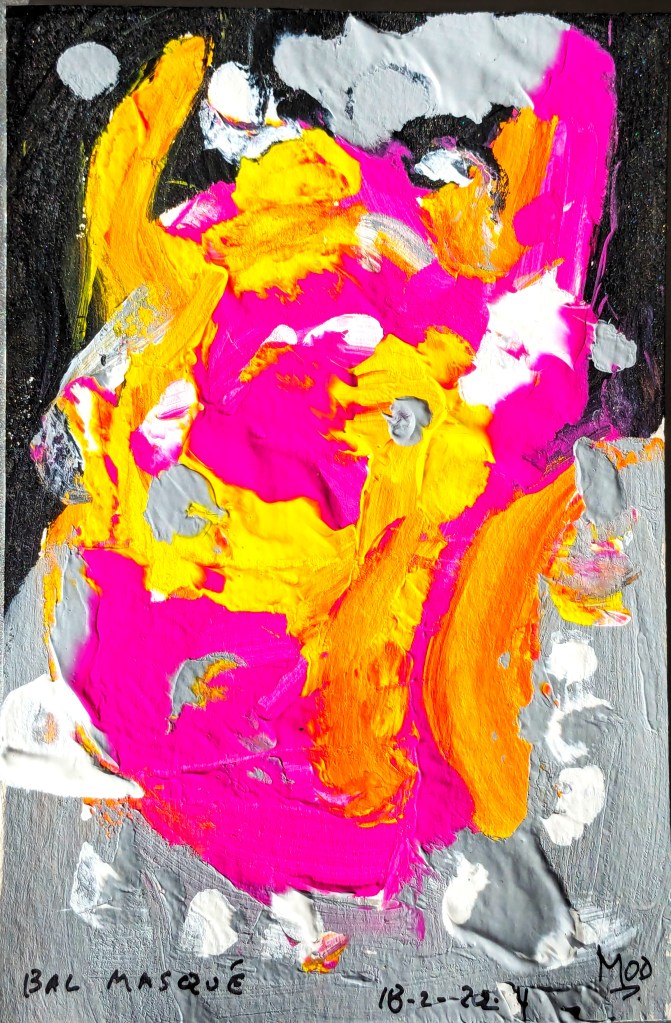
A Masked Ball

Masked Ball

After a two-week lay-off, the Dance of Colors returns. What caused the lay-off? Absolutely nothing. I grew tired of posting, of writing, of throwing my paint on the waters of the web and waiting to see what, if anything, happened. Well – nothing happened.

Steven King, On Writing, says “Paper your walls with rejections.” And I have done, pages and pages of them. The secret is ‘never surrender’ – ‘never give up’ – or, in the language of the WWII Prisoner of War Camps – Nil carborundum illegitimi. You can Google the meaning, if you can’t read Latin. It is a euphemism for ‘never despair’.

Rejection is one thing. Silence is something else. When I check my notebooks I find submissions, some sent several years ago, that are still unanswered. There is simply no response. It is as if the writer – submitter – does not exist, is not even worthy of a form letter.

I ran into that wall of silence during this two week lay-off. Does it matter? Probably not. The creation of art is as much a monologue as it is a dialogue. Bakhtin calls it ‘a creative artist’s dialogue with his time and place.’ I think of it as ‘this creative artist’s monologue with his time and place.’

Footsteps – I leave them here, I leave them there, you can find those footsteps anywhere. But beware the footsteps left on the beach at low tide. You will not find them on the beach the day after you leave them. The tide will have risen and washed them all away. In spite of that, some footprints are here to stay.

Change

1

Change

Waters rise, tides get higher,
streams wash roads away.
grey, rainy skies, day after day.

Temperatures drop down at night.
Water turns to ice. Northern Lights
burn bright, set the sky alight.

I forget my gloves. Fingers, cold,
fumble at buttons, and my zip
is not the easy zip of old.

My life cries out for change,
but change is out of reach.
I change the things I can arrange.

Some days I’m weary and sore.
Most days I can do no more.

2

Change

Waters rise, tides get higher,
streams wash roads away.
Grey, rainy skies, day after day.

Temperatures drop down at night.
Water turns to ice. Northern Lights
burn bright, setting the sky alight.

I forget my gloves. Fingers, cold,
fumble at buttons, and my zip
is not the easy zipper of old.

Some days I’m weary and sore.
Most days I can do no more.

My life cries out for change,
but most changes are out of reach.
I change the things I can arrange.

Comment:

I decided to change my format today and go back to the left margin alignment, rather than the central alignment that I usually use for poetry. Your comments on the adjustment would be welcome. I have included both formats so you can see how the poem flows in each one. As for this poem – a rhyming sonnet, wow!

Moo’s painting, executed late last night, is his way of showing how rage can suddenly build and, like a runaway river, suddenly and unstoppably break out. It is extraordinary how his paintings so often mirror my moods and word flows.

Have you ever performed on stage or given a speech?

Daily writing prompt
Have you ever performed on stage or given a speech?

Have you ever performed on stage or given a speech?
I began teaching in 1966 and continued until 2009. In those 43 years of academia, I performed on stage almost every day and gave speeches at least once or twice per class. I began as a top down teacher – I had all the knowledge, and I shared it with the individuals in the class room who had oh-so-much-less knowledge than me.

One morning, later in my career, I looked at myself when I was shaving. I looked deep into my own eyes and asked myself the vital question – “What are you teaching?” I looked at myself, razor in had. My mind was as blank as the look on my face, covered as it was with shaving soap. Then I awoke to a new world – I was not teaching a subject, I was teaching people, real, live human beings who were searching for knowledge, real knowledge, not just book knowledge.

Up until that point I had looked upon teaching in the same way as most of my colleagues did, filling empty heads with knowledge. As one of my old professors, in my first university back in the UK, once told us, after a senate house lunch swilled down with expensive sherry – “Knowledge is that which passes from my notes to your notes without ever passing through anybody’s head.”

That was the day I got down off the stage. I stopped giving speeches – aka lectures – and I asked the people in my class what they wanted to know. The answers surprised me. That was the day I began my teaching career, my real career, teaching people to become better learners, self-teachers, and hence better people. I stopped teaching my subject, and started teaching my students. I taught them how to teach themselves, how to assess the teaching material they were using, how to express themselves verbally and in writing, how to think critically for themselves, how to question everything, including me.

In short, I no longer taught them. I introduced them to Chaos Theory, how to teach themselves, how to assess their own work, how to develop the skills necessary for life-long learning, and how to love the pursuit of knowledge, for its own sake and for their own self-development.

The day I made that decision, I left the stage, retired as an actor and a speech maker, and became a teacher, a real, live teacher, of real, live human beings. It was one of the best days of my life. When I meet my former students, I realize that the stones I cast that day are still rippling round the universal pond of knowledge. Long may those ripples continue to enrich the world of teaching and learning.