We’ll Rant and We’ll Rage …

We’ll Rant and We’ll Rage …

Spring is here. An election is near. Road repair season has started.

1. Spring potholes – they are terrible and they are everywhere.

It was so bad in one area of town that people filled them with water and put out little plastic yellow ducks to float on them.

That way they could be seen, which saved the loud clunk of them being heard and felt.

In one place, some street artist used the potholes as the centerpiece for porno pictures.

Success –  early next morning, the potholes had been filled in.

2. Spring road repairs – horrific – and all too abundant.

We have a sign at the bottom of road saying “Caution – Construction  – drive carefully for the next 6 kms.”

At the 1 km mark, a lollipop person with a STOP sign. 

Ahead of us, 24 cars – behind us, the traffic line up is building. 

We wait 15 minutes.

A white half ton appears, followed by a line of cars. 

The half ton pulls into a drive ahead of us.

We count the cars as they drive past.

99 of them. Then a pause.

The white half ton reverses out of the drive and pulls up in front of us.

On his tail gate a sign that says “FOLLOW ME”.

He pulls away, and the first car follows him, as do we all.

He drives at 10-15 kph.

After 1.4 kms, we see the road works – the actual working space is less than 200 meters long.

We keep driving. 

At the 3 km mark, the white half ton turns off, into someone’s drive.

Alas, the driver of the first car has no sense of humor and doesn’t follow the leader into the drive but sets off at speed down the road.

I count the cars that are waiting to return – 59 of them and more arriving.

It has taken us close to 25 minutes to negotiate 200 meters of road repair.

3. Bridge closures – there are three bridge crossings from the south side to the north side of the river.

One is at Mactaquac, over the dam, about 15 kms up stream from the Westmoreland Bridge, the central crossing point. 

The Mactaquac crossing has been reduced to ‘one way at a time’ traffic for the last two or three years, and will stay like that for most of the summer. 

Don’t ask, they won’t tell and I can’t tell, because I don’t understand.

The third bridge is the Princess Margaret. 

It is closed to all traffic for the next five weeks and this is the third year that someone has been working on it.

So, for the next five weeks, we are all reduced to crossing the river by one bridge, the Westmoreland, unless we drive 15 kms to a ‘one way at a time’ crossing or 20 kms down river to the Burton Bridge at the Town of Oromocto.

Rage, rage, against the dying of the light!
My thanks to my good friend, Dana Webster who inspired me to write this by sending me a rant of her own. NB Click here to link Dana’s Creative World.

White Space

White Space

A place of silence,
          white space
at page edge,
          bearing witness
to the absence
          of words.

A place to pause,
          rest,
to think.

A place,
          like the white space
between lines of prose,
          where eye and mind
can pause and rest.

Bewildering
          the pounding
of earwig music,
          the advert repeated

again and again,
          the omnipresent
sound byte.

Everlasting,
          the loop, the loop,
the interminable loop
          that intrudes on
silence.

Words

Words emerge
          from the silence
of blood and bone.

They break
          that silence
the day they are born.

Silence,
          once broken,
cannot be repaired.

A word once spoken
          cannot be recalled.

The greatest gift –
           knowing how to be alone,
how to sink into silence.

A world of words
          smothered at birth
and that world,
          dismissed, forgotten,
sometimes still-born.

A lost world of words
          whirled on the silent wind
that fans the unborn fire within.

The spider web of the mind
          blown clear by the wind
that blows unspoken words.

The hush of the tadpole
          swimming
into its own metamorphosis.

The sultry oblivion
          of blood and bone.

Poetry that expresses the authenticity of being. Playful, yes, but packed with meaning. Taste it on the tongue. Savor it in the mind. Touch the words on the page. Indulge yourself in the white spaces between the words. Read and re-read each poem. Dive into its depths. Swim – but do not let yourself drown. When you surface again, return to the light and remember, all will be well.

What’s in a name?

What’s in a name?

“A rose by any other name would smell as sweet.” What’s in a name? And how do we name things? Perhaps, more important, why do we name them? Perhaps when we name something, we feel that we control, if not the thing itself, then perhaps our relationship to it.

The Naming of Cats – that seems to be a strange place to start. To begin with, do we think we can control our cats when we name them? Now that is a very good question. And what name should we give to a cat when, in the words of T. S. Eliot and Old Possum, only a cat knows its one and only inscrutable name.

So, is a cat inscrutable? Does a cat have the inscrutable smile of the Sphinx? I wonder what the cat, pictured above, is thinking. One, two, three, where’s my breakfast? Oh yes, that’s Rudyard Kipling, my dearly beloveds, as you well know. Or do you? So much knowledge is being lost, swallowed up by the black hole of AI that is gnawing away at our brains the same way the moon gnaws at the sun disc in a solar eclipse.

“Sitting on my back porch watching the moon
devouring the sun with a big, black spoon.”

So what would we like to call the inscrutable cat who lounges so luxuriously on the bed in the above picture? Old Deuteronomy? No. Princess Squiffy? No. Willow, as in Pussy Willow? No. That’s somebody else’s cat. Blackjack? No. Blackjack is a black dog and this cat is white. Seamus? Sorry – wrong house, wrong family, wrong set of memories. Spot? No. Sorry, that’s what my grandfather called his zebra. Smudge? No. No smudges on that beauty. Sphinx? Or Sphincter? No. Mustn’t be rude.

Control. It’s all about control. Do you really think we can control that cat merely by naming it? Or , as is all too often the truth, do you thank that a cat like that actually controls us. In that case we must move from Thy Servant a Dog to Thy Master (or Mistress) a Cat.

“Do you like Kipling?”
“Not really. I never Kipple.”

So how about Master? Mistress? Colonel Bogey? Sergeant Major? Boss? Top Cat? Prince or Princess? Queen or Queenie? Please send your answers on a postcard to the North Pole via dog sled, preferably before Christmas, and maybe Santa will send you a nice present – if you give Saucy Sue her correct name.

PS. It’s not Saucy Sue. Roll the dice and try again.

It’s A Small World

It’s A Small World

Light returns to Island View after Monday’s eclipse. Here it is post the total eclipse and daylight is being restored. It was a wonderful experience, totally unlike the last total eclipse we saw, at Skinner’s Pond, In PEI, on 10 July 1972.

That one was unexpected. Nobody talked about it. Nobody said a thing. We travelled to Skinner’s Pond, the birth place of Stompin’ Tom Connors, just to see where he was born. We parked the car, put the dog on a leash, and walked on the beach. Normal sea-side sounds – waves, sea birds, wind among the dune grass – swallows rose and fell, twittering joyfully. A world at peace. Then it happened.

A shadow moved across the sun and the world started to darken. The dog went wild, strained at the leash, started to whimper. The bank swallows began to gather, then, as the darkness deepened, they dived for their burrows and vanished from sight. We shivered and wondered. We had no glasses of any kind. We avoided looking at the sun, and just experienced the world as it darkened and became colder and more silent, save for the sound of the wind in the grass. As the light returned, the dog settled down, the swallows emerged from their tunnels and took to the skies, twittering again. Life, light, and warmth returned to normal.

Monday’s eclipse was so very different. We weren’t intending to watch it, other than on the television. While I was out shopping, early that morning, I joked with the people I met that, during the eclipse, I was going to tuck myself into bed and hide my head under the blankets, in case it was dangerous. [Yes, I have read Day of the Triffids and seen the movie. Now that does date me.] On the way home, I met one of my neighbors. Was I going to watch the eclipse? Once in a life experience. Did I have the right glasses? He told me to avoid normal sunglasses. Told me I wouldn’t get the right glasses now. All sold out. He gave me a strange look when I told him of my decision to bury my head in the blankets – just in case – so no harm would come to me.

Several news items turned up on my computer. In one of them I read that approved special glasses – true specifics and details given – had vanished from the stores in Fredericton. Only one place still stocked them – Canadian Tire, South Side. Ha! I drove back into town and there, on the door of CT-South, I saw a sign – Eclipse Glasses available at Check Outs. I joined the line up of late buyers, bought two pairs, and headed joyfully home.

When the eclipse started, I drove around the block, looking for the best place from which to view it. I parked here, there, and everywhere, tried my glasses out – a small, black line, curved, was slowly and silently invading the sun’s disc. I drove back home and discovered, after an experiment or two, that our back porch was the perfect spot for viewing. We put chairs on the deck, sat down, and watched as the blackness on the sun’s face grew larger. No beach view this. The Island in Island View is in the St. John River / Wolastoq, on the other side of the hill. No sea gulls, no swallows, in our garden. In fact very few birds at all.

As it grew darker, we could hear the soulful hooting of some mourning doves. They soon grew silent. The crows, on the other hand, rose up to defend their territory, just like they do when a hawk passes over and puts its shadow between them and the sun. What a racket of sheer defiance.

Through our glasses we could see wavy lines of light flickering around the visible parts of the sun’s circumference. Occasional red streamers, flared up and out. Then the eclipse became total. We took off our glasses and for two minutes and seven seconds (or so) we basked in celestial glory. Breathtaking. Spell binding. A mystical moment of myth and magic. We sat in silence. Then, the spell broke. The sun emerged from its moon shadow and light returned. The earth warmed. Life was as it was. Nothing had changed, except for us. Light broke where no sun shone, and suddenly we realized so many truths.

How tiny is our world. How enormous is the space around us. How mighty is the universe. How fragile are we humans. How small and insignificant is our world. How glorious is our existence, the joy of life, of witnessing, of seeing such power and such glory. The joys of knowing that we are sentient, and alive.

Two images of partial eclipse – with clouds – Kingsbrae International Residencies for Artists (KIRA, June 2021).

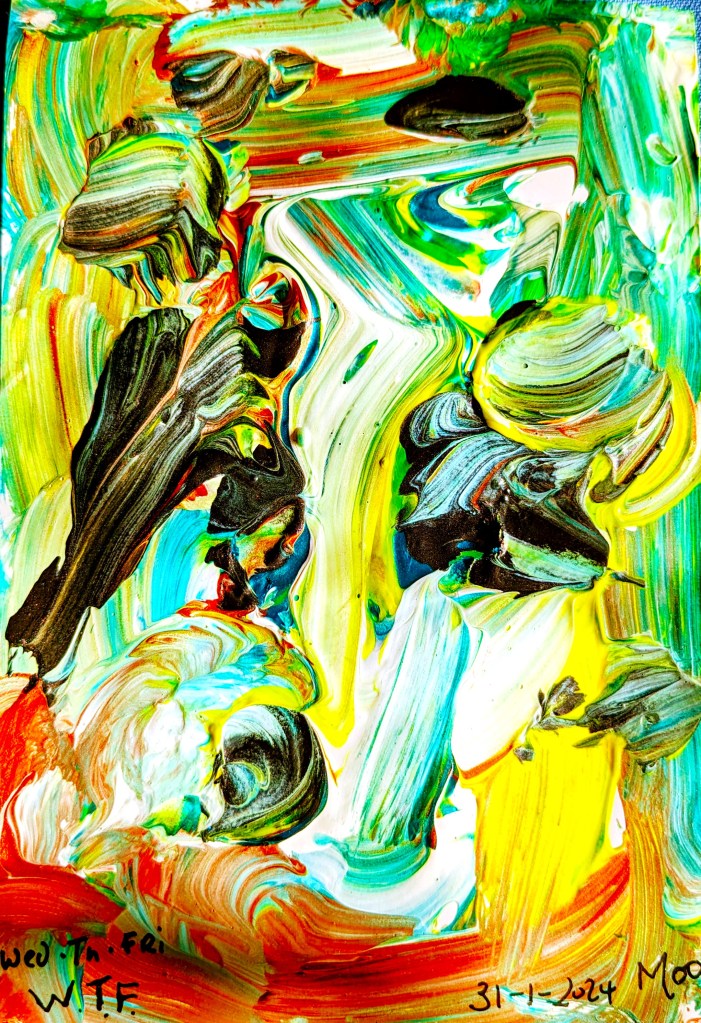
Wed Th Fri

WTF

Wednesday, 31 January.
Thursday, 01 February.
Friday, 02 February.

Where has the first month of 2024 gone?
WTF – I always knew it meant Wednesday, Thursday, Friday.

Comment:

I never know what I am painting until I have painted it. I thought of calling this one Doggy in the Window. But there are so many other creatures swimming around in this little aquarium of mine. How many can you spot? What fun. A fishing expedition in search of the meaning of meaning and who knows how many little doggies you may pull out. There may even be an Axolotl in there. Who knows?

This painting is on sale for the remarkably small sum of $1,000,000. And if you beleive that, you will believe anything. You may even believe you can find the little doggy in there!

PS – I may start posting poetry again soon. I have nearly finished my next collection and all the unwanted extras can be placed here, on my blog.

Ice Flow

Ice Flow

Free fall, then scree on the road
to Wolastoq. with the fresh air
speaking to the rock face
in a long-forgotten tongue,
broken words metamorphosing
into fragmented scree at rock-foot.

Just for a moment we glimpse
the ancient water in the stone,
catch the flow of winter words.

The January sun, low in our eyes,
heavenly glory glancing off rock
to give earthly joy, golden beams
highlight damp, glistening slate.

Afternoon frost, water and rock,
polished into ice-maiden tears
that dance their sparkling way
and are held for a moment
in a vision that will last forever.

Comment:
Such beauty in silent things, ice, rock, sky. But learn to listen and perhaps you will hear them talking, one to the other. One day, you too may share their words of wisdom.

Islands

Islands

Bewildered
by the rush hour
surge of traffic
we peer at street signs,
slide slowly round
roundabouts
sprung up overnight,
mushrooms
grown to confuse us.

Swept along by the main
street’s vibrant flow,
we fail to recognize
new shops standing
where we remember
old cracked paint
and the woman who sold
curiosities.

A face in the crowd
holds us for a moment.
Grey hair, unshaven,
clothes ragged,
a scarecrow on the street,
was that the man
who once ruled our world?

That old woman,
hunched, wrinkled,
her face a Hallowe’en mask,
her limp, her canes
and dragging feet:
is that the dancing queen
who ruled beside him?

Lights change.
Cars move on.
Another island
beckons
as we pull away
from the past
and drive
into the future.

The Banks of the Seine

Banks of the Seine

Gnawing at the carcass of an old song,
my mind, a mindless dog, chasing its tail,
turning in circles, snapping at the fragment
of its own flesh, flag-flourished before it,
tournons, tournons, tournons toujours,
as Apollinaire phrased it, on a day
when I went dogless, walking on a mind-leash
before the Parisian bouquinistes who sold,
along the banks of the Seine, such tempting
merchandise, and me, hands in pockets,
penniless, tempted beyond measure,
by words, set out on pages, wondrous,
pages that, hands free, I turned, and turned,
plucking words, here and there, like a sparrow,
or a pigeon, picks at the crumbs thrown away
by pitying tramps, kings, fallen from chariots,
as Eluard wrote, and me, a pauper among riches,
an Oliver Twist, rising from my trance, hands out,
pleading, “Please, sir, can I have some more?”

Comment:
This is a fusion / confusion, if you like, of The Kingston Trio’s song – The Seine – with a quote each from Guillaume Apollinaire – Alcools – and Paul Eluard – Il ne m’est Paris que d’Elsa, and Francisco de Quevedo’s – El Buscon – and a tip of the old chapeau nouveau to R. S. Thomas and Charles Dickens. Fools rush in, I am afraid, where angels fear to tread. Go on. Rush right in. Sort it all out. I double-dog dare you – and thank you for that one, Jude.

Limbo

Limbo

I live with my head in the clouds.
What clouds you ask – Alto-Stratus,
Nimbus, Cumuli-Nimbus?

No, I reply, none of those.
At one level I build cloud castles,
in Spain, as they say in French.

But, at another level,
I find myself lost in the medieval
cloud of unknowing, this mental limbo.

Here, grey mists weave spider-webs
of doubt that glisten with dew, and sparkle
with the two-edged sword of thought.

Here, I feel my life-web tremble
and I realize that I alone can walk
this way and try to understand

how frail threads catch small flies,
how words tell stories, but not the story
of all I know, nor where my world will go.

Comment:
Once more I have linked verbal and visual images. Moo’s painting above – thank you, Moo, – called Limbo, depicts a limbo dancer while my poem expresses the reality of that internal space in which creative spirits sometimes find themselves. It is a sort of Limbo of the mind, in which thoughts appear, dance along the frail threads of the mind’s web, yet never really materialize into formal verse or poetic patterns. This is also the lost world of the dreamer. But remember, the dreamers of the day are dangerous people, because sometimes they make their dreams come true.

What historical event fascinates you the most?

Daily writing prompt
What historical event fascinates you the most?

What historical event fascinates you the most?

First, let us define ‘historical’. Here’s what I found – (1) of or concerning history. (2) concerning past events. (3) The historical background to such studies. (4) Belonging to the past, not the present. (5) Famous historical figures.

Now let us think of the number of times we hear on the TV sports shows that such and such an event is making history “right before our eyes”. Wow! In a boxing match, almost ever punch thrown is “an historical event”. Ditto rugby – with every try scored, every penalty missed, and every tackle made. Ditto soccer, basketball, baseball, athletics. So, from the battery of past events that adorn my life, I am being asked to choose “which historical event fascinates me most”. Double wow.

My answer – the day of my birth, about which I know absolutely nothing. Or, to be more specific, the actual action of being born, about which I know even less. So, how do I study the historical background, when no eye witnesses are left alive to assist me? More important, nobody in my family wanted to talk about such an important – for me at any rate – event.

I do have some factual memories – tales told to me later. I was born at exactly 8:00 pm. I know this because my parents’ dog had been left at a neighbor’s house while my home-birth was taking place. As the clock struck eight, Paddy, the dog, jumped straight through their window, and ran up the road towards the house that was now to be our house, barking. “Ah,” said our wise neighbor, “there goes the dog. That means the baby’s been born.”

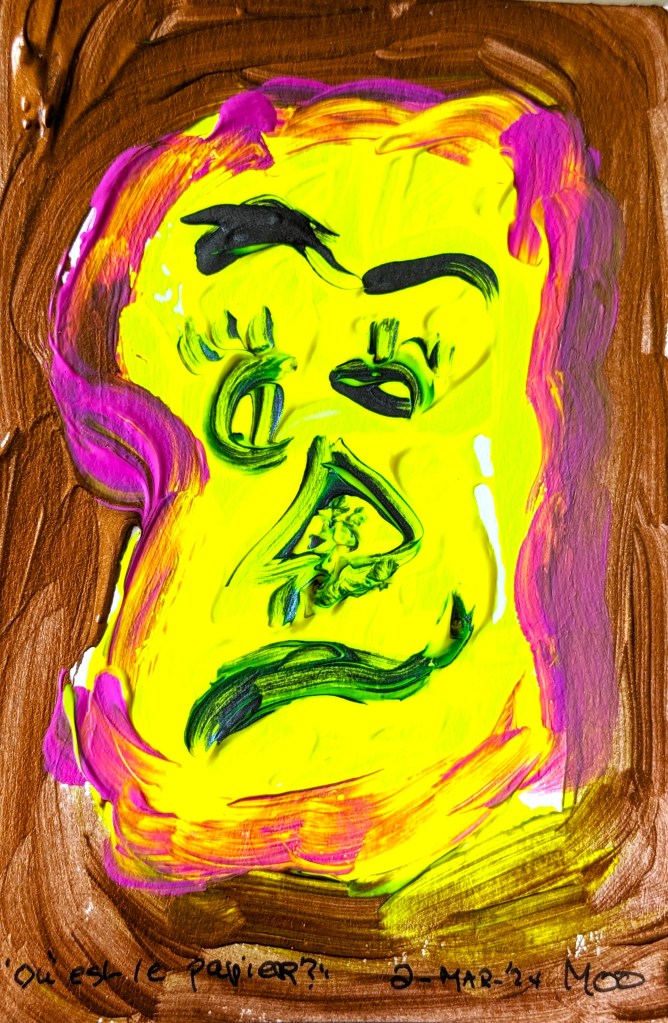
That is one version of the tale. My own version is the squawking of the stork who carried me, a sudden screech as he dropped me, a slow descent from a bright blue sky, a tumble down the chimney into the fireplace. And there I was. All covered in soot and ashes. I needed washing, of course. But baby, just look at me now. [See self-portrait above – Face in a Mirror].

My maternal grandfather swore that I had not been born at all, but found under a gooseberry bush. That would account for the green tinges in the painting. Apparently, all babies in South Wales were found under gooseberry bushes at that time. Unless they were delivered by the milkman.

And there’s many a tale about merry milkmen for, as they say in Wales, “It’s a wise man who knows his own father.” And I guess that is also a hysterical historical event about which I know nothing. But perhaps that’s why when the milkman who delivered the morning milk used to say “Good morning, son” when I met him at the the doorstep.

Come to think of it, the mailman also used to call me “Son” when he delivered the mail. Hmmmm – so did the butcher, the baker, and the candle-stick maker. Oh dear, so many historical events to choose from.